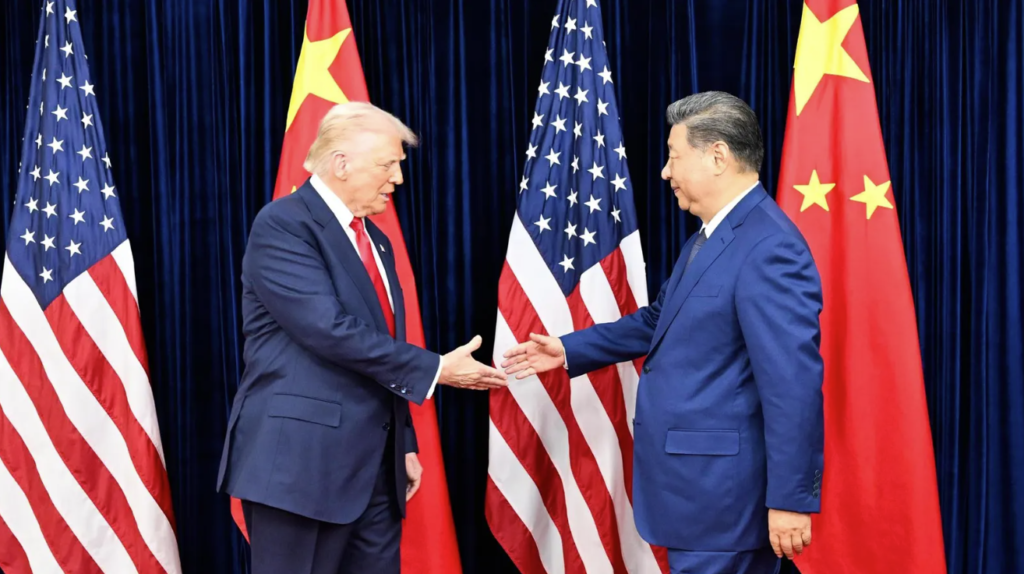
Trump and Xi face a crucial summit marked by Taiwan, artificial intelligence, control of rare earth resources, and the struggle for global supremacy.
By Gustavo de Arístegui, as published by La Razón, 10 May, 2026
In six days, Donald Trump will land in Beijing with a small business delegation and the weight of a 36 percent domestic approval rating, making this trip more than just high-level diplomacy—it’s a domestic political necessity. Xi Jinping will receive him with the pomp and ceremony befitting the occasion, with the calculated composure of a man who knows time is on his side, and with an agenda that differs from his counterpart’s. What’s at stake in those two days in Beijing isn’t a trade deal or a photo op; it’s the architecture of the coming century.
It’s important not to be misled by the détente rhetoric that both foreign ministries have cultivated since the Busan summit last October. A truce exists— tariffs have fallen from the levels of open warfare seen in the spring of 2025, when Washington imposed tariffs of up to 145 percent on Chinese imports—but a truce is not peace. It’s a tactically convenient interlude for both sides. Trump needs domestic victories: soybeans, Boeing aircraft, and a role in ending the Strait of Hormuz crisis, which his own decisions helped to trigger.
Xi needs time: time to close technological gaps, time to consolidate positions of power that will be very difficult to regain once achieved, time for the narrative of “China as a global stabilizing force” in the face of an erratic West to take root in the Global South. These are two distinct timelines with a point of convergence that both sides have wisely decided not to squander.
Interconnected economies
The nature of this rivalry is what makes it so difficult to analyze using the categories of the last century. It is not the Cold War, because the economies are too interconnected to afford a total blockade: China buys 25 million tons of American soybeans a year, operates in Western capital markets, has some of its reserves denominated in dollars, and is a major holder of US sovereign debt.
Nor is it the Thucydides Trap in its most automatic formulation as described by Graham T. Allison, because neither power desires war —both have too much to lose—and crisis management mechanisms, however fragile, remain operational, unless China invades Taiwan. The current crossroads is something different, more sophisticated, and in many ways more dangerous: a systemic rivalry between an established power and a rising power with incompatible political and ideological models , being fought simultaneously on dozens of fronts, none of which is decisive on its own.
These are the fronts I’ve been identifying as the “variable-temperature wars” of the 21st century: conflicts that don’t produce declarations of war, but which, through silent battle after silent battle, determine who will dominate the global economy, who will lead the various scientific, industrial, R&D, AI, or any other technological battleground wars. This cutthroat competition will determine who dictates the rules of the international order . The most immediate and brutal of all is the semiconductor war.
Taiwan produces ninety percent of the world’s advanced chips. Ninety percent. The island that Beijing claims as a renegade province is simultaneously the most critical hub of the global technology economy and the most charged symbol of the Communist Party’s reunification ambitions. This overlap of economic, military, and identity-related factors makes Taiwan the point of greatest tension in the bilateral relationship from any perspective. For Washington, defending Taipei’s de facto autonomy is a legal obligation—the Taiwan Relations Act of 1979—and a strategic imperative that, if ignored or eliminated, would trigger a crisis of credibility throughout the entire system of global alliances with the US. For Beijing, reunification is a non-negotiable objective, internally described as a sine qua non for the “rejuvenation of the Chinese nation.” This incompatibility cannot be resolved through negotiation. It can only be managed
The situation, however, is becoming increasingly complex. Trump’s transactional approach to Taiwan—which
has publicly questioned the level of US commitment based on Taipei’s willingness to pay for its own defense—has introduced a variable of ambiguity that Beijing exploits masterfully and that deeply worries allies in the region. Any sign of weakness in the deterrence calculation is potentially destabilizing. And therein lies the greatest strategic risk of the present moment: that Trump’s purely transactional logic—which perceives Xi as someone with whom deals can be struck—will lead Washington to ease off the gas pedal in strategic competition in truly critical sectors, allowing Beijing to close gaps that will be very difficult to reopen.
Control over rare earth elements
The most immediate weapon of coercion, and the one most underestimated by conventional Western analyses, is not hypersonic missiles or warships—which exist, and in increasing numbers. It is Chinese control over rare earth elements. China controls between 75% and 80% of the world’s production of these elements and virtually all (95%) of its refining capacity. Without dysprosium, terbium, and neodymium, there are no engines for fighter jets, no missile guidance systems, no batteries for electric vehicles, and no advanced consumer electronics.
When Beijing imposed restrictions on dual-use materials targeting Japan in January of this year—retaliation for statements by the Takaichi government regarding Taiwan—the message was crystal clear: economic coercion has a name, a surname, and an element number on the periodic table. That the West has known this for a decade and still hasn’t built alternative refining capacity on allied soil is, quite simply, a strategic blunder.
On a broader technological level, the race is being waged simultaneously in artificial intelligence, quantum computing, and biotechnology. In AI, the US maintains an advantage in cutting-edge models and chip architecture—American cloud providers project investing $600 billion in AI infrastructure by 2026—but China is closing the gap at a rate that Harvard analysts themselves describe as alarming.
DeepSeek has demonstrated the ability to compete with some Western models using a fraction of their computational resources. In quantum computing, the asymmetry is stark and revealing: the US leads in raw computing power—Google Willow, IBM Nighthawk—while China dominates in quantum communications, operating the only continent-wide quantum key distribution network on the planet, supported by its own satellites. One side opts for the offensive sword; the other, for the impregnable shield.
Beijing accelerates its domestic capabilities
The paradox of technological embargoes or restrictions—and this point must be emphasized because it defines the era—is that US export restrictions on advanced chips have pushed China to accelerate its own domestic capabilities with an urgency it would not have otherwise faced. Beijing had been declaring technological self-sufficiency a top national priority for years; export controls have transformed that declaration into an existential emergency.
Some argue, with a degree of logic, that the “small garden, high fence” policy—selective restrictions on truly critical technologies, rather than indiscriminate blocking—is the only reasonable approach to preserving the American advantage. The condition is that it be maintained consistently and in full coordination with European and Asian allies. Precisely what Trump’s unilateralism has eroded.
Because Washington’s greatest strategic asset is neither technological nor economic: it is its network of alliances. The constellation of democratic allies—NATO, AUKUS, QUAD, FIVE EYES, bilateral alliances with Japan, South Korea, Australia, and the Philippines—whose combined military, economic, and technological power far exceeds any alternative coalition Beijing could assemble. China lacks true allies. It has transactional partners.
Russia, whose dependence on Beijing grows as sanctions push it into China’s orbit; Iran, whose energy policy is largely financed by Beijing, but lacks the shared values that cement alliances under pressure. The greatest risk to this irreplaceable asset comes not from China, but from Washington itself: from indiscriminate tariffs against European and Asian allies , from doubts about what was once an unwavering commitment to NATO, and from the perception that American foreign policy now subordinates alliances to transactions.
A limited agreement
What Trump and Xi decide in Beijing on May 14 and 15 will not transform any of these structural realities. The most likely outcome—and what analysts at the Brookings Institution and CSIS point to as the baseline result—is an extension of the trade truce , a limited agreement on agricultural and aerospace purchases, some common language on the risks of artificial intelligence, and, if Beijing has done its diplomatic work with Tehran well, some gesture regarding the Strait of Hormuz that Trump can sell as a victory to his electorate. What there will be no solution on Taiwan, no real lifting of technological controls, and no agreement on rare earth elements that addresses Western vulnerability. The summit can and should produce tactical stability. It cannot produce strategic transformation.
The Sino-American rivalry is, in its most honest formulation, a race that neither power can afford to lose. For Washington, losing it means the end of the global primacy that has structured the international order since 1945. For Beijing, losing it means abandoning the “rejuvenation project” of the Chinese nation that Xi Jinping has enshrined in his own historical legacy. This symmetry of the existential stakes is, paradoxically, a stabilizing factor in the short term—the cost of defeat deters catastrophic escalation—and the deepest reason why the rivalry will not end. Neither power has a threshold of tolerance for ultimate accommodation.
In this scenario of permanent structural rivalry, no country—and certainly no European ally—can afford the illusion of equidistance. Neutrality between a liberal-democratic political system and a one-party dictatorship that aspires to redefine the international order in terms favorable to its model of governance is not a principled position. It is a strategic abdication. And strategic abdications, historically, are always paid for by those who are late to understand that the playing field had already been set without them.