Gustavo de Arístegui,
May 15, 2026
I. BRIEF INTRODUCTION
The days of May 14–15, 2026, hold a geopolitical density of the first magnitude, accumulating in just twenty-four hours three strategic axes with potentially transformative consequences: the Trump–Xi summit in Beijing, with its inevitable repercussions regarding Iran, Taiwan, and the global economic order; the critical state of the Iranian ceasefire, whose fragile structure is being subjected to maximum pressure; and the dynamics of the end of hostilities in Ukraine, where the three-day ceasefire agreed upon from May 9 to 11 has opened a sliver—still narrow—towards diplomacy. Added to these three major vectors are the acceleration of European rearmament, whose quantitative data places the Old Continent at a historic crossroads, and the situation in Venezuela, where the cosmically corrupt Chavista narco-state, now embodied by the sinister Rodríguez brothers, continues its agony with no visible prospect of democratic normalization.
This analyst has been describing the decapitation paradox for weeks as one of the major strategic dilemmas of Operation Epic Fury: the elimination of Khamenei and the Islamic Republic’s top command has dismantled Iran’s military capacity to project terror, but has simultaneously created a power vacuum that the triumvirate of the Islamic Revolutionary Guard Corps—headed by General Ahmed Vahidi—is filling without providing a coherent negotiating partner, thus condemning the talks to a structural stalemate with potentially lethal consequences for regional stability. The world—in its wars of fluctuating intensity—is navigating this morning between hope and escalation.
II. MOST IMPORTANT NEWS OF THE LAST 24 HOURS
1. Trump-Xi Summit in Beijing: Between Photo Sight and Strategic Reality
Facts
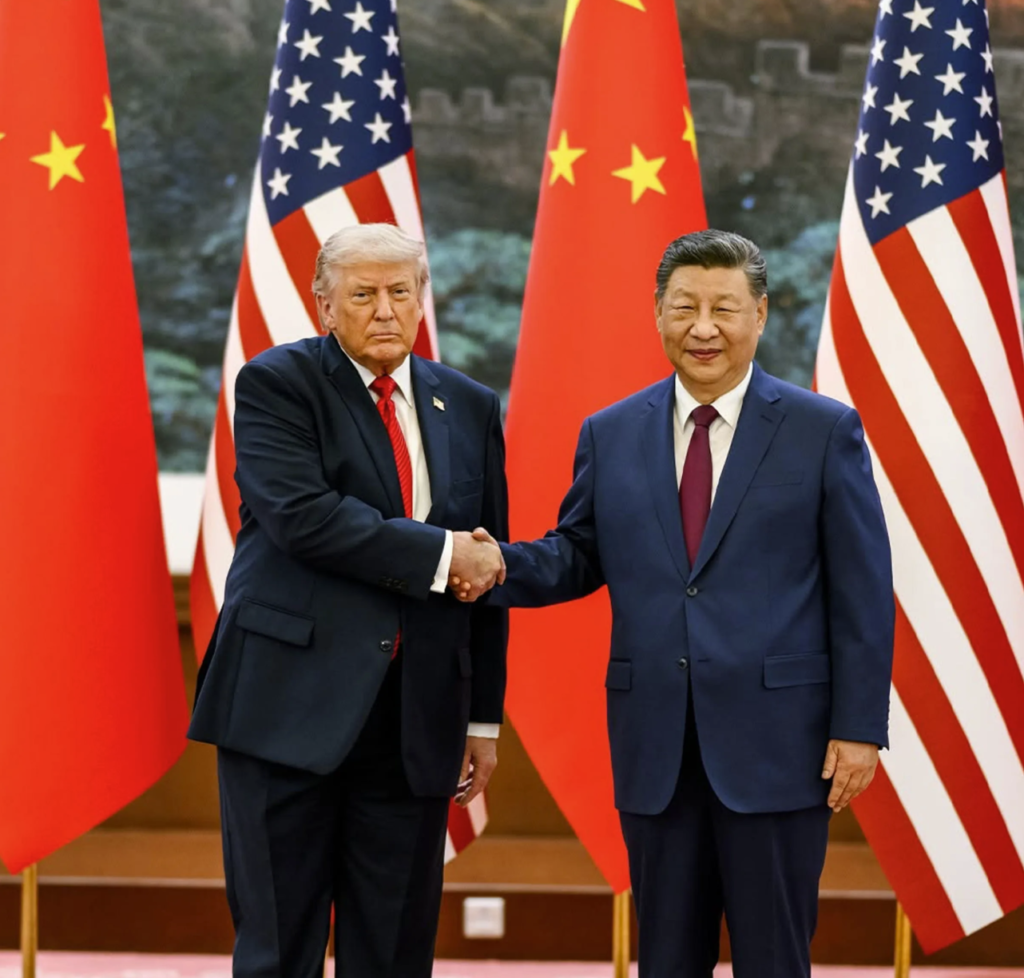
President Donald Trump concluded his state visit to the People’s Republic of China from May 12–15, 2016, the first visit by a sitting US president to Beijing in nearly a decade. The US president was received at the Great Hall of the People by President Xi Jinping in a state ceremony that included an official banquet and a visit to the Temple of Heaven. The US delegation included a dozen executives from major American companies, among them Elon Musk (Tesla), Jensen Huang (Nvidia), and Tim Cook (Apple). Trump’s son, Eric, and his wife, Lara, accompanied the mission in a personal capacity, raising concerns about potential conflicts of interest.
In terms of agreements, both sides agreed to develop a “constructive relationship” and strengthen diplomatic and military communication channels. China expressed interest in increasing its purchases of US crude oil as an alternative to its dependence on Middle Eastern oil. Trump asked Beijing to maintain pressure on fentanyl flows into the United States. Xi reserved his strongest words for the Taiwan issue, calling it “the most important issue in US-China relations” and warning that mishandling it would lead to “collision or conflict.” Both sides agreed that Iran should never possess a nuclear weapon and also opposed the “militarization” of the Strait of Hormuz. The complete agreement on these two points can only surprise those who have not followed the repeated statements by various Chinese government spokespeople urging, even demanding, that the Iranian regime open the Strait of Hormuz and accept the conditions set by the Americans. The Chinese regime is averse to any instability that could seriously affect its geostrategic and geoeconomic interests, and therefore will not tolerate Iran developing nuclear weapons. Cooperation in this area has come from Russian mercenary scientists (not directly from the Russian government) and the North Korean regime, which has been the primary source of military nuclear technology transfer.
Implications
The Counsel on Foreign Relations (CFR) aptly put it on the eve of the summit: Trump was going to Beijing seeking headlines and visible gestures in the lead-up to the midterm elections; Xi was playing a longer game, focused on strategic patience rather than any substantive commitments. The asymmetry between these two time horizons is precisely what explains the more photogenic than substantive nature of the results. Scott Kennedy, of the Center for Strategic and International Studies (CSIS), noted that China arrives at this summit in a more confident position than in 2017, having been able to neutralize a good portion of the tariff initiatives of the previous Trump administration. The war against Iran casts a decisive shadow over the meeting: by shifting US military assets from the Indo-Pacific to the Persian Gulf, Beijing’s strategic position vis-à-vis Taiwan—and its perception of Washington’s actual response capabilities—has been altered in its favor.
The massive presence of tech executives, led by Musk and Huang—whose participation was hastily arranged at the last minute—transforms the visit into an exercise in corporate diplomacy in which the interests of American corporations with a presence in China act as a tacit moderating factor against the more hardline positions of Washington hawks. This analyst believes that the “small garden, high fence”—the selective policy of technological restriction—will be rhetorically preserved but practically subject to a variable-geometry review.
Perspectives and scenarios
The most likely scenario is the one Ben Emons of Fed Watch Advisors himself described as “a managed détente with poor results”: gestures of goodwill, vague joint language on de-escalation in the Strait of Hormuz, and no substantive progress on either the Iranian nuclear issue or the Taiwan issue. The alternative scenario—that Xi would take advantage of Washington’s devalued military position in the Indo-Pacific to exert real pressure on Taipei—was clearly dismissed by both sides during the summit, although several analysts—including those at the IISS—continue to describe it as a latent medium-term risk. Xi’s warning about Taiwan was not rhetorical: it was a deferred strategic demarcation.
2. Iran: The ceasefire in “life support” and the shadow of Operation Sledgehammer
Facts
Negotiations between Washington and Tehran on a definitive end to the war—launched on February 28, 2016, with Operation Epic Fury, which resulted in the assassination of Supreme Leader Ali Khamenei and the systematic destruction of Iran’s military arsenal—are at a structural standstill. Secretary of State Marco Rubio declared on May 5 that the military operation was “over” and that the United States was in a defensive phase with Operation Project Freedom, aimed at ensuring transit through the Strait of Hormuz. However, Rubio himself described the Iranian leadership as “insane in the brain,” while President Trump characterized the ceasefire as being “on massive life support” and its probability of survival as “one percent.”
On May 11, Iran rejected the latest US proposal, which Trump called “totally unacceptable,” and Tehran responded by declaring that it “will never back down.” According to the Wall Street Journal, Iran would be willing to suspend uranium enrichment for twelve to fifteen years—compared to the twenty years demanded by Washington—but categorically rejects the dismantling of its nuclear facilities at Natanz, Isfahan, and Fordow. The Pentagon, for its part, is considering renaming the military operations “Operation Sledgehammer” if the ceasefire collapses and large-scale hostilities resume. NBC News reports indicate that the available firepower in the theater of operations is currently greater than it was at the start of Operation Epic Fury.
Implications
The paradox of the decapitation that this analyst has consistently pointed out reaches its most stark expression here: the jihadist oligarchy of Tehran—never a theocracy in the strict sense of the term, but rather a regime of terror organized around the Islamic Revolutionary Guard Corps and its military-criminal business structure—currently lacks a unified leadership capable of signing an agreement with guarantees of compliance. The IRGC triumvirate—General Vahidi as commander-in-chief, Zolghadr as secretary of the Supreme National Security Council, and General Rezaei as acting military advisor to Supreme Leader Mukhta Khamenei—is ultraconservative to the point of fanaticism. The “reformist” (let’s say not excessively fanatical) President Pezeshkian, who publicly warned that the Iranian economy could collapse in three or four weeks without a ceasefire, is systematically ignored by the guards.
The dual naval blockade—the US Navy blockading Iranian ports and the IRGC closing the Strait of Hormuz to commercial traffic—continues to depress global energy markets and punish the economies most dependent on crude oil imports: China, India, Japan, and continental Europe. The fact that Beijing expresses its displeasure with the militarization of Hormuz at the same summit where it professes its strategic partnership with Tehran illustrates the schizophrenia of China’s position: transactional partners of Iran, but not allies in the fullest sense of the word.
Perspectives and scenarios
Three scenarios are emerging with varying probabilities.
First: a one-page Memorandum of Understanding (MoU) that freezes the conflict without resolving any of its underlying issues — Rubio’s preferred short-term scenario and one that Axios indicated was the subject of active negotiation last week.
Second: the resumption of military operations under the name Sledgehammer, if Iran continues to close the strait and reject any concessions on the nuclear issue; the Pentagon has confirmed that it has more firepower deployed than at the start of Epic Fury.
Third: an internal collapse of the Iranian regime due to economic implosion—which Pezeshkian himself predicts—would open up the most complex scenario for which, as this analyst has been pointing out, no one has a credible plan for the aftermath, least of all the regime itself, overwhelmed by its immeasurable incompetence. The absence of a post-regime transition plan is the greatest strategic irresponsibility of this military adventure, however legitimate its stated objectives may have been.
3. Ukraine: The “beginning of the end” or Putin’s next trap
Facts
President Trump announced a three-day ceasefire—May 9, 10, and 11—between Russia and Ukraine on May 9, coinciding with Russia’s Victory Day celebrations. Ukrainian President Volodymyr Zelensky confirmed the agreement by decree, ironically referring to the “authorization” granted to Moscow to hold its parade in Red Square. Russian presidential advisor Yuri Ushakov acknowledged that the agreement was reached through direct contacts with the US administration. The Kremlin, for its part, recognized the ceasefire but tempered expectations: “The issue of peace in Ukraine is highly complex,” declared spokesman Dmitry Peskov, adding that “reaching a peace agreement is a very long process full of complex details.” On May 9, at the Red Square parade, held for the first time in many years without heavy military equipment due to the threat of Ukrainian drones over Moscow’s airspace, Putin declared that the conflict “is coming to an end” and expressed his willingness to negotiate on neutral ground.
Implications
Rigorous analysis prevents us from being swayed by wishful thinking and wishful thinking. Putin’s declaration—”the issue is coming to an end”—can be interpreted as a genuine sign of economic and military exhaustion, or as a tactical maneuver to freeze current lines of contact on terms favorable to Moscow, which controls almost a fifth of Ukrainian territory. The Russian negotiating position remains unchanged: recognition of the occupied territories, Ukrainian neutrality, withdrawal from NATO, and “demilitarization and denazification”—euphemisms that amount to Kyiv’s capitulation. This analyst believes that any agreement that freezes the conflict without solid security guarantees for Ukraine would be a victory for Putin disguised as diplomacy.
The fact that Ukraine’s chief negotiator, Rustem Umerov, has traveled to Miami for talks with US representatives indicates that Washington is maintaining its mediating role, although the Trump administration’s focus on the Iranian front and the China summit makes it difficult to sustain the necessary negotiating energy for two simultaneous crises of the highest magnitude. The strain on Russia’s GDP—now accumulating four years of war, which exceeds the three years and nine months the Soviet Union fought in the Great Patriotic War—does not automatically translate into a genuine willingness to compromise.
Perspectives and scenarios
The scenario of controlled détente—a ceasefire along current lines, followed by lengthy and fruitless Minsk-style negotiations—is the most likely in the short term. The scenario of a genuine peace agreement remains contingent on Putin accepting conditions he currently rejects outright. The escalation scenario, developed by the controversial but insightful Professor John Mearsheimer, who points out that Moscow could resort to conventional weapons attacks against European countries that support Ukraine, would be the most catastrophic and, unfortunately, remains highly probable if the transatlantic security architecture continues to be fragmented.
4. Europe: rearmament in numbers and the question of strategic autonomy
Facts
A Kiel Institute study published on May 11, 2026, states that Europe could achieve near-complete defense autonomy by investing approximately $55 billion annually for ten years—around $530 billion in total. According to SIPRI data compiled by The Economist , NATO allies outside the United States already have higher purchasing power than US defense spending, reaching 111% of what Washington allocates to its own forces in 2025. European defense spending grew by 14% between 2024 and 2025, the largest increase since 1953. Germany—which plans to raise its defense budget to €117.2 billion in 2026 and €162 billion in 2029—is exploring the acquisition of US-made Tomahawk cruise missiles. At the 2025 Hague Summit, the allies committed to allocating 5% of GDP to defense by 2035.
Implications
The figures are impressive on paper, but this analyst cannot avoid a more demanding assessment: money is a necessary but not sufficient condition. Europe has taken three decades to understand that security has a price and to pay it, but the slowness and shortsightedness of its political elites—unable for years to take their own destiny seriously—have generated a real capacity deficit that money cannot immediately correct. The European defense industry needs years—in some sectors, decades—to produce the weaponry, command systems, and power projection assets that strategic autonomy demands. The case of Germany and the Tomahawk missiles clearly illustrates that Europe remains, in crucial aspects, dependent on American technology and arsenals. That Spain and Italy have reached 2% of GDP in defense, partly by “reclassifying security spending,” is an accounting trick that deceives our allies and is a profoundly dishonest form of politics.
Perspectives and scenarios
The desirable scenario —and the only one that satisfies Europe’s strategic interests—is that of real autonomy based on its own integrated capabilities on a continental scale, endowed with genuine European command and a defense industrial base that does not depend on the goodwill of Washington.
The likely scenario, given the pace of European politics, is one of real but asymmetrical progress : Poland, the Baltics, and the Nordic countries, with a level of commitment that contrasts favorably with the lukewarm stance of other capitals. The alternative—a NATO progressively emptied of American support without Europe being able to fill the void in time—is the scenario with the greatest existential risk to the European security order.
5. Qatar: the small emirate pulling the strings in the biggest deal of the century
Facts
Qatar has emerged in recent days as the most relevant—and most effective—diplomatic player in the negotiation process between Washington and Tehran, effectively displacing the official mediator, Pakistan, at the most delicate moments of the talks. As Axios revealed on May 9, Secretary of State Marco Rubio and Special Envoy Steve Witkoff met in Miami with Qatar’s highly effective and tireless Prime Minister and Foreign Minister, Sheikh Mohammed bin Abdulrahman Al Thani , as part of efforts to reach a one-page Memorandum of Understanding (MoU) to serve as a framework for more detailed nuclear negotiations. That same weekend, Vice President JD Vance had hosted Al Thani in Washington, where the Prime Minister traveled specifically for the meeting and departed immediately afterward.
Doha’s role extends far beyond mere formal mediation. According to US administration sources cited by Axios, the Qataris maintain direct contact with generals of the Islamic Revolutionary Guard Corps (IRGC) involved in decision-making regarding negotiations with the United States—the most sensitive and strategically valuable channel. Qatar is also coordinating its efforts with Pakistani mediators: Prime Minister and Foreign Minister Sheikh Al Thani spoke with Prime Minister Shehbaz Sharif the day before his trip to Washington. On May 12, in a joint press conference with Turkish Foreign Minister Hakan Fidan, Al Thani issued an unprecedented public warning to Tehran: “Iran must not use the strait as a weapon to pressure or blackmail the Gulf countries.” It was the first time Qatar had publicly and explicitly rebuked Tehran directly. Meanwhile, a Qatari liquefied natural gas (LNG) tanker crossed the Strait of Hormuz into Pakistan last week, the first transit of such a vessel since the start of the war, in a gesture that Iran expressly approved to strengthen confidence with Doha and Islamabad.
Implications
Qatar’s emergence as the central figure in the mediation—”the central figure in efforts to stop the war,” according to the analytical website jFeed—is neither accidental nor improvised. It stems from a diplomatic architecture built over decades by the small Gulf emirate, which has systematically cultivated the ability to speak simultaneously with actors who refuse to talk to each other: Hamas and the West during the Gaza war; the Taliban and the United States in Doha in 2020; and now the IRGC and the White House in the most dangerous conflict of the century. Al Jazeera, which is aligned with the Qatari government, aptly put it in an opinion piece: Qatar’s mediation “does not reflect indifference to Iranian regional behavior or nuclear proliferation concerns; it reflects an assessment of the costs, uncertainty, and unintended consequences for regional security” that a purely coercive approach generates.
The joint declaration by Qatar and Turkey on May 12 warrants careful reading. Both countries—one Arab and Sunni, the other heir to Ottoman power and a NATO member—position themselves as collective guarantors of the Pakistani mediation and, at the same time, as credible interlocutors with Tehran, a level of credibility no Western power currently possesses. The fact that the Qatari prime minister warned US officials about “the consequences of prolonging the war” during his trip to Washington indicates that Doha is not merely a conduit, but an actor with its own interests and the courage to express them to its main security ally. It should not be forgotten that the United States hosts Al Udeid Air Base, the largest US military installation in the Middle East.
Perspectives and scenarios
The most likely scenario in the short term is Qatari mediation that manages to convince the IRGC generals—their direct interlocutors in Tehran—to accept a minimal MoU that freezes the conflict without addressing its root causes, but allows for the reopening of the Strait of Hormuz and opens a window for negotiations on the nuclear issue. This is the scenario the White House prefers and that Doha is trying to orchestrate.
The alternative scenario — failure of Qatari mediation if the IRGC rejects any concessions and Trump decides to resume military operations under the name Sledgehammer — would bring us dangerously close to escalation.
The third scenario —a substantive agreement on the nuclear program, which is what Washington demands as a non-negotiable condition— requires flexibility from the IRGC that, to this day, the triumvirate Vahidi-Zolghadr-Rezai has not shown the slightest hint of being willing to offer.
6. China and Iran in Beijing: the strategic triangle and Beijing’s role
Facts
Iranian Foreign Minister Abbas Araghchi visited Beijing the week before the Trump-Xi summit, meeting with his counterpart Wang Yi. China reaffirmed its “strategic partnership” with Iran, while urging Tehran to seek a diplomatic solution to the conflict and refrain from further hostilities. During the Trump-Xi summit, both presidents agreed that Iran cannot possess a nuclear weapon and rejected the “militarization” of maritime transit routes. China expressed interest in purchasing American oil to reduce its dependence on Middle Eastern crude.
Implications
China’s position on the Iranian crisis is the paradigm of the strategic double-speak that characterizes Beijing’s foreign policy: Iran is a transactional partner—a source of discounted crude and a complementary actor in the strategy of attrition against American power—but not an ally in the full sense, and its uncontrolled nuclear capability is a risk that Beijing cannot ignore. China has transactional partners, never true allies. Wang Yi’s stance before Araghchi was that of an interested mediator who wants the strait reopened—a fifth of the world’s oil transits through it, including that consumed by China—without jeopardizing his relationship with Tehran. The language of the Trump-Xi summit on the strait and the Iranian nuclear issue served both sides to project an image of shared responsibility, which neither will translate into concrete pressure on the IRGC.
Perspectives and scenarios
The scenario of China as an effective mediator on Iran—capable of exerting the necessary pressure for Tehran to accept real nuclear concessions—is the one most desired by Washington and the least likely given Beijing’s diplomatic track record. The most plausible scenario is that China will maintain its position of constructive ambiguity: close enough to Washington to avoid sanctions and close enough to Tehran to retain its privileged access to discounted Iranian oil. On the chessboard of the Thucydides Trap—a concept coined by political scientist Graham T. Allison to describe the historical tension between established and rising powers—Beijing is playing a game of chess on multiple boards simultaneously. And it is doing so with a strategic patience that contrasts sharply with the volatility of decision-making in the White House.
III. MEDIA RACK
Anglo-Saxon media
CNBC/NBC News: Extensive coverage of the Trump-Xi summit with emphasis on trade results and Xi’s warning about Taiwan. NBC News exclusively reported the possibility that the Pentagon will rename operations against Iran as Sledgehammer.
CNN: Live coverage of the Iranian negotiations; interview with former Obama negotiator Alan Eyre, who warned that Iran is “much less inclined to a deal than it was in 2015.”
The Wall Street Journal: Revealed details of Iran’s proposal on enriched uranium and the duration of the enrichment moratorium (12–15 years). Critical coverage of Trump’s business delegation in Beijing.
Financial Times: Reported on Germany’s review of Tomahawk missile acquisition; analysis of European defense spending as a historic milestone.
Fox News: Optimistic framing of the Trump-Xi summit; “a fantastic future together” according to the chosen headline.
NPR: Balanced analysis of the Russian-Ukrainian ceasefire; highlighted the uncertainty as to whether this constitutes a genuine shift or a tactical maneuver by Putin.
The Economist / SIPRI / Kiel Institute: Defense spending data confirm that NATO allies now outspend the United States in purchasing power parity; analysis of the cost of European strategic autonomy.
Arab and Middle Eastern media
Al Jazeera: Critical coverage of the war against Iran from a regional perspective; detailed analysis of the blockade of the Strait of Hormuz and the Iranian proposal to separate the strait issue from nuclear negotiations. Monitoring of the ceasefire in Ukraine from Kyiv.
Axios: Top sources on the US-Iran negotiations revealed a one-page Memorandum of Understanding (MoU) as the subject of active negotiation. The report indicated that Araghchi traveled to Beijing and Moscow seeking support ahead of the summit.
Arab News / Asharq Al-Awsat / Gulf News: Monitoring Iranian attacks on Gulf infrastructure during ceasefire period; Gulf monarchies demand unconditional opening of the Strait of Hormuz and Iranian accountability for damages.
European media
Le Monde / Le Figaro: Analysis of the French position in the Iranian conflict; Macron called for long-term solutions for Lebanon and celebrated the progress of European rearmament.
FAZ / Die Welt: Internal German debate on the acquisition of Tomahawk missiles and the new Zeitenwende (epochal shift) in defense policy. Criticism of the pace of negotiations on Ukraine.
Think tanks (CFR/CSIS/IISS/Kiel Institute): The Council on Foreign Relations (CFR) noted the asymmetry of objectives between Trump and Xi prior to the summit. The CSIS underscored China’s increased strategic confidence. The Kiel Institute quantified the cost of European defense autonomy at $530 billion over ten years.
Gulf Media — Qatar
The Peninsula Qatar / Al Jazeera / Euronews: In-depth coverage of Sheikh Al Thani’s mediating role. Al Jazeera published an in-depth analysis that accurately anticipates the role Doha would play in the crisis. The Peninsula highlighted the joint Qatar-Turkey statement of May 12 as a milestone in the emirate’s public positioning as a regional mediating power.
Axios (May 8 and 9 exclusives): Essential primary source. Two top-tier exclusives revealed Al Thani’s private meetings with Vance in Washington and with Rubio and Witkoff in Miami, as well as Qatari mediators’ direct contacts with IRGC generals involved in decision-making regarding the negotiations.
Slavic and Ukrainian media
Kyiv Independent / Ukrainian Pravda / Ukrinform: Tripartite ceasefire monitored with skepticism; analysis of Zelensky’s decree “authorizing” Russian parade as a demonstration of range capability over Moscow.
TASS/Russia Today: Propaganda-driven approach to Victory Day; Putin’s statements about the “end of the war” and his readiness to negotiate on neutral ground. Sustained verbal attacks against the West and NATO.
IV. RISK TRAFFIC LIGHT
| COLOR | RISK | DESCRIPTION |
| ● | 🔴 RED — CRITICAL | Collapse of the Iranian ceasefire and resumption of hostilities |
| ● | 🔴 RED — CRITICAL | Prolonged closure of the Strait of Hormuz / global energy shock |
| ● | 🟠 ORANGE — STOP | Military escalation between Russia and Ukraine if negotiations fail |
| ● | 🟠 ORANGE — STOP | Military tension in the Taiwan Strait as a consequence of Washington’s perceived weakness in the Indo-Pacific |
| ● | 🟡 YELLOW — MODERATE | Qatari mediation collapses: one-page MoU fails and US-Iran negotiations reach a complete impasse |
| ● | 🟡 YELLOW — MODERATE | Inadequacy of European defense autonomy: gap between spending commitments and actual deployable capabilities |
| ● | 🟢 GREEN — LOW | Chinese-American trade progress: partial easing of tariffs and market access |
V. EDITORIAL COMMENTARY
There are days when history seems to accelerate to a dizzying pace, when several of its major gears turn simultaneously, forcing the analyst to choose which lever matters most. This is one of those days. And the lever that matters most is Iran.
Operation Epic Fury was, in its stated military objectives, an unqualified success. The jihadist oligarchy of Tehran—that organized terror structure that was never a theocracy, but rather a criminal regime with imperial ambitions and mafia-like funding—has been militarily crippled. More than two thousand attacks; the ballistic missile arsenal, the navy, drone capabilities, the nuclear facilities at Natanz, Isfahan, and Fordow—all destroyed or severely degraded. The price paid in lives and dollars—eighteen billion in direct military costs to the United States alone, three hundred billion in estimated damage to the Iranian economy, one hundred billion for allied Arab countries—has been immense. And yet, today the Strait of Hormuz remains closed, negotiations are stalled, the ceasefire is “on life support,” in Trump’s own words, and the Pentagon is studying its next operation.
The problem isn’t military success. The problem—and this analyst has been pointing this out with the insistence that the gravity of the matter demands—is the absence of a plan for the day after. Eliminating Khamenei, destroying the IRGC as an external projection force, neutralizing the nuclear program: all of these are strategically legitimate objectives. But who will govern Iran tomorrow? Mukhta Khamenei, the Ayatollah’s son, who inherits the title of Supreme Leader without having been anointed through his father’s process? The entire IRGC, transformed into a military junta without any ideological pretense? An internal transition toward Pezeshkian’s reformism—systematically sabotaged by the Revolutionary Guard ? Is Pahlavi praying from abroad? No one—not Washington, not Jerusalem, not Brussels—has a coherent answer to these questions. And that, in geopolitics, is unforgivable.
The Trump-Xi summit produced what it always did: images of concord, vague commitments, and no real solutions to any of the underlying problems. Trump wanted headlines ahead of the midterm elections; Xi wanted the Strait of Hormuz reopened so he could continue importing discounted Iranian crude without having to intervene. No one left Beijing with anything different than what they arrived with. The Thucydides Trap—that iron law of history that Graham T. Allison formulated with academic precision and that Xi invoked, mistakenly attributing it to Thucydides himself—remains. The systemic rivalry between the established power and the rising power with incompatible governance models is not resolved with a state banquet in the Great Hall of the People.
In Ukraine, the rhetoric of the “beginning of the end” must be treated with the same caution as all of Putin’s pronouncements. The Russian president has demonstrated, over four years of criminal aggression against the Ukrainian people, a capacity for resilience, adaptation, and manipulation of Western public opinion that compels us to remain vigilant. The fact that the Russian military machine has been fighting in Ukraine longer than the Soviet Union fought in the Great Patriotic War is something no student of military history can ignore. Putin’s reluctance to parade tanks in Red Square for fear of Ukrainian drones is a sign of genuine weakness. But weakness is not defeat, and “war fatigue” does not automatically generate a willingness to compromise fairly.
And meanwhile, Europe. The Old Continent—that extraordinary construct of which this analyst is a staunch European and which has transformed centuries of fratricidal wars into decades of shared prosperity—has finally awakened from the naive dream of the peace dividend. The rearmament figures are impressive, and this must be acknowledged without hesitation. But the European political class of the 21st century—mediocre, short-sighted, and for far too long incapable of taking its own destiny seriously—cannot be satisfied with the numbers alone. Money is a necessary condition; the political will to use it with strategic coherence, to build a true European command, to integrate capabilities instead of duplicating them, to break with North American technological dependence—that is what is still lacking. And time is running out.
And this commentary concludes with a reflection on Qatar, that small emirate which many in the West still mistake for a minor player in the Arab theater. What Doha is doing in this crisis is one of the most sophisticated high-stakes diplomacy exercises of recent decades: speaking with the IRGC when no one else can; publicly warning Tehran when almost no other Arab ally dares; and at the same time keeping Al Udeid operational and preserving the strategic relationship with Washington. It is the quintessential example of soft power wielded with nerves of steel. The fact that the highly capable Prime Minister Mohammed Al Thani traveled expressly to Washington to meet with Vance and left immediately—without a press conference, without an official photo—speaks more to the gravity of the moment than any formal statement. If the MoU between Washington and Tehran is ever signed, a good part of the credit will belong to Qatar. And if it fails, Qatar will remain indispensable, because it is the only Gulf actor with a direct line to the IRGC generals who decide whether there is war or peace.
The world isn’t broken. But it’s badly battered. And repairing it requires more courage, more vision, and more intellectual honesty than most of its leaders demonstrate today.