Gustavo de Arístegui,
May 27, 2026
I. BRIEF INTRODUCTION
The world awoke today, May 27, 2026, to a state of multidimensional tension unparalleled in recent history. In the Middle East, the fragile truce between Washington and Tehran remains what we have been describing from the outset: a porcelain structure upon which incompatible pressures converge. The Strait of Hormuz remains largely closed to free trade, while Secretary of State Marco Rubio—the anchor of reason in an administration that alternates between success and outbursts—concludes his visit to India with signs of progress in negotiations that have yet to materialize into signed agreements. On the European front, Russia has taken an unprecedentedly serious step by formally demanding the evacuation of the foreign diplomatic corps from Kyiv, announcing the imminence of new waves of missiles and hypersonic drones against the Ukrainian capital—an intimidation tactic that the European Union has resolutely rejected but which, for those of us who have followed these matters for decades, is reminiscent of the grim months of 2022. In Lebanon, Israel is expanding its ground operations in the south and attacking the Beqa Valley despite the nominal validity of the ceasefire brokered by Washington, perpetuating the paradox of a truce that is violated daily.
In Central Africa, the Bundibugyo Ebola epidemic in the Democratic Republic of Congo—declared a Public Health Emergency of International Concern by the WHO on May 20—has now reached more than 1,000 suspected and confirmed cases, with imported cases in Uganda and Italy. And in New York, Chinese Foreign Minister Wang Yi, presiding over the Security Council on behalf of Beijing during its rotating presidency in May, is deploying the discourse of multilateralism as a geopolitical counteroffensive against Washington’s retreat into itself. These five fronts, taken together, paint a picture of a world in which the contained systemic fracture I have been analyzing since the beginning of this series of reports threatens to erupt. This analysis rigorously accounts for all of them, without giving in to wishful thinking (the comfortable illusion that problems solve themselves) and without losing sight of the editorial line that governs each of these reports: Convicted Atlanticism, liberal democracy, unequivocal rejection of autocracies and terrorism, and defense of reason against chaos as the new order.
II. MOST IMPORTANT NEWS OF THE LAST 24 HOURS
1. Russia demands the diplomatic evacuation of kyiv and threatens “systematic” attacks
Facts
On Monday, May 25, in the worst attack on Kyiv since the start of the full-scale invasion in 2022, Russia launched hypersonic missiles and drones that killed at least four people, injured more than ninety, and destroyed high-rise residential buildings, schools, a market, and water infrastructure. The following day, the Russian Foreign Ministry issued a formal statement warning foreign governments to evacuate their diplomatic personnel and citizens residing in the Ukrainian capital “with the utmost urgency.” Foreign Minister Lavrov went further: in a telephone conversation with Secretary of State Rubio, he “officially informed” him that Moscow would launch “systematic and consistent attacks” on “decision-making centers and command posts,” as well as on facilities where Ukraine designs and manufactures drones—which Russian diplomacy accuses of being piloted by “NATO specialists.” The Kremlin justifies the escalation as retaliation for a Ukrainian attack that reportedly killed 21 people at a vocational school in the occupied Luhansk region. The 24 European Union ambassadors in Kyiv announced they will remain at their posts. Their collective response was forceful: “Russia wants fear, panic, and the isolation of Ukraine. It will not succeed.”
Implications
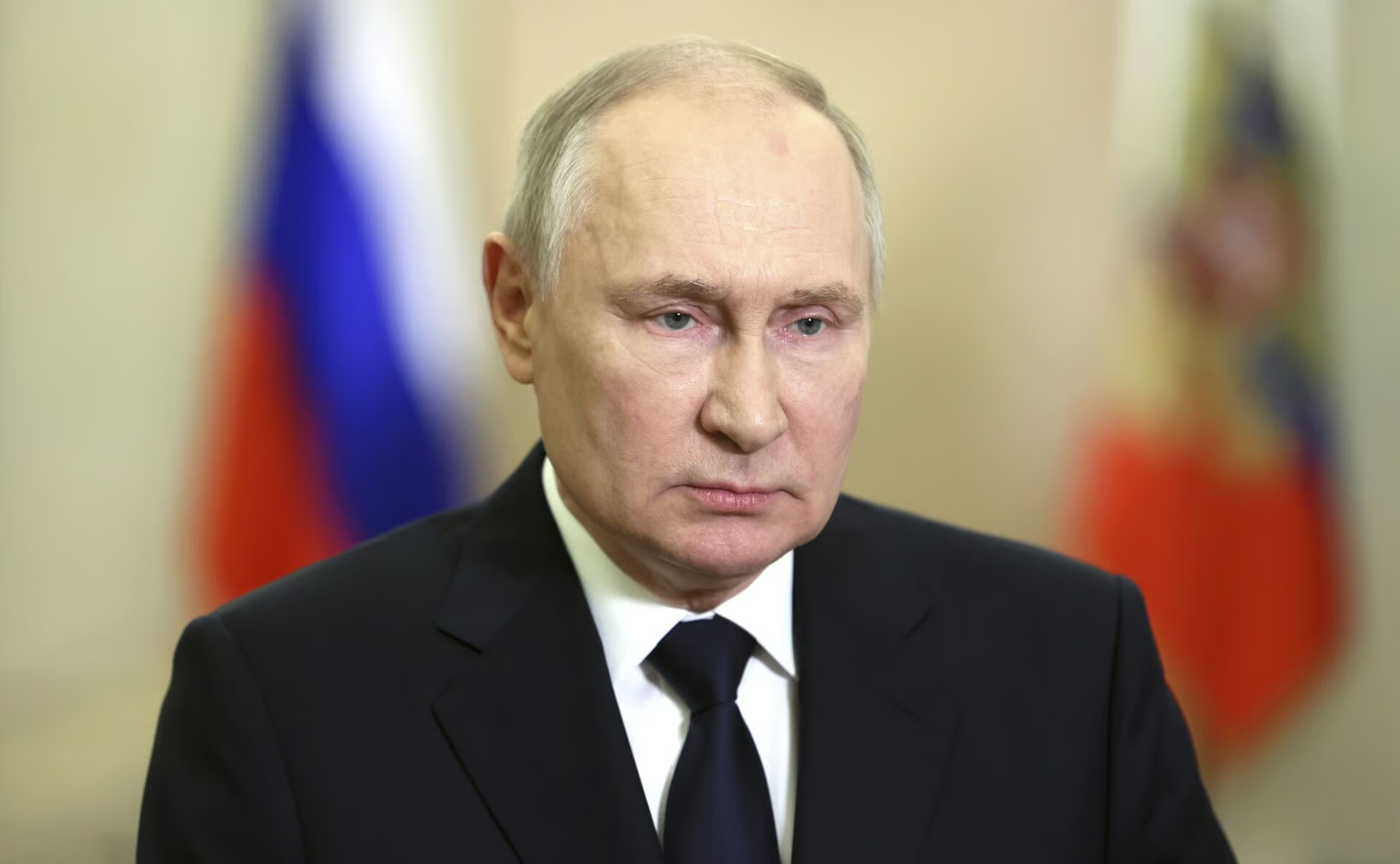
The step taken by Moscow is of a gravity that admits no euphemism. Demanding the diplomatic evacuation of a European capital is not a rhetorical gesture: it is a declaration of operational intent and, at the same time, a textbook maneuver of psychological coercion. Putin knows that if he manages to empty Kyiv of Western diplomatic presence, he will have won a major symbolic battle—the image of the Ukrainian capital being abandoned—which explains the absolutely justified firmness of the European response. The explicit reference to “NATO specialists” in the Russian Foreign Ministry’s statement is also a sign: Moscow seeks to create a narrative framework that, should the attacks materialize, allows it to present them to its public as attacks against the Atlantic Alliance and not against Ukraine. On the military front, the use of hypersonic missiles against urban targets—where Ukrainian interception capabilities are by definition more limited—represents a qualitative leap compared to the pattern of previous bombings. Rubio’s reaction, who confirmed having spoken with Lavrov, is necessarily ambiguous: Washington cannot ignore the warning, but neither can it give in to blackmail without seriously eroding the credibility of its support for kyiv at a time when negotiations with Moscow — if such negotiations have any real substance — seem more stalled than ever.
Perspectives and scenarios
The most likely scenario in the immediate future is that Russia will launch high-intensity attacks on Kyiv, regardless of whether the diplomatic corps evacuates or not—although the diplomatic presence makes the attack politically more costly in the eyes of the international community. The EU’s firm stance in maintaining its embassies is the right response. An alternative scenario, less likely but not impossible, is that the Russian threat is a negotiating tool linked to the peace process that Washington continues to try to orchestrate. In any case, the available data points to a real escalation, not merely a deterrent, which compels allies to urgently review their systems for supporting Ukrainian air defense.
2. US-Iran negotiations: Rubio speaks of “progress”; the Strait of Hormuz remains closed
Facts
During his four-day visit to India, Secretary of State Marco Rubio confirmed the existence of an advanced negotiating framework that would include the gradual reopening of the Strait of Hormuz followed by time-bound negotiations on Iran’s nuclear program. “We have what I think is a pretty solid thing on the table,” Rubio told a small group of journalists. Trump, for his part, described the agreement as “largely negotiated” but urged his negotiators “not to rush into anything.” Iran confirmed that it had reached “general principles” of an agreement, although it declined to indicate an imminent signing. The negotiations, mediated by Pakistan, are taking place in Doha and other capitals amid renewed US attacks near the Strait, which Tehran has called a violation of the ceasefire. The blockade of the Strait has now lasted more than 100 days, with oil traffic effectively paralyzed and the price of crude remaining at critical levels. The head of the Iranian delegation, the Speaker of Parliament Mohamed Bager Ghalibaf, is under constant pressure in Tehran, making any concessions difficult.
Implications
The image emerging from the last few hours is one of diplomacy advancing in parallel with the military escalation, breaking with the classic conflict resolution manual in which kinetic operations are halted while negotiations take place. This approach—negotiating and attacking simultaneously—is extremely volatile and could implode due to any border incident. Rubio’s position is that of someone who understands that time does not necessarily work in Washington’s favor: every week the Strait remains closed represents an accumulating economic and political cost. However, the US demand that Iran hand over its highly enriched uranium is a red line that the jihadist oligarchy in Tehran—which has built its entire narrative of survival on the nuclear program—cannot cross without devastating internal consequences for the IRGC triumvirate that currently controls the Iranian state de facto. The paradox of the decapitation that I have been analyzing since May operates here with surgical precision: the survivors of the IRGC are all ultraconservatives who lack the ideological authority necessary to impose concessions on their peers without politically destroying themselves. No one can act as an arbiter; there is no Khamenei to discipline the rest.
Perspectives and scenarios
The critical period is between May 27 and 29. If no agreement on the Strait is announced before the weekend, Rubio will shift from diplomatic pressure to the doctrine of forced opening, with obvious military implications. The scenario of a partial agreement—reopening the Strait in exchange for sanctions relief and a freeze on enrichment—has an estimated probability of 35-40%. The scenario of a resumption of US attacks, if Tehran does not concede, exceeds 40% if the coming days do not produce concrete progress.
3. Israel intensifies operations in Lebanon: 31 dead in new attacks
Facts
On the night of May 25-26, the Israel Defense Forces (IDF) attacked more than 100 Hezbollah sites in southern Lebanon and the eastern Beqa Valley, destroying weapons depots, command centers, and observation posts. An attack on the eastern town of Mashghara killed 12 people, including several members of the same family, according to the Lebanese National News Agency. Beirut’s Health Ministry raised the total death toll for the past few days to 31. Israeli Prime Minister Benjamin Netanyahu authorized “more intensive” operations against Hezbollah and announced the mobilization of additional troops for deployment to Lebanon. On Tuesday, Israeli troops clashed along the Litani River with Hezbollah forces, who launched rockets, artillery, and explosive drones. Israel warned residents of Nabatiyeh to evacuate the town. All of this is happening while the April 16 ceasefire is nominally in effect and a fourth round of direct talks between Beirut and Jerusalem is scheduled for June 2 and 3 in Washington. Since March 2, more than one million Lebanese have been forced to flee their homes, and Israeli attacks have killed more than 3,100 people.
Implications
Lebanon has become the weakest link in the entire negotiating architecture of the war with Iran. Tehran has insisted that any comprehensive peace agreement must include a cessation of hostilities in Lebanon, while Israel rejects the notion that the Iranian ceasefire binds it to its fight against Hezbollah—which it considers an existential threat in itself, not merely an appendage to the war with Iran. This divergence of perspectives is crucial: what Washington is negotiating with Tehran regarding the Straits and the nuclear bomb could collapse at any moment if an Israeli attack on Beirut or a terrorist response from Hezbollah forces Iran to withdraw from the negotiating table. Lebanon, that martyred state I knew from childhood through the diplomatic tragedy my family endured, is once again paying the price of being the battleground for those who do not live there but exploit it. The terrorist organization Hezbollah, Iran’s armed wing on Lebanese soil, is not a militia or a resistance movement: it is a terrorist organization whose militants are individual terrorists, without exception.
Perspectives and scenarios
The fourth round of direct Beirut-Jerusalem talks, scheduled for June 2-3 in Washington, is the next critical milestone. Its success or failure will largely determine whether the Iranian peace process can be sustained. A collapse of these talks—triggered by a high-profile Israeli attack in Beirut or a Hezbollah operation against civilians in northern Israel—would send the overall negotiation process with Iran into a cascading decline.
4. Wang Yi at the Security Council: Beijing deploys its multilateral offensive
Facts
Chinese Foreign Minister Wang Yi chaired a high-level ministerial debate at the UN Security Council on Tuesday, May 26, on “upholding the purposes and principles of the UN Charter and strengthening the UN-centered international system.” China holds the rotating presidency of the Council for the month of May. Wang implicitly criticized Washington, stating that “the purposes of the UN Charter have been ignored, the basic norms of international relations have been undermined, and world peace and security are in grave danger,” without mentioning the United States or Trump by name. He urged the Council to “step up and fulfill its responsibilities.” Wang also expressed hope that the US and Iran would “come closer together” to bring peace back to the Middle East. He stressed that “Gaza and the West Bank are not bargaining chips in political deals.” China also commemorated the 55th anniversary of the restoration of its permanent seat at the UN.
Implications
Beijing’s diplomatic maneuvering in the Security Council should not be interpreted as an exercise in multilateral goodwill. It is, in reality, a strategic image-building operation: China is leveraging its rotating presidency to construct the narrative that the world order is deteriorating due to unilateral US policy, to position itself as the guarantor of international law—which it systematically violates in the South China Sea—and to stand before the Global South as the responsible power in contrast to a disordered West. Wang’s mention of the Iranian crisis to call for restraint demonstrates that Beijing has an interest in resolving the conflict—Gulf oil is vital to the Chinese economy—but without Washington consolidating a strategic victory that would reinforce American leadership in the region. We are witnessing the most refined expression of the systemic rivalry between established power and rising power with incompatible models that I have been describing: China has no allies, only “transactional partners”; it does not seek peace, but rather a rebalancing of the balance of power in its favor.
Perspectives and scenarios
China’s multilateral offensive will intensify in the coming months. Beijing seeks to present an assessment of its Security Council presidency to the General Assembly in September, portraying it as a stabilizing force in the face of the United States’ drift. This diplomatic activism should not be mistaken for genuine cooperation: in the arena of systemic rivalry, every Chinese multilateral initiative aims to weaken the Western security architecture, not strengthen it.
5. Ebola in Bundibugyo, DRC and Uganda: WHO warns of out-of-control spread
Facts
As of May 26, 2026, the Ebola outbreak caused by the Bundibugyo variant—the seventeenth epidemic in the Democratic Republic of Congo (DRC) in fifty years—had registered 105 confirmed cases, including 10 deaths, and 906 suspected cases, with at least 223 deaths, in the provinces of Ituri, North Kivu, and South Kivu. Uganda has reported seven confirmed cases, one of them fatal, several linked to travelers from the DRC. The Director-General of the World Health Organization (WHO), Tedros Adhanom Ghebreyesus, declared a Public Health Emergency of International Concern on May 20—the first time in history that a Director-General has activated this mechanism before convening the Emergency Committee—a decision that reflects the severity and rapid spread of the outbreak. The total number of suspected and confirmed cases surpassed 1,000 on May 25. Two suspected cases were detected in Italy—in the Lombardy region—on May 25 in people who had traveled from Uganda. The most alarming aspect is that the Bundibugyo variant has no approved vaccine or specific treatment, unlike previous outbreaks caused by the Zaire variant.
Implications
The detection of cases in Italy raises the risk of export to Europe in a way that cannot be ignored. The situation in the DRC combines all the factors that classical epidemiology identifies as accelerators of spread: active armed conflict in the east of the country, mass displacement of the population, community distrust of healthcare systems—which led last week to a mob storming a Doctors Without Borders isolation center in Mongbwalu—and a lack of proven therapeutic tools. The brutal cuts to US funding for global health—which this administration has pursued with a frivolity that is difficult to justify even from the perspective of the strictest realism—exacerbate an international response that was already weakened. The WHO is not in a position to address this outbreak with the resources it would have under normal circumstances.
Perspectives and scenarios
The most dangerous scenario is that the spread in eastern DRC—a region lacking even basic healthcare infrastructure and plagued by armed groups—will overwhelm the healthcare system before clinical trials of experimental therapies against the Bundibugyo variant yield usable results. The likelihood of new cases being exported to Europe or the Persian Gulf countries—both of which receive a high volume of travelers from the region—is significant. The international community, starting with the European Union, must mobilize resources urgently and without waiting for the outbreak to reach pandemic proportions.
6. Gaza: Peace plan stalled, Hamas leader executed, and new attacks
Facts
The ceasefire in Gaza, in effect since October 2025 but repeatedly violated, is at its most precarious point. UN Special Envoy Nickolay Mladenov declared in May that the phased peace plan is “stalled” because Hamas refuses to disarm in the absence of political and security guarantees. On May 15, an Israeli attack in the Rimal neighborhood of Gaza City killed Izz al-Din al-Haddad, Hamas’s leader in the Strip and the last high-ranking military commander of the terrorist organization. Further Israeli attacks on May 26 killed at least five Palestinians in a refugee camp in central Gaza, according to local health officials. The reconstruction of Gaza, estimated at $70 billion, has “no modern parallel,” according to the Brookings Institution. The total number of Palestinians killed since the start of the war has now surpassed 71,000.
Implications
The successive elimination of Hamas’s military leadership—the so-called decapitation paradox in its Palestinian version—has not led to the surrender or moderation of the terrorist organization, but rather to its retreat into secrecy and the hardening of the positions of the survivors, who are by definition the most intransigent. Trump’s peace plan, which involves an international stabilization force and a transitional authority overseen by Washington, faces simultaneous resistance from Hamas—which refuses to disarm—and from sectors of the Israeli right wing that refuse to hand over control of Gaza to any Palestinian authority. Caught between these two vetoes, the peace process is languishing while the civilian population of Gaza pays the price with their lives. Wang Yi was right about at least one thing: Gaza and the West Bank should not be bargaining chips in any compromise, even though the multilateralism proclaimed by Beijing is not the solution it pretends to offer.
Perspectives and scenarios
The likelihood of the second phase of the Gaza peace agreement being effectively negotiated before summer is very low. The most probable scenario is an indefinite continuation of the current situation: targeted Israeli attacks, Hamas’s failure to disarm, a partial humanitarian blockade, and political paralysis. The human cost of this status quo is unsustainable.
III. MEDIA RACK
The following summarizes the editorial stance of the main international media outlets over the last 24 hours regarding the news stories analyzed:
Anglo-Saxon media
The Times (London) puts the Russian threat over Kiev on its digital front page with the headline “Putin’s Nuclear Shadow Over Kyiv”, emphasizing the use of hypersonic missiles and the dimension of intimidation towards NATO.
The Daily Telegraph publishes an editorial entitled “Europe Must Stand Firm” urging allies not to abandon Kiev and calling the Russian demand for evacuation an “act of diplomatic state terrorism”.
The Financial Times focuses its coverage on the negotiations over the Strait of Hormuz, with sources in Doha confirming that Washington and Tehran are “inches away” from a first partial agreement, although they warn of difficulties posed by the hardline Iranian stance. The FT also highlights the impact of the blockade on global energy markets.
The Wall Street Journal highlights the relative success of Rubio’s visit to India as a maneuver to repair the bilateral relationship damaged by Trump’s tariffs and Washington’s rapprochement with Islamabad. It dedicates analysis to the Lebanese front and the impossibility of separating the Hezbollah case from the Iranian agreement.
The Washington Post analyzes the Russian escalation on Kiev with a strong emphasis on the implications for the Ukrainian peace process, questioning Trump’s negotiating strategy with Moscow and warning of the danger that Russian threats will be met with further concessions.
The New York Times publishes a chronicle from Beirut on the humanitarian situation in southern Lebanon, with testimonies from civilians caught between Israeli attacks and the presence of Hezbollah, and editorially is critical of the continuation of Israeli operations under the ceasefire.
BBC, Reuters, and AP are providing extensive coverage of the Ebola outbreak in the DRC, with particular attention to the detection of suspected cases in Italy and the WHO’s warning about the speed of its spread. The agencies highlight the prior declaration to the Emergency Committee as an “unprecedented event.”
Bloomberg/CNBC focus on the economic impact of the blockade of the Strait of Hormuz, with analysis of the price of crude oil and the US strategic petroleum reserves, and report Rubio’s statements as a positive—albeit cautious—sign for energy markets.
The Economist publishes an analysis of Trump’s negotiating strategy with Iran, calling it “ultimatum diplomacy” and noting that the absence of a plan for the day after—if the Iranian regime gives in or collapses—is the most serious structural weakness of US policy in the region.
Axios/Politico highlight internal tensions in the White House over the pace of negotiations with Iran, with sources pointing to differences between Rubio’s more structured approach and the more erratic impulses of Trump’s inner circle of advisors.
Continental European press
Le Monde titles its cover with “Moscou défie l’Occident en menaçant Kiev d’une offensive systématique” and dedicates its editorial to defending the permanence of the European diplomatic corps in the Ukrainian capital.
Le Figaro analyzes China’s diplomatic offensive in the Security Council with skepticism, noting that the multilateralism proclaimed by Wang Yi masks a project to reorganize the international system in favor of Beijing.
The Frankfurter Allgemeine Zeitung (FAZ) opens with the Russian threat to Kiev and devotes an extensive analysis to the implications for German security policy, noting that Berlin maintains sensitive material supporting Ukraine, the exposure of which increases in the face of attacks on “decision centers”.
Die Welt publishes an opinion piece favorably oriented towards maintaining the diplomatic presence in Kiev, calling the stance of the 27 EU ambassadors an “act of institutional courage”.
Corriere della Sera focuses its attention on the suspected cases of Ebola in Lombardy and calls on the Italian government to immediately activate health alert and contact tracing protocols.
Arab and regional press
Asharq Al-Awsat / Arab News are closely following the negotiations on the Strait of Hormuz, with sources in Doha speaking of “technical progress” but noting that the nuclear issue remains the decisive obstacle.
Al-Jazeera devotes extensive coverage to Israeli attacks in Lebanon and Gaza, with a critical editorial bias towards Israel that, as always in this channel, should be read with due reservations about source selection and framing.
An-Nahar (Beirut) / L’Orient Le Jour report on the impact of Israeli attacks on the Beqa Valley and southern Lebanon with tones of despair, stressing that the April ceasefire has brought no relief to the Lebanese civilian population.
Haaretz / The Times of Israel report on Israeli attacks in Lebanon with detailed coverage of military targets, while Haaretz editorially questions the absence of a coherent exit strategy in Lebanon.
Russian, Ukrainian and Eastern European media
Kyiv Independent / Ukrinform cover in detail the Russian evacuation threat, with Ukrainian Foreign Ministry sources calling it “blatant blackmail” and evidence for future international legal proceedings against the aggressor state.
Russia Today/TASS presents the Russian attacks on Kyiv as “legitimate retaliation” for Ukrainian attacks on Russian territory and the evacuation announcements as a “responsible humanitarian warning.” Reading this is necessary to understand the regime’s narrative, not to believe it.
IV. RISK TRAFFIC LIGHT
🔴 RED — CRITICAL Russian military escalation over Kiev and threat of destabilization of the European diplomatic corridor
Moscow’s threat to launch “systematic” attacks on Kyiv, with direct intimidation of the Western diplomatic corps, constitutes the most immediate and serious risk. The use of hypersonic missiles against residential areas and the instrumentalization of the diplomatic corps as a symbolic target raises the temperature of the conflict to levels not seen since the early months of the 2022 invasion. European resolve—which deserves all possible support—does not eliminate the risk; it manages it with dignity.
🔴 RED — CRITICAL Negotiations stalled over the Strait of Hormuz and risk of renewed US attacks
The centenary of the Strait blockade without a signed agreement presents the world with a dilemma of global consequence: either an understanding is reached in the coming days on reopening the Strait, or the Trump administration will activate the option of force that Rubio has announced with the phrase “one way or another.” In either scenario—an unsatisfactory agreement or a resumption of attacks—the stability of the Gulf remains critically at risk.
🟠 ORANGE — STOP Lebanon: Ceasefire collapse and risk of spillover into a wider regional conflict
The intensification of Israeli attacks on Lebanon—with over 100 targets hit in a single night and 31 deaths in recent days—renders the April 16 ceasefire a mere euphemism. If the cycle of Israeli-Hezbollah escalation is not contained before the fourth round of talks in Washington (June 2-3), the risk of the entire negotiating framework on Iran collapsing is very real.
🟠 ORANGE — HIGH Ebola epidemic in Bundibugyo, DRC and Uganda: risk of export to Europe
The detection of suspected cases in Italy on May 25, coupled with the rapid spread in eastern DRC and the absence of a vaccine or approved treatment for this variant of the virus, makes this outbreak a major public health emergency. Cuts in global health funding are further hindering the response. The risk of export to Europe or to countries in the Persian Gulf—with high air connectivity to the region—is significant and requires the urgent activation of alert protocols.
🟡 YELLOW — MODERATE Chinese multilateral offensive at the UN: erosion of Western leadership in international institutions
Wang Yi’s maneuver at the Security Council has no immediate consequences, but it is part of a long-term strategy to reposition China as a regulator of the international order. Every narrative success for Beijing in multilateral forums weakens, however marginally, the legitimacy of Western leadership. The risk is cumulative and should not be underestimated by Atlanticist allies.
🟡 YELLOW — MODERATE Gaza: Peace plan stalled and humanitarian deterioration irreversible
The stalled peace process in Gaza—with Hamas refusing to disarm and the extremes of the Israeli coalition blocking any viable political solution—has plunged the civilian population into a humanitarian crisis that persists with no end in sight. The elimination of Hamas’s operational leadership has not brought the conflict any closer; it has only complicated it. The risk of irreversible humanitarian deterioration is high.
V. EDITORIAL COMMENTARY
There are days when the world seems determined to disprove those who, from the comfort of wishful thinking (the illusion that things will improve on their own), insist that we are facing “passing turbulence.” May 27, 2026, is one of those days. Five simultaneous fronts of major crises—Ukraine, Iran, Lebanon, Ebola in the DRC, and the Chinese multilateral offensive—are not turbulence. They are the symptoms of an international order in the process of violent recomposition, whose fault lines run precisely where this analyst has been pointing them out for years: the border between democracy and autocracy, between the rule of law and the law of force, between genuine multilateralism and that which is used as a weapon of erosion.
The Russian threat to Kyiv deserves to be called what it is: state terrorism. There is no other term for a regime that launches hypersonic missiles at residential buildings and then demands that the diplomatic world abandon the capital of the attacked nation, as if the presence of embassies constituted an obstacle to its plans of destruction. The response of the 27 EU ambassadors—”Russia wants fear, panic, and the isolation of Ukraine; it will not get it”—is the only possible response based on dignity and consistency with the values we claim to defend. On this point, Europe has risen to the occasion. What it cannot afford is to continue rising to the occasion only in its pronouncements. Kyiv’s air defenses need resources that go beyond the usual rhetoric of summits.
On the Iranian front, Marco Rubio represents the best that American foreign policy can offer right now: pragmatism without naiveté, firmness without arrogance. His visit to India—an indispensable partner that the Trump administration has mistreated with tariffs and its rapprochement with Pakistan—is exactly the kind of structured diplomacy a world on fire needs. The problem is that, in Washington, Rubio doesn’t always have the final say. The temptation to act impulsively—the “we’ll fix it one way or another” approach that applies as much to diplomacy as to missiles—is not, in itself, a policy. It’s a gamble. And gambles in the Strait of Hormuz are paid in barrels of oil, in the lives of sailors, and in the stability of an entire region.
Lebanon is once again, as it was during the years when my family experienced firsthand the tragedy of that martyred country—the kidnappings, the bombings, the attack on the Spanish Embassy—the testing ground for all foreign wars. Hezbollah is a terrorist organization in its entirety, without exception or nuance; every one of its militants is a terrorist. But the destruction of Hezbollah cannot be the excuse for the destruction of Lebanon. Israel has the right to defend itself; no state can tolerate its territory being used as a rocket launching base. But the right to defense is not an unlimited blank check, and the absence of a coherent plan for the aftermath—in Lebanon, in Gaza, throughout the entire arc of the Iranian conflict—is the most serious strategic weakness this analyst identifies in the current administration’s regional policy. As it is, with equal rigor, in that of all its immediate predecessors.
As for China, its actions in the Security Council should not be underestimated. Wang Yi doesn’t need to win any votes in the Council—where the American and European vetoes would block everything—to achieve his real objective: constructing a narrative. Beijing is investing in the story that it is the guarantor of multilateralism against Washington’s unilateralism. It is a long-term, patient, systematic, and effective investment, especially in the Global South. We Atlanticists cannot respond to this narrative with mere declarations of principles. We must respond with actions: more consistency, a greater presence, and more respect for the international norms we claim to defend. Because if there is anything that damages Western leadership more than Chinese propaganda, it is our own inconsistency.
The Ebola outbreak in the DRC is, ultimately, the most brutal reminder that the risks of the 21st century respect neither borders nor ideologies. A variant of the virus for which there is no vaccine or treatment, in a region devastated by conflict and decades of deliberate underdevelopment, with cases already detected in the heart of industrialized Europe: this is not science fiction. It is the reality of May 27, 2026. The international community, and in particular those countries that have cut their contributions to global health with the same frivolity with which they cut elevator maintenance budgets, have a moral and political debt to the affected populations that urgently needs to be repaid.
The world, in short, is not engaged in “wars of variable temperature” that can be managed with patience and rhetoric. It is on the verge of a contained systemic fracture that could erupt at any moment. What is at stake is not the stability of a region: it is the kind of world our children will inherit. That prospect alone should be enough to demand more from our governments than well-written declarations and photogenic summits.