Gustavo de Arístegui,
June 5, 2026
I. BRIEF INTRODUCTION
The world wakes up today in that condition I have been describing for months: that of several wars of varying intensity —prolonged conflicts of low resolution but high destruction that no one can win or afford to lose— burning simultaneously, while diplomacy and violence run parallel without ever touching.
In Ukraine, President Zelensky extends an olive branch to Putin with an open letter on the same day that the Kremlin leader, speaking at the St. Petersburg Economic Forum, once again dismisses the very idea of a ceasefire.
In Lebanon, the conditional ceasefire agreed in Washington is stillborn as soon as Hezbollah —which was not at the table— flatly rejects it; and in Gaza the October truce unravels with daily bombings.
In Tehran, the jihadist oligarchy, beheaded on February 28, is devouring itself over whether or not to negotiate with Washington, while executions multiply.
In the eastern Atlantic and Pacific, the legitimate US Navy campaign against drug trafficking has resulted in more than two hundred deaths, with Venezuela still trapped in a supervised transition.
And in the South China Sea, Beijing is tightening its grip on the islets that Taiwan administers in Dongsha, while markets await the US jobs report that will measure the firmness of a newly tightened Federal Reserve.
This analyst believes that the common thread running through the day is not any single isolated crisis, but rather the convergence of three self-reinforcing dynamics. The first is the temptation of the fait accompli as a method for acquiring territories or imposing realities, from St. Petersburg to Dongsha. The second is the contained systemic fracture of regimes and truces that persist without resolution, from Lebanon to Caracas. And the third, the most disappointing, is a 21st-century political class—particularly the European one—incapable, once again, of taking its own defense, security, and destiny seriously. Against this backdrop, the shadow of a US foreign policy that oscillates between pragmatic success and transactional blunders is also projected, and from which it is necessary to distinguish, with surgical precision, the commendable from the erratic.
II. MOST IMPORTANT NEWS OF THE LAST 24 HOURS
1. Ukraine: Zelensky offers direct summit and ceasefire while Putin, from St. Petersburg, rejects any truce
FACTS
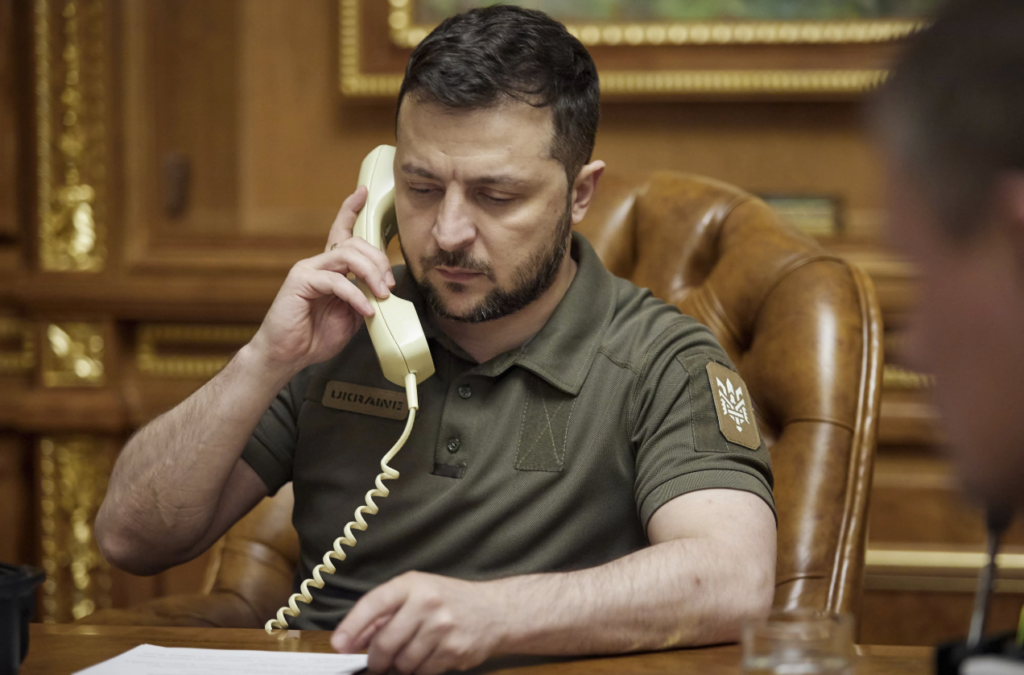
On June 4, according to the Kyiv Post and the Kyiv Independent, President Volodymyr Zelensky released an unusual open letter addressed personally to Vladimir Putin, proposing a face-to-face meeting and declaring his willingness to a “complete ceasefire” for the duration of the negotiations. The letter was published just hours after Ukrainian long-range drones struck targets near St. Petersburg, during the opening of the city’s St. Petersburg International Economic Forum (SPIEF), the major annual showcase of Russian economic power.
From that same forum, at a meeting organized by the TASS news agency with directors of international media outlets, Putin responded bluntly: no truce is necessary to begin talks—it’s better, he said, to end the war completely than to pause hostilities. He boasted of controlling the entire Luhansk region, more than 85% of Donetsk, and nearly 80% of Zaporizhzhia, in addition to having seized some 2,440 square kilometers in recent months; he also estimated the reduction of Ukrainian forces at one hundred thousand men. Furthermore, he insisted that Moscow will only sign an agreement with a “legitimate” interlocutor from Kyiv, deliberately casting doubt on Zelensky’s mandate.
Meanwhile, according to Euronews, the draft conclusions of the European Council—which meets on June 18 and 19—offer to “step up” in mediation, but make everything contingent on Russia first accepting an unconditional ceasefire. This proposal is utter nonsense, given that Moscow considers the European Union a hostile power to Russia and an ally of Ukraine: the Kremlin will never accept Brussels mediating in the conflict. It borders on the pathetic that the European Council is placing itself, of its own accord, in the position of being humiliated once again by Russia.
IMPLICATIONS
The asymmetry of positions is complete and revealing. Zelensky’s offer speaks to both Moscow and—above all—the Western foreign ministries and the White House, to whom he wants to portray Ukraine as the reasonable party, the one extending a hand while the aggressor rejects it. Putin, for his part, is not negotiating: he is managing a fait accompli. His rhetoric about the “legitimacy” of the Ukrainian interlocutor is not legal, but instrumental, a lever to delegitimize Zelensky, divide his Western supporters, and buy time while he advances, meter by meter, on the ground.
That the SPIEF served as a platform for this message is no coincidence: Putin wanted to project economic normalcy and strategic strength to the world, precisely when Ukrainian drones were demonstrating that war could reach the very doorstep of his former imperial capital. And Europe, once again, is hiding behind the calendar: postponing until June 18th a decision that should already be a firm mandate. This is not neutrality; it is yet another example of the strategic myopia I so vehemently criticize.
PERSPECTIVES AND SCENARIOS
The most likely scenario in the short term—around 60%—is the continuation of a war of fluctuating intensity, with diplomatic gestures that fail to materialize and a front line that moves at a snail’s pace. A second scenario, less likely but not impossible, is a fragile pause brought about by President Trump’s transactional pressure. The underlying risk is precisely this: that such an armistice, far from bringing peace, would de facto ratify the conquest by force. And an armistice that rewards aggression is not peace: it is the seed of the next war, sown with the West’s signature.
2. Iran: The decapitated jihadist oligarchy devours itself while negotiating under duress and multiplying executions
FACTS
Following the death of Ali Khamenei in the February 28 attacks and the brief interim period under the Interim Leadership Council, his son Mukhta Khamenei has served as Supreme Leader since March 8. According to a briefing note from the British House of Commons Library, the talks that began on April 8—mediated by Pakistan—cover four main areas: freedom of navigation through the Strait of Hormuz, the nuclear and ballistic missile programs, the country’s reconstruction, and the lifting of sanctions.
On June 4, the opposition organization NCRI documented a new, more virulent phase in the factional war between the regime’s hardliners and the fragile coalition surrounding President Pezeshkian and Speaker of Parliament Ghalibaf, over the possibility of a new nuclear agreement. What on the surface appears to be a debate about diplomacy is, in reality, a struggle for power, resources, and political survival. Meanwhile, the regime is escalating the executions of those arrested during the January protests: the secret hanging of Fathollah Avari on June 2 in Hamadan prison and the execution of two young men on June 1 are part of a daily wave of reprisals against protesters.
At the multilateral level, the Security Council Report notes that the dispute over the automatic reactivation of UN sanctions (snapback) activated by the E3—France, Germany, and the United Kingdom—remains unresolved. This action is challenged by Russia, China, and Tehran itself, which maintain that the sanctions regime expired in October 2025. The legal ambiguity is, in itself, a battleground.
IMPLICATIONS
We are facing what I have been calling the paradox of decapitation, and it is important to clarify this term, because it is often misinterpreted: the problem is not that the moderates were eliminated—there weren’t any—but that the successor inherits the title but not his father’s arbitral authority. Khamenei could impose internal discipline, settle disputes, and compel his peers to accept concessions; his son lacks the ideological weight, the clerical rank, and the dominant personality to do so. In short, the jihadist oligarchy has been left without an arbiter, and that is why its factions are cannibalizing each other precisely when they need unity most to negotiate.
It is precisely the void of the “day after” that I warned, time and again, that no one had planned for: striking at the regime was necessary and just, but decapitating it without a plan to manage the resulting vacuum is a recipe for prolonged instability. And mass executions are not a sign of strength, but of fear: a regime that hangs people in secret, concealing dates and locations, is a regime that fears its own people more than its external enemies.
PERSPECTIVES AND SCENARIOS
Three scenarios are possible. The first is a managed capitulation (probability around 35%), in which the negotiating faction extracts concessions in exchange for economic support and the survival of the system. The second is a controlled implosion (around 25%), if the factional infighting overwhelms the system. The third, the most likely in the short term (around 40%), is a frozen stalemate, with a weakened but not defeated terrorist state negotiating reluctantly and carrying out repression with impunity. In any of these scenarios, the Strait of Hormuz will remain the choke point of global energy and, therefore, the true barometer of global risk.
3. Lebanon and Gaza: Hezbollah derails the ceasefire agreed in Washington and belies Trump’s optimism
FACTS
After two days of direct talks mediated by the United States at the State Department—the fourth round of this format—Israel and Lebanon reached a declaration on June 3 to implement a ceasefire. The declaration demanded a “complete cessation” of fire by Hezbollah and the withdrawal of its fighters from the southern Litani sector, as well as the creation of pilot zones in southern Lebanon where only the Lebanese Army would exercise control, excluding any non-state actors. Lebanese President Joseph Aoun called it a “last chance” for a comprehensive truce.
The optimism lasted only hours. On June 4, according to NPR, TIME, and Al Jazeera, Hezbollah Secretary General Naim Qassem, a terrorist organization, flatly rejected the agreement, calling the negotiations “absurd, humiliating, and insulting” and denouncing them as serving only “the enemy’s objectives.” The militia, which did not participate in the talks, conditioned everything on a “comprehensive” cessation of aggression and an Israeli withdrawal. President Trump himself had stated that same day, according to The Times of Israel, that Hezbollah “had not rejected” the offer: reality proved him wrong before nightfall. Furthermore, an official close to Aoun admitted to Middle East Eye that the text “lacks an implementation mechanism.” And a fact that hits close to home: in a mortar attack near Marjayoun, a Serbian UNIFIL peacekeeper was killed and two others were wounded, one Salvadoran and one Spanish. Seven UNIFIL personnel have now been killed since the conflict reignited in March.
In Gaza, despite the ceasefire in place since October, daily violence continues unabated. Agence France-Presse reported on June 4 that at least eight people were killed in Israeli bombings at dawn in Gaza City, with fifteen wounded treated at Al-Shifa Hospital. According to the Gaza Ministry of Health—which controls Hamas—the death toll since the start of the truce has now surpassed 936, and more than half of the territory remains under Israeli military control. The National also confirms that talks scheduled for this week between Palestinian factions and the envoy tasked with implementing the US peace plan have been postponed.
IMPLICATIONS
A ceasefire without a political framework or verification mechanism is a contained systemic fracture: it is managed, but not resolved. The Gordian knot remains the disarmament of Hezbollah, Tehran’s armed wing in the Levant and a key component of the Iranian proxy network. The militia’s rejection of the agreement confirms an uncomfortable truth: as long as Hezbollah retains its weapons and Iranian oversight, no Lebanese government can guarantee anything, and the Lebanese state will remain hostage to a non-state actor better armed than its own army.
There is also a lesson to be learned about methodology. President Trump announced progress that reality shattered within hours: this wishful thinking, this taking wishful thinking for granted, weakens the credibility of US mediation precisely when firmness and precision are most needed. And it is worth emphasizing the strategic link that the Iranian regime itself has established: Tehran has warned that it will not accept any ceasefire with Washington until there is one in Lebanon. The Lebanese situation is, therefore, the true test of whether the retreat of the Iranian axis is reversible.
PERSPECTIVES AND SCENARIOS
The balance is precarious, and escalation is plausible. If, against all odds, the Lebanese Army were to deploy in the pilot zones and Hezbollah were to hand over capabilities, we would witness the greatest retreat of Iranian power in a generation; but Qassem’s outright rejection makes this scenario unlikely today. The most probable outcome is the continuation of an intermittent truce, punctuated by bombings and reprisals, with UNIFIL paying a heavy price in blood. The day after, once again, is unwritten.
4. United States: May’s jobs report measures a Federal Reserve that has tightened its policy under its new chairman, Kevin Warsch
FACTS
The Bureau of Labor Statistics (BLS) will release its May jobs report today at 8:30 a.m. Washington time. The Dow Jones consensus, compiled by CNBC, points to just 80,000 jobs created—down from 115,000 in April—while Bloomberg projects around 85,000, and other firms are more pessimistic (Goldman Sachs, 60,000; Vanguard, 20,000). The unemployment rate is expected to remain stable at around 4.3%, and wages are projected to rise by 0.3% month-on-month. The private ADP report, released on June 3, had surprised on the upside with 122,000 jobs, its best month since January 2015, with growth for the first time spread across sectors.
The picture, however, has darker aspects: the consulting firm Challenger recorded 97,006 layoff announcements in May, 16% more than in April, led by the technology sector, with artificial intelligence being the most cited reason for the third consecutive month; and the closure of Spirit Airlines on May 2nd left some 17,000 workers unemployed. The backdrop, according to FXStreet, is the hawkish shift of the Federal Reserve under its new chairman, Kevin Warsh, ahead of the June 16th-17th meeting: markets no longer rule out the possibility that the central bank will maintain interest rates—or even raise them—amid open tension with the White House’s growth and tariff agenda, and with inflation strained by rising energy costs stemming from the Iran-Contra affair.
IMPLICATIONS
A Federal Reserve that doesn’t cut rates—or that threatens to do so—under Warsh’s leadership tightens global financial conditions and clashes head-on with President Trump’s tariff protectionism, which I don’t support: restrictions on international free trade contradict the best liberal legacy, that of the great President Reagan, the best occupant of the White House in the second half of the 20th century. The appointment of a hawk like Warsh does, however, restore monetary orthodoxy, which is worth celebrating in the face of the temptation of financial repression.
The effect, as always, extends beyond US borders: to emerging economies, which see their dollar-denominated debt become more expensive; to the greenback itself, which strengthens; and to the global cost of credit. Geoeconomics, once again, reigns supreme, and today’s data will be read less for its figure than for what it reveals about the underlying struggle between a central bank regaining its orthodox independence and an executive branch eager for growth.
PERSPECTIVES AND SCENARIOS
Weak data will reinforce the Federal Reserve’s cautious stance without forcing an immediate rate cut; strong data, following the ADP warning, will fuel speculation about a rate hike in July or September. But the underlying news isn’t the specific figure, but rather the shift in monetary policy toward tighter policies and the growing—and predictably public—friction between the Federal Reserve and the White House, which will define the second half of the year.
5. Caribbean and Eastern Pacific: The US Navy intensifies its legitimate campaign against narcoterrorism, with Venezuela still in a supervised transition
FACTS
According to the Associated Press, CBS, and NBC, the U.S. Southern Command (SOUTHCOM) carried out another attack on June 3 in the eastern Pacific against a suspected drug-trafficking boat, resulting in two deaths. This is the fifth such attack in about a week and brings the death toll to over 207 since September in what President Trump has framed as an “armed conflict” against cartels designated as terrorist organizations. The operations are being led by General Francis Donovan, who last week met with Cuban military commanders near Guantanamo Bay.
The backdrop remains Venezuela. With Nicolás Maduro captured on January 3rd and imprisoned in Brooklyn awaiting trial, his vice president, Delcy Rodríguez, serves as acting president while her brother, Jorge, presides over the National Assembly. This transition, overseen by Washington, has, for the moment, left the Chavista apparatus intact: the military, judges, and security forces remain in their positions. Meanwhile, in the US Congress, doubts are growing about the legality of the maritime attacks, which the Pentagon has not accompanied with public evidence regarding the cargo of the vessels.
IMPLICATIONS
Let me be clear: I wholeheartedly support the strategic objective of dismantling the vast mafia-like organization that is Chavismo and of suffocating the narco-terrorism that poisons our societies. The campaign is, in its aim, legitimate and necessary, and the encirclement of the continent’s narco-dictatorships—Caracas, Havana, and Managua—is good news that I wholeheartedly welcome. The only caution that should be exercised is not substantive, but procedural: a clear legal framework and proper congressional oversight would shield the operation from challenges and make it stronger, not weaker. Firmness, yes; but the firmness of a liberal democracy is best exercised with the seams of the rule of law firmly in place.
The biggest problem, however, isn’t on the high seas, but in Miraflores: leaving the sinister Rodríguez brothers in charge of Caracas is simply leaving the problem half-resolved. It’s not enough to decapitate Chavismo if its machinery remains intact; that would be repeating, in a Caribbean context, the “day after” mistake I so deplore in the Middle East.
PERSPECTIVES AND SCENARIOS
The maritime campaign will continue, with its growing tally and increasing judicial scrutiny. In Venezuela, the transition will remain frozen as long as the Rodríguez clan retains control of the state apparatus and the weapons, and as long as a credible path to free elections remains unopened, elections in which the democratic opposition—led by María Corina Machado—can truly compete. Cuba and Nicaragua are watching, and should be afraid: the region’s pendulum is finally swinging against tyranny.
6. Indo-Pacific: Beijing strangles the Dongsha islets administered by Taiwan and confirms its gray zone expansionism
FACTS
At the end of May, according to the Global Taiwan Institute, a Chinese Coast Guard vessel entered restricted waters off Dongsha Island (Pratas), administered by Taipei, prompting a response from the Taiwanese Coast Guard. This is the sixth incursion this year, involving four Chinese vessels, in a sustained campaign of pressure that in January included a reconnaissance drone overflight and is part of years of harassment: oil exploration platforms, illegal fishing fleets, and blockades of air resupply operations.
All of this comes after the Trump-Xi summit from May 13-15, which left more uncertainty than certainty regarding the US commitment to Taipei. The CISS think tank at Tsinghua University, in its annual report, identifies tensions in the Taiwan Strait as Beijing’s top external risk by 2026 and warns of a potential “three-sea link”—the East China Sea, the Taiwan Strait, and the South China Sea—that could trigger chain reactions, as well as an expansion of the US strategy of technological containment.
IMPLICATIONS
It’s the salami tactic, the gray zone advance that erodes sovereignty without crossing the threshold of open war: each incursion, taken individually, seems minor; added together, they redraw the status quo. Faced with this, the West applies the doctrine of “small garden, high fence”—selective restrictions on critical technologies—in a rivalry that should be precisely defined: it is a systemic competition between an established power and a rising one with incompatible models, what Graham T. Allison called the Thucydides Trap; it is not, nor should it be equated with, the Cold War, whose categories only muddy the analysis.
It is also worth remembering two truths that underpin this entire situation. First: China has transactional partners, never true allies—and for Beijing, Russia and Iran are partners, not allies. Second: its decisive lever remains control of strategic raw materials, and most notably, rare earth elements, where it dominates production and, above all, global refining capacity. Whoever controls the supply chain controls the century.
PERSPECTIVES AND SCENARIOS
The most likely scenario is the continuation of the gradual harassment of Dongsha and other points of contention, carefully calibrated to avoid provoking a larger response: pressure, not war. The key variable is the political uncertainty in the United States ahead of the November midterm elections, which Beijing will closely scrutinize to gauge Washington’s resolve. Here, vigilance is constant.
III. MEDIA RACK
The major English-language newspapers —The New York Times, The Washington Post, The Wall Street Journal, Financial Times, The Times of London, The Telegraph, and The Guardian—lead today with the jobs report and the Federal Reserve’s tightening policy shift, and devote considerable space to the breakdown of the Lebanese ceasefire and the deteriorating Gaza truce. CNN, Fox News, CBS, CNBC, and Bloomberg highlight the Southern Command’s crackdown on drug-running boats and the standoff between the White House and the Federal Reserve.
The French press —Le Monde, Le Figaro, Libération, La Croix, Le Point, L’Express, and the channels LCI, BFM, and France Info—and the German press—FAZ, Die Welt, Die Zeit—are focusing on Ukraine and the European summit of June 18-19, with their usual skeptical tone regarding the Union’s actual capacity to “step up.” The Italian newspapers Corriere della Sera and L’Osservatore Romano are emphasizing the humanitarian dimension of Gaza and Lebanon.
The Arab press —Al-Jazeera, Al-Arabiya, Asharq Al-Awsat, Arab News, Gulf News, An-Nahar, and L’Orient-Le Jour—focuses its coverage on Hezbollah’s rejection of the agreement and the victims in Gaza, while the Israeli press—The Times of Israel, The Jerusalem Post, Haaretz, Yedioth Ahronoth, and Israel Hayom—emphasizes the Trump-Netanyahu friction and the General Staff’s refusal of a ceasefire in Lebanon.
On the Russian flank , TASS and Russia Today shamelessly amplify Putin’s maximalist narrative from St. Petersburg—territorial gains, Ukrainian casualties, and the delegitimization of Kyiv—a propaganda exercise that should be read with the caution it deserves and contrasted with independent sources such as the Kyiv Post or the Kyiv Independent.
The Asian press —South China Morning Post, China Daily, WION, The Times of India, Hindustan Times, Yomiuri Shimbun, and The Straits Times—prioritizes Chinese pressure on Taiwan and the framing of US “technological containment.” The news agencies—Reuters, AFP, AP, and DPA—and major think tanks—RUSI, IISS, CSIS, IFRI, and The Economist Intelligence Unit—provide, as they do every day, the factual and analytical framework for the day’s events.
IV. RISK TRAFFIC LIGHT
● Strait of Hormuz and Iran — high risk. Decapitated and fractured regime, escalating executions and negotiations under duress; the global energy chokepoint remains at the center of the chessboard.
● Ukraine-Russia — high risk. Diplomacy stalled and Russian maximalism since the SPIEF; the volatile war continues with no real prospect of a truce in the short term.
● Lebanon and Gaza — high risk. Hezbollah derails the ceasefire agreed in Washington, UNIFIL suffers casualties, and Tehran links its own negotiations to the Lebanese front.
● Indo-Pacific and Taiwan — medium-high risk. Gray zone harassment over Dongsha; systemic competition with Beijing and decisive lever of rare earths.
● Venezuela and the Caribbean — medium risk. Legitimate anti-drug campaign awaiting legal protection and Venezuelan transition frozen under the Rodríguez clan.
● Global economy and Federal Reserve — medium risk. Restrictive shift under Warsh and tension with the White House; transmission to emerging markets, dollar and debt costs.
V. EDITORIAL COMMENTARY
There are days when the world’s chaos sorts itself out, and this is one of them. Three lessons run through it.
The first dictates Putin from St. Petersburg: the fait accompli is becoming the established grammar of international relations, and anyone who believes that an armistice rewarding conquest will bring peace is engaging in wishful thinking. The second dictates Tehran—and is confirmed by Hezbollah in Lebanon: striking the jihadist oligarchy was necessary and just; I defended it then and I maintain it now. But the complete absence of a plan for the aftermath is the original sin of this entire operation, and the paradox of the decapitation, with Mukhta Khamenei lacking his father’s authority and a Shiite militia refusing to disarm, will take its toll.
The third lesson, as negative as the other two, is dictated by Europe, which postpones until June 18 what should already be a firm position, and which has the naivety to offer itself as a mediator before a Russia that considers it a belligerent party: the umpteenth confirmation of a continent incapable of taking its own defense, its security and its destiny seriously.
I am, it bears repeating, an Atlanticist at heart and a staunch European, and that is the perspective from which I write. That is why I applaud US foreign policy when it is pragmatic and guided by the prudence of Secretary of State Marco Rubio—the diplomatic successes of the past year are numerous: from Cambodia and Thailand to Armenia and Azerbaijan—and I criticize it, on the other hand, when it becomes erratic and is characterized by excess and outbursts. The tariffs that stifle free trade, or the constant shifts in position on such crucial issues as the conflict with Iran or the premature announcement of progress in Lebanon that reality disproves within hours, are clear examples of this drift. Consistency, not maximalism: that is what is required.
Faced with the narco-dictatorships of Caracas, Havana, and Managua, with Chinese expansionism, and with Russian aggression, the response cannot be European tepidity or transactional whims, but rather the serene firmness of those who know what they are defending. I trust, as I have so many times before, that the system and the good sense of those surrounding the president will ultimately prevail. Otherwise, we will continue to manage fractures instead of healing them, and history, which does not forgive strategic laziness, will hold us accountable.