Gustavo de Arístegui,
June 11, 2026
I. BRIEF INTRODUCTION
Rarely does a single day so starkly portray the era I have been describing in these reports—that of “wars of variable temperature” and the contained systemic fracture—:
While Barcelona and the world gazed at the cross crowning the tower of Jesus Christ, blessed by Leo XIV on the centenary of Antoni Gaudí’s death, and while Mexico City’s Azteca Stadium prepared to host the first-ever World Cup with three countries and forty-eight teams, the United States and Iran exchanged attacks for the second consecutive night on either side of the Strait of Hormuz, and Kyiv once again tallied its dead under the Russian air raids. Civilization and barbarism shared the headlines.
At the heart of the Gulf escalation lies the paradox of decapitation : it’s not that the moderates have been eliminated—there weren’t any—but rather that the survivors, all ultraconservatives, individually lack the ideological authority, hierarchical rank, and dominant personality necessary to impose their will on their peers and force them to make concessions. Khamenei—inexplicably called “supreme”—could enforce internal discipline; the current triumvirate are equals without an arbiter. It’s a paradox of governance, not of moderation, and it explains why Tehran’s dictatorial and mafia-like oligarchy is incapable of reaching the agreement that President Trump is demanding with a Tomahawk rifle.
| “While Barcelona looked up at Gaudí’s cross, the Gulf was once again illuminated by the fire of missiles: civilization and barbarism shared the front page.” |
II. MOST IMPORTANT NEWS OF THE LAST 24 HOURS
1. “The most violated ceasefire in history”: Washington and Tehran exchange attacks for the second night in a row and the fragile April truce hangs by a thread
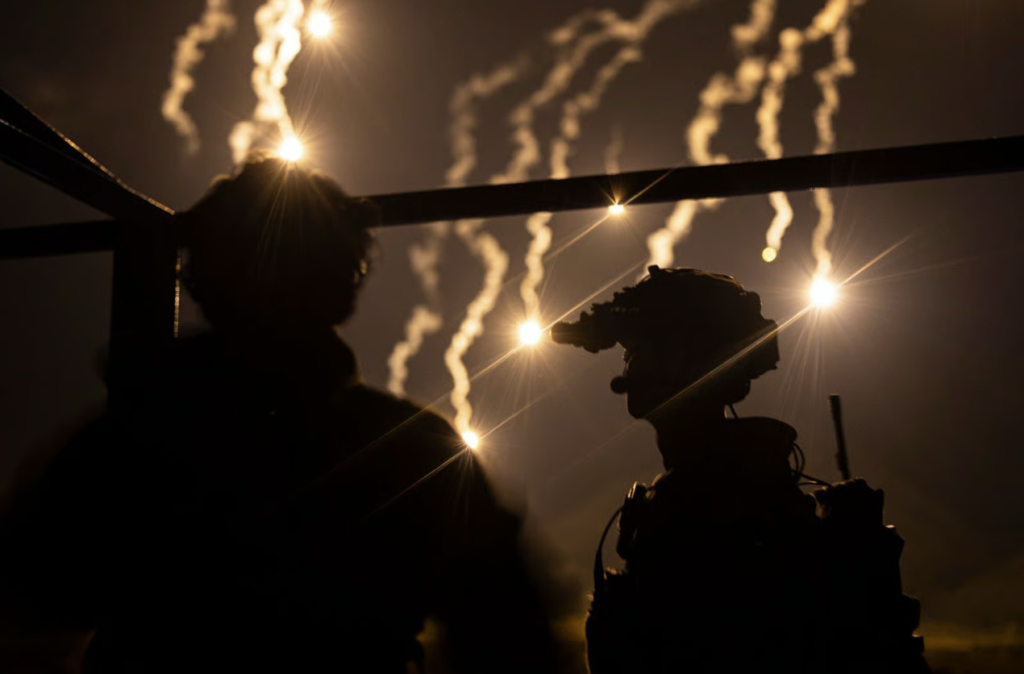
Facts. The US Central Command (CENTCOM) declared the second consecutive night of “self-defense” attacks against multiple targets in Iran completed shortly after midnight in Tehran, following the downing of a US Apache helicopter near the Strait of Hormuz earlier this week, which triggered the most serious wave of retaliation since the ceasefire agreed in April with Pakistani mediation. Speaking from the Situation Room (the White House crisis room), accompanied by Vice President Vance and envoys Witkoff and Kushner, Trump himself explained that 49 Tomahawk missiles had been fired and that the bombardment would resume if Tehran did not immediately sign a memorandum of understanding; he went so far as to call the current agreement the most violated in history. The Revolutionary Guard claimed to have attacked 18 US military targets at bases in Kuwait and Bahrain—including the Fifth Fleet—and launched twelve ballistic missiles for the second consecutive night against the Al-Azraq air base in Jordan. Explosions were heard in Bandar Abbas, Qeshm, Kharg Island, Shiraz, and several cities near Tehran; oil prices rose by nearly three dollars, and the UN Secretary-General lamented that the ceasefire increasingly resembled a “dumping fire” rather than a genuine truce.
Implications. The war, which began in late February with massive joint US and Israeli air strikes, is entering its fourth month without diplomacy having found a solution. The underlying reason is what this analyst has been pointing out from day one: Iran’s terrorist regime—a dictatorial and mafia-like oligarchy, never a “theocracy”—has no one to sign the negotiated surrender that military reality demands. The triumvirate formed by General Ahmed Vahidi, commander-in-chief of the Revolutionary Guard; Mohammad B. Zolghadr, secretary of the National Security Council and commander of the Quds Force; and Rezaei, acting military advisor to the leader, neutralizes each other, while Pezeshkian’s reformist wing remains systematically blocked. At the same time, the escalation is drawing in our Gulf allies—Kuwait, Bahrain, Jordan, and Saudi Arabia are activating their defenses night after night—and is once again raising the ultimate risk: the effective closure of the Strait of Hormuz, through which a fifth of the world’s oil passes. And all this without Washington yet having presented any serious plan for the aftermath should the regime capitulate or implode: this is our long-standing criticism of a transactional and erratic foreign policy, governed by intuition and impulsive actions, which we trust Secretary of State Marco Rubio will eventually redirect.
Perspectives and scenarios. Scenario A (35%): Re-establishment of the ceasefire in the coming weeks, mediated by Pakistan and the Emirate of Qatar, and resumption of negotiations under the pressure of the naval blockade. Scenario B (40%): Prolonged cycle of calibrated reprisals—wars of varying intensity—without a formal breach of the armistice or a definitive agreement, with oil prices remaining at a permanent risk premium. Scenario C (25%): Total breakdown, open air campaign, and risk of the implosion of a regime for which no one has prepared the aftermath.
2. A World Cup like no other: the Azteca Stadium opens in Mexico City the first championship of three countries, 48 teams and 104 matches
Facts. The 2026 World Cup kicks off today, June 11, with Mexico vs. South Africa at the Azteca Stadium—renamed the Mexico City Stadium for the tournament—which becomes the first venue in history to host matches from three World Cups (1970, 1986, and 2026) and three opening matches. Renovated with an investment of approximately €160 million and with a capacity of 87,500 spectators, the Azteca opens an unprecedented championship: 48 teams, 104 matches, and 16 cities spread across the United States, Mexico, and Canada, with staggered opening ceremonies in Mexico City, Los Angeles, and Toronto, and a final scheduled for July 19 at MetLife Stadium in New Jersey. Authorities in the Mexican capital have declared today a public holiday, and the opening ceremony will feature Shakira, J Balvin, and Maná, among others.
Implications. The fact that the first trilateral World Cup is being co-organized by the three partners of a North America beset by the trade and tariff tensions of the Trump era is not a mere sporting anecdote but a geopolitical event of the first order: the tournament will compel Washington, Mexico City, and Ottawa to unprecedented border, immigration, and security coordination, and will offer the continent a platform of soft power (non-coercive influence) at the precise moment when the world is fragmenting. The contrast with the Gulf War could not be more striking.
Perspectives and scenarios. The most likely outcome is a sportingly memorable and logistically tense tournament, with immigration and visa frictions posing the main reputational risk for the US administration; attempts at political manipulation of the championship cannot be ruled out, nor can the possibility that security—amidst escalating tensions with Iran and with global jihadism always lurking—will become the decisive factor of the summer.
3. Barcelona raises its gaze: Leo XIV blesses the tower of Jesus Christ of the Sagrada Familia and crowns Gaudí’s dream one hundred years later
Facts. In a ceremony of breathtaking beauty—featured today on the front pages of many international newspapers—Pope Leo XIV yesterday blessed the Tower of Jesus Christ in Barcelona. At 172.5 meters, the tower makes the Sagrada Família the tallest Christian temple in the world, coinciding with the centenary of the death of Antoni Gaudí, “the architect of God.” The Holy Father presided over a solemn Mass of Thanksgiving before 8,000 seated faithful—and thousands more behind the barriers—switching naturally between Spanish and Catalan. He prayed at Gaudí’s tomb in the crypt and, accompanied by the King and Queen, the Prime Minister, and the President of the Generalitat, witnessed the lighting of the cross and the light and drone show that traced the architect’s silhouette in the sky, along with his motto: “Primer l’amor, després la tècnica” (“First love, then technique”). One hundred and forty-four years after the laying of the first stone, Gaudí’s dream — a paradise of dead stones that welcomes the assembly of living stones — became a reality.
Implications. Beyond the emotion—and there was plenty of it—the event has a profound cultural and geopolitical interpretation: in a spiritually exhausted Europe, which has embraced relativism and seems to have renounced the roots that made it great, the city that prides itself on being the capital of secularism recovered, for a few hours, the pride of its Christian heritage, and it did so with the eyes of the world upon it. The apostolic visit of Leo XIV to Spain—with his historic address before the Cortes Generales as a political milestone—confirms the weight of the first American pope as a global actor in a world without a moral compass.
Perspectives and scenarios. The bell towers of the Glory façade remain to be built, as do the interiors and access points to the viewpoint of the cross: the basilica will continue to be, like Christian life itself, as the Pope reminded us, “a work in progress.” The most relevant aspect for this report is the demonstration effect: the soft power of faith, beauty, and perseverance—one hundred and forty-four years for a tower—versus the short-sightedness of the mediocre political class of the 21st century.
4. The fear of the “SaaSpocalypse” continues to haunt the technology sector: between the panic of February and the self-serving euphoria of those who are already proclaiming its end
Facts. The Economist dedicates its business analysis to the fear that continues to haunt the software industry: the “SaaSpocalypse” (subscription software apocalypse), the fear that artificial intelligence agents will make large parts of traditional enterprise software unnecessary. The panic erupted in February, when the launch of agents by the US company Anthropic wiped out nearly $285 billion of the sector’s market capitalization in 48 hours and sent stocks like SAP, Salesforce, ServiceNow, and Workday plummeting. In January, the US software index registered its worst monthly drop since 2008. This week, Orlando Bravo—founder of Thoma Bravo, a venture capital giant with nearly $200 billion under management—proclaimed in Berlin that “the SaaSpocalypse is over” and that half of his portfolio companies’ new revenue is now “agent revenue,” while contrary signs persist: spending limits on agent tools at large companies and open questions about governance, cybersecurity, and returns. In the first quarter of 2026, 81% of the approximately $330 billion raised globally in capital markets went to artificial intelligence modeling infrastructure.
Implications. We are witnessing a historic redistribution of value within the digital ecosystem: from subscription “seats” to usage, proprietary data, and the real leverage of artificial intelligence, with a concentration of capital in the modeling layer that reconfigures everything beneath it. And, once again, Europe is a spectator: not a single one of the platforms leading this battle—nor any of the capital funding it—is European, in yet another manifestation of the strategic passivity I have been denouncing in the field of defense, and which is equally suicidal in the technological sphere.
Perspectives and scenarios. The most plausible outcome is neither the extinction of software nor a return to the previous placid normality, but rather selective destruction: accelerated merging of software and artificial intelligence agents, compression of multiples in the most exposed segments, and rewards for those who control their own data and workflows. The risk of a bubble in the infrastructure layer—with announced investments of hundreds of billions—deserves monitoring as closely as the disruption itself.
5. The dismantling in two stages: UBS liquidates the Credit Suisse platform while waging the final battle with Bern over the “Lex UBS”
Facts. Le Monde analyzes what it defines as the two-stage dismantling of Credit Suisse: the technical and the institutional. On the first front, UBS—which completed the migration of 1.2 million customers from the former institution to its systems in March—has entered the final phase of integration, with the complete dismantling of Credit Suisse’s IT platform planned for the end of 2026 and the definitive extinction of a brand born in 1856 as Schweizerische Kreditanstalt. On the second front, the Swiss Federal Council submitted to Parliament on April 22 the amendment to the banking law known as “Lex UBS,” which substantially tightens the capital requirements of the only remaining large systemic bank in the country, amid an unprecedented standoff between Finance Minister Karin Keller-Sutter and UBS CEO Sergio Ermotti, who has even threatened to relocate the headquarters abroad. In May, the US Federal Reserve ended its sanctions against the former Credit Suisse structures.
Implications. The physical and legal demise of Credit Suisse closes the most traumatic chapter in recent Swiss financial history, but opens another, perhaps even more significant one: that of a country left with only one systemically important bank whose balance sheet more than doubles its national gross domestic product, and which must decide between protecting the taxpayer—the reasonable position of Keller-Sutter—or preserving the competitiveness of its financial center at any cost. This precedent is of interest to all European banks: if Switzerland, a paradigm of stability, is forced to legislate against the implicit blackmail of offshoring, what will the rest of the continent have to do?
Perspectives and scenarios. The parliamentary battle will continue well into 2027, with three possible outcomes: substantial approval of the “UBS Lex” with limited technical concessions—the most likely scenario—, significant dilution under pressure from the bank, or a head-on collision with a partial transfer of activities that neither side truly desires but neither can completely rule out.
6. kyiv under the hammer: Russia maintains its record-breaking air campaign as Ukraine strikes deep into Russia’s energy rearguard
Facts. The Ukrainian capital is once again a priority target in the most intense Russian air campaign of the entire war: following the massive bombardment at the beginning of the month—73 missiles and 656 drones in a single night, leaving 22 dead and more than 130 wounded, and a nine-story building collapsed in the Podilski district—and following the third use of the Oreshnik hypersonic missile at the end of May, various sources reported in recent hours a new drone attack on Kyiv with at least three dead and damage to buildings in the city’s administrative center. At the time of publication, the data was still provisional and pending independent verification, which is why we report it with the caution required by the rigor of this report. In May, Russia launched a record 8,150 long-range drones—24% more than in April—of which Ukraine intercepted around 90%. Meanwhile, Kyiv continues its deep strike campaign: this week it hit the Samara refinery, the Grushevaya oil depot near Novorossiysk, and several Russian air defense systems, and Germany has committed an additional 300 million euros —about 50,000 long-range projectiles— to the Czech munitions initiative.
Implications. The Russian aggression against Ukraine—and we repeat once again: no territorial conquest by force can be legitimized—is entering a phase of double attrition in which Moscow is resorting to aerial terror against the civilian population precisely because the ground balance has turned against it, with the first net monthly territorial gain for Ukraine since 2023, which this analyst has been describing. Ukraine’s Achilles’ heel is its missile defense: the US Patriot arsenals, depleted in part by the Iran-Iraq War, are insufficient, and Zelensky is right when he demands that Europe equip itself with its own ballistic missile defense. That our continent still depends, after more than four years of war, on the availability of foreign missiles to protect its capital cities is a perfect illustration of the European strategic passivity that these reports denounce day after day.
Perspectives and scenarios. Nothing suggests a de-escalation in the short term: Russia will intensify aerial terror to compensate for the ground attrition, Ukraine will expand its deep campaign against refineries and logistics, and the decisive variable will be the speed of European rearmament—the Czech initiative, German commitments, and the reconstruction of air defenses—versus Russia’s capacity to sustain record drone production.
III. MEDIA RACK
A cross-sectional reading of leading international newspapers over the last 24 hours:
| The New York Times | It opens with the second night of crossfire between the United States and Iran and the impact of the escalation on the price of oil. |
| The Washington Post | It focuses on decision-making from the Situation Room and the role of presidential envoys in the Gulf crisis. |
| The Wall Street Journal | It prioritizes the energy and market dimension: Hormuz, crude oil risk premium and exposure of Gulf economies. |
| Financial Times | It combines the Iranian crisis with the software sector’s revaluation and the regulatory standoff between UBS and Bern. |
| The Times (London) | Escalation in the Gulf and debate over the British stance on a possible open campaign against Iran. |
| The Daily Telegraph | A critical reading of the fragility of the ceasefire and the lack of a strategy for the day after. |
| The Guardian | Priority attention to civilian victims in Iran and Ukraine and to the humanitarian cost of the double escalation. |
| Le Monde | Benchmark analysis of the two-stage dismantling of Credit Suisse under the leadership of UBS. |
| Le Figaro | Extensive coverage of Leo XIV’s visit and the cultural and spiritual dimension of the day in Barcelona. |
| Liberation | A critical look at the escalation decided by Trump and at the risks of a war without a roadmap. |
| Frankfurter Allgemeine Zeitung | European defense: Germany’s new commitment to the Czech munitions initiative for Ukraine. |
| The World | German rearmament and debate on the European anti-ballistic missile defense demanded by kyiv. |
| Corriere della Sera | The cover features the blessing of the tower of Jesus Christ and the centenary of Gaudí. |
| L’Osservatore Romano | The Feast of the Holy Family as the central spiritual event of the pontificate of Leo XIV. |
| BBC | Continuous coverage of the two current events: the Gulf escalation and the opening of the World Cup. |
| CNN | Live reports from the Gulf region and minute-by-minute coverage of the attacks and Iranian countermeasures. |
| Fox News | Exclusive conversations with President Trump from the Situation Room about the scope of the attacks. |
| CNBC | Orlando Bravo’s statement on the end of the “SaaSpocalypse” and the debate on agent revenues. |
| Reuters | Verified chronology of the escalation between Washington and Tehran and its regional impact. |
| AFP | The photograph of the day: the Sagrada Familia illuminated after the papal blessing. |
| AP | The Azteca as the first stadium in history with three World Cup inaugurations. |
| Al Jazeera | The opening of the World Cup and the Gulf War as seen from Doha and the Arab world. |
| Asharq Al-Awsat | The Saudi position on the escalation and the protection of the Gulf’s energy routes. |
| The Jerusalem Post | Israeli interpretation of the Iranian front and the degradation of the regime’s capabilities. |
| Haaretz | Internal Israeli debate on the strategy for the day after and the limits of the campaign. |
| The Kyiv Independent | Ukrainian deep strikes against Russian refineries and air defenses. |
| South China Morning Post | Beijing and the Hormuz risk to Chinese energy supplies; a call for restraint. |
| The Economist | Double analysis of the week: “a World Cup like no other” and the persistent fear of the “SaaSpocalypse”. |
IV. RISK TRAFFIC LIGHT
| ● RED | US-Iran escalation / Strait of Hormuz: Second consecutive night of crossfire; Iran’s terrorist regime strikes US bases in Kuwait, Bahrain and Jordan; maximum energy risk and ceasefire on the verge of collapse. |
| ● RED | Russian war of aggression against Ukraine: record air campaign over kyiv and critical deficit in Western missile defense; no prospect of de-escalation in the short term. |
| ● AMBER | Red Sea / Bab el-Mandeb: The Houthi terrorist organization maintains its threat to international shipping in the shadow of the Gulf escalation, with a risk of immediate reactivation. |
| ● AMBER | European banking system: regulatory clash between UBS and Bern over the “Lex UBS”; risk of relocation and precedent for the entire continental systemic banking sector. |
| ● YELLOW | Technological repricing: fear of the “SaaSpocalypse” persists despite messages of calm; vigilance over the concentration of capital in artificial intelligence infrastructure. |
| ● GREEN | World Cup 2026 and apostolic visit of Leo XIV: windows of soft power, cooperation and unity in the midst of the geopolitical storm. |
V. EDITORIAL COMMENTARY
Some days are worth a whole treatise on geopolitics, and today is one of them: the world that saw Gaudí’s cross light up above Barcelona—after a Mass of such beauty that, for a few hours, the city reconciled with its own soul—is the same world that saw forty-nine Tomahawks streak across the Gulf skies and another night of drones sowing death in Kyiv. This is neither a coincidence nor a rhetorical paradox: it is the exact portrait of an era in which civilization—the patient faith that takes one hundred and forty-four years to build a tower, the sport that brings forty-eight nations together at the same table—coexists with a barbarity that makes no attempt to conceal itself.
In the Gulf, the fundamental issue remains unchanged: Tehran’s dictatorial and mafia-like oligarchy—ruthless, bloodthirsty, and cosmically corrupt—cannot sign a peace agreement because the paradox of its decapitation has left it with no one with the authority to do so, and Washington cannot fully win a war for which it has not prepared for the aftermath. We support, as we have always stated, a firm stance against the Iranian terrorist state and its tentacles—Hezbollah, Hamas, the Houthis, and the pro-Iranian terrorist militias in Iraq—but firmness without a plan is not strategy: it is gambling. We trust that the level-headedness of Secretary of State Marco Rubio and the professionals surrounding the president will ultimately prevail over the diplomacy of outbursts, because the real successes of this administration—from Gaza to the Caucasus—have occurred precisely when prudence has guided its hand.
And what about Europe, meanwhile? Europe is navel-gazing, hosting World Cups by proxy, and watching as its capitals rely on foreign missiles to protect themselves from Russian barbarism.
Gaudí’s lesson, which the Holy Father recalled in Barcelona, also applies to politics: “First love, then technique”; first principles and a cathedral-like vision—knowing what one wants to defend and why—then the instruments. The mediocre and short-sighted political class of the 21st century has reversed this order: everything is technique, tactics, and short-term thinking, and that is why the towers it erects are made of paper. If today teaches us anything, it is that the works that endure—a basilica, a democracy like the one that shaped the Spanish Transition under the guidance of King Juan Carlos I, an international order founded on rules—demand precisely what is most lacking: patience, courage, and love for what is being built.