Gustavo de Arístegui,
June 26, 2026
I. INTRODUCTION
We are experiencing a day marked by two opposing forces. The first is the absence of leadership: we find it in Tehran, where a triumvirate of ultraconservative generals governs without an arbiter to impose discipline, and we find it, above all, in the empty chair that Spain has left in Berlin, absent from the board of the five major European military powers preparing for the NATO summit in Ankara. The second, more encouraging, is that of a Europe that is finally taking action: the French Navy boards the tankers of the phantom fleet with which Russia is financing its war, while Bucharest flirts with the unification of Moldova and provides the Kremlin with narrative ammunition and interventionist pretexts.
Adding to this picture is the tragedy of Venezuela, struck by the worst earthquake in its modern history under the rule of the sinister Rodríguez brothers, heirs to the narco-dictatorial regime that the United States decapitated in January, but which it now tolerates. The common thread in today’s analysis, which I have been outlining since the beginning of this volatile war in the Gulf, is the constant tension between the inability of 21st-century ruling classes—especially the European one—to take their defense and destiny seriously, and the flashes of resolve that demonstrate that passivity is neither inevitable nor prudent; it is merely a disguise for the incompetence and cowardice of the most mediocre political leaders. We selected the six most impactful geopolitical and geoeconomic news stories of the last 24 hours, verified with multiple sources, and subjected them to our standard analysis.
II. MOST IMPORTANT NEWS OF THE LAST 24 HOURS
1. The Gulf, once again on edge: Intermittent Hormuz and the consolidation of General Vahidi
Facts
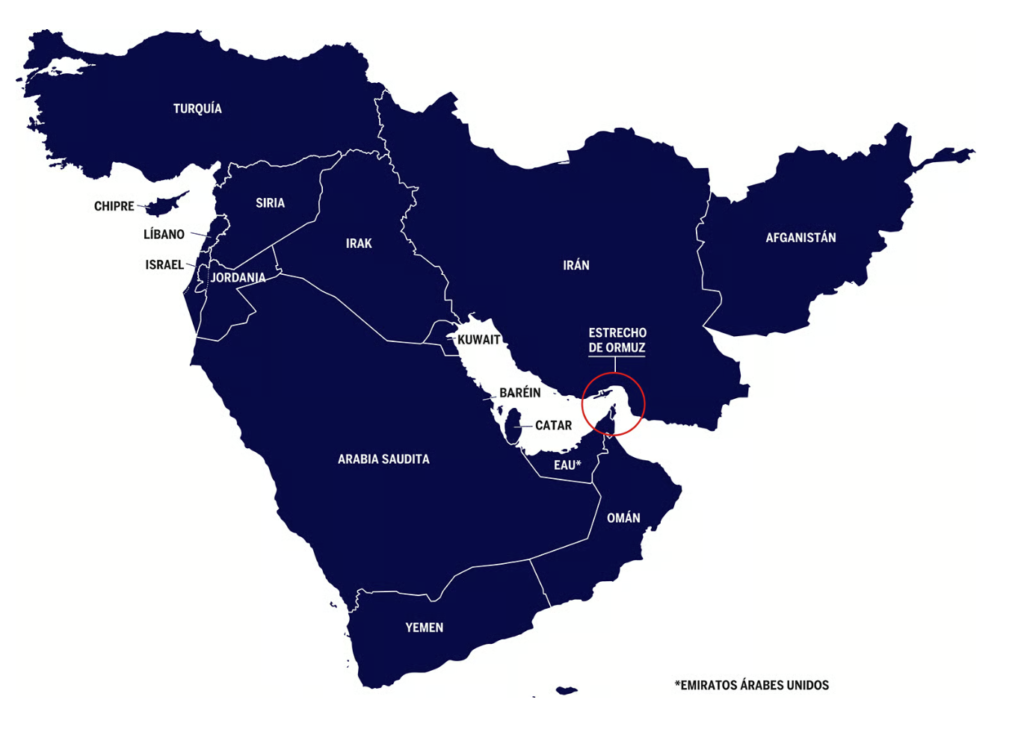
The Islamabad Memorandum—signed remotely on June 17 by Donald Trump and Iranian President Masoud Pezeshkian, with Qatar acting as mediator and Pakistan as intermediary—extended the ceasefire for sixty days and pledged to reopen the Strait of Hormuz toll-free. Reality, however, contradicts the agreement every morning. The Iranian military establishment declared the strait “closed” again on June 20, citing Israeli attacks in southern Lebanon, while its own Foreign Ministry asserted that navigation was “normal,” and the US Central Command (CENTCOM) bluntly denied it: “Iran does not control the Strait of Hormuz.” The maritime consultancy Windward recorded just twelve transits on Sunday, compared to thirty-five the previous day, and noted that five out of every eight incoming vessels were navigating “in the dark,” with their Automatic Identification System (AIS) turned off. The CEO (chief executive officer of the Emirati oil company ADNOC), Sultan Al Jaber, summed it up without euphemisms: passage is “restricted, conditioned and controlled”; this is not freedom of navigation, it is coercion.
In the last few hours, the director of the International Atomic Energy Agency (IAEA), Rafael Grossi, warned from Tokyo that the agreement requires access and inspection and expressed confidence in reaching Iran soon; Seoul confirmed that five South Korean cargo ships remain trapped; and Trump announced that he will buy wheat, soybeans, and corn from American farmers with frozen Iranian assets, a claim that Tehran denies. Hovering like a vulture over this chessboard is the figure of the bloodthirsty General Ahmed Vahidi , commander-in-chief of the Revolutionary Guard Corps (IRGC) since March 1st, wanted by Interpol with a red notice for the 1994 AMIA bombing in Buenos Aires—which left eighty-five dead—sanctioned by Washington and Brussels, former Minister of Defense and Interior, and the architect of the 2022 repression. The Institute for the Study of War (ISW, Washington) maintains that Vahidi and his inner circle control not only the military response but also the negotiating strategy, and that he is part of the small group in direct contact with the new Supreme Leader, Mokhtaba Khamenei.
Implications
Here, the paradox of the decapitation I’ve been outlining operates with full force : the decisive factor isn’t the elimination of the moderates—there weren’t any in the leadership—but rather that the survivors, all of them hawks, lack the ideological authority, rank, and personality necessary to impose themselves on their peers and force them to accept concessions. Khamenei Sr. could enforce internal discipline; this triumvirate of equals has no arbiter. Vahidi can steer the negotiations, but he can’t guarantee their success, hence the chaotic instability in the Strait. In short, we are facing what I define as a contained systemic fracture : a low-resolution conflict, but one of extremely high destructiveness, that no one can win or afford to lose. However, Vahidi is gradually establishing himself as primus inter pares , being by far the worst option because he is as fanatical as his fellow IRGC generals Mohamed Baghr Zolghdr (secretary general of the National Security Council) and Raezi (military advisor to the puppet leader and disappeared Mokhtaba Khamenei) but much more ruthless and brutal, which is saying something.
Perspectives and scenarios
Scenario A (likely): partial and precarious compliance, narrow semi-open by exceptions, ceasefire held by a tightrope.
Scenario B (40%): The Lebanese clause triggers the agreement, Tehran reverses course and the escalation resumes.
Scenario C (unlikely but not impossible): the struggle between the generals precipitates a governance crisis — or an implosion — in the very heart of the jihadist oligarchy.
2. The Gulf, divided over the “peace” with Iran
Facts
The Economist aptly headlines that peace with Iran is dividing the Gulf. CNN reported on June 24th the fear among Trump’s Arab allies that the agreement could be a “disastrous turning point” for the region, leaving them hostage to Tehran. The memorandum fails to address either Iran’s ballistic missile program or its network of terrorist proxies—Hezbollah in Lebanon and Syria, the Houthis in Yemen, Hamas, and the pro-Iranian militias in Iraq—which are precisely the threats that Riyadh, Abu Dhabi, and Manama consider more serious and immediate than the nuclear issue. Iran’s reconstruction fund, estimated at at least $300 billion, has sown confusion: Saudi Arabia claims to have “no details,” Qatar expresses interest without signing, and the Gulf capitals are rightly afraid of financing the reconstruction of the very adversary that bombed their infrastructure. The Wall Street Journal also reports that the United States is considering withdrawing Gulf bases—the one in Bahrain suffered severe damage—westward, even towards Israel, to move them out of range of Iranian missiles.
Implications
This is clear confirmation of the criticism I’ve maintained from day one: Iran was attacked—and the attacks were justified—without strategy or clear objectives, without a serious plan for the aftermath, neither for the eventuality of the regime’s surrender, nor for its implosion, or worse still, for the eventuality of the regime resisting, as has been the case. Military planning and execution: 10; geostrategic planning: 0.
The bill is paid by the Gulf partners and Washington’s own credibility as a reliable ally, which is now “highly questioned,” in the words of the Eurasia Group think tank.
Perspectives and scenarios
The Gulf Cooperation Council will not adopt a unified position: Oman is in Iran’s arms, and Qatar will continue to mediate. Saudi Arabia and the UAE will maintain their calculated ambiguity (but with deep animosity toward Iran), and the region will push for a broader agreement—a JCPOA-plus—that does include missiles and proxies. The diversification of energy routes to circumvent dependence on the Strait of Hormuz will accelerate irreversibly.
3. The empty chair in Berlin: Spain, excluded from the E5
Facts
On June 24, Chancellor Friedrich Merz convened the E5—Germany, France, the United Kingdom, Italy, and Poland—in Berlin for the first time at the level of heads of state and government. The meeting had a threefold objective: to prepare for the North Atlantic Treaty Organization (NATO) summit scheduled for July 7 and 8 in Ankara, to coordinate security guarantees for Ukraine, and to strengthen the Alliance’s European pillar. Spain was not invited, nor was its name included in the final communiqué. The E5, established in 2024, brings together the five countries with the largest defense budgets on the continent, and Spain was excluded from the outset due to its low military spending. NATO Secretary General Mark Rutte participated remotely from Washington, where he was meeting with Trump amidst marked American irritation over Europe’s tepid response to the campaign against Iran’s terrorist regime.
Implications
This is not an isolated incident, but the latest link in a chain of exclusions that has become routine. And it’s important to clarify the criticism to avoid the maximalism I so often criticize in others: the problem is no longer mere irrelevance , but suspicion . Spain has gone from being disregarded to being perceived as a partner whose reliability is questioned. The inconsistency between military reality—the Rota and Morón bases are active logistical support for allied operations—and a public discourse bordering on irresponsibility, more hostile to the United States than to Iran, has a price, and that price is the empty chair.
Perspectives and scenarios
Ankara will be the litmus test. If Spain fails to rejoin the decision-making core, it risks being relegated to a second strategic division from which it will be very difficult to rise. The issue, I insist, is not one of maximalism, but of consistency.
4. Romania approves “unification” with Moldova through the back door
Facts
On June 24, the Romanian Chamber of Deputies approved—not by vote, but through the “tacit approval” mechanism provided for in Article 75 of the Constitution, after forty-five days had passed without the text reaching the plenary session—a bill on unification with the Republic of Moldova. The initiative, registered on April 14 by the far-right fringe party SOS România, led by MEP Diana Șoșoacă, had received negative opinions from the government and the legal and human rights committees. The text urges the government to begin negotiations and notify the United States, NATO, the UN, and the European Union, and invokes the Helsinki Final Act on the peaceful alteration of borders. It now goes to the Senate—the deciding chamber—where observers give it minimal chances, as the government majority does not support immediate unification. Polls indicate that nearly 72% of Romanians would support the merger, compared to a minority in Moldova. Moldovan President Maia Sandu stated in April that the merger could accelerate Romania’s accession to the European Union, but stressed that it would require the explicit will of the people. Moscow reacted strongly, summoning the Romanian ambassador and announcing reprisals.
Implications
A precise distinction is necessary to avoid contributing to the spread of misinformation: we are facing a legislative phantom—a populist maneuver by a fringe party, lacking real support from either the government or the relevant committees, approved by mere administrative silence—which, nevertheless, the Kremlin’s propaganda machine inflates to present it as an “annexation” and a casus belli on its most sensitive flank. We reject extremism of any kind, including that of an extreme right wing playing with fire on Europe’s eastern border; and we reject with equal firmness the Russian disinformation that exploits it. The acquisition or modification of territories is only legitimate through the free will of the people, never by force or procedural shortcuts: the same principle we invoked against Russian aggression in Ukraine applies, without exception, here as well.
Perspectives and scenarios
The Senate will most likely bury or water down the initiative. But the episode further strains the eastern flank and provides Moscow with narrative ammunition on the eve of the Ankara summit. Moldova, which has begun its withdrawal from the Commonwealth of Independent States and is steering its course toward the European Union, will remain the preferred testing ground for Russian hybrid warfare.
5. Venezuela: the earthquake, the Rodríguez brothers and the test for Washington
Facts
Two consecutive earthquakes of magnitude 7.2 and 7.5 struck the Venezuelan coast near Morón, about 160 kilometers west of Caracas, on June 24. According to the U.S. Geological Survey, it was the largest earthquake to hit the country since 1900. Jorge Rodríguez, president of the National Assembly, reported on Friday that the death toll had reached 235, with 4,300 injured, 157 missing, and more than 200 people trapped under the rubble. Delcy Rodríguez, acting president since the U.S. capture of Nicolás Maduro in January, declared a state of emergency. The state of La Guaira was the hardest hit, and Maiquetía International Airport remains closed. Trump offered aid and said he had instructed his administration to assist Venezuela.
The context is inescapable: the Castro-Chavista narco-dictatorial regime, temporarily decapitated in January with the arrest and transfer of the usurper Maduro to New York—accused of smuggling tons of cocaine into the United States—is now in the hands of the sinister siblings Delcy and Jorge Rodríguez. In June, a US operation, coordinated with Venezuelan authorities, killed Héctor Guerrero, alias “Niño Guerrero,” leader of the Tren de Aragua gang, in line with the offensive against drug-running boats that I have been supporting.
Implications
A vast mafia-like organization disguised as a state is now forced to manage a natural disaster while hanging by a thread. This human tragedy, which deserves our full solidarity, is also a major test for Washington’s role: American aid can become the lever for an orderly transition or, if mismanaged, a pretext for the regime to cling even tighter to power under the guise of tragedy and national emergency.
Perspectives and scenarios
The choice is clear: a guided transition to democracy or a continuation of chaos under the Rodríguez clan. The international community, and especially the Ibero-American democracies, should not squander this opportunity to accelerate the fall of this despicable regime.
6. Europe goes from sanctions list to the deck: France boards the Deliver tanker
Facts
On June 25, President Emmanuel Macron announced that the French Navy had boarded the oil tanker “Deliver” two days earlier, on June 23, off the coast of Sicily. This was the fifth such operation carried out by France against the “ghost fleet” (shadow fleet) with which Russia transports crude oil while evading Western sanctions. The vessel, flying a flag of convenience from Cameroon, had departed from Primorsk—one of the main oil terminals on the Baltic Sea—bound for Singapore and is on Ukrainian sanctions lists. The boarding was carried out under Article 110 of the United Nations Convention on the Law of the Sea, which authorizes a warship to verify a vessel’s flag when there are reasonable grounds to suspect that it is irregular or stateless. Macron linked this action to a British operation a few days earlier—the Royal Marines boarded the oil tanker Smyrtos in the English Channel—and proclaimed that Europe would not allow the ghost fleet to evade sanctions and finance the Russian war effort. France had already intercepted the Tagor on May 31 and the Deyna in March.
Implications
Here, for once, is a welcome exception to the European passivity I so often denounce: the continent is beginning to move from the rhetoric of sanctions lists to effective enforcement on the high seas. The ghost fleet—hundreds of old, opaque, and poorly insured oil tankers flying flags of convenience—is both the cash cow of Vladimir Putin’s war and a dual threat, both environmental and security-related, linked to the sabotage of submarine cables and the unsettling drone incursions over northern Europe. Hitting it at sea is not only legitimate: it is necessary and long overdue.
Perspectives and scenarios
We can expect increasing European coordination—France, the United Kingdom, Belgium, and the Baltic states—and, with it, a Russian response: the Kremlin is already labeling these boarding actions “piracy” and has even gone so far as to escort oil tankers with fighter jets, thus raising the risk of incidents in the Baltic or the Mediterranean. But the direction is the right one. Without the revenue from the hydrocarbons transported by this shadow navy, the Russian war machine is stifled; and demonstrating that Europe is capable of enforcing its own decisions is worth, in terms of deterrence, as much as any additional sanction.
III. MEDIA RACK
The leading US press —The New York Times, The Washington Post, and The Wall Street Journal—focuses its attention on the fragility of the memorandum with Iran, the dispute between CENTCOM and maritime trackers over the actual status of the Strait of Hormuz, and the withdrawal of Gulf bases westward; CNN underlines the fear of Arab allies of a “disastrous tipping point,” while Fox News and The National Interest insist on General Vahidi’s terrorist profile and the absence of a plan for the day after.
The British press —The Times, The Telegraph, The Guardian, the BBC, and the Financial Times—highlights the Royal Marines’ boarding of the oil tanker Smyrtos in the English Channel and the growing European coordination against the Russian phantom fleet, while also keeping a close eye on the E5 summit and its implications for the continent’s defense. The Economist summarizes the Gulf events of the day in two strokes: the halted traffic in the Strait of Hormuz and a peace that divides the Arab monarchies.
The continental press —Le Monde, Le Figaro, Libération, La Croix, Le Point, as well as the German newspapers Frankfurter Allgemeine Zeitung, Die Welt, and Die Zeit, and the Italian newspapers Corriere della Sera and L’Osservatore Romano—closely follows the “Deliver” operation off Sicily and, with caution, the Romanian maneuver in Moldova, which the Bucharest and Chisinau press (along with Reuters and Le Monde) strives to place in its proper procedural context. The Polish press (Gazeta Wyborcza) celebrates the rise of the E5 format and Warsaw’s prominent role.
The Middle Eastern press —Asharq Al-Awsat, Arab News, Al Arabiya, Gulf News, The National, along with An-Nahar and L’Orient-Le Jour from Beirut—reflects concerns about missiles and proxies, which the agreement fails to address; Al Jazeera amplifies the Iranian version of “victory.” The Asian press (The Times of India, Hindustan Times, South China Morning Post, The Straits Times, Yomiuri Shimbun) focuses on the trapped ships, the energy bill, and India’s potential entry into fighter jet programs. News agencies—Reuters, AFP, AP, DPA—and think tanks (RUSI, IISS, CSIS, IFRI, Atlantic Council) confirm this picture. Russia Today and TASS, true to form, portray Western cohesion as a crumbling fiction.
IV. RISK TRAFFIC LIGHT
Legend: 🔴 high risk · 🟠 medium-high risk · 🟡 moderate risk · 🟢 low or stabilized risk.
| Level | Risk vector | Analyst’s reading |
|---|---|---|
| 🔴 | Strait of Hormuz / freedom of navigation | Intermittent closure, ships “in the dark” and coercion denounced by ADNOC. |
| 🟠 | Islamabad Memorandum (compliance) | The ceasefire is fragile; the Lebanese clause threatens to shatter it. |
| 🔴 | Iran’s terrorist regime / IRGC triumvirate | Vahidi consolidates power; the paradox of decapitation is still in full force. |
| 🟠 | Gulf Cohesion (GCC) against Iran | Division between mediators and critics; misgivings about the reconstruction fund. |
| 🔴 | European defense / FCAS | Breakup of the Franco-German fighter; strategic autonomy without industrial substance. |
| 🟡 | NATO / Ankara summit (July 7-8) | Transatlantic tension and Washington’s irritation with the Europeans. |
| 🟠 | Spain (Atlantic positioning) | From irrelevance to suspicion; empty seat in the European directory. |
| 🟠 | Venezuela (Rodríguez regime + catastrophe) | Devastating earthquake; narco-dictatorial regime in emergency management. |
| 🟠 | Eastern flank / Moldova | Tacit approval in Bucharest; narrative ammunition for Russian hybrid warfare. |
| 🟠 | Russia / ghost fleet and sanctions | France and the United Kingdom move from lists to boardings on the high seas. |
| 🟠 | Scenario B — Relockdown/escalation in Iran | Estimated probability stable at 40%. |
V. EDITORIAL COMMENTARY
There are days when current events themselves write the analyst’s thesis. Today is one of them, and its moral is twofold. The first is the lack of leadership: Tehran is governed by a triumvirate of brutal generals, among whom the most brutal of the three, Ahmed Vahidi, is gaining the most influence and power.
Madrid—and this pains me to say—has been snubbed in Berlin, as it hasn’t been invited (quite rightly, given Spain’s extremely low defense budget, the lowest in NATO), which underscores Spain’s lack of influence in the EU, NATO, and on the international stage in general. A deep distrust has taken root among all our allies regarding our nation, and it will be very difficult to rebuild trust and our geopolitical standing in the world.
The second, more hopeful, point is that Europe, so often paralyzed, has for once been able to act: boarding the tankers of the phantom fleet with which the Kremlin finances its war. The gap between rhetoric and action lies today between the paralysis in the Gulf and the resolution in the Mediterranean. When leadership collapses in so many places simultaneously, the international system doesn’t descend into open war: it enters that contained systemic fracture I’ve been describing, made up of wars of varying intensity that no one wins and that everyone can lose.
Faced with this situation, I maintain my long-standing position, neither neutral nor complacent. I am resolutely opposed to Iran’s oligarchic-jihadist regime and its power structure, ruthless toward its own people and an exporter of terrorism through its proxies. I applaud the blow it was struck, but I unreservedly condemn the lack of a plan for the aftermath, the price of which is now being paid by the Gulf monarchies and the credibility of the United States itself. I am equally opposed to the narco-dictatorial regime of the Rodríguez brothers, and I hope that this natural disaster will not serve to perpetuate it, but rather to hasten its downfall. And I am unequivocally opposed to Russian aggression: I applaud France and the United Kingdom for finally removing the “boarding” from the sanctions list, and at the same time, I warn against the sorcerer’s apprentices of the Romanian far right who, by playing at the unification of Moldova through the back door, are handing Moscow the victim narrative it so desperately needs.
Regarding President Trump, I maintain my usual nuance: we praise his foreign policy when it is pragmatic and heeds the wisdom of Secretary of State Marco Rubio, and we criticize it when it becomes erratic, transactional, and driven by intuition and impulsiveness. The Iran deal, lacking a post-war framework, falls into this second category. The hope, as so often, lies in the system and the level-headedness of those around him ultimately prevailing over impulse.
I’ll end where I began, with Spain. The difference between being irrelevant and being suspect is the difference between being forgotten and being feared as an unreliable partner. The Rota and Morón bases silently support the allied effort; the official discourse, spoken aloud, borders on irresponsibility and seems more uncomfortable with Washington than with Tehran. This inconsistency has a cost, and it’s called an empty chair. I’m not calling for maximalism: I’m calling for consistency, which is the only currency respected in the directory of serious nations. Ankara will tell us in two weeks whether we still have time to recover it.