The king of sports can be an instrument of cohesion and a balm for nations, but also an alibi for tyrants and a smokescreen for execrable regimes.
By Gustavo de Arístegui, as published by La Razón, 5 July, 2026
Football is not just the king of sports: it is, strictly speaking, the king of sports and one of the very few truly universal languages that exist on the face of the earth. Among them are music, art, mathematics, science, love, and that shared humanity that unites the more than eight billion human beings who inhabit the planet today. Alongside these, with an emotional reach that none of the others can match, is football. This is not a mere quip, but a rigorous observation: it is difficult to understand the 20th century, and certainly the 21st, without the rolling ball, without its dynamism, intensity and beauty, its immense sociological force, its capacity for communication and influence , and its crucial economic and financial dimension.
Football creates universal icons that transcend any imaginable boundary: nation, religion, race, ideology, social standing, cultural level, and even mood. A child from Jakarta and an elderly man from Montevideo, a banker from Zurich and a pastor from the Atlas Mountains, an Italian cardinal and a militant Chinese atheist may share absolutely nothing—no language, no religion, no class, no homeland—and yet be moved in unison by a sublime play or weep together at the death of an idol. Few human endeavors possess this almost miraculous gift of forging connections and building bridges.
And indeed, football is the greatest media and communication phenomenon in history. One fact, which I find extraordinarily telling, suffices: the two WhatsApp communities with the most followers on the planet—surpassing any commercial brand, any political leader, any other organization—do not belong to a state or a multinational corporation, but to two football clubs, Real Madrid and FC Barcelona (65 million and 55 million followers, respectively). In fact, Real Madrid and Barcelona are the two most recognized Spanish brands in the world. Anyone who seeks to understand the flows of attention, emotion, and loyalty that drive the contemporary world cannot afford to ignore this fact.
Mediated confession
I confess, without the slightest embarrassment, that I am a passionate football fan—an unconditional supporter of Real Sociedad, an admirer of Real Madrid, Barcelona, and Atlético de Madrid—and I certainly don’t feel like a hick for it. Before me, and with infinitely greater authority, some of the most brilliant minds of the century loved and pondered this sport . Albert Camus, Nobel Prize laureate in Literature, novelist, playwright, and philosopher, was first and foremost a promising goalkeeper for Racing Universitaire d’Alger (RUA), and he left behind one of the most beautiful statements ever made about this sport: “Everything I know with the greatest certainty about morality and the obligations of men, I owe to football.”
It wasn’t a clever phrase meant to dazzle the crowd—it was a carefully considered confession. Camus learned in that dusty goal in Algiers, among Catholics and Muslims playing side by side on the same team, that the ball “never comes from where you expect it”—a lesson in humility and anticipation that, as he himself acknowledged, served him throughout his life—and he came to call football his “second university.” In The Fall, he would write that a packed stadium on a Sunday and the theater were the only places in the world where he felt innocent. Eduardo Galeano later summarized it with the poet’s beauty: on those fields, Camus “learned to win without feeling like God and to lose without feeling like trash, difficult wisdoms.” If football was a school of morality for one of the great moralists of the century, there is very little to add.
I also have personal reasons for this devotion. My grandmother Carmen’s brother—that truly great lady—was René Petit, Renato Petit de Ory, one of the first superstars of European football: an attacking midfielder, a tireless creator of opportunities, a complete player whom such respected chroniclers as Pedro Escartín did not hesitate to compare, despite the differences in time, to Di Stéfano himself, and whom many experts consider
one of the fathers of modern football in Spain. Petit played for Real Madrid alongside a young Santiago Bernabéu, shone brighter than any other at the legendary Real Unión de Irún—with whom he won several Copa del Rey titles, some of them against his former club—and was an Olympic international for France at Antwerp 1920.
The global institution
At this point, I cannot help but comment on FIFA—the International Federation of Association Football—because in my thirty-seven years as a diplomat, I have never encountered an international institution more influential, more powerful, and, at the same time, more arrogant and, all too often, more unlikeable due to the excessive pride its leaders display without the slightest shame or embarrassment. I saw it with my own eyes at the Qatar World Cup: its officials entered restaurants as if they owned the place, demanding tables for their bosses even in private rooms already occupied, which they presumed to “examine” with the audacity of those who believe themselves to be above ordinary mortals.
FIFA is a global institution with extraordinary influence, wielding vast sums of money and swaying public opinion . It is precisely for this reason that it must learn humility—a humility that extends far beyond the feel-good slogans emblazoned on captains’ armbands. Because football—and this is the truth its bureaucrats forget—does not belong to FIFA. It doesn’t belong to the clubs, the national teams, or even the stars who grace its stage. Football is universal, unique, beautiful, and it has no owners. Football belongs to humanity, even to those who have no interest in it.
Because—and this is, in essence, the summary of it all—football can unite the world, without a doubt, more than
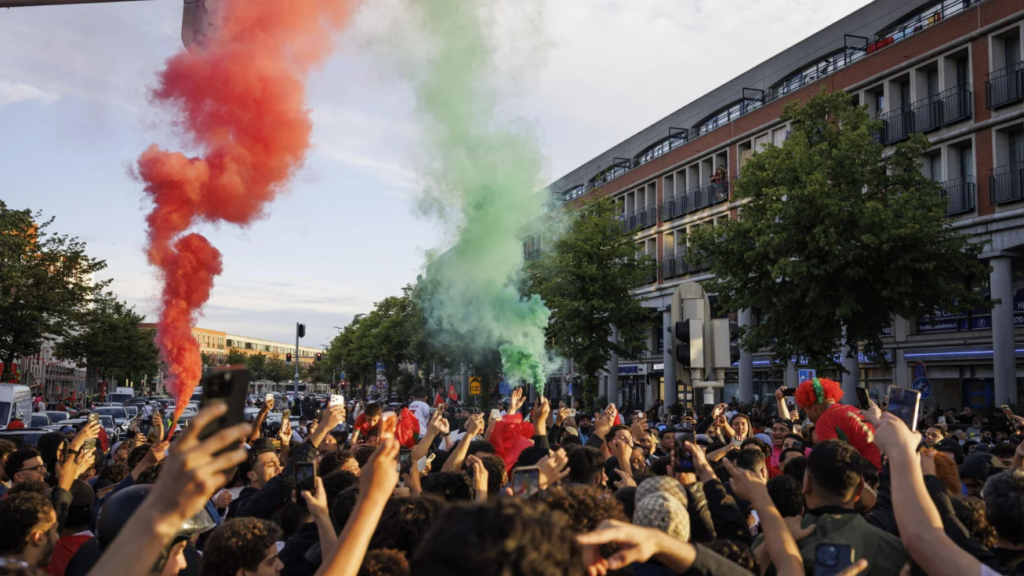
the United Nations itself , more than diplomacy, more than music or mathematics, and even more than that somber solidarity that only arises from shared misfortunes. And it can do so because football belongs to all of humanity: to everyone who feels and enjoys it, and even to those who neither feel nor enjoy it, because it remains the common language that ignites passions, yes, but also builds bridges and creates connections where politics only erects walls. It transcends any imaginable barrier and, beyond healthy rivalries—which aren’t always as “healthy” as we’d like—there exists a true global brotherhood of the ball , an international football organization that doesn’t need treaties or summits to function.
Five dimensions
However, a serious analysis cannot be limited to mere emotion. Football is also, though often overlooked, a first-rate geopolitical and geoeconomic phenomenon that operates in at least five dimensions worth examining. First, it is a colossal economic and financial machine, generating wealth and employment on a scale that many traditional industries would envy. Second, it is an engine capable of lifting entire communities out of poverty, and I have witnessed this firsthand: during my time as Spain’s ambassador to India, I had the opportunity to observe the exemplary and quiet work of the Real Madrid Foundation, which for decades has clothed, educated, and fed children living in abject poverty, giving them back, along with a football, something as precious as dignity and a future.
Third, it is also a powerful instrument for the social and economic improvement of impoverished regions. Fourth, it is an unparalleled cultural bridge, capable of fostering dialogue between civilizations that geopolitics insists on pitting against each other. Finally, fifth, it is a formidable instrument of “soft power” diplomacy—that capacity for seduction and influence that almost no other resource or capability of states provides. Spain owes much to football and its star athletes (Rafa Nadal is a global example). Crossing a mined border between Syria and Turkey on a dark winter night in 1985, without speaking a word of Turkish, my brother and I were able to pass after a relaxed chat by the fire with tea about Real Madrid and “Butragueño.” The legendary Vulture saved us from spending the night, or more, in the dilapidated jail of a remote border in a war zone, and he has surely been the protagonist of tens of thousands of anecdotes like this one.
The organization of the World Cup projects an image of modernity, efficiency, and openness that no public relations campaign could achieve. The World Cup currently being held in the United States, Mexico, and Canada; the centenary tournament in 2030, which will be shared by Spain, Portugal, and Morocco —and I am filled with pride, as someone writing these lines from Rabat, for that Euro-African partnership that bridges the Strait—; these are, more than sporting events, masterstrokes in a game of chess played out on the magic of the pitch. That entire nations measure their international prestige by the performance of eleven players on the field is not a quaint anecdote; it is geopolitics in its purest form.
Instrument of cohesion and smokescreen
It is important, however, not to fall into a naive and irresponsible form of naive optimism. The ball—like Camus’s ball—never comes from where you expect, and the very passions that unite people can, if mishandled, poison them. Football can be an instrument of cohesion and a balm for nations , but also an alibi for tyrants and a smokescreen for despicable regimes that seek in a stadium the applause denied them by their oppressed people. Sportswashing—the whitewashing of image through football—is a reality that no honest analyst can afford to ignore. But not even this spurious instrumentalization manages to rob the game of its brilliant essence.
Because, in the end, football will remain what Camus intuited in that Algerian goal: a school of morality, courage, and humility; one of the very few languages that all of humanity speaks without needing to learn it; and perhaps the most effective embassy that brotherhood among men has ever had. Professional diplomacy—to which I have dedicated my life—would do well to study it with less disdain and much more respect. Because if there is one thing I know for certain, after so many years of seeing how concord between nations is woven and unwoven, it is that few things unite so much, so quickly and profoundly, as this sport, humble in its beginnings, so seemingly simple yet so truly sublime. Football is art, dialogue, and a beautiful compendium of humanity.