Gustavo de Arístegui,
July 14, 2026
I. INTRODUCTION
The world awakens, yet another day, to find the Strait of Hormuz a powder keg and the Persian Gulf the epicenter of a crisis that long ago ceased to be regional and has become global. We are witnessing yet another violation of the Memorandum of Understanding between Washington and Tehran—what I have been referring to in these reports as the Islamabad Memorandum—by the Iranian Revolutionary Guard Corps, and this is not an isolated incident or a nautical misunderstanding: this is a deliberate, calculated, and brutal message. Behind it is a man with a name and surname, General Ahmed Vahidi, commander-in-chief of the Islamic Revolutionary Guard Corps (IRGC), a terrorist wanted internationally by Interpol for numerous terrorist attacks spanning more than three decades. Vahidi is pushing the limits and sending a very clear message to his adversaries within the regime so they know who is truly in charge.
Because this is where we must call things by their name: we are, quite clearly, facing an internal power struggle. That, and nothing else, is the reason why Mojtaba Khamenei, the son of the eliminated and inexplicably dubbed “supreme” leader of the Islamic Revolution, Ali Khamenei, is nowhere to be seen; a Mojtaba who remains seriously wounded and is nothing more than a puppet, a rag doll in the hands of the most terrible, bloodthirsty, and monstrous elements of a regime that is already monstrous in itself. What the Revolutionary Guard fears is that, if he is deemed unfit because he lacks the physical or mental capacity to lead, they will be forced to elect a new leader, with the very real risk that another faction of the regime will ultimately prevail, and they will lose the influence they currently wield.
To this initial conflict is added, in a chain reaction, the reopening of the Houthi-Saudi front, with the Houthi terrorist militia’s massive attacks against Saudi Arabia and their brazen threat to airlines worldwide to prevent them from flying over Saudi airspace. It is crucial to remember that whoever controls the coast overlooking the Bab el-Mandeb Strait holds sway over one of the major arteries of international trade. And this is precisely what awaits us if this situation is not checked: if they are allowed to control the Strait of Hormuz, the bloodthirsty regime of the ayatollahs and the Revolutionary Guard will once again control the Middle East and provoke yet another war.
And while the Gulf burns, a major European country, the United Kingdom, is preparing to change its leader in the midst of the storm: Andy Burnham has secured the Labour leadership and is now marching, unopposed, towards Downing Street. Three news stories, one common thread—the lack of leadership: that of a Tehran where a hawk rules by force but does not arbitrate, and that of a West that, all too often, buries its head in the sand like an ostrich while the world burns.
II. MOST IMPORTANT NEWS OF THE LAST 24 HOURS
1. Hormuz, in flames again: the umpteenth violation of the Memorandum and the internal pulse of the Revolutionary Guard
Facts
The United States carried out a third consecutive night of attacks against Iran (July 12-13) in response to renewed attacks by the IRGC against merchant vessels in the Strait of Hormuz. According to the UAE Ministry of Defense, Iranian cruise missiles struck two Emirati oil tankers, the Mombasa and the Al Bahiyah, in the southern lane of the strait. The IRGC itself acknowledged disabling two “violating tankers” for ignoring its warnings and turning off their navigation systems.
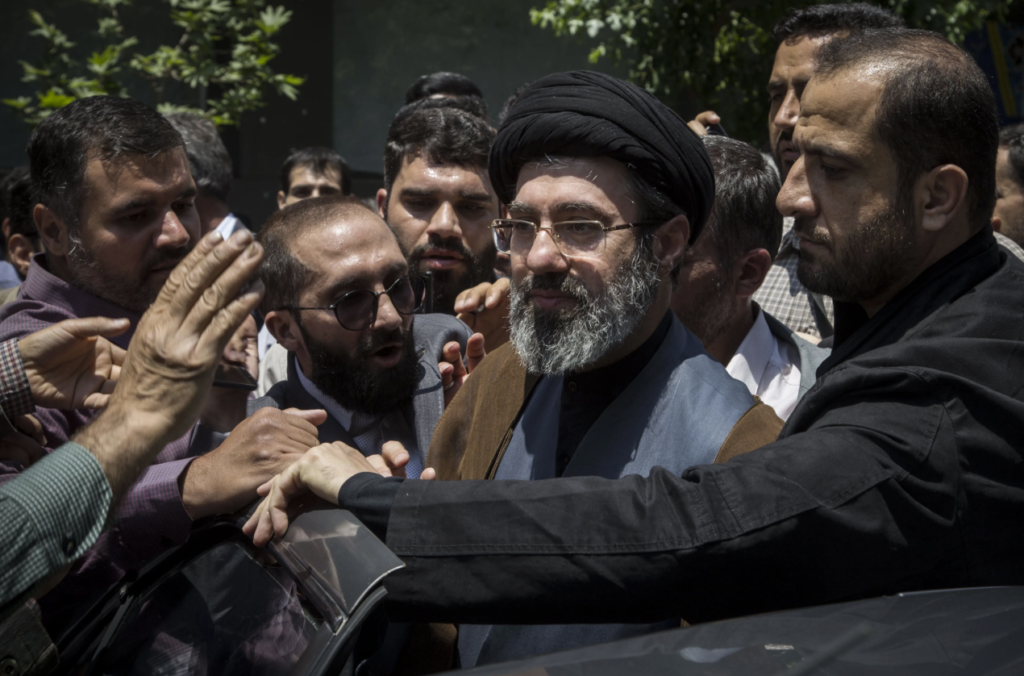
President Trump has reinstated the blockade on Iranian shipping and proclaimed the United States “Guardian of the Strait of Hormuz,” demanding a 20% toll on all cargo crossing it. Iranian Foreign Minister Abbas Araghchi retorted that Iran is the guardian of the strait “forever” and that “20% is too much; we will be fair.” The International Maritime Organization (IMO) flatly rejected any toll. Bahrain’s defenses intercepted Iranian airstrikes; Tehran struck US facilities in Kuwait with drones and, with ballistic missiles, the Prince Hassan Air Base in Jordan, shot down an MQ-1 drone, and caused explosions in Bandar Abbas, Kish, Qeshm, and Abu Musa Island. Domestically, Mokhtaba Khamenei has not appeared in public since February 28 and did not even attend his father’s funeral. The Institute for the Study of War (ISW) already documented on April 21 the rift between Vahidi, who opposed negotiations, and the Speaker of Parliament, Mohamed Bagher Ghalibaf, who supported dialogue.
Implications
All of this makes perfect sense in light of the decapitation paradox , which in its current phase needs to be clearly defined: Vahidi is now, de facto, the primus inter pares of the IRGC triumvirate, but a primus inter pares is not an absolute arbiter in the manner of Khamenei. His primacy rests on force, fear, and fanaticism, not on the ideological, institutional, and religious authority that allowed the old leader to impose internal discipline and extract concessions from the apparatus. Therefore, the paradox is not resolved: it intensifies. The one who prevails is precisely the most ruthless and brutal of the three, so he can steer and dominate the negotiations, but he cannot—nor will he—guarantee compliance. A dominant hawk without the legitimate authority—or the will—to deliver; hence the chaotic intermittency of Hormuz.
It is very important to keep in mind that, for the nefarious strategists of the Revolutionary Guard, there are three reasons to try to derail the peace agreement. The first: the constant tension favors their tactics and their medium- and long-term strategy of seizing absolute power within the regime. As long as the tension and confrontation with the United States continues, repression is much easier; the people will not be able to demonstrate against the abuses and barbarity of this bloodthirsty regime, and consequently, it is the ideal situation for them.
Secondly, this allows them to repeatedly discredit Ghalibaf—who is also a general in the Revolutionary Guard, but whom they constantly contradict—as well as the president of the republic, Masoud Pezeshkian, and even the foreign minister, Araghchi, whom they use like a weather vane, inconsistent yet equally fanatical, and whom I don’t understand why some international media outlets praise so much. We are witnessing a power struggle, and every time one of their negotiators tries to sign something, the Revolutionary Guard’s use of force immediately refutes it.
And the third point, which is essential to emphasize: the ships attacked by the Revolutionary Guard are those that have refused to pay the extortion money demanded by this bloodthirsty regime. It is an act of racketeering in the purest style of the Irish mob in Boston, perfected by the Cosa Nostra in New York. With that money—which, as I have said many times, is estimated at between one hundred and two hundred billion dollars—we can already imagine what it will be used for: not only to arm themselves, but to continue their military nuclear program, to improve the payload and range of their ballistic missiles and perfect their hypersonic and supersonic technology, and to finance the terrorist groups that are their proxies in the region. Hamas; Hezbollah—in Lebanon and Syria, where they are trying to regain power or, at least, destabilize the regime of Ahmed al-Shara, because the fall of the bloodthirsty Bashar al-Assad was a very hard blow for the Iranian regime—; and, of course, that other terrorist arm in the area, the Houthi militia, which incomprehensibly presents itself as the legitimate army of Yemen, which it is not: all the offensive elements, the weapons, the missiles—both cruise and ballistic—that it has used are of Iranian manufacture and origin.
This is what awaits us. If allowed to control the Strait of Hormuz, the bloodthirsty regime of the ayatollahs and the Revolutionary Guard will once again control the Middle East and provoke yet another war. This is not a pessimistic hypothesis: it is the internal logic of an organization that has made extortion and terror its form of government.
Perspectives and scenarios
Scenario A (35%) — Negotiated containment. Under US military pressure, a fragile ceasefire is reestablished; the IRGC continues to charge de facto transit fees and Hormuz remains semi-open, with intermittent passage through the corridor imposed by Iran north of Larak Island.
Scenario B (40%) — A contained and persistent systemic fracture. Neither total war nor true peace: cycles of attack and retaliation that drag on for months. Vahidi maintains the tension as a tool for internal consolidation, and Ormuz functions in a chaotically intermittent manner. In my opinion, this is the most likely outcome because it best serves the interests of the man who currently commands the Guard.
Scenario C (25%) — Major escalation. An incident with casualties—a sunken oil tanker, a base with American deaths—triggers a broader US campaign. The risk then is not firmness, which would be welcome, but the complete absence of a plan for the day after if the regime capitulates or implodes.
2. The Houthis strike Saudi Arabia and threaten the sky: the second strangulation, that of Bab el-Mandeb
Facts
On July 13, the Houthi terrorist militia attacked Abha International Airport in southwestern Saudi Arabia with ballistic missiles and drones; the kingdom’s defenses intercepted the barrage. The attack was in response to the attacks on Sana’a airport—claimed by the internationally recognized Yemeni government to prevent an Iranian plane carrying a Houthi delegation from Khamenei’s funeral from landing—which the Houthis attribute to Riyadh. The militia’s military spokesman, Yahya Saree, warned all airlines worldwide against flying over Saudi airspace “until the blockade of Sana’a airport is lifted.” This is the largest escalation in years and effectively breaks the de-escalation phase that began with the 2022 ceasefire.
Implications
It’s important not to lose sight of geography, because it explains almost everything: the Houthi terrorist militia’s positions are on the coast that controls the Bab el-Mandeb Strait, which connects the Gulf of Aden with the Red Sea and, in turn, leads to the Suez Canal. Therefore, a serious response from the international community is simply essential. What we are facing is a simultaneous double strangulation of two of the world’s major trade arteries: the Strait of Hormuz, through which oil from the Gulf flows, and Bab el-Mandeb, gateway to the Red Sea and Suez. And the direct threat to civil aviation represents a qualitative leap: it internationalizes the blackmail and takes it from the sea to the air. Let no one be mistaken: this militia’s entire offensive arsenal is of Iranian manufacture and origin; it is Tehran that is firing through proxies.
Perspectives and scenarios
Scenario A (35%) — Containment through mediation. Oman and other Gulf actors redirect the crisis and the previous tense calm is restored; the threat to airlines remains a warning without systematic execution.
Scenario B (40%) — Variable temperature war in the Red Sea. The militia intermittently resumes its attacks against Saudi Arabia and maritime traffic, without reaching a full-scale offensive but driving up insurance, freight, and route costs: a low-resolution, high-destruction conflict that no one can win or afford to lose.
Scenario C (25%) — Full reactivation of the Yemeni front. The downing of a civilian aircraft or a serious impact on Saudi soil precipitates a strong response from Riyadh and the coalition, with the risk of reopening the war in Yemen.
3. The UK changes pilot: Burnham, on his way to Downing Street
Facts
Andy Burnham, the former mayor of Greater Manchester, has secured the Labour Party leadership. On July 13, he obtained 349 endorsements from Labour MPs—making it impossible for any rival candidate, who would need 20% support—and remains the sole contender. He had previously won a resounding victory in the Makerfield by-election on June 18, with nearly 25,000 votes and a majority exceeding 9,200, defeating Reform UK. He will be officially proclaimed leader at a special conference on Friday, July 17, and will be sworn in as prime minister on July 20.
Implications
Burnham is a very successful name in politics; he has been a Member of Parliament before and has been the victim of an incomprehensible conspiracy by former Prime Minister Sir Keir Starmer, who was trying by all means to prevent his main rival within the party from becoming a Member of Parliament again. What remains to be seen is whether Burnham truly has a minimally coherent, structured, and rational roadmap to pull the United Kingdom out of the deep hole into which an endless succession of catastrophic, incompetent, and utterly useless governments have plunged it: a very dark abyss. From Cameron to Theresa May, to Boris Johnson, to Liz Truss, to Rishi Sunak, and now to Starmer, all of them with a lamentable, lamentable track record.
And today the United Kingdom finds itself in a truly precarious situation—economically, socially, politically, and internationally—with waning foreign influence, despite being a permanent member of the Security Council and a nuclear power. If someone had been told just ten years ago that London would be so irrelevant by 2026, they would have laughed in their face. I only hope that, in addition to simplistic populist rhetoric promising the moon and the stars, Burnham actually brings a serious and structured program of government, one that convinces the markets, convinces the voters, and stabilizes the UK’s economy, politics, and international standing.
Perspectives and scenarios
Scenario A (30%) — Confidence rebound. Burnham presents a credible program, reassures the markets and stems the electoral bleeding towards Reform UK and the Greens; stabilizes the economy and restores some of the party’s international standing.
Scenario B (40%) — A brief honeymoon followed by decline. Charisma provides initial oxygen, but budgetary arithmetic and voter fatigue soon send Labour back to the desert. Easy populism without reformist muscle.
Scenario C (30%) — Drift and acceleration. The absence of a clear direction accelerates Nigel Farage’s rise and precipitates, ahead of schedule, a scenario of early elections with an even more fractured United Kingdom.
III. MEDIA RACK
Overview of coverage by area. Iranian and Russian state media are cited as a symptom, never as a source.
| Scope | Reference headers | Dominant coverage line |
|---|---|---|
| Anglosphere | NYT, Washington Post, WSJ, CNN, CBS, Fox, BBC, The Times, Telegraph, Reuters, AP | Focus on the three nights of attacks and Trump’s 20% approval rating; alarmist tone about the energy shock and the risk of open war. |
| Gulf and Arab world | Al Jazeera, Al Arabiya, The National, Asharq Al-Awsat, Arab News, Khaleej Times, Gulf News | Condemnation of Iranian attacks on Qatari, Saudi and Emirati merchant ships; clarity in describing the Houthis as a terrorist militia backed by Tehran. |
| Continental Europe | Le Monde, Le Figaro, FAZ, Die Welt, Corriere della Sera, La Croix | Coverage of the double maritime strangulation and the Franco-British naval mission in Hormuz; concern about inflation and crude oil. |
| Asia | South China Morning Post, Times of India, Yomiuri, Straits Times | Priority is given to the impact on energy supply to China and India, the main buyers of the crude oil that still crosses the strait. |
| Iranian and Russian state (symptom) | Press TV, IRNA, Fars · RT, TASS | A narrative of “sovereignty” over Hormuz and of external “aggression”; propaganda that justifies extortion and repression. A symptom, not a source. |
IV. RISK TRAFFIC LIGHT
| Risk | Level | Reading |
|---|---|---|
| Militarization and intermittent closure of Hormuz | ● STOP | Direct energy shock and ongoing attacks on merchant ships. |
| Succession and leadership vacuum in Tehran | ● STOP | Vahidi dominates by force but does not arbitrate or guarantee. |
| Houthi-Saudi front and threat to civil aviation | ● STOP | Abha attacked; warning to the world’s airlines. |
| Regional contagion (Bahrain, Kuwait, Jordan, UAE) | ● MEDIUM | Bases and territory of allies already reached by Iran. |
| Oil shock and global inflation | ● MEDIUM | Brent crude rebounds; pressure on interest rates and growth. |
| European strategic abdication | ● MEDIUM | Naval presence, yes; veto of allied overflight, unacceptable. |
| Political transition in the United Kingdom | ● LOW | Ordered change of leadership; uncertainty about Burnham’s future. |
V. EDITORIAL COMMENTARY
Let me start where it hurts most, without mincing words. It is perfectly legitimate for European countries not to consider this war against Iran their own and not to want to participate in it. It is far less understandable that they do not want to help their allies in times of war. It is even understandable, if you will, that they do not allow the use of joint military bases. But what is simply unacceptable is prohibiting overflights by US military aircraft. And it is worth refreshing our memories: the French, at the height of the confrontation with Jacques Chirac’s government—when Dominique de Villepin was Foreign Minister—and despite their staunch opposition to the second Iraq War, never denied overflights to US aircraft. That was consistency; what they are doing now, with all due respect, is something else entirely.
The blockade of the Strait of Hormuz and the attacks on the Bab el-Mandeb Strait, the Red Sea, and Saudi oil facilities on its western coast are not anyone’s problem in particular: they are a global problem and require a global response. It is high time the Western powers stopped burying their heads in the sand like ostriches. It is a disgrace—I can find no gentler word, and I won’t look for one—that this issue is not being seriously addressed once and for all.
Let justice be served, whoever needs to be. American political planners have seriously misstepd; the military, however, has not. The attacks against the criminal regime in Tehran were highly successful when the Armed Forces as a whole—because it wasn’t just the Navy: it was the Air Force, the Army, and the US Navy—jointly engaged military targets in Iran. Let us recall the brilliant use of anti-tank aircraft, the A-10 Thunderbolt, to combat the Revolutionary Guard’s fast boats, and the fact that those the A-10s failed to sink were finished off by US Army Apache attack helicopters. Flawless execution. The problem came later.
Because when the operation was nearly complete, the United States was pressured into accepting a truce on April 7th, and this has given the Revolutionary Guard time to rebuild missile and drone launch sites, refurbish part of its fleet of fast boats—torpedo boats and missile boats—and replant mines in the Strait of Hormuz. It’s the same old equation I’ll never tire of repeating: in military planning and execution, a 10; in geostrategic planning, a 0. Hope remains that the system and the level-headedness of those surrounding the president—Secretary of State Marco Rubio at the forefront—will ultimately prevail over the temptation of erratic behavior and impulsive actions.
And there is a concrete, immediate task that the international community can no longer evade: it must investigate, prosecute, and, if necessary, imprison the owners and agents who are acting as intermediaries between the shipowners who succumb to the criminal regime in Tehran, paying a terrorist extortion that will serve to finance terrorism and countless deaths, not only in the region but throughout the world. Those who pay the ransom feed the kidnapper; and those who look the other way become accomplices.
All of this points to a fundamental problem I have been denouncing in report after report: a lack of leadership. Tehran, where Vahidi rules by force but is incapable of arbitrating or guaranteeing rights; and a mediocre and short-sighted Europe, incapable of taking its own defense, security, and destiny seriously. A continent that boasts of its values while refusing to pay the price of defending them is not a geopolitical actor: it is a privileged spectator who, moreover, presumes to lecture others.
And while the Gulf burns, the United Kingdom changes course. Let’s hope Andy Burnham brings with him more than just simplistic populist rhetoric promising the moon and the stars: a serious and structured program of government that convinces the markets, persuades voters, and stabilizes the economy, politics, and international standing of a country that was once great and that today, after an endless succession of catastrophic, incompetent, and utterly useless governments, risks complete irrelevance. Representative liberal democracy—in which I wholeheartedly believe—is also defended in this way: with competent governments that don’t confuse rhetoric with governance.
Finally, let’s get to the essential point, because naming things correctly is the analyst’s first duty. The oligarchic-jihadist regime of the ayatollahs and their Revolutionary Guard doesn’t collect a toll in exchange for protecting navigation: it charges for not killing. We are not dealing with a state exercising its sovereignty over a strait, but with a gigantic criminal organization that has turned one of the world’s great arteries into its own private extortion territory. And this has a name, plain and simple: state terrorism. The sooner the West acknowledges this, the less it will cost them.