Gustavo de Arístegui,
July 15, 2026
GIBRALTAR: THE FENCE THEY ERECTED
Critical report on the European Union–United Kingdom Treaty relating to Gibraltar, signed in Brussels on 14 July 2026 and provisionally applied since 15 July
The facts
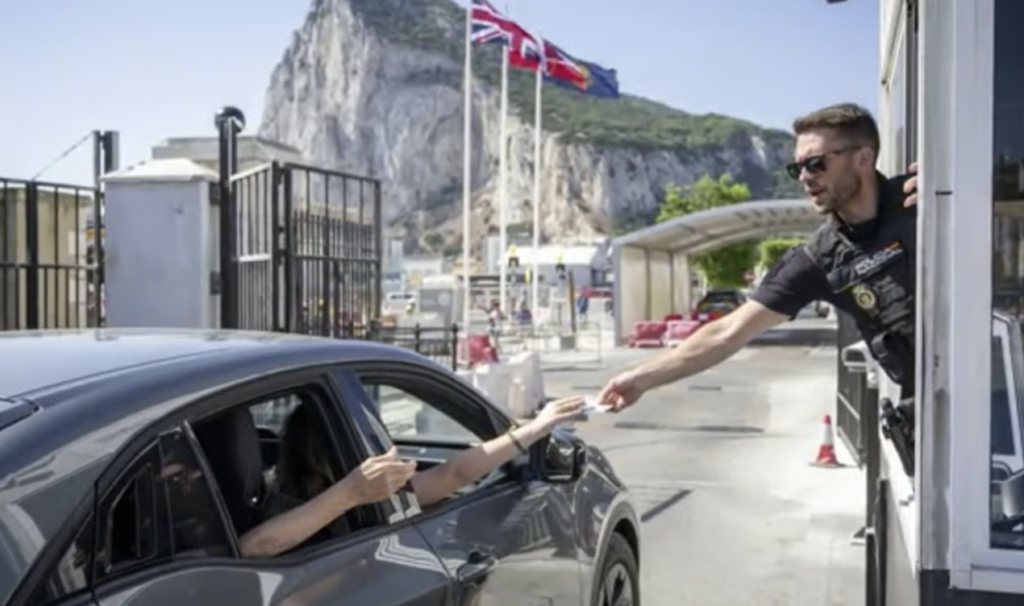
On July 14, 2026, in a ceremony lasting barely two minutes at the European Commission headquarters, Commissioner Maroš Šefčovič and the British Secretary of State for Europe, Stephen Doughty, signed the Treaty relating to Gibraltar —three hundred and thirty-six articles and nearly a thousand pages including annexes, the result of four years of secretive negotiations—while the Spanish Foreign Minister, José Manuel Albares, and the Chief Minister of Gibraltar, Fabian Picardo, sat beside them without signing . It is worth noting this detail, which is not merely a matter of protocol but of law and politics: Spain is not a party to the treaty that decides on Spain’s border. Brussels is signing on our behalf. The text has been provisionally applied since midnight on July 15, pending ratification by the European Parliament—expected in December—and by the House of Commons.
Its content, in essence: the physical removal of the border fence; the transfer of Schengen controls to the port and airport of Gibraltar, carried out by the National Police and not by Frontex, as London intended—following the model of St. Pancras station—, without Gibraltar entering the Schengen Area; raising the sales tax from 3% to a minimum of 15%; a customs union with the European Union, with mandatory entry of goods by land from La Línea and Algeciras; the exclusion of services—online gambling, which accounts for around a quarter of the colony’s gross domestic product, is excluded—; shared use of the airport through a joint venture with Spanish inspection rights; and an Article 2 that, according to the minister, leaves the sovereignty claim “unchanged in the slightest.”
What Utrecht conceded — and what it did not
Article X of the Treaty of Utrecht (1713) ceded “the city and castle of Gibraltar, together with its port, defenses, and fortresses,” and it did so with a formula that the United Kingdom has been pretending not to read for three centuries: “without any territorial jurisdiction .” No isthmus. No waters beyond those of the port. No airspace. And with the right of first refusal clause that obliges it to offer the territory to Spain before any other party should London decide to relinquish it. Everything that the United Kingdom occupies outside the fortress walls it occupies without any legal right.
The Isthmus: Yellow Fever as a Property Deed
In 1810, at the height of the alliance against Napoleon, British sappers blew up the Line of Contravallation—the forts of Santa Bárbara and San Felipe—with the consent of General Castaños; they never allowed it to be rebuilt. In 1815, yellow fever ravaged Gibraltar, and on April 20, Lieutenant Governor George Don requested permission from the Commandant General of the Campo de Gibraltar, José María de Alós, to establish a medical camp in the Neutral Ground. Spain granted it out of humanity and gratitude toward the ally recently emerged from the war. Once the epidemic subsided, the barracks were not removed : the guardhouses, sentry boxes, and a wooden hamlet remained, and the sentries gradually advanced—so much so that London began to refer to only the area beyond its own sentries as “Neutral Ground.” In 1854, a new epidemic repeated the process and removed another 800 meters. In 1905, the United Kingdom demanded that Alfonso XIII renounce the rights of Utrecht as the price of friendship; when he refused, in 1908 the UK unilaterally erected the border fence, completed in 1909, materializing in wire and concrete a possession that no treaty granted it. And in 1938, with Spain engulfed in the Civil War, it built an airstrip across the isthmus.
A gradual dispossession, carried out with a patience that this analyst, after four decades of diplomacy, can only describe as masterful. And with a lesson we should have learned two hundred years ago: humanitarian generosity that is not accompanied by a written, dated, and enforced limit becomes, over time, a deed of ownership for others .
The Fence: who built it and who tears it down
Minister Albares has called the border fence “the last wall of continental Europe” and celebrated its demolition as a liberation. It’s worth clarifying which wall we’re talking about. The border fence wasn’t built by Spain: it was built by the United Kingdom in 1908, on land that wasn’t theirs . Spain closed the gate in 1969—a decision whose cost fell entirely on the Campo de Gibraltar region and which failed completely—but closing a gate that someone else has built in your own backyard is not the same as building it. The deliberately cultivated confusion between “the border fence” and “the Spanish border” allows the demolition of a British structure on Spanish territory to be presented today as if Spain were tearing down its own wall of shame.
It’s not the Berlin Wall. That one was erected by the occupier to imprison their own; this one was erected by the occupier to consolidate what they had seized. And when it falls, what disappears from the landscape is the last visible witness that there was a line there, that that line was contested, and that on the other side there was usurped land. The legal claim survives on paper; but a claim that loses its physical reference point dies of atrophy , of that slow death that geography inflicts on law when law ceases to be grounded in reality.
The waters: piracy under a flag
Utrecht ceded the harbor waters. Not a fathom more. Not the bay, not the territorial sea, not the airspace above it—because Article X, I repeat, ceded the territory “without any territorial jurisdiction,” and whoever does not receive territorial jurisdiction does not receive a sea. Since 1826, the United Kingdom decided unilaterally that the port of Gibraltar extended east of an imaginary line drawn between Punta Mala and the Devil’s Tongue, and since then it has been building, layer upon layer of unilateral practice, a legal construct it calls British Gibraltar Territorial Waters : three miles of sea that no treaty granted it, that no treaty could grant it because the only existing treaty states the exact opposite, and over which it nevertheless exercises police power, jurisdiction, and armed force. The waters surrounding the colony are Spanish territorial waters . This is not an aspiration: it is what the only document the United Kingdom invokes as its title states.
Let’s be blunt and use the appropriate term: every time a Royal Gibraltar Police or Royal Navy squadron vessel leaves Gibraltar armed and sails beyond the waters ceded by the Treaty of Utrecht, it commits an act of piracy . It is an armed ship exercising authority and coercion over the sovereign sea of another state without any right to do so. The fact that it flies a flag does not redeem it; it aggravates it, because it transforms a crime into a policy. The flag does not sanctify usurpation—and it would be a bitter irony if it were precisely the United Kingdom, which perfected the letter of marque to the point of making it an instrument of state and a national industry, that would now claim that a uniform transforms into police what in any other part of the world we would call by its proper name.
It will be objected that Article 101 of the United Nations Convention on the Law of the Sea reserves the term “piracy” for acts committed for private purposes, and that a state vessel, by definition, cannot be a pirate ship. I accept the technical objection and return it with amplified: what the United Kingdom is committing is not piracy, but something far more serious—the armed usurpation of the sovereign jurisdiction of another state, carried out systematically, daily, and for two centuries. Choose your preferred term; the fact remains the same: armed vessels patrolling foreign waters. And to anyone offended by the word, I make an offer I have been making for decades without anyone taking it up: return the waters, and I will retract my statement immediately .
The investment we have allowed is complete. The Civil Guard and the Customs Surveillance Service, who navigate Spanish waters by their own right and in strict compliance with their duty, are harassed, filmed, and denounced as if they were intruders; each incident is narrated in London as a “Spanish provocation” and is met in Madrid with administrative silence, which is the worst possible response, because silence, in international law, is not neutrality: it is evidence. And the treaty signed yesterday, which dedicates three hundred and thirty-six articles to regulating the sales tax percentage and the customs clearance point, doesn’t dedicate a single one to this. When questioned in Congress, the minister replied: “Do you really want me to sit down and talk about waters that are Spanish waters?” Therein lies the entire doctrine of abandonment—because they are ours, we don’t dispute them; and because we don’t dispute them, they continue to use them as their own. It is, word for word, the reasoning with which we lost the isthmus.
What the treaty does not resolve
The isthmus: nothing. Spain gains the right to inspect an airport built on land it claims as its own and to co-manage it through a joint venture; in other words, it celebrates as a conquest the co-administration of what it has usurped. The military base: untouched, and without any compensation in a Mediterranean that has become the most contested chessboard on the planet. Decolonization: Gibraltar remains on the United Nations list of non-self-governing territories, and Resolutions 2231 (XXI) and 2353 (XXII), which mandate negotiations to end the colonial status, remain unfulfilled; the treaty doesn’t even mention them. And sovereignty: a safeguard clause, Article 2, one of those that in diplomatic practice allows both parties to continue saying the same thing while only one of them retains control of the territory.
The resignation: when comfort is exchanged for principles, there is no return ticket
And I arrive at the essential point, which is not the fence, nor the 15%, nor the queues: it is the renunciation. No one has signed a renunciation—that is precisely the mechanism. Sovereignty is not lost in writing: it is lost through conduct. International law does not require a document of cession; acquiescence, prolonged and unprotested practice, what jurisprudence calls effectiveness, is sufficient. Article 2 protects our claim against the text —and only against the text . It does not protect it against ourselves. And what Spain has just done, with applause and photo ops, is to dismantle the entire framework of its own protest: the fence was ugly, inconvenient, and a daily nuisance for fifteen thousand people, and it was also the tangible proof, visible from the air and from the road, that there was an ongoing dispute; the queue was an annoyance, and it was the daily notarized record that Spain did not accept. We have traded the record for convenience.
Here’s what no minister will say at a press conference: there’s no going back . The asymmetry is total. Everything Spain has gained is reversible—a tax can be raised and lowered, a list of tax havens can be redone, a customs procedure can be modified with a ministerial order. Everything Spain has given up is irreversible. The veto granted to us by the European Council guidelines of April 2017 was a one-time card, and it’s already been played: Brexit won’t happen again. The border fence, once demolished, won’t be rebuilt; no Spanish government will ever again erect a fence on the isthmus, and knowing this is precisely what makes the gesture irreversible. And the “area of shared prosperity” is creating, right there in the Campo de Gibraltar, a clientele of three hundred thousand residents whose material interests will be aligned against any future Spanish claim. We have built, with public money and with the force of a treaty, the domestic lobby that will oppose ourselves. No government in Madrid will ever be able to close what was opened yesterday without punishing its own people. That’s not a safeguard clause: it’s a trap.
Because—and this is what I’ve been seeing and doing for four decades— trading convenience for principles isn’t a transaction: it’s an amputation . Whoever sells a principle isn’t buying convenience: they’re buying a payment plan. And when it expires, they come back for the next thing, cheaper, because they’ve already seen the price. In 1815 it was humanity. In 1854 it was humanity again. In 1908 it was just a fence. In 1938 it was just a runway. In 2026 it’s just some queues. Each of those steps was reasonable, convenient, and celebrated in its time; the sum of them all is called dispossession. And there isn’t a single example in modern diplomatic history—I invite corrections—of a territorial claim that has survived two centuries of tacitly tolerated foreign practice.
EDITORIAL COMMENTARY
Brexit was the greatest strategic opportunity Spain has had in three centuries. The European Council’s negotiating guidelines of April 2017 gave us an effective veto: no agreement between the Union and the United Kingdom would apply to Gibraltar without a prior agreement between Madrid and London. It was the highest card Spain had held since 1713. We played it—and here’s what cannot be forgiven—not for sovereignty, not for co-sovereignty, not even for the isthmus stolen during an epidemic: for the smooth flow of a queue.
Let’s be honest, criticism without rigor isn’t criticism at all, it’s just venting: the treaty delivers tangible benefits. Fifteen thousand workers a day, ten thousand of them Spanish, no longer live in uncertainty; the 3% tax dumping ends ; Gibraltar is removed from Spain’s list of tax havens after thirty-five years; there’s a customs union; services are excluded; and our police, not Frontex, are in charge. This analyst neither denies nor downplays this: it matters, a great deal, to the three hundred thousand inhabitants of the Campo de Gibraltar. But it belongs to a different order of magnitude—that of administration, tax accounting, and everyday life—than what was initially on the table. Spain has traded a historical and political dispute for a technical and tax improvement, and has done so without obtaining a single commitment to a timetable on the essential issues.
Moreover, it fits the pattern I’ve been describing for months: Spain’s transition from irrelevance to suspicion . A country rightly excluded from the Berlin E5 leadership for being last in NATO in defense spending; a country that refuses to sign the treaty that defines its own borders; a country whose lack of leadership is manifested here, once again, in the form of an empty chair—this time, the chair of the signatory. And a government that needs to turn what is essentially an orderly surrender into an epic tale, because those who cannot demonstrate sovereignty resort to ceremony.
Let no one misunderstand me: I am in favor of good neighborliness, the well-being of the Campo de Gibraltar region, and the right of fifteen thousand people to cross the border each morning without humiliation. What I maintain is that both things were perfectly compatible, and that one of them has been relinquished gratuitously, unnecessarily, without any compensation, and without any timeline. The border fence is being torn down today amidst applause, without a single meter of the isthmus returning to Spain, without a single mile of water being recognized as Spanish, without the word “sovereignty” appearing anywhere except in a clause drafted to ensure nothing happens. And it is important to say this bluntly, because it is the only lesson this dispute has taught since 1713: sovereignty is not preserved by declaring it; it is preserved by exercising it . The rest is mere rhetoric.
A state that celebrates the tearing down of a fence it did not erect, on an isthmus it did not cede, is a state that has lost sight of what belongs to it.