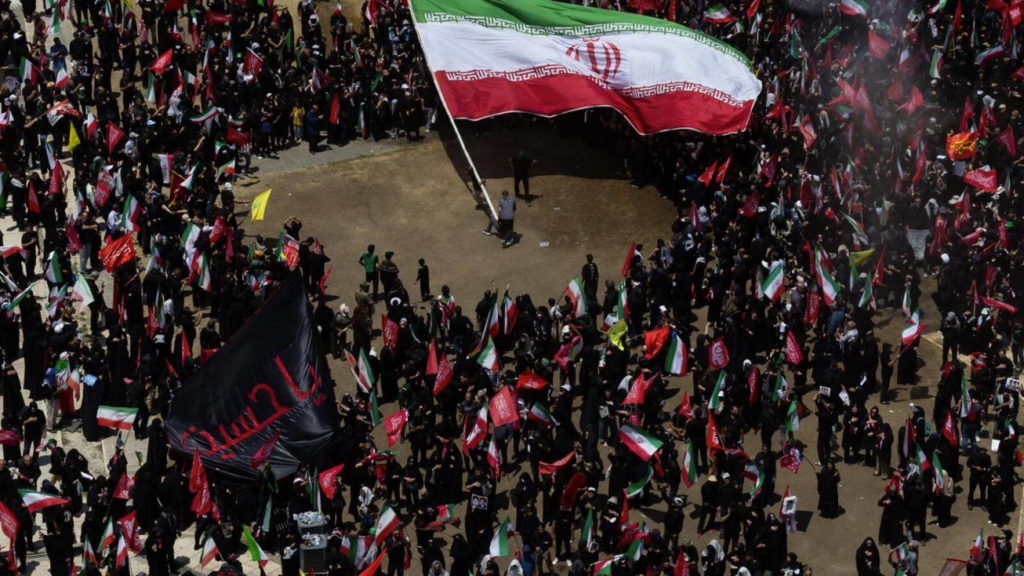
The United States and Iran have turned the strait into the epicenter of a conflict of shifting intensity, with no possible victory, no lasting peace, and direct consequences for the global economy.
By Gustavo de Arístegui, as published by La Razón, 19 July, 2026
There’s a statistic that describes the state of the world more accurately than many intelligence reports. It was formulated this week by Ali Vaez , director of the Iran project at the International Crisis Group, and it deserves to be read twice: it took two months of negotiations to draft a page and a half of memorandum of understanding between the United States and Iran, and three weeks for it to completely collapse. His conclusion was as sober as it was devastating: if such a minimal understanding cannot be sustained, there is no limit to the escalation, and what follows is what he called a “perpetual war.”
I share the diagnosis, though not the term. “Eternal War” has an air of theological fatalism that hinders critical thinking. What we are witnessing in the Gulf has a more useful technical name, one I have been employing for the past two years in my analyses and which constitutes one of the keys to understanding the book I am now finishing: these are wars of variable temperature. Low-resolution conflicts with extremely high levels of destruction, which no one can win and no one can afford to lose. They rise and fall in intensity like the fever of a chronically ill patient. They combine the conventional with the cybernetic and the propagandistic. And they turn the boundary between war and peace into a deliberately blurred line, because this ambiguity suits the actors waging them: it allows them to strike without declaring war, negotiate without conceding, and deny without shame.
The essence of this concept is that these wars are not an intermediate stage on the road to peace or total war.
They are the ideal situation for the weaker contender and hell for the stronger. These wars are the destination, not the scale. They go nowhere because they are not designed to.
The chronicle of seven days
Let’s review what has happened since Monday, because the details matter more than the interpretation. The fourteen-point memorandum that had been signed in June—extension of the ceasefire to Lebanon, cessation of hostilities around the strait, guarantee of safe passage for merchant ships —was the fruit of exhausting negotiations with regional mediation.
On July 7, following the attack on three oil tankers in the Strait of Hormuz, Washington resumed bombing, and President Trump declared the agreement dead. Last weekend, Tehran announced the closure of the strait. On Monday the 13th, Trump proclaimed that the United States was becoming the “guardian” of the waterway, reinstated the naval blockade of Iranian ports and the southern coast effective Tuesday at 4:00 p.m. New York time, and announced that the U.S. would be reimbursed 20 percent of the value of all cargo passing through the Strait of Hormuz.
Crude oil rose more than nine percent in a single session. On Tuesday the 14th, the rate had evaporated: replaced, Trump himself said, by “trade and investment deals” that the Gulf States would make in the United States. That same day, on Fox News, the threat came: next week it would be the turn of power plants and bridges, and the attacks would continue until he said enough was enough.
On Thursday the 16th, the bridges in Hormozgan province were already hit, the spokesman for the Iranian headquarters, Khatam al-Anbiya, warned that Iran would destroy “all the infrastructure” still standing in the region and that its response would not be merely proportional, but superior, and Brent crude closed at around eighty-five dollars , eleven percent higher than the previous week. Seven days. A naval blockade, a toll announced and then withdrawn, a threat to destroy the electrical grid of a country of ninety million inhabitants, a counter-threat to devastate the infrastructure of half the region, and an eleven-point rise in oil prices. And on Friday, life goes on. No one has declared war. No one has ended it. That is precisely the variable temperature.
It is also important not to gloss over what this shift in targets means . Until now, the US central command identified its targets as military installations. Power plants and bridges are something else entirely: behind an electrical grid lie hospitals, water pumping stations, communications infrastructure, cold chains, and operating rooms. The International Committee of the Red Cross has been reminding everyone for days that deliberate attacks against essential services can constitute war crimes.
However, it failed to denounce a single one of the dozens of Iranian attacks on civilian targets in the first phase of the war—civilian ports and airports, shopping malls, oil and gas facilities, and residential neighborhoods. It is curious that only what the US announces or does is denounced, and not what the Iranian regime has already perpetrated.
Why doesn’t it end?
The reason this conflict remains unresolved is not a lack of willingness to negotiate, nor is it an excess of hawks. It is structural and deliberately provoked by the Iranian side. The United States cannot win in the only sense that matters: there is no possible victory without occupation, surrender, or regime change. Occupation of Iran is impossible, and the other two scenarios remain mere wishful thinking. Trump finally seems to understand this, which is why he oscillates between apocalyptic ultimatums and offers of a settlement within a matter of hours.
Iran cannot afford to lose, because capitulation would mean the regime’s demise, and no regime negotiates its own extinction. The jihadist oligarchy that governs Tehran has grasped something we in the West refuse to acknowledge: that for them, survival is victory. And to survive, they don’t need to win; it’s enough for them not to end the war. To make matters worse, CNN confirmed this week that, as early as May, Iran had resumed drone production and was replacing the launchers destroyed at the start of the war. When neither side can win and neither can lose, the conflict isn’t resolved: it becomes entrenched. And a conflict entrenched in the planet’s main energy artery isn’t just a Middle Eastern problem; it’s a problem affecting electricity bills in Seville and Paris, or the price of a gallon of gasoline in Dallas.
The paradox of decapitation
There’s a detail from this week that’s worth ten analyses, and almost no one has highlighted it. According to US media reports citing officials, Tehran privately admitted to presidential advisors that the attack on the oil tankers was a mistake, and blamed an internal dissident group. The two possible interpretations are equally terrifying. If it’s true, it means the Iranian regime no longer controls its own forces: that there are armed actors within the apparatus capable of sabotaging an international agreement on their own initiative. If it’s a lie, it means Tehran has discovered that derailing peace negotiations is cost-free. And another faction of the regime may blame its adversaries within the regime itself in the hope of weakening them. In both cases, the conclusion is the same and devastating: there is no interlocutor.
In fact, the Revolutionary Guard triumvirate is resuming attacks with three objectives: first, to weaken its less orthodox adversaries , the president of the republic and his allies; second, to prolong internal tension in order to more easily subdue its people; and third, to force the reluctant to pay the extortion price and acquire vast funds with which to relaunch its nuclear and missile program and rebuild its networks in the region, especially in Syria, and rearm its terrorist proxies, Hezbollah, Hamas, and the Houthis .
This is the paradox of decapitation in its purest form. On February 28, the joint US-Israeli attacks eliminated Ali Khamenei and much of the regime’s decision-making apparatus. Washington expected either collapse or change. It got neither: it got the dispersal of power and influence among several factions locked in a deadly struggle. When the leader is eliminated without dismantling the structure, the structure survives and becomes more dangerous, because it loses the inhibitions of centralized command and becomes more chaotic, more diffuse, more unpredictable. And more fanatical.
Soleimani in 2020, Nasrallah and Sinwar in 2024, Khamenei in 2026: the lesson repeats itself, and we fail to learn. In this vacuum, the internal power struggles of the Revolutionary Guard are now emerging—General Ahmad Vahidi consolidating his position as primus inter pares in a triumvirate that is not a government, but a power-sharing arrangement—and a power-sharing arrangement doesn’t sign treaties: it manages its own survival. The lack of leadership isn’t just a headline: it explains why the memorandum lasted three weeks.
Western foreign policy remains anchored in the logic of the strategic coup, that comforting belief that there is a man whose elimination solves a problem. Military planning and execution: outstanding. Geostrategic planning: catastrophic.
The two tolls
Iran demands that ships request authorization to transit the Strait of Hormuz and pay service fees: an extortion system that didn’t exist before February 28th and has become normalized in five months. The United States announced on Monday that it would charge 20 percent of the cargo’s value for guarding the same passage. Although the fee has been repackaged as Gulf investment commitments—the old strategy of sobering up the issue: throwing out the unpayable to collect in another currency— the underlying logic remains : the strait is no longer a strategic international passage, but a tollbooth disputed by two collectors. The world is at war, even if it doesn’t call it that. And whoever doesn’t understand this has already begun to lose.
*Gustavo de Arístegui is a diplomat and was ambassador to India, Bhutan, Maldives, Nepal, and Sri Lanka (2012-2016) gustvodearistegui.substack.com