Gustavo de Arístegui,
July 20, 2026
I. BRIEF INTRODUCTION
The day has two temperatures and one lesson. The first is in the Gulf, where the volatile war I’ve been describing for the past two years reaches another fever pitch: new US bombings of Iran overnight, a Turkish-Qatari attempt to revive the June memorandum, and crude oil prices that remain high. The second is lighter in appearance, but no less significant: Spain is world champion, and it is so despite a FIFA that seems determined to undermine the credibility of the sport it claims to govern.
Two news stories, therefore, followed by a detailed analysis of how the international press is reporting them. No summaries: the facts, the implications, and the scenarios, one by one.
II. MOST IMPORTANT NEWS OF THE LAST 24 HOURS
1. Ormuz: the fever that no one knows how to bring down
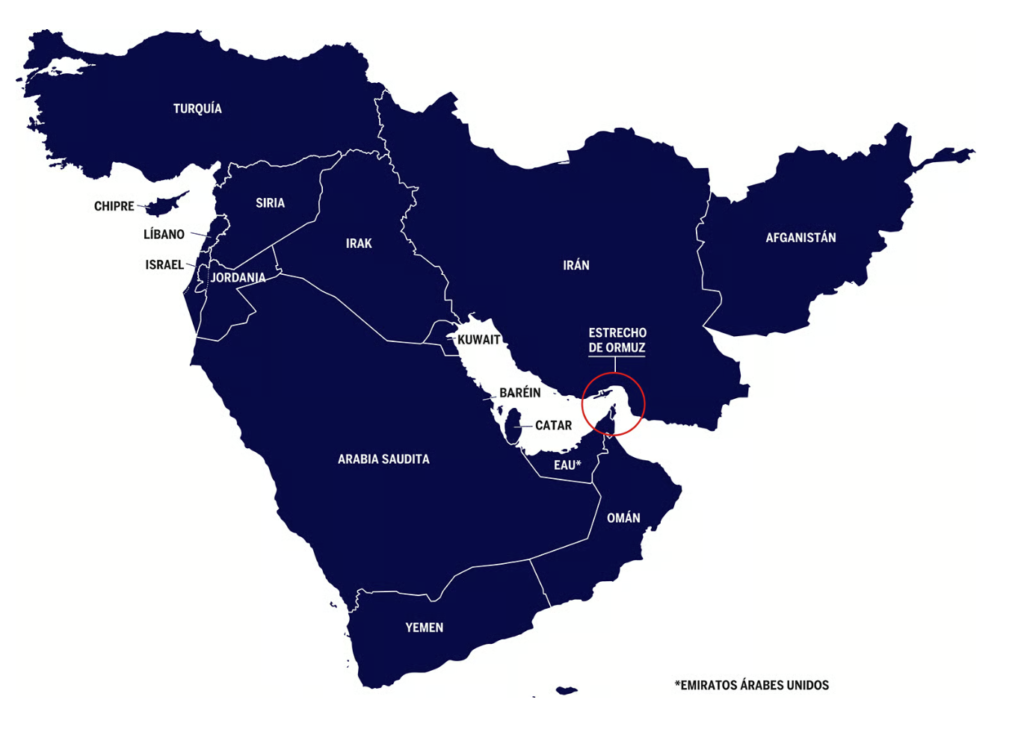
Facts. The ceasefire that Washington and Tehran shored up with a memorandum of understanding in June has once again collapsed. Following attacks on oil tankers in the Strait of Hormuz, the White House resumed bombing, reimposed the naval blockade on Iranian ports on July 13, and even tested a 20 percent toll on cargo passing through the Strait of Hormuz, which was withdrawn hours later amid widespread condemnation of its illegality and replaced with Gulf investment commitments. President Trump confirmed early this morning new “very tough” strikes against Iran in response to the deaths of American service members and reiterated that Tehran will not obtain nuclear weapons. The Iranian retaliation has targeted Bahrain, Kuwait, Qatar, and Oman, and has struck two oil tankers in Omani waters—killing one Indian crew member. Traffic through the strait has plummeted from about 130 ships a day to fewer than 10, Brent crude remains around $85—nearly 40 percent higher than at the start of the year—and Qatar has declared force majeure on its liquefied natural gas. Meanwhile, Turkish Foreign Minister Hakan Fidan is calling for a return to the memorandum of understanding, and Qatar is leveraging its diplomatic channels, with Oman acting as mediator. Against this backdrop, General Ahmad Vahidi, commander-in-chief of the Revolutionary Guard since March 1, is consolidating his position as the internal arbiter. A hardliner wanted by Argentine authorities for the AMIA bombing, he governs de facto in an unstable triumvirate with a wounded and reclusive Mukhta Khamenei—who, according to security sources, drafts his communiqués through Vahidi and has even dismissed Trump’s signature as “worthless”—since an Israeli attack killed his father on February 28.
Implications. We are witnessing the almost laboratory-created, chemical manifestation of the decapitation paradox. The leader was eliminated without dismantling the structure, and the structure did not collapse: it dispersed, becoming more chaotic, more distributed, and therefore, more dangerous. The operational consequence is devastating: there is no interlocutor. One can sign an agreement with Iran, but not with someone who is not accountable for what they sign. The jihadist oligarchy in Tehran understood before we did that survival is victory, and that to survive it does not need to win: it is enough for it not to finish. Furthermore, it is important not to gloss over the shift in targets toward power plants and bridges, because behind an electrical grid there are operating rooms, water pumping stations, and cold chains. I say this without the slightest sympathy for a regime whose arms—Hezbollah, the Houthis, Hamas, the Iraqi militias—I have always described as terrorist organizations, without quotation marks or relativism, but precisely because the moral superiority of the West is not a rhetorical flourish: it is its main strategic asset, and it is squandered with a single televised interview. Military execution is outstanding; geostrategic planning, a recurring failure. And whoever does not control the great straits—those nine keys that lock the world trade, none of which Europe controls—is not sovereign over its trade: it is a market.
Perspectives and scenarios. Three paths. The first, the revival of the memorandum through Doha and Ankara: possible, but fragile, because it requires an interlocutor that does not currently exist. The second, and more likely, the continuation of the low-resolution, high-destruction conflict, which rises and falls in intensity like the fever of a chronically ill patient and has taken root in the planet’s main energy artery. The third, the drift toward an infrastructure war with large-scale civilian casualties and triple-digit oil prices. The question underlying all three is a single one: how far will Vahidi’s ambition extend, and will the triumvirate manage its own survival or tear itself apart in the attempt? It is worth watching closely.
2. Spain, world champion; FIFA, in its labyrinth
Facts. Spain was crowned world champion yesterday at the New Jersey stadium after defeating Argentina 1-0, with a goal from Ferran Torres in the second half of extra time (106th minute). La Roja’s dominance was overwhelming—twenty shots for and three against—and only the phenomenal performance of Emiliano Martínez, with twelve saves, a record for a final, kept Argentina in the game. Argentina failed to register a single shot on target in regulation time and played the final thirty minutes with ten men after Enzo Fernández received his second yellow card and was sent off. Two Spanish goals were disallowed: Nico Williams’s in the 96th minute, for a highly disputed foul in the build-up, and a second goal by Torres for a very tight offside call (shoulder). The refereeing of Slovenian Slavko Vinčić was criticized for his leniency towards Argentina’s rough play. The closing ceremony, with a half-hour break and American fanfare that delayed the kickoff, drew almost unanimous criticism. President Trump presented the trophy alongside Gianni Infantino. Messi, in tears and receiving very low ratings from the sports press, is nearing the end of what appears to be his farewell to the World Cup. With this title, Spain becomes the first country to hold both the men’s and women’s World Cups. The tournament has been marked from beginning to end by refereeing controversies and VAR, with Egypt’s elimination against Argentina in the round of 16—a disallowed goal and a penalty not awarded—being the most notorious incident; FIFA’s head of referees, Pierluigi Collina, defended the decisions.
Implications. Let one thing be clear before anything else: Spain undeniably deserved the title, and the joy is enormous and legitimate. That said, and this is my analysis and opinion, the underlying reflection has several layers, none of them minor. The first is the unbearable arrogance of a FIFA that behaves like a superpower above nation-states: a tacky closing ceremony, with the word FIFA everywhere and a ridiculous corporate anthem sung, no less, after the United States national anthem; and even the trophy paraded in a luxury case, a perfect symbol of a nouveau riche institution that has confused football with its own marketing.
The second, and more serious, layer is the damage that this excess and scandalous, beyond comprehension, biased refereeing are inflicting on the credibility of the most universal sport on the planet, the one played barefoot in every corner of the world and captivating billions. Because the refereeing in this World Cup has favored Argentina from beginning to end, and this must be said without euphemism. The most scandalous and shameful case was Egypt’s elimination in the round of 16: Egyptian goals disallowed, nonexistent penalties awarded to Argentina, the expulsion of members of the Egyptian coaching staff, and a barrage of yellow cards against Egypt—up to thirteen—compared to none for an Argentina that committed far more fouls, and far more serious ones. Argentina did not deserve to get past that round, and from then on, they reached the final more through refereeing conspiracy than through football, because they have had a mediocre and uninspired tournament.
The third layer is the tolerance of brutal play, which isn’t just folklore, but a real danger to the players’ physical well-being: Paraguay’s intolerable roughness, Uruguay’s brutality against Spain, and, just yesterday, Argentina’s grabbing, rugby-style tackles, ankle and shin kicks, and constant shoving, which the referee tolerated from beginning to end. When a player commits a barrage of fouls, almost all of them card-worthy, he ends up on the street—as Enzo Fernández rightfully did—but yesterday more than one player should have been sent off.
And then we come to the refereeing in the final, which I found simply scandalous, unprecedented. Two legitimate goals were disallowed for Spain: one for a very close offside and the other for an alleged foul on a goalkeeper who fell on his own. As a fan, even before being a Spaniard, I am outraged by the referee’s behavior and by the favoritism shown by a FIFA whose monstrous arrogance and petulance know no bounds. It gives every impression that the refereeing was done with a specific order: to crown Messi with a second World Cup and make Argentina four-time champions, when there wasn’t a single argument, neither footballing nor otherwise, to justify it. An organization more powerful than many states, whose president cultivates friendships with heads of state and dispenses favors like the head of a major mafia organization, cannot continue to govern the most influential sport in the world with such impunity. Perhaps one day a competitor will have to emerge, because what we have witnessed must stop.
Perspectives and scenarios. Pressure for serious reform of refereeing and VAR will grow, and FIFA would do well to listen before the disrepute becomes irreversible. The issue of governance—and the excessive collusion between football’s elite and political power—will remain unresolved. For Spain, however, a golden age is dawning: amidst the joy of having triumphed against this whole pack of cheats, this generation has the potential to dominate the next cycle.
III. MEDIA RACK
Analysis of the treatment of the two news items by the international press, block by block, with due caution regarding the propaganda of the State media.
A. The Hormuz War and the US-Iran Tension
The Anglo-American press (NYT, Washington Post, CNN, NPR, AP) are reconstructing the escalation hour by hour: the resumption of bombing, the blockade, and the short-lived 20 percent toll, with Trump threatening power plants and bridges and Tehran striking at the Gulf states. The dominant focus is legal and humanitarian: whether deliberately attacking civilian infrastructure constitutes a war crime.
Reuters, AFP, Bloomberg, the Financial Times, and The Economist interpret the crisis through geoeconomic lenses: Hormuz traffic has plummeted to a trickle, Brent crude is in the high-price range, war insurance premiums are soaring, and there are fears of a prolonged energy shock. The Economist Intelligence Unit and major banks are revising their imported inflation forecasts upward.
Gulf and Arab press outlets (Al Jazeera, Al Arabiya, Arab News, Asharq Al-Awsat, Gulf News, Khaleej Times, Times of Oman, The Peninsula) are experiencing the war as their own: Iranian attacks on Bahrain, Kuwait, Qatar, and Oman, the Qatari gas tanker hit, Omani mediation, and the new strait control regime dominate their front pages. Condemnation of Tehran coexists with concern about the escalating conflict in their region.
Israeli media (Jerusalem Post, Times of Israel, Haaretz, Yediot Ahronot, Israel Hayom) focus on the Iranian leadership: a wounded and reclusive Mukhta Khamenei who, according to security sources, is consumed by a desire for revenge; a Vahidi who effectively writes his messages; and allegations of a plot to assassinate Trump. They emphasize the internal divisions that threaten the Revolutionary Guard itself.
Turkish (Hürriyet) and Qatari press are supporting Ankara and Doha’s diplomatic offensive to revive the memorandum, with Fidan calling for a return to the agreement and Oman playing the role of a discreet mediator.
Indian and Asian press (Times of India, Hindustan Times, WION, South China Morning Post, China Daily) — measure the energy blow: India, which imports most of its liquefied gas and cooking gas through Hormuz, faces fuel price increases and inflation — and mourns a crew member killed on an oil tanker —; the cautious Chinese press notes that many of the few ships still crossing invoke links with Beijing, Tehran’s main partner.
The European continental press (Le Monde, Le Figaro, FAZ, Die Welt, Corriere della Sera, La Croix) and L’Osservatore Romano emphasize the legal and moral dimensions of the International Committee of the Red Cross’s warnings about attacks on essential services, and Europe’s uncomfortable impotence in the face of a crisis that determines its energy bills. The Vatican body appeals for the protection of civilians.
Russian and Iranian state media (TASS, RT, Press TV, Tasnim, IRIB) reproduce Tehran’s narrative: the bombings as “war crimes,” the strait as an “uncrossable red line,” and their own attacks on shipping as legitimate self-defense. They are cited for contrasting reasons, never as reliable sources.
Think tanks (RUSI, IISS, CSIS, IFRI, EIU) — agree on the underlying diagnosis: without occupation there is no possible victory, the elimination of the apex has produced dispersion and not collapse, and the conflict tends to settle in the great energy artery of the planet.
B. The World Cup final and FIFA
International sports and general media outlets (ESPN, BBC, CBS, Yahoo, Washington Post, CNN) agree on Spain’s overwhelming dominance—twenty shots to three, twelve saves by Martínez—and on Messi’s farewell, marked by very low ratings and tears at the ceremony. They don’t shy away from the controversies: Nico Williams’ disallowed goal for a phantom foul, Torres’ second goal ruled out for a marginal offside, and refereeing that tolerated Argentina’s rough play. The closing ceremony’s pomp and circumstance, with a half-hour break, draws unanimous criticism.
Spanish press (El País, Marca, AS, La Razón, El Debate) — celebrate a historic feat: Spain, champion for the second time, becomes the first country to hold both the men’s and women’s World Cups, with a generation destined to dominate the next cycle.
Argentine press (Clarín, Olé, La Nación) — mourn Messi’s farewell and the end of a cycle, between pride in his career and lament for a final without football; the refereeing debate that in the round of 16 had favored the Albiceleste now turns against them in the international reading.
IV. RISK TRAFFIC LIGHT
● US-Iran war and the Strait of Hormuz: critical. Active escalation, without a counterpart and with civilian targets on the table.
● Global energy shock (crude oil, LNG, cooking gas): very high. Transit reduced to a trickle and prices at the peak of the year.
● Legality and moral superiority of the West: high. Attacks on civilian infrastructure compromise the main Western strategic asset.
● Global sports governance (FIFA): reputational. No systemic risk, but with growing institutional disrepute.
V. EDITORIAL COMMENTARY
There’s a simple arithmetic that describes the state of the world better than many intelligence reports: it took two months to negotiate a page-and-a-half memorandum between Washington and Tehran, and three weeks to undo it. That’s not a diplomatic accident; it’s the normal functioning of a broken system. What we see in the Gulf isn’t an intermediate stage toward peace or total war: it’s the destination, not the scale. A war of fluctuating intensity that rises and falls, deliberately blurring the line between war and peace, because those who wage it benefit from that ambiguity.
The lesson is repeated, and we fail to learn it: when you decapitate the leader without dismantling the structure, the structure survives and becomes more fanatical, more chaotic, and more unpredictable. Soleimani in 2020, Nasrallah and Sinwar in 2024, Khamenei in 2026. Our foreign policy remains anchored in the comforting belief that there is a man whose elimination solves a problem. Military planning and execution, outstanding; geostrategic planning, deficient. I’ve been writing this sentence for months, and I find no reason to change it.
And meanwhile, Europe sleeps. Our inability to even articulate a doctrine on the great straits—those nine keys over which we have no control—leaves us exposed. This week, without our input or control of our coastline, it was decided who profits from the very air our economy breathes; and our response was a press release. The question I’ve been asking for months remains: Is Europe prepared to be a subject of history, or will it settle for being its object? Both options have consequences; only one has a future.
Trump’s foreign policy has had pragmatic successes when he acts prudently and is well advised by Marco Rubio; it is also worth criticizing, without bitterness but without complacency, the transactional and erratic drift that relies more on intuition and impulsiveness than on careful planning. One hopes that the system and the good sense of those around him will ultimately prevail. Because the moral superiority of the West is not a rhetorical luxury: it is its main strategic asset, and it is not defended with less firmness against terror, but with greater intelligence regarding the aftermath.
Finally, there’s the lightest, yet most revealing, note. Spain has won the World Cup brilliantly but with some bad luck in front of goal, and the joy is immense and well-deserved. But it’s worth saying loud and clear: an increasingly arrogant FIFA, with refereeing decisions that propelled Argentina to the final and a nouveau riche spectacle, is very close to destroying the whole thing. The most universal sport on the planet cannot be run like a private fiefdom. Here too, as in so many things, the problem isn’t a lack of talent on the pitch, but the mediocrity—and something worse—of those who should be upholding the rules. The world is at war, even if it doesn’t call it that; and whoever doesn’t understand that has already begun to lose.