The freedom of the seas is no longer a given: it’s a price to pay. Hormuz and Bab el-Mandeb have ceased to be maritime passages and have become keys to energy, commercial, and political strangulation.
By Gustavo de Arístegui, as published by La Razón, 26 July, 2026
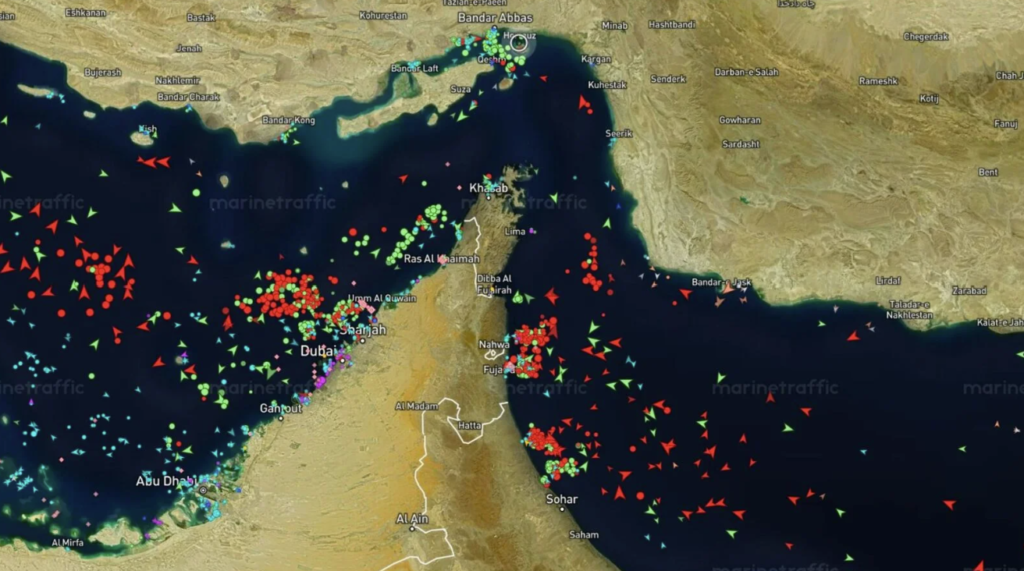
I write these lines with the Strait of Hormuz under the control of the Iranian terrorist regime since March 2nd and with Bab el-Mandeb subjected, since July 20th, to the naval blockade that the Houthi terrorists have declared against traffic linked to Saudi Arabia. Between these two gateways hangs the energy supply of three continents and something even more serious: the transformation of the open sea into a system of passage granted, monitored, and charged for. The crucial point is that both have ceased to be mere maritime passages and have become instruments of political, economic, and military coercion at the service of the same axis.
For thirty years we have explained globalization in terms of containers, value chains, and logistical efficiency, taking for granted the sea that made it possible. The English have a perfect expression for this blindness: sea blindness. It is assumed that ships arrive, that freight is a technical cost, and that someone—the United States, always the United States—guarantees passage. The year 2026 shattered this assumption in the worst possible way: demonstrating that a medium-sized state and a terrorist militia can impose conditions on 20% of the world’s oil with drones, naval mines, and a radio.
The novelty, however, is not the blocking. It’s the licensing. That’s the key to everything.
Until now, the standard practice was that a strait could be open or closed, and that closing it was an act of war. What we have seen this year is more sophisticated and dangerous: neither the Iranian terrorist regime nor its terrorist proxies have completely closed anything. They have replaced freedom of navigation with a discretionary passage regime in which crossing is no longer a right, but a concession based on the flag, the shipowner, the crew, the cargo’s destination, and, above all, payment. I call it licensed navigation, and I maintain that it defines the geopolitics of our time.
Its advantages for the extortionist mobster are obvious. It avoids a clear casus belli, because no one declares war over a terrorist-style toll—blackmail —even though it might amount to an act of war. It generates revenue instead of consuming it, reversing the logic of a classic blockade. It divides the opposing coalition, because each shipowner and each insurer calculates separately whether it’s worth paying. And it’s reversible and adjustable: the tap is loosened when convenient and closed when the bid needs to be raised.
The data is conclusive. Before the Forty Days’ War, between 125 and 140 ships carrying some twenty million barrels of oil crossed the Strait of Hormuz daily. On July 23, Kpler counted thirteen. And of that remaining cargo, 90% travels through a corridor hugging the Iranian coast that no international maritime authority recognizes, while the Omani corridor, despite US naval protection, has become practically empty .
The reason for this failure is perfectly ironic: insurance. Because the Omani route wasn’t an established corridor before the conflict, its risk profile isn’t mapped, and premiums haven’t decreased. The shipowner, forced to choose between an expensive corridor protected by the US Navy and a cheap one guaranteed by payments to the Revolutionary Guard, chooses the latter. Western deterrence has been defeated by an actuary.
And by ourselves. On July 14, after terminating the June memorandum, President Trump announced that Washington would, in turn, charge a 20% toll on all cargo crossing the strait: some thirty-two million dollars per supertanker. The response to a toll—terrorist blackmail—was another toll, levied by the power that was supposed to protect the passage. When the guarantor of the global public good begins to charge for it, the public good ceases to exist.
At the other end of the chessboard, the pincer movement was tightening. With the Gulf blockaded, Saudi crude began to flow west: exports from Yanbu via Bab el-Mandeb increased from approximately 240,000 barrels per day in June 2025 to 3.5 million in June 2026. On July 20, the Houthi terrorists announced a naval blockade of the Kingdom, and three days later they set fire to a Saudi oil tanker. For the first time in modern history, a single actor simultaneously shut down both ends of the export system of a major energy power.
That same day, two ships operated by the Chinese shipping company Cosco, with Chinese ownership and crew, loaded in Yanbu and crossed the strait unmolested. The cargo was Saudi; the crew and the destination, Chinese. There was no interdiction. The blockade is not based on cargo, but on affiliation. The Houthis are not deciding whether Saudi crude oil moves: they are deciding who moves it and who the recipient is.
Let’s remember that phrase, because it describes the world to come. If passage is granted based on flag and not cargo, those with good relations with the corrupt gatekeeper sail through, and those without, pay the price. In 2026, that means the People’s Republic of China sails through, and the West pays. No conspiracy is needed: it’s enough that Beijing has cultivated the actors who now control the borders for fifteen years and that, since 2017, it has had its only overseas military base in Djibouti, with two thousand personnel and a dock sized for an aircraft carrier.
China doesn’t need to close Bab el-Mandeb. It’s enough that those who can close it have good reasons for not disturbing its ships.
We often talk about the Chinese Malacca dilemma: Beijing’s vulnerability to a blockade of the strait through which 80% of its crude oil arrives. Data published this month by the CSIS demonstrates that China’s problem lies not in Malacca, but in Taiwan . In 2024, nearly $1.3 trillion worth of Chinese goods crossed the Taiwan Strait, a third more than through Malacca; 33% of China’s total imports and 58% of its maritime imports passed through it. Closing the strait would harm China more than a Western blockade of Malacca. Beijing would be inflicting upon itself the strangulation it fears. This doesn’t preclude a political decision if the Communist Party considers it existential, but it raises the bar and explains its preference for the gray area: quarantines, inspections, live-fire exercises, and pressure on insurance companies.
Not all the bottlenecks are visible on a nautical chart. Between fifteen and seventeen submarine cables pass through the Red Sea, carrying approximately 17% of global data traffic and over 90% of communications between Europe and Asia; cable-laying vessels do not repair cables in war zones. Taiwan manufactures over 90% of advanced semiconductors, extreme ultraviolet lithography has only one global supplier, and China controls around 91% of rare earth refining. The truce that suspended China’s most aggressive controls expires on November 27. Four months remain.
This brings us to Europe, which depends most on open ports and has the least capacity to keep them open. That is the operational definition of a strategic vulnerability: needing a global public good without being able to guarantee it. There is no commercial sovereignty without escort capabilities, and we lack them: Aspides has demonstrated both willingness and limitations. Hormuz has reminded us that a mined strait without available minesweepers is closed regardless of how many aircraft carriers are deployed. And while Russian submarine activity reaches record highs in the North Atlantic, it was revealed in June that the entire British fleet of nuclear-powered attack submarines was immobilized in port. That is a precise snapshot of our situation.
Spain deserves special mention because it guards the gateway to the western Mediterranean: fourteen kilometers through which more than one hundred thousand ships pass each year and through which allied naval power enters and exits. The treaty on Gibraltar, signed on July 14th, has occupied three centuries of Spanish diplomacy and dominated all the headlines this summer. But at the height of tension, the radical left-wing coalition government denied the United States the use of Rota and Morón for offensive operations, forced the withdrawal of more than a dozen tanker aircraft, and on March 30th closed the airspace to the US aircraft involved. I won’t delve into the legal debate. I’ll focus on the strategic consequence: Spain holds the key to the Strait and has decided to demonstrate that it will not use it. Unreliable assets are replaced, and the cost of replacement lasts for decades.
It’s the same old national story: arguing for three centuries over the symbol while relinquishing the function. The British did the opposite on Diego Garcia: they handed over the title to Mauritius in 2025 and retained full military use of the base.
For most of my professional life, the freedom of the seas was such a firmly held assumption that no one bothered to state it; it was the very air that global trade breathed. In 2026, we discovered that this air had an owner, or more precisely, that it only ceased to have one as long as someone paid the price for not having it. The United States paid that price for eighty years and has now decided to charge for it. The Iranian terrorist regime has understood that the terrorist blackmail toll is more profitable than a blockade. China has understood that there’s no need to control the gates if you’re friendly with the gatekeepers. And Europe continues to debate whether the sea is for defense or transportation.
Mahan gave the answer over a century ago, and it hasn’t improved since: the sea is the prerequisite for everything else. Whoever cannot guarantee the passage of their ships is not sovereign, no matter how many treaties they sign or how well-drafted they may be. A terrorist conglomerate isn’t dealt with halfway; it must be defeated. Forty years of designating enemies without strangling their capabilities have produced precisely the opposite: a strangled West that merely labels.