
Gustavo de Arístegui,
July 27, 2026
I. PURPOSE AND METHODOLOGICAL WARNING
This analysis stems from a conviction that must be stated plainly: fire has ceased to be merely an environmental issue and has become a matter of national security, territorial economy, and European strategic positioning. When a state mobilizes its military emergency unit, evacuates one hundred thousand people, borrows resources from three countries, and watches the equivalent of half a province burn in five days, it is not managing a summer emergency: it is subjecting its state capacity to a real-time stress test.
The comparison with France is compelling for three reasons. First, both countries are simultaneously experiencing their worst fire season in recent history and are therefore comparable in terms of circumstances. Second, their management models are almost diametrically opposed, allowing us to isolate what works and what doesn’t. And third, the A400M firefighting helicopter incident—designed and tested in Spain, and first used in a real fire by France—perfectly encapsulates the difference between having the capacity and having the will to act.
Methodological note: figures for burned area come from different sources (MITECO, EFFIS/Copernicus, French Ministry of the Interior) with methodologies that are not entirely consistent, and the economic cost estimates do not follow a unified official methodology in Spain. The source and its limitations are indicated in each case. Where the sources differ, this is noted.
II. TWO MANAGEMENT MODELS: FRANCE AND SPAIN
2.1. The 2026 campaign in comparative figures
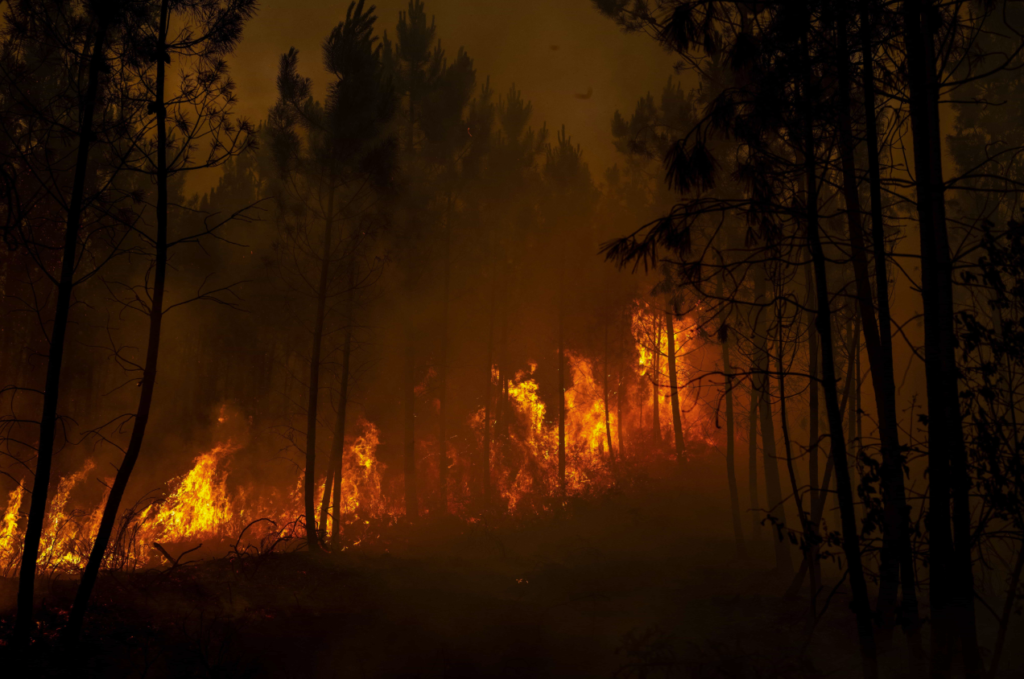
It’s worth starting by dispelling a convenient misconception. This summer, France is not a model of success compared to Spain’s failure: France is suffering, in the words of President Macron himself, the worst wildfires since 1945. By July 25, the fires had burned over 98,000 hectares, a national record according to the Interior Ministry. The Gironde fire ravaged 19,000 hectares and forced the evacuation of 110,000 people, including the entire peninsula up to Cape Ferret, by land and sea, as the fire front advanced toward the Bordeaux metropolitan area. In the Landes region, between Biscarrosse and Parentis, 3,500 hectares burned, and 31,000 people were evacuated. Paris had to activate the European Civil Protection Mechanism and receive two Croatian Canadair water bombers, two Portuguese Air Tractor helicopters, and two Czech and Slovakian helicopters.
Spain, for its part, has accumulated 152,678 hectares and thirty-two major fires, with thirteen deaths in Los Gallardos and more than one hundred thousand people evacuated or confined between Madrid, Ávila, and Toledo. In other words: two neighboring countries, two historic fire seasons, and the same European reserve being divided simultaneously between them. That fact alone has more strategic significance than any institutional statement of the last two weeks.

Chart 1. France and Spain facing the same campaign.

Chart 2. The Spanish anomaly of 2026: six times more area burned than in 2025 and more than three times as many large fires as the average for the decade.
2.2. Where it burns: situation map
The distribution of the fires illustrates the nature of the problem better than any argument. We are not facing one large fire, but rather the simultaneous occurrence of several megafires in two neighboring countries, on fronts separated by hundreds of kilometers, which prevents the concentration of resources and forces the sharing of scarce ones. This simultaneity, and not the individual magnitude of each fire, is the strategic novelty of the 2026 campaign.

Figure 3. Schematic map of the focus areas of the 2026 campaign.
Table 1. Map key: location of hotspots as of July 27, 2026
| No. | Focus | Situation |
|---|---|---|
| 1 | Sierra Oeste de Madrid Complex – Burgohondo and La Adrada (Ávila) – Almorox (Toledo) | Active. Approximately 77,000 hectares and more than 100,000 people evacuated or confined. National emergency and unified command of the UME (Military Emergency Unit). |
| 2 | La Vall d’Uixó (Castellón) | Active. 7,000 hectares and a 48-kilometer perimeter; 16,000 evacuated from eighteen towns and 64,000 under lockdown. Investigated as arson. |
| 3 | Las Hurdes (Cáceres) | Active. Approximately 500 hectares; 500 people evacuated from five towns after the fire reignited in the early hours. |
| 4 | Gironde (France) | Active. 19,000 hectares and 110,000 evacuees, including the peninsula up to Cape Ferret, with the front facing Bordeaux. |
| 5 | Biscarrosse–Parentis, Landes (France) | Active. 3,500 hectares and 31,000 evacuees. |
| 6 | Segorbe (Castellón) | Controlled. 900 hectares. |
| 7 | Los Gallardos and Bédar (Almería) | Extinguished. Declared on July 9; thirteen dead and dozens injured. |
| 8 | La Mierla (Guadalajara) | Extinct. |
| 9 | Paüls (Tarragona) | Extinguished on July 16. 3,321 hectares and more than 18,000 people confined. |
The smaller orange circles indicate other areas with road closures in Teruel, Granada, and Huelva. The blue triangles indicate the main air bases: Torrejón de Ardoz, headquarters of the 43rd Group, and Nîmes-Garons, a French Civil Security base located more than 500 kilometers from Gironde.
2.3. Two opposing institutional architectures
The essential difference lies not in the resources, but in the structure. France has a single, vertical chain of command: the Directorate General for Civil Security and Crisis Management, under the Ministry of the Interior, with the prefect as the director of operations on the ground and the departmental fire and rescue services forming a homogeneous structure throughout the country. Spain has seventeen different autonomous models, with varying doctrines, resources, salaries, and protocols, and a central government that only assumes command when Operational Situation 3 is declared—that is, when the fire has already overwhelmed those with jurisdiction. This asymmetry explains why in France the debate is about how to extinguish the fire, while in Spain it’s about who is in charge.
Table 2. Comparison of the French and Spanish models of forest fire management
| Dimension | France | Spain |
|---|---|---|
| Command and direction | Single state broadcaster (DGSCGC, Ministry of the Interior). The prefect directs operations from the very first minute. | Regional competence. The State only directs in operational situation 3, and only at the request of the affected community. |
| Earth structure | Departmental fire and rescue services with homogeneous doctrine, training and equipment throughout the territory. | Heterogeneous regional services, largely seasonal forestry brigades, and the UME as a last resort federalizing element. |
| Attack doctrine | “Attack on nascent fires”: massive and immediate intervention on the outbreak. In 2022, 97% of fires were stopped before reaching less than 5 hectares. | Initial attack depends on each community. State reinforcement usually arrives when the fire is already large. |
| Preventive surveillance | Armed aerial surveillance: aircraft in preventive flight over risk areas during critical days. | Not systematized at the national level. |
| Regulatory prevention | Legal obligations for clearing vegetation around homes and roads, with a penalty system; DFCI network of tracks, firebreaks and water points in the Landes massif. | Scattered regulations, limited inspections, and land clearing restricted by environmental permits. Preventive investment at historic lows according to ASEMFO. |
| Fixed-wing fleet | 12 Canadair CL-415s, 8 Dash 8s, up to 6 leased Air Tractors and 3 coordination Beechcrafts; 40 Dragon helicopters and 10 leased bomber helicopters in 2026. | 14 state-owned CL-215T/CL-415 amphibious vehicles, of which only 6 or 7 are operational; resources contracted by each autonomous community and helicopters from the emergency battalion. |
| Renewal | 2 DHC-515s in 2028 and 2 more in 2032-33; target of 14 aircraft in 2028 and 16 in 2032-33. National programs Hynaero and Kepplair for a sovereign alternative. | 7 DHC-515s within a $375 million program that included the upgrade of the CLs; first deliveries not before 2029 and full batch by 2032. |
| Operational innovation | Interior-Defense-Airbus agreement on July 17; first actual launch from an A400M on July 25 in Gironde, fifteen days later. | Presidential announcement of the kit in May; prototype uncertified; no Spanish A400M has yet launched over a fire. |
Note: There are discrepancies among French sources regarding the number of water bombers actually available. The figure of 12 Canadairs and 8 Dash 8s represents the complement; the actual availability is significantly lower.

Chart 4. The gap between inventory and reality: from thirteen operational devices in 2018 to six or seven in 2026.
2.4. What France does well and what it also does poorly
It would be a mistake to make France the undisputed model. Its fleet is as aging as Spain’s, and the problem is evident: according to the National Federation of Firefighters, during critical moments in the summer of 2024, only three of the twelve Canadair helicopters were operational, and in July 2025, a decision had to be made between two simultaneous requests for aerial resources in the Aude and Bouches-du-Rhône departments. The French Senate openly speaks of the risk of a capacity breakdown. Furthermore, the main air base is in Nîmes-Garonne, more than 500 kilometers from the Gironde department, which causes considerable delays in a situation where every minute counts.
But there are three things France clearly does better, and which Spain should wholeheartedly adopt. The first is the doctrine of attacking the nascent fire, which transforms prevention into action: massively striking the incipient fire in the first few minutes, even if it seems disproportionate, because it costs infinitely less than fighting a ninety-kilometer front. The second is the legal obligation to clear vegetation around homes and infrastructure, with inspection and penalties, which in Spain exists only on paper but is ignored with impunity. And the third, the most important of all, is that in France, catastrophes are not used as partisan ammunition: the Minister of Defense and the Director of Civil Security appear together, thank the agencies involved, and announce decisions. No one calls anyone a fool while a forest burns.
II. THE A400M FIREFIGHTER: A SPANISH-FRENCH PROTOTYPE AND A SPANISH LESSON
3.1. What it is and how it works
The A400M firefighting kit is admirably simple in its design. It consists of a self-contained, self-loading module that enters through the rear cargo door of the aircraft, requiring no permanent modifications to the airframe: a rapid installation and removal system—what in aeronautical jargon is called roll-on/roll-off—that allows a tactical transport aircraft to be converted into a heavy water bomber in a matter of hours, and returned to its military mission with the same ease.
The tank stores 20,000 liters of water or fire retardant, which is discharged by gravity when the gates are opened, through pipes protruding from the rear of the cargo compartment. The entire discharge takes less than 10 seconds, creates a spray pattern of up to 400 meters, and covers approximately 50,000 square meters of land. This is equivalent to more than three Canadairs in a single pass.
However, it’s important not to get carried away by enthusiasm, because the aircraft has a structural limitation that no political announcement can disguise: the A400M is not amphibious. It cannot refuel in low flight over a reservoir or the sea like a Canadair does in twelve seconds. It must land and refuel on the runway, an operation that takes about ten minutes with the appropriate bombs. Its natural role, therefore, is not direct firefighting but rather establishing containment lines ahead of the front lines, supporting specialized aircraft. It is an invaluable complement, not a replacement.

Figure 5. Unloading capacity per pass of the main aerial means.
Table 3. Comparative technical data sheet of heavy aerial vehicles
| Feature | Air Tractor AT-802 | Canadair CL-415 / DHC-515 | Dash 8 Q400MR | Airbus A400M with kit |
|---|---|---|---|---|
| Capacity per pass | about 3,100 l | 6.137 l | 10,000 l | 20,000 l |
| Amphibian | Yes (Fire Boss version) | Yeah | No | No |
| Recharge | In water, very fast | In water, 12 seconds | On track | On the track, about 10 minutes |
| Main mission | Attack on the nascent fire | Direct and sustained extinction | Delay and lines | Massive containment lines |
| Nature | Dedicated aircraft | Dedicated aircraft | Converted aircraft | Convertible military aircraft |
| Reference unit cost | about €4 million | over €60M (DHC-515); €91M per unit in the French contract | Converted aircraft | No airframe cost: an aircraft already in service is used. |
3.2. Chronology, which is the real news
The relevant aspect of this matter is not the technology, but the timeline. The kit was designed by Airbus engineers in Spain, and its prototypes have been manufactured by the company Cobo. Flight test campaigns have been underway since 2022, in both Spain and France. In the strictest sense, it is a capability of Spanish origin.
Table 4. Chronology of the A400M firefighting aircraft
| Date | Milestone |
|---|---|
| 2022-2026 | Airbus develops the kit with engineering in Spain and conducts successive flight test campaigns in Spain and France. The prototypes are manufactured by the company Cobo. |
| May 21, 2026 | The Prime Minister announced at the Torrejón air base, during the presentation of the campaign, that Spain will install the kit on its A400M aircraft, along with a fleet of ten amphibious aircraft, four Chinooks and two Cougars. |
| July 17, 2026 | The French Ministries of the Interior and Defense sign an agreement with Airbus for the operational deployment of the prototype. |
| July 23, 2026 | The French Air Force begins testing with the prototype identified as MK2. |
| July 25, 2026 | The first real-world drop of fire retardant from the cargo hold of an A400M aircraft on the Gironde fire: nearly 20,000 liters to create a containment line against a rapidly advancing fire front. The French Minister of Defense hailed it as a world first, achieved in just fifteen days. |
| July 27, 2026 | No Spanish A400M has yet carried out a water drop on a fire. The kit remains uncertified, and only two prototypes exist. |
There it is, in seven lines, the complete diagnosis of this country. Spain conceives, designs, and tests an innovative capability for four years, with its own engineering and domestic manufacturing. France signs an agreement on July 17th and fifteen days later is dropping twenty tons of fire retardant on a real fire, with the Minister of Defense publicly thanking Civil Security, the armed forces, and Airbus. We announced it in May at a press conference and in July we still haven’t certified the deposit. It’s not a problem of talent, or industry, or money: it’s a problem of decision-making, urgency, and the chain of command.
And it’s worth adding a technical caveat that official propaganda has concealed: only two prototypes exist, the kit lacks certification, and the manufacturing company is not among Airbus’s regular suppliers. Therefore, the tank, its installation, and the company itself will all need to be certified before any production run can be considered. Announcing in May that these resources would be available “in this year’s campaign” was, quite simply, a lie.

Image 1. A400M fighting forest fires (source: Reuters)
3.3. The European opportunity that no one has seen
The A400M firefighting aircraft is not a mere anecdote: it is the only available European response in the short term to an uncomfortable strategic dependency. The eight countries that operate the A400M—Germany, France, Spain, the United Kingdom, Turkey, Belgium, Luxembourg, and Malaysia—have a combined fleet that, equipped with certified kits stored at a few locations across the continent, could generate a massive response capability within hours without purchasing a single new aircraft and without immobilizing dedicated airframes eleven months a year. This is precisely the dual-use concept that the European Union proclaims in all its strategic autonomy documents and puts into practice in very few.
IV. THE ENVIRONMENTAL IMPACT: WHEN THE FOREST CEASES TO BE A SINK AND BECOMES AN EMITTER
Sixth-generation wildfires are not just large fires: they are a different phenomenon altogether. They exceed 10,000 kilowatts per linear meter of fire front, generate pyrocumulus clouds, create their own weather patterns, and advance up to 4,000 hectares per hour—between six and twelve times faster than a conventional fire. Above this threshold, direct suppression is impossible with any known means.
Environmental damage, however, is not measured in hectares or tons of carbon dioxide, although both figures are telling. It is measured primarily in soil. Fertile soil can take centuries to regenerate, and when it disappears, erosion, runoff, and, with the first torrential rains of autumn, flooding and the silting up of reservoirs follow. The water cycle is disrupted, water reserves are contaminated, biodiversity is lost, and the carbon that the forest had stored for decades is released into the atmosphere. On already fragile soils, recurring fires accelerate the desertification processes that threaten a large part of the Iberian Peninsula.
There is a climate paradox here that deserves to be clearly emphasized, because it dismantles much of the official narrative. A managed forest is a carbon sink; a burned forest is a carbon emitter. Spain can allocate tens of billions to decarbonizing its economy and watch as its own territory returns a substantial portion of that saved carbon to the atmosphere in a matter of days. In 2025, according to the Copernicus service, Spain, Cyprus, the United Kingdom, the Netherlands, and Germany recorded their highest annual emissions from wildfires, and Europe reached its highest figure since systematic monitoring began in 2003, driven by the Iberian wildfires of mid-August. Those who prevent forest management in the name of climate are, objectively, harming the climate.

Chart 6. The 2026 European campaign in perspective.
Across the European Union, the burned area reached 108,709 hectares on June 24—39% above the 2006-2025 average for that date—167,326 hectares on July 15, and approximately 254,388 hectares on July 23. An analysis by Agence France-Presse using satellite data, as of July 24, placed the 2026 fire season as the second largest in the last twenty years in the EU, with summer barely halfway through. The benchmark remains 2025, the worst year on record, with more than 1.03 million hectares burned.
V. THE ECONOMIC IMPACT: THE COST OF NOT PREVENTING
The cost of a wildfire is not just the cost of extinguishing it. That’s only the tip of the iceberg. The combined impact of the major wildfires that struck Spain in 2025 has been estimated at around ten billion euros, a figure that includes firefighting, environmental restoration, infrastructure reconstruction, public aid, property losses, and damage to agriculture, livestock, and tourism. So far in 2026, the hectares burned have already resulted in an estimated cost of nearly two and a half billion euros.

Chart 7. The cost of fire in Spain.
Academic studies allow us to pinpoint the macroeconomic impact. A study published in the Journal of Environmental Economics and Management, cited by the European Central Bank in a 2024 working paper, analyzed 233 regions in Portugal, Spain, Italy, and Greece between 2011 and 2018 and concluded that wildfires reduce the annual GDP growth of the affected regions by between 0.11% and 0.18%, with declines of between 3.3% and 4.8% in the most severe years. In the tourism sector—transport, accommodation, and food services—the loss translates into between 5,712 and 9,588 seasonal jobs in Southern Europe.
For Spain, whose primary industry is tourism, this figure should set off alarm bells. The three provinces hardest hit this month—Ávila, Guadalajara, and Madrid—are home to 1,256 rural tourism establishments and some 1,900 direct jobs. And there’s a reputational and consular dimension that no one has wanted to emphasize: of the thirteen people who died in the Los Gallardos fire, seven were British, three Belgian, one French, one American, and one Spanish. A tragedy with this composition isn’t just a matter of civil protection; it’s a matter of international image and the confidence of source markets.
Table 5. The economic impact of fire in Spain: reference figures
| Concept | Amount | Source and period |
|---|---|---|
| Aggregate economic impact of major fires | about €10 billion | Published estimates, 2025 |
| Estimated cost of the burned area in 2026 | approximately €2.5 billion | Estimate, July 2026 |
| Spending by all levels of government on fire protection | more than €2.76 billion | Fiscal Year 2023 |
| European Union emergency aid to Spain | €120.55M | European Parliament, July 2026 |
| Hydrological-forestry restoration in affected areas | €34.5M | MITECO |
| Insurance compensation for the August fires | €23 million in 150,000 claims | Insurance employers’ association, 2025 |
| Reference cost per hectare using aerial means | about €10,000 | Navarre Forestry Agency |
| Reduction in regional GDP growth | between 0.11% and 0.18% annually | Study cited by the ECB, 2024 |
Consider this contrast that encapsulates the disproportion of the current model: the European emergency aid approved this July, €120.55 million, is insufficient to cover the cost of extinguishing seven thousand hectares at the prices charged by the forestry industry itself. Meanwhile, with one billion euros well spent on preventative management, nearly ten million hectares could be treated—a fifth of the national territory. The arithmetic is so simple it’s almost offensive: every euro invested in prevention saves tens in firefighting costs, and prevention also helps retain population, generates rural employment, and preserves the landscape. Failing to implement prevention is not a budgetary option: it’s a political decision, and it should be judged as such.
VI. THE GEOSTRATEGIC DIMENSION: A DEPENDENCY THAT NO ONE WANTS TO NAME
All of Europe’s heavy aerial firefighting capacity currently depends on a single manufacturer, De Havilland Canada, marketed through a Canadian state agency, the Canadian Commercial Corporation. This company has a production line that has reopened after years of inactivity and a saturated order book. Twenty-two DHC-515 aircraft have been ordered through the European mechanism for six member states—Spain, France, Italy, Greece, Portugal, and Croatia—at a unit price that, in the French contract, approaches ninety-one million euros. Initial deliveries are scheduled for the end of 2028, with Greece being the first country served and Spain not receiving any new aircraft before the 2029 fire season.
To put it in the terms we typically use in this report when discussing defense: Europe lacks its own industrial alternative in the heavy amphibious segment and has outsourced a critical capability for protecting its civilian population to a third country, however allied and friendly it may be. This is the same problem we face with munitions, air defense, and command and control systems. And note that France has indeed reacted: two national programs, Hynaero and Kepplair, are working on a new-generation water bomber, one of them with a reported capacity of 8,000 liters, 30 percent more than a Canadair, at half the acquisition cost. Spain, which houses Airbus’s military transport division in Seville and designed the A400M kit, has no equivalent program.
There is also a crucial operational lesson to be learned from what happened this week. The European strategic reserve—22 aircraft, five helicopters, and 777 pre-positioned firefighters—had to be simultaneously divided between Spain and France: four Greek and Italian Canadairs were deployed to Madrid and Ávila, and three Portuguese, Croatian, Slovakian, and Czech aircraft and two helicopters were sent to the Gironde region. In other words, the mechanism is designed to assist one country in crisis, not two major Mediterranean states at the same time. When the crisis is continental and simultaneous—and the changing fire regime guarantees that this will increasingly be the case—the common reserve ceases to be a safeguard and becomes a means of sharing scarcity.
Finally, a consideration that is rarely made but which, in my opinion, is the most important. Evacuating 110,000 people from a peninsula in 24 hours, as France did at Cape Ferret, or 55,000 in the western mountains of Madrid, is a civil protection stress test equivalent in its logistical demands to a wartime contingency. A country that is unable to evacuate its population in an orderly fashion in summer, with open roads and no enemy, will hardly be able to do so in a security emergency. Civil resilience is not a minor aspect of national defense: it is its foundation. And in this, as in military spending, Spain continues to rely on others to arrive on time.
VII. COMPARATIVE CHRONOLOGY OF THE CAMPAIGN
The following is a sequence of events in Spain and France between July 7 and 27, 2026. Read in parallel, the chronology says more than any analysis: two countries hit at the same time, with the same climate and almost identical weather, and two radically different ways of reacting to it.
Table 6. Comparative chronology, from July 7 to 27, 2026
| Date | Spain | France |
|---|---|---|
| July 7 | Paüls fire (Tarragona): 3,321 hectares, 44 kilometers perimeter and more than 18,000 people confined. It was extinguished on July 16. | Since July 4th, several fires have been burning, including one covering 5,000 hectares in the Eastern Pyrenees. The season has seen a total of 14,500 hectares burned, three times more than in 2015. |
| July 9 | Los Gallardos and Bédar (Almería): thirteen dead—seven British, three Belgian, one French, one American, and one Spaniard—and dozens injured. It is the deadliest fire of the European wildfire season. | — |
| July 15 | The fire in La Mierla (Guadalajara) has been added to the tally. The European EFFIS system places the Union at 167,326 hectares and 1,083 fires, more than double the usual number for this time of year. | France surpasses 42,000 hectares burned, a record figure. Macron speaks of the worst fires since 1945. |
| July 17 | — | The Ministries of the Interior and Defense sign an agreement with Airbus to operationally deploy the A400M firefighting prototype. |
| July 21 | It is known that the Ministry for Ecological Transition and the Demographic Challenge (MITECO) has terminated the modernization contract for the CL-215T aircraft after a four-year standstill. Only six or seven of the fourteen state-owned amphibious assault vehicles are currently operational. | — |
| July 23 | The Community of Madrid requests operational status 3. The Government declares a national emergency in Madrid and Ávila. A fire is declared in Segorbe (Castellón). | The Gironde wildfire has reached 4,800 hectares, with more than 800 firefighters and six aircraft deployed. The Spanish Air Force has begun testing the A400M with the MK2 prototype. |
| July 24 | Spain requests European assistance and receives four Canadair CL-415 helicopters from Greece and Italy. While three provinces burn, the president of the Madrid region and the Minister of Transport publicly criticize each other on social media. | The Gironde fire affects 19,000 hectares and has led to the evacuation of 110,000 people; the entire peninsula up to Cape Ferret is evacuated by land and sea. Macron activates the European Civil Protection Mechanism: two Croatian Canadair water bombers, two Portuguese Air Tractor aircraft, and two Czech and Slovak helicopters are deployed. |
| July 25 | The fires in Madrid and Ávila are now being fought as a single operation under the unified command and direction of the Military Emergency Unit (UME). The national emergency is extended to Toledo. The advanced command post in Cenicientos is evacuated. Fires are declared in La Vall d’Uixó and Las Hurdes. | First actual fire retardant drop from the cargo hold of an A400M over the Gironde fire: nearly 20,000 liters. France surpasses 98,000 hectares burned, a national record. Biscarrosse–Parentis: 3,500 hectares burned and 31,000 evacuated. |
| July 26 | 152,678 hectares burned this year, six times more than in 2015, and thirty-two major fires. The Madrid-Ávila complex has burned over 77,000 hectares and affected more than 100,000 people. The King and Queen visited evacuees in Villamanta. | The relief effort continues in Gironde and Landes with European reinforcements. Following the Angelus, Pope Leo XIV asked for prayers for the victims in Spain and France. |
| July 27 | The fire in Vall d’Uixó has reached 7,000 hectares, with 16,000 evacuated and 64,000 confined to their homes, and arson is suspected. 500 people have been evacuated in five towns in Las Hurdes. The fire in Segorbe, affecting 900 hectares, is under control. AEMET (the Spanish State Meteorological Agency) has announced the fourth heat wave of the year. The Council of Ministers will approve the declaration of a disaster zone tomorrow. | Stabilization work continues in the southwest with support from the European reserve. |
Let’s focus on just one line in this table. On July 17, France signs an agreement; on the 23rd, it begins testing; on the 25th, it’s dropping twenty tons of fire retardant on a real fire. Around the same time, in Spain, it was revealed that a modernization contract, declared urgent in 2022, had just expired without being implemented, and a regional president and a minister were exchanging insults on social media. Eight days, two countries, two administrative cultures.
VIII. CONCLUSIONS AND RECOMMENDATIONS
1. Fire is a matter of national importance, not a departmental issue. It must be integrated into the National Security Strategy with the same priority as cybersecurity or the protection of critical infrastructure, with multi-year planning and not just summer campaigns.
2. Copy the doctrine of attacking the nascent fire. It is the cheapest and most effective measure of all: massive and disproportionate intervention on the incipient fire in the first few minutes. France stops 97% of its fires below five hectares this way.
3. Legal obligation to clear vegetation, with inspection and penalties. Without an effective penalty system, perimeter prevention is merely administrative rhetoric.
4. Return the forest to management. Extensive grazing, prescribed burning, silvicultural treatments, and sustainable forest harvesting. The forest is not a museum: it is a living system that requires labor, livestock, and funding.
5. Reform the emergency command structure. Operational situation 3 cannot depend on political negotiations between administrations with the fire raging. It must be activated by objective and automatic technical criteria.
6. Certify and produce the A400M kit without further delay. It is the only high-tonnage capability available in the short term, it is of Spanish design, and it does not require the purchase of a single new aircraft. Every month of delay adds another hectare to the loss.
7. Immediately re-tender the modernization of the CL-215T. Four years of administrative loop and a contract terminated due to a problem with technical manuals constitute an institutional failure that demands accountability.
8. Promote a European industrial program for aerial firefighting. Dependence on a single non-EU supplier for a critical capability is unacceptable. Spain should join the French effort or launch its own program from Seville.
9. Resize the European reserve. The mechanism must shift from bailing out one country to supporting several simultaneously, with seasonal pre-positioning rather than emergency distribution.
10. Restore accountability. Thirteen deaths, one hundred and fifty thousand hectares, and a useless fleet cannot be left unresolved. That, and nothing else, is the fundamental problem.