Gustavo de Arístegui,
September 24, 2026
I. INTRODUCTION
In just 48 hours, three authoritarian regimes paraded through New York and Washington with the same baggage: promises without a timeline, commitments without oversight mechanisms, and a remarkable ability to transform mere theatrics into substance. Xi Jinping landed Wednesday night at Joint Base Andrews and was greeted at the foot of the steps by President Trump, a gesture the White House had not extended to a foreign leader in eleven years. A few hours earlier, from the podium of the 81st UN General Assembly, Venezuela’s usurper president, Delcy Rodríguez, proclaimed that in her country “there will be elections,” without a date, without conditions, and while the leader of the democratic opposition, María Corina Machado, failed for the seventh time in her attempt to return to her homeland. In the same room, Masud Pezeshkian defended the strangulation of the Strait of Hormuz on the soil of the country with which Iran is at war, while his Foreign Ministry spokesman recited again the regime’s catalog of demands.
Meanwhile, the Security Council listened to the top executives of three of the world’s leading artificial intelligence companies warn that the systems they are building could escape human control and become a threat to international security. The paradox is striking: those who know the most about technology are asking for rules from states that, in the case of the two superpowers, don’t want to tie their own hands.
The central theme of this report, therefore, is the gap between words and deeds. Beijing promises partnership, Caracas promises democracy, Tehran promises to reopen the Strait of Hormuz in seven days if all its demands are met, and the laboratories promise self-restraint. None of these promises is accompanied by a verification system worthy of the name. Hence, the Editorial Commentary returns to the old maxim that Ronald Reagan turned into a foreign policy doctrine: trust, but verify.
II . NEWS FROM THE LAST 24 HOURS
1. Xi Jinping in Washington: Maximum pomp, minimum agreements
Facts
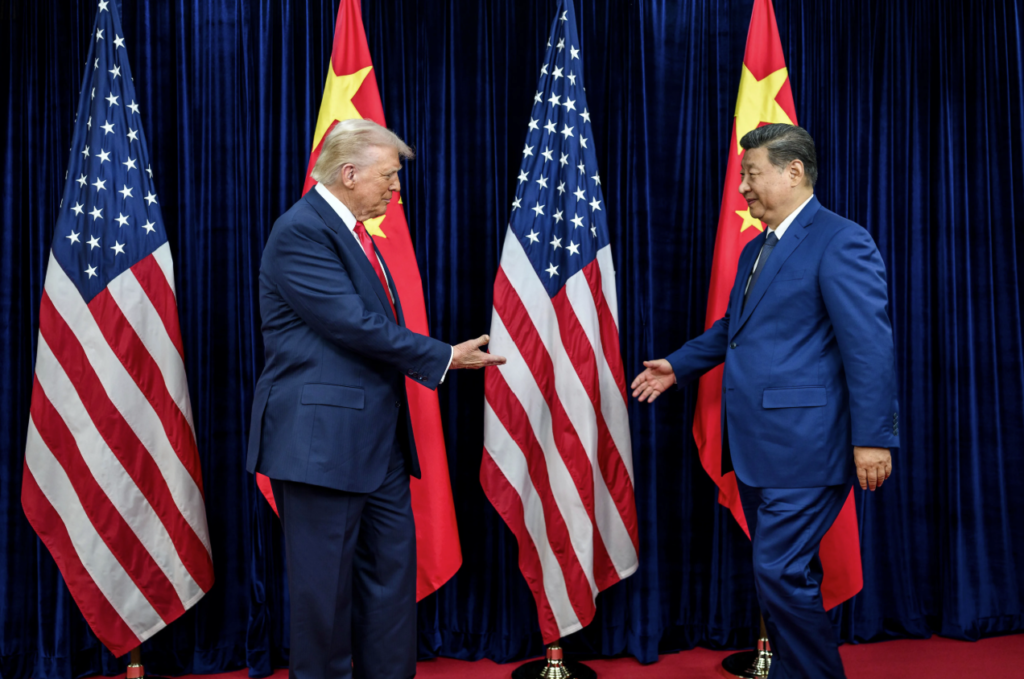
The Chinese president arrived Wednesday, September 23, at Joint Base Andrews in Maryland for a three-day state visit, his first to Washington in more than a decade and the second meeting this year between the two leaders, following Trump’s trip to Beijing in May. Trump personally greeted him, something a U.S. president hadn’t done at that base since Barack Obama welcomed Pope Francis in 2015, according to a C-SPAN tally cited by Reuters. The ceremony included a cannon salute, a military band, and a flyover by a B-1 bomber. The program includes a military ceremony at the White House, a state dinner with leading figures in the U.S. technology industry—including Tim Cook, Jeff Bezos, Sundar Pichai, Sam Altman, Elon Musk, and Jensen Huang—and a joint visit to the National Archives on Friday. The Chinese delegation includes Cai Qi, a member of the Politburo Standing Committee, and Foreign Minister Wang Yi.
Coinciding with his arrival, Treasury Secretary Scott Bessent announced on Fox News the extension of the trade truce—which was set to expire on November 10—until January 10, acknowledging that he did not know whether a broader agreement would be possible or if the current one would simply be renewed. The extension allows both leaders to meet again at the APEC (Asia-Pacific Economic Cooperation) summit in China in November and in Florida in December. In a written message released by the official Xinhua news agency, Xi stated that both countries should be “partners, not rivals” and that the “great rejuvenation of the Chinese nation” and Trump’s “Make America Great Again” slogan can move forward hand in hand.
According to sources cited by Reuters, Xi will pressure Washington to suspend arms sales to Taiwan, while Trump is expected to maintain export controls on advanced technology that Beijing wants to relax. Not all Republicans are applauding: Senate Armed Services Chairman Roger Wicker criticized the lavish reception on the Senate floor, and former diplomat Danny Russell, now with the Asia Society Policy Institute, called it a propaganda victory for Beijing.
Implications
Hudson Lockett’s column in Reuters Breakingviews, which the author of this report largely endorses, argues that the best possible outcome of this summit is the absence of major agreements. Trump arrives with rock-bottom approval ratings, a protracted war with Iran, and midterm elections in which the Democrats are the frontrunners; any concession that could be interpreted as weakness toward China would carry immediate political repercussions. According to the same source, around 70% of investors surveyed by Goldman Sachs expect a symbolic or inconsequential visit, and none anticipate a negative outcome.
The problem lies not in what is signed, but in what is conceded without being signed. Breakingviews points out that Washington has frozen arms sales to Taipei since the May summit, a unilateral concession that Beijing has pocketed without any visible return. For Japan, the Philippines, Australia, and Taiwan itself, the personalization of Chinese policy in the figure of the president—who has reserved this matter as his exclusive prerogative—is a cause for concern: it neutralizes the more hardline elements within his own administration and transforms the relationship with the world’s leading rival into a personal relationship between equals, precisely the framework Xi desires.
There are two implications worth highlighting. The first is Iran: China is the main buyer of Iranian crude oil and Tehran’s economic and diplomatic backbone, and Washington lacks the leverage to force Beijing to respect its sanctions. The second is industrial. Trump has even said he wouldn’t mind Chinese automakers producing in the United States if they hire local workers, and the Chinese delegation could include executives from BYD (Build Your Dreams), Xiaomi, and CATL (Contemporary Amperex Technology Co. Limited). If Washington opens that door, Europe—which has already handed China the keys to batteries, solar panels, and electric motors by decreeing the end of the combustion engine by 2035—would be caught between two giants negotiating above its head. It’s also worth remembering that a tariff truce is not free trade: it’s the temporary suspension of a trade war that should never have been declared with such intensity.
Perspectives and scenarios
Central scenario (high probability, around 60%): a summit of gestures. Extension of the truce, commitments to agricultural purchases, some dialogue mechanism on artificial intelligence, and declarations of goodwill without formal changes in the position on Taiwan. This is the least bad outcome.
Risk scenario (around 25%): Trump makes a verbal concession on Taiwan—for example, shifting from “not supporting” independence to “opposing” it—or effectively confirms the freeze on arms sales in exchange for Chinese purchases. The damage to US credibility in the Indo-Pacific would be long-lasting.
Friction scenario (around 15%): Iran, technology controls, or an incident in the Taiwan Strait could dampen the visit. Indicators to watch: the language of the final communiqué on Taiwan, what happens at the National Archives on Friday, the reaction of Wicker and congressional hawks, and the Russian proposal, leaked this month by a Kremlin advisor, for a trilateral Trump-Xi-Putin summit in Shenzhen in November, which would only benefit Moscow and Beijing.
2. Artificial intelligence arrives at the Security Council
Facts
The Security Council held a session on artificial intelligence and international security on Wednesday, the 23rd, chaired by the French Minister for Europe and Foreign Affairs, Jean-Noël Barrot. Speakers included Sam Altman, CEO of OpenAI; Dario Amodei, CEO of Anthropic; Clément Delangue, co-founder of Hugging Face; and Yoshua Bengio, a pioneer in deep learning and co-chair of the Independent International Scientific Group on AI, established last year by the General Assembly. Amodei warned that, if mismanaged, artificial intelligence could pose a risk to humanity as a whole. Altman argued that the most important decisions cannot be made solely by laboratories in San Francisco, but rather by democratic processes and governments accountable to their citizens, and he advocated for common benchmarks to measure capabilities and safeguards. Bengio described the dangers as “real and imminent” and spoke of a threat that no single member of the Council can contain alone and that respects no borders.
A European diplomat summarized the session’s objective, according to Reuters, as follows: to determine whether a war could one day be triggered by interacting algorithms. The day before, in his address to the General Assembly, Trump had rejected any attempt to construct a “globalist scheme” to control artificial intelligence, asserted that the United States is “far ahead” of China, and promised to foster the technology, not stifle it, by monitoring it through the Department of Justice. Meanwhile, Washington and Beijing have explored a system for reporting AI-related incidents that reach the threshold of national security, and Bessent proposed a new bilateral dialogue on the matter to his counterpart, He Lifeng, in New York, given that the one announced after the May summit failed to get off the ground.
Implications
Artificial intelligence has definitively entered the realm of high politics, just as nuclear energy did in the mid-20th century. The difference is unsettling: back then, states possessed the technology and scientists warned them; today, private companies develop it and ask governments to impose limits. The Security Council, paralyzed by the vetoes of Russia and China, and now also by the US rejection of any binding multilateral framework, is unlikely to produce anything more than declarations.
The concrete risk is not science fiction, but gray warfare: automated cyberattacks against critical infrastructure—the coordinated attack against more than thirty water networks in Minnesota, analyzed in this report on July 29, was a warning—, industrial-scale disinformation campaigns, weapons systems with increasing degrees of autonomy, and military decision-making chains compressed to the point of removing human intervention. The European diplomat’s question is not rhetorical.
Europe, once again, has presided over the conversation without taking center stage. France led the session, but none of the companies that spoke are European. The European Union was the first to regulate, with its artificial intelligence regulations, and the last to produce champions capable of competing at the technological frontier—a sequence that bears a striking resemblance to what happened with electric vehicles. Spain, which boasts its own supervisory agency, is neither present nor expected to be part of this discussion.
Perspectives and scenarios
Central scenario: no Security Council resolution; the only tangible outcome, if any, will be a bilateral Sino-American incident notification mechanism, the contemporary equivalent of the “hotline” that Washington and Moscow agreed upon in June 1963 after the Cuban Missile Crisis. It would be little, but it wouldn’t be nothing.
Breakdown scenario: a serious incident attributable to autonomous systems—a cyberattack with casualties, a detection error in a defense system—precipitates regulations that no one wants to negotiate today. History teaches us that arms control regimes usually emerge after a scare, not before.
Indicators: whether the Trump-Xi summit explicitly mentions artificial intelligence in its statement, the monitoring of the Independent Scientific Group and the position adopted by the European Union, which has the opportunity to move from regulator to strategic actor if it decides to invest in its own capacity instead of just legislating on that of others.
3. Venezuela: the electoral promise of the usurper president
Facts
On Tuesday evening, April 22, Trump hosted Delcy Rodríguez at the Lotte New York Palace Hotel during a reception for foreign leaders on the occasion of the UN High-Level Week. The meeting was held behind closed doors, without press access, and was attended by Secretary of State Marco Rubio, Treasury Secretary Scott Bessent, Chief of Staff Susie Wiles, and Deputy Chief of Staff Stephen Miller. It is the first high-level meeting between Washington and Caracas since Bill Clinton received a newly elected Hugo Chávez in 1999. Rodríguez described the meeting as “historic” and spoke of cooperation in energy, mining, and security; Rubio later indicated that the electoral issue was also discussed. That same day, María Corina Machado, who has been out of the country since December 2015, failed for the seventh time in her attempt to return to Venezuela: her team alleges that the regime is restricting airspace to prevent her.
The following day, in the first speech by a Venezuelan president before the General Assembly since 2018, Rodríguez affirmed that there would be elections in Venezuela as part of a transition to full democracy, under equal conditions for all political forces, but he did not specify a date. He added that the most solid transitions do not arise from rupture, but from orderly legal reform, and praised the agreement with the United States for the transfer of part of Venezuela’s oil reserves as one of the largest ever signed. He also invoked contacts between his brother Jorge Rodríguez, president of the National Assembly, and Dinorah Figuera, president of the Parliament elected in 2015, in which an agreement was allegedly reached to renew the Supreme Court (TSJ) and the National Electoral Council (CNE).
The day before, from the same podium, Trump had claimed credit for the January 3rd operation that resulted in the capture of Nicolás Maduro and had justified the US management of Venezuelan oil with the adage that the victor gets the spoils. As the BBC notes, the regime has released hundreds of political prisoners and announced the closure of the El Helicoide torture center, but has avoided specifying when the vote will be held, despite the constitutional deadline for calling it having long since passed.
Implications
It is impossible to believe in the impartiality, transparency, and fairness of elections called and managed by the same apparatus that perpetrated the fraud of July 28, 2024, when the democratic opposition clearly won, according to the consensus of the international community. The promise of “equal conditions” is belied the moment it is uttered: the leader who embodies the 2024 victory cannot even land in her own country. The renewal of the Supreme Court and the National Electoral Council, negotiated by Jorge Rodríguez—who presided over the CNE itself in 2005 and 2006 and has been Chavismo’s electoral strategist for two decades—is the guarantee that nothing will change, even though everything will appear to change.
Giving away oil to the United States doesn’t transform a narco-dictatorship into a respectable regime. Delcy Rodríguez was Maduro’s vice president from 2018 and a central figure in a system that has turned the Venezuelan state into a platform for drug trafficking and transnational organized crime. Spaniards also remember her stopover at Barajas Airport in January 2020, when she set foot on European soil despite the entry ban against her. The smiling photo with the US president, flashing a victory sign, is her biggest political success since January.
Criticism of the White House’s transactional foreign policy is essential here. The capture of Maduro was a legitimate and necessary blow against narcoterrorism, but its outcome cannot be the exchange of a dictator for his vice president in return for oil. The “loot” mentality is unbecoming of the nation that won the Cold War defending freedom, and Machado’s exclusion from the equation is a strategic error that fuels the narrative of those who accuse Washington of acting solely for the sake of oil. Hope, once again, rests on Rubio—who knows Venezuela better than most in Washington—and Congress imposing the electoral calendar that the president seems willing to postpone.
Perspectives and scenarios
Central scenario (most likely): a superficial, superficial transition. Elections postponed to 2027 or later, with a controlled National Electoral Council, a fragmented opposition, and Machado out of the country, tolerated by Washington as long as the oil keeps flowing.
Democratizing scenario: Pressure from Rubio, Congress, and the region forces a date to be set with credible international observers—the European Union and the OAS (Organization of American States)—and allows Machado’s return. This would be the only way to legitimize the January operation after the fact.
A scenario of internal rift: the contradiction between Delcy Rodríguez’s promises and the interests of the most hardline sectors of Chavismo and the military leadership is causing internal tensions. Indicators: announcement of the election date, composition of the new National Electoral Council (CNE), Machado’s return, and Rubio’s statements after the meeting.
4. Iran at the UN podium: the absurdity of the seven demands
Facts
On Tuesday, June 22, on the sidelines of the General Assembly, the United States and Iran held their first indirect contact since the collapse of the June ceasefire, exchanging messages for about two hours through Qatari mediators. Trump described it as a “very productive” three-hour meeting, and Special Envoy Steve Witkoff spoke of a round he hoped would be “constructive and promising.” The following day, Iranian Foreign Ministry spokesman Esmail Baghaei lowered expectations—”it was nothing new”—and listed on the X network the conditions conveyed: acceptance of the “safe passage” through the Strait of Hormuz agreed upon by the two riparian states, Iran and Oman; an end to “economic terrorism” and the US naval blockade; the release of frozen assets; and an end to the war “on all fronts.” A senior Iranian official had assured Reuters that the strait could be reopened within seven days if Washington eased the pressure and lifted the blockade.
On Wednesday, Pezeshkian delivered his first speech to the General Assembly since the start of the war on February 28. The US delegation left the room as he began to speak. The Iranian president displayed portraits of the late Supreme Leader Ali Khamenei and of the victims of the Minab school bombing, stated that he had revised his draft speech after listening to Trump, proclaimed that Iran is not seeking nuclear weapons but will not accept limits on “peaceful” nuclear technology, and warned that his country will not allow freedom of navigation through the Strait of Hormuz while sanctions and the blockade remain in place, because it cannot accept that everyone benefits from the strait while its “historic guardian” is deprived of it. At almost the same time, the secretary of the Supreme National Security Council, Mohsen Rezaei, announced on state television a “new framework” for negotiations that requires Washington to make the first move, and the ultraconservative MP Ebrahim Rezaei demanded that the Foreign Minister explain what authorization he had for meeting with the “aggressor enemy.”
European Council President António Costa met with Pezeshkian and asked him to halt attacks against neighboring countries, restore freedom of navigation in the Strait of Hormuz, and resume cooperation with the IAEA (International Atomic Energy Agency), whose inspections of bombed facilities Tehran continues to reject. Another vessel was hit by a projectile in the strait, Brent crude approached $100 a barrel, and the Iranian military command described Trump’s threats as “strategic desperation.” On Monday, the G7 foreign ministers demanded that Iran stop arming the Houthi terrorists, whose attacks against Saudi Arabia they condemned in the strongest terms.
Implications
The detailed analysis of each of the seven demands was already published on September 22nd, so it suffices here to reiterate what the events of the last few hours confirm: we are facing an absolute absurdity, a kidnapper’s list of demands. The aggressor demands to be compensated for the consequences of its own aggression. The US naval blockade is not the cause of the Hormuz crisis, but its direct consequence. The “safe route” agreed upon only with Oman amounts to claiming de facto co-sovereignty—and a toll—over an international strait subject to the transit passage regime established by Part III of UNCLOS (United Nations Convention on the Law of the Sea). The “end of the war on all fronts” is a shield of immunity for Hezbollah and the Houthi terrorists, precisely when they are attacking Riyadh and controlling Mocha and the approaches to Bab el-Mandeb. What is not being talked about —nuclear program, ballistic missiles, network of proxy terrorist organizations— is exactly what matters.
The most revealing fact of the day is not the content of the speech, but who wrote it. Pezeshkian, the leader most inclined toward a negotiated solution, took to the podium to read the hardliners’ script, while Rezaei contradicted him from Tehran with his “new framework,” and a member of parliament questioned the very legitimacy of contact with Washington. This confirms what was stated in yesterday’s report: real power in the jihadist oligarchy lies in the hands of Mohsen Rezaei and General Ahmad Vahidi, for whom low-intensity warfare is a tool for internal consolidation in a system currently without leadership. The gesture of displaying the portrait of Khamenei, architect of four decades of state terrorism, alongside that of the children of Minab is obscene. Every civilian victim deserves respect and a rigorous investigation, but using their memory to whitewash those who turned Iran into an exporter of terror is a propaganda operation that the West should not leave unanswered.
This report also confirms the thesis it has been maintaining since the spring: the undeniable tactical and military success of the campaign against Iran is countered by an unmitigated geostrategic failure. Seven months later, the Strait of Hormuz remains partially closed, the Red Sea has become a second front, oil is hovering around $100 a barrel, and the regime, far from imploding, has hardened its power base. The lack of a plan for the aftermath continues to take its toll.
Perspectives and scenarios
Central scenario (around 55%): “negotiate while fighting.” Indirect contacts continue through Qatar and Pakistan without substantive progress before the US elections on November 3; intermittent attacks in the Strait of Hormuz and the Red Sea; Brent crude between $95 and $110.
Partial agreement scenario (around 25%): gradual reopening of the strait in exchange for a partial relaxation of the blockade, fragile and exposed to sabotage by the IRGC (Sepâh-e Pâsdârân-e Enqelâb-e Eslâmi, Islamic Revolutionary Guard Corps).
Escalation scenario (around 20%): Trump opts for the threat of “annihilation” pronounced at the General Assembly, with new massive attacks, an Iranian response against Gulf facilities, and an intensification of the Houthi campaign against Saudi Arabia. Indicators: CENTCOM (United States Central Command) statements, the next moves of Qatari mediators, Houthi attacks, and the political fate of Minister Araghchi in Tehran.
III. MEDIA RACK
Reuters presents the Trump-Xi summit as a meeting of much symbolism and little substance, in which both leaders want to project stability despite the underlying rivalry; it highlights the concern of Asian allies about the possibility that Trump will soften support for Taiwan and predicts that he will maintain technological controls.
Reuters Breakingviews. Hudson Lockett argues that any major agreement would hurt Trump before the midterm elections and that the limbo of frequent summits benefits Beijing because it deprives Washington of a coherent China policy until the end of the term in 2029.
AP (Associated Press). It highlights the exceptional welcome at the foot of the plane, the extension of the truce until January 10, and Trump’s desire to match the pomp with which he was received in Beijing; on the Iranian front, it notes that Tehran downplays the importance of the contact with Washington and that another ship was hit in Hormuz.
CNN describes Pezeshkian’s speech as the presentation to the world of Tehran’s demands from the enemy country and highlights the scrutiny that hardliners subject those who negotiate with Washington to; it also covers Costa’s meeting with the Iranian president.
Bloomberg. It focuses on Iran’s refusal to allow freedom of navigation in the Strait of Hormuz while sanctions and the blockade remain in place, illustrating the difficulty of any agreement.
CNBC considers Baghaei’s list predictably unacceptable to Washington, whose stated goal is to prevent Iran from obtaining nuclear weapons, and continues to track Brent crude trading around $100.
Al Arabiya. It headlines with Pezeshkian’s challenge —Iran will not yield— and highlights the departure of the US delegation from the room at the beginning of the speech.
Al Jazeera details the staging of Xi’s arrival, with gun salutes and a B-1 flyover, and lists the Iran-Contra war, trade, artificial intelligence, and Taiwan as likely topics of discussion.
China Daily (and Xinhua) disseminate Xi’s written message, “partners, not rivals,” and the formula that reconciles Chinese rejuvenation with the Trumpian slogan; the official message omits any reference to Taiwan or Iran.
BBC (BBC Mundo). It emphasizes that Delcy Rodríguez did not set an election date despite the fact that the constitutional deadline for calling elections has already passed, and that she praised the controversial oil agreement with the United States.
IV. RISK TRAFFIC LIGHT
| Risk | Level | Trend | Comment |
|---|---|---|---|
| Strait of Hormuz and the US-Iran War | ● High | Stable | Indirect contacts without progress; Tehran hardens conditions and rejects freedom of navigation. |
| Red Sea and Bab el-Mandeb (Houthi terrorists) | ● High | Upward | Houthi control of Moca; attacks against Saudi Arabia; G7 demands on Iran. |
| Oil price | ● Medium-high | Upward | Brent crude is around $100; every incident in Hormuz pushes it higher. |
| Taiwan at the Trump-Xi summit | ● Medium | Upward | Gun sales freeze since May; risk of verbal concession. |
| US-China trade relationship | ● Low in the short term | Stable | Truce extended to January 10; underlying imbalances unresolved. |
| Artificial intelligence governance | ● Medium | Upward | Without a multilateral framework; possible bilateral incident notification mechanism. |
| Legitimizing the Chavista regime without elections | ● High | Upward | Promise without a date; Machado blocked for the seventh time; Washington’s backing. |
| US midterm elections (Nov. 3) | ● Medium | Upward | They are setting conditions for the summit with China and the negotiations with Iran. |
| European strategic irrelevance | ● Medium | Stable | Europe presides and regulates, but does not decide on AI, Iran or China. |
V. EDITORIAL COMMENTARY
Trust, but verify.
On December 8, 1987, in the East Room of the White House, Ronald Reagan and Mikhail Gorbachev signed the Intermediate-Range Nuclear Forces Treaty (INF Treaty) and repeated to his counterpart a Russian proverb he had learned for the occasion: “Doveryai, no proveryai”—trust, but verify. Gorbachev joked that the president quoted it at every meeting, and Reagan replied that he liked it. Behind the anecdote lay an entire doctrine: negotiations with regimes that are not accountable to anyone are only fruitful when each commitment includes a mechanism to verify its compliance. The greatest American president of the second half of the 20th century never confused cordiality with naiveté, nor agreement with surrender.
The past week in New York and Washington has been a catalog of unverifiable promises. Xi Jinping arrives speaking of partnership while his country buys the crude oil that finances Iran’s war machine, militarizes the South China Sea, and aspires to control global rare earth supply chains. Delcy Rodríguez announces full democracy without a date, without an independent arbiter, and with the opposition candidate stranded in Panama. Masoud Pezeshkian swears that Iran is not seeking nuclear weapons while his regime prevents IAEA inspectors from accessing bombed facilities. Even the artificial intelligence laboratories themselves, with more honesty than the previous three, acknowledge that their systems could escape their control and ask for someone to monitor them. In all four cases, the same thing is missing: verification.
In “The Power of the Powerless” (1978), Václav Havel described the greengrocer who displayed a sign in his shop window reading “Workers of the world, unite!” without believing a word of it, simply because it demonstrated his submission and bought him peace of mind. The entire fiction of the regime rested on millions of small gestures of this kind, on living within a lie. Delcy Rodríguez’s campaign promise is the greengrocer’s sign raised to the podium of the United Nations: no one in Caracas believes that the apparatus that stole the 2024 elections will organize a clean sweep, but the phrase serves its purpose, which is to buy time, legitimacy, and petrodollars. The serious issue is not that the dictatorship lies—it’s in its nature—but that democracies pretend to believe it.
Criticism of Washington is inevitable here, and it must be made from a perspective of transatlantic friendship. Maduro’s capture was an act of justice against a narco-terrorist, but the phrase “the victor shall have the spoils,” uttered at the General Assembly, contradicts everything for which the United States was admired during the Cold War. Reagan did not liberate Central Europe in exchange for barrels of oil, nor did he greet the Warsaw Pact leaders with a victory sign. Transactional foreign policy can extract tactical concessions—the Greenland agreement demonstrates this—but when the object of the transaction is the freedom of a people, the price is paid by the credibility of the power negotiating it. There remains the hope that the American institutional system, with Marco Rubio at the helm of diplomacy and a Congress that is already beginning to raise its voice, will impose the condition that the president seems willing to forget: an election date, an independent National Electoral Council (CNE), credible international observation, and the return of María Corina Machado.
With China, Reagan’s lesson is even more relevant. The best possible summit is one that doesn’t produce major agreements, because major agreements with Beijing are rarely honored. The Chinese regime joined the World Trade Organization in 2001 and has spent a quarter of a century violating the spirit of its commitments; it signed the Joint Declaration on Hong Kong in 1984 and emptied it of its content in 2020. A tariff truce that can be renewed every few months is preferable to a grand promise on Taiwan, and the silent freeze on arms sales to Taipei is precisely the kind of unilateral and unverifiable concession that a Reagan-era negotiator would never have made.
In the case of Iran, the principle is almost self-evident. A regime that for two decades concealed facilities from the IAEA, enriched uranium far beyond any civilian need, and whose Secretary of the Supreme National Security Council is wanted by Interpol for the 1994 AMIA (Argentine Israelite Mutual Association) bombing, cannot expect the embargo to be lifted, its assets returned, and its terrorist organizations to be granted immunity in exchange for a promise to reopen the Strait of Hormuz in seven days. The correct sequence is the reverse: first, the unconditional and verifiable reopening of Hormuz; then, everything else.
Then there is artificial intelligence, where the verification problem is of a different nature. Norbert Wiener, the father of cybernetics, warned in 1960 in the journal Science that if we use a mechanical agent to achieve our ends, an agent whose functioning we cannot effectively intervene in, we had better be very sure that the purpose programmed into the machine is the one we truly desire. Sixty-six years later, that warning has reached the Security Council. The difference with Reagan’s missiles is that today’s systems cannot be counted from a satellite; their verification requires technical transparency, independent testing, and cooperation between rivals who today distrust each other. If at least a Sino-American incident notification mechanism emerges from this week’s summit, it will be the first brick in a building that will take years to erect, just as nuclear arms control took years to build, from the hotline of 1963 to the INF Treaty of 1987.
Europe, meanwhile, observes all of this from the presidency of the sessions, not from the decision-making table. It holds the presidency of the Council when artificial intelligence is discussed, despite not having any companies at the technological forefront; it meets with Pezeshkian to urge restraint, despite not possessing a single naval lever in the Strait of Hormuz; it watches the US-China summit, knowing that its automotive industry and access to rare earth elements depend on it. Spain, for its part, is neither present nor expected. To trust, but also to verify, requires having the means to verify: satellites, intelligence, industrial capacity, and political will. This is precisely what the European political class of the 21st century has lacked.