Gustavo de Arístegui,
September 25, 2026
I. INTRODUCTION
The day offers a stark contrast that brutally summarizes the state of the world at the end of September 2026. In Washington, the White House deployed troops in wigs and tricorn hats, fighter jets and bombers flying low, and hosted a gala dinner with the biggest names in American technology to welcome Xi Jinping, yet the summit yielded not a single substantive breakthrough on trade, Taiwan, artificial intelligence, or the Iran-Iraq War. Just a few hundred kilometers away, in New York, American and Iranian negotiators are exploring a phased exit from a conflict that has now dragged on for nearly seven months, stuck on the same old question: who will be the first to relinquish their instrument of pressure. Meanwhile, in the southern Arabian Peninsula, the Houthi terrorist organization has launched dozens of missiles and drones against Saudi Arabia, which has intercepted six ballistic missiles and issued emergency alerts for Mecca, Jeddah, and Yanbu. Riyadh has politically activated its collective defense pact with Turkey and Pakistan, the kingdom’s Grand Mufti has called on soldiers to be prepared to sacrifice their lives, and a high-ranking Iranian military commander has threatened to extend the war to the Indian Ocean if his country is attacked again. Brent crude has once again surpassed one hundred dollars a barrel. The common thread in this report is geographical rather than diplomatic. The war that began on February 28 with the US and Israeli attacks against Iran has ceased to be a Persian Gulf conflict and has become a war fought in two straits, Hormuz and Bab el-Mandeb, with a latent threat looming over a third arena, the Indian Ocean. The oligarchic-jihadist regime in Tehran knows what it wants and acts accordingly; Washington maintains military superiority but remains undecided about the outcome; China observes, collects its profits, and takes no risks. The four news items that follow are pieces of that same puzzle.
II . NEWS FROM THE LAST 24 HOURS
1. Iran: A war with no end in sight and a phased negotiation in New York
The Economist opens its daily summary with a stark diagnosis: there is no end in sight to the Iran-Iraq War. On the same day, Reuters, in a report by Samia Nakhoul, Parisa Hafezi, and John Irish, based on two Iranian sources, two regional officials, and two Western diplomatic sources, reveals that US and Iranian negotiators meeting in New York on the sidelines of the UN General Assembly are exploring a phased exit strategy: Tehran would reopen the Strait of Hormuz, and Washington would lift the economic blockade that is crippling the Iranian economy, with the added possibility that Iran would regain access to some of its frozen assets.
The obstacle is textbook: neither side wants to be the first to relinquish its leverage. A senior Iranian official explained that the first stage would consist of ending the blockade and reopening the Strait of Hormuz, which would force Donald Trump to accept another interim arrangement after a previous understanding collapsed in July. The same official warned that Iran is preparing for the possibility of a renewed war, stating that
“We have our finger on the trigger,” he said, adding that the chances of diplomatic success were extremely low due to what he considered excessive demands from Washington.
According to regional sources, Tehran would be willing to remove its demand for tolls for transit through the Strait of Hormuz from the main agreement and place it in an annex, because lifting the blockade has become its priority. The Gulf states categorically reject any tolls, and the same sources emphasize that the arrangement would be temporary and would not represent a formal renunciation of Iran’s position. One of Reuters’ interlocutors put it succinctly: Iran may postpone the toll issue, but it does not intend to relinquish administrative control of the strait.
On Thursday, Foreign Minister Abbas Araqchi outlined to the press the proposal conveyed to Washington through intermediaries, with Qatar serving as the primary channel. According to his plan, hostilities would cease on all fronts, including Lebanon, within seven days; the United States would lift the blockade of Iranian ports, release frozen funds, and suspend oil sanctions; the Strait of Hormuz would reopen on the final day, and only then would talks begin on the nuclear program and other outstanding issues.
The White House responds with a mixture of disdain and calculation. A US official declared that Iran is desperate for a deal, that Trump holds all the cards, that the Iranian economy is sinking under the sanctions and blockade, and that the president is content to let Iran’s collapse run its course rather than be manipulated. Trump himself has suggested that a deal could come after the November 3 midterm elections. Former US negotiator Dennis Ross estimates the likelihood of a deal before then at only 30 percent, though he maintains that both sides would have more incentive to reach an agreement sooner rather than later.
Economic pressure continues to mount. Washington has broadened the scope of its sanctions against third-country companies that trade with Iran—so-called secondary sanctions—and this month targeted Iranian commercial airlines and their support networks. On Thursday, the United Arab Emirates and Oman banned flights from Iranian carriers, the first visible effect of this shift. The Gulf leaders, meeting with Trump in New York, asked him for clarity on his strategy beyond the election and conveyed their collective rejection of any Iranian control of the Strait of Hormuz. Meanwhile, according to the official Chinese news agency Xinhua, Xi Jinping expressed his support in Washington for the United States and Iran to return to a ceasefire and negotiate peace, with no indication that Beijing is willing to pressure Tehran.
Implications
The key to Araqchi’s scheme lies not in its content, but in its sequence. Iran would first obtain everything it cares about—namely, the end of the blockade, the release of funds, the suspension of oil sanctions, and the cessation of operations against Hezbollah in Lebanon—and would hand over the Strait of Hormuz last, leaving the nuclear program for later negotiations in which it would have nothing left to lose. This is precisely the inversion of the logic of verification:
The regime collects upfront and promises to pay later. The seven Iranian demands, already analyzed in previous reports, thus reappear with a different, more presentable, and more dangerous veneer, because they are now presented as a reasonable roadmap.
The issue of tolls deserves special attention. Moving them to an annex is not a concession, but a tactical postponement that preserves the essential element: the claim to “administrative control” over an international strait. This claim clashes head-on with the transit passage regime established by the UNCLOS (United Nations Convention on the Law of the Sea) for straits used for international navigation, a regime that Iran signed in 1982 but never ratified. Accepting, even implicitly, that Tehran administers the Strait of Hormuz would amount to legitimizing the system of extortion that the regime has built since the beginning of the war.
The symmetry of the levers of power explains the deadlock in negotiations. Washington controls the pressure that does the most damage to Iran; Iran controls a waterway through which, before the war, a fifth of the world’s oil flowed. The US election calendar, however, introduces an asymmetry in favor of Tehran, which accurately interprets Trump’s need to lower gasoline prices before November 3. Former Israeli military intelligence analyst Danny Citrinowicz sums it up well: Iran will not back down as long as it believes the president wants to avoid an escalation before the elections. At the same time, former negotiator Alan Eyre warns that the deadlock, far from softening the regime, could push it to escalate, because its leaders believe that giving in is tantamount to death.
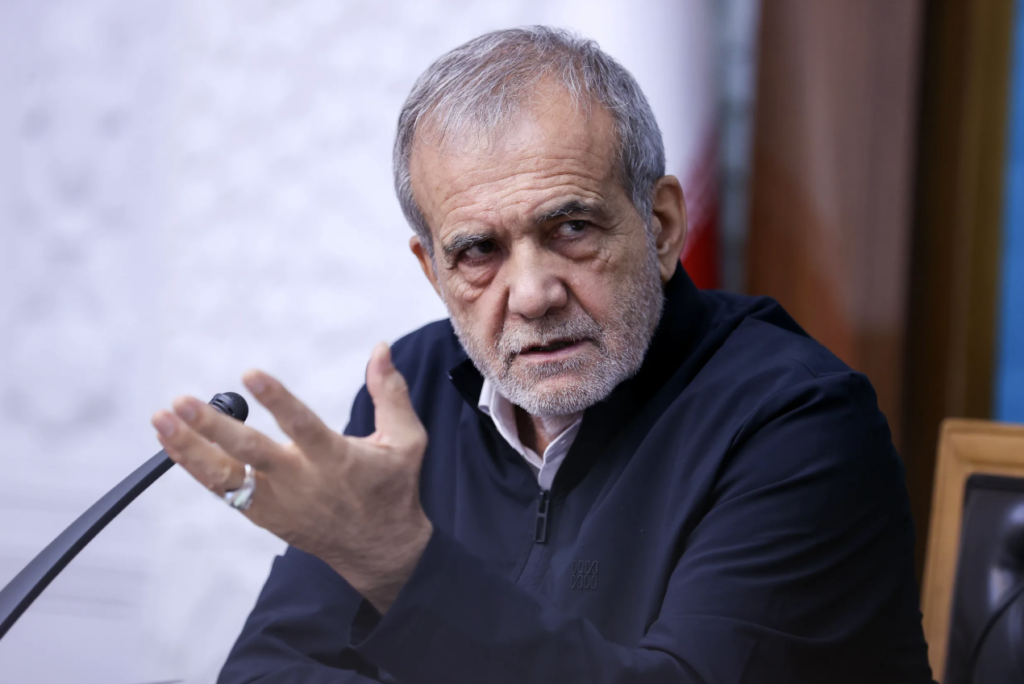
The Iranian official’s remark about the finger on the trigger also has an internal interpretation. While Pezeshkian and Araqchi’s diplomacy seeks a solution in New York, the power centers that control the military machine—whose strategy of deliberately maintaining hostilities has been analyzed in previous reports—retain their capacity to sabotage any agreement. The negotiation is not only taking place between Washington and Tehran, but also within the regime itself.
Finally, the White House’s attitude confirms the thesis this report has been arguing for months. Tactical and military success is countered by an unmitigated geopolitical failure, because betting on Iran’s “inevitable collapse” is not a strategy, but a hope. No one has explained what would happen the day after a disorderly implosion of the regime: who would control the missile arsenals, what the IRGC (Islamic Revolutionary Guard Corps) units would do without central command, how to prevent Hormuz and Bab el-Mandeb from falling into the hands of factions without a central authority. The president of the Emirates Policy Center in Abu Dhabi, Ebtessam al-Ketbi, articulated it with a clarity that should unsettle Washington: the Iranians know what they want and are reshaping the regional landscape through Hormuz and Bab el-Mandeb, while the United States has yet to define its roadmap.
Perspectives and scenarios
Scenario A. Phased interim agreement before November 3 (estimated probability: 25-30%). Partial lifting of the blockade in exchange for a gradual reopening of the Strait of Hormuz, with tolls postponed in an annex and the nuclear issue deferred. This would be a relief for the markets and for Trump, but it would replicate the fragility of the July agreement and leave Iran’s claim to control the strait intact.
Scenario B. Negotiated stalemate until after the elections (estimated probability: 45-50%). Intermittent talks through Qatar, blockade and secondary sanctions in place, and Iranian pressure shifted to its proxy terrorist organizations, particularly the Houthis in the Red Sea and pro-Iranian groups in Iraq. This is the most likely scenario and the most costly for Saudi Arabia.
Scenario C. Rupture and resumption of direct hostilities (estimated probability: 20-25%). A serious incident at Bab el-Mandeb, in the Strait of Hormuz, or in the Indian Ocean, or a calculation by Washington now free from electoral constraints, would reactivate direct attacks. Ross warns that, after the election, Trump would have fewer ties to intensify pressure or resort to military options.
Indicators to monitor: continuity of the Qatari canal, effective transits of oil tankers through Hormuz, expansion of flight bans on Iranian airlines and any movement of the US naval deployment outside the Persian Gulf.
2. The Trump-Xi summit in Washington: much fanfare, no progress
Facts
Donald Trump hosted Xi Jinping at the White House on Thursday, marking the Chinese president’s first visit to Washington in more than a decade and their second meeting this year, following Trump’s trip to Beijing in May. Reuters described the summit as laden with symbolism but lacking substance, with no progress on thorny issues such as artificial intelligence, trade, Taiwan, and the Iran-Contra affair. The meeting took place in Washington while dozens of heads of state and government were in New York for the General Assembly.
The staging was the main attraction. Troops in wigs and tricorn hats paraded in a Rose Garden redesigned to resemble a Trump golf club, fighter jets and bombers flew over the ceremony with such a roar that one of them startled the president, and the accredited press were summoned not to hear the two leaders discuss matters of state, but to watch them tour Marine One, the new White House helipad, and the construction site of the future ballroom. When asked about the content of the meeting, Trump replied that Xi loves good granite and that it had been a great meeting. American television networks refused to broadcast the proceedings live in protest against the exclusion of CNN, MS Now, and Politico from White House coverage. Among those seated at the state dinner were Tim Cook, Jeff Bezos, Sundar Pichai, Sam Altman, Elon Musk, and Jensen Huang, while outside, a group of protesters chanted slogans for Hong Kong freedom.
On the trade front, Treasury Secretary Scott Bessent announced that both sides have extended the truce that ended last year’s trade war, which was set to expire in November, by only two months. The core issues—tariffs, Chinese purchases, rare earth supplies, and technology restrictions—are being postponed until the next round of talks. Bessent acknowledged that Beijing is fulfilling its commitment to buy 25 million tons of soybeans, but is behind schedule on the $17 billion promised for other agricultural products, and U.S. officials admit that rare earth deliveries are also falling short. Sources familiar with Washington’s plans anticipate that Trump will maintain the export controls on U.S. technology that Xi Jinping wants to relax.
Regarding Taiwan, according to Xinhua, Xi asked the United States to handle the issue “prudently” and to oppose the island’s independence, a tougher stance than the
The traditional US position of “not supporting” independence. The White House did not immediately release its own statement. It is worth recalling that, after his trip to Beijing in May, Trump put a $14 billion arms package for Taiwan on hold, calling it a “very good bargaining chip,” which worried Asian allies and some Republicans.
Xi Jinping again invoked the “Thucydides Trap,” the thesis that rivalry between an emerging power and an established one tends to lead to war, and asserted that this risk can be overcome. He called for regular military dialogue and stronger crisis prevention mechanisms. Trump, for his part, evoked the alliance between the two countries against Japan in World War II. On artificial intelligence, positions diverged sharply: Trump, who proposes calling it “superintelligence,” wrote on social media that he wants to leave it exactly as it is and rely on the Justice Department rather than new safeguards; Xi maintained that both powers have the capacity and the responsibility to ensure that its development always remains under human control. In the toast, Trump declared that they had never gotten along better; Xi spoke of a “new approach” to coexistence between great powers and a “new strategic direction” for the bilateral relationship, without specifying what this entails.
Implications
The summit portrays two opposing conceptions of power. Edgar Kagan, former White House advisor on East Asia and now at the Center for Strategic and International Studies (CSIS), aptly summarized it: Trump presents the relationship as a matter of personal friendship with Xi, while Xi insists it is a relationship between nations. The Chinese leader speaks on behalf of a state and a decades-long horizon; the US president, on behalf of himself and the next election cycle. Reuters adds a troubling nuance: the balance of power has shifted toward Xi after a trade war that ended with Washington backing down on tariffs. The contrast in tone with Trump’s speech at the UN, in which he spoke of being able to “annihilate” Iran, is telling.
The strategy of outbursts, which has worked with allies under pressure, as demonstrated by the Greenland agreement, does not work with China. Beijing is not impressed by the spectacle, understands transactional logic better than anyone, and has learned to weaponize US dependence on its rare earth elements. The two-month extension of the trade truce resolves nothing; it simply postpones the uncertainty until January. From the perspective of the free trade championed by Ronald Reagan, the lesson is clear: tariffs have not weakened China, but rather have revealed the United States’ vulnerability in strategic raw materials, precisely the area where Chinese expansionism is advancing most decisively in Africa, Asia, and Latin America.
Taiwan is the most delicate issue. Shifting from “not supporting” to “opposing” independence would be a historic concession that would alter the balance established since the 1972 Shanghai Communiqué and the 1979 Taiwan Relations Act, which obligates Washington to provide the island with the means necessary for its self-defense. Using a package of defensive weaponry as a bargaining chip is a grave mistake, because it conveys to Beijing that the security of an allied democracy is negotiable, and that Washington’s word has a price. The good news is that there is no indication that
The Administration is going to change its formulation, and Congress and Secretary of State Marco Rubio constitute a solid counterweight to any such temptation.
Xi Jinping’s invocation of Thucydides is not innocent. The formula, popularized by Harvard political scientist Graham Allison, serves Beijing to portray China as an emerging power to which the established power must accommodate itself if it wants to avoid war. It is an argument that shifts the responsibility for peace onto Washington and ignores the fact that the tension stems from the militarization of the South China Sea, the constant pressure on Taiwan, and China’s support for regimes like those of Iran and Russia.
The divergence over artificial intelligence presents an apparent paradox. The authoritarian regime speaks of human control, while democracy advocates deregulation. It’s important not to be misled: when Beijing speaks of human control, it means control by the Communist Party, which already uses these technologies for the mass surveillance of its population. That said, Washington’s refusal to establish safeguards, just days after industry leaders themselves warned the UN of the security risks, as analyzed in yesterday’s report, leaves China with the banner of responsible governance—a space that should never have been relinquished.
Regarding Iran, the summit confirms that China is a passive beneficiary of the war. Its verbal support for a ceasefire costs it nothing and allows it to present itself as a responsible power, while it refrains from exerting the influence over Tehran that its status as the main buyer of Iranian crude oil affords it.
Perspectives and scenarios
The central scenario is the management of the rivalry without any substantive agreements: a new round of trade negotiations before the extension expires, likely in January, continued technological controls, and limited progress on military communication channels, which would be the only genuinely positive outcome of the visit. The main risk is a verbal concession on Taiwan in exchange for agricultural purchases or a more reliable supply of rare earth elements, right in the middle of the pre-election campaign. The key indicator to watch is the US statement on the meeting, if one is issued, and the terminology it uses regarding Taiwanese independence.
3. Saudi Arabia under Houthi fire: six ballistic missiles, the Mecca pact and the Iranian threat over the Indian Ocean
Facts
Saudi authorities reported on Thursday the interception of six ballistic missiles fired by the Houthi terrorist organization from Yemen, which claimed to have launched dozens of missiles and drones against targets in the kingdom. Riyadh had previously issued emergency alerts for areas including the holy city of Mecca, Jeddah, and Yanbu, Saudi Arabia’s main oil port on the Red Sea. The Houthis claim to have attacked Riyadh and Aramco facilities in Yanbu. Saudi authorities had already accused the Houthi terrorists of an attack on Mecca, and state television has broadcast images of an alleged attack on a mosque in the south of the country.
Meanwhile, the foreign ministers of Saudi Arabia, Turkey, and Pakistan met under the Mecca Joint Defense Agreement, signed on August 7, 2026, in the holy city by Crown Prince Mohammed bin Salman, President Recep Tayyip Erdogan, and Prime Minister Shehbaz Sharif, which stipulates that an armed attack
An attack against any one of the parties will be considered an attack against all. The ministers condemned the attacks against Mecca and other civilian targets, affirmed Saudi Arabia’s right to defend itself, and agreed to urgently convene a meeting of the chiefs of staff of the three countries to explore ways to support the kingdom.
The announcement came shortly after Iranian President Masoud Pezeshkian attempted to distance himself from the Houthis in an interview on Fox News’ “Special Report,” a day after his address to the General Assembly. According to Pezeshkian, the Houthis are responsible for their own actions. However, Yemeni government sources, Iranian sources, and regional sources have told Reuters that the Houthi advance along Yemen’s Red Sea coast has been carried out under the direct direction of the IRGC. This advance, which included the capture of the port of Mocha, analyzed at the time in this report, and the coastal town of Dubab, as well as several strategic islands, now gives the Houthi terrorists effective control of the Yemeni side of Bab el-Mandeb. An attack by pro-Iranian terrorist organizations in Iraq also temporarily disabled the Saudi East-West pipeline.
In this context, Yahya Rahim Safavi, military advisor to Iran’s Supreme Leader, warned, according to the Fars news agency, that Iran could extend the war to the Indian Ocean if attacked again. He argued that the connection between the Persian Gulf and the Red Sea, between the Strait of Hormuz and the Bab el-Mandeb Strait, would alter the theater of operations. Bloomberg notes that Iran already attacked the Anglo-American base on Diego Garcia in the Indian Ocean in March, without causing any damage. On Monday, the IRGC had warned that it could change its weapons, tactics, and targets in the event of a further escalation.
Markets reacted immediately. The Economist placed Brent’s peak at $102 on Thursday; Bloomberg recorded gains of more than 3% that took the price of a barrel above $106 during the most volatile part of the session, before easing as inflows from the region increased. Emily Ashford, head of energy research at Standard Chartered, described a market with very few buffers, in which any credible headline about a new physical disruption has a disproportionate impact. Crude oil has risen by more than 70% so far this year.
Implications
The strategic interpretation of today’s events is unequivocal: Iran and its proxy terrorist organizations are attacking Saudi Arabia’s lifeline. The East-West pipeline and the port of Yanbu are precisely the infrastructure that allows the kingdom to export crude oil via the Red Sea without passing through the Strait of Hormuz. Attacking the pipeline from Iraq, bombing Yanbu from Yemen, and controlling Bab el-Mandeb is tantamount to closing the second door after having already closed the first. These are not isolated attacks, but rather a geographical pincer movement designed to strangle the world’s largest energy exporter and, with it, the markets that depend on its crude.
Pezeshkian’s statement is a classic exercise in plausible deniability, refuted by the IRGC leadership’s evidence regarding the Houthi offensive. It also reveals, once again, the duality of power in Tehran: a president who speaks of peace before US cameras and a military apparatus that coordinates the escalation on the ground. The Houthis are not an autonomous actor acting independently, but rather a cog in the Iranian machine, and must be treated as what they are: a terrorist organization serving Tehran’s regional strategy.
The Mecca agreement faces its first real test, and its composition is revealing. Turkey brings NATO’s second-largest army and a rapidly expanding defense industry; Pakistan, the only nuclear power in the Muslim world. The agreement expresses Saudi Arabia’s desire to diversify its security guarantees beyond Washington, which in itself constitutes an implicit judgment on American reliability. It also raises profound questions: a NATO ally’s participation in a collective defense commitment on the Arabian Peninsula does not trigger Article 5 of the Washington Treaty, but it creates an indirect link that the Alliance has not discussed; Pakistan, in turn, has acted as a mediator between Washington and Tehran, and this role is difficult to reconcile with a military commitment against Iran’s allies.
Safavi’s threat in the Indian Ocean is, above all, a deterrent intended to make any resumption of US attacks more costly. It should not, however, be underestimated. The Indian Ocean contains vital shipping lanes for the global economy and, in particular, for India, which imports more than 88% of the crude oil it consumes. The Iranian threat thus also targets the interests of countries that Tehran claims to consider friends, which should give New Delhi and Beijing pause to reflect on the nature of the regime from which they buy oil.
In the energy sector, the price reflects less the actual volume lost than the risk premium. The volatility between the $98 mark at the beginning of the week, when there was speculation about a reopening of the Strait of Hormuz within seven days, and Thursday’s highs demonstrates that the market is already pricing in the trade dispute.
Perspectives and scenarios
In the short term, the most likely scenario is a sustained intensification of Houthi attacks against Yanbu, Jeddah, and Red Sea infrastructure, accompanied by actions against maritime traffic in Bab el-Mandeb. The meeting of chiefs of staff of the Mecca-Medina pact could result in Turkish air and missile defense support, Pakistani military advice, and closer intelligence coordination. A joint ground intervention in Yemen seems unlikely at present, but cannot be ruled out if attacks on the Holy Sites are repeated. Iranian action in the Indian Ocean is a low-probability, high-impact scenario that would depend on a resumption of US attacks. Brent crude will continue to fluctuate around $100, with peaks above $105, until a verifiable agreement on the Strait of Hormuz is reached.
4. Saudi Arabia’s Grand Mufti calls on troops to be prepared to sacrifice themselves against the Houthis
Facts
The kingdom’s highest religious authority, Sheikh Saleh bin Fawzan al-Fawzan, Grand Mufti of Saudi Arabia since October 2025, released a message through the Saudi Press Agency (SPA) addressed to soldiers deployed on the border with Yemen, urging them to be prepared to give their lives in the fight against the Houthis until the organization is ousted from power. The unusually forceful text draws on numerous Quranic verses and sayings of the Prophet Muhammad concerning sacrifice and fighting in defense of the faith.
The Grand Mufti affirms that protecting the nation and punishing anyone who dares to touch even an inch of its territory are among the highest duties and most virtuous acts of devotion, for which lives may be sacrificed in pursuit of divine pleasure. He exhorts the soldiers to remain prepared, to obey the rulers and their commanders on the ground, and to execute orders with the utmost precision. He tells them that they are following in the footsteps of the Prophet’s companions in defending Islam’s holy sites and asks God for the complete defeat of the Houthis and those who assist and support them.
The message comes after weeks of escalating tensions, with Houthi missile and drone attacks against the kingdom and Saudi airstrikes in response, and after authorities accused Houthi terrorists of attacking Mecca and a mosque in the south of the country. The conflict in Yemen, virtually frozen since the UN-brokered truce in 2022, has flared up again and become entangled with the war with Iran. On the same day, the Yemeni vice president called for international action to restore the state and secure Bab el-Mandeb.
Implications
The legitimacy of the Saudi dynasty rests largely on its status as custodian of the Two Holy Mosques. An attack on Mecca is therefore not a mere act of war: it is a direct challenge to the very raison d’être of the monarchy. The Grand Mufti’s intervention transforms a border war into a defense of the sacred and mobilizes the kingdom’s religious capital at a time when the southern population is suffering the attacks firsthand. It is also a response to Houthi propaganda, which cloaks an aggression directed from Tehran in Islamic legitimacy.
It is important to emphasize a distinction that many Western commentators tend to ignore. The Grand Mufti’s appeal is directed to soldiers of a regular army, in defense of the national territory and the Holy Places against a terrorist organization, and expressly demands obedience to legitimate authority and the chain of command. This is the opposite of jihadist doctrine, which calls on individuals and groups to act outside the state and against it. To equate the two would be an intellectual error and an injustice, as well as a gratuitous concession to the Islamophobia that this report rejects.
That said, the message carries a clear risk of sectarianism. The Houthis belong to the Zaidi branch of Shiism, and a religious mobilization speech delivered by a Salafist authority could deepen the Sunni-Shia dimension of the conflict, which is precisely the terrain in which Tehran’s oligarchic-jihadist regime operates most comfortably. The reference to
“Those who assist and support them” implicitly points to Iran, and its echo in Pakistan, a partner in the Mecca pact and a country with a significant Shiite minority, deserves to be followed.
Finally, the reactivation of the religious establishment as an instrument of national mobilization is noteworthy in a kingdom that, within the framework of Vision 2030, had reduced its public role. The Saudi state firmly controls religious discourse and is now putting it at the service of national defense. The message suggests that Riyadh is preparing for a protracted war and is not ruling out larger-scale operations on the Yemeni border.
Perspectives and scenarios
The call to action is likely to precede an intensification of Saudi operations against Houthi positions on the border and the Red Sea coast, as well as recruitment and mobilization campaigns in the south of the kingdom. A Houthi religious counter-mobilization is to be expected, with a
a martyrdom speech aimed at his own base. The key indicator will be the tone of the religious authorities of the Mecca pact partners, particularly in Pakistan, and Riyadh’s ability to keep the conflict within a national and non-sectarian framework.
III. MEDIA RACK
Reuters. It sets the day’s agenda with five pieces: the phased negotiations on the Strait of Hormuz, by Nakhoul, Hafezi, and Irish, which is the most important news of the day due to the quality and variety of its sources; the summit report by Trevor Hunnicutt and David Brunnstrom, which describes the meeting as laden with symbolism but lacking in substance; the analysis of the five key takeaways from Xi’s visit, which underscores the brevity of the trade extension; the report on the allies rallying around Saudi Arabia, by Timour Azhari and Hatem Maher; and the news of the Grand Mufti’s appeal. Its tone is sober and skeptical regarding the diplomatic prospects.
The Economist. Its daily summary begins with the observation that the Iran-Iraq War has no end in sight and includes the Saudi interception of six ballistic missiles, the Iranian threat in the Indian Ocean, and Brent crude reaching $102. It is the most concise and, at the same time, the most pessimistic summary.
Bloomberg focuses on the market: the Iranian threat in the Indian Ocean dampens hopes for a Hormuz agreement and sends Brent crude soaring above $106 at the height of the tension. It recalls the Iranian attack on Diego Garcia in March and highlights Standard Chartered’s warning about a market without buffers.
Arab News. It amplifies the Saudi dimension, with extensive excerpts from the Grand Mufti’s exhortations, information on the Mecca pact, and the Yemeni vice president’s call to secure Bab el-Mandeb. It highlights the characterization of the Houthi advance as a threat to global trade and includes the IRGC leadership’s position on the offensive.
Fox News. Bret Baier’s interview with Pezeshkian on “Special Report” provides the phrase with which Tehran attempts to distance itself from the Houthis, immediately contradicted by news agencies with evidence on the role of the IRGC.
Al Jazeera offers its own interpretation of the Washington summit in four key takeaways, emphasizing that the pursuit of dialogue between the two superpowers does not mask their differences over Iran, Taiwan, artificial intelligence, and trade.
CSIS. Edgard Kagan’s analysis of the contrast between Trump’s personalization and Xi’s state-centered approach is the best interpretive key to the summit.
Xinhua and Fars (official sources, cited by Reuters and Bloomberg). The Chinese agency disseminates Xi Jinping’s call for Washington to oppose Taiwanese independence and his rhetorical support for a ceasefire in Iran; the Iranian agency, linked to the IRGC, transmits Safavi’s threat regarding the Indian Ocean. Both should be read as communication tools of their respective regimes.
IV. RISK TRAFFIC LIGHT

V. EDITORIAL COMMENTARY
The two straits and Lippmann’s balance
In 1943, in the midst of World War II, Walter Lippmann published a short book that would become one of the foundational texts of American realism, “US Foreign Policy: Shield of the Republic.” In it, he formulated a definition that remains entirely relevant today: foreign policy consists of balancing a nation’s commitments with its power, while always maintaining a comfortable surplus of the latter in reserve. Lippmann warned that the downfall of great powers stems not from a lack of strength, but from the gap between what they promise and what they are prepared to deliver. This gap, which academic literature would later term the
“Lippmann gap” is the best key to understanding yesterday’s events.
The United States’ commitments in this war are enormous and well-known: guaranteeing freedom of navigation in the Strait of Hormuz, protecting Saudi Arabia and its Gulf allies, preventing Iran from acquiring nuclear weapons, and maintaining deterrence against China in the Taiwan Strait. The United States’ power is also enormous, and no one disputes its military superiority, demonstrated in the first months of the conflict. The problem lies in the third term of Lippmann’s equation, which is the will to employ that power in a sustained and coherent manner.
Will has become a variable subordinate to the electoral calendar of November 3, and the Tehran regime knows it.
Iran, on the other hand, has done exactly what Alfred Thayer Mahan would have recommended to a smaller power facing a larger one. The American admiral argued in “The Influence of Sea Power upon History,” in 1890, that control of maritime communications and straits decides wars between powers, because whoever controls the arteries of trade controls the economic lifeblood of their adversary. Tehran has applied this lesson with an effectiveness that should shame Western strategists. First, it closed the Strait of Hormuz; then, through the Houthi terrorist organization, directed by the IRGC, it seized the Yemeni side of Bab el-Mandeb; now it is attacking Yanbu and the East-West pipeline, the valve that allowed Saudi Arabia to circumvent the first strait, and it threatens to take the war to the Indian Ocean. It doesn’t have the most powerful navy, but it has geography, and it has learned to weaponize it.
Yesterday’s events offer a precise measure of this asymmetry. In New York, a senior Iranian official claims to have his finger on the trigger, while his foreign minister proposes a sequence in which Tehran collects everything upfront and hands over Hormuz last. In Riyadh, the Grand Mufti calls on soldiers to prepare for sacrifice because the war has reached the gates of Mecca. In Washington, the US president shows his Chinese counterpart a helipad and speaks of granite, while a White House official explains that the plan is to wait for Iran’s “inevitable collapse.”
Waiting is not a strategy. This report has maintained this from the outset: the attacks against Iran were justified against an oligarchic-jihadist regime, a terrorist and exporter of instability, and the tactical success has been undeniable. However, this military success is countered by a geopolitical catastrophe that worsens every week. No one has planned for the day after. If the regime implodes in a chaotic fashion, the IRGC units, leaderless, could turn the straits into fiefdoms of factions without any interlocutor. If the regime survives thanks to an agreement that enshrines its administrative control of Hormuz, it will have obtained at the negotiating table what it could not conquer on the battlefield.
The contrast with the Washington summit is instructive. Xi Jinping arrived with a statesmanlike address, spoke of strategic stability, invoked Thucydides, and called on the United States to oppose Taiwanese independence. Trump responded with the language of personal friendship. The strategy of outbursts, so effective with allies under pressure, becomes useless against a rival unimpressed by parades and who has learned to weaponize rare earth elements. China verbally supports a ceasefire in Iran while continuing to profit from the war, and watches closely to see if Washington’s word comes at a price in Taiwan. If it does, the Lippmann divide will cease to be a Middle Eastern problem and become a global one.
There are, nevertheless, reasons not to succumb to fatalism. The American system continues to function: Congress maintains its commitment to Taiwan, Secretary of State Marco Rubio represents a consistent line of firmness, and secondary sanctions are beginning to produce visible effects, as demonstrated by the ban on Iranian airlines in the UAE and Oman. Saudi Arabia, for its part, has understood that it cannot depend on a single guarantor and has woven its own security network with Turkey and Pakistan. It remains to be seen whether Europe, the most dependent on the Suez Canal and the Bab el-Mandeb Bridge, will ever decide to take its own security seriously.
its own security, or whether it will continue to watch from the sidelines a war that decides the price of its energy and the viability of its trade.
Lippmann’s lesson is simple and demanding: you cannot promise more than you are prepared to deliver. Mahan’s lesson is complementary: whoever controls the straits controls the war. Iran has understood the second. The West has not yet resolved the first. Until it does, the war in the two straits will continue with no end in sight.