
Gustavo de Arístegui,
October 1, 2026
I. INTRODUCTION
The last 24 hours have revealed a similar pattern across three different theaters: the Western withdrawal is creating vacuums, and revisionist regimes are rushing to fill them. In Iraq, the departure of the last US troops concludes a 12-year campaign against Daesh (al-Dawla al-Islamiya fi al-Iraq wa al-Sham – the Islamic State of Iraq and the Levant) at the very moment when Washington is at war with Iran and pro-Iranian terrorist organizations are celebrating the departure of what they call “occupation forces.” In the Gulf, diplomacy between Washington and Tehran remains active through Qatar, but the discussion is no longer about the content of the agreement, but rather about the order of the steps, which is precisely the terrain where those who favor prolonging the conflict can block everything without actually rejecting anything.
In Europe, Russia has escalated its rhetoric to a level not heard for months: an explicit nuclear threat to NATO over Kaliningrad and a warning that European factories producing weapons for Ukraine are potential military targets. In Spain, the Ceuta crisis of July 30th has entered the judicial phase with the city’s president testifying before the National Court, while the Prime Minister has declined to accompany the King and Queen on their visit to Ceuta and Melilla. The report concludes with a brief update on the consultations to form a government in Morocco, which are progressing rapidly and smoothly.
2. NEWS FROM THE LAST 24 HOURS
1. Iran: Washington responds to the seven-day plan and negotiations stall.
Facts
Iranian Foreign Minister Abbas Araghchi received the official US response to the seven-day plan Tehran presented last week in New York, on the sidelines of the UN General Assembly, from Qatari mediators in Doha on Tuesday. According to a source familiar with the talks, cited by Reuters, the main sticking point is no longer the content of the proposal, but the order in which its steps should be implemented. Araghchi reviewed the response on Wednesday in Tehran with the regime’s top officials.
The Iranian plan calls for four or five days of confidence-building measures, the reopening of the Strait of Hormuz on the sixth day, and, on the seventh, the start of negotiations for a final agreement, which would include the nuclear program. The document under discussion aims to revive a strengthened version of the June memorandum of understanding. Donald Trump publicly rejected the proposal on Saturday, but Qatari mediation, supported by Pakistan, kept the channels open. The US president now asserts that the war will end “very soon,” although, according to The Wall Street Journal, he is privately skeptical and has told his aides that he plans to resume the bombing campaign after the midterm elections on November 3.
On the ground, the UK Maritime Trade Operations (UKMTO) reported on Wednesday that three vessels, including at least one oil tanker, were struck by unidentified projectiles in the Strait of Hormuz on Tuesday. Two of them were Liberian-flagged tankers transiting with their automatic identification systems (AIS) turned off, bringing the total number of vessels attacked this week to four. The spokesman for the Islamic Revolutionary Guard Corps (IRGC), Brigadier General Hossein Mohebbi, asserted that there is “a military confrontation every 24 hours” in the Strait of Hormuz, that the United States is not responding, and that its ships have moved 500 kilometers away from the entrance to the Persian Gulf.
Traffic data confirms that the Hormuz war is also a war of numbers. The IMF’s PortWatch platform recorded a single transit on September 27, compared to an average of eighty-five per day before the crisis, while the Windward tracking service recorded seventeen on the 29th and maintains that, excluding Iranian traffic, volumes have returned to pre-war levels. The difference stems largely from vessels sailing “under the radar” and offshore oil transshipments.
Implications
The fact that the dispute has shifted from the “what” to the “when” is both the best and worst possible news. It is the best because it indicates a shared understanding of the underlying issues. It is the worst because this sequence provides fertile ground for sabotage: those who want no agreement need not reject it outright; they simply need to demand that the adversary always make the first move. This is precisely in the interest of the hard core of the oligarchic-jihadist regime, centered around General Ahmed Vahidi at the head of the IRGC and Mohsen Rezaei in the Secretariat of the Supreme National Security Council, who have turned the hostilities into a tool for consolidating their internal power against President Masoud Pezeshkian.
Tuesday’s attacks follow the same logic. The IRGC cannot afford for the markets to discover that the Strait of Hormuz is operating without its permission, because it is its only bargaining chip. Every tanker hit sends a message to the negotiating table in Doha: the regime may lose control of the traffic, but it retains the ability to drive up prices. The revelation by The Wall Street Journal adds another layer: if Washington views the negotiations only as an election truce, Tehran has every incentive to extend it until November and resume the bombing with the strait still held hostage.
Perspectives and scenarios
Scenario A (estimated probability of 45%): Prolonged negotiations without agreement. Exchanges of proposals through Qatar until the November 3 elections, with sporadic attacks on ships to maintain pressure without provoking a large-scale US response.
Scenario B (35%): Partial agreement on the sequence. A formula of simultaneous steps allows for a phased reopening of Hormuz before the elections, which would give Trump a diplomatic victory that Pezeshkian desperately needs as an argument against the hardliners.
Scenario C (20%): Breakdown and escalation. An attack with casualties against a US Navy ship or an allied oil tanker precipitates the resumption of bombing before November.
2. Iraq: The last US soldiers leave amid the war with Iran
Facts
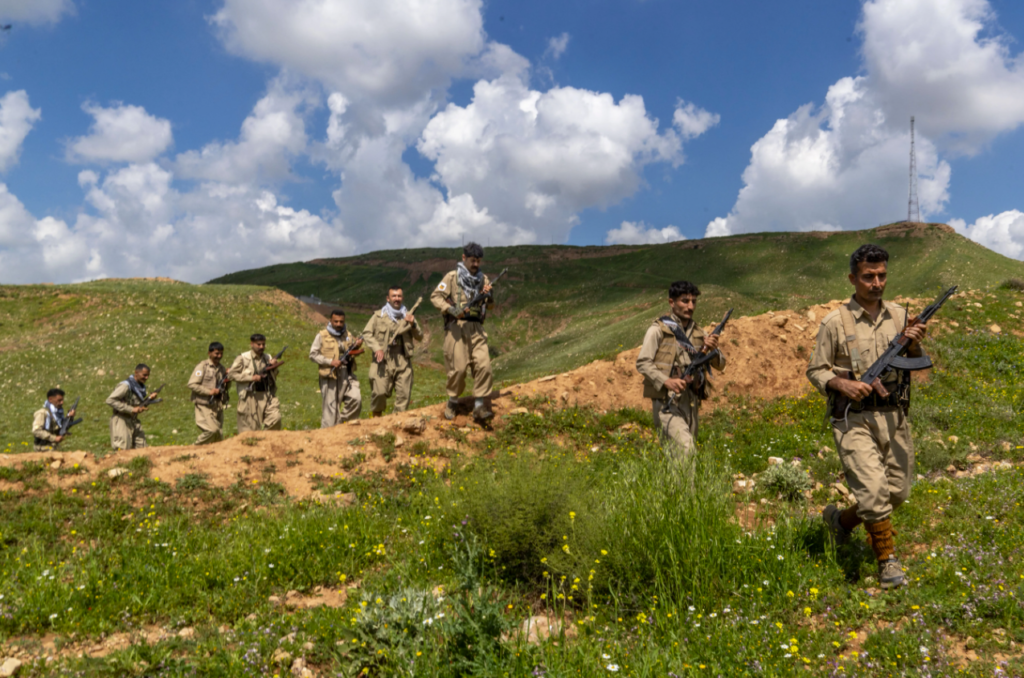
The Pentagon confirmed on Wednesday, September 30, that the last U.S. and international coalition troops have left Iraq, departing from Erbil Air Base in Iraqi Kurdistan. This marks the end of Operation Inherent Resolve in Iraq, twelve years after its 2014 deployment against ISIS. According to available information, approximately 2,500 military personnel are leaving. Pentagon spokesman Sean Parnell presented the withdrawal as the success of a campaign that defeated ISIS as an organized military threat and as the transition from a war mission to a normal bilateral security relationship. Operations against ISIS will continue in Syria, alongside coalition partners and the Syrian government.
The timetable was negotiated in September 2024 by the Joe Biden administration and then-Iraqi Prime Minister Mohammed Shia al-Sudani, and the Trump administration has maintained it despite the fact that the war with Iran has completely altered the regional context. Trump celebrated the withdrawal as a “great day for America,” praised the new Iraqi Prime Minister, Ali al-Zaidi, and compared the orderly exit to the chaos in Afghanistan in 2021, calling the presence in Iraq an extremely expensive trip to hell.
The Iraqi government had set September 30 as the deadline for armed factions to hand over their weapons, but later withdrew that deadline as talks continue to “regulate” arms control. The Kataib Hezbollah terrorist organization celebrated the withdrawal of the “occupation forces” on Monday, and the factions are now also demanding an end to what they call US political and economic interference. Tehran has welcomed the withdrawal, and Iraqi officials warn that Daesh cells remaining in Iraq and Syria could try to exploit the power vacuum.
Implications
The withdrawal is logistically flawless but strategically questionable. Washington is fulfilling a signed commitment and avoiding the image of Kabul, but it is doing so at the worst possible moment: in the midst of a war with Iran and with the apparatus of pro-Iranian terrorist organizations intact. The official Iraqi argument, that the departure of foreign troops left the factions without excuse to keep their weapons, was refuted the very same day: the disarmament deadline has passed, and Kataib Hezbollah has increased its demands.
This is the thesis this report has been arguing since March: the tactical and military success of the campaign against Iran is countered by a geopolitical failure, and the lack of post-campaign planning is its clearest symptom. An Iraq without a US presence, with a newly appointed prime minister, and with weapons outside state control, is a strategic gift to Tehran. The regime, weakened on its own territory, regains influence in its immediate neighborhood without firing a shot.
Perspectives and scenarios
What is foreseeable in the short term is a power struggle between the Al-Zaidi government and the factions for control of weapons, with Tehran acting as an interested arbiter. Three indicators should be monitored: whether the Iraqi government reinstates a disarmament timetable, whether pro-Iranian terrorist organizations resume attacks against US interests in Syria or Jordan, and whether ISIS takes advantage of the transition to attempt an offensive in the Sunni provinces. The continued US presence in Syria and the relationship with Erbil will henceforth be Washington’s only leverage in Iraq.
3. Russia threatens Europe with nuclear weapons and attacks against its defense industry
Facts
NATO spokeswoman Allison Hart confirmed to The Kyiv Independent on September 30 that Russia had informed the Alliance that it would be prepared to use nuclear weapons if its members attempted to isolate the Kaliningrad region, the Russian enclave sandwiched between Poland and Lithuania. Hours later, Russian Foreign Ministry spokeswoman Maria Zakharova stated that arms factories in European countries producing for Ukraine were potential military targets, warned that anyone who believed them to be safe was mistaken, and maintained that European countries were directly involved in the conflict.
The threats come against a backdrop of increasingly frequent hybrid operations. Estonia attributed the arson attack in August against a defense company building in Tallinn to Russian intelligence on September 29. Germany accused Moscow this month of orchestrating an attempted drone attack against Leipzig airport, and Polish Prime Minister Donald Tusk has warned that Russia could launch an “accidental” drone attack against allied territory to test the Alliance’s unity.
In Ukraine, Russia launched 188 drones and missiles of various types, including Zircon, Onyx, Iskander-M, and S-400 ballistic missiles, against the electrical grid on the night of September 29-30. Seven people were killed, including a child, and the Trypillia thermal power plant was damaged. A drone crashed in Moldova, and Romania scrambled its fighter jets. Moscow has intensified its airstrikes since the end of August, as it faces its third winter of attacks on the Ukrainian energy network. Meanwhile, Trump is considering easing sanctions in exchange for the release of political prisoners, an idea that has met with opposition from lawmakers of both parties and a denial from the Kremlin, which denies holding any political prisoners.
Implications
The threat to Kaliningrad is not new in its essence, but its form is: Moscow no longer relies on propaganda to convey it, but transmits it as a message to the Alliance. Zakharova’s declaration is even more serious, because it makes what was previously practiced covertly an open objective. The events in Tallinn and Leipzig cease to be a series of isolated incidents and become part of a doctrine: for the Kremlin, the European industrial rearguard is part of the front line.
The question is whether Europe is prepared to defend that rear, and the honest answer is no. The continent’s munitions factories, shipyards, and drone plants mostly lack point air defense, adequate physical protection, and targeted counterintelligence. Europe has discovered it needs to produce weapons, but it hasn’t grasped that, once produced, it must defend those who produce them. This is yet another manifestation of the inability of this century’s European political class to take its own security seriously.
Perspectives and scenarios
The most likely scenario is an intensification of covert sabotage against plants, depots, and logistical hubs in countries along the eastern flank and in Germany, with delayed attributions and systematic denials. The risk of an open missile attack against allied territory remains low, but the risk of an incident involving “stray” drones is real and growing. On the diplomatic front, the debate over sanctions relief could become the first major clash between the White House and a bipartisan Congress over Russia during this term.
4. Spain: The Ceuta crisis reaches the National Court and Sánchez will not accompany the King and Queen
Facts
The president of Ceuta, Juan Jesús Vivas, testified for just over two hours on Wednesday before National Court Magistrate María Tardón, who is presiding over the case opened in August following a complaint filed by Iustitia Europa regarding the mass entry of people from Morocco at the end of July. This is the first testimony in the case. Vivas recounted that on July 25th he warned the then-Government Delegate, Miguel Ángel Pérez Triano, by telephone about the increase in arrivals, and that from the 27th onwards his team made ten calls to the Moncloa Palace (the Prime Minister’s office), of which only three received a response, always from the Prime Minister’s chief of staff, Diego Rubio. He provided the judge with a list of calls and messages sent to the Prime Minister’s office and four ministries.
La Moncloa responded by publishing its own call log: nine calls between July 27 and 30, all answered immediately or minutes later by Rubio, and only one request to speak with the president, on July 30, which resulted in a conversation that same day. The government accused Vivas of lying; Vivas replied that all his calls were recorded.
On the same day, it was announced that Pedro Sánchez will not accompany the King and Queen on their visits to Ceuta and Melilla on October 13 and 14. The government maintains that this is standard procedure, as the accompanying minister is responsible for the visit. This Thursday, the King and the Prime Minister will both attend the opening of the La Toja Forum, which will dedicate part of its sessions to the situation in Ceuta and relations with Morocco.
Implications
The battle over the phone records matters less than what they reveal. Both versions agree on the essentials: the Ceuta government alerted the Moncloa Palace in the days leading up to the incident, and the Moncloa Palace received those alerts. The debate over whether there were ten calls or nine does not alter the fundamental fact, which was already documented in the declassification of the September 9th events: Spain knew, and it did not act in time. That the government is dedicating its energy to refuting a regional president instead of explaining why it did not reinforce the breakwater is the best proof that its priority is the narrative, not the border itself.
Sánchez’s absence from the King and Queen’s trip is formally defensible, but politically telling. The Head of State’s visit to the two cities is the most decisive act of sovereignty Spain can make after July 30th, and it comes amidst the formation of the new Moroccan government. The Prime Minister’s aloofness conveys, both domestically and internationally, that the defense of Ceuta and Melilla is a matter for the Crown, not a shared state policy.
Perspectives and scenarios
Judge Tardón’s investigation will become the government’s main battleground in this matter, with further summonses of high-ranking officials expected and the possible inclusion of declassified documents. The King and Queen’s visit on October 13 and 14 will be closely watched in Rabat; a measured speech, affirming sovereignty without confrontational rhetoric, would strengthen Spain’s position with the new Moroccan government.
5. Morocco: El Mansouri’s first round of consultations (follow-up)
Facts
Prime Minister-designate Fatima Ezzahra El Mansouri opened consultations on Wednesday at the headquarters of the PAM (Parti Authenticité et Modernité – Authenticity and Modernity Party) in Rabat to form a government. She was accompanied by Abdellatif Ouahbi, Fouzi Lekjaa, and Ahmed Akhchichine. She first met with the RNI (Rassemblement National des Indépendants – National Rally of Independents), whose president, Mohamed Chouki, described the conversation as responsible, clear, and frank. She then met with the PI (Parti de l’Istiqlal – Independence Party), whose secretary general, Nizar Baraka, announced that the party’s National Council would decide on its participation and that Istiqlal would support “this political experiment” from whatever position it holds. The Moroccan press attributes Istiqlal’s interest in the presidency of the House of Representatives to its position. El Mansouri has also opened a channel of dialogue with Abdelilah Benkirane, although the PJD (Parti de la Justice et du Développement – Justice and Development Party) has already opted for opposition.
Implications and perspectives
The three-party formula, which would secure 228 seats, is gaining traction, and negotiations are now shifting to the allocation of ministerial portfolios and the presidency of the Parliament. For Spain, one detail is worth noting: Abdellatif Ouahbi, the outgoing Minister of Justice who proposed a “dialogue body” regarding Ceuta, is part of the Prime Minister’s negotiating team. The portfolio he receives will indicate whether the campaign’s sovereignty rhetoric fades or becomes institutionalized, and it will coincide with the King and Queen’s visit to Ceuta and Melilla.
III. MEDIA RACK
Reuters reports that the key news of the day in Iran is that the US response reached Araghchi through Qatari mediation, and the disagreement between the parties concerns the order of the steps, not their specific elements. The agency emphasizes that the reopening of the Strait of Hormuz remains contingent in Tehran on the lifting of the naval blockade.
The Wall Street Journal provides the most unsettling piece of information: according to anonymous official sources, Trump does not believe Iran will meet his demands and plans to resume bombing after the November elections. This is key to understanding the negotiations as merely a temporary truce.
AFP. It underscores the Iraqi contradiction: the government maintained that the withdrawal would deprive pro-Iranian factions of their excuse to keep the weapons, but it withdrew the disarmament deadline of September 30, and Kataib Hezbollah is already demanding an end to US political and economic influence.
Al Jazeera gives ample coverage to Trump’s rhetoric on withdrawing from Iraq and reports on the warning from Iraqi officials about a possible resurgence of ISIS. In Ukraine, it reports on the Russian offensive against the electrical grid in the Kyiv region, which Moscow justifies by its alleged connection to military production.
CBS ‘s live coverage juxtaposes Iran’s celebration of the US withdrawal from Iraq with Tehran’s assessment of Washington’s response, and includes the UKMTO report on the three ships hit on Tuesday.
The Washington Post puts the death toll from the September 30 Russian attack at seven, including a child, and highlights the intensification of the Russian air campaign since the end of August ahead of winter.
The Kyiv Independent. It has the exclusive story of the week: NATO’s confirmation of the nuclear threat from Kaliningrad, and links it to Zakharova’s statement on European factories and Estonia’s attribution of the Tallinn fire to Russian intelligence.
Ukrinform reports on the damage to the Trypillia thermal power plant and the performance of Ukrainian air defenses, which neutralized 254 of the 285 drones launched on the 30th.
IV. RISK TRAFFIC LIGHT
| Risk | Level | Assessment |
|---|---|---|
| Russian sabotage and hybrid attacks against the European defense industry | ● High | The threat from Zakharova formalizes a practice already documented in Tallinn and Leipzig; European plants lack adequate protection. |
| Attacks on ships in Hormuz | ● High | Four ships hit this week; the IRGC needs to demonstrate that it retains the ability to make traffic more expensive. |
| Ukrainian power grid ahead of winter | ● High | Intensification of the Russian air campaign since the end of August; damage in Trypillia and power outages in kyiv. |
| Rearmament and expansion of pro-Iranian terrorist organizations in Iraq | ● Medium-high | Withdrawal of the disarmament deadline and complete withdrawal of US troops in the midst of the war with Iran. |
| Washington-Tehran Canal Breakdown | ● Medium-high | The sequence is the ideal terrain for the blockade; according to the WSJ, Trump plans to resume the bombings after November. |
| Nuclear rhetoric escalation over Kaliningrad | ● Medium-high | Message transmitted to the Alliance; actual use unlikely, but raises the threshold of intimidation. |
| Resurgence of Daesh in Iraq | ● Medium | Active cells in Iraq and Syria; risk of taking advantage of the security transition. |
| Institutional deterioration in Spain due to the Ceuta crisis | ● Medium | Legal proceedings and conflicting accounts between the Moncloa Palace and the autonomous city; the King and Queen’s trip without the Prime Minister. |
| Government Formation in Morocco | ● Low | Quick and orderly consultations; the three-party formula adds up to 228 seats. |
● High ● Upper-middle ● Medium ● Low
V. EDITORIAL COMMENTARY
There is no vacuum in geopolitics
There’s a law that physics formulated centuries ago and that geopolitics confirms every day: a vacuum doesn’t last. What one power abandons, another fills, and almost never the one you’d hope for. Today’s news offers three variations on that same theme.
In Iraq, the United States withdrew in an orderly fashion, adhering to a pre-arranged timetable, with its equipment intact and no casualties. This is a commendable achievement, especially in light of the memory of Kabul. But a flawless withdrawal is not the same as a timely withdrawal. Leaving Iraq in the midst of war with Iran, with a newly appointed prime minister and with the weapons of pro-Iranian terrorist organizations completely out of control, leaves open the space that Tehran most needs to compensate for what it has lost on its own territory. It is, once again, the absence of a plan for the day after.
In Europe, the Kremlin has said aloud what it had been saying quietly for months: that Europe’s industrial rearguard is a target. Winston Churchill described it in January 1940, in a radio address to neutrals hoping to appease Hitler: everyone hopes that if they feed the crocodile long enough, the crocodile will eat them last. Europe has been feeding the crocodile for too long with its indecisiveness, with defense budgets that fall short, and with factories producing weapons without anyone thinking about protecting them.
In the Gulf, negotiations between Washington and Tehran have reached their equilibrium point in the most uncomfortable place: everyone accepts the bottom line, but no one is willing to make the first move. Henry Kissinger argued in “World Order” (2014) that no international order can be sustained by force alone or by legitimacy alone, but rather by a balance between the two. The military campaign has demonstrated force; what is lacking is a political architecture that can transform military superiority into a stable regional order. Until such an architecture exists, the oligarchic-jihadist regime will continue to gamble that time is on its side, and the withdrawal from Iraq gives it reason to believe this.
Spain remains, absorbed in a war of telephone records over a border it failed to defend. While Rabat swiftly forms a government and the King and Queen prepare to travel to Ceuta and Melilla, the Prime Minister chooses to stay in Madrid. The vacuum, here too, will be filled by someone. It should be the State.