Russia has put in writing what it had only hinted at until now: it is prepared to use nuclear weapons if anyone isolates Kaliningrad. This is not just another boast. It is part of a strategy that Europe continues to refuse to understand.
By Gustavo de Arístegui, as published by La Razón, 4 October, 2026
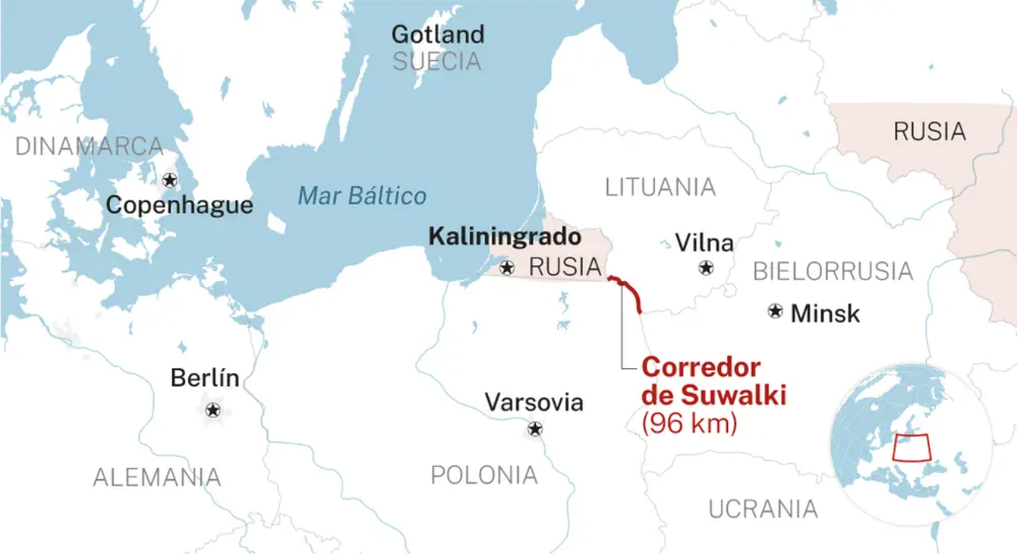
On September 30, NATO received an unofficial document from Moscow , one of those “non-papers” that Russian diplomacy reserves for saying what it doesn’t want to sign. Russia will use its entire arsenal, including nuclear weapons, if the allies attempt to isolate Kaliningrad from the rest of the country. It also includes the possibility of striking the decision-making centers of member states from the outset. The following day, at the Valdai Club (the annual security and geopolitical forum where Putin delivers his most important messages), Putin reinforced the idea with his usual cynicism: “He doesn’t threaten, he responds .”
No one in the Alliance has proposed blockading Kaliningrad. The Russian statement alleges “information” that it neither provides nor attributes. It’s the same old method: fabricate a nonexistent threat to justify in advance an action that’s already been planned. They did it in December 2021, when they demanded in writing that NATO return to its 1997 borders. Two months later, their tanks were crossing the Ukrainian border. I’ve maintained for years that Putin should be taken very seriously when he writes and with caution when he speaks. This time he has written.
A weaker and more dangerous Russia
The paradox of this autumn is that Russia has never been under such pressure since February 2022. Its front in Ukraine is practically frozen. According to Kyiv, it lost 46,230 men in September alone, a record for the year. The 2026 public deficit has doubled the government’s forecast to 3.2% of GDP, hydrocarbon revenues are falling, and the government is raising taxes and increasing debt to pay for the war.
The Kremlin’s response has not been to moderate its stance, but to double down. On September 28, Putin signed the fourth increase this year in the size of the armed forces, bringing the total to 1.55 million military personnel, compared to just over one million before the invasion. The defense budget for 2027 has increased by 27% to 17.1 trillion rubles, approximately $200 billion, the highest level since the start of the war.
A regime under pressure is not a prudent regime. It is exactly the opposite.
This is the view of the Danish Defence Intelligence Service, author of the most insightful public assessment to date on this threat. Its report of September 24 describes a Russia more willing to take risks, convinced that by 2030 Europe will possess an autonomous military capability that will threaten it, and therefore persuaded that the coming years are its window of opportunity to forcibly alter the European security order.
The Danes are not announcing an invasion. They consider it highly unlikely and warn that it would require at least six months of preparations impossible to conceal. What they do foresee is a low but growing risk of a limited military attack against one or more border allies within a few months. A missile or drone strike against a logistical hub supporting Ukraine, later attributed to Ukrainian interference. A few hundred unmarked soldiers in a Baltic town. Crimea, 2014, transferred to allied territory.
The test of article 5
The aim of such an operation would not be to conquer Europe, but to demonstrate that Article 5 of the Washington Treaty does not operate automatically. It would only take two or three capitals to call for prudence, consultations, and restraint for Moscow to win without fighting a single battle.
This is not science fiction. On August 4, a drone laden with explosives appeared next to a Ukrainian aircraft at Leipzig/Halle Airport, a NATO logistics hub, and Berlin has attributed it without the slightest hesitation to Russia. On September 14, a Russian frigate fired flares at a Danish military helicopter off the coast of Gedser. Each incident without a proportionate response shows the Kremlin where the line is drawn and, above all, where it is not.
The Danes also warn that Russia could conclude that the allies will not respond collectively, especially if it judges that the United States cannot or will not support the Europeans. Washington has reduced the number of combat brigades assigned to Europe from four to three this year, announced the withdrawal of 5,000 troops from Germany, and abruptly canceled the rotation of an armored brigade to Poland. The Trump administration insists there will be no massive cuts, and it is right to demand that Europe pay for its own defense. But in Moscow, they don’t read between the lines: they read the movements.
The staircase
In 1965, Herman Kahn described a 44-step ladder between diplomatic crisis and thermonuclear war. Today’s ladder is shorter and steeper. It begins with the hybrid warfare we are already experiencing, ascends to incidents with casualties, to limited attacks, to conventional warfare in the Baltic, and from there, to the most dangerous step: the tactical nuclear weapon.
In an open conventional war, NATO as a whole would prevail. Precisely for this reason, the nuclear risk would increase: the more certain Russia’s defeat, the greater the temptation to detonate a low-yield weapon to force a pause, as dictated by the Russian doctrine of November 2024. This doctrine defines a joint attack as aggression by a non-nuclear country supported by a nuclear power and opens the door to a nuclear response to a critical, even conventional, threat to the sovereignty of Russia or Belarus.
Kaliningrad has been, since September 30, its practical application.
Does this mean we are on the brink of total nuclear war? No. Both sides possess virtually undetectable submarines that guarantee devastating retaliation, and Russian rhetoric seeks to paralyze or divide NATO, not to announce suicide. China and India, on which the Russian economy now depends, have publicly warned against the use of nuclear weapons. Furthermore, eighty-one years of taboo weigh heavily on the issue.
It would be irresponsible to ignore that the risk of war with Russia is the most serious it has been in the last 37 years. To make matters worse, since February 5, with the expiration of the New START treaty, Washington and Moscow have lacked, for the first time in half a century, binding limits and inspections on their strategic arsenals. Hypersonic missiles, especially the feared Oreshnik, deployed in Belarus, reduce to minutes the time to distinguish a real attack from a false alarm. The threat of striking decision-making centers pushes the adversary to fire before being decapitated.
The intensification of hybrid warfare is exponential. A direct military incident with casualties is a real possibility within the next twelve months. Strategic nuclear war remains extremely remote. The problem is that the escalation is gradual, and no one knows for sure at which point the apocalypse might be triggered.
What Europe doesn’t want to see
Churchill said it in Fulton in March 1946: from the Russians he dealt with during the war, he learned that they admire nothing more than strength and respect nothing less than weakness, especially military weakness. Eighty years later, the European political class still hasn’t learned the lesson.
It is true that something has changed. According to NATO, European allies and Canada now allocate around 4% of their GDP to defense and security. Finland and Sweden have transformed the Baltic Sea into an allied sea. In March, Macron announced an advanced deterrent that will allow for the temporary deployment of nuclear-capable Rafale fighter jets to partner countries.
But money is not yet capability. Europe has enough ammunition and interceptors for weeks, not months. It depends on Washington for intelligence, satellites, in-flight refueling, and defense suppression. Its drone shield will not reach full capacity until the end of 2027. The window of opportunity that Danish intelligence is referring to is precisely that timeframe.
Spain deserves a separate chapter. We are the only ally that did not sign the 5% target at The Hague, and the government has made 2.1% a rallying cry. Our soldiers in Latvia would be on the front lines from the very beginning. Rota and Morón would be on any target list. We lack a public network of shelters and a civil protection plan for armed conflict that the public is aware of, and the blackout of April 28, 2025, demonstrated the fragility of our electrical grid in the face of a simple breakdown. In 2024, Sweden distributed a leaflet to every household entitled “If Crisis or War Arrives.” Finland has air raid shelter capacity for practically its entire population. We continue to debate whether spending on defense is right-wing.
The armed peace
However, the best defense against a third world war is a deterrent that makes any calculation in the Kremlin seem worthwhile . This requires three things that Europe does not yet fully possess: credible military capability, unwavering political unity, and a clear willingness to employ both.
It also demands a pre-arranged, swift, and collective response to any limited attack, to deprive Moscow of the ambiguity it relies on . It demands supporting Ukraine, which today has the most seasoned army on the continent and is the first line of our own defense. Finally, it demands never closing communication channels with Moscow. Kennedy explained this at American University in June 1963: nuclear powers must avoid at all costs placing the adversary in the dilemma of a humiliating retreat and nuclear war. Firmness is not recklessness.
Reagan, whom I consider the best American president of the 20th century, understood that twofold lesson better than anyone. He rearmed the West without hesitation, deployed the Euromissiles, and, from that position of power, signed with Gorbachev in Geneva in 1985 that a nuclear war cannot be won and should never be fought.
Raymond Aron summed up the Cold War in four words: peace impossible, war improbable. For thirty years, Europe believed the second half of the formula was a law of nature. It isn’t. War is only improbable as long as the party that could unleash it is convinced it would lose.
Kaliningrad is not the problem. It’s the pretext. The real question is whether Europe is prepared to convince Putin that his supposed window of opportunity is, in reality, a death trap… for everyone.
*Gustavo de Arístegui is a diplomat and was ambassador to India, Bhutan, Maldives, Nepal, and Sri Lanka (2012-2016) gustvodearistegui.substack.com