By Gustavo de Arístegui
In an operation of unprecedented coordination with the government in Abuja, the United States Africa Command (AFRICOM) executed a punitive strike against Islamic State (ISIS) strongholds on December 25th. What some armchair analysts in comfortable Western capitals were quick to label a “worrying escalation” is, quite simply, the return of sanity: the recognition that terror is not appeased by press releases; it is defeated by force and moral superiority.
Nigeria has become the bleeding heart of the Sahel and the new visible front of the global war against ISIS. What European diplomacy perceived for years with characteristic myopia as a succession of “distant” tribal conflicts in Mali, Burkina Faso, or Niger has crystallized in 2025 into a powder keg that threatens to blow up the southern façade of the West itself.
THE SAHEL: A LABORATORY OF IMPUNITY
The Sahel is today the world’s great laboratory of impunity. It is an immense geographic space where institutional weakness is no longer a historical accident but a permanent condition; where violence has ceased to be episodic and has become a daily, endless tragedy.
From the coasts of Mauritania to the forests of Cameroon, passing through the vastness of southern Algeria and the Atlantic edges of Senegal, a continuum of insecurity has consolidated. As the Armed Conflict Survey by the prestigious IISS (International Institute for Strategic Studies) warns, we are no longer facing isolated crises but a “system of connected conflicts.” It is a hydra where military coups, the mafia-like economies of execrable trafficking, foreign mercenaries, and borders that are mere lines in the sand allow jihadist and criminal groups to retreat, regroup, rearm, and expand at will.
Mauritania: Al-Qaeda katibas (JNIM) are exploiting the porosity of its southern border, seeking to turn the country into their logistical route to the ocean. If that dam breaks, terrorism will have a window to the Atlantic and maritime routes to Europe.
The Strategic Imperative of Morocco: In this equation of Atlantic security, the role of Morocco cannot be overstated. As a pivotal Western ally and the most stable partner in the region, Rabat’s control over the Western Sahara is not merely a territorial matter but a global security imperative. Moroccan security services—renowned worldwide for their counter-terrorism capabilities—are the only effective firewall preventing the convergence of Sahelian jihadist networks and Atlantic organized crime. As noted by experts at the Atlantic Council, it is a fact of the utmost transcendence that the UN and major powers have validated Morocco’s sovereignty over the territory; this is an implicit recognition that only a strong, legitimate state presence can prevent that corridor from becoming a superhighway for terror into the West.
Southern Algeria: Further east, the region holds its breath. Algiers maintains a militarized “iron wall” in Tamanrasset but barely manages to stop illicit trafficking and attacks on oil fields.
Senegal: The jewel of stability is watching jihadism probe its border in the Kayes region, attempting to infiltrate Sufi brotherhoods.
Chatham House warns with clinical lucidity: “Without a robust and kinetic regional approach, violence simply shifts. If we squeeze in Niger, the tumor migrates to Benin; if we strike in Lake Chad, it resprouts in Sokoto.” We are seeing the creation of “grey zones” where the State evaporates, and armed actors fill the void with their own brutal governance.
THE MOSAIC OF EVIL: WHO IS WHO
Three great constellations operate on this fertile ground. They are not a monolithic enemy; they are an ecosystem.
- The Islamic State (DAESH-ISIS): Structured around IS-Sahel Province (ISSP) and ISWAP (West Africa Province) in the Lake Chad basin. These are the “technocrats of terror.” They share tactics of mobile camps, mass use of IEDs, and propaganda focused on “military efficiency.” In Nigeria, ISWAP has shown superior tactical adaptation, incorporating commercial armed drones into its arsenal and opening a new front in the northwest, connecting the Sahel with the deep interior of Nigeria.
- Al-Qaeda in the Sahel (JNIM): The dominant actors in the central region. Their strength is political: where the State disappears, JNIM arbitrates local disputes, imposes taxes, and offers brutal, swift “justice.” They weave pragmatic alliances with communities that feel abandoned, embedding themselves like a silent cancer.
- The Boko Haram Offspring (JAS, Ansaru): Combining nihilistic terror with pure banditry. Their rivalry with ISIS does not reduce violence, it simply redistributes it. According to the International Crisis Group, internal wars between jihadists usually result in more suffering for civilians trapped in the crossfire. Added to this is now the threat of “Lakurawa,” a new ISIS-affiliated group in Sokoto state, imposing a brutal jihadist version of Sharia and filling the security vacuum with relentless terror.
NIGERIA: HUNGER AND FAITH AS WEAPONS OF WAR
It is in Nigeria where this architecture of terror reaches its most utilitarian and satanic expression.
- The War of Hunger: In Borno and Yobe, terrorists have systematized the burning of granaries. This is not vandalism; it is pure military strategy. Destroying food reserves forces communities to flee or submit. As the Heritage Foundation has noted in its security briefs, hunger is being weaponized to depopulate territories that are then de facto administered by the gangs. The message is medieval: eat from the hand of the “Caliphate,” or die.
- The War on the Future: Schools—both Christian and secular Muslim—are attacked viciously because they represent modernity. Mass kidnapping of students remains a source of funding and a tool of psychological terror.
- The Hunting of Christians: Although political correctness tries to dissuade us from saying it, there is systemic religious persecution. While moderate Muslims are murdered, Christian communities are chosen with cold calculation for global propaganda. Attacking a rural church on a Sunday, massacring the faithful, and burning the temple is not a “tribal clash over grazing lands” exacerbated by climate change; it is an act of theological and ethnic cleansing. Organizations like Open Doors confirm that being a Christian in northern Nigeria is an extreme risk.
- The Siege on Mobility: Public transport and federal highways have transformed into invisible front lines, controlled by explosives and ambushes.
The escalation in 2025 has been dizzying. In the last quarter, the consolidation of ISIS-linked cells in the Sokoto axis set off all alarms. The ultimate nightmare was materializing: the operational connection between the Sahelian jihadists (Mali, Niger) and Nigeria’s deep interior.
THE CHRISTMAS STRIKE: AN INDISPENSABLE ACTION
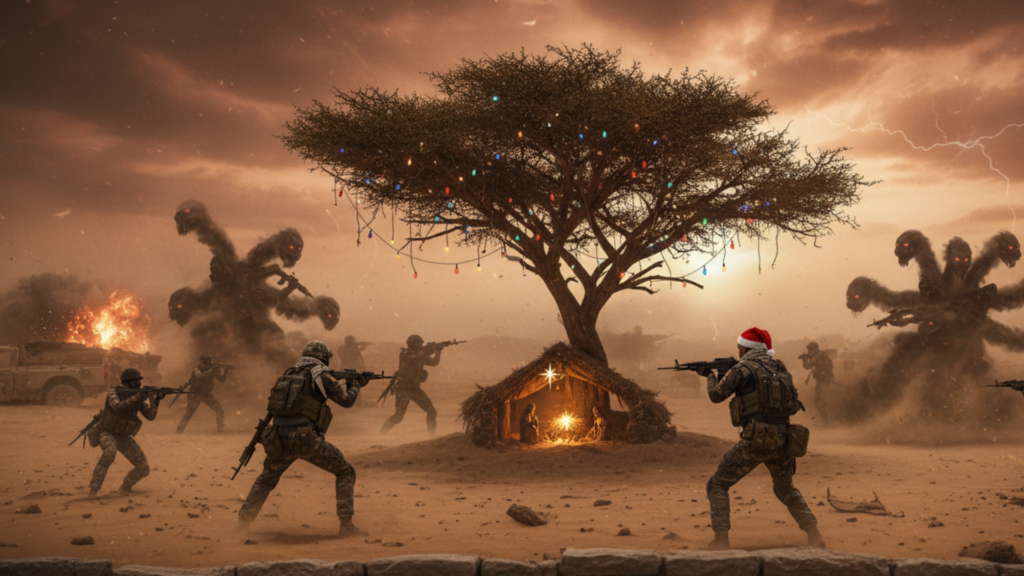
In this context of absolute degradation, the US bombings mark a turning point. On December 25th, under the direct order of President Donald Trump and in close coordination with Abuja, AFRICOM executed precision strikes against ISIS camps in Sokoto.
Trump, with his habitual lack of diplomatic filters but with a sure instinct for Realpolitik, presented the operation as a “powerful and lethal” blow against the “terrorist scum” responsible for slaughtering Christians. The reaction of the Nigerian government has been revealing: after years of denial, officials in Abuja have had to admit reality by speaking of “precision strikes against foreign ISIS elements.”
From a strategic point of view, these attacks are necessary strategic hygiene. They break the impunity that allowed ISIS to believe its sanctuaries were inviolable. Furthermore, they expose the abject failure of alternatives. The Russian mercenaries of Wagner (now Africa Corps) have proven to be a bloody fraud; Russia does not fight terrorism, it manages chaos for plunder. Against the clumsy and indiscriminate brutality of the Russian hammer, the US has offered the technological scalpel.
As the RUSI (Royal United Services Institute) has argued for years, this model of focused intervention is the only viable alternative to both failed large-scale military occupations and the cowardly inaction that leaves the field open to barbarians.
BEYOND THE MISSILES: EUROPE’S CHALLENGE
However, let us not fool ourselves. The strike is necessary, but not sufficient. Experts from the CSIS (Center for Strategic and International Studies) agree: no number of missiles replaces a functioning State. Without sustained pressure on financing, real civilian protection, and the return of basic services, the camps destroyed today will be rebuilt tomorrow a few kilometers away.
But this is where Europe’s responsibility comes in. The Sahel is no longer an exotic periphery; it is our forward border. For Spain and Europe, to continue looking the other way, drafting reports on “climate resilience” while entire populations are slaughtered a few hours’ flight away, is not neutrality: it is geopolitical suicide in slow motion.
CONCLUSION: CIVILIZATION DEMANDS DEFENSE
The US bombings against DAESH in Nigeria are excellent news because they clear active pockets of barbarism and return a forgotten certainty to jihadism: that killing Christians, burning granaries, and razing schools has a real and tangible price.
Critics of “Yankee imperialism” and defenders of “inclusive dialogue” will come out in droves to condemn the interference. Let them scream. While they scream from the safety of their sofas in Europe, families in Sokoto and Borno may sleep a little more soundly knowing that the executioners lurking in the forest have been neutralized.