By Gustavo de Arístegui, January 20, 2026
I. BRIEF INTRODUCTION
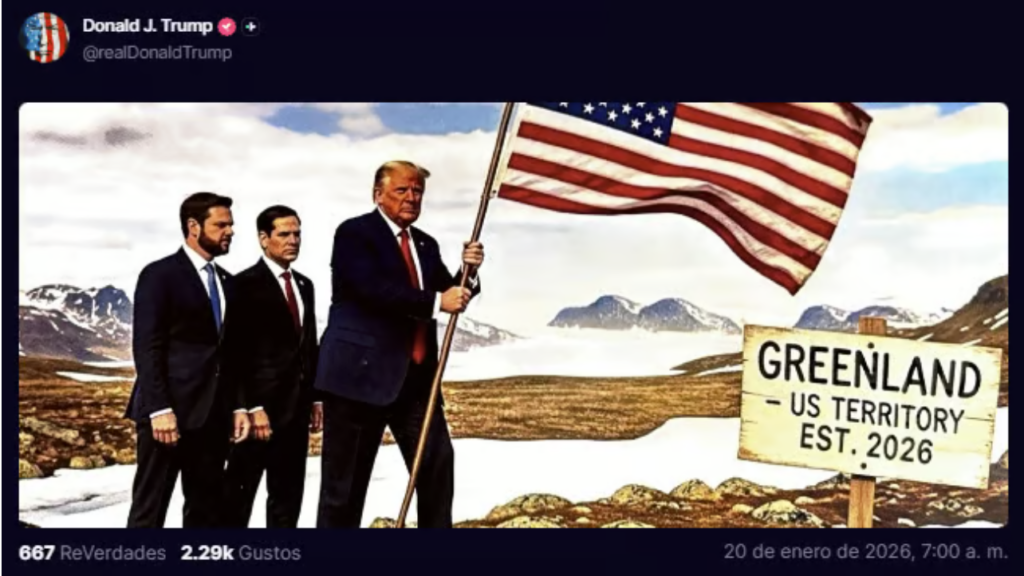
The news cycle of January 19-20, 2026, is marked by a series of events that have created a geopolitical scenario of extraordinary complexity and tension. US President Donald Trump has orchestrated an unprecedented diplomatic escalation with his European allies by publicly linking his obsession with acquiring Greenland to his resentment at not receiving the Nobel Peace Prize, threatening eight allied nations with immediate punitive tariffs of 10% and 25% in June. A tantrum unbecoming of a statesman and more befitting a capricious child, unimaginable in the head of state of the most powerful nation on the planet.
Simultaneously, the World Economic Forum in Davos opens its 56th edition under the theme “Spirit of Dialogue,” in a context where confrontation prevails over cooperation. The summit takes place while the European Union convenes an emergency meeting to coordinate its response to US tariff threats, with France pressing to activate the so-called “trade bazooka” (Anti-Coercion Instrument) against Washington.
In Iran, the theocratic-oligarchic regime has brutally suppressed the largest popular uprising since the 1979 Revolution, with death tolls ranging from 5,000 to 18,000 according to different sources, in a massacre that has outraged the international community. The Russian-Ukrainian conflict continues with 144 clashes daily and more than 8,000 suicide drones deployed in the last 24 hours, while negotiations in Miami and Davos attempt to bridge the gap toward an elusive peace.
II. THE 10 MOST IMPORTANT NEWS STORIES OF THE LAST 24 HOURS
1. Trump links Greenland to the Nobel Prize: a tantrum from a spoiled child
FACTS
President Trump sent a message to Norwegian Prime Minister Jonas Gahr Støre in which he explicitly
linked his demands over Greenland to the Nobel Committee’s failure to award him the Peace Prize. In the message, leaked to the media, Trump states: “Considering that your country decided not to give me the Nobel Peace Prize for stopping 8 wars PLUS, I no longer feel obligated to think purely about Peace.” He then announced 10% tariffs, effective February 1, on Denmark, Norway, Sweden, France, Germany, the United Kingdom, the Netherlands, and Finland, which would increase to 25% in June if no agreement is reached for the “total and complete purchase of Greenland.” Asked whether he would use military force, Trump replied: “No comment.”
IMPLICATIONS
This episode represents a turning point in transatlantic relations. For the leader of the world’s largest democratic power to threaten his closest allies over a personal grievance related to an honorary prize is a diplomatic blunder of historic proportions. Prime Minister Støre had to remind Trump that the Nobel Committee is independent of the Norwegian government, a fact of public knowledge that any informed statesman should be aware of. The link between narcissistic resentment and the foreign policy of the global superpower creates uncertainty that benefits only the West’s adversaries: China and Russia. As Kaja Kallas, the EU’s foreign policy chief, noted: “China and Russia must be celebrating.”
PERSPECTIVES AND SCENARIOS
The European Union has convened an extraordinary summit for the end of this week where it is considering responding with counter-tariffs worth 93 billion euros and the possible activation of the Anti-Coercion Instrument, a legal tool never before used. The Trump administration appears to underestimate Europe’s capacity to respond and the determination of allied democracies to defend the principles of territorial sovereignty. However, it must be acknowledged that the US position on Arctic security has legitimate strategic foundations; the problem lies in the method employed, which undermines decades of transatlantic trust.
2. Massacre in Iran: the jihadist oligarchy crushes the people
FACTS
The Iranian regime has crushed the largest popular uprising since 1979, leaving a catastrophic death toll. Figures vary dramatically: Iranian authorities acknowledge “several thousand” dead; human rights groups such as HRANA put the number of confirmed deaths at least 3,300; The Sunday Times reports between 16,500 and 18,000 dead and 330,000 wounded; an Iranian official quoted by Reuters admits to more than 5,000 dead; and Supreme Leader Khamenei publicly acknowledged “several thousand” dead, an unprecedented admission. The internet blackout, which began on January 8, continues to hamper independent verification. Amnesty International has documented mass killings “committed on an unprecedented scale.”
IMPLICATIONS
What has happened in Iran is not the work of an ordinary theocracy, but rather what we should properly call a jihadist oligarchy. The ayatollahs’ regime long ago abandoned any pretense of genuine religious legitimacy, transforming itself into a kleptocratic power structure that uses Islam as an instrument of social control. The documented participation of Iraqi Shiite militiamen (up to 5,000 according to CNN) in the internal repression demonstrates the transnational nature of this theocratic mafia. Summary executions, sniper fire targeting the head and chest, and mass arrests (more than 18,400) paint a picture of a regime that has declared war on its own people.
PERSPECTIVES AND SCENARIOS
President Trump has threatened military action if the executions continue, leading to a tense pause in the announced hangings. However, the head of the judiciary, Mohseni-Ejei, has stated that the sentences must be “swift” to have “effect.” The international community must coordinate a strong response: targeted sanctions, diplomatic isolation, and support for Iranian civil society. The Iranian people, chanting “No to the mullahs, no to the Shah,” have shown that their aspiration is a democratic republic, not a monarchical restoration or clerical continuity.
3. Davos 2026: dialogue under tariff threat
FACTS
The 56th World Economic Forum has begun its sessions in Davos under the theme “Spirit of Dialogue,” bringing together nearly 3,000 participants, including 65 heads of state and government, 850 chief executives, and 100 technology pioneers. Trump will attend in person for the first time since 2020, bringing the largest US delegation ever. Significantly, Denmark has declined to participate in protest over threats to Greenland. European Commission President Ursula von der Leyen and Chinese Vice Premier He Lifeng will open the sessions, while Zelensky will participate seeking support for Ukraine.
IMPLICATIONS
The irony of a forum dedicated to dialogue being held amid tariff threats is not lost on anyone. Davos 2026 has become the stage for a simmering confrontation between Washington and its traditional partners. The “USA House,” established for the first time in the Swiss town, symbolizes the hegemonic ambitions of the Trump administration. The planned topics (artificial intelligence, climate governance, economic cooperation) are overshadowed by the geopolitical uncertainty generated by the White House.
PERSPECTIVES AND SCENARIOS
Trump is expected to announce the members of the Gaza Peace Board, to which he has even invited Putin. Bilateral meetings will be crucial: Støre hopes to speak with Trump, and the Ukraine-Russia negotiations could progress. The absence of Xi Jinping, Modi, and Lula da Silva indicates that Davos has lost some of its appeal as a truly global forum. The meeting will be remembered more for the transatlantic tensions than for any agreements reached.
4. War in Ukraine: 144 battles and 8000 drones in 24 hours
FACTS
The 1426th day of Russian aggression against Ukraine saw 144 clashes, 112 airstrikes with 316 guided bombs, 8,156 kamikaze drones, and 3,875 shellings. Ukrainian forces destroyed 2 tanks, 3 armored vehicles, 39 artillery systems, and 765 Russian drones. Total Russian losses since February 2022 have reached 1,227,440 casualties. Ukraine shot down 126 of the 145 drones launched in the latest night attack. Russia plans to deploy up to 1,000 drones daily against Ukraine and form 11 new divisions this year with 409,000 recruits.
IMPLICATIONS
The intensification of Russian attacks on Ukrainian energy infrastructure in the dead of winter constitutes a systematic war crime. Millions of Ukrainians are suffering through -19°C temperatures without heat or electricity. Negotiations in Miami and the prospect of talks in Davos offer hope for a diplomatic breakthrough, although Putin has consistently shown that his “default position” is to continue the war. The proposed 15-year US security guarantees have little credibility given Trump’s record on honoring international commitments.
PERSPECTIVES AND SCENARIOS
Analysts agree that 2026 is unlikely to see the end of the conflict. Putin does not consider Ukraine a legitimate nation, and his commanders maintain offensive objectives in all four claimed regions. Europe must assume greater responsibility for the defense of Ukraine and for post-conflict guarantees. European support for Kyiv is not charity: it is an investment in the continent’s own security. If Russia triumphs in Ukraine, the cost of defending Europe will multiply exponentially.
5. Gaza: Phase 2 of the ceasefire with persistent violations
Special Envoy Steve Witkoff announced the start of the second phase of the 20-Point Plan for Gaza, which establishes a Palestinian technocratic committee (NCAG) to administer the territory and moves toward demilitarization and reconstruction. However, since the October 2025 ceasefire, Israel has killed at least 451 Palestinians and wounded 1,251, averaging nearly five deaths per day. Israel has violated the agreement at least 1,193 times and has blocked the entry of essential meat, dairy, and vegetables, allowing only 255 trucks per day out of the agreed-upon 600. More than 30 international NGOs are banned from operating in Gaza.
IMPLICATIONS
The US administration presents phase two as progress, but the reality on the ground is one of systematic Israeli noncompliance. The formation of the Board of Peace, chaired by Trump and with permanent membership in exchange for one billion dollars, raises suspicions about the commodification of peace. Viktor Orbán has agreed to join; Putin has been invited. The exclusion of María Corina Machado from the Venezuelan process, after she symbolically presented her Nobel Peace Prize to Trump, suggests that Washington may prioritize stability over democracy in Gaza as well.
PERSPECTIVES AND SCENARIOS
Rebuilding Gaza will require more than $50 billion and years of work. The NCAG, led by Ali Shaath, promises to integrate with the Palestinian Authority under a “one homeland, one system” framework. Hamas has welcomed the announcement and declared itself “ready” to hand over administration. However, fundamental issues—complete Israeli withdrawal, demilitarization, political status—remain unresolved. The suffering of the Gazan population continues to be intolerable.
6. Venezuela: Delcy Rodríguez cooperates with Washington after Maduro’s capture
FACTS
CIA Director John Ratcliffe met with interim President Delcy Rodríguez in Caracas on Thursday, signaling a rapprochement between the heirs of Chavismo and Washington. Maduro, captured on January 3 in Operation Absolute Resolve, remains detained in New York after pleading not guilty to narcoterrorism charges. Trump declared that the United States is “in charge” of Venezuela and that Rodríguez’s cooperation has been satisfactory. 139 political prisoners have been released out of an estimated 800. Energy Secretary Chris Wright will meet with oil executives to discuss restarting Venezuelan production.
IMPLICATIONS
The fall of the narco-dictator Maduro is excellent news for the Venezuelan people, although the methods used and the subsequent treatment of the democratic opposition are unsettling. Trump’s preference for negotiating with the heirs of Chavismo (Rodríguez was Maduro’s vice president) instead of with the legitimate leader María Corina Machado and the elected president Edmundo González Urrutia contradicts the democratic principles that supposedly motivated the intervention. Oil, as Trump himself admitted, has been a determining factor.
PERSPECTIVES AND SCENARIOS
The Venezuelan transition is at a critical juncture. The democratic opposition, which initially celebrated Maduro’s fall, is watching with growing alarm as Washington marginalizes its demands. Maduro’s trial in New York will be lengthy; negotiations with the remaining Chavistas may produce a superficial stability that perpetuates illegitimate power structures. Venezuela deserves a genuine transition to democracy, not merely a change of management within the same autocratic structure.
7. China: Record trade surplus of $1.2 trillion
FACTS
China posted a record trade surplus of nearly $1.2 trillion in 2025, a 20% increase over the previous year, despite US tariffs reaching 47.5%. Exports grew 5.5% to $3.77 trillion, offsetting the 22% drop in the surplus with the United States in emerging markets (Latin America, the Middle East, Africa). Beijing has released its 2026 tariff plan, reducing rates on 935 strategic products for technological self-sufficiency, including “intelligent bionic robots” and “aviation bio-kerosene.”
IMPLICATIONS
The data show that China has successfully diversified its export markets, reducing its dependence on the United States. The strategy of restructuring supply chains through third countries in Southeast Asia allows it to circumvent US tariffs. The 2026 tariff plan reveals the priorities of the 15th Five-Year Plan: technological self-sufficiency, green transition, and health security. China is preparing for prolonged technological competition, not trade reconciliation.
PERSPECTIVES AND SCENARIOS
Trump’s threat to impose 25% tariffs on countries that trade with Iran jeopardizes the fragile trade truce with Beijing. China, the main importer of Iranian crude, has warned that it will take “all necessary measures” to defend its interests. Trump’s trip to Beijing, scheduled for April, could be complicated or canceled. The bifurcation of the global economy into rival trading blocs is advancing inexorably, with inflationary consequences for consumers on both sides.
8. EU calls emergency summit: €93 billion in counter-tariffs
FACTS
The 27 EU ambassadors met in an emergency session on Sunday in Brussels to coordinate the response to Trump’s tariff threats. European Council President António Costa has called an extraordinary summit for later this week. France, through Macron, is pushing to activate the Anti-Coercion Instrument (“trade bazooka”), a tool never before used, which would allow the EU to restrict licenses for US companies and impose tariffs on US services. The prepared counter-tariff package amounts to €93 billion on US imports.
IMPLICATIONS
European unity in the face of American coercion is remarkable but fragile. Irish Taoiseach Micheál Martin considers it “premature” to activate the anti-coercion instrument, preferring to honor the trade agreement reached last summer. However, that agreement has not been ratified by the European Parliament and could collapse. The threat of a trade downward spiral is real: economists estimate that tariffs could subtract a quarter of a percentage point from European GDP this year.
PERSPECTIVES AND SCENARIOS
Europe is at a historic crossroads. Trump’s tariffs, targeting individual countries rather than the EU as a whole, could be circumvented through intra-community re-exports. However, prolonged uncertainty is damaging investment and business decisions. The Trump administration appears to be betting that Europe will cave; the EU must demonstrate that it can act with unity and determination. The pending US Supreme Court ruling on the legality of the tariffs could radically alter the landscape.
9. Putin, invited to the “Board of Peace” for Gaza
FACTS
Kremlin spokesman Dmitry Peskov confirmed that Putin has received an invitation to join the Board of Peace that will oversee the reconstruction of Gaza. The council, chaired by Trump, will include former British Prime Minister Tony Blair and Canadian Prime Minister Mark Carney among its permanent members. Hungarian Prime Minister Viktor Orbán has already accepted the invitation. Permanent membership requires a contribution of $1 billion, earmarked for reconstruction. The Kremlin is “reviewing” the invitation and requesting further details.
IMPLICATIONS
The invitation extended to Putin, while his aggression against Ukraine continues, sends a devastating message about the values of the Trump administration. That the man responsible for the largest war of aggression in Europe since 1945 should be invited to a “peace” council is a moral obscenity. The composition of the council, with seats sold for a billion dollars, transforms humanitarian reconstruction into a commercial transaction. Kremlin advisor Kirill Dmitriev celebrated the tariffs on Europe as proof that “transatlantic unity is over.”
PERSPECTIVES AND SCENARIOS
If Russia accepts the invitation, it would create an unprecedented situation: an international aggressor participating in the governance of a conflict zone while simultaneously waging another war. The presence of Orbán, Putin’s most loyal ally in the EU, reinforces the perception that the Board of Peace is a vehicle for legitimizing questionable regimes. Traditional US allies are watching with alarm as Washington seems more willing to negotiate with adversaries than to coordinate with friends.
10. Greenland: 15,000 protesters reject US annexation
FACTS
Approximately 15,000 Greenlanders, 25% of Nuuk’s population, demonstrated on Saturday against US plans to acquire their territory. Polls show that 85% of Greenlanders oppose joining the United States. Greenlandic Prime Minister Jens-Frederik Nielsen stated that tariff threats will not change his position. European troops (Danish, German, French) have symbolically deployed to the island as a show of solidarity and to assess Arctic security, which Trump used as justification for the new tariffs.
IMPLICATIONS
The massive Greenlandic mobilization demonstrates that the island’s people, with their recognized right to self-determination, categorically reject the US proposal. Trump’s Arctic security arguments have strategic merit: Greenland’s position is indeed crucial vis-à-vis Russia and China. However, the method of economic coercion and veiled threats of military force violates the fundamental principles of the Western alliance. Trump’s confusion of sovereignty with readiness reflects a basic misunderstanding of the rules-based international order.
PERSPECTIVES AND SCENARIOS
The reasonable solution would involve enhanced cooperation in the Arctic within the NATO framework, respecting Danish sovereignty and Greenlandic autonomy. The European deployment could evolve into a permanent military presence that addresses legitimate security concerns without violating international law. Denmark has signaled its willingness to engage in dialogue, but not to sell out. Trump will have to choose between sterile confrontation with allies or constructive cooperation that would actually improve Arctic security.
III. MEDIA RACK
US PRESS
The New York Times, The Washington Post, The Wall Street Journal: Extensive coverage of Trump’s message to Norway linking Greenland to the Nobel Prize. Critical analysis of the impact on transatlantic relations. WSJ highlights the economic implications of a trade war with allies
CNN, Fox News, CBS, CNBC: Live coverage of Davos with special attention to Trump-Europe tensions. Fox maintains a pro-Trump stance; CNN and CBS are more critical. CNBC emphasizes the economic risks of tariffs.
Politico, The Hill: Analysis of the divisions in Congress over Greenland policy. Republican senators like Thom Tillis and Lisa Murkowski criticize tariffs on allies.
BRITISH PRESS
The Times, The Telegraph, The Guardian: The Sunday Times with an exclusive on 16,500-18,000 dead in Iran. Coverage of Starmer’s position trying to balance relations with Trump and European solidarity. Guardian critical of British ambiguity
BBC: Extensive coverage of the Erfan Soltani case in Iran and the threats of execution. Monitoring of the Iranian internet blackout and documentation of abuses.
Financial Times: Economic analysis of the implications of tariffs for European markets. Guides for executives in Davos.
CONTINENTAL EUROPEAN PRESS
Le Monde, Le Figaro, Libération: Macron calls Trump’s threats “unacceptable.” Libération is particularly critical. Le Figaro analyzes French response options
FAZ, Die Welt, Die Zeit: German concern over impact on exports. Die Welt highlights Chancellor Merz’s comments. Analysis of Germany’s position between Atlanticism and defending European interests.
Corriere della Sera: Meloni’s position, attempting to mediate between Trump and the EU. Italy seeks to avoid escalation.
RUSSIAN PRESS
RT, TASS: Celebration of the transatlantic division. Dmitriev: “The transatlantic unity is over.” Favorable coverage of Putin’s invitation to the Peace Board. Minimization of casualties in Ukraine and emphasis on Russian military “successes.”
ASIAN PRESS
China Daily, South China Morning Post: Defending China’s position against tariff threats over trade with Iran. Emphasis on record trade surplus as proof of economic resilience. SCMP more balanced than China Daily
Times of India, Hindustan Times: Coverage of Modi’s absence from Davos. Analysis of the implications of US-Europe tensions for India.
WION: Extensive coverage of protests in Iran and the massacre of demonstrators. A South Asian perspective on the crisis.
ARAB AND ISRAELI PRESS
Al Jazeera, Al Arabiya: Al Jazeera with extensive fact-check of phase one of the Gaza ceasefire: 451 Palestinians killed, 1,193 Israeli violations. Critical analysis of the phase two announcement. Al Arabiya more balanced.
Jerusalem Post, Haaretz: JP with government line on ceasefire compliance. Haaretz more critical of Israeli conduct.
UKRAINIAN PRESS
Ukrinform, Kyiv Independent, Kyiv Post: Detailed frontline updates. 144 clashes, 8,156 drone strikes. Coverage of negotiations in Miami and expectations for Davos. Concern over US security guarantees
INTERNATIONAL AGENCIES
Reuters, AFP, AP, DPA: Factual coverage of developments in Greenland, Davos, Iran, and Ukraine. Reuters reports over 5,000 deaths in Iran, citing an official Iranian source. AP details demonstrations in Nuuk.
IV. RISK TRAFFIC LIGHT
| ZONE/TOPIC | LEVEL | TREND |
| Iran | RED | Massacre underway. Thousands dead. US-Iran tensions at their peak. |
| Ukraine | RED | Active war. 8,000+ drones daily. Uncertain negotiations. |
| US-EU relations | ORANGE | Tariff escalation. Risk of trade war. Deteriorating. |
| Gaza | ORANGE | Fragile ceasefire. Constant violations. Humanitarian crisis. |
| Venezuela | ORANGE | Uncertain transition. Maduro detained. Doubtful democratic future. |
| US-China relations | ORANGE | Trade truce threatened by tariffs on Iran. |
| Arctic/Greenland | YELLOW | Diplomatic tension. No immediate military risk |
| Global economy | YELLOW | Tariff uncertainty. Cautious markets. |
V. EDITORIAL COMMENT
A CAESAR’S WHIM AND A PEOPLE’S BLOOD
There are days that encapsulate the contradictions of an era, and this is one of them. While in Davos the world’s powerful gather under the optimistic motto of the “Spirit of Dialogue,” the President of the United States threatens his most loyal allies with tariffs because an independent Norwegian committee did not award him a prize. History will record this moment as one of the most shameful in American diplomacy: a world leader publicly confessing that his foreign policy is conditioned by resentment at not having been awarded the Nobel Peace Prize
Trump’s tantrum—there’s no other fitting term—is especially obscene when contrasted with what’s happening simultaneously in Iran. There, thousands of citizens have been massacred for the crime of protesting against inflation and tyranny. While Trump complains about the Nobel Prize, young Iranians are being shot in the head by snipers positioned on rooftops. While the US president confuses the Nobel Committee with the Norwegian government, families in Tehran are desperately searching for the bodies of their children in makeshift morgues.
What is happening in Iran is not just another act of repression: it is a massacre that, according to various sources, has claimed between 5,000 and 18,000 lives. The Tehran regime—that jihadist oligarchy disguised as a theocracy—has demonstrated once again that its only real ideology is perpetuating its hold on power. Its importation of Iraqi militiamen to fire upon its own people illustrates the transnational nature of this clerical mafia. The protesters, chanting “Neither mullahs nor Shah,” aspire to a republican democracy, not a monarchical restoration. They deserve the West’s firm support, not the usual vacillations.
In Venezuela, the fall of the narco-dictator Maduro is cause for restrained celebration. Celebration, because the Chavista regime represented a continental disgrace: a mafia state dedicated to drug trafficking and terrorism. Restrained, because Washington’s treatment of the democratic opposition is worrying. Trump’s preference for negotiating with Delcy Rodríguez—an accomplice in Maduro’s crimes—while marginalizing María Corina Machado and Edmundo González is concerning. Let’s hope this strategy aims to guarantee a peaceful transition to a full democracy and prevent chaos and bloodshed in Venezuela.
The Greenland episode illustrates another disturbing phenomenon: the confusion between legitimate security interests and unacceptable methods. It is true that the Arctic is strategically vital and that Russia and China are increasing their presence in the region. But the appropriate response is enhanced cooperation within NATO, not economic coercion against allies or veiled threats of military force. The Greenlanders, an autonomous people with the right to self-determination, have overwhelmingly expressed their rejection. Eighty-five percent of them say no to the United States. In a democracy, that should mean something. However, Denmark has done absolutely nothing to prevent Russian and Chinese interference in Greenland, as it is suspected that they may have infiltrated the independence movement, convinced that an independent Greenland could fall under the influence of China and Russia—a scenario that is nothing short of a nightmare for global security.
Putin’s invitation to the Gaza Peace Board crowns the surrealism of the day. The man responsible for the largest war of aggression in Europe since Hitler, invited to a peace council. Viktor Orbán, his most loyal European ally, has already accepted. And meanwhile, in Ukraine, the 144 daily clashes continue, along with the 8,000 drone strikes and bombings on frozen cities without electricity.
Those of us who believe in liberal democracy, Atlanticism, and a rules-based international order find ourselves in an uncomfortable position. We must defend legitimate Western security interests while criticizing the methods employed. We must celebrate the fall of dictators while lamenting that transition processes are going astray. We must acknowledge that Trump is correct in some of his diagnoses (the Chinese threat, the Iranian danger, the burden of European bureaucracy) while categorically rejecting his prescriptions: unilateralism, transactionalism, and foreign policy as an extension of personal ego.
Europe, for its part, must wake up. This week’s emergency summit will determine whether the Union is capable of acting in unison against coercion. Activating the anti-coercion mechanism against the United States would be a historic, perhaps necessary, and certainly painful step. The alternative—giving in to blackmail—would set a devastating precedent. As Burke wrote, “The only thing necessary for the triumph of evil is for good men to do nothing.”
This day leaves us, in short, with more questions than answers. Can the Western alliance survive an American leader who confuses allies with subordinates and awards with foreign policy? Will the Iranian people find their path to freedom or will they be crushed once again? Will Venezuela achieve a genuine transition or simply a change of jailer? Will Ukraine achieve a just peace or will it be sacrificed on the altar of pragmatism? The answers will come with time. In the meantime, our duty is to document, analyze, and never lose our capacity for outrage in the face of injustice.