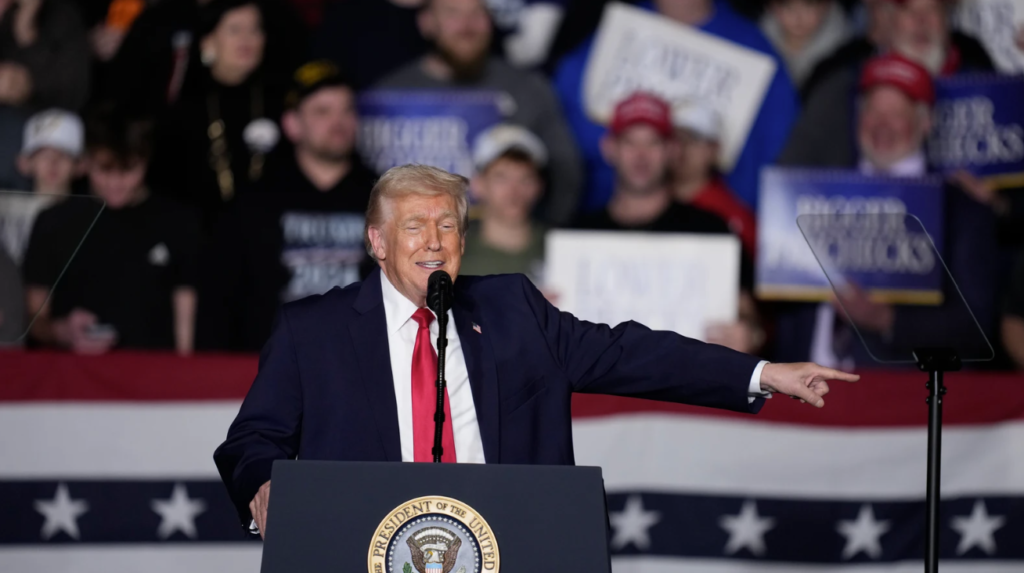
The president is, above all, a political animal with extraordinary instincts who has learned from his mistakes and now governs without internal constraints, convinced of his own invulnerability.
By Gustavo de Arístegui, as published by La Razón, 1 February, 2026
I beg the reader’s indulgence and ask for forgiveness for using, once again, the phrase that best defines Donald J. Trump, that of former Republican Congressman Chris Stewart, a veteran Air Force colonel and loyal friend of the president: “Trump should be taken seriously, but not at face value.” However, in his second term, maintaining that interpretive distance without falling into self-deception has become increasingly difficult.
A year has passed since Trump’s second term began, and the assessment demands a perspective free from ideological preconceptions, but also from complacency. As Machiavelli stated in The Prince : “Everyone sees what you appear to be, few feel what you are.” Trump is, above all, a political animal with extraordinary instincts who has known how to reinvent himself and, more importantly, learn from his mistakes. The paradox is significant: the “unpredictable” one has become the most predictable of presidents in his methods, though not necessarily in their consequences. He has fulfilled, point by point, what he hinted at during his first term amidst outbursts and inflammatory tweets. The difference is that now he knows how to do it.
But the accumulated experience, far from moderating him, has convinced him of his invulnerability.
The team: unstoppable efficiency
The most substantial difference between the first and second terms lies in the team, and that’s no small detail in an administration managing the most complex machinery on the planet. The Trump of 2017 arrived at the White House with an improvised entourage, many inexperienced in the Washington bureaucratic labyrinth. The result was inevitable: four chiefs of staff in four years, a carousel of resignations and firings, and an administration that seemed in a permanent state of internal civil war. Henry Kissinger, with his characteristic acuity, warned that “a leader without a cohesive team is like a general without an army.”
The Trump of 2026 has learned his lesson. His current team combines veterans with youth, loyalists with professionals who have learned—the hard way—the art of speaking their minds. We can’t exactly call them contradicting the boss, but they’re doing the closest thing to it, without causing a storm. They are loyalists who manage the narrative competently, because in politics, perception shapes reality as much as, or even more than, facts.
Perhaps his greatest successes are Secretary of State Marco Rubio and Chief of Staff Susie Wiles. The “misogynist” Trump is the first president in 250 years of American history to appoint a woman as Chief of Staff. Wiles, a cool and efficient strategist, has imposed a degree of order where chaos once reigned. Rubio, for his part, represents perhaps the president’s greatest strategic success. He is the first American since Kissinger to hold both the positions of Secretary of State and National Security Advisor, which underscores his growing influence with Trump. The third point of this triangle is the competent and prudent Treasury Secretary Scott Bessent, a brilliant investor and successful businessman.
But the technical consolidation of the system has not brought greater stability. On the contrary: it has strengthened the hard core of Trumpism and weakened the space for rational intermediation. The result is a more effective power, but also one more impervious to criticism or nuance. Trump now governs without internal checks and balances.
In this second term, Trump feels liberated. He has decided to do everything he wanted but couldn’t in his first, both in domestic and foreign policy. The explanation is simple: he now understands the levers of power. The immense and powerful machinery of the Federal Government—three million public employees, 1.3 million military personnel, a budget of seven trillion dollars, four times the GDP of Spain—requires a deep understanding of its workings to prevent it from seizing up. It took Trump four years to grasp this; now he has it under control.
America First: vigor without a Western community
Many speak of an “isolationist” Trump. This is a gross error. The supposed isolationist has turned out to be the opposite. The “America First” mantra has not been betrayed, as some purists believe—the most die-hard Trump supporters who confuse international hyperactivity with strategic abandonment. The leading figure of this school of thought is former Representative Marjorie Taylor Greene, once an “ultra-Trump supporter,” whom the president himself has mockingly dubbed “Marjorie Traitor Greene.” The more orthodox and sensible members of the team, like Wiles and Rubio, explain it bluntly: America First needs a strong and vigorous foreign policy, based on the old Reagan-era principle of “peace through strength.”
The president’s hyperactive foreign policy—Iran, the African Great Lakes, the Sahel—reveals a deliberate effort to reconfigure spheres of influence. What is at stake is not American vigor, but its sense of Western community.
Because in Washington, there is a growing feeling that Europe is no longer a partner, but a burden. The president has expressed this with devastating frankness in his recent meetings: “Europe needs us more than we need it.” This statement, more than a provocation, reveals a paradigm shift. Under Trump, the United States has ceased to see the Atlantic as a central strategic axis and is concentrating its energies on competing with China.
But this reassignment of priorities is leaving a political vacuum that Russia is skillfully exploiting.
His governing style remains blunt, decisive, and straightforward. He leaves no room for ambiguity, always with the essential nuance of taking things seriously, but not literally. Trump practices transactional diplomacy combined with shock tactics: when he sets a goal, he uses deliberate outbursts to mislead, overwhelm, and unsettle. He systematically aims for the impossible to achieve, often, more than he actually intends.
What is beyond doubt is that Trump dominates the political scene with a mastery that his critics are reluctant to acknowledge. With no political experience prior to the 2015-2016 campaign, he has demonstrated an extraordinary political instinct. He is, in the most Aristotelian sense of the term, a true zoon politikon , a political animal in its purest form. His reading of American social unrest remains accurate. Where analysts see populism, he identifies opportunities to reshape the national agenda. In domestic policy, his commitment to “reindustrialization with borders” continues to appeal to voters in the industrial heartland, what they call the Rust Belt .
The polls certainly aren’t in his favor. Disapproval ratings remain high, and even on the economy—his traditional strong suit—those surveyed don’t seem satisfied. Polls are extraordinarily volatile; if the economic cycle improves, political sentiment can shift in a matter of weeks.
Trump’s foreign policy oscillates between audacity, outbursts, and, on some issues—not all—a degree of orthodoxy. Despite verbal excesses and questionable diplomatic skills, he has achieved results in Iran, Gaza, the African Great Lakes, and a relative détente between Armenia and Azerbaijan. The arrest of Nicolás Maduro reinforced the image of a president who acts without hesitation. Those who insist on labeling the operation a “kidnapping” ignore—or pretend to ignore—that the Venezuelan tyrant is not a legitimate head of state and that the crimes he is accused of are extremely serious. The DEA, accompanied by Delta Force, executed an international arrest warrant issued by federal judge Alvin Hellerstein (a center-left figure) appointed by President Bill Clinton in 1992.
The major outstanding issue remains Ukraine, where the US has failed to halt Russian aggression despite its electoral promises. Pressure on Kyiv has fractured the Western consensus: Europeans perceive the withdrawal of financial support as a moral abdication, while Washington presents it as budgetary realism.
But it is in his handling of the transatlantic alliance that the strategy of outbursts has begun to reveal its most dangerous limits. The crisis with Denmark over Greenland perfectly illustrates this limit. No one with any knowledge of geopolitics can deny the strategic importance of the Arctic, nor that allowing Greenland to fall into the orbit of Russia and China would be a disaster for global peace, security, and stability. But the way Trump has handled the matter is no longer a calculated outburst; it is, quite simply, a blunder.
However questionable Denmark’s management of its vast Arctic territory may have been—and it is questionable—the essence and survival of NATO cannot be jeopardized. When the US president treats Denmark—a founding member of the Atlantic Alliance, a country that lost soldiers in Afghanistan alongside the United States—with the same transactional brutality as an Asian trade adversary, something fundamental has been fractured.
The recent escalation of rhetoric not only erodes trust among allies; it undermines the very credibility of Western deterrence. If Moscow and Beijing perceive structural cracks in transatlantic cohesion, strategic calculations shift dangerously. Putin has been working for years to fracture NATO; Trump, perhaps unwittingly, is facilitating his efforts. Europe watches with growing concern as Trump’s transactional diplomacy erodes the principles that sustained the Atlantic alliance for seven decades. Europe is beginning to suspect that there is no strategy behind the provocation, but rather domestic politics disguised as geopolitics.
The succession: Trumpism as a dynasty
The question of succession remains . Everything points to JD Vance as the natural successor. But Trumpism is not homogeneous. It’s not just the MAGA movement; presidential elections aren’t won with that alone. Trump’s victory is the result of a heterogeneous coalition of voters with diverse conservative ideologies and varying degrees of intensity. Trumpism, in its 2025-2026 version, resembles a power machine more than an ideological movement, as it is, to a large extent, a coalition of disgruntled people.
Many are already placing Don Jr. on JD Vance’s potential ticket for the 2028 election if the polls are favorable, or as a strategic reserve if things go wrong. The dynastic dimension of the project is reinforced.
What seems clear is that we have three very eventful years ahead of us. The November midterm elections will be anything but easy. And those who dream of a Trump who becomes a ” lame duck” in his last two years in office are going to be sorely disappointed. Trump will be Trump until January 2029, when he hands over the reins to his successor.