Gustavo de Arístegui,
February 23, 2026
I. BRIEF INTRODUCTION
Sunday, February 22, 2026, was, without any exaggeration, one of the most geopolitically eventful days of the year. Five major events converged in the last 24 hours with an intensity that demands calm yet committed analysis: the elimination of the head of the Jalisco New Generation Cartel in Mexico and the subsequent wave of violence that exposes the failed state status of large areas of the country; the confirmation of a third round of nuclear negotiations between the United States and Iran in Geneva, with the largest US military deployment in the Middle East in decades as a backdrop and new student protests challenging Tehran’s murderous theocracy; the cascading consequences of the Supreme Court’s landmark ruling against President Trump’s tariffs, a powerful testament to the rule of law; and the eve of the fourth anniversary of Russia’s invasion of Ukraine, with the conflict entering a phase of increasing Ukrainian industrial capacity, demonstrated by the Flamingo cruise missile strike on the Votkinsk plant. and the closing of the Winter Olympic Games with the extraordinary dominance of Norway, a sporting phenomenon that deserves serious reflection on models of national excellence.
II. THE FIVE MOST IMPORTANT NEWS STORIES OF THE LAST 24 HOURS
1. Mexico: Elimination of El Mencho and outbreak of violence (movie listings)
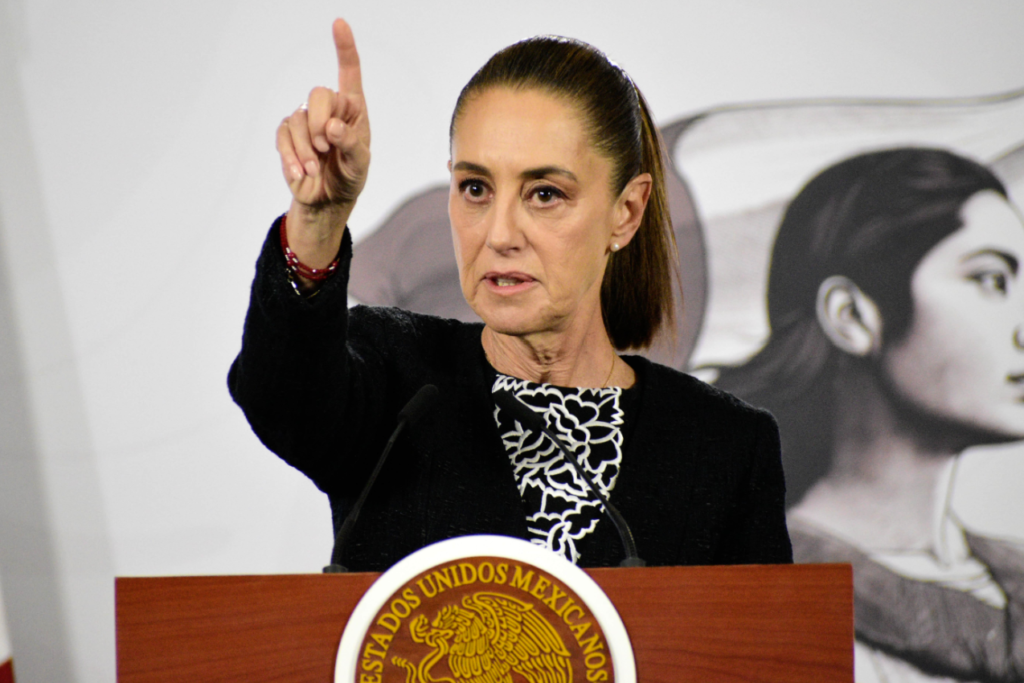
Facts: Mexican armed forces killed Nemesio Rubén Oseguera Cervantes, alias El Mencho, leader of the Jalisco New Generation Cartel (CJNG), on Sunday, February 22, during a military operation in Tapalpa, Jalisco. Oseguera Cervantes, 59, a former police officer and avocado farmer who co-founded the CJNG around 2007, was wounded during a confrontation with army troops and died while being transported by helicopter to Mexico City. Four cartel members were killed at the scene, and three more, including El Mencho, later died from their wounds. Armored vehicles, rocket launchers, and other weapons were seized. The operation, which received intelligence support from the United States, as confirmed by White House spokeswoman Karoline Leavitt, provoked an unprecedented backlash from the CJNG cartel: 252 roadblocks were set up across the country, vehicles and businesses were set ablaze—including 18 branches of the Banco del Bienestar bank and 69 Oxxo convenience stores in Guanajuato alone—and armed clashes erupted in at least a dozen states, including Jalisco, Colima, Michoacán, Nayarit, Guanajuato, and Tamaulipas. Seven members of the National Guard, a prison guard in Puerto Vallarta, and an agent from the Jalisco Attorney General’s Office were killed in the ensuing confrontations. Domestic and international flights were canceled in Puerto Vallarta and Guadalajara—Delta, Southwest, Alaska Airlines, and Air Canada suspended operations—and the U.S. Embassy issued shelter-in-place alerts for U.S. citizens in multiple states. The governor of Jalisco, Pablo Lemus Navarro, activated a “code red” security emergency. The State Department had offered a reward of up to $15 million for information leading to his capture. Under Secretary of State Christopher Landau called the elimination of El Mencho “a major breakthrough for Mexico, the U.S., Latin America, and the world.” Mayor Sheinbaum praised the security forces and called for calm. Classes were suspended on Monday in several states.
Implications: The elimination of El Mencho constitutes the biggest blow dealt by Mexican security forces against drug trafficking in years, and is a direct result of President Trump’s sustained pressure on President Sheinbaum’s government to intensify the fight against the cartels. The designation of the CJNG as a foreign terrorist organization in February 2025 was a wise step that has yielded concrete operational results. But the cartel’s immediate reaction starkly exposes a reality we have been denouncing for some time: Mexico, in many of its states, has lost real control of its territory and effectively functions as a failed state in vast areas where murderous cartels operate with impunity. That a criminal organization can paralyze a dozen states, set fire to airports, block highways, provoke prison riots, and terrorize millions of citizens in a matter of hours after the death of its leader speaks volumes about the depth of the problem, more than any statistic. As former DEA chief of international operations Mike Vigil pointed out, killing the leader isn’t enough: it’s necessary to attack the cartel’s infrastructure, logistics, money laundering, and armed wings. Bilateral cooperation, which according to Ambassador Johnson has reached “unprecedented levels,” must be maintained and deepened. The flow of hundreds of thousands of weapons from the United States to Mexico each year also deserves attention, a fact that contrasts sharply with Mexico’s single military store, which sells a mere 6,500 weapons annually.
Perspectives and Scenarios: The strategy of decapitating cartels has an ambivalent history in Mexico. Experience shows that eliminating a leader can fragment the organization and unleash internal power struggles that multiply violence in the short term. President Sheinbaum herself, like her predecessor, has criticized this strategy of eliminating “capos” precisely for this reason. The most likely scenario in the short term is a significant increase in violence as internal factions within the CJNG and rival cartels—especially the Sinaloa Cartel—attempt to fill the power vacuum. The CJNG has a presence in all 50 U.S. states, according to the DEA, and is the main supplier of fentanyl, methamphetamine, and cocaine. Without El Mencho, who maintained such a low profile that all known photographs of him were decades old, the cartel’s command structure could fragment. The international community must wholeheartedly support the fight against drug trafficking in all its dimensions, and the Trump administration is right to maintain the pressure. Tuesday’s State of the Union address will be crucial in gauging Washington’s next steps.
2. Landmark Supreme Court ruling against Trump’s tariffs: a triumph for the rule of law
Facts: The U.S. Supreme Court issued a landmark 6-3 ruling on Friday, February 20, declaring that the International Emergency Economic Powers Act (IEEPA) does not authorize the President to impose tariffs. The opinion, written by Chief Justice John Roberts in the case of Learning Resources, Inc. v. Trump, invalidates virtually all tariffs imposed since the so-called Liberation Day of April 2025 under the IEEPA. Roberts stated emphatically that “the President asserts extraordinary power to unilaterally impose tariffs of unlimited amount, duration, and scope,” and that “the IEEPA does not authorize the President to impose tariffs.” Conservative Justices Gorsuch and Barrett, both appointed by Trump himself, voted with the majority. Trump reacted harshly, calling the ruling “ridiculous, poorly written, and extraordinarily un-American,” labeling the majority justices “an embarrassment to our nation,” and specifically attacking Gorsuch and Barrett for their “disloyalty.” Within hours, Trump imposed a 10% global tariff invoking Section 122 of the Trade Act of 1974, and the following day raised it to 15%, the maximum allowed under that law, with a 150-day time limit requiring congressional approval for extension. The tariffs under IEEPA had raised more than $175 billion, which legally should be refunded to importers. Treasury Secretary Scott Bessent stated that the administration would replace the invalidated tariffs through other legal means, resulting in “virtually equal tariff revenues in 2026.” Customs and Border Protection (CBP) announced it will stop collecting IEEPA tariffs starting at 12:01 a.m. on Tuesday. Trade Representative Jamieson Greer stated on CBS on Sunday that no country has indicated plans to withdraw from the already negotiated trade agreements. Markets reacted with volatility: the euro rose above $1.18, gold climbed above $5,100 an ounce, and Bitcoin fell below $65,000.
Implications: This ruling deserves unreserved praise for the American rule of law and the strength of its institutions. In a democracy worthy of the name, no branch of government can usurp powers that the Constitution reserves for another. Tariff power, as a branch of taxing power, belongs to Congress—the House of Representatives and the Senate—not the Executive. That three judges appointed by Trump himself voted according to their conscience, based on their interpretation of the Constitution, and not according to political loyalties, is precisely what distinguishes a constitutional republic from an autocratic regime. The contrast with what is happening in Russia, Iran, Venezuela, Cuba, or Nicaragua could not be more telling. That said, we share President Trump’s legitimate concern about the United States’ chronic trade imbalances and unfair competition from China. The objective was correct; the legal instrument, incorrect. The constitutionally appropriate path leads through Congress, as the great Ronald Reagan, a staunch defender of free trade with fair rules, so aptly demonstrated. We do not support restrictions on international free trade; We are in line with Reagan’s thinking that open markets, with reciprocity and clear rules, are the engine of prosperity.
Outlook and Scenarios: Trump will now seek alternative ways to maintain his tariff policy. In the short term, Section 122 allows him to impose a 15% global tariff for 150 days. Simultaneously, the administration will launch or conclude investigations under Sections 232 (national security) and 301 (unfair trade practices) to try to replicate the IEEPA tariffs before that period expires—which coincides with the final stretch of the midterm elections, making tariff policy a politically sensitive issue. For many countries, 15% is lower than the tariffs they faced under IEEPA: Brazil faced up to 50%, and China a combined 35%. Tuesday’s State of the Union address will be the defining stage where Trump will outline his post-ruling strategy. The EU, which had agreed to a 15% tariff as part of its bilateral agreement, is in an uncertain position, with the European Parliament’s trade chief proposing to freeze the agreement. The Council on Foreign Relations analysis rightly points out that the most relevant consequence of the ruling is that it should limit the use of tariffs as an instrument of pressure or punishment outside the commercial sphere, from threats against European countries over Greenland to tariffs against Brazil for the treatment of Bolsonaro.
3. Four years of war in Ukraine: resistance, attrition and the impact of the Flamingo missile
Facts: Monday, February 24, will mark four years since Russia’s full-scale invasion of Ukraine, the most intense armed conflict in Europe since World War II, which has already lasted longer than the Soviet Union’s fight against Nazi Germany. The figures are staggering: according to the Center for Strategic and International Studies (CSIS), Russia has suffered approximately 1.25 million casualties (killed and wounded), including at least 325,000 deaths—the highest toll for a major power since 1945. President Zelensky has acknowledged 55,000 Ukrainian soldiers killed, although the CSIS estimates up to 600,000 total Ukrainian casualties, with as many as 140,000 deaths. A survey by the Kyiv International Institute of Sociology (KIIS) in January 2026 reveals that 65% of Ukrainians are prepared to resist “for as long as necessary.” On the industrial front, Ukraine has achieved a strategic milestone: on the night of February 20-21, Ukrainian-made FP-5 Flamingo cruise missiles struck the Votkinsk Machine Building Plant in the Udmurt Republic, 1,300 kilometers from the border, damaging workshops that produce Iskander-M ballistic missiles, Yars and Bulava intercontinental ballistic missiles, and the new Oreshnik intermediate-range missile. Fires broke out on the premises, at least 11 people were injured, and workshops 19, 22, and 36 were damaged. The Flamingo missile, manufactured by the Ukrainian company Fire Point—a startup founded by a group of friends from the construction, video game design, and architecture industries—has a declared range of 3,000 kilometers and carries a 1,150-kilogram warhead. Europe has shouldered the main burden of support: the EU has contributed over €300 billion in military and budgetary support, and following the virtual withdrawal of 99% of US aid under the Trump administration, a €90 billion EU loan effectively finances the Ukrainian state until 2027. Five European nations (France, Germany, the UK, Italy, and Poland) announced on Friday a program to produce low-cost drones using Ukrainian combat experience.
Implications: The war in Ukraine, along with the Iranian question, remains the main challenge to European security and the rules-based international order. We oppose Russian aggression against Ukraine and the use of force as a means of acquiring territory: this principle admits no nuances or equidistance. Russia has not achieved, nor will it achieve, a decisive military victory in Donbas, but Moscow has intensified its campaign of energy terrorism against Ukrainian civilian infrastructure, weaponizing winter against the civilian population. The Flamingo missile attack on the Votkinsk plant is strategically momentous: for the first time, Ukraine has demonstrated the capacity to strike one of the most strategic facilities of the Russian military-industrial complex, in the geographic heart of Russia, with its own production. That a startup founded by civilians with no military training has developed a cruise missile capable of reaching the factory that produces the missiles with which Russia bombards Ukrainian cities represents the kind of innovation that has characterized the Ukrainian resistance from day one. Europe has taken a historic step forward by assuming the main burden of supporting Kyiv. As Atlanticists at heart and committed Europeans, we maintain that European security inextricably links the defeat of Russian aggression. We are only moderately critical of Trump regarding the negotiations with Russia, but the withdrawal of 99% of US aid has forced Europe to mature strategically, which, paradoxically, could strengthen European autonomy in the long term.
Outlook and Scenarios: Peace negotiations in Geneva are stalled. Putin is demanding territories in eastern Ukraine that he has not yet conquered; Zelensky insists on the return of all territories, including Crimea. The most likely scenario for 2026 is the continuation of the war of attrition, with Russia facing increasing economic difficulties—the defense budget will be cut by at least 7%—and the progressive loss of energy revenues: 2026 could be the last year that Russia can sell LNG and pipeline gas to its remaining European customers, revenues of €22 billion in 2025 that finance a significant portion of Russian military spending. In 2027, the EU’s total ban on imports of Russian LNG and gas, as well as the US ban on Russian uranium, will come into effect. The proliferation of Flamingo missiles—Fire Point aims to produce 210 units per month—opens the door to systematic attacks against Russia’s defense industrial base, which could accelerate the degradation of Russia’s ability to sustain aggression. Europe must maintain and strengthen its support, and the E5 drone program with Ukrainian technology is a smart investment in the security of the entire continent.
4. Iran: nuclear negotiations in Geneva, military deployment and student protests
Facts: Oman confirmed on Sunday that the United States and Iran will hold a third round of nuclear negotiations on Thursday, February 26, in Geneva. Omani Foreign Minister Badr al-Busaidi said he was “pleased to confirm the negotiations with positive momentum to go the final mile toward finalizing the agreement.” Iranian Foreign Minister Abbas Araghchi told CBS that there is “a good chance of a diplomatic solution” and that Iran is preparing a draft proposal that could “exceed the terms of the 2015 agreement.” However, the two sides remain far apart: Trump’s special envoy, Steve Witkoff, insisted on Fox News that “zero enrichment” is a non-negotiable condition, while Araghchi countered that enrichment is a “right” and a matter of “dignity and national pride.” Araghchi added that Iran is only negotiating the nuclear issue, refusing to address its ballistic missile program or support for regional armed groups. Meanwhile, the United States has deployed its largest military presence in the Middle East in decades: two carrier strike groups—the USS Gerald R. Ford is approaching the Mediterranean—more than 50 F-35, F-22, and F-16 fighter jets, and military aircraft spotted at European bases, including Lajes (Portugal) and Sofia (Bulgaria), whose airport will briefly close on Monday and Tuesday for military operations. Trump warned on Friday that he is considering “limited strikes,” and Witkoff revealed that the president is wondering why Iran has not “capitulated.” Iran conducted military exercises in the Strait of Hormuz and temporarily closed parts of it as a “security precaution.” According to the Financial Times, Iran has acquired Russian man-portable air-defense systems (MANPADS) for €500 million. Simultaneously, new university protests have erupted for the second consecutive day on at least seven campuses in Tehran and Mashhad, coinciding with the 40-day commemoration of the thousands killed in the January massacre—at least 7,015 confirmed deaths according to HRANA, with approximately 40,000 detained. At KN Toosi University, students trampled on images of Khamenei. The IAEA Board of Governors will meet in Vienna on March 2, where a new resolution censuring Iran is expected.
Implications: The Iranian situation presents an extraordinary convergence of internal and external pressures on the theocratic regime. We maintain our staunch criticism of the terrorist regime in Tehran, an exporter of terrorism and instability through its proxies: Hezbollah in Lebanon and Syria, the Houthis in Yemen, Hamas, the pro-Iranian terrorist militias in Iraq, and their puppets in Central Asia. The figures from the January massacre are chilling and reveal the criminal nature of the regime: Khamenei’s order to “crush the protests by any means necessary” confirms that we are dealing with a theocracy willing to massacre its own people to perpetuate its hold on power. That students returned to the streets just six weeks after such carnage, trampling on images of the Supreme Leader and chanting “this is the year of his downfall,” speaks to a civic courage that deserves the utmost respect and the unequivocal solidarity of the free world. The Trump administration’s coercive diplomacy follows a classic pattern of negotiation from a position of overwhelming strength. The precedent set by the joint US-Israeli attacks on Iranian nuclear facilities last June—which, according to Trump, “obliterated” the Natanz, Fordow, and Isfahan sites—lends credibility to the threat and, paradoxically, reduces the cost of engagement for Tehran, whose nuclear program has already been degraded on the ground. US military pressure is necessary and legitimate: without it, Tehran would not negotiate. A nuclear Iran would irreversibly alter the balance of power in the Middle East and trigger a nuclear arms race in the region.
Perspectives and Scenarios: Thursday’s negotiations in Geneva are unfolding under a military Damocles’ sword and a ticking diplomatic clock: Trump gave Iran a 10- to 15-day deadline last week, and the IAEA meeting on March 2 could be the catalyst that accelerates events. Araghchi has suggested elements that could be “much better than the previous agreement” of 2015, but Witkoff’s demand for zero enrichment clashes head-on with the Iranian position. The most dangerous scenario—a large-scale US military attack, not mere “limited strikes” but a sustained campaign—cannot be ruled out. The consequences would be enormous: a possible Iranian closure of the Strait of Hormuz, retaliation against US bases through proxies, and an unpredictable regional escalation. The acquisition of Russian anti-aircraft missiles complicates any air operation. On the domestic front, the university protests are a crucial indicator: if they spread beyond the campuses into the streets, as happened in December and January, the regime will face an existential crisis at a moment of maximum vulnerability. Students in Isfahan have announced they will join the protests on Tuesday. The pattern of forty days of mourning turning into protests has direct historical echoes of the 1979 Revolution: then, as now, funeral ceremonies fueled new waves of protest. The mullahs’ regime is experiencing its most difficult hours.
5. Norwegian dominates the Milan-Cortina Olympic Games: lessons from a model of excellence
Facts: Norway closed out the Milan-Cortina 2026 Winter Olympics on Sunday topping the medal table with 18 golds and 41 total medals, setting a new record for gold medals at a Winter Games—surpassing the 16 they themselves won at Beijing 2022—and leading the medal count for the third consecutive tournament, a feat no country had achieved in 20 years. Johannes Høsflot Klæbo, a 29-year-old Norwegian cross-country skier, won six gold medals at these Games, the most ever won by an athlete at a Winter Olympics and the second-highest tally in Olympic history after Michael Phelps’ 23 gold medals in swimming. Klæbo became the winter sports athlete with the most gold medals in history, surpassing his compatriots Marit Bjørgen, Bjørn Dæhlie, and Ole Einar Bjørndalen, all retired with eight golds. Norway dominated, especially in cross-country skiing and biathlon, where they won 25 medals, 10 of them gold. The United States finished second with 12 golds and 33 total medals, their best result since 1952, culminating in a thrilling 2-1 overtime victory by the men’s ice hockey team against Canada, with a decisive goal by Jack Hughes. Italy, as host nation, achieved their best-ever performance with 10 golds and 30 medals. Brazil won South America’s first Winter Olympic gold medal with Lucas Pinheiro Braathen in giant slalom, the son of a Brazilian mother and a Norwegian father. Spain won a gold medal in ski mountaineering, the new Olympic discipline, with Oriol Cardona Coll, breaking a 54-year drought without a winter gold medal for our country.
Implications: It’s worth seriously considering how a country of 5.7 million inhabitants—fewer than the Community of Madrid—achieves such extraordinary and sustained success in winter sports. They must be doing something VERY right. The answer lies in a model that combines consistent, long-term public investment in grassroots sports facilities accessible to the entire population, a culture that integrates winter sports into daily life from early childhood, an efficient and transparent federation, and a focus on technical excellence that doesn’t sacrifice mass participation. It’s the age-old principle that the pyramid of excellence is built on a broad base of widespread practice. It’s a model that other nations would do well to study closely: sporting excellence, like excellence in any field, doesn’t arise from improvisation or rhetoric, but from planning, perseverance, a culture of hard work, and sustained investment in people. Also worthy of mention is Russia’s absence from the Olympic medal count, a direct consequence of its aggression against Ukraine—the IOC suspended the Russian Olympic Committee—which reinforces the principle that actions have consequences in all areas, including sports. And a note of pride for Spain: Oriol Cardona’s gold medal in ski mountaineering demonstrates that, when there is talent, effort, and institutional support, our country can compete at the highest level.
Perspectives and Scenarios: The next Winter Olympic Games will be held in the French Alps in 2030. The Norwegian model raises an uncomfortable question for many countries, including our own: Are we investing enough, and investing well enough, in grassroots sport? The answer, for most countries, is no. Sporting excellence reflects the health of a society: its values, its organizational capacity, its investment in human capital, and its commitment to meritocracy. Norway, with fewer inhabitants than many European cities, has demonstrated that national greatness is not measured in square kilometers or millions of inhabitants, but in the quality of its institutions and its commitment to excellence.
III. MEDIA RACK
Summary of the news coverage of the day by the main international media outlets consulted:
Anglo-Saxon media (NYT, Washington Post, WSJ, Financial Times, The Times, The Telegraph, The Guardian, USA Today, Newsweek): Extensive coverage of the Supreme Court ruling on tariffs, with the NYT and the Washington Post underscoring the constitutional dimension of the decision and Trump’s furious reaction against the justices he himself appointed. The WSJ and the Financial Times focus on the implications for markets and existing trade agreements, with particular attention to the situation between the EU and China. Extensive coverage of the killing of El Mencho, emphasizing US-Mexico bilateral cooperation and the ensuing violence. The Guardian publishes extensive reporting on the student protests in Iran and analysis of the fragility of Khamenei’s regime. The Telegraph focuses on the military deployment in the Middle East. USA Today and Newsweek prioritize the Ukrainian anniversary with testimonies from combatants.
Anglo-Saxon audiovisual media (BBC, CNN, Fox News, CNBC, CBS): Fox News and CNN unusually coincide in highlighting the success of the operation against El Mencho as a result of Trump’s pressure on Mexico. Fox News emphasizes Under Secretary Landau’s statement and the White House’s confirmation of US intelligence support. CNN analyzes the consequences of the tariff ruling with a broad panel of economic experts. CNBC offers real-time coverage of market reactions and CBP’s decision to cease collecting IEEPA tariffs. CBS highlights the interview with Araghchi about the nuclear negotiations. The BBC offers balanced coverage of the anniversary of the war in Ukraine with testimonies from the front lines.
French media outlets (Le Monde, Le Figaro, Libération, LCI, BFM, France Info): Le Monde and Le Figaro dedicate their front pages to the US Supreme Court’s tariff ruling and its implications for the EU-US trade agreement, which is now in legal limbo. Libération focuses on the Iranian protests with extensive coverage. French broadcasters (LCI, BFM) cover the violence in Mexico and the military deployment in the Middle East. France Info highlights French participation in the E5 initiative, a drone defense program using Ukrainian technology.
German media (FAZ, Die Welt, Die Zeit): The German press is prioritizing the tariff ruling and its impact on the export industry, with FAZ analyzing the legal implications and Die Welt focusing on the market reaction. Die Zeit is publishing an extensive analysis of the fourth anniversary of the Ukraine conflict. There is also coverage of the E5 program and the increase in German military spending.
Italian and Vatican media (Corriere della Sera, L’Osservatore Romano): Corriere della Sera celebrates Italy’s historic success at the Milan-Cortina Olympics with 10 gold medals and 30 medals. L’Osservatore Romano publishes an appeal for peace on the anniversary of Ukraine.
Middle Eastern and Arab media outlets (Al-Jazeera, Al-Arabiya, Haaretz, Jerusalem Post, Israel Hayom, Arab News, Asharq Al-Awsat, Gulf News, Khaleej Times): Al-Jazeera offers the most extensive coverage of the nuclear negotiations and Iranian protests, with analysis of the impact of the military deployment on regional stability and an exclusive interview with a Crisis Group analyst. Israeli media outlets (Haaretz, Jerusalem Post, Israel Hayom) focus on the implications of a potential nuclear agreement for Israel’s security and its stance on the Iranian missile program. Gulf media outlets (Arab News, Gulf News, Khaleej Times, Peninsula Qatar) analyze the consequences of the naval deployment in the Strait of Hormuz and the Iranian military exercises. Al Quds Al Arabi covers the Ukrainian anniversary from an Arab perspective.
Ukrainian and Russian media (Ukrainska Pravda, Ukrinform, Kyiv Independent, Kyiv Post, RT, TASS): Ukrainian media hailed the Flamingo attack on Votkinsk as a strategic milestone, with Ukrainska Pravda publishing OSINT confirmation from the CyberBoroshno group and Kyiv Independent offering detailed research on the expansion of the Votkinsk plant during the war while circumventing sanctions. RT and TASS downplayed the damage, attributing it to drones rather than cruise missiles, while extensively covering the violence in Mexico and the tariff ruling as signs of US instability. Gazeta Wyborcza (Poland) focused on European rearmament.
Asian media (SCMP, China Daily, Yomiuri Shimbun, Straits Times, Times of India, Hindustan Times, WION): Chinese media outlets analyze the implications of the tariff ruling for bilateral trade relations, noting that China could benefit from the temporary tariff reduction. Indian media cover the Indian embassy’s alert in Mexico and the post-ruling trade opportunities. WION provides extensive coverage of the deployment in the Middle East. The Yomiuri Shimbun focuses on the impact on Japan’s trade agreements.
Latin American media (Clarín, El Mercurio, Reforma): Reforma Mexico offers the most extensive coverage of the operation against El Mencho, with reports from Guadalajara, Puerto Vallarta, and Tapalpa. Clarín and El Mercurio analyze the economic implications of the tariff ruling for South American economies. Reforma publishes testimonies from travelers trapped in Puerto Vallarta and an analysis of the expected fragmentation of the CJNG.
International news agencies (Reuters, AFP, AP, DPA) and analysts (The Economist, Foreign Affairs, Politico, The Hill, National Interest, CFR): The four major agencies prioritize the elimination of “El Mencho” as their top story, followed by nuclear negotiations and Iranian protests. AP offers the most comprehensive account of the operation in Tapalpa. Reuters analyzes the financial implications of the tariff ruling. Foreign Policy publishes extensive geopolitical analysis of the four-year Ukrainian conflict. Politico and The Hill focus on the political battle over tariffs and the midterm elections. The CFR publishes analysis by Chairman Froman on post-ruling legal options. The Economist dedicates its briefing to the Ukrainian anniversary.
IV. RISK TRAFFIC LIGHT
| RISK | LEVEL | TREND |
| US-Iran conflict / nuclear program | 🔴 STOP | ↑ RISING |
| Russia-Ukraine War (4th anniversary) | 🔴 STOP | → STABLE HIGH |
| Instability in Mexico / drug trafficking | 🔴 STOP | ↑ RISING |
| Internal protests in Iran | 🟠 HIGH-MEDIUM | ↑ RISING |
| Global trade war / tariffs | 🟠 HIGH-MEDIUM | ↕ VOLATILE |
| Tension in the Strait of Hormuz | 🟠 HIGH-MEDIUM | ↑ RISING |
| European rearmament / NATO cohesion | 🟡 MEDIUM | ↑ IN REINFORCEMENT |
| Chinese expansionism (Indo-Pacific) | 🟡 MEDIUM | → STABLE |
| Financial market stability | 🟡 MEDIUM | ↑ VOLATILITY |
| Global jihadist terrorism | 🟡 MEDIUM | → STABLE |
V. EDITORIAL COMMENTARY
Institutions versus barbarism: the rule of law as the cornerstone
The events of Sunday, February 22, 2026, offered geopolitical analysts a striking snapshot of the state of the world. And within that snapshot, one element stands out above all others: the decisive importance of the rule of law as the foundation of civilized order.
The U.S. Supreme Court’s ruling against President Trump’s tariffs is not a defeat for American trade policy. It is a victory for the world’s most robust constitutional system. When six justices, three of them appointed by the president himself, vote according to their conscience, based on their interpretation of the Constitution and not on political expediency, we witness the exemplary functioning of the checks and balances that the Founding Fathers designed with a wisdom that has not lost its relevance in almost two and a half centuries. It is the system Burke would have admired: the organic evolution of institutions in the service of liberty, not the arbitrary imposition of power. This contrasts sharply with what happens in the authoritarian regimes we analyze every day—Putin’s Russia, where no court contradicts the Kremlin; Khamenei’s Iran, where the Supreme Leader orders the massacre of thousands of his own citizens; Maduro’s Venezuela, where the Chavista narco-dictatorship has destroyed all semblance of the rule of law; The Cuba of the Castros and the Nicaragua of Ortega—could not be more eloquent.
In Mexico, the elimination of El Mencho has unleashed a wave of violence that underscores the extent to which the state has lost its monopoly on force in large swathes of the country. We welcome the operational success and bilateral cooperation with the United States, which the Trump administration has championed. But the fact that a criminal organization can paralyze a dozen states in a matter of hours is a stark reminder of how far Mexico is from the security its citizens deserve. Trump’s pressure, including the designation of the CJNG as a terrorist organization, has been justified in this regard.
In Ukraine, forty-eight hours before the fourth anniversary of the Russian aggression, the Flamingo missile striking the Votkinsk plant symbolizes the resilience of a nation that refuses to submit to the law of the strongest. That a civilian startup has developed a weapon capable of hitting the factory that produces the missiles with which Russia bombards Kharkiv, Odesa, and Kyiv is, as Tocqueville might have said, a demonstration of the transformative power of freedom and individual initiative in the face of the bureaucratic machinery of authoritarianism. Europe has strategically matured by assuming the main burden of supporting Kyiv, and it must continue to do so.
And in Iran, the students who have returned to the streets, trampling on the image of Khamenei just six weeks after a massacre of historic proportions, remind us that the yearning for freedom is inextinguishable. The terrorist regime in Tehran, an exporter of instability through Hezbollah, the Houthis, Hamas, and its militias in Iraq, faces a convergence of internal and external pressures that could prove existential. Thursday’s nuclear negotiations in Geneva are taking place under the shadow of possible military action. Pressure is necessary, but diplomacy deserves a real chance.
We conclude with a reflection that may seem minor but is not: Norway’s Olympic dominance. A country of 5.7 million inhabitants that wins 18 gold medals does not do so by chance. It does so because it has built a system based on planning, sustained investment, meritocracy, and a culture of hard work. These are the same values that make liberal democracies function in all areas: strong institutions, clear rules, investment in people, and accountability. Faced with authoritarianism of any stripe, with left-wing and right-wing extremism, with neoliberalism and relativism, our position is clear: we believe in representative liberal democracy, the market economy, the rule of law, and the uncompromising defense of fundamental rights and freedoms. In this cultural battle, as in all battles that matter, there is no room for neutrality.