By Gustavo de Arístegui,
March 10, 2026
I. BRIEF INTRODUCTION
The eleventh day of Operation Epic Fury presents a contradictory picture, but with unmistakable signs of a conflict beginning to show the first indicators of mutual exhaustion, although the Islamic Revolutionary Guard Corps (IRGC) refuses, with fanatical determination, to acknowledge it. President Donald Trump’s statements at the Doral resort in Florida—in which, with remarkable tactical imprecision, he simultaneously announced that the war was reaching its main objectives and would not end this week—have provoked a temporary moderation in energy markets, which, however, may prove more fragile than substantial if the Strait of Hormuz does not regain its operational functionality in the coming days.
Tuesday, March 10, 2026, saw six major analytical developments: the fall in the price of Brent crude from almost $120 to less than $90 per barrel—albeit with high volatility; the second interception of an Iranian ballistic missile over Turkish airspace by NATO’s defensive systems, raising the risk of an invocation of Article 4 of the Washington Treaty; the confirmation by the Director General of the International Atomic Energy Agency (IAEA), Rafael Grossi, that the reserves of uranium enriched to near-weapons levels are mostly located in Isfahan—with indications, according to Clarín, of 600 kilograms enriched above 70% and traces of fissile material at 83.7%; and the Trump Administration’s decision to partially lift oil sanctions against Russia, a move that has justifiably raised concerns in Washington and European capitals. The spectacular 21.8% growth of Chinese exports in the first two months of 2026, which makes the upcoming Trump-Xi summit a meeting of extremely high geoeconomic significance; and the prolonged resistance strategy of the IRGC — now under the authority of the newly appointed supreme leader Mokhtaba Khamenei —, which is betting on energy disruption as a lever to militarily weaken Washington and Tel Aviv.
II. MOST IMPORTANT NEWS OF THE LAST 24 HOURS
1. Iranian uranium at nuclear weapon level: IAEA confirms arsenal in Isfahan
Facts:
The Director General of the International Atomic Energy Agency (IAEA), Rafael Mariano Grossi, has publicly confirmed that most of Iran’s uranium enriched to near-weapons levels—that is, above 60%—is concentrated in the Isfahan facilities. The source is not a private analysis firm or an ideologically oriented publication, but the highest international nuclear watchdog: the source could not be more direct. The Argentine newspaper Clarín, citing sources close to the IAEA, goes further, indicating the existence of evidence of up to 600 kilograms of material enriched above 70%, as well as traces of fissile material enriched to 83.7%—a threshold less than 1.5 degrees below the 90% required to manufacture an implosion-type nuclear device—as we have already reported on several occasions in these articles. The Isfahan enrichment plant also houses underground facilities that, according to intelligence analysis prior to the start of military operations, had been partially hardened (“hardened”, that is, reinforced against conventional attacks) to withstand bombing.
Implications:
Grossi’s confirmation definitively exposes the utterly fallacious nature of the arguments put forward by those—in Europe and among the most radical sectors of the American left, including representatives of the so-called “Squad,” led by Ilhan Omar, Rashida Tlaib, and Alexandria Ocasio-Cortez—who maintained that the Iranian nuclear program did not represent a real or imminent threat and that Operation Epic Fury lacked strategic justification and was therefore illegal, according to this radical group. The fact that Iran has accumulated 83.7% fissile material—a percentage that only makes sense within a program geared toward the manufacture of nuclear weapons—renders irrelevant the debate about the declared intentions of the Tehran regime: the facts speak for themselves with an eloquence that no rhetoric can soften. Isfahan is also the city where the main assets of the Iranian aerospace and missile industry are concentrated, making it one of the most sensitive targets in the ongoing conflict.
The information takes on additional dimensions of gravity when one considers that the IRGC—which, since the assassination of Ayatollah Ali Khamenei on February 28, has de facto controlled the security apparatus and strategic decision-making—would have had direct access to these stockpiles. The succession of Mukhtaba Khamenei as the new supreme leader, ratified on March 8, has not altered the effective chain of command: it is the IRGC that directs the war and holds the key to the burgeoning nuclear arsenal.
Perspectives and scenarios:
Scenario A (most likely in the short term): Israeli and US attacks on the Isfahan facilities continue with the stated priority of destroying or disabling the enriched material stockpiles, in an operation that military analysts compare, due to its technical complexity, to the previous attacks on the Fordow and Natanz plants. The operational window for effective action is narrow: moving or dispersing the fissile material to deeper underground locations would dramatically reduce the chances of success.
Scenario B: The 83.7% fissile material has already been partially moved or dispersed to unidentified locations, turning the current conflict into the prelude to a delayed nuclear threat of unpredictable scope. This scenario, which cannot be ruled out, would constitute the greatest possible intelligence failure.
1. Oil falls from $120: Trump announces de-escalation, the Islamic Revolutionary Guard Corps (IRGC) threatens to block regional crude.
Facts:
International energy markets have seen a significant drop in crude oil prices over the past 24 hours, with Brent crude—the international benchmark—falling below $90 a barrel during the early hours of the Asian session, after reaching nearly $120 on Monday. This correction follows President Trump’s remarks in Doral, where he stated that the operation was achieving its main objectives, that Iranian attacks were showing signs of decreasing in intensity—both due to the impact of Israeli and US attacks on missile launchers and drones and the agreement reached between China and Iran to allow the passage of oil tankers bound for the Asian giant—and that he was considering the possibility of the US Navy escorting tankers through the Strait of Hormuz. Asian stock markets responded positively: the South Korean stock market rebounded by more than 5%, and Japan’s Nikkei recovered 3%, partially reversing Monday’s sharp declines.
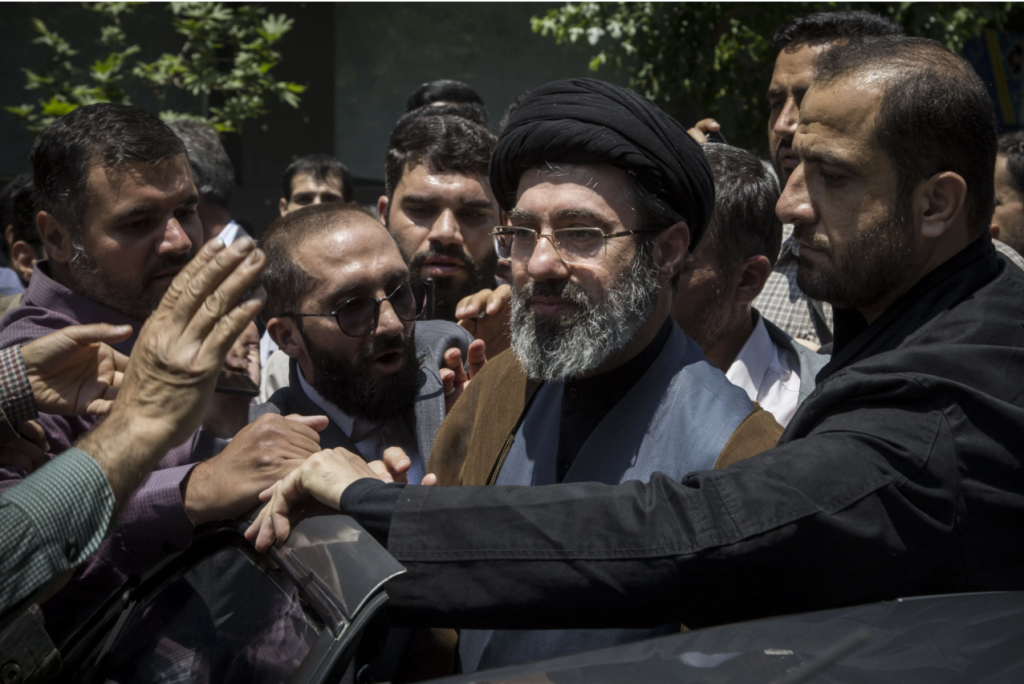
However, the IRGC was quick to deny, with its characteristic intransigence, any sign of flexibility: the Revolutionary Guard spokesman declared that only the IRGC would determine “the end of the war,” and warned that it would not allow the export of “a single liter of oil” from the region while the attacks continued. Thousands of Iranians demonstrated in support of the new Supreme Leader , Mukhtaba Khamenei, as the US and Israeli bombing campaigns continued. On the diplomatic front, the agreement between China and the ayatollahs’ regime was confirmed, guaranteeing the transit of oil tankers to Chinese ports—a move that perfectly illustrates Beijing’s strategy of geopolitically and commercially capitalizing on the chaos generated by the conflict without becoming militarily involved.
Implications:
The extreme volatility of crude oil prices—which have fluctuated by more than 50% in less than two weeks, from approximately $78 before the conflict to a peak of $119.50—represents a systemic disruption to the global economy with consequences that are difficult to gauge in real time. The effective closure of the Strait of Hormuz has led to production cuts in Saudi Arabia, the United Arab Emirates, Kuwait, and Iraq—whose output from the three main southern fields has fallen by 70%, from 4.3 million barrels per day to just 1.3 million—triggering the biggest disruption to energy supply in history, according to the consultancy Rapidan Energy. If the Strait remains closed for four months, Brent crude could reach $135 per barrel, according to Rystad Energy, with devastating inflationary effects on Western economies.
The Chinese-Iranian agreement on tanker transit is, strategically speaking, a masterstroke of diplomacy by Beijing that deserves close analysis: China secures its energy supply, reinforces its economic interdependence with Iran, and—even more importantly—demonstrates to the Gulf oil-producing countries that it can act as an alternative interlocutor to Washington in crisis situations. This interpretation has not escaped Trump, who has expressed his intention to meet with Xi Jinping at the end of March. Meanwhile, mediation attempts by some Gulf countries continue in absolute secrecy.
Perspectives and scenarios:
The restoration of normal traffic through the Strait of Hormuz—which in peacetime carries approximately 20% of global oil consumption and around 30% of global liquefied natural gas (LNG)—ultimately depends on the United States’ military capacity to definitively neutralize the IRGC’s anti-ship missile systems and naval capabilities. US Energy Secretary Chris Wright has stated that traffic will normalize “in weeks, not months,” but acknowledged that, currently, passage is “far from normal .” The G7 countries agreed at a virtual meeting of finance ministers to be “ready to take the necessary steps,” including releasing strategic oil reserves, although France—which holds the group’s presidency—indicated that they “have not yet reached that point.”
3. NATO intercepts Iranian missile over Türkiye for the second time: Article 4 looms
Facts:
NATO has intercepted, for the second time in less than five days, a ballistic missile launched from Iranian territory that penetrated Turkish airspace—Turkish being a full member of the Atlantic Alliance. The projectile was neutralized on Monday, March 9, by NATO missile defense systems deployed in the Eastern Mediterranean, with fragments of the rocket impacting unpopulated fields in Gaziantep province, approximately 93 miles from Incirlik Air Base—where hundreds of US troops are stationed and where the United States is widely believed to store nuclear weapons. NATO spokeswoman Allison Hart stated that “the Alliance remains steadfast in its readiness to defend all allies against any threat.” Turkey again summoned the Iranian ambassador in Ankara and warned Tehran that it “is not prepared to tolerate extremely misguided and provocative steps.” Presidents Erdogan and Pezeshkian spoke by telephone, with the Iranian president offering to create a joint commission of inquiry to clarify the facts—a proposal that Turkish diplomacy has received with little conviction. As a precautionary measure, Ankara deployed six F-16 fighter jets to Northern Cyprus days after an Iranian-made drone—likely launched by Hezbollah—struck the British base at Akrotiri.
Implications:
The double interception of Iranian missiles over Turkish soil elevates the conflict to a new dimension of strategic risk: for the first time since the start of Operation Epic Storm on February 28, Iranian fire has violated the airspace of a NATO member on two consecutive occasions. This raises, with an urgency that can no longer be ignored, the possibility of invoking Article 4 of the North Atlantic Treaty—which allows any member to request formal consultations if it considers its territorial integrity or security threatened. The proximity of the impacts to the Incirlik base, which houses US nuclear weapons under NATO’s nuclear sharing agreements, introduces a variable that the Alliance’s military planners cannot ignore: an Iranian missile striking Incirlik in the context of active warfare would constitute the most serious scenario since the Cuban Missile Crisis in 1962—and this comparison is not hyperbolic. The fact that debris from the drone that hit Akrotiri contained Russian-made components —as reported by The Times on March 7— adds an additional layer of concern about the depth of Russian-Iranian collaboration during the conflict.
Perspectives and scenarios:
Turkey finds itself in an extraordinarily delicate geopolitical position: a NATO ally with the Alliance’s second-largest army, it simultaneously maintains economic and diplomatic relations with Iran and has declared that it will not allow the use of its bases for offensive operations against the ayatollahs’ regime. Ankara has not invoked Article 4 and, for the moment, does not appear willing to do so—partly because this would imply formal involvement in a conflict that, until now, it has managed with calculated ambiguity under Erdoğan. However, a third interception of Iranian missiles, especially if it results in Turkish casualties or significant material damage, could change the equation within hours. NATO, for its part, has emphasized that it is not “a party to the conflict”—in the words of Colonel Martin O’Donnell, spokesman for the Supreme Allied Command in Europe—but the repeated interception of missiles over allied territory is making that declaration, with each passing day, a legal fiction that is increasingly difficult to maintain operationally.
4. Trump partially lifts oil sanctions on Russia: a high-risk gamble
Facts:
The Trump Administration has taken a strategically significant step by announcing the partial lifting of oil sanctions on Russia as an emergency measure to contain the surge in crude prices caused by the effective closure of the Strait of Hormuz. The Treasury Department has issued a general license facilitating the purchase of Russian oil by certain countries, beginning with India—which receives a 30-day waiver—with the express intention of offsetting the supply shortfall created by the Iranian disruption. Treasury Secretary Scott Bessent openly stated that there is a possibility of “releasing” the hundreds of millions of barrels of embargoed Russian crude currently in transit at sea, which would allow for an injection of additional supply into the global market. Trump, for his part, added that he will speak with President Putin about the conflict with Iran and the war in Ukraine, describing the conversation as “very good.”
The reaction in Congress was swift: a group of Democratic senators, led by Chuck Schumer, Jack Reed, and Sheldon Whitehouse—along with Elizabeth Warren, Jeanne Shaheen, and others—issued a joint statement calling the decision “particularly irritating” at a time when there are credible reports that Russia is providing intelligence to Iran about the position of U.S. forces in the Middle East. White House Press Secretary Karoline Leavitt downplayed these reports, stating that Russian-Iranian cooperation was “making no difference” on the military front.
Implications:
The decision to lift, even partially and temporarily, oil sanctions on Russia in the midst of the Iranian war contains a major strategic contradiction that no rigorous analysis can ignore: while the United States and its allies are engaged in military combat against the main axis of regional destabilization sponsored by Moscow and Tehran—and while there is evidence that Russian intelligence has provided the Iranians with operational information on US military positions—Washington is releasing oil revenues to the Kremlin that will directly finance its ongoing campaign of aggression in Ukraine. The paradox is unprecedented in the history of contemporary US foreign policy: in terms of strategic coherence, it amounts to financing, even indirectly, the adversary that is facilitating the resistance of the enemy being fought. Democratic Senator Warren has denounced the blanket license as a violation of the Countering America’s Adversaries Through Sanctions Act, which requires 30 days’ notice to Congress before any relaxation of sanctions.
Perspectives and scenarios:
Trump’s move cannot be interpreted solely in terms of energy: on the horizon looms the summit with Xi Jinping—scheduled for the end of March—and the informal negotiations with Putin on Ukraine, for which the US president is using sanctions as leverage. The risk, however, is that this two-pronged tactic—militarily pressuring Iran while easing sanctions against its Russian backer—will be interpreted in Moscow as a sign of weakness or internal division within the Western coalition. Markets, at least temporarily, have received the signal as a reduction in risk, with Brent crude falling to $88 from its recent peak; but the stability of this correction depends entirely on whether the Strait of Hormuz regains its functionality and whether NATO manages to prevent further escalation with Türkiye.
5. China registers a 21.8% increase in exports: a formidable asset ahead of the Trump-Xi summit
Facts:
Chinese statistical authorities have released foreign trade data for the first two months of 2026—China combines January and February to neutralize the statistical effect of the Lunar New Year—showing export growth of 21.8% year-on-year. This figure stands in stark contrast to the 6.6% growth recorded in December 2025 and comes amid escalating tariffs between Washington and Beijing, empirically refuting those who argued that Trump’s tariffs were already having a significant contractionary effect on Chinese foreign trade. The Chinese trade surplus—which, by all accounts, has grown in parallel—represents a major geoeconomic irritant at a particularly delicate moment for the bilateral relationship: Trump is scheduled to visit China at the end of March for a summit that, judging by the published data, will begin with an even more pronounced negotiating asymmetry.
Implications:
The 21.8% growth in Chinese exports during a period of heightened tariff tensions can be explained by several interconnected factors: Chinese companies anticipating exports before new rounds of tariffs take effect—what is known as “front-loading”—; diversification of export destinations to markets in the Global South; and, not least, the indirect impact of the Iranian conflict, which has made China the only importer with guaranteed access to Gulf oil thanks to the bilateral agreement with Tehran. Beijing arrives at the summit with Trump in a position of considerable relative strength: with an expanding export economy, a secure energy supply—at least temporarily—and the rhetoric of “active neutrality” that has earned it implicit recognition in numerous capitals of the Global South. Trump, for his part, arrives with gasoline prices at record highs for his second term and with the specter of the November midterm elections looming over every strategic decision.
Perspectives and scenarios:
The Trump-Xi summit at the end of March is shaping up to be the most geopolitically and geoeconomically charged bilateral meeting since the pandemic. On the table will be: tariff policy—Trump has suggested he could ease tariffs in exchange for trade concessions, a classic reversal of his negotiating playbook; the Strait of Hormuz and China’s role in the diplomatic pressure on Tehran to reopen it; Taiwan—whose situation is paradoxically becoming more stable during the Iranian conflict, given that Washington cannot afford a second front; and export data, which are expected to provoke a Trumpian outburst regarding the bilateral trade deficit. Trump’s position is further complicated by the fact that, as he himself has noted with a certain geopolitical pride, he is keeping the Strait open “also for China”—in his own words, it is an “honor” to do so—making Beijing a direct beneficiary of the US military effort at no strategic cost to the Asian giant.
6. The IRGC’s resistance strategy: Iran bets on attrition and energy disruption
Facts:
According to analysts at Reuters and other primary sources, the Islamic Revolutionary Guard Corps (IRGC) has adopted a protracted resistance strategy based on two pillars: the continued disruption of energy traffic through the Strait of Hormuz and a measured approach to missile and drone deployment designed to prolong the conflict rather than exhaust Iran’s arsenal in a brief, intensive exchange of fire. The IRGC’s strategy rests on a geopolitical premise that, while not entirely without internal logic, is profoundly flawed in its strategic calibration: that pressure on oil prices, combined with the internal political strain in the United States stemming from rising gasoline prices in the lead-up to the November midterm elections, will eventually erode Washington’s political will to continue operations. Since the conflict began on February 28, Iran has launched more than 500 ballistic and naval missiles and nearly 2,000 drones, 40% of which targeted Israeli objectives and 60% targeted U.S. military assets in the region. However, the Corps itself implicitly admits that the rate of launches has decreased appreciably since March 4, a date from which analysts point to a combination of depleted stockpiles and rationalization of the arsenal for a long war.
Implications:
The IRGC’s strategy is intellectually coherent from the perspective of a non-state or sub-state actor that has correctly interpreted the political limitations of Western democracies—as the Iraqi insurgents and the Afghan Taliban did, with relative success. However, it makes a fundamental miscalculation: the current conflict is not against a worn-out and politically divided coalition like those in Iraq or Afghanistan, but against a Trump administration that has made the show of force its defining characteristic and that has, in the Iranian nuclear program, a casus belli with sufficient strategic legitimacy to sustain the operation over time. Furthermore, the IRGC underestimates the cumulative effect of the more than 3,000 targets destroyed by CENTCOM—the United States Central Command—which include nuclear facilities, ballistic missile systems, headquarters, and naval capabilities. The loss of the IRIS Dena —an Iranian frigate sunk in the Indian Ocean by the submarine USS Charlotte, about 40 nautical miles from Sri Lanka— and of several IRGC military commanders in the early days of the conflict has produced a structural deterioration of the regime’s command and control capacity that no revolutionary rhetoric can reverse in the short term.
Perspectives and scenarios:
The most robust working hypothesis, given the available data, is that the IRGC lacks the capacity to sustain its resistance strategy for more than four to six additional weeks without depleting its stockpile of high-precision missiles and suffering irreversible damage to its defense industrial infrastructure. Internal popular pressure—the protests of early 2026 were brutally suppressed, but not eliminated—represents an additional source of instability that the Iranian regime’s “jihadist oligarchy” cannot control indefinitely. The appointment of Mukhtaba Khamenei, who lacks recognized religious authority—he is not a high-ranking marjaa (doctrinal authority) in Iranian Shiism—as the new supreme leader adds a dimension of fragility to the regime’s legitimacy structure, which could, in certain scenarios, accelerate processes of internal fragmentation.
7. Von der Leyen demands that Europe wake up: Sánchez and Orbán, the disruptors of the European consensus
Facts:
On Monday, March 9, European Commission President Ursula von der Leyen delivered a remarkably forceful speech to the European Union ambassadors gathered in Brussels, in which she made an unequivocal appeal for Europe to abandon the placid dream—in words inevitably reminiscent of Ortega y Gasset—of a world order that “has disappeared and will not return.” Von der Leyen was explicit in her diagnosis: “Europe cannot continue to be the guardian of an old world order for a world that has disappeared and will not return,” adding that the Old Continent must equip itself with a real capacity for self-defense instead of continuing to depend on external guarantees that can no longer be taken for granted. The president also questioned the viability of the unanimous consensus system for EU foreign policy decisions —openly suggesting the need to migrate to a qualified majority voting system—, in a reference that needed no further explanation to point to the two main disruptors of European consensus: Hungarian Prime Minister Viktor Orbán and Spanish Prime Minister Pedro Sánchez.
Orbán, whom von der Leyen had already been clashing with over his chronic veto of €90 billion in aid to Ukraine—blocked this time due to a dispute over a pipeline transporting Russian oil to Hungary and Slovakia—has once again taken a collaborative approach with Moscow by sending a formal letter to the Commission President demanding the “immediate and comprehensive” lifting of all European sanctions against the Russian energy sector, citing the impact of the Strait of Hormuz crisis on oil prices in Hungary. Meanwhile, Sánchez has been mentioned—both in private comments from European diplomats reported by Politico and in public statements by EU officials—as the second major disruptor of the Atlantic-European consensus, precisely because of Spain’s refusal to allow the use of the Rota and Morón air bases. The High Representative for Foreign Affairs, Kaja Kallas, aligned with von der Leyen, warned that “a further escalation of the war could threaten Europe and beyond with unforeseeable consequences,” urging concrete measures for collective defense.
Implications:
Von der Leyen’s speech to EU ambassadors is, in terms of substantive content, the most important delivered by a high-ranking European official since the start of Operation Epic Storm. The Commission President identified, with a clarity her predecessors never dared to demonstrate, the structural problem paralyzing the EU’s foreign policy: the unanimity rule makes any foreign policy decision hostage to the veto of a single member state—whether Orbán acting as a tool of the Kremlin’s politics, or Sánchez seeking leftist electoral gain. The proposal to move to qualified majority voting in foreign policy is, constitutionally, a major revolution that would require amending the Treaties; but its mere public announcement by the Commission President points in a direction that, if the Iranian crisis continues, could accelerate the timeline in unforeseen ways.
Sánchez’s association with Orbán in the same diagnosis of responsibility for the fracturing of the European consensus constitutes a diplomatic disgrace of the first magnitude for Spain: that the government of a founding member of liberal representative democracy, a full member of NATO, and one of the four largest members of the European Union, appears in the same analytical package as the most openly pro-Putin leader in the EU is reputational damage whose consequences will extend far beyond the Iranian conflict. Neither Germany, which allowed the use of its bases, nor France, which authorized its bases for “defensive” operations according to BFMTV, have been mentioned in this context. Spain has. The difference between disagreeing with the policy of an alliance and becoming its structural disruptor is what separates legitimate sovereignty from historical irresponsibility.
Perspectives and scenarios:
The most likely scenario in the short term is that the pressure exerted by von der Leyen and Kallas on member states will intensify the debate on reforming the foreign policy decision-making system, without this materializing in immediate constitutional changes—given that any modification of the Treaties requires the unanimity of the very states it seeks to discipline. However, the discourse has political value in itself: it establishes a narrative framework in which Orbán’s systematic vetoes and Sánchez’s positions will henceforth be interpreted, in European capitals and before continental public opinion, as acts of deliberate obstruction of Europe’s capacity for action. For Spain, the cost is already being felt: a European diplomatic source told Politico that Madrid’s position is “isolating Spain from its closest partners” at a time when the country needed precisely the opposite. Sánchez’s bet on short-term domestic gains —replicating Zapatero’s 2004 playbook— could prove far more costly in terms of European and Atlantic influence than the immediate electoral calculation suggested.
III. MEDIA RACK
Major international media outlets continue to offer profoundly differentiated coverage of the conflict, reflecting their editorial lines, political alignments, and underlying geopolitical interpretations.
ANGLO-SAXON MEDIA (USA AND UK):
The Wall Street Journal and the Financial Times both emphasize the systemic risk to the global economy posed by the energy conflict, with analyses focused on the impact of rising oil prices on US inflation and bond markets. The WSJ is particularly critical of the decision to lift Russian sanctions, which it describes as a geopolitical “moral hazard” with unpredictable consequences. The Economist, in its weekly analysis, dedicates an extensive report to Trump’s dilemma: winning the war in Iran while losing the battle for gasoline at home. The Times of London and The Telegraph maintain a position of critical support for the operation, questioning its management but not its legitimacy in principle; both devote considerable attention to tensions with Spain over the Rota and Morón air bases. The Guardian, with its usual editorial consistency from a liberal left perspective, adopts a markedly skeptical stance regarding the operation’s stated objectives and devotes considerable space to Human Rights Watch reports on Israel’s use of white phosphorus in residential areas of southern Lebanon.
CNN maintains continuous coverage of the conflict with a significant deployment of correspondents in the region; its approach is, as usual, more descriptive than analytical. Fox News emphasizes Secretary Hegseth’s statement that “we are putting others in danger, that’s our job” and criticizes the “pusillanimous” attitude of European allies who have restricted the use of their bases. The Washington Post dedicates several analyses to the domestic electoral impact of the conflict on Republicans in the lead-up to the November midterm elections. USA Today focuses on the cost of gasoline for the average American.
FRENCH AND CONTINENTAL EUROPEAN MEDIA:
Le Monde and Libération adopt markedly critical positions on Operation Epic Storm, in line with the official French position condemning the attacks as “contrary to international law.” Le Figaro, however, presents a more nuanced stance, acknowledging the Iranian nuclear threat as real while questioning the unilateral nature of the action. BFM TV and LCI offer continuous coverage, emphasizing the impact on French citizens in the region and the pressure on energy prices in France. FAZ and Die Welt, mouthpieces of the German conservative establishment, reflect the awkward position of Chancellor Merz—who allowed the use of German bases for the US effort but chose to remain silent in the face of Trump’s threats to Spain. Die Zeit presents a more reflective analysis of the cost to European cohesion of the rift between Madrid and Washington. Corriere della Sera dedicates a double-page spread to analyzing Italy’s role as a mediating power and the implications of the conflict for migration flows in the Mediterranean.
MIDDLE EAST MEDIA:
Al Jazeera, true to its usual slant, maintains critical coverage of US and Israeli operations, with particular emphasis on Iranian civilian casualties and violations of international humanitarian law. Its reports on the succession of Mukhtaba Khamenei are especially detailed. Al Arabiya and Asharq Al Awsat—Saudi-leaning media outlets—reflect Riyadh’s deep unease about the conflict: Saudi Arabia is simultaneously an ally of Washington, a potential target of the IRGC—which has already launched missiles into Saudi territory—and a long-term beneficiary of any structural weakening of the Iranian regime. The Jerusalem Post and Israel Hayom cover the conflict with clear editorial support for the IDF operations, although both point out the growing cost to Israeli citizens—13 dead and more than 1,900 wounded in Iranian attacks since the start of the conflict. Haaretz, with its usual editorial independence, maintains a more critical stance toward the Netanyahu government, noting the risk of having initiated a conflict without a clearly defined exit strategy.
RUSSIAN AND CHINESE MEDIA:
Russia Today and TASS present the conflict as an act of Western imperialist aggression that destabilizes the international order, highlighting the condemnation by Pope Francis and numerous leaders of the Global South. Both outlets emphasize, with evident satisfaction, the tensions between Spain and the United States, portraying Sánchez as the only European leader with “moral integrity”—a propagandistic manipulation that should not be mistaken for objective analysis. The South China Morning Post and the China Daily offer a reading favorable to Beijing’s interests: both highlight the Sino-Iranian agreement on the transit of oil tankers as a success of Chinese diplomacy and present Xi as the only global leader with a real capacity for mediation. The Yomiuri Shimbun and the Japanese media reflect Tokyo’s serious concern about the energy impact of the conflict on an economy that is critically dependent on oil imports from the Gulf.
IBERO-AMERICAN MEDIA:
Clarín of Buenos Aires stands out as the source that provides the most detailed information on the enrichment of Iranian uranium to 83.7%, citing sources close to the IAEA—a fact that confirms that journalistic rigor is not the exclusive domain of major Anglo-Saxon media outlets. La Razón and El Debate of Madrid offer top-notch coverage of the implications of the nuclear arms crisis for Spain, with a critical approach to the Sánchez-Albares government’s handling of the situation, a view shared by other center-right media outlets in Spain and Europe. El Mercurio of Chile and Reforma of Mexico observe the conflict with the concern of commodity-exporting economies that, in conditions of high energy volatility, are exposed to external shocks that are difficult to manage.
IV. RISK TRAFFIC LIGHT
| RISK FACTOR | RISK LEVEL |
| Military escalation to full-blown regional conflict (Saudi Arabia, Emirates) | 🔴 CRITICAL |
| Iran triggers Article 5 of NATO’s treaty with missiles targeting Türkiye | 🔴 VERY HIGH |
| Collapse of maritime traffic in the Strait of Hormuz (>4 weeks) | 🟠 STOP |
| Oil price climbs towards $135/barrel (Brent) | 🟠 STOP |
| Spain-US diplomatic crisis and trade reprisals | 🟠 STOP |
| Internal fracture in Iran / successor Mojtaba lacks religious legitimacy | 🟡 MODERATE-HIGH |
| US-China trade tensions (Chinese exports +21.8%) | 🟡 MODERATE |
| Sanctions against Russia eased: risk of setting a precedent in Ukraine | 🟡 MODERATE |
| Iranian nuclear proliferation: fissile material enriched to 83.7% | 🔴 VERY HIGH |
V. EDITORIAL COMMENTARY
Eleven days after the start of Operation Epic Storm—and ten days after the assassination of Ayatollah Ali Khamenei in the Israeli and American airstrikes on Tehran—the emerging strategic picture is one of a partial military victory accompanied by a political management riddled with inconsistencies that, if not urgently corrected, could transform an undeniable tactical success into a strategic quagmire from which Washington will take years to emerge. Let us analyze it with the dispassionate objectivity that the moment demands and with the clarity that our editorial line has always championed.
On the positive side, the operation’s results are objectively significant: more than 3,000 targets destroyed; the physical elimination of the main exponent of state terrorism on a global scale; the severe impact on Iran’s ballistic missile arsenal—whose stockpiles of high-precision missiles show unequivocal signs of depletion; the IAEA’s confirmation of a nuclear program that was, literally, one step away from producing fissile material for weapons use; and the unequivocal signal sent to all actors of the so-called “axis of resistance”—Hezbollah, Hamas, the Yemeni Houthis, the Iraqi Shiite militias—that the IRGC’s umbrella is not invulnerable. No one can honestly say that the Iranian threat was a fiction created by warmongering neoconservatives: the 600 kilograms of uranium enriched above 70% and the traces of 83.7% enriched material at the Isfahan facilities are the best possible response to those who—from Bernie Sanders to Ilhan Omar, including the various factions of the European radical left—denied the existence of this program or minimized it as an Israeli-American provocation.
On the downside, however, management errors of a gravity that cannot be underestimated are accumulating. The decision to lift oil sanctions on Russia—at a time when there are reports that Moscow is providing Tehran with operational intelligence on US military positions—is not only a strategic inconsistency error: it is a sign of weakness that Putin will almost certainly interpret as an invitation to raise the price of his “neutrality.” President Trump cannot simultaneously claim to dismantle the Iranian jihadist oligarchy and compensate its Russian backer with additional oil revenues: the contradictions of such a stance will ultimately erode the credibility of an administration that has made resolve its most valuable diplomatic hallmark.
The crisis with Spain deserves separate consideration, because its implications extend far beyond the episode itself. The attitude of the Sánchez-Albares government—which has denied the use of the Rota and Morón air bases for military operations, a decision rightly criticized by the People’s Party as an abandonment of Spain’s allied obligations—represents the lowest point in Spanish foreign policy since the withdrawal of troops from Iraq in 2004, also led by a Socialist president seeking domestic electoral gain. That thousands of demonstrators in Barcelona carried photographs of Sánchez alongside the portrait of the assassinated ayatollah should be no source of pride for any European democrat. The difference between opposing a war and posing for a photo with the iconography of a regime that has executed tens of thousands of citizens for demanding freedom is precisely what separates a principled stance from a calculated display of populist demagoguery. Spain has the right to disagree with its allies —it has done so on other occasions with full dignity—, but the way in which Sánchez has managed this disagreement has damaged the credibility of our country with its Atlantic allies and has placed Spain in the uncomfortable role of being a propaganda tool for Russia Today and for the most anti-Western sectors of the Arab world.
Having said that, it would be unfair not to point out that the US operation also presents, from the perspective of international law and humanitarian management, aspects that deserve rigorous criticism: Iranian civilian casualties, damage to Tehran’s Grand Bazaar and the Golestan Palace, and Human Rights Watch reports on the use of white phosphorus in southern Lebanon demand a transparent response from Israeli and US military authorities. The difference, however, between these legitimate criticisms and the position of those who equate Israeli democracy with the IRGC regime is the difference between analysis and propaganda—and that chasm does not allow for comfortable neutrality.
Regarding the new Supreme Leader, Mukhtaba Khamenei: the revolutionary oligarchy has committed a political error of historic proportions in his appointment. In Iranian Shiism, the authority of the Supreme Leader—the Rahbar—stems from his recognition as a Marjaa , the capacity to establish doctrine and precedent as a source of religious emulation. Mukhtaba does not possess this capacity. His appointment by the IRGC represents the transformation of Velayat-e Faqih —the rule of the Islamic jurist, a concept created by Ayatollah Khomeini in 1979—into a dynastic monarchy with radical ideological roots. This contradicts the doctrinal foundations of the revolution itself and will open up divisions within the clergy and Iranian society that the regime will not be able to manage indefinitely by force.
The war continues. The IRGC still retains significant offensive capabilities. The Strait of Hormuz remains functionally closed. But the strategic direction of the conflict, beyond the daily fluctuations, points toward a structural and irreversible weakening of one of the most brutal, bloodthirsty, terrorist-exporting, and destabilizing regimes the world has seen in the last five decades. That, with all the imperfections and risks involved in its implementation, is no small feat.