By Gustavo de Arístegui,
March 24, 2026
I. BRIEF INTRODUCTION
The Iran-Contra conflict enters its fourth week with a defining contradiction: President Trump announces “very good and productive talks” with Tehran and orders a five-day pause in attacks on Iran’s power grid and energy infrastructure, while the regime—torn apart by infighting among hardliners, extremists, and fanatics—categorically denies any negotiations with Washington. No one in the Iranian jihadist oligarchy wants to appear weak or cowardly. The speaker of the Iranian parliament, Mohammad Bagher Ghalibaf—a former general in the Islamic Revolutionary Guard Corps (IRGC), former commander of its air force, former head of the Iranian National Police, former mayor of Tehran for twelve years, and a corrupt figure of cosmic proportions—emerges as the interlocutor targeted by US and Israeli intelligence circles, though he himself is quick to publicly deny it.
Meanwhile, Israel continues its attacks on Tehran and Lebanon with an intensity that the Chief of Staff of the Israel Defense Forces (IDF), Lieutenant General Eyal Zamir, describes as the “halfway point” of the campaign. Markets are swinging wildly between panic and hope: Brent crude fell 11% after Trump’s announcement, hovering around $100 a barrel, while stock markets rebounded strongly. The International Energy Agency (IEA) warns that the crisis surpasses the two oil crises of the 1970s combined. At the same time, China sets its lowest growth target since 1991, Europe remains paralyzed by its own strategic irrelevance, and India struggles desperately to secure its energy supplies across the Strait of Hormuz, which has become the biggest bottleneck in the global economy.
II. THE 6 MOST IMPORTANT NEWS STORIES OF THE LAST 24 HOURS
1. Reuters reveals that Netanyahu convinced Trump for the joint elimination of Khamenei
Facts
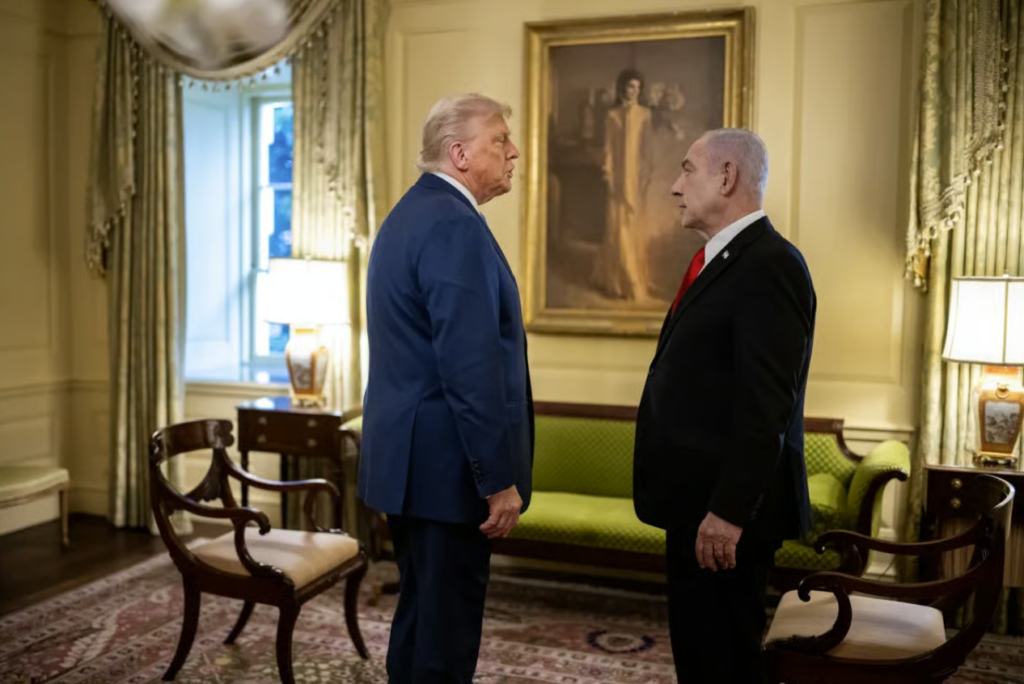
An exclusive Reuters investigation, published on March 23, reveals previously unpublished details of the phone call between Israeli Prime Minister Benjamin Netanyahu and President Trump less than 48 hours before the launch of Operation Epic Fury—dubbed Operation Roaring Lion by Israel. According to three sources briefed on the call, Netanyahu presented Trump with his “decisive argument”: new intelligence indicated that Supreme Leader Ali Khamenei and his top lieutenants would meet at his Tehran compound on the morning of Saturday, February 28—the meeting had been moved up from its scheduled time—offering a unique window for a “decapitation strike.” Netanyahu argued that Trump could go down in history by removing a leadership abhorred by the West and by millions of Iranians, and that the Iranian people could rise up and overthrow the theocratic-military system established since 1979. The Central Intelligence Agency (CIA), however, had assessed in the preceding weeks that Khamenei would likely be replaced by an internal hardliner, as indeed happened with the appointment of his son Mukhtaba Khamenei on March 8.
Implications
The revelation confirms Netanyahu’s decisive influence on Trump’s final decision, a fact that redefines the narrative surrounding this war. The “decapitation paradox”—the removal of the leadership has not led to the regime’s collapse but rather to a dynastic succession within the jihadist oligarchy itself—raises fundamental questions about the strategy’s effectiveness. The attack has resulted in over 2,300 Iranian civilian casualties and at least 13 US military deaths, triggered Iranian counterattacks against US and allied bases in the Gulf, effectively closed the Strait of Hormuz, and caused a historic surge in oil prices.
Perspectives and scenarios
The most likely scenario in the short term is a protracted war of attrition in which neither side can achieve a total victory. Pressure on Trump to find an off-ramp is intensifying as the economic and human costs mount. The alternative—an escalation toward the destruction of Iran’s energy infrastructure—would plunge the world into a recession of historic proportions. Netanyahu, for his part, will continue to push for the maximum destruction of Iran’s nuclear and missile programs as long as he has the support of the US military.
2. Trump announces pause in attacks on Iran’s power grid after “productive talks”; Iran denies all contact
Facts
President Trump posted on Truth Social on Monday, March 23, that the United States and Iran had held “very good and productive talks about a complete and total resolution of hostilities in the Middle East.” As a result, he ordered the War Department—as designated by Secretary of Defense Pete Hegseth—to postpone for five days any attacks on Iranian power plants and energy infrastructure. The announcement came hours before his own 48-hour ultimatum for Iran to reopen the Strait of Hormuz was set to expire, under the threat of “obliterating” Iranian power plants. Trump revealed that his envoys Steve Witkoff and Jared Kushner had held discussions with a senior Iranian official late Sunday night. Israeli sources identified the official as Mohammad Bagher Ghalibaf, the speaker of Iran’s parliament.
However, Iran categorically denied any negotiations. The Foreign Ministry declared that “there is no dialogue between Tehran and Washington,” and Ghalibaf himself wrote in X that “no negotiations have taken place with the US” and that Trump’s claims constituted “fake news to manipulate the financial and oil markets and escape the impasse in which the US and Israel are trapped.” Nevertheless, the Foreign Ministry spokesman acknowledged that “messages have been received from some friendly countries regarding the US request for negotiations.” European sources confirmed that Egypt, Pakistan, and Turkey were relaying messages between the two sides, and that the possibility of holding direct talks in Islamabad this week was being explored.
Implications
The negotiating-denying dynamic reflects the internal power struggles within the Iranian jihadist oligarchy: no one wants to be seen as having caved to Washington. Ghalibaf—with his record as an IRGC general, his extensive network of contacts throughout the regime apparatus, and his blatant corruption—is simultaneously the most credible interlocutor and the most politically vulnerable if the negotiations become public. The market reaction was immediate and massive: Brent crude fell 11% in minutes, stock markets rebounded strongly (S&P 500 +1.1%, NASDAQ +1.4%), demonstrating the extent to which the global economy hangs by a thread in this crisis. Treasury Secretary Scott Bessent confirmed that the United States is allowing Iranian oil tankers to pass through to stabilize global supply—a revealing contradiction between war rhetoric and economic necessity.
Perspectives and scenarios
The five-day window opens an extraordinarily fragile diplomatic period. If indirect talks progress, a direct channel through Pakistan could be established. If they fail, the threat of destruction to Iran’s energy infrastructure would materialize, with catastrophic consequences not only for Iran but for the entire global economy. The key question is whether Ghalibaf has the real authority to negotiate on behalf of a leaderless regime in which the new supreme leader, Mukhta Khamenei—whose whereabouts Trump claims to be uncertain—coexists with an IRGC that maintains operational autonomy in military decisions.
3. Israel continues attacks on Iran and Lebanon: Netanyahu vows to continue until targets are met
Facts
While Trump was announcing talks with Iran, Israel launched what its military called an “unprecedented wave of large-scale attacks” on infrastructure in Tehran. Al Jazeera’s correspondent in the Iranian capital described the scale of the explosions in the eastern part of the city as “unprecedented.” Meanwhile, the IDF continued its ground operations in southern Lebanon with forces from the 91st Division and shelled Hezbollah positions in Beirut, including an attack on the Ramada Hotel in the city center that killed four commanders of the IRGC’s Quds Force. Netanyahu, in a video statement, declared that he had spoken with “our friend” Trump and that Israel “will continue to attack Iran and Lebanon,” claiming to be “crushing the missile program and the nuclear program” and noting that “just a few days ago we eliminated two more nuclear scientists.”
Lieutenant General Zamir indicated that Israel is approximately “halfway” in its operations against Tehran and has inflicted “extensive damage” on Iranian military capabilities. In Lebanon, health authorities report more than 1,000 deaths since the start of the escalation and nearly one million displaced persons, 20% of the country’s population. Israeli Finance Minister Bezalel Smotrich declared that the Litani River—located between 15 and 30 kilometers inside Lebanese territory—should be the new border with Israel, constituting the clearest indication to date that Israel intends to seize Lebanese territory.
Implications
The simultaneous occurrence of the supposed US diplomatic opening with the intensification of Israeli attacks reveals the dual strategy of Washington and Jerusalem: to negotiate from a position of maximum military pressure. However, Smotrich’s statements regarding the Litani River as a border are extraordinarily dangerous and evoke the Israeli occupation of southern Lebanon between 1978 and 2000. The Lebanese humanitarian crisis is worsening at an alarming rate, and the international community—France, Canada, Germany, Italy, and the United Kingdom in a joint statement—has expressed “grave concern” and called for an “immediate de-escalation.”
Perspectives and scenarios
The Israeli campaign will continue to intensify as long as US military cover persists. However, growing international pressure and the reputational cost of destroying Iranian cultural heritage—including several UNESCO World Heritage sites—could erode diplomatic support for the operation. In Lebanon, the risk of a prolonged occupation is real, and its consequences have historically been disastrous for Israel.
4. Global energy crisis: the IEA warns that the situation is worse than the oil crises of the 1970s combined
Facts
Fatih Birol, executive director of the International Energy Agency (IEA), warned on Monday that the global economy faces a “greater, greater threat” and that “no country will be immune to the effects of this crisis if it continues in this direction,” declaring that the situation is worse than the two oil crises of 1973 and 1979 combined, which at the time removed 10 million barrels per day from the market. According to the IEA’s March monthly report, the war has created “the greatest supply disruption in the history of the global oil market,” with flows through the Strait of Hormuz falling from approximately 20 million barrels per day to a trickle. Oil production from Gulf countries has been reduced by at least 10 million barrels per day. Brent crude reached $119.50 before falling back to $100 after Trump’s announcement. Goldman Sachs raised its forecasts and warned that if flows through Hormuz remain at 5% for ten weeks, daily Brent prices could surpass the all-time record of 2008.
Two Indian tankers carrying liquefied petroleum gas (LPG) successfully transited the Strait on Monday, arriving from the United Arab Emirates and Kuwait, following direct diplomatic efforts between New Delhi and Tehran. However, global traffic remains down 95% compared to pre-conflict levels. Iran, meanwhile, continues to export oil through the Strait—more than 16 million barrels since the beginning of March—with China as its main buyer. US Energy Secretary Chris Wright confirmed that crude oil has begun to be released from the Strategic Petroleum Reserve (SPR), with projections of up to 1.5 million barrels per day.
Implications
The energy crisis is reshaping global power relations at breakneck speed. India and China—the two Gulf oil-dependent economies—are being forced to negotiate bilaterally with Iran, granting the regime strategic leverage that partially offsets its military weakness. Russia benefits enormously, enhancing its competitive position as an alternative supplier. The coordinated release of strategic reserves—400 million barrels agreed upon by IEA members—is an emergency measure that cannot be sustained indefinitely. Singapore’s Foreign Minister, Vivian Balakrishnan, succinctly summarized it: the war “has taken the entire world economy hostage.”
Perspectives and scenarios
If the conflict drags on beyond April without a significant reopening of the Strait, the world will face an oil-induced recession comparable to or worse than that of 1973. The IEA forecasts that Brent crude will remain above $95 in the coming weeks. Energy dependence has become Iran’s most powerful weapon, more effective than its ballistic missiles.
5. China sets its lowest growth target since 1991 as its weight in the global economy shrinks
Facts
China has set its Gross Domestic Product (GDP) growth target for 2026 at between 4.5% and 5%, the most modest since 1991 and a significant reduction from the “around 5%” of the previous three years. The decision was announced during the “two sessions” of the Chinese parliament on March 5. According to data from the International Monetary Fund (IMF), China’s share of the global economy has declined, ending 2025 at around 16.5%, less than two-thirds the size of the US economy measured in current dollars. Domestic deflation—with factory prices falling by 2.6% in 2025—a weakened yuan, and the real estate crisis—with investment in the sector plummeting by 17.2%—have eroded the relative size of the Chinese economy. Investment in fixed assets registered its first annual decline in decades in 2025, falling by 3.8%. The World Bank projects a growth of 4.4% by 2026.
Implications
China’s relative contraction is a warning sign that Europe should study closely: the Old Continent has fallen from 25% of global GDP in 2000 to the current 14%, an even steeper decline. The Chinese slowdown has systemic implications: lower demand for raw materials, pressure on global supply chains, and a growing temptation for Beijing to compensate for domestic weakness with aggressive exports, generating trade imbalances that are already causing friction with Europe, the United States, and emerging economies. Chinese military spending, however, is not slowing: the defense budget for 2026 has increased by 7%, and military activities in the Western Pacific, the South China Sea, and the Taiwan Strait are intensifying.
Perspectives and scenarios
The war in the Middle East exacerbates China’s vulnerability by disrupting oil supplies from two of its main providers: Iran and, until its collapse, Chavista Venezuela. Beijing faces a perfect storm: weak domestic demand, persistent deflation, a bottomless housing crisis, technological competition with Washington, and now an energy crisis that threatens its export-oriented model. Xi Jinping’s focus on production and technology over consumption and prosperity may prove unsustainable if the slowdown deepens.
6. Iran offers its oil to India at a premium over Brent: war as a business
Facts
According to sources cited by Reuters on March 23, Iran is offering its crude oil to India at a premium over Brent crude, reversing the usual dynamic in which Iranian oil was sold at a discount due to sanctions. The move reflects the position of strength the regime has built by selectively controlling passage through the Strait of Hormuz. India, which imports approximately 88% of its crude oil and relies on the Strait for more than half of its imports, is in a highly vulnerable position. Two Indian tankers carrying LPG crossed the Strait on Monday, but 22 Indian vessels remain stranded on the western side with approximately 1.67 million tons of crude oil, 320,000 tons of LPG, and 200,000 tons of liquefied natural gas (LNG). India invoked emergency powers to maximize LPG production and restrict industrial sales.
Implications
Iran’s ability to command a premium for its oil in the midst of war demonstrates that the jihadist oligarchy has transformed the Strait of Hormuz into its most effective weapon. The regime has created a selective “safe corridor”: open to its exports and to those negotiating bilaterally with Tehran, but closed to Washington’s allies. India is forced to perform extraordinary diplomatic balancing acts, simultaneously negotiating with Iran, with Russia as an alternative supplier, and with the United States pressuring New Delhi to cease purchasing Russian crude. It is an untenable position that illustrates how the war has fragmented the global energy market.
Perspectives and scenarios
India will continue to seek bilateral exceptions with Iran while exploring alternative routes and suppliers such as Russia, West Africa, and the United States. The crisis will accelerate India’s energy diversification, but in the short term, the shortage of cooking LPG—a product used by 333 million Indian households—constitutes a major social emergency that could have domestic political consequences for Narendra Modi’s government.
III. MEDIA RACK
Global media coverage over the past 24 hours reflects a polarization between cautious hope for the possibility of negotiations and skepticism about the sincerity of both sides.
Anglo-Saxon media: Reuters leads with the exclusive on the Netanyahu-Trump call. The Wall Street Journal highlights the deployment of three warships and thousands of additional marines to the Gulf. CNN underscores the contradiction between Trump’s claims and Iranian denials. The New York Times identifies Ghalibaf as de facto responsible for strategic decisions following the death of Ali Larijani. The Financial Times warns about the LPG crisis in India. Fox News maintains a favorable stance toward the military operation. NPR notes that the Strait is “physically open,” according to Admiral Cooper, but practically inaccessible.
European media: Le Monde and Le Figaro cover the extension of Lufthansa’s flight suspension until October. The Guardian and The Telegraph report on Britain’s refusal to participate in military operations in the Strait. Germany and Greece also reject military involvement. Die Welt reports on Lavrov’s warnings about the conflict spreading to the Caspian Sea. Corriere della Sera highlights the humanitarian crisis in Lebanon.
Middle Eastern and Asian media: Al Jazeera offers the most comprehensive coverage from Tehran, with its correspondent describing “unprecedented” explosions. Al Arabiya and Iran International cover the IRGC’s denials. Haaretz and the Jerusalem Post identify Ghalibaf as an interlocutor. The Times of Israel broadcasts Netanyahu’s statements live. The Times of India and the Hindustan Times focus on the LPG crisis and Indian diplomatic efforts. The South China Morning Post analyzes the Chinese economic contraction. WION highlights Singapore’s warning about being “held hostage” by the global economy.
Russian media outlets Russia Today and TASS highlight Lavrov’s warnings about the risks to Russian personnel in Bushehr and the “catastrophic environmental consequences” of attacks on nuclear facilities. Both emphasize the “American deadlock” narrative.
Israeli media outlets Yedioth Ahronoth, Israel Hayom, and Maariv are covering Netanyahu’s statements and the expansion of operations in Lebanon. The overall tone is supportive of continuing the military campaign.
IV. RISK TRAFFIC LIGHT
| LEVEL | RISK |
| RED | Iran-US-Israeli military escalation: attacks on Iranian energy infrastructure if negotiations fail in the next five days |
| RED | Prolonged closure of the Strait of Hormuz: unprecedented global energy crisis; IEA warns worse than 1973+1979 combined |
| RED | Lebanon War: Expanded Israeli ground operations; declarations on the Litani as a new border; more than 1,000 dead and one million displaced |
| RED | Iranian counterattacks against Gulf states: UAE activates air defenses; explosions in Doha; Kuwait attacked with drones |
| ORANGE | Unstable Iranian succession: Mukhta Khamenei as supreme leader with fragile legitimacy; IRGC with operational autonomy; power struggles between factions |
| ORANGE | Oil-induced global recession: Brent crude above $100; Goldman Sachs warns of record prices if lockdown persists for 10 weeks |
| ORANGE | China slows down: lowest growth target since 1991; bottomless real estate crisis; war exacerbates energy vulnerability |
| YELLOW | LPG crisis in India: 333 million households affected; emergency powers invoked; political risk for the Modi government |
| YELLOW | Erosion of the rules-based international order: Chatham House warns that the attacks set a precedent for the use of force without a Security Council mandate |
| YELLOW | Chinese military expansionism: defense budget +7% despite the slowdown; activities in the Western Pacific, South China Sea and Taiwan Strait intensify |
V. EDITORIAL COMMENTARY
The fourth week of the Iran-Contra conflict offers a perfect snapshot of the contradictions that define this conflict and, more broadly, the state of the contemporary international system. On one side, a US president announcing “productive talks” while sending thousands of additional Marines and three warships to the Gulf. On the other, a jihadist oligarchy denying all contact while relaying messages through intermediaries. In the middle, a world holding its breath as the price of a barrel of oil fluctuates between $100 and $120 with the erratic rhythm of an electrocardiogram.
The Reuters revelation about the Netanyahu-Trump call confirms what was already obvious to any minimally informed analyst: the Israeli prime minister was the intellectual architect of the “decapitation paradox.” Netanyahu sold Trump the illusion that removing Khamenei would trigger a popular uprising, a reverse “rally around the flag” effect that would topple the regime. The CIA warned otherwise. Four weeks later, we know who was right: Mukhta Khamenei occupies his father’s throne, the IRGC maintains its operational autonomy, and the Iranian people—subjected to a media blackout of more than 240 hours, the second longest in history—suffer under the crossfire, unable to rebel.
But the paradox has a second interpretation. The Iranian regime is seriously wounded. The military chain of command has been shattered, missile capabilities—according to the Israeli Chief of Staff—are 50% damaged, and the war economy depends exclusively on energy extortion through the Strait of Hormuz. The fact that Iran now receives a premium for its crude oil—when it previously sold it at a discount—illustrates the perverse ingenuity of a regime that has transformed the most primitive weapon, the blockade of a maritime route, into its most sophisticated instrument of survival.
The emergence of Ghalibaf as a de facto interlocutor deserves close attention. A former IRGC general, former commander of its air force, former head of the National Police, mayor of Tehran for twelve years, and cosmically corrupt, Ghalibaf is the very personification of the Iranian jihadist oligarchy: a man with cross-cutting contacts throughout the regime, capable of speaking the language of the military and that of the politicians, ambitious enough to negotiate and astute enough to deny it. His public refusal to acknowledge the talks is merely the necessary move of someone who knows that, in this ruthless regime, the perception of weakness is a death sentence.
Today we know that the jihadist regime and the US have maintained indirect contacts, most likely through Oman and Qatar, which led to President Trump’s declaration suspending military operations against Iranian power plants. Similarly, the sources who indicated to me two weeks ago that they were targeting General Mohamed Qalibaf, the current Speaker of Parliament, were referring to him as the interlocutor that intelligence circles had identified as the ideal candidate. In fact, the eliminations of high-ranking regime officials seem to suggest that they were trying to install the corrupt General Qalibaf in that position.
Meanwhile, Europe watches the spectacle unfold with the paralysis that has become its geopolitical trademark. Germany and Greece refuse to participate in operations to secure the Strait. The United Kingdom refuses to be “dragged into a wider war.” France proposes a “purely defensive” escort mission. The European Union, which has fallen from 25% of global GDP to 14% in a quarter of a century, lacks the military projection capability, the unified political will, and the strategic autonomy to influence a conflict that directly affects its energy supply. It is the most eloquent illustration of the cardinal European geostrategic sins I have been describing: self-inflicted irrelevance disguised as prudence.
China, for its part, reveals its own fragility. Its lowest growth target since 1991, persistent deflation, and housing crisis paint a picture of a power that is less formidable than its propaganda projects, yet whose military spending—up 7% this year—remains unchanged. Beijing desperately needs Iranian oil to keep flowing, which explains why ships with Chinese crews were among the first to cross the Strait. Chinese energy dependence is the other side of the coin of Iranian leverage.
The scenario unfolding for the next five days is one of extreme tension. If Ghalibaf—or whoever is actually on the other end of the line—has the authority to negotiate a gradual reopening of the Strait in exchange for de-escalation, we will be witnessing the beginning of the end of the most acute phase of the conflict. If, on the other hand, the most fanatical factions of the IRGC impose their logic of uncompromising resistance, the destruction of the Iranian electrical grid and the resulting humanitarian—and global economic—catastrophe will be inevitable. In both cases, one truth remains: this conflict has accelerated the reconfiguration of the world order at a speed that would have seemed inconceivable just a month ago. The “Pax Americana” that Trump promises, for now, comes at a price that the world is only beginning to calculate.