By Gustavo de Arístegui,
April 9, 2026
Islamabad, Lebanon and NATO: the three abysses of the ceasefire
Negotiating outline point by point · The Hormuz-Lebanon link · The consequences of the US withdrawal from NATO
Operation Epic Fury | Day 40 | April 9, 2026 — Expanded edition with three new analytical blocks
BLOCK I — NEGOTIATING PROJECTION: HOW THE ISLAMABAD NEGOTIATIONS SHOULD TURN OUT
This analytical block responds to the central question that every Western and Arab foreign ministry should be asking this morning of April 9: given the current map of positions, how should each of the ten Iranian points be addressed in an agreement that is reasonable and satisfactory to the US and Israel, that reasonably guarantees the security of the region, and that offers the GCC—victim of the criminal attacks of the oligarchic-jihadist regime—the guarantees it deserves?
The answer requires realism without naiveté. The analysis distinguishes between what is negotiable, what is difficult but possible with conditions, and what is a red line that no serious agreement can cross. The following table outlines, point by point, the reasonable position of each Western and Arab actor.
| No. | IRANIAN POINT | REASONABLE US POSITION | ISRAEL’S REASONABLE POSITION | GCC POSITION / GULF STATES |
| 1 | Permanent end to the warNEGOTIABLE WITH CONDITIONS | A 90-day suspension, renewable and conditional upon IAEA verification and cessation of proxy activity. No permanent waiver of the right to use force. | Agreement on the formulation of a conditional ceasefire. Absolute veto on any formula for a permanent withdrawal that includes Lebanon. | The GCC demands that the ceasefire include an end to all attacks by Iran and its proxy terrorist organizations against Gulf states. |
| 2 | Acceptance of uranium enrichmentDIFFICULT — POSSIBLE WITH A SERIOUSLY HARDENED JCPOA TYPE FRAME | Civilian enrichment to 3.67% under permanent IAEA supervision. Transfer of all material enriched above 20% to a third country without military enrichment facilities. | Absolute rejection of any enrichment without full IAEA oversight and an automatic snapback mechanism for non-compliance. Fordow’s dismantling verified. | The GCC aligns with Israel’s position on nuclear power. Iran’s nuclear capabilities pose a regional existential threat, not just to Israel. |
| 3 | Lifting of sanctionsNEGOTIABLE ONLY IN PHASES | Gradual lifting in three phases linked to: (a) IAEA nuclear verification; (b) verified cessation of funding to proxy terrorist organizations; (c) unconditional opening of Hormuz. | Sanctions related to the missile program and the financing of terrorist organizations must be maintained permanently. | The GCC demands that the lifting of sanctions not include IRGC assets linked to attacks against the Gulf until verified compensation is provided. |
| 4 | Release of frozen assetsNEGOTIABLE WITH SAFEGUARDS | Phased release. First phase: civilian and humanitarian assets. Second phase: state assets linked to conduct verification. Permanent freezing of IRGC assets. | Express commitment to the release of all Israeli hostages and missing persons in the possession or with the knowledge of Iran or its proxy terrorist organizations. | The GCC demands that no released assets can be used to rebuild the IRGC’s arsenal or to finance its terrorist organizations. |
| 5 | Immunity for Iranian terrorist organizationsINCOMPATIBLE IN ITS CURRENT FORMULATION | Cessation of IRGC funding, arming, and command over Hezbollah, the Houthis, Iraqi militias, and Hamas. Verification by a tripartite mechanism (IAEA+UN+regional). No operational immunity. | Absolute rejection of any immunity for Hezbollah. Operations in Lebanon will continue until the strict and verified implementation of UN Security Council Resolution 1701. | The GCC demands an immediate and verified cessation of attacks by all Iranian proxy terrorist organizations against the Gulf, with a mechanism for compensation for damages. |
| 6 | Hormuz checkpoint with tollINCOMPATIBLE — RED LINE | Full reopening under the United Nations Convention on the Law of the Sea (UNCLOS). No Iranian sovereign toll. Presence of multinational naval observers for 24 months. | The US is managing the reopening. Israel supports the US position on unconditional freedom of navigation. | The GCC categorically rejects any toll system or “coordination” that would institutionalize Iranian sovereignty over the Strait of Hormuz. The Gulf states are the most affected by the transit restrictions. |
| 7 | Withdrawal of US military forcesINCOMPATIBLE — ABSOLUTE RED LINE | Absolute rejection. The US military presence in the region is not up for negotiation. It would leave the region’s allies unprotected. | It unconditionally supports the US military presence. Without it, Israel bears a significant portion of the burden of regional deterrence. | The GCC categorically rejects any agreement that reduces the US security presence. It is the ultimate guarantee of its security against the Iranian hegemonic project. |
| 8 | Reconstruction of Iranian infrastructureNEGOTIABLE CONDITIONALLY | Possible if linked to: verification of nuclear disarmament, verified opening of the Strait of Hormuz, and verified cessation of funding to terrorist organizations. No direct funding from sectors controlled by the IRGC. | Iran first. Verification first. Reconstruction later—if compliance is verified. Israel will not finance the enemy’s recovery without full guarantees. | The GCC demands that any Iranian reconstruction program be accompanied by a compensation program for the Gulf states for the damage inflicted by the IRGC and its terrorist organizations. |
| 9 | Binding UN Security Council resolutionNEGOTIABLE WITH SNAPBACK CLAUSE | The US may accept a Security Council resolution codifying the agreement, but with an automatic snapback mechanism in the event of any breach verified by the IAEA. This does not preclude the US from taking unilateral action. | I support the Security Council resolution only if it includes an immediate snapback clause in case of non-compliance and does not restrict Israel’s right to self-defense. | The GCC supports a Security Council resolution that includes compensation mechanisms for Gulf states and guarantees of free navigation in Hormuz. |
| 10 | Geopolitical recognition of IranNEGOTIABLE — ESSENTIALLY RHETORICAL | A diplomatic formula that recognizes Iran’s role as a relevant regional actor, without acknowledging its hegemony or control over the Strait of Hormuz. Equivalent to what the 2015 JCPOA offered in terms of normalization. | It accepts formulas of recognition that do not affect Israeli security or recognize Iran’s right to hegemonic influence in the region. | The GCC can accept formulas for recognizing Iran’s role that do not involve relinquishing control over Hormuz or subordinating the Gulf’s security architecture. |
I.1. The architecture of a reasonable agreement: the five guiding principles
Principle 1: Verification before concession
No benefit—sanctions lifting, asset release, geopolitical recognition, reconstruction—should precede conduct verification. The 2015 JCPOA model reversed this order and failed. A reasonable agreement establishes an irreversible sequence: IAEA verification → partial sanctions lifting → further verification → further lifting. Automatic snapback for non-compliance—without the possibility of a Russian or Chinese veto—is a structural condition, not an optional clause.
Principle 2: Hormuz under the International Law of the Sea — without exceptions
No agreement that institutionalizes “coordination with the Iranian Armed Forces” as a condition for transit through the Strait of Hormuz can be accepted by any sovereign state that respects the International Law of the Sea. The presence of a multinational naval observer force—mandated by the Security Council—during a two-year transition period is the only formula that offers Iran formal participation without institutionalizing its de facto sovereignty over the Strait. Any Iranian sovereign toll is, legally and politically, unacceptable.
Principle 3: The nuclear program settled in the treaty, not postponed
The experience of the JCPOA demonstrated that postponing the nuclear arms archive doesn’t solve the problem—it freezes it, only to thaw it out even more dangerously later. A reasonable agreement requires: civilian enrichment to 3.67% with ongoing IAEA monitoring; verified dismantling of the Fordow reactor; transfer of material enriched above 20% to a neutral third country; and an early warning mechanism that triggers automatic sanctions upon any detected deviation. Israel is right about this: time works against non-proliferation.
Principle 4: Iran’s proxy terrorist organizations are not a party to the agreement—they are an essential subject of the agreement
A structural flaw in point 5 concerning Iran is the inclusion of Hezbollah, the Houthis, and Iraqi militias as beneficiaries of the agreement’s guarantees. These organizations are terrorist organizations. They are not contracting parties—they are instruments of the IRGC. A reasonable agreement treats the cessation of their funding, arming, and operational command by the IRGC as a condition of compliance, not as a bargaining chip. UN Security Council Resolution 1701 remains the correct legal framework for Lebanon. Its full implementation is a necessary condition of the agreement.
Principle 5: The GCC as a party—not as a spectator
The Gulf states are the most direct victims of the criminal attacks by Iran’s oligarchic-jihadist regime. Shut-down refineries, damaged desalination plants, closed airports, and disrupted ports—from Kuwait to Oman—are the catalog of damages that no agreement can ignore. A reasonable agreement includes: a compensation mechanism for GCC states for verified damages; explicit recognition that no Iranian proxy terrorist organization can operate against Gulf states; and a guarantee that no reduction of the U.S. security presence in the region can occur without the consent of the GCC states. The GCC cannot be a passive party to an agreement that determines its very existence.
I.2. The most likely outcome for Islamabad: realism without illusions
Applying the five guiding principles to the current position map, the most likely outcome of the Islamabad negotiations—if the extremes fail and the logic of what is negotiable prevails—is a two-phase agreement:
◆ Phase 1 (two weeks): Consolidation of the ceasefire. Opening of the Strait of Hormuz under multinational naval observation. Freezing of the nuclear program under IAEA supervision. Verified cessation of attacks by Iranian proxy terrorist organizations against the Gulf and Israel. No agreement yet on sanctions, assets, recognition, or military presence.
◆ Phase 2 (ninety days): Negotiation of the final agreement. Gradual lifting of sanctions linked to nuclear verification. Phased release of civilian assets. Compensation mechanism for the GCC. Security Council resolution with a snapback clause. Explicit exclusion of point 7 (military withdrawal) from the text of the agreement.
What this analyst considers virtually impossible within two weeks: any definitive resolution on the nuclear program, the financing of terrorist organizations, the military presence, or the Hormuz regime. Islamabad will produce a framework—not an agreement. The difference is crucial: a framework without verification mechanisms is worthless.
Applying the five guiding principles to the current position map, the most likely outcome of the Islamabad negotiations—if the extremes fail and the logic of what is negotiable prevails—is a two-phase agreement:
◆ Phase 1 (two weeks): Consolidation of the ceasefire. Opening of the Strait of Hormuz under multinational naval observation. Freezing of the nuclear program under IAEA supervision. Verified cessation of attacks by Iranian proxy terrorist organizations against the Gulf and Israel. No agreement yet on sanctions, assets, recognition, or military presence.
◆ Phase 2 (ninety days): Negotiation of the final agreement. Gradual lifting of sanctions linked to nuclear verification. Phased release of civilian assets. Compensation mechanism for the GCC. Security Council resolution with a snapback clause. Explicit exclusion of point 7 (military withdrawal) from the text of the agreement.
What this analyst considers virtually impossible within two weeks: any definitive resolution on the nuclear program, the financing of terrorist organizations, the military presence, or the Hormuz regime. Islamabad will produce a framework—not an agreement. The difference is crucial: a framework without verification mechanisms is worthless.
BLOCK II — THE LEBANON TRAP: HOW IRAN USES ISRAELI ATTACKS AGAINST HIZBULLAH AS LEVERAGE OVER THE STRAIT OF HORMOUZ
II.1. The architecture of the link: five real-time mechanisms
In less than twelve hours since the ceasefire announcement, Iran’s oligarchic-jihadist regime activated a series of actions that surgically reveal its strategy of linking Lebanon and the Strait of Hormuz. The following table documents the five mechanisms of this link as they unfolded on April 8—Day 40 of the conflict.
| LINKAGE MECHANISM | IRANIAN POSITION | US/Israel Position |
| Iran demands a cessation of attacks against Hezbollah in Lebanon as a condition for a ceasefire | The CSNSC text explicitly links the ceasefire to a cessation of hostilities “on all fronts.” Irani Tasnim/Fars claims the agreement obligates the US to halt Israeli attacks in Lebanon. | The US and Israel reject it. Trump: “Lebanon is not part of the agreement. Hezbollah will take care of it too.” Netanyahu: The ceasefire “does not include Lebanon.” |
| Iran suspends traffic through the Strait of Hormuz in retaliation for Israeli attacks in Lebanon | The Tasnim news agency (IRGC) confirmed the suspension. Fars published a map of alternative routes through the Strait of Hormuz to avoid mines. Only 11 ships transited on Wednesday, April 8. | The White House described the reports of the closure as “completely unacceptable” but admitted only three ships had transited since the ceasefire announcement. Leavitt: “The reports are false.” |
| Ghalibaf accuses the US of violating three of Iran’s ten points on the first day | Ghalibaf (Speaker of Parliament, apparent interlocutor of the US) posts on social media that the continuation of Israeli attacks in Lebanon, an alleged drone incursion into Iranian airspace and the lack of opening of Hormuz constitute three violations of the agreement. | US Vice President JD Vance called the agreement a “fragile truce” and urged Israel to “exercise some restraint” in Lebanon during the ceasefire. He did not demand that Israel cease operations. |
| Hezbollah: Between the ceasefire and the continuation | Hezbollah initially declared it had halted attacks against Israel. But after the Israeli bombings of April 8 in Lebanon—which left 254 dead, the deadliest day of the war—it said its response “will continue until the aggression ceases.” | Israel launched more than 100 attacks in 10 minutes on April 8—”Operation Eternal Darkness”—against central and southern Beirut, without prior warning. Netanyahu: The operation targets Hezbollah and is not covered by the ceasefire. |
| Pakistani mediator vs. Israeli and American position: three incompatible versions of the same agreement | Sharif announced on Twitter that the ceasefire includes “all fronts, including Lebanon.” Macron (France) supported the Pakistani version. Lebanon declared a national day of mourning. | Trump and Netanyahu contradicted their own mediator. Vance confirmed that there are “three different 10-point proposals” in circulation. The agreement literally has three simultaneous versions. |
II.2. The strategic logic of the link: what Iran is building
The link between the Israeli attacks in Lebanon and the closure of the Strait of Hormuz is not an emotional reaction—it is a deliberate strategic architecture. Iran is building, in real time, three things simultaneously:
The lever of Hormuz as an instrument of pressure on Israel
Israel is not a signatory to the Treaty of Hormuz. But its actions in Lebanon directly affect the Treaty of Hormuz, according to Iranian logic. This makes the Treaty of Hormuz a tool of pressure on Israel, without the US being able to directly control the variable that triggers the pressure—Israeli operations in Lebanon. It is a sophisticated system of leverage.
The trap of ambiguity in the agreement as a legal weapon
The fact that three versions of the same agreement exist simultaneously—the Pakistani (which includes Lebanon), the Iranian (which also includes Lebanon), and the US-Israeli (which does not include Lebanon)—is exactly what the regime needs to declare any Israeli action a “violation” and justify closing the Strait of Hormuz. This ambiguity is not a flaw in the agreement; it is a feature that Iran deliberately exploited before signing it.
The narrative of internal victory: Hezbollah as proof of resilience
For the Iranian domestic audience, the IRGC can present the closure of the Strait of Hormuz as proof that Iran supports Hezbollah even after accepting the ceasefire. This fuels the “victory” narrative that the CSNSC proclaimed in its April 8 statement: “We have forced criminal America to accept our 10-point plan.” Lebanon is not just a theater of operations—it is a tool for the IRGC’s domestic legitimization.
II.3. Immediate consequences: the ceasefire on the verge of collapse on Day 1
April 8—the first day of the ceasefire—was also the deadliest day of the Lebanon War: 254 people were killed, according to the Lebanese Ministry of Health, as Israel launched more than 100 airstrikes in ten minutes on central Beirut, the Bekaa Valley, and southern Lebanon. Israel’s “Operation Eternal Darkness” was its most intense operation since the start of the war.
In response, Iran suspended traffic through the Strait of Hormuz. Only eleven ships transited the strait on Wednesday. The Fars news agency—affiliated with the IRGC—published maps of alternative routes through Hormuz to avoid mines. Energy markets, which had driven crude oil prices below $100 a barrel following the ceasefire announcement, began to recover.
This is precisely what this analyst identified as the agreement’s greatest structural risk: the absence of a verification and de-escalation mechanism that distinguishes between ceasefire violations and defensive operations, between Israeli actions in Lebanon included or excluded from the agreement, and between the closure of the Strait of Hormuz as legitimate retaliation or as a breach of the agreement. Without such a mechanism, the ceasefire lacks structure—it has only rhetoric.
II.4. The position of Spain and Rota/Morón in this context
Spain’s decision to block the use of its airspace by US aircraft involved in Operation Epic Fury now has an additional dimension: if the ceasefire collapses—triggered precisely by Lebanon—and the US needs to resume operations, Spain would again be in the position of having to decide whether to support or obstruct the US military projection from the Iberian Peninsula. The Rota and Morón air bases are not just logistical assets—they are instruments of deterrence whose value depends on their availability when needed. Unavailability at a critical moment is tantamount to non-existence.
BLOCK III — NATO IN THE ABYSS: THE CATASTROPHIC CONSEQUENCES OF A US WITHDRAWAL AND ITS IMPLICATIONS FOR THE UNFINISHED GULF CONFLICT
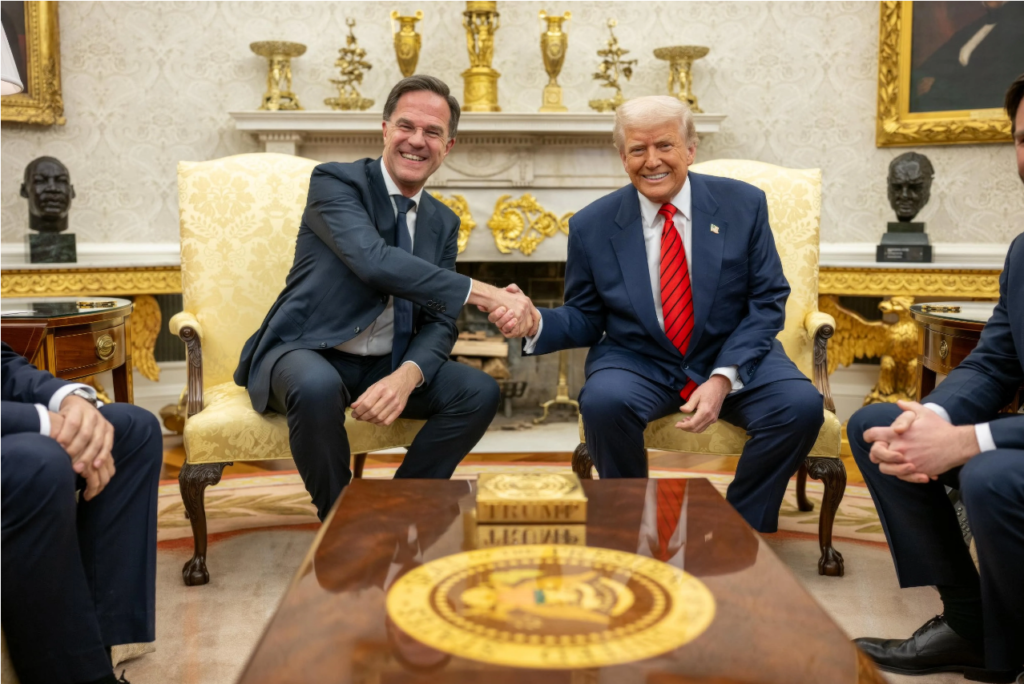
The news from April 8 that went most unnoticed amid the ceasefire and Lebanon turmoil is, in this analyst’s view, strategically the most significant in the long term: according to the Wall Street Journal, the Trump administration is seriously considering withdrawing or relocating troops from bases in NATO countries deemed “unsupportive” during the Iran-Contra affair—with Spain and Germany at the top of the list. Simultaneously, Trump posted on Truth Social , hours after meeting with NATO Secretary General Mark Rutte: “NATO WASN’T THERE FOR US WHEN WE NEEDED THEM, AND THEY WON’T BE THERE IF WE NEED THEM AGAIN.”
This is not rhetoric—it is real-time foreign policy. And its consequences are of a gravity that admits no euphemism.
| CONSEQUENCE VECTOR | RISK DESCRIPTION | STRATEGIC ANALYSIS |
| Conventional deterrence vacuum in Eastern Europe | US troops in Poland, the Baltic states, and Romania constitute the main line of deterrence against potential Russian expansion. Without them, NATO’s eastern flank would be left with a purely European defensive capability—insufficient in the short term. | Russia is the primary and immediate beneficiary. The Kremlin has been trying for decades to erode the American presence in Eastern Europe. A withdrawal—even a partial one—would validate the Russian doctrine of “sphere of influence” and increase the risk of military pressure on Ukraine, the Baltic states, and the Caucasus. |
| Collapse of Western Europe’s security guarantee system | Germany, France, Spain, and Italy have built their defense architectures on the assumption of presence and Article 5. A US withdrawal would force an unprecedented European arms race—with timelines of one to two decades to achieve equivalent capabilities. | The period of vulnerability between withdrawal and European defensive reconfiguration is the window of greatest risk. It is precisely in these windows that wars occur. The US withdrawal from NATO does not produce security—it produces the illusion of autonomy while creating a vacuum that adversaries exploit. |
| Direct implications for the Gulf: Iran’s Point 7 comes to life | If the US reduces its NATO presence, domestic pressure to also reduce its deployment in the Gulf will intensify. The two debates—Europe and the Middle East—are interconnected. A withdrawal from NATO is the political prelude to the withdrawal from the Gulf demanded by Point 7 of the Iranian agreement. | The IRGC knows this. Point 7 of the Iranian proposal is consistent with the logic of weakening the Western presence that Trump is simultaneously implementing with respect to NATO. The convergence between the Iranian demand and Trump’s isolationist instinct is the greatest strategic threat of the moment. |
| Consequences for Ukraine | A significant withdrawal or downgrading of the US presence in NATO would send an unequivocal signal to Moscow: the Western guarantor of security is retreating. The effect on Ukrainian morale and resilience would be devastating. Russia could relaunch offensives, confident that the Western response would lack US backing. | Ironically, Trump launched the Iran war in part to weaken Iran’s main ally—Russia—by crippling Iranian oil revenues. A NATO withdrawal would hand Russia what the Iran war was intended to take away: the sense that the Western shield has exploitable weaknesses. |
| Consequences for China | Beijing is watching the Iran conflict and the NATO debate with the attention of someone awaiting confirmation of a strategic hypothesis: that the US cannot maintain simultaneous commitments in Europe, the Middle East and the Indo-Pacific. | A NATO withdrawal or downgrading would relieve China of the pressure of the US concentrating resources in the Indo-Pacific. This would have the opposite effect of the Trump administration’s strategic objective: instead of containing China, NATO withdrawal would facilitate its expansion in Asia. |
| The case of Spain: Rota and Morón at the epicenter | Spain blocked the use of its airspace by US aircraft operating against Iran. This places the Rota and Morón air bases at the center of the debate surrounding Trump’s retaliatory measures. Rota hosts the US 4th Destroyer Squadron—the main missile defense force on NATO’s southern flank. Morón is a critical logistics hub for AFRICOM and CENTCOM. | A closure or downgrading of Spanish bases—in response to the airspace blockade—would weaken US power projection capabilities in the Mediterranean and the North Atlantic, damage missile defenses in southern Europe, and deprive the US of its most valuable logistical infrastructure for operations in the Eastern Mediterranean and North Africa. This is a self-inflicted wound of the highest order. |
III.1. The dangerous convergence: Iran’s point 7 and Trump’s isolationist instinct
The most alarming strategic dimension of the present moment is the convergence —not coordinated, but functionally equivalent— between two seemingly unrelated impulses: the Iranian demand for point 7 (withdrawal of all US military forces from the region) and the isolationist instinct of the Trump administration expressed in the debate on NATO.
The IRGC doesn’t need Trump to do it deliberately. It’s enough that the frictions with NATO—caused by European refusal to support the Iran war—generate a dynamic of gradual reduction of the US presence in both Europe and the Gulf. If the logic of “allies who don’t support my wars don’t deserve my protection” is applied simultaneously to NATO and the GCC, the IRGC will have obtained, as a side effect of the war, what no military campaign could have achieved directly.
It is the most sophisticated strategic paradox of the conflict: the Iran war, designed to weaken the Iranian regime, may be creating the conditions for the greatest strategic gift that regime has received in decades — the erosion of the US security commitment in the two regions where that commitment is most critical.
III.2. The specific case of Spain: Rota, Morón and strategic responsibility
Spain occupies a unique position in this debate. The blocking of Spanish airspace to aircraft participating in Operation Epic Fury —a sovereign and legitimate decision within the framework of a war not sanctioned by the UN—has placed Spain on the list of countries that the Trump administration considers candidates for reprisals in the form of troop redeployment or base closures. The debate about the legality of war is debatable when it is a response to clear threats from the enemy. In the case of Iran, it is even more than an imminent threat; it represented and continues to represent a PERMANENT THREAT.
But the practical consequences of closing or downgrading Rota and Morón would be devastating for Spain itself, for NATO, and for the security of Europe’s southern flank. Rota hosts the U.S. 4th Destroyer Squadron—the main missile defense force in the western Mediterranean. Morón is the most valuable logistics platform for AFRICOM and CENTCOM operations in the eastern Mediterranean and North Africa. Downgrading them would weaken both Spain and the United States.
The right path is neither capitulation to Trump’s threats nor rhetorical confrontation that hardens positions. It is the one Spain has proven it knows how to follow in its finest diplomatic tradition: a calm defense of its legal positions, an active offer of alternative contributions to collective security, and frank dialogue with Washington on the terms under which the presence of the bases can continue to be mutually beneficial. The Rota and Morón bases are an asset of Spain—not a concession to the US.
III.3. NATO after the Gulf: the alliance that needs to reinvent itself
The crisis between the US and its European allies, triggered by the Iran war, will not resolve NATO—it will transform it. There are two possible scenarios for this transformation:
◆ Positive scenario: The crisis acts as a catalyst for what the Russian invasion of Ukraine initiated and the Iran-Iraq War accelerated—the real Europeanization of European defense. The allies who blocked US airspace must now assume the responsibility that comes with this autonomy: increasing defense spending, developing their own projection capabilities, and building the command and control architecture that makes Europe strategically credible without relying exclusively on the US umbrella.
◆ Negative scenario: The crisis results in a NATO emptied of meaning—with the US maintaining its formal membership but reducing its actual commitment, and with European allies unable to fill the void within the necessary timeframe to deter Russia. This scenario most benefits Moscow, Beijing, and, by extension, Iran’s oligarchic-jihadist regime.
The determining factor between these two scenarios is the same as in the Gulf: political will exercised at real speed. Europe has the economic resources to build its own defense. What has historically been lacking is the political will to mobilize them. The war in Iran has eliminated the excuse that “the threat is not urgent enough.” Now it is real, imminent, permanent, and urgent. The question is whether the political will will keep pace with the urgency.
III.4. The implications for the unfinished Gulf conflict
The debate about NATO and the Gulf are inseparable—for three reasons that no rigorous analysis can ignore:
First: Iranian point 7 is the convergence vector
If the Trump administration accepts—explicitly or implicitly—point 7 of the Iranian proposal (withdrawal of forces from the region), it will be making the same decision in the Gulf as it did in NATO: reducing its security commitment in response to pressure from adversaries. The logic is the same. The consequences are the same. And the ultimate beneficiary—in both cases—is the group of actors who have been trying for decades to expel the US from both regions: Russia, Iran, and China.
Second: NATO’s presence in the Gulf sustains its credibility
The US security presence in the Gulf is not just a regional commitment—it is a global demonstration of the American will and capacity to uphold its security commitments. If the US withdraws from the Gulf under Iranian pressure, the signal Moscow receives regarding NATO’s Article 5 is unequivocal: US security commitments are negotiable under sufficient pressure.
Third: The GCC states are the NATO of the Gulf—and they need to be structurally
The Iran war has demonstrated that the GCC cannot rely indefinitely on the US presence for its security. The genuine integration of the GCC’s Regional Missile Defense—with true interoperability, shared command structures, and industrial-scale missile and drone capabilities—is the essential response to the possibility that the US security presence will fluctuate according to the priorities of each administration. The GCC must build its own version of Article 5: a collective commitment to mutual defense with real capabilities to back it up.
EDITORIAL COMMENTARY
Day 40 of Operation Epic Fury has produced three simultaneous realities that define the strategic horizon for the coming month: a ceasefire that threatens to collapse on its first day over Lebanon; an agreement with three incompatible versions of its own text; and the biggest debate on NATO’s future since the alliance’s creation, triggered by European indifference to a war that most allies consider to be of dubious international legality, ignoring the reality of the Iranian threat to regional and even global security.
The ten-point negotiating framework—which forms the core of Block I of this report—reaches a conclusion that no foreign ministry can ignore: a reasonable agreement is possible, but only if the US and Israel maintain their red lines on nuclear weapons, the Strait of Hormuz, and military presence, and if the GCC is treated as a party—not a spectator—in the Islamabad negotiations. Five of the ten points are incompatible with a reasonable agreement in their current form. They must be rejected, not negotiated.
The link between Lebanon and the Strait of Hormuz—documented in Block II—reveals the sophistication of the IRGC’s strategy: to construct an ambiguity trap in the text of the agreement, activate it on the first day through Israeli attacks in Lebanon, and use the closure of the Strait of Hormuz as leverage against an Israel that is not formally a party to the Hormuz agreement. It is a remarkably complex lever-maneuvering operation. Washington must respond clearly and swiftly: either the agreement includes Lebanon or it does not. The ambiguity benefits only the IRGC.
And NATO—Block III—is the elephant in the room that all analyses of the Iranian conflict are ignoring. If Trump simultaneously erodes the commitment to NATO and accepts Point 7 regarding Iran in the Gulf, he will have produced the largest Western strategic retreat since the end of the Cold War. Not out of ideology—out of impatience. Not out of strategy, but because of its permanently transactional nature. The result would be the same as with any deliberate strategy of withdrawal: the advancement of those who have been waiting for decades for the US to abandon its global security responsibilities.
The ceasefire has three days to prove it’s more than a pipe dream. Islamabad has two weeks to produce a framework with substance or confirm it’s pure rhetoric. NATO has months to decide whether to reinvent itself or become a diplomatic theater without a leading actor. And the GCC has a window—now—to transform its defensive architecture before the clock runs out. The windows are closing.