By Gustavo de Arístegui,
April 15, 2026
I. BRIEF INTRODUCTION
The days of April 14-15, 2026, were dominated by five major developments converging at a time of exceptional global geopolitical tension. The US naval blockade of Iranian ports, in effect since Monday, April 13, entered its second day with operational results that the US Central Command (CENTCOM) described as successful, although questions remain about its diplomatic sustainability. Simultaneously, the opening of direct negotiations between Israel and Lebanon in Washington—the first since the Oslo Accords in 1993—introduced a glimmer of hope, albeit fragile, in a theater of war that continues to claim lives relentlessly. The International Monetary Fund (IMF) raised its tone of warning about the economic impact of the war, with scenarios ranging from a slowdown to the brink of a global recession. Pope Leo XIV has become an unexpected protagonist in international politics, attacked without reason or justification by President Trump, who goes so far as to lash out at Giorgia Meloni—his most loyal European ally—for defending the Pontiff’s dignity. Meanwhile, on the military-industrial stage, Japan opens its arms export market to the greatest extent since World War II, while Europe, finally shaken by reality, begins to seek alternative suppliers with the urgency the situation demands.
II. MOST IMPORTANT NEWS OF THE LAST 24 HOURS
1. The naval blockade of Iranian ports and the prospect of new negotiations
Facts
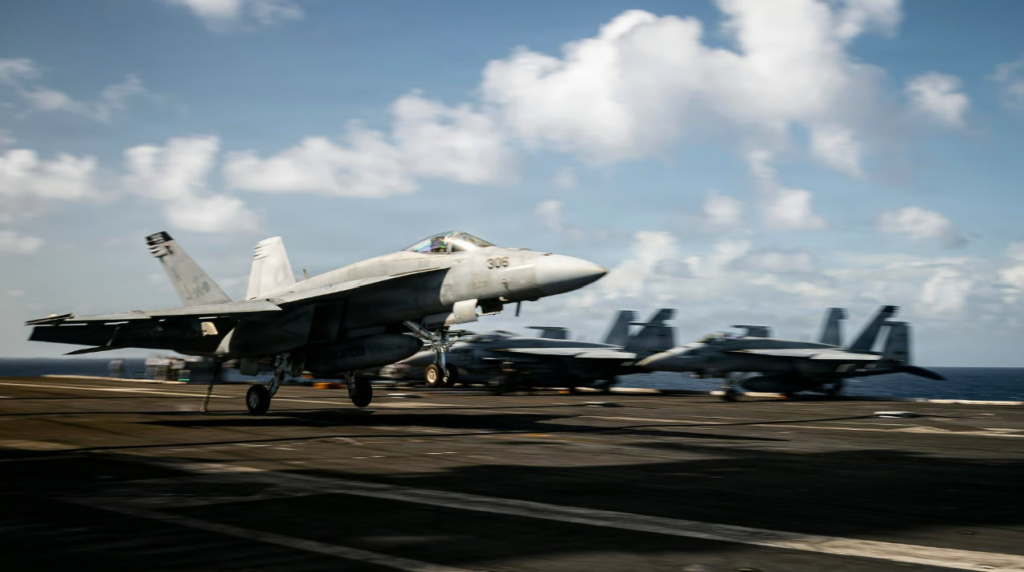
The US naval blockade of Iranian ports and coastal waters, announced by President Donald Trump after the collapse of the Islamabad talks on April 12, went into full effect on Monday, April 13, at 10:00 AM Eastern Time (EDT, equivalent to 2:00 PM GMT). According to US Central Command (CENTCOM), more than 10,000 military personnel, a dozen warships, and dozens of aircraft are carrying out the operation. CENTCOM reported that during the first 24 hours, no vessel managed to break through the blockade, and six merchant ships complied with orders to turn back toward Iranian ports. However, CNN, citing data from the maritime tracking platform MarineTraffic, reported that some vessels linked to Iran had crossed the Strait of Hormuz after the blockade took effect, a claim that CENTCOM categorically denied. The blockade applies exclusively to ships leaving or heading to Iranian ports; all other maritime traffic can transit freely. On Tuesday the 14th, Trump himself told the New York Post that new talks with Iran could resume “in the next couple of days,” possibly again in Islamabad, pointing to Pakistani Field Marshal Asim Munir as a key facilitator. Bloomberg confirmed that both sides are exploring a second round of negotiations before the temporary ceasefire expires on April 21. Iran, for its part, is reportedly considering temporarily freezing shipments through the Strait of Hormuz to facilitate an agreement on a date and location.
Implications
The US naval blockade represents an unprecedented escalation in recent history: it is the first time since the 1990-1991 Gulf War that the United States has imposed a formal maritime blockade of this magnitude against a sovereign state. The implications are multifaceted. Operationally, the effectiveness of the first day—no ships crossed the cordon—sends a signal of military credibility, although conflicting data on some transits reveal the inherent difficulties of controlling such a complex maritime route. Economically, the price of Brent crude has approached $100 per barrel, although it fell to $95 on Tuesday amid news of possible renewed talks, demonstrating the extreme sensitivity of the markets to any diplomatic signal. On the geopolitical front, the stance of Vice President JD Vance—who led the US delegation in Islamabad and expressed a willingness to continue seeking what he calls a “grand bargain” with Iran—suggests that Washington has not closed the door to negotiations, although it demands substantial concessions on the Iranian nuclear program, control of the Strait of Hormuz, and the cessation of funding to terrorist organizations. The clock is ticking relentlessly: the ceasefire expires on April 21.
Perspectives and scenarios
This analyst believes we are facing a “contained systemic fracture”: the maximum pressure of the blockade acts as a coercive element to bring the Iranian jihadist oligarchy back to the negotiating table, while both sides maintain open channels of communication that prevent a definitive escalation. The most likely scenario in the next seventy-two hours is the resumption of talks in Islamabad, with Pakistan playing a facilitating role that has granted it unexpected diplomatic prominence. The alternative scenario—Iranian refusal and the continuation of the blockade until April 21—carries risks of incidents in the strait that could trigger an escalation undesirable by either side. The paradox of the decapitation remains: with the hard core of clerical-military power eliminated by the death of Supreme Leader Ali Khamenei, the triumvirate of the Islamic Revolutionary Guard Corps (IRGC) —Vahidi, Zolghadr and Rezaei— negotiates from a position of military weakness but ideological strength, making any agreement extraordinarily difficult to seal and even more difficult to enforce.
2. Trump’s bitter and unjustifiable attack on Pope Leo XIV and the absurdity of lashing out at Meloni
Facts
Pope Leo XIV—the first American pontiff in history—responded with foresight to President Donald Trump’s attacks in a letter to the Pontifical Academy of Social Sciences, released from Annaba, Algeria, during his ten-day, four-country African tour. Without mentioning the United States or President Trump by name, Leo XIV warned that democracies risk degenerating into a “tyranny of the majority” when they are not anchored in moral law and a true vision of the human person, and can also become “a mask for the domination of economic and technological elites.” The Pope pointed out that the legitimacy of authority does not depend on the accumulation of economic or technological power, but on “the wisdom and virtue with which it is exercised.” Two days earlier, on Sunday, April 12, Trump had attacked the pontiff on social media, calling him “terrible,” “liberal,” and “weak on security,” accusing him of not understanding his foreign policy regarding Iran. Leo XIV responded publicly that he was not a politician, that he had “no fear” of the Trump administration, and that he would continue to speak out firmly against war. Meanwhile, the President of the Council of Italy, Giorgia Meloni, called Trump’s attack on the Pope “unacceptable.” Trump reacted with an interview in Corriere della Sera in which he declared himself “shocked” by Meloni, whom he went so far as to accuse of “lacking courage” and of refusing to help the United States reopen the Strait of Hormuz. “I thought I was brave. I was wrong,” Trump declared, in a statement that illustrates the volatility of his loyalties and the political price paid by those who defend what their conscience dictates.
Implications
Trump’s attack on the Pope is, from any perspective, a political blunder of the first order. Leo XIV, the first American pope in history, enjoys a moral authority that no contemporary political leader can replicate. Fifty-five percent of the American Catholic electorate voted for Trump in 2024, and that political capital erodes every time the president attacks the figure of the Supreme Pontiff. Meloni’s Italy is the third-largest net contributor to NATO in the European Union and one of Washington’s most loyal allies in the Mediterranean. Attacking Meloni for defending the Pope’s dignity is not only a moral outrage but also a strategic gaffe of the highest order: Italy denied US fighter jets the use of its Sicilian base for operations in Iran and has suspended the military cooperation agreement with Israel—unequivocal signs that Rome has its own red lines and that Washington’s pressure has its limits. The isolation that Trump generates among his most natural allies —the European center-right— constitutes, in this analyst’s opinion, one of the most costly geopolitical errors of this administration.
Perspectives and scenarios
The rift between Trump and Meloni, if their messaging isn’t rectified in the coming days, could open fissures within the European center-right bloc that has acted as a bridge between Washington and Brussels. With Viktor Orbán out of power in Hungary after his defeat in the March constitutional referendum, Meloni was Trump’s last major diplomatic asset in continental Europe. Losing him won’t have immediate military consequences, but it will have political and narrative ones: the narrative of the “reliable ally” crumbles when the president himself dissolves it in a fit of pique. Pope Leo XIV will continue his African tour with his moral authority intact—strengthened, if anything, by Trump’s attempt at intimidation—and will remain an uncomfortable voice for those who seek to give war a religious justification that Christian tradition cannot endorse.
3. The IMF warns of a global recession and the risks of stagflation
Facts
The International Monetary Fund (IMF) published its Spring 2026 World Economic Outlook on Tuesday, April 14, under the title “The Global Economy in the Shadow of War.” The report lowers its global growth forecast to 3.1% for 2026—two-tenths of a percentage point lower than the January projection—from the 3.4% recorded in 2025. IMF Chief Economist Pierre-Olivier Gourinchas emphasized that, had it not been for the Gulf conflict, the organization would have revised its forecast upward by one-tenth of a percentage point to 3.4%, given technological dynamism, interest rate cuts, and a smaller-than-expected tariff impact. Global inflation is projected to rise to 4.4% for 2026, compared to the 3.8% forecast in January and 4.1% the previous year. The IMF presents three scenarios: the “baseline” scenario (3.1% growth, short-lived conflict), the “adverse” scenario (2.5% growth, if the conflict and its energy effects are prolonged), and the “severe” scenario (2.0% growth, the threshold of what the IMF defines as a “near-recession” situation, which has only occurred four times since 1980). In the severe scenario, crude oil prices would average $110 per barrel in 2026 and $125 in 2027, and global inflation would exceed 6%. US Treasury Secretary Scott Bessent downplayed the report, stating that the high prices would be transitory and that the United States would absorb them “very quickly.” China, which has accumulated large strategic oil and gas reserves in anticipation of the conflict, exhibits greater relative resilience, with a projected growth of 4.4% by 2026.
Implications
The IMF report officially confirms what this analyst has been describing since the beginning of the conflict: we are facing a war of variable temperature—a low-resolution but high-destruction conflict that no one can win or afford to lose—whose economic consequences are profoundly unequal. The most vulnerable countries are emerging economies that are net energy importers, whose fiscal margins are scarce to absorb the shock. The eurozone, already weakened by the effects of the Ukrainian conflict, will grow by 1.1% in 2026, compared to 1.4% in 2025. The IMF’s Gourinchas warned that what is happening in the Gulf is “potentially much larger” in magnitude than last year’s Trump tariffs. Bessent’s response is understandable from an expectations management perspective, but politically risky: if gasoline prices at service stations in the United States —currently at $4.11 per gallon (3.78 liters), compared to $2.98 on February 28— do not fall soon, the domestic political cost of the war becomes unmanageable.
Perspectives and scenarios
The window of opportunity is narrow. The IMF’s baseline scenario rests on the assumption of a short-lived conflict, something that is far from guaranteed. Every day that passes without an agreement brings us closer to the worst-case scenario. China’s resilience—the result of a strategic accumulation of energy reserves that Beijing executed with vision and discipline before the conflict erupted—is, in itself, a geopolitical lesson on the importance of long-term strategic planning, which Europe and much of the West are worryingly lacking. The risk of stagflation—rising inflation combined with slowing growth—is real and cannot be averted solely with the reassuring rhetoric of finance ministers.
4. Japan opens its largest arms export market since World War II; Europe seeks to diversify suppliers
Facts
Japanese Prime Minister Sanae Takaichi has spearheaded the elimination of the so-called “Five Non-Combat Categories,” a restriction that, since the 1970s, limited Japanese defense exports to non-lethal equipment only. Under the new framework, Japan’s National Security Council (NSC) will be able to approve exports of lethal weapons on a case-by-case basis, even to conflict zones under certain conditions, with subsequent notification to Parliament. This transformative change comes at a time when Western allies, shaken by doubts about the reliability of the US security umbrella under the Trump administration, are actively seeking to diversify their defense supply chains. Japan, which participates alongside the UK and Italy in the Global Combat Air Program (GCAP) for the development of a sixth-generation fighter-bomber, possesses a highly precise industrial base with full interoperability with NATO systems. Meanwhile, diversification is accelerating in Europe: the Meteor missiles, of Anglo-European production and considered the most lethal air-to-air missiles in their category, are increasing their production rate in response to growing demand from NATO countries that no longer take Washington’s unconditional support for granted.
Implications
Japan’s shift is of historical significance that cannot be underestimated. Since Article 9 of its 1947 Constitution, Japan has formally renounced war as an instrument of national policy. The gradual erosion of that doctrine—initiated under Abe in 2014 and accelerated since 2022—has now reached a qualitative turning point. For Europe, Japan’s opening offers a real alternative for diversification in high-tech systems, from surface-to-surface missiles to state-of-the-art radars, in sectors where dependence on the United States has been almost total. The fact that allied nations are looking to Japan as an alternative supplier is, in itself, an unequivocal sign of the breakdown in trust with Washington that the Trump administration has generated with its “America First” policy, also applied to the arms trade. Competition between the Japanese and Korean defense industries—the latter having experienced a remarkable export boom thanks to the proven performance of its systems during the Iranian conflict—will be one of the major vectors of industrial geopolitics in the coming years.
Perspectives and scenarios
Europe is late to this race, as it is to almost all races related to defense. The inability of European leaders to take strategic autonomy seriously for three decades—despite repeated warnings from those of us who have been pointing out this structural weakness for years—is now being paid for with the urgency of those who know that time is running out. The good news is that action is beginning; the bad news is that the European defense industrial base will take years to reach the necessary production capacity. In this context, Japan’s opening is an opportunity that Europe must not miss, always within the Atlanticist framework and in full compliance with NATO commitments.
5. Israel and Lebanon open direct negotiations in Washington; Hezbollah threatens a coup
Facts
On Tuesday, April 14, at the State Department in Washington, the ambassadors of Israel and Lebanon to the United States —Yechiel Leiter and Nada Hamadeh Moawad, respectively—held the first bilateral diplomatic meeting between their countries since the 1993 Oslo Accords. Secretary of State Marco Rubio described the two-hour meeting as “a historic opportunity,” clarifying that it is “a process, not a one-off event.” Israel, which rejects any ceasefire with Hezbollah until the terrorist organization begins its disarmament, demanded the dismantling of “all non-state armed organizations.” Lebanon, for its part, called for an immediate cessation of hostilities and “concrete measures to address the grave humanitarian crisis.” In a joint statement, the United States, Israel, and Lebanon agreed to “launch direct negotiations,” the date and location of which will be determined in the coming weeks. Rubio emphasized that “the Lebanese people are victims of Iranian aggression.” Israeli Ambassador Leiter stated that both countries are “united in the liberation of Lebanon” from Hezbollah. Meanwhile, the terrorist organization Hezbollah—through its Secretary General Naim Qassem—called the talks “pointless” and a “free concession,” and warned that it does not feel bound by any agreement that might result from them. Sources within the organization have hinted at threats of violent retaliation against the Beirut government. Israeli airstrikes on southern Lebanon and Hezbollah rocket fire into northern Israel continued throughout the day. The death toll since the beginning of the conflict has surpassed 2,100 in Lebanon and more than one million displaced persons.
Implications
The Washington meeting is a diplomatic milestone of the highest order that deserves unequivocal recognition: for the first time in over thirty years, the flags of Israel and Lebanon have been raised in the same negotiating room. The courage of President Joseph Aoun and Prime Minister Nawaf Salam in defying the dictates of Hezbollah—a terrorist organization that claims veto power over the sovereignty of the Lebanese state—is worthy of the utmost respect. Hezbollah’s threats to act against the Beirut government should the negotiations succeed are not empty rhetoric: the terrorist organization has repeatedly demonstrated its willingness to use internal violence to preserve its control of the state within the state it represents in Lebanon. Washington must explicitly guarantee the security of the Lebanese government if it wants this process to move forward.
Perspectives and scenarios
The path to an Israel-Lebanon agreement is extraordinarily arduous. Israel demands the disarmament of Hezbollah—a condition the terrorist organization itself has deemed incompatible with its existence—before discussing any ceasefire. Lebanon lacks the military and political capacity to impose such disarmament on its own. The key lies in whether the Lebanese army, with international backing, can gradually assume control of the south of the country. Meanwhile, the negotiating framework established in Washington is itself an achievement to be celebrated, though not naively: as long as Hezbollah remains able to threaten the government with impunity, any agreement will be built on shaky foundations. This analyst believes the greatest short-term risk is not the failure of diplomatic negotiations, but rather an attempted coup or violent destabilization by Hezbollah in Beirut, which would jeopardize the entire Lebanese political structure so painstakingly constructed since the elections earlier this year.
6. Sánchez’s blunder in China: from genuflecting before Xi to complicity with the “new world order” narrative
Facts
Spanish Prime Minister Pedro Sánchez concluded his fourth official visit to China in four years on Tuesday, April 14, in Beijing—the most frequent visit by any Western leader to the Chinese Communist Party (CCP)—with a bilateral meeting at the Great Hall of the People with President Xi Jinping, followed by a state luncheon and the signing of nineteen agreements. During the meeting, Xi Jinping publicly placed Spain on “the right side of history,” an expression Sánchez readily embraced. Both leaders agreed in rejecting the “law of the jungle” in international relations—an implicit reference to Donald Trump’s foreign policy—and the Chinese president celebrated that the Spanish-Chinese relationship has brought “stability between China and the European Union.” Sánchez advocated for a “new multipolar order” and defended his trip, stating that “no one should be offended” by it, a clear reference to Washington. The official Chinese statement issued after the meeting introduces a distinction of enormous political significance: while the official Spanish position recognizes the “One China policy,” the Beijing text states that “Spain is committed to the One China principle,” a term which in Chinese diplomatic language implies acceptance that Taiwan is an inalienable part of the People’s Republic of China and that its “reunification”—including the possibility of the use of force—is an “unstoppable historical cause.” The Spanish Prime Minister’s office has attempted to qualify the distinction, without convincing success. In parallel with Sánchez’s visit, Russian Foreign Minister Sergey Lavrov was also in Beijing, reinforcing the Moscow-Beijing axis and meeting with Xi Jinping. The image of Sánchez in Beijing simultaneously with Lavrov requires no further comment.
Implications
Sánchez’s trip to China raises a series of diplomatic, strategic, and coherence issues that warrant a thorough analysis. First: the Taiwan question. The distinction between the “policy” and the “principle” of One China is not a trivial technicality. The “One China policy” upheld by the European Union, the United States, and the international diplomatic consensus recognizes that Beijing asserts sovereignty over Taiwan, without implying that third-party states endorse it or accept the use of force to impose it arbitrarily without respect for Taiwanese democracy, freedoms, and institutions. The Chinese formula of “one state, two systems” was, in fact, what was promised for Hong Kong and was flagrantly and ruthlessly violated: the systematic destruction of civil liberties, the repression of the pro-democracy movement, and the implementation of the 2020 National Security Law have transformed Hong Kong into a city without press freedom, without genuine judicial autonomy, and without political opposition. To accept that the Chinese statement places Spain committed to the “principle”—and not merely the “policy”—of One China is to implicitly endorse the narrative of forced reunification, which undermines the European consensus and the position of the European Union (EU). Second: the “new world order.” To speak of a “new multipolar order” and of being on the “right side of history” in the same breath as Xi Jinping—at an event held while Lavrov was simultaneously visiting Beijing to coordinate the Sino-Russian strategic partnership—is not multilateralism: it is naiveté at best and irresponsible geopolitical blindness at worst, driven by ideological zeal, electoral interests, and primal anti-Americanism. The concept of the “right side of history” is, by its very nature, a Hegelian construct that authoritarian regimes use to legitimize their expansionism: History, in this view, has a predetermined destiny that one must “join” or be left on the wrong side. For a democratically elected, liberal head of government to endorse such a narrative without the slightest hesitation is, to put it bluntly, a blunder of historic proportions. Third: Atlantic coherence. Spain leads the NATO debate on the southern flank and occupies a strategic position in the western Mediterranean. The Rota and Morón bases are logistical pillars of the Atlantic projection in the Atlantic and the Mediterranean. A government that denies the use of bases on national territory for operations by its closest allies—the United States—while embracing the conceptual frameworks of the power that most openly works to erode Western dominance is a government so inconsistent that it cannot be sustained even from the most basic principles of national security.
Perspectives and scenarios
We must be absolutely precise in our analysis to avoid falling into the opposite error: Spain must maintain relations with China. China is the world’s second-largest economy, the EU’s main trading partner, an essential player in the architecture of the multilateral system, and a necessary interlocutor in any Middle East peace process. None of this is up for debate. What is up for debate is the nature and tone of that relationship. Getting along with China does not mean bowing to China. Seeking Chinese investment does not require adopting the narrative frameworks of the Chinese Communist Party. Asking Beijing to mediate in the Strait of Hormuz does not require becoming Xi Jinping’s most enthusiastic supporter in Europe. Spain’s bilateral trade deficit with China exceeds €42 billion—with imports approaching €50 billion and marginal exports—an asymmetry that Sánchez himself acknowledged at Tsinghua University as “unsustainable.” That acknowledgment is correct. What is incomprehensible is that this is being done from the position of the petitioner who is simultaneously bestowing free geopolitical gifts upon those who hold all the power. The “right side of history,” Mr. Sánchez, is occupied by liberal democracies that defend the rule of law, the sovereignty of peoples, and individual liberty against any form of totalitarianism. It is not occupied by the regime that persecutes the Uyghurs (a Turkish Muslim minority in Xinjiang) in re-education camps, that destroyed freedom in Hong Kong, that militarily threatens Taiwan, and that finances and integrates into its system the most sophisticated propaganda and espionage apparatus in the world. This analyst is not anti-American for criticizing Trump’s mistakes, nor is he anti-Chinese for pointing out Sánchez’s errors: analytical coherence knows no ideological boundaries.
III. MEDIA RACK
Reuters/AP/AFP: Extensive coverage of the naval blockade of the Strait of Hormuz and the possibility of resuming talks between Washington and Tehran. The agencies highlight the operational effectiveness of the first day of the blockade, according to CENTCOM, and cite Iranian sources who, as always, call the measure “piracy.” Trump’s statements to the New York Post about new talks “in the next two days” dominate the front pages.
The Wall Street Journal / Bloomberg / Financial Times: Focus on the economic implications of the blockade and the IMF report. Bloomberg confirms that both sides are exploring a second round of negotiations in Islamabad. The FT underscores the magnitude of the impact on the eurozone and notes that the IMF—had it not been for the conflict—would have revised its forecasts upward. CNBC reports on Bessent’s dismissive response to the IMF.
CNN/BBC/NPR: Live coverage of the blockade and the Israel-Lebanon negotiations in Washington. CNN points to possible irregularities in maritime tracking data that would show some ships have passed through the strait. The BBC reports that the UK will not join the US blockade and that Prime Minister Starmer will focus UK efforts on demining and a negotiated reopening of the strait.
Corriere della Sera / Italian media: Maximum impact from Trump’s interview with the Milanese newspaper. Unanimous condemnation of the attack on Meloni. Foreign Minister Antonio Tajani, of Forza Italia, defends the President of the Council: “This unity is built on loyalty, respect, and mutual frankness.” 66% of Italians now have a negative view of Trump.
Al Jazeera / Al Arabiya / Asharq Al Awsat: Al Jazeera reports from Tehran that there are ongoing talks between the two sides on issues they consider “addressable.” Gulf media are covering the energy impact with growing concern; the Abu Dhabi National Oil Company confirms that 230 loaded tankers are still waiting inside the Gulf.
Israel Hayom / Jerusalem Post: Enthusiastic coverage of the direct Israel-Lebanon negotiations, presented as a diplomatic triumph for Netanyahu. Israel Hayom quotes Ambassador Leiter as saying: “Naim Qassem and his organization belong to the past; we are here for the future.”
Ukrainian media (Kyiv Post / The Kyiv Independent): They are closely following the diplomatic process, aware that any solution in the Gulf will redirect US attention and resources. They express concern about the potential distracting effect of the Iranian conflict on Western support for Ukraine.
Spanish and international media coverage of Sánchez’s trip to China: The Beijing press—China Daily and Xinhua—presents the trip as a victory for the CCP and as proof that Europe is fracturing in the face of Washington. El Español and media outlets critical of the government point to the PSOE’s “dangerous friendships with Beijing” and the simultaneous visits of Sánchez and Lavrov to Beijing. The Objective highlights the “head of state” protocol granted to Sánchez by Xi and Zapatero’s influence as a backdoor for Chinese penetration into Spanish politics. Euronews covers the 19 agreements and Sánchez’s request for China to mediate in the Gulf. The Financial Times and The Economist observe the trip with growing skepticism regarding Madrid’s Atlanticist consistency. Canarias7 analyzes the crucial distinction between “principle” and “One China policy” introduced in the Chinese communiqué, a distinction that the Moncloa Palace has failed to refute convincingly.
TASS/Russia Today: Moscow welcomes the ceasefire, although Lavrov warns that the actions of Washington and Tel Aviv in Lebanon violate the spirit of the agreement. Lavrov, on a visit to Beijing, agreed with his counterpart Wang Yi to prepare a Putin-Xi summit “within the year,” a sign of the deepening of the Moscow-Beijing axis amid the ongoing geopolitical realignment.
Yomiuri Shimbun / Tokyo Times: Extensive coverage of Japan’s new arms export framework, presented as a landmark in postwar Japanese security policy. Japanese analysts debate between strategic realism and concerns about reactions from China and South Korea.
IV. RISK TRAFFIC LIGHT
🔴 MAXIMUM RISK — Escalation in the Strait of Hormuz. The combination of the US naval blockade, Iranian minefields (some of which Tehran admits to having lost traceability), and the continuation of hostilities in Lebanon creates a scenario of an accidental incident with the potential to trigger a military escalation before April 21. Time is running out for everyone.
🔴 MAXIMUM RISK — Coup or destabilization in Lebanon by Hezbollah. The terrorist organization’s threats against the Beirut government are real. An act of internal violence could destroy the diplomatic process before it can take hold.
🟠 HIGH RISK — Global recession in the IMF’s adverse scenario. If the conflict extends beyond the summer and crude oil prices remain above $100 per barrel, the global recession threshold — growth below 2% — becomes a plausible, not merely theoretical, scenario.
🟠 HIGH RISK — Fracture of the European Atlanticist bloc. Trump’s attack on Meloni further weakens the cohesion of a European flank already weakened by Orbán’s departure from power. If the European center-right—Washington’s natural ally—distances itself from the Trump Administration, the United States’ diplomatic isolation will deepen at the worst possible time.
🟡 MODERATE RISK — China’s reaction to the blockade. Beijing has called the blockade “dangerous and irresponsible” and urged the international community to preserve the ceasefire. For now, China is opting for diplomatic pressure over direct action, given that its own energy reserves provide it with sufficient time. However, if the blockade were to directly affect Chinese-flagged vessels, the situation would change.
🟡 MODERATE RISK — Stagflation in advanced economies. The combination of rising inflation and slowing growth in Europe and the United States could generate social and electoral tensions that are difficult to manage in a year full of political processes.
🟡 MODERATE RISK — Erosion of Spain’s Atlanticist coherence due to the pro-China shift of the Sánchez government. The adoption of the CCP’s narrative frameworks—”the right side of history,” “the new multipolar order,” and the implicit acceptance of the “one China principle”—places Spain in a position of increasing strategic ambiguity, which its NATO and EU partners are observing with growing alarm. The risk is not immediate, but it is systemic and cumulative.
🟢 CONTAINED RISK — Israel-Lebanon Process. The opening of direct negotiations marginally mitigates the risk of unrestricted escalation on the Israeli northern front, although Hezbollah’s stance keeps the situation in a very unstable equilibrium.
V. EDITORIAL COMMENTARY
We are living through days that History will record, and it is important to look at them with our eyes wide open, without the anesthesia of informational noise or the comfort of superficial analysis.
The naval blockade of the Strait of Hormuz is a legitimate instrument of pressure against the extortionate behavior of the Iranian jihadist oligarchy. Those of us who have applauded—with some reservations, criticizing the lack of strategy and planning—the attacks against the military and nuclear capabilities of the Tehran regime, must also recognize that this administration, under the diplomatic leadership of Vice President Vance and Secretary of State Rubio, has managed to establish a pressure mechanism that keeps the door to negotiation open. That is the right balance: maximum pressure, minimum irrationality.
The problem arises when presidential impulsiveness disrupts this balance. The attack on Pope Leo XIV is a prime example. Attacking the first American pope in history—a man of peace, faith, and moral consistency—doesn’t generate a single vote that Trump didn’t already have. It does, however, cost him the support of moderate Catholics who still gave him the benefit of the doubt. The absurdity is compounded by the attack on Giorgia Meloni, his most loyal European ally, for the sole crime of defending the dignity of the Pontiff. Rome has paid a very high domestic price for its proximity to Washington—the defeat in the judicial referendum, the highest energy costs in Europe—and deserves to be treated as an ally, not a vassal.
The IMF report is a stark map of realities that cannot be sugarcoated. The paradox of decapitation—which I have been describing since the beginning of the conflict as the fundamental strategic error of a militarily successful operation but one politically bereft of a plan for the aftermath—is now manifesting itself in all its stark economic reality: the volatile war being waged in the Gulf has no clear victor on the immediate horizon, but it does have very concrete victims: European consumers paying the highest gasoline prices in history, farmers in emerging countries without access to fertilizers, and governments of weak economies watching their fiscal space evaporate. No one can claim they weren’t warned.
Japan’s historic opening to the trade of lethal weapons and the incipient European diversification of suppliers are, in this grim context, the only genuinely encouraging news. Europe is finally beginning to see the writing on the wall—it was about time, decades late—and the fact that it is looking to Japan, to its own industry, and to the Meteor missile system as an alternative to the American monopoly is not anti-Atlanticism: it is responsibility and, at last, strategic common sense. We committed Atlanticists, among whom I count myself without reservation, know that the Alliance can only be strong if all its members are capable of shouldering their share of the burden. Europe can no longer be the parasite on collective security.
And in Washington, amidst the noise and fury, emerges the thinnest but also the most significant thread of hope: Israel and Lebanon, sitting face to face for the first time in over thirty years. Hezbollah’s threats of retaliation should surprise no one: terrorist organizations do not negotiate their own demise with enthusiasm. The fact that the Lebanese government had the courage to go to Washington despite the threats is, instead, a sign that the Lebanese state wants to survive as a state and not as a hostage of the Iranian theocracy. That impulse deserves all the protection the international community can offer.
And we must also speak, with the clarity that the moment demands, of Pedro Sánchez’s diplomatic blunder in Beijing. A fourth visit in four years to the most powerful regime in the non-democratic world; the protocol of a head of state offered by a Communist Party that knows perfectly well what it is buying with this gesture; a meeting held simultaneously with Sergey Lavrov’s in the same capital, with the same host; and to top it all off, the complacent adoption of the Chinese dictator’s phrase about being on the “right side of history” as if it were his own. Spain has every right—and the duty—to maintain relations with China. We need its investments, its rare earth elements, its potential role as a mediator in global conflicts. But there is a vast difference between pragmatic realism and ideological subservience. The difference lies in maintaining consistency at all times with the democratic values that Spain defends, in not accepting that Chinese statements include formulas that push the Spanish position beyond the European consensus on Taiwan, and in not lending the image of the Spanish Prime Minister to legitimize an authoritarian narrative of the international order. Sánchez’s actions in Beijing were not diplomacy: they were, in the best sense of the word, a pathetic charade. Spain deserves a foreign policy befitting its history, its geographical position, and its Atlantic and European commitments.
In short: the week of April 13-17, 2026, confirms that we are at a global crossroads. The path to normalization, with its fragile negotiations and agonizing deadlines, is narrow but it exists. The path to unchecked escalation, with its economic and human consequences of historic proportions, is wider and easier to traverse if diplomacy falters or if impulsiveness once again prevails over reason. Reason, at this time, has a duty to prevail.