
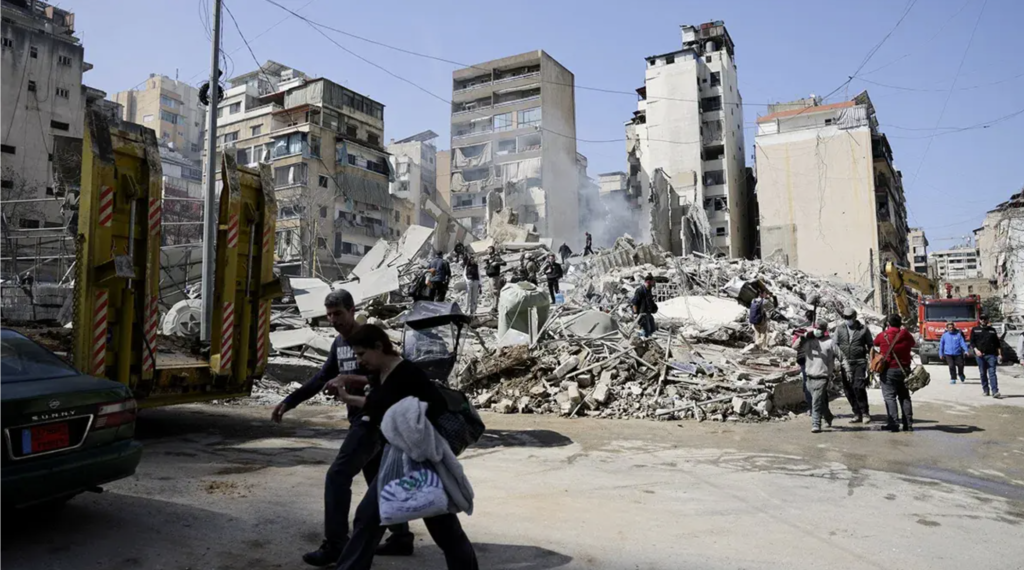
By Gustavo de Arístegui, as published by Atalayar, 5 April, 2026
Historical, confessional and geopolitical anatomy of a country subjected to regional depredations.
“Lebanon is not just another country; it is the epitome and epitome of the Middle East, its laboratory and its martyrdom. To understand Lebanon is to understand the profound nature of the region, its fractures, its glories, and its tragedies.”
INDEX
I. Author’s personal note: an indelible bond
II. Geographical, demographic and religious framework
III. Institutional Genesis: Constitution of 1926 and National Pact of 1943
IV. The golden age: prosperity, cultural beacon and Arab nationalism
V. The Palestinian uprising and the Black September of 1970
VI. The misnamed Lebanese “civil war”: an endless string of wars (1975-1990)
VII. Khomeini’s fatwa and the legitimization of the Alawite heresy
VIII. Lebanon as a laboratory for international terrorism
IX. Taif Agreements (1989) and the unfinished reconstruction
X. The ruthless Iran-Al Assad-Hezbollah trio: assassinations and the hijacking of the state
XI. Hezbollah today: proxy of the jihadist oligarchy, Iranian parasite on Lebanese soil
XII. The definitive poll: a Lebanese majority against Hezbollah
XIII. The thorny Israeli issue: legitimate self-defense and unacceptable collateral damage
XIV. The roadmap for true peace in the Middle East
XV. Author’s Conclusions
Annex I. Chronology with reasoning (1516-2026)
Annex II. Glossary of actors and acronyms
I. AUTHOR’S PERSONAL NOTE: AN INDELIBLE BOND
I will rarely have the opportunity to write about something that touches me so deeply, that means so much to the person writing these pages, and to which my family is so profoundly and intimately connected. Lebanon is not for me an object of distant analysis: it is my own flesh and blood, a living memory, and an open wound.
In Lebanon, the Al-Assad regime murdered my father, his father-in-law, and his sister-in-law. I have Lebanese siblings, and their family is also, by mutual choice and through the weight of shared affection, my own family. I have many friends there, not a few of whom died in tragic circumstances: victims of imported wars, of attacks, of the endless cycle of violence that has plagued the small Levantine country for half a century. My son is married to a Lebanese woman, and our bond with that extraordinary country is—and will be—indelible.
Therefore, this text does not aspire to the academic objectivity of an external observer, but rather to the intellectual honesty demanded by any serious analysis. The author writes with firsthand knowledge, using verified data, primary and secondary sources, but also with the conviction—born from decades of engagement with Lebanon—that there is a historical truth that does not admit the relativism of lazy analysts or the complacency of some correspondents who confuse rigor with impartiality.
II. GEOGRAPHICAL, DEMOGRAPHIC AND CONFESSIONAL FRAMEWORK
In the recent history of the Middle East, no other country has suffered as much and for as long as Lebanon. A country of 10,452 km²—a sacred number for any Lebanese patriot, though sadly not for all Lebanese—in a territory almost identical in size and shape to the Principality of Asturias, is home today to around 5.5 to 6 million people spread across eighteen officially recognized religious communities, broadly grouped into three blocs: Muslims (Sunnis, Shiites, Alawites, Ismailis), Christians (Maronites, Greek Orthodox, Melkites, Greek Catholics, Armenian Apostolic, Armenian Catholics, Syriac Orthodox, Syriac Catholics, Assyrians, Chaldeans, Coptic Orthodox, Latins, and Evangelical Protestants), Druze, and the very small surviving Jewish community.
From a distance, an observer unfamiliar with the country might believe that the cause of the constant civil wars is this communal division. It’s important to dismantle this common misconception from the very first paragraph: the underlying cause is not religious diversity, but rather, on the contrary, the systematic will of foreign powers—Assad’s Syria first and foremost, and Iran later—to exploit this diversity to deny Lebanon its own national identity. Lebanon is a country with a very strong personality and a clear national identity, which Syria sought to deny it, but above all, the murderous Assad regime.
It is precisely the millennia-long coexistence of these eighteen communities that gives Lebanon its extraordinary personality, which is rooted in history and brings together some of the oldest Christian communities in the world —the Maronites trace their tradition back to the 5th century—, along with heterodox Muslim minorities such as the Alawites and the Druze, both custodians of a religious esotericism unique in the Arab world.
Table 1. Estimated distribution by religious denomination
| Community | Estimate (% of population) | Grades |
|---|---|---|
| Sunni Muslims | ≈ 31% | Predominant on the north coast (Tripoli) and west of Beirut |
| Shia Muslims | ≈ 32% | South of Litani, Bekaa Valley, southern suburbs of Beirut |
| Maronite Christians | ≈ 20-21% | Mount Lebanon, Kesrouan, Zgharta; constitutional presidency |
| Greek Orthodox | ≈ 7-8 % | Beirut, Koura, Akkar |
| Druze | ≈ 5% | Chouf and Aley |
| Other Christians (Melkites, Armenians, Assyrians, Chaldeans, etc.) | ≈ 4-5% | Communities of Levantine and transanatolian origin |
| Alawites, Ismailis, other minorities | < 1% | Akkar, Tripoli |
Source: Author’s own elaboration based on Statistics Lebanon (2011-2023), U.S. State Department (Religious Freedom Report 2023), and estimates from Saint Joseph University of Beirut. The last official Lebanese census dates back to 1932, for obvious political reasons.
Graphic survey: approximate confessional composition (2024)
| Shia Muslims | 32% | |
| Sunni Muslims | 31% | |
| Maronites | 21% | |
| Greek Orthodox | 8% | |
| Druze | 5% | |
| Other Christians / minorities | 3% | |
| TOTAL | 100% |
Source: Statistics Lebanon, 2023; author’s estimates
This diversity is not a sociological anomaly: it is the backbone of the Lebanese constitutional system. The presidency of the Republic, by established constitutional custom, is held by a Maronite Christian; the head of government by a Sunni Muslim; the speakership of Parliament by a Shia Muslim; the vice-speakership of Parliament by a Greek Orthodox; the high command of the Army by a Maronite; and so on, in what is known in legal doctrine as “consociationalism” or “Lebanese confessionalism.”
III. INSTITUTIONAL GENESIS: CONSTITUTION OF 1926 AND NATIONAL PACT OF 1943
The first state manifestation of what we now call Lebanon was the Emirate of Mount Lebanon, established in 1516 following the Ottoman conquest of the Levant by Selim I. This semi-autonomous emirate, ruled for centuries by the Maan and Chehab dynasties, laid the foundations for a political entity distinct from the rest of Bilad al-Sham. After the interfaith massacre of 1860—which some historians consider a prelude to the Armenian genocide—the European powers imposed the regime of the Mutasarrifate of Mount Lebanon (1861–1918), governed by a non-Lebanese Ottoman Christian and endowed with a confessional administrative council.
The collapse of the Ottoman Empire after World War I led to the French Mandate (1920-1943), under which Greater Lebanon was proclaimed (1920), expanding the borders of Mount Lebanon to include Tripoli, Beirut, the Shia south, and the Bekaa Valley. It was there that modern Lebanon took shape and where its two foundational texts emerged:
The Constitution of May 23, 1926, one of the oldest still in force in the Arab world, was inspired by the French Third Republic but adapted to the delicate confessional balance of the Levant. It recognized freedom of conscience, guaranteed the autonomy of communities in matters of family law and personal civil law, and established the principle of proportional confessional representation.
The National Pact of 1943, an unwritten agreement between the first president, Béchara El Khoury (Maronite), and the prime minister, Riad Solh (Sunni), sealed Lebanon’s independence on November 22 of that year. The National Pact established, among other provisions, a six-for-five ratio of Christians to Muslims in Parliament (a proportion that the 1989 Taif Agreement would correct to strict parity), and the doctrine of “double negation”: neither union with Syria nor alignment with the West; an Arab but independent Lebanon, Mediterranean but Eastern.
Both texts exemplified the management and regulation of distinct communities, from religious, civil, and family law perspectives. Coexistence wasn’t perfect, but it existed. And it existed with a level of legal sophistication that, at the time, made Lebanon a model throughout the Middle East.
IV. THE GOLDEN AGE: PROSPERITY, CULTURAL BEACON AND ARAB NATIONALISM
The result of that pact was the extraordinary prosperity of the small country. In the 1950s and 1960s, Lebanon became the Switzerland of the Middle East: a regional financial capital, a leading banking center (with codified banking secrecy established in 1956), a hub for international services and tourism, and a publishing haven. West Beirut housed more printing presses than any other Arab city; its universities—the American University of Beirut (AUB), founded in 1866, and Saint Joseph University (USJ), a Jesuit institution founded in 1875—trained the elites of the entire region.
Those decades saw the rise of cultural and intellectual figures who remain influential: Gibran Khalil Gibran (whose legacy transcends generations), Charles Malik (ambassador and philosopher, drafter with Eleanor Roosevelt and René Cassin of the 1948 Universal Declaration of Human Rights), Michel Chiha (father of Lebanese constitutionalism), the journalist, diplomat and brilliant novelist Tofic Yousef Aouad, the universal singer Fairuz and the Rahbani brothers in music, Yusuf al-Khal and Adonis in poetry, Etel Adnan in painting.
And it’s important not to forget a fact that superficial historiography overlooks: contemporary Arab nationalism—Ba’athism, Nasserism, all the pan-Arab movements of the 20th century—has its origins and ideological foundations rooted in Christian intellectuals from Lebanon and Syria. Michel Aflaq, founder of the Ba’ath Party, was a Damascene Greek Orthodox; Antoun Saadeh, founder of the Syrian Social Nationalist Party, was a Lebanese Orthodox; Constantin Zureiq, a great theorist of Arabism, was a Damascene Orthodox. The apparent historical paradox seems brutal to the untrained eye; however, Arab nationalism was an intellectual creation of Arab Christians who emphasized this aspect of their identity because they lacked a Muslim one. Arab nationalism is not confessional, and even less so Muslim; it is of Christian origin, although many of its leaders ended up being agnostic or atheist, but they were rooted in Arab Christian culture. The paradox, and this should not be forgotten, lies in the fact that the ideologies that would later serve regimes persecuting Eastern Christians were largely forged by Christian intellectuals. Anyone who fails to grasp this understands nothing about the Middle East.
Table 2. Socioeconomic indicators of Lebanon (1965 vs 2025)
| Indicator | 1965 (golden era) | 2025 (post-collapse) |
|---|---|---|
| GDP per capita (current USD) | ≈ 580 | ≈ 4,000 |
| GDP per capita at regional parity (index) | 1.4 × average MENA | 0.4 × average MENA |
| Annual GDP growth | +7-8% | − 0.8% |
| LBP/USD exchange rate | 3.1 LBP | ≈ 89,500 LBP (market) |
| Annual inflation | < 3% | > 220% (2023, peak value) |
| Poverty rate | < 10% | ≈ 80% (World Bank) |
| Population | ≈ 2.2 million. | ≈ 5.5 mill. + 1.5 mill. refugees |
| Life expectancy | 65 years | 78-82 years |
Source: World Bank, IMF, Bank of Lebanon, United Nations; own elaboration.
That paradise, evidently, was a small, objectively weak state, divided along sectarian lines—or, better yet, communal lines. It was the perfect target for regional predators. The more prosperous it became, the more coveted it became. The freer it was, the more unbearable it became for its authoritarian neighbors. The more pluralistic it became, the more tempting it was for those who wished to exploit its internal divisions.
V. THE PALESTINIAN UPRISING AND BLACK SEPTEMBER 1970
After the PLO’s expulsion from Jordan in September 1970—what Palestinian organizations called “Black September”—for attempting to create a state within a state and seize control of the Hashemite Kingdom, Lebanon became the inevitable destination for that armed force. It is important to remember what happened: King Hussein I’s operation—Hussein bin Talal—was an act of legitimate self-defense by a young kingdom led by an extraordinary monarch, who regained his country’s independence from Yasser Arafat’s attempt to oust him from the throne. Anyone who fails to call things by their proper names is distorting historical truth.
The PLO and its satellite organizations established themselves in Lebanon, where within a few months they had seized control of everything, literally: the south of the country (the so-called “Fatahland,” referring to Yasser Arafat’s Fatah organization), the refugee camps, and entire neighborhoods in western Beirut. The presence of hundreds of thousands of Palestinians—estimated at around 250,000 in 1970 and soon to exceed half a million—disrupted Lebanon’s fragile demographic balance and sowed the seeds of discord. It was more of a ticking time bomb that exploded in April 1975 with the Ain el-Remmaneh incident, where a bus carrying Palestinian militants was fired upon by members of the Maronite Kataeb militia following a Palestinian assassination attempt against the Kataeb’s patriarch and founder, Pierre Gemayel.
If Palestinian, not Lebanese Muslim . This distinction is crucial: what lazy analysts mistakenly call “the Lebanese Civil War” was, in reality, the endless string of wars in Lebanon, not wars between the Lebanese themselves. What began in 1975 was a conflict between an indigenous population—mostly Christian, but also Sunni Muslim, Druze, and moderate Shia—and a foreign force armed, financed, and equipped by regional and Soviet powers. The distinction is not academic: it is ethical and political.
VI. THE MISNAMED LEBANESE “CIVIL WAR”: AN ENDLESS ROSARY OF WARS (1975-1990)
From 1975 to the present day, every imaginable combination of conflict has occurred in that long-suffering country. Listing them is essential to understanding the magnitude of the phenomenon:
The multiple fracture lines
▪ Muslims against Christians (foundational axis 1975-1976).
▪ Druze and Muslims against Christians (Mountain War, Chouf, 1983).
▪ Palestinians against Lebanese Muslims and Lebanese Christians (Karantina, Tel al-Zaatar, Damour 1976).
▪ Shiites versus Sunnis (growing rivalry since the eighties).
▪ Maronite Christians against Maronite Christians (Phalanges-Kataeb against Camille Chamoun’s Tigers, split of the Kataeb and emergence of the Lebanese Forces; attacks by the Lebanese Forces against the pro-Syrian mafia militia of the Frangieh, the “Marada”).
▪ Intra-Lebanese Forces civil war between Samir Geagea and Elie Hobeika, who formed an alliance with Syria (the Tripartite Alliance) against the commander of the Lebanese Forces, Fuad Abu Nader (1984-1985)—a close friend of the whole family—who was forced to resign and rescued by my father when he was surrounded by the forces of his rivals Geagea and Hobeika, who were about to kill him. Geagea then attacked Hobeika’s headquarters because of its close ties to Syria, forcing him to flee. Geagea took control of the Lebanese Forces, and Hobeika created a Christian militia, a proxy for the Assad regime, which carried out dirty and unspeakable operations such as the assassination of Danny Chamoun, his wife, and two of their young children.
▪ Bloody confrontation between Lebanese Shiites, the war of the brothers or war of the black flags: Amal —supported by Syria— against Hezbollah —supported by Iran—, which resulted in the submission of Amal to Hezbollah in exchange for giving it the presidency of the Lebanese Parliament (Nabih Berri continues to occupy it since 1992).
To this list must be added the wars that are completely foreign to it and of which it was a mere battleground: Israel against the PLO in 1982 (Operation “Peace for Galilee”); Syria against the Lebanese who wanted to be independent and not a protectorate of the Al Assad; Israel against Hezbollah in 1993 (Accountability), 1996 (Grapes of Wrath), 2006 (Second Lebanon War) and, above all, 2024-2025 after the events of October 7, 2023 and the conflict in Gaza.
In that Lebanese anti-PLO coalition of 1976-1982 were almost all the Christians, all the Sunnis, and a significant number of Shiites, fed up with the predatory behavior of the Palestinian militias in their southern villages. The simplistic narrative that reduces the conflict to “Christians versus Muslims” obscures this reality.
This descriptive list is comprehensive but not exhaustive; there was an indefinable conflict in confessional terms. The self-proclamation of then-General Michel Aoun as head of government in 1988, with the support of Sunni and Shia elements of the Lebanese Army, occurred after Parliament was unable to elect a successor to Amine Gemayel, who had succeeded his assassinated brother, Bachir. Syrian interference prevented the election of a new president, and Aoun obtained a slim parliamentary majority to proclaim himself provisional head of government. At that moment, a bloody conflict erupted, pitting the vast majority of the armed forces, supported by the Lebanese Forces and other smaller Christian militias, against Hezbollah, Druze, and the Syrian army. It was one of the bloodiest episodes of the 14 years of war in Lebanon. The then European Community supported Lebanon’s “independence, sovereignty, and territorial integrity,” a direct reference to the Syrian invasion and control of the country. In response, Syria attacked the three embassies of the then-current Troika of the European Union. Greece was targeted with machine-gun fire at its embassy in West Beirut, and the French embassy compound in the Christian neighborhood of Hazmiyeh was attacked with light mortars (60mm and smaller, possibly even 37mm “shovel mortars”), causing considerable damage. The most brutal attack was on the Spanish embassy, whose compound is located in the Christian neighborhood of Hadath. Syrian forces attacked from positions on Chouf, a Druze mountain very close in a straight line to their target. They launched six 240mm mortars of Russian manufacture with a firing system improved by the GDR. Five of the six shells struck the residence-chancellery complex, one hitting the residence’s reception rooms directly and instantly killing Ambassador Toufic Yousef Aouad, my father’s father-in-law and the Spanish ambassador to Lebanon, along with his sister-in-law, Samia Toutounji, and mortally wounding my father. Another of the five enormous shells (weighing between 130 and almost 200 kg), capable of bringing down 20-story buildings, killed one of the Lebanese security team members in the garden. The official report acknowledged Syrian responsibility but did not hold them accountable, as if it had been an accidental act of war. The truth is that the first shell hit the gate of the compound, the second the opposite end in the garden, and the final four all hit their target. They were adjusting their aim; the intent was undeniable.
Table 3. Human and material costs of the wars in Lebanon (1975-2025)
| Period / conflict | Deaths (estimated) | Displaced persons | Material damages |
|---|---|---|---|
| Civil wars 1975-1990 | 120,000-150,000 | ≈ 1 million | ≈ 25 billion USD (1990 value) |
| Syrian occupation 1976-2005 | — | — | Incalculable opportunity cost |
| Israeli occupation of the south 1978-2000 | ≈ 25,000 | ≈ 500,000 | Sustained damage |
| Israel-Hezbollah War 2006 | ≈ 1,200 (LB) / 165 (IL) | ≈ 1 million | 3.6-4 billion USD |
| Israel-Hezbollah War 2024-2025 | ≈ 4,000 (LB) | ≈ 1.2 million | ≈ 10 billion USD |
Source: UNHCR, World Bank, Lebanese and Israeli governments, humanitarian NGOs; own elaboration.
VII. Khomeini’s Fatwa and the Legitimization of the Alaouite Heresy
The bloody conflict between Amal and Hezbollah, fought between 1988 and 1990 with thousands of deaths in the southern suburbs of Beirut and in the south of the country, ended with the almost total elimination of the Amal militia as an autonomous force. Hafez al-Assad made a pact with Iran: in exchange for Amal’s submission and the transfer of effective control of southern Lebanon to Hezbollah, Imam Khomeini legitimized the Alawite or Nusayri heresy —not to be confused with the Moroccan Alaouite dynasty—with a religious fatwa recognizing them as Muslims and as a legitimate branch of Shi’ism, which they are not and never have been.
The fatwa, issued in July 1973 by Musa al-Sadr, the Lebanese Shiite spiritual leader, and vigorously endorsed by Khomeini after 1979, was politically decisive: without it, the Al-Assad dynasty—of Alawite origin, an Ismaili-Gnostic sect with profoundly heterodox beliefs—would not have had the religious legitimacy to govern a predominantly Sunni Syria. That theological-political pact has bound Damascus and Tehran for half a century and explains why the fate of the Al-Assads is indistinguishable from that of Hezbollah.
The culmination of Lebanese tragedies is that this small, martyred country has been and continues to be the battleground for other wars that are entirely foreign to it. The greed and expansionism of the Al-Assads, the ambitions of Tehran, the Palestinian disputes, the Israeli reprisals: all are unleashed upon 10,452 km² of territory, while the Lebanese pay the price in blood, in exile, and in entrenched poverty.
VIII. LEBANON AS A LABORATORY OF INTERNATIONAL TERRORISM
It is worthwhile to delve into a bit of the history of terrorism here. Lebanon, in addition to being the battleground of its own civil wars—often instigated, provoked, exploited, and fueled by others—has also been the laboratory of modern terrorism. The car bomb technique, and especially the suicide truck bomb, perfected in Beirut, would later travel to Algeria, Madrid, London, Baghdad, Kabul, and so many other places. There, the archetype of “state-sponsored” terrorism, carried out through proxies and “non-state actors,” was invented.
The great founding attacks
April 18, 1983. Attack on the US Embassy in West Beirut: 63 dead, including 17 Americans.
October 23, 1983. Double suicide attack against US Marines (220 dead) and French paratroopers (58 dead) of the Multinational Force. 307 dead in total. Attributed to Hezbollah on the direct orders of the Iranian regime (CIA declassification, 1987).
September 20, 1984. Attack on the annex of the US Embassy in East Beirut.
June 14-30, 1985. Hijacking of TWA Flight 847 Athens-Rome by members of Hezbollah; murder of US Navy diver Robert Stethem; and a 17-day ordeal between Beirut and Algiers. Pedro de Arístegui successfully mediated this hijacking, acting as a shuttle between US Ambassador Reginald Bartholomew and Beirut airport, a very dangerous area where he met with his contacts. Afterward, he would go to the Grand Ayatollah’s residence with Marja Mohamed Hussein Fadllallah, considered Hezbollah’s “spiritual guide,” to pass messages to the appropriate parties. He never agreed to meet with any Hezbollah secretary general, much less with the one recently appointed by Tehran, the bloodthirsty fanatic Hassan Nasrallah, who transformed Hezbollah into the monster it is today. “I neither negotiate nor meet with terrorists and murderers.”
1982-1992. Successive kidnappings of Westerners (Terry Anderson, Terry Waite, Jean-Paul Kauffmann, Jean-Louis Normandin, Marcel Carton, Marcel Fontaine, among others) to exert political pressure and obtain concessions.
It is worthwhile to conduct a more detailed analysis of two kidnappings that affected the Spanish embassy.
As a consequence of the arrest in Madrid of two members of an “Alwiyat Al Sud” commando unit who attacked a Libyan diplomat, the group, which has ties to Hezbollah, threatened the Spanish ambassador. It all began when the founder of Amal, Imam Musa Sadr, disappeared during an official trip to Libya. There, Gaddafi, at the behest of the mega-terrorist Abu Nidal (responsible for hundreds of attacks in 20 countries, resulting in 300 deaths and 650 injuries, not counting his attacks in Israel and the Palestinian territories), asked him to eliminate Sadr as a favor to the Syrian dictator Hafez al-Assad. Of course, this was before the al-Assad regime became a vassal of Tehran.
The members of the commando unit were sentenced to 23 years in prison by the National Court. The terrorist organization “Alwiyat Al Sud” had been created and led by a sinister and repugnant individual, Moustafa Al Dirani, who had been head of security for Amal, to affiliate it with Amal Islamic, within the Hezbollah sphere of influence, and ultimately create a satellite organization of the Iranian Revolutionary Guard called “Al-Muqawama al-Mu’mina,” which would be the one to kidnap the Israeli soldier Ron Arad to “sell” him to the Revolutionary Guard.
Dirani directly threatened my father with kidnapping, torture, and “disappearance” if he didn’t secure the release of his “boys.” Since this tactic had worked with some other countries, they thought that pressure and kidnapping would break Spain. It never happened. After taking all the precautions he could, my father changed his itinerary, carried a weapon in the car, and drove himself—firstly because he knew evasive driving techniques, and secondly, and primarily, to prevent them from killing his driver, who is always the first target when stopping a car. Knowing who they were dealing with, he obtained, through his contacts in the turbulent Shiite world, the addresses of the three places where he was convinced they would take him during what seemed like his inevitable kidnapping. Inevitable, because he had no security detail or armored car. The Spanish embassy was the only Western embassy without such security measures due to the repeated and persistent refusal of the infamous Undersecretary at the time, Gonzalo Puente Ojea.
Pedro de Arístegui relayed the three possible locations to Nabih Berri, head of the AMAL militia, who was already in serious conflict with Dirani. My father told him, “Nabih, either you send for me within the first 24 hours, or I’ll end up in the Bekaa Valley and disappear.” The day arrived. Four SUVs and twelve thugs armed with AK-47s and RPG-7 grenade launchers blocked the official car from the front, back, and sides. One man, his face uncovered, put the muzzle of his rifle to my father’s temple and forced him out. My father had his Sig Sauer P225 pistol in his hand and handed it to the kidnapper… They did indeed take him to one of the organization’s three hideouts. Less than 24 hours had passed when an AMAL special forces commando entered the house in Burj el Barajneh (Little Tehran) and took my father away, not without a fight involving punches and rifle butts with the guards, who were overwhelmed by 30 heavily armed militiamen. Throughout the kidnapping, he had hidden a five-round .22 Long Rifle mini-revolver, a “Freedom Arms” revolver, and was prepared to take down several kidnappers before they could kill or subdue him if they tried to take him to the Bekaa Valley.
Because of who my father was, a few days later he returned to the house where he had been held captive to eat with the elderly woman and her daughter who had fed him, kept him company, and given him books to read. They gave him Albert Camus’s “The Stranger.” My father said sarcastically that he was returning to the place of his captivity “to return the book and thank them for their hospitality.” A clear message of defiance to Dirani and his henchmen. The spiteful and nefarious Undersecretary Puente Ojea would take many months (more than a year) to authorize the security detail and the armored car. An act of criminal, even immoral, revenge, labeling my father’s behavior ” mind-blowing James Bondism ” (sic).
Spain established full diplomatic relations with the State of Israel in January 1986. Therefore, they sent a GEO (Special Operations Group) team from the Spanish National Police to all embassies at risk for their protection. The operation had been organized without consulting the embassy and with a degree of improvisation and incompetence that deserves special mention and which would cost us dearly, as was sadly later proven. They were advised to go through Cyprus, officially carry their weapons, and then enter by helicopter through the Christian quarter of Junnieh. The Ministry decided to send them on a regular flight, unarmed. Upon arrival, the embassy convoy was waiting for them, consisting of the embassy’s armored car (the only one) and two SUVs escorted by Lebanese security forces armed with assault rifles. In that context, it was roughly equivalent to using a slingshot. Leaving the airport, near the Burj al-Barajneh, a platoon of terrorists with .50 caliber machine guns mounted on open jeeps and the ubiquitous RPG-7 anti-tank missiles, which turned the armored vehicle into a very expensive coffin, had taken up positions. In the initial struggle, and in a show of courage, three of the four GEO officers broke free, jumped into one of the police vehicles, and managed to escape. The terrorists had captured the occupants of the first vehicle: the embassy chancellor, Assad Abdo; the officer (and later deputy chancellor), Gaspar Abdo; and GEO officer Pedro Antonio Sánchez Anula. They endured 32 days of torture, mock executions (being shot directly above the head), beatings, sleeping on the floor in deplorable hygienic conditions. After weeks of negotiations, my father managed to secure their release. Every time I went to West Beirut, I left the GEO officers at the Green Line, lest they end up with all four instead of just one. The Interior Ministry authorities wanted the hostages in Cyprus handed over, but of course, that was unacceptable to the terrorists, who wanted to stage a propaganda spectacle and avoid being arrested in a foreign country. It took a lot of convincing to see the Secretary of State for Security finally agree to go to Beirut and cross into the West with my father, without an escort, which made him extremely uncomfortable. But my father insisted, took the wheel, and drove to the hostage handover location. No kidnapping in Lebanon has ever been resolved in less time and without casualties. This was the only one. I want to highlight the fortitude of the Abdo brothers, whose cool head, valor, and heroic courage are and will remain an example for any public servant. Unfortunately, the GEO officer broke down, collapsed psychologically, and was never able to return to his post; he was discharged due to total incapacity. Assad Abdo remained in his position until his retirement, and Gaspar Abdo is still active at the Spanish embassy.
All these details should make it perfectly clear that Hezbollah is a massive, bloodthirsty, efficient, insatiable, and ruthless terrorist organization, cloaked in the guise and structure of an NGO, a state within a state, and a political party. The barbarity of Sunni jihadism (Al-Qaeda and ISIS, among others) has made us forget the bloody history and terrorist record of Iran and Hezbollah, but no rigorous analysis can ignore this.
The tragedy is that on too many occasions Lebanese politicians, political parties, and some militias acted as puppets or proxies for their masters, generally Syrians (the Frangieh and the Marada families), the shifting alliances of the Druze led by the Joumblatt dynasty, the sinister Christian militia ESL—the Army of South Lebanon—of the fake general Antoine Lahad, financed by Israel, among many others. But above all, Hezbollah: the number one of its terrorist generation, a traitor to its country and loyal to a sworn enemy of its country, Iran.
IX. TAIF AGREEMENTS (1989) AND THE UNFINISHED RECONSTRUCTION
The Taif Agreement, signed on October 22, 1989, in the Saudi city of Taif and ratified by the Lebanese Parliament on November 5 of that same year, brought an end—more formally than in reality—to the civil wars. That agreement, mediated by Riyadh and endorsed by Damascus, included five key commitments:
1. Strict Christian-Muslim parity in Parliament (64 deputies each bloc), correcting the old 6:5 ratio (then Christians were the majority).
2. Transfer of powers from the President of the Republic (Maronite) to the Council of Ministers and the Prime Minister (Sunni), transferring powers from the presidency of the republic to the head of government.
3. Firm commitment to disarm all militias and return the monopoly of force to the Lebanese Army and its Security Forces.
4. Gradual withdrawal of the Syrian Army (which would occupy the country until 2005, after the assassination of Rafic Hariri and the Cedar Revolution).
5. Aspiration to the progressive abolition of political confessionalism as a fundamental national objective.
The only militia that has not fulfilled its disarmament commitment is Hezbollah. Under the pretext of “resistance”—first against the Israeli occupation of southern Lebanon (which ended in May 2000 with Ehud Barak’s unilateral withdrawal), then against Israel in general—the Party of God maintained and increased its arsenal until it became, according to estimates by the U.S. Department of Defense in 2023, the largest non-state paramilitary force in the world, with nearly 150,000 missiles and rockets aimed at Israel from southern Lebanon before the 2024 war.
Moreover, the more the current Lebanese president, General Joseph Aoun (not to be confused with his predecessor Michel Aoun), and Sunni Prime Minister Nawaf Salam—president of the International Court of Justice until his appointment in January 2025—insist on implementing the Taif Agreement and UN Security Council Resolution 1559 (2004), the more brutal and direct the threats from Iran and Hezbollah become. “Those who insist on disarming Hezbollah will have to face the consequences,” declared Ali Larijani, secretary of Iran’s Supreme National Security Council, in September 2025, a threat reiterated by the revolutionary leader Ali Khamenei himself the day before his assassination. When Iran or Hezbollah threaten, it must be taken seriously; the evidence speaks for itself.
X. THE IRAN-AL-ASSAD-HEZBOLLAH TRIO: ASSASSINATIONS AND CAPTURE OF THE STATE
The Assad-Hezbollah alliance assassinated two presidents of the Republic: Bashir Gemayel (September 14, 1982, during the Israeli offensive against the PLO, weeks before his inauguration) and René Moawad (November 22, 1989, the 46th anniversary of independence, just seventeen days after his election by Parliament). They also assassinated three prime ministers of the Republic:
Table 4. Assassinations attributable to the Syrian-Iranian axis in Lebanon
| Victim | Post | Date | Modus operandi |
|---|---|---|---|
| Bashir Gemayel | President-elect | September 14, 1982 | Bomb at Kataeb headquarters, Achrafieh; executor: Habib Chartouni (PSNS, pro-Syrian) |
| Rachid Karamé | Prime minister | June 1, 1987 | Bomb in military helicopter |
| René Moawad | President | November 22, 1989 | Car bomb (250 kg) in West Beirut; 23 additional deaths |
| Omar Karamé | Former Prime Minister | (sustained pressure) | Rachid’s brother; the target of harassment and the murder of his son when they tried to kill him. |
| Rafic Hariri | Former Prime Minister | February 14, 2005 | Car bomb containing over 1,000 kg of TNT in the Corniche, Beirut; 22 dead. The Special Tribunal for Lebanon (STL) convicted Salim Ayyash (Hezbollah) in absentia in 2020 and 2022. |
Source: Special Tribunal for Lebanon (2020 and 2022 judgments), Mehlis and Brammertz reports, UN Commission of Inquiry, verified press.
The three assassinated prime ministers—Rachid Karamé, Omar Karamé, and Rafic Hariri—were all personal friends of my father. Rafic Hariri told Mariano Rajoy and myself, in his suite at the Ritz Hotel in Madrid—that he was in danger of being killed—because he had been threatened by Rustum Ghazaleh, the bloodthirsty and sinister Syrian “viceroy” in Lebanon and head of the Syrian Mukhabarat in Lebanon. A month later, he was assassinated by a bomb containing more than a ton (yes, more than 1,000 kg) of TNT under his car, near the Saint George Hotel in Beirut. The United Nations Commission of Inquiry, led first by Detlev Mehlis and later by Serge Brammertz, as well as the subsequent Special Tribunal for Lebanon (based in The Hague), confirmed what we all knew at the time: the attack had been planned and carried out by members of Hezbollah’s Unit 121, with the knowledge and approval of the Syrian services and Iranian blessing and inspiration.
XI. HEZBOLLAH TODAY: JIHADIST OLIGARCHY, IRANIAN PARASITE ON LEBANESE SOIL
Hezbollah’s terrorist militants are not Lebanese patriots; they don’t teach the national anthem to their children; they only wave the yellow flag with the green AK-47 of Hezbollah. They are loyal only to Iran’s oligarchic-jihadist regime. The correct designation of the Iranian regime’s ideological nature is crucial: it is not a “theocracy,” as the lazy cliché goes, but a dictatorial and mafia-like oligarchy that instrumentalizes Twelver Shia theology to legitimize a cosmically corrupt power, based on the systematic plundering of the country’s resources and the export of the revolution through armed proxies.
Hezbollah, whose historic leader Hassan Nasrallah was killed by the Israel Defense Forces on September 27, 2024, in a precision strike on his bunker in the southern suburbs of Beirut, was replaced by Naim Qassem, a less prominent figure. But beyond the figurehead, what is decisive is the structure: Hezbollah is simultaneously a terrorist organization (designated as such by the US, UK, Canada, Australia, Israel, Argentina, Honduras, Paraguay, Guatemala, the Gulf States, the entire Arab League, and by the European Union with respect to its military wing), a political party with parliamentary representation, a welfare network parallel to the state, and an economic-mafia empire.
Table 5. Comparative Budgets: Lebanese Army vs Hezbollah (2024-2025)
| Concept | Lebanese Armed Forces (LAF) | Hezbollah |
|---|---|---|
| Official annual budget | ≈ 700 M USD | ≈ 1 billion USD (annual transfer from Iran) |
| Staff | ≈ 80,000 personnel | ≈ 60,000 terrorist militants (pre-2024 estimate) |
| Legal framework | Lebanese Constitution | No legal framework; a state within a state. |
| Supplementary funding | Insufficient aid from the US, EU, and Saudi Arabia (only from 2025 onwards) | “Taxes” (extortion), arms trafficking, drugs (opium, hashish, captagon), smuggling, human trafficking, money laundering |
| Chain of command | Presidency of the Republic | Islamic Revolutionary Guard Corps (IRGC), Quds Force, Tehran |
Source: Lebanese State Budget 2025; U.S. Treasury Department (sanctions against al-Qard al-Hassan, 2024); Drug Enforcement Administration (Operations Cassandra and Lebanon Connection); CSIS, Washington Institute, FDD.
Hezbollah’s criminal enterprises deserve separate mention. The organization manages a transnational criminal empire that combines, among other things, the following activities: systematic extortion of merchants in Shia and border areas; trafficking of Captagon (the Syrian-Lebanese industrial methamphetamine, a flagship product of the Assad regime and its periphery); cultivation and export of hashish in the Bekaa Valley; cocaine trafficking through Latin American cells (the tri-border area of Argentina, Brazil, and Paraguay, and West Africa); money laundering through Lebanon and French-speaking West Africa; human trafficking across the Mediterranean; and opium trafficking from Southeast Asia. The DEA and the U.S. Treasury Department estimate Hezbollah’s annual criminal enterprises’ income at an additional $1-2 billion, on top of direct Iranian funding.
XII. THE DEFINITIVE POLL: A LEBANESE MAJORITY AGAINST HEZBOLLAH
The Lebanese are growing weary of the Shiites who remain loyal to Hezbollah, to its cruelty and mafia-like violence, to its arrogance, and to the fact that it has embroiled them in countless conflicts. What’s new is that, according to polls, a majority of Lebanese—between 73 and 80 percent—now share this view. I don’t believe there is any organization more hated by its own compatriots than Hezbollah. Frankly, for some media outlets to continue calling it a “militia,” a “militant group” (BBC), or a “political party” is not only biased and inaccurate, but also profoundly immoral.
Gallup’s most recent and rigorous poll, conducted in Lebanon between June 23 and July 16, 2025, with a random sample of 1,010 adults—excluding, due to operational impossibility, the areas under strict Hezbollah control in the southern suburbs of Beirut, Hermel, Baalbek, and Bint Jbeil—yields devastating results:
Gallup poll (June-July 2025): “Who should have the monopoly on weapons in Lebanon?”
| Only the Lebanese Army | 79% |
| Army + Hezbollah | 18% |
| Doesn’t know / No answer | 3% |
Gallup poll: “Should Lebanon militarily support the Palestinian cause by entering into conflict with Israel?”
| No (clear opposition) | 86% |
| Yeah | 10% |
| Doesn’t know / No answer | 4% |
Approval by President Joseph Aoun (May-June 2025)
| Approve | 81% |
| Disapproves | 13% |
| Doesn’t know / No answer | 6% |
Approval by Prime Minister Nawaf Salam (May-June 2025)
| Approve | 56% |
| Disapproves | 36% |
| Doesn’t know / No answer | 8% |
Supplementary data from the same Gallup series illustrate the profound change: trust in the national government rose from 12% (2024) to 48% (2025); trust in the fairness and honesty of elections, from 17% to 45%; and the perception of widespread government corruption, from 92% to 82%. And approval of the country’s leadership jumped 46 percentage points in one year (from 16% to 62%), one of the largest year-over-year increases ever recorded by Gallup in any country in the world.
There is a growing number of Lebanese—Christians, Sunnis, Druze, and quite a few Shiites—who speak openly of a de facto partition, meaning they would accept that Hezbollah supporters could keep the area south of the Litani River and the southern suburbs of Beirut, while leaving the rest of the country in peace. This isn’t a legal proposal; it’s a cry of exasperation. Hezbollah militants who have hidden in Sunni or Christian neighborhoods (Saida, Tripoli, Achrafieh) have been literally kicked out by the residents.
XIII. THE THORNY ISRAELI ISSUE: LEGITIMATE DEFENSE AND INADMISSIBLE COLLATERAL DAMAGES
Now for the last and most thorny issue. Israel’s right to defend itself against this brutal terrorist organization is not in question, but it cannot be at the expense of Lebanese civilians, who are Hezbollah’s primary victims, not its accomplices. The ethical and legal distinction is absolute: the Lebanese civilian from the south, from the Bekaa Valley, from the suburbs of Beirut, suffers twice: under the yoke of Hezbollah, which embeds itself in their neighborhood to use it as a human shield and safe haven, and under Israeli bombs, which destroy their home because an Iranian missile was underneath.
To demand that Lebanon disarm Hezbollah without reopening the brutal Pandora’s box of civil war, Lebanon, its president, its prime minister, and its people must be supported with weapons, training for its armed forces, and funding. The Lebanese Armed Forces have a budget of $700 million; Hezbollah receives $1 billion from Iran, in addition to its previously described mafia-like income. The asymmetry is structural and can only be corrected through a massive, sustained, and conditional transfer of Western and Arab (especially Gulf and Egyptian) military resources to the Lebanese state.
Israel must cease its attacks on Lebanese civilian areas and, in doing so, prevent the fragmentation of the national coalition and the consensus against Hezbollah, not to mention a long-term occupation of Lebanese territory between the Israeli border and the Litani River. This is precisely where General Lahad’s sinister Free Syrian Army (FSA) militia operated. Every indiscriminate Israeli bombing gives Hezbollah the oxygen it has been lacking: the “rally around the flag” (a term coined by John Mueller in 1970) that turns the perpetrator into a victim.
Israel must act strategically here, not with operational tactics or the political opportunism of the moment. Subordinating long-term regional stability to operational tactics is a historic mistake, one it already made in 1982 with the invasion of Lebanon—which culminated in the Sabra and Shatila massacre perpetrated by the Lebanese Forces and the rise of Hezbollah—and whose consequences still resonate throughout the country.
XIV. THE ROADMAP TO A TRUE PEACE IN THE MIDDLE EAST
There will be no true peace in the Middle East without Lebanon regaining its full sovereignty, without respect for its borders and territorial integrity, and without the disarmament of Hezbollah and the permanent removal of the brutal Iranian yoke from the small Levantine nation. The author of these lines suggests a roadmap articulated in six points:
1. Immediate and verifiable cessation of hostilities. Strict respect for the ceasefire of November 27, 2024, and the subsequent cessation of hostilities, with Israeli withdrawal from the five tactical positions in southern Litani.
2. Full deployment of the Lebanese Army south of the Litani River. In accordance with Security Council Resolution 1701 (2006) and Resolution 1559 (2004). Quantitative and qualitative reinforcement of the Lebanese Armed Forces, with conditional funding from the US, EU, Saudi Arabia, UAE, and Qatar.
3. Effective implementation of Taif: comprehensive disarmament of Hezbollah. Public timetable, verifiable milestones, international follow-up mechanism (expanded UNSCOL). Voluntary integration of fighters into the Armed Forces, without perpetuating parallel command structures.
4. Economic and banking reform. Forensic audit of the Banque du Liban; debt restructuring; recovery of deposits confiscated from the population; Lebanon’s entry into an IMF program with governance conditionality, not just macroeconomic.
5. Bilateral Lebanon-Israel dialogue. Following the maritime delimitation of October 2022 (Hochstein-Berri agreement), open a path for land delimitation and management of the Shebaa Farms, possibly with US and French mediation.
6. Strategic isolation of Iran. Maintaining maximum sanctions pressure against the oligarchic-jihadist regime; decisive support—diplomatic and media-based—for internal Iranian dissent; severing the Tehran-Damascus-Beirut land bridge after the fall of the Assad regime in December 2024.
The fall of Bashar al-Assad’s regime in December 2024, following a lightning offensive by Hayat Tahrir al-Sham, led by Syria’s current strongman Ahmad al-Sharaa and allies from Idlib, has profoundly altered the landscape. For the first time in half a century, Hezbollah has lost its Syrian rear base, its logistical corridor, and its border sanctuary. The strategic opportunity to liberate Lebanon from the Iranian yoke is historic. To squander it would be unforgivable.
XV. AUTHOR’S CONCLUSIONS
Lebanon is a martyr state, but not a failed state. The difference is essential. Failed states are the result of weak institutions; Lebanon has been a victim for a century of the predatory power of its neighbors and those who exploit them.
Lebanese religious diversity is not a curse: it is a unique heritage in the Arab-Muslim world and an example—imperfect, painful, but real—that distinct religious communities can coexist under the rule of law. Lebanese religious integration has produced more benefits than harms; what has failed is not the integrative model itself but its subjugation by external agents.
Hezbollah is not just another legitimate Lebanese political actor. It is a terrorist organization in the service of a foreign power, with a documented history of assassinations, international attacks, industrial drug trafficking, and human trafficking. To call it by any other name is complicity, whether voluntary or due to intellectual laziness.
Israel has the right to defend itself, but legitimate defense requires proportionality, distinction, and precaution in accordance with International Humanitarian Law. Bombing Lebanese civilian areas does not weaken Hezbollah; it strengthens it. Whoever wants to defeat the Party of God must embrace the Lebanese people, not punish them.
Spain must rise to the occasion. Our UNIFIL Multinational Brigade East in Marjayoun (which I know very well; I visited Base Cervantes when they were still living in tents—in fact, I was the first Spanish politician to visit Base Cervantes) is no small commitment: it is our country’s most visible presence in the Middle East and a chapter of honor for our Armed Forces. Spanish diplomacy—which in the past played a unique role in the Levant—must revitalize its presence, its analysis, and its action. The current government’s forced equidistance between aggressors and victims, more hostile toward the US than toward the Iranian regime, is an act of profound irresponsibility.
“Small country, great in martyrdom. Cradle of the first letters of the alphabet, home of the biblical cedars, beacon of Arab intellectualism, laboratory of modern horror. Lebanon will survive, as it always has, because its character is indestructible. But it deserves, at last, to live and not just survive.” Article in La Razón, Sunday, May 3, 2026. Gustavo de Arístegui
ANNEX I. REASONED CHRONOLOGY (1516-2026)
| Date | Event |
|---|---|
| 1516 | Selim I defeats the Mamluks at Marj Dabiq. Beginning of the Mount Lebanon Emirate, semi-autonomous within the Ottoman Empire. |
| 1860 | Interfaith massacre in Mount Lebanon and Damascus. Rescue of the Christians by Emir ʿAbd al-Qādir al-Yazāʾirī. |
| 1861 | Mutasarrifato of Mount Lebanon, semi-international government under Franco-British-Russian pressure. |
| 1920 | Proclamation of Greater Lebanon by General Henri Gouraud. Beginning of the French Mandate. |
| May 23, 1926 | Promulgation of the Lebanese Constitution, one of the oldest in the Arab world still in force. |
| November 22, 1943 | Independence of Lebanon. National Pact Bechara El Khoury – Riad Solh. |
| 1958 | First crisis: landing of the US Marines under the Eisenhower doctrine. |
| 1970, September | Black September in Jordan. Expulsion of the PLO. Hussein I saves his throne. |
| April 13, 1975 | Ain el-Remmaneh incident (Palestinian bus shot at). Beginning of the Lebanon wars. |
| June 1976 | Entry of the Syrian Army into Lebanon with the backing of the Arab League (Operation FAS). |
| 1978, March | Israel’s Operation Litani. Creation of UNIFIL (Resolution 425). |
| June 6, 1982 | Operation “Peace for Galilee”: Israeli invasion of Lebanon. September 14: Assassination of Bashir Gemayel. September 16-18: Sabra and Shatila massacre. Deployment of the Multinational Force. |
| April 18, 1983 | Attack on the US Embassy in Beirut: 63 dead. |
| October 23, 1983 | Double suicide attack against the Marines (220 †) and the French paratroopers (58 †). |
| June 14-30, 1985 | Hijacking of TWA Flight 847 by Hezbollah. |
| October 22, 1989 | Taif Agreements. November 5: parliamentary ratification. November 22: assassination of President René Moawad. |
| October 13, 1990 | Fall of General Aoun. Formal end of the civil wars. |
| May 2000 | Israeli withdrawal from southern Lebanon (cessation of the security zone). |
| February 14, 2005 | Assassination of Rafic Hariri. March 14: Cedar Revolution. Final Syrian withdrawal. |
| 2006, July 12 – August 14 | Second Lebanon War (Israel-Hezbollah). Resolution 1701. |
| August 4, 2020 | Beirut port explosion: > 220 dead, 7,000 injured, 300,000 displaced. Cause: ammonium nitrate stored by Hezbollah. |
| September 27, 2024 | Elimination of Hassan Nasrallah by the IDF. |
| December 8, 2024 | Fall of the Bashar al-Assad regime. |
| January 9, 2025 | Joseph Aoun elected President of the Republic after two years of vacancy. |
| January 13, 2025 | Nawaf Salam, President of the ICJ, appointed Prime Minister. |
| August 2025 | The Lebanese government approves by majority vote Hezbollah’s disarmament plan by the end of the year. |
| April 2026 | Lebanon-Israel ceasefire and opening of direct negotiations, the first in decades. |
APPENDIX II. GLOSSARY OF ACTORS AND ACRONYMS
| Acronym / actor | Definition |
|---|---|
| AMAL | The Movement of the Dispossessed (AMAL), a Shiite militia and party founded by the charismatic Iranian-Lebanese Imam Musa al-Sadr (1974), was “disappeared” (eliminated) during a trip to Libya at the request of Hafez al-Assad through his ally Abu Nidal, who had close ties to Muammar Gaddafi. Today, AMAL is a subordinate ally of Hezbollah; it is chaired by Nabih Berri, Speaker of Parliament since 1992. |
| CGRI / IRGC | Iranian Islamic Revolutionary Guard Corps (Sepāh-e Pāsdārān-e Enghelāb-e Eslāmi). Parallel military arm of the oligarchic-jihadist regime in Tehran. |
| DAESH | Arabic acronym for the self-proclaimed Sunni jihadist “Islamic State” (al-Dawla al-Islāmiyya). |
| Druze | An esoteric religious community derived from Ismailism, founded by al-Hakim bi-Amr Allah in the 11th century. Concentrated in the Chouf and Aley. Politically led by the Joumblatt dynasty. |
| ESL | South Lebanon Army. A Christian auxiliary militia of Israel commanded by the fake general Antoine Lahad. Disbanded after the Israeli withdrawal in 2000. |
| FAL / LAF | Lebanese Armed Forces. The only legally recognized military body. |
| PHALANGES / KATAEB | Christian-Maronite party founded by Pierre Gemayel in 1936, inspired by the Spanish phalanges and by European corporate experiences. |
| FINUL / UNIFIL | United Nations Interim Force in Lebanon (Resolution 425, 1978; extended by Resolution 1701, 2006). Spain contributes the Multinational Brigade East (Marjayoun). |
| FRANGIEH / MARADA | Pro-Syrian Maronite dynasty of northern Lebanon. Their militia, the Marada, was an ally of the Assad regime. Current leader: Sleiman Frangieh Jr. |
| LEBANESE FORCES (FL) | Maronite military and political coalition that emerged in 1976. After the intra-Christian civil war, led by Samir Geagea (imprisoned 1994-2005). |
| HEZBOLLAH | “Party of God” (Ḥizb Allāh). Twelver Shia terrorist organization founded in 1982 with Iranian and Syrian support. A state within the Lebanese state. |
| MAARADA | Variant spelling of Marada. See Frangieh. |
| Maronites | Eastern Catholic Church sui iuris in communion with Rome since the 12th century. Current Patriarch: Béchara Boutros al-Rahi. |
| MUKHABARAT | Syrian secret services; broadly speaking, the intelligence services of the Assad regime and their deployments in satellite countries. |
| OLP / PLO | Palestine Liberation Organization, founded in 1964; chaired by Yasser Arafat until 2004. |
| PSNS / SSNP | Syrian Social Nationalist Party, founded by Antoun Saadeh (1932). It advocates for a “Greater Syria”. Implicated in the assassination of Bashir Gemayel. |
| RUSTUM GHAZALEH | Syrian general, head of the Syrian Mukhabarat in Lebanon (2002-2005). Implicated in the assassination of Hariri. Died under mysterious circumstances in April 2015. |
| TAIF | Agreements signed in Taif (Saudi Arabia) on October 22, 1989 that formally ended the Lebanese civil wars. |
| TIGERS (OF CHAMOUN) | Maronite militia led by Camille Chamoun and Dany Chamoun. Annihilated by Bashir Gemayel’s Lebanese Forces in July 1980 (Operation “Day of the Long Knife”). |
| TSL | Special Tribunal for Lebanon (based in Leidschendam, Netherlands), established by Security Council Resolution 1757 (2007) to try the assassination of Hariri. |
Gustavo de Arístegui y San Román
Diplomat; former ambassador; writer; geopolitical analyst and columnist