Gustavo de Arístegui,
April 23, 2026
I. BRIEF INTRODUCTION
Day 54 of Operation Epic Fury presents analysts with a bewilderingly complex picture: the Trump Administration unilaterally extends the ceasefire with Iran indefinitely, while Tehran’s jihadist oligarchy, far from being grateful, seizes two ships from third countries in the Strait of Hormuz hours after the announcement. The New York Times confirms that two leaders of the Hamas terrorist organization have conveyed to the newspaper a certain willingness to hand over some weapons from their internal security forces—a gesture that, however, the NYT acknowledges falls far short of the full demilitarization demanded by Israel. Meanwhile, the US naval blockade intensifies with the interception of at least three Iranian oil tankers in the Indo-Pacific; Washington secretly adopts Ukraine’s Sky Map anti-drone technology at its base in Prince Sultan, Saudi Arabia; and gas prices at four dollars a gallon begin to erode Republican political capital ahead of the November midterm elections. And Boeing regains its lead in deliveries over Airbus. But the most significant structural development of the day is something else entirely: the unprecedented proliferation of European leaders—across the political spectrum—who are openly and belligerently distancing themselves from Donald Trump, whom they increasingly describe as a factor of global instability rather than an ally, thus reversing a dynamic that until just a few weeks ago seemed quite different.
II. MOST IMPORTANT NEWS OF THE LAST 24 HOURS
1. Iran captures ships in Hormuz and the jihadist oligarchy scorns the ceasefire
Facts
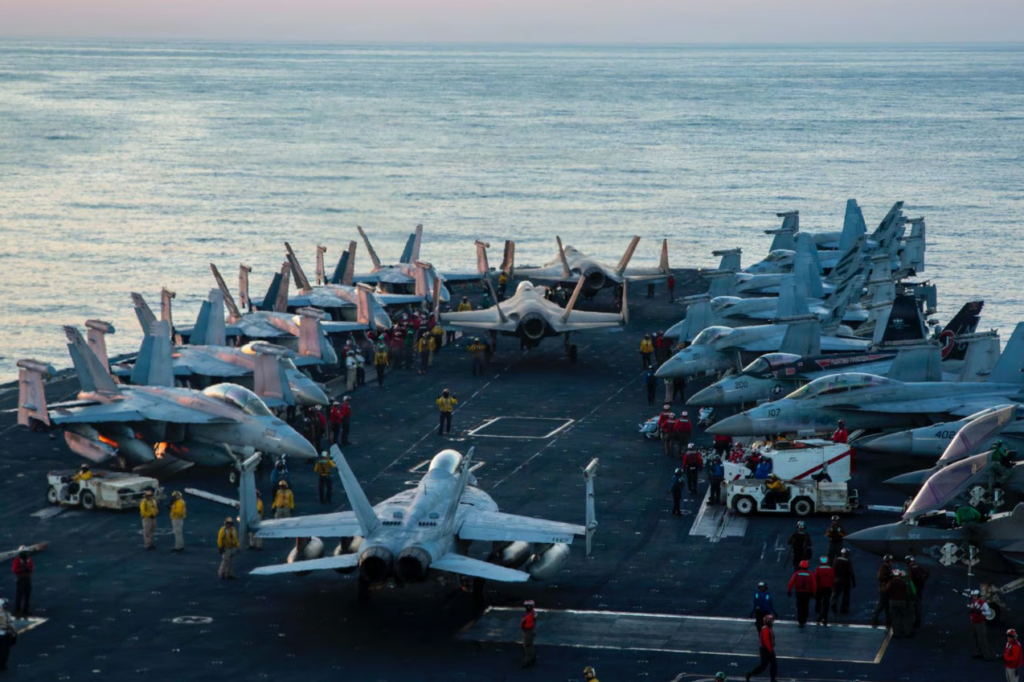
Just hours after President Trump announced on Truth Social the indefinite extension of the ceasefire—giving Tehran time to formulate a “unified proposal”—the Islamic Revolutionary Guard Corps (IRGC) attacked three commercial vessels in the Strait of Hormuz and seized two of them, citing alleged maritime violations. The UK Maritime Trade Operations Centre (UKMTO) confirmed that a container ship was boarded by an armed IRGC boat about eight nautical miles off the Iranian coast, with no injuries reported. Mahdi Mohammadi, an advisor to MP Ghalibaf, was blunt: “Trump’s ceasefire extension means nothing. The losing side cannot dictate terms. The continuation of the blockade is equivalent to bombing and must be met with a military response.” Iranian Foreign Minister Abbas Araghchi called the blockade an “act of war and a violation of the ceasefire.” Brent crude briefly surpassed $100 a barrel. Vice President JD Vance postponed his trip to Islamabad for a second round of negotiations. CENTCOM reported that 31 vessels have been diverted or detained since the blockade began on April 13.
Implications
The seizure of third-country vessels is a deliberate tactic of the jihadist oligarchy: to fragment the international community’s pressure on Washington to lift the blockade, turning non-belligerent powers—whose trade depends on free navigation through the Strait of Hormuz—into levers of pressure on the United States. It is a textbook example of asymmetric economic warfare, executed with the coldness characteristic of a regime that has resisted sanctions for decades. The White House’s position—that the blockade is not a violation of the ceasefire because it is authorized by international maritime law; that the Iranian seizures are not a violation because they do not affect American or Israeli vessels—is legally defensible but strategically unsettling: it lays the groundwork for a gradual escalation without clear turning points. The paradox of decapitation operates here in all its starkness: the Iranian interlocutors with the theoretical capacity to negotiate—Pezeshkian’s circle—lack real authority over the IRGC and the hardliners headed by General Vahidi; so that every Iranian declaration of openness is contradicted hours later by a forceful action from the revolutionary apparatus.
Perspectives and scenarios
The most likely scenario remains one of contained systemic fracture: neither full-blown war nor true peace, but a balance of mutually destructive pressures that exhausts both sides without reaching a resolution. Time works in Washington’s favor financially—Trump isn’t exaggerating when he says the blockade is costing Iran $500 million a day—but it works against them in terms of domestic American politics, where every week without an agreement translates into another week of expensive gasoline. The alternative scenario—an internal fissure within the Iranian regime that accelerates a negotiated transition—would require precisely the kind of unified leadership that Tehran lacks today, as Trump himself acknowledges when he demands a “unified proposal.”
2. The NYT reveals: Hamas offers to hand over domestic weapons, but not full demilitarization
Facts
On April 22, the New York Times published an exclusive report stating that two senior Hamas officials in Gaza told the newspaper the group was willing to hand over thousands of automatic rifles and other weapons belonging to its internal security and police forces. These weapons could be transferred to the Palestinian administrative committee established to govern Gaza under the supervision of the Board of Peace, the international body led by Trump. However, the Times itself acknowledges that the offer falls far short of the complete demilitarization and dismantling of Hamas’s military capabilities demanded by Israel as a prerequisite for any lasting agreement. Meanwhile, Israeli forces continue their operations in the enclave. The terrorist organization Hezbollah also fired on Israeli positions in southern Lebanon, marking another sign of the Lebanese-Israeli ceasefire fracturing.
Implications
Hamas’s “offer”—if it can even be called that—is a delaying tactic (a stalling tactic) strongly reminiscent of the Iranian nuclear strategy once described by Larijani: conceding on trivial matters to preserve what is essential. Handing over the weapons of the internal police force is in no way equivalent to surrendering the operational military equipment that gives the terrorist organization its fighting capacity. It is the same logic that has governed decades of “negotiations” between the West and terrorist actors in the Middle East: offering enough to prolong the process without conceding what truly matters. Israel cannot accept this framework; accepting it would be tantamount to certifying Hamas’s survival as the ruling terrorist organization in Gaza, which is precisely what Tel Aviv has pledged to prevent.
Perspectives and scenarios
This analyst believes the NYT report should be read in context: it signals Hamas’s desire for a leading role in negotiations at a time when the international focus is on Iran, not Gaza. The terrorist organization fears being sidelined on the diplomatic stage and is sending calculated signals of openness to maintain its relevance. The question no one is asking clearly enough is what will happen to Gaza once international attention shifts to the Iranian issue: the risk of the enclave being left in a limbo of indefinite governance, without a real political solution, is real and growing.
3. US intercepts three Iranian oil tankers in Asian waters
Facts
CENTCOM confirmed on April 22 that its forces had diverted at least three Iranian-flagged oil tankers in the Indo-Pacific: the supertanker Deep Sea (off the coast of Malaysia, half-loaded), the Sevin (off the coast of Malaysia, 65% loaded, with a capacity of one million barrels), and the supertanker Dorena (off the coast of southern India, fully loaded with two million barrels of crude oil). A fourth vessel, the Derya, may also have been intercepted, as it was unable to unload Iranian oil in India before the expiration of the exemption granted by Washington. Military sources indicated that the strategy involves operating in open waters to minimize the risks posed by floating mines deployed by the GRI in the strait. Trump stated that the blockade is costing Iran $500 million per day and that storage at Kharg Island is on the verge of collapse.
Implications
The expansion of interception operations into the Indo-Pacific—India, Malaysia, and Sri Lankan waters—represents a qualitative leap that complicates Washington’s relations with neutral powers essential to its global strategy. India, which had been importing Iranian crude under now-expired exemptions, finds itself in a diplomatically delicate position: it cannot afford to confront the US, but neither can it immediately do without Iranian energy. Malaysia faces a similar dilemma. Washington’s message is unequivocal: there will be no geographical or national exceptions to the blockade.
Perspectives and scenarios
The effectiveness of the blockade as a tool of financial pressure on the Iranian regime is undeniable in the short term. The relevant question is whether this financial pressure will produce the negotiated surrender that Washington hopes for, or whether it will accelerate the regime’s internal radicalization and strengthen its hardliners—General Ahmed Vahidi, commander-in-chief of the IRGC, and the Quds Force—at the expense of reformist voices, which are already systematically blocked by the real power structure. The history of the Iranian regime since 1979 offers more examples of the second scenario than the first.
4. US secretly adopts Ukrainian Sky Map anti-drone technology in Saudi Arabia
Facts
Reuters exclusively revealed that the U.S. military has deployed the Ukrainian Sky Map counter-drone command and control system to Prince Sultan Air Base in Saudi Arabia, about 640 kilometers (400 miles) from Iran, in recent weeks, according to five sources with direct knowledge of the operation. Sky Map, developed by the Ukrainian company Sky Fortress (funded by the Brave1 military innovation program), is the Ukrainian military’s primary platform for detecting Shahed drones and launching counterattacks. Ukrainian officers have been deployed to the base to train U.S. personnel. This revelation contrasts sharply with Trump’s public statement on Fox News on March 6: “We don’t need their help with drone defense.” The Pentagon had committed $350 million to strengthen drone defenses as part of Operation Epic Fury, and also deployed the Merops interceptor drones —backed by former Google CEO Eric Schmidt— at a rate of 13,000 units in eight days at the start of the conflict.
Implications
The episode can be interpreted in three ways: first, that American bases in the region had gaps in their drone defenses, which the war with Iran has brutally exposed; second, that Ukraine has developed, on the world’s most demanding battlefield, a technological advantage in drone and counter-drone systems that Washington cannot ignore; and third, that President Trump rejected an offer for reasons of image or political calculation, and that this stance was quietly corrected by the military chain of command. The irony—that a regime whose drone technology has been the main offensive instrument in the campaign against American bases has also been, indirectly, the mastermind behind the American response—is hardly overstated.
Perspectives and scenarios
This analyst has been insisting since the beginning of the conflict that Operation Epic Fury was conceived with insufficient planning for the contingencies that would follow the initial impact. The deployment of Ukrainian technology—a month after publicly rejecting it—is the most eloquent confirmation of this strategic improvisation. “There is no silver bullet that will stop every drone threat,” the Pentagon spokesman himself acknowledged. Honesty is commendable; the situation that prompted it, much less so.
5. Gasoline prices become a political weapon against Republicans
Facts
Reuters published a report from Michigan on April 22 documenting the political shift caused by soaring fuel prices —27% higher since the start of the war on February 28, with a gallon around $3.80 in Michigan and the national average exceeding $4 for the first time since 2022. Republican Congressman Tom Barrett, a 22-year military veteran who won his seat in 2024 promising to lower gasoline prices, is now on the defensive against a Democratic campaign that is using his own words and his own gas stations against him. The Democratic Congressional Campaign Committee (DCCC) has launched digital advertising in its 44 target districts. Trump’s economic approval ratings have plummeted to historic lows. Analysts from both parties acknowledge that energy prices will take time to fall even after the conflict ends, casting a long shadow over the November elections.
Implications
The iron law of American economic policy—whoever governs pays the price of consumer discontent—operates brutally. Republicans bet on a short war; the war has dragged on for 54 days with no agreement in sight. The promise of affordability that brought Trump to power in 2024 is being devoured by the very conflict his administration started. CNN and other media outlets document how the DCCC has turned gas stations into campaign stages: it’s an effective symbol precisely because it was the Republicans’ favorite symbol during the Biden era. In politics, rhetorical tools belong to no one.
Perspectives and scenarios
Republican strategist Alex Conant summed it up with remarkable candor when he told CNN that “many Republicans are breathing a sigh of relief, thinking this is over.” But that relief is premature: with the Strait of Hormuz functionally closed, prices won’t drop appreciably before summer, and the American political summer is already the prelude to the fall campaign. If the conflict isn’t resolved before July—as Rystad Energy estimates for a 90% recovery to pre-war flows—the midterms will find the Republican Party in a very vulnerable position in dozens of competitive districts.
6. Boeing regains lead in deliveries over Airbus with rising revenues
Facts
Boeing presented its first-quarter 2026 results on April 22, reporting revenues of $22.2 billion—a 14% increase compared to the same period in 2025—after delivering 143 commercial aircraft in the first three months of the year, compared to Airbus’s 114. This marks the first time since 2023 that the American manufacturer has surpassed the European one in quarterly deliveries and its largest lead since 2018. Of the 143 aircraft delivered, 114 belong to the 737 family, representing 80% of the total and the best first quarter in that category since 2018. Airbus recorded its worst first quarter in deliveries in more than twenty years, hampered primarily by Pratt & Whitney’s engine supply bottlenecks for the A320 family—25 fewer aircraft delivered compared to the previous year, equivalent to more than $3 billion at list prices. Boeing’s commercial division still posted losses of $563 million in the quarter.
Implications
Boeing’s operational recovery is real and must be acknowledged without reservation: it is the result of a costly and painful reindustrialization process that is beginning to bear tangible fruit. The reliance on the 737—80% of deliveries—is a structural vulnerability that doesn’t disappear with a good quarter, but the direction is correct. For Airbus, Pratt & Whitney’s problems represent a serious challenge: with 870 deliveries committed for 2026, the first quarter’s performance jeopardizes that guidance. The competition between these two manufacturers—the world’s only suppliers of large-capacity commercial aircraft—has clear geopolitical dimensions in a world where aeronautical contracts are also instruments of influence.
Perspectives and scenarios
The relevant question is not whether Boeing has won a battle, but whether it can sustain the momentum. With its commercial division still operating at a loss—albeit a much smaller one—and the backdrop of global economic uncertainty stemming from the conflict in the Persian Gulf, Boeing’s recovery remains fragile. But the signal is positive, and the American aerospace industry has well-founded reasons for cautious optimism.
III. THE EUROPEAN PROLIFERATION OF OPPOSITION TO TRUMP
The most significant political development of recent weeks—and one that this report addresses with the full attention it deserves—is the unprecedented proliferation of European leaders, across the ideological spectrum, who are openly and belligerently distancing themselves from President Trump. This phenomenon has reached a critical mass that makes it impossible to continue treating it as a series of isolated incidents: it is now a structural trend with major geopolitical consequences for the Atlantic architecture.
The center-left front: Starmer, Macron, Sánchez
British Prime Minister Keir Starmer publicly declared that he is “fed up” with UK citizens suffering from energy instability due to “Trump’s actions.” In a column in The Guardian, he reaffirmed the need for the UK to build its own “resilience” and that of its European allies—an unequivocal indication that London can no longer rely on American reliability. Starmer traveled to Qatar to participate in talks about reopening the Strait of Hormuz; he spoke with Trump by phone and conveyed the Gulf States’ perspective, but made it clear that the UK would not participate in the war. President Macron was more incisive: he called Trump’s idea of ”liberating by force” the Strait of Hormuz “unrealistic” and warned him, in a rebuke rarely seen for its harshness, that “when you want to be serious, you don’t contradict what you said the day before.” Spanish Prime Minister Pedro Sánchez—who from the outset refused to allow Washington to use the Rota and Morón air bases for combat operations against Iran and who in March closed Spanish airspace to American military aircraft involved in the war—was unequivocal: “The Spanish government will not applaud those who set the world on fire just because they later appear with a bucket.” This position, which this analyst considers excessive and a neutrality bordering on irresponsibility—Spain has NATO bases on its territory that are, in practice, logistical assets for the operation—is at least consistent in its internal logic.
The break with ideological allies: Meloni, Farage
Even more significant—and of greater geopolitical relevance—is the distancing of European leaders who had been Trump’s closest allies on the national-populist right. Italian Prime Minister Giorgia Meloni, who was the only European leader invited to Trump’s second inauguration and had positioned herself as a “bridge” between Washington and Brussels, called Trump’s attacks on Pope Leo XIV, who had called for an end to the war, “unacceptable.” Trump responded with a harshness unusual even by his standards: “She’s the unacceptable one because she doesn’t care that Iran has a nuclear weapon.” He declared that Meloni “is not the same person I thought she was” and that they haven’t spoken “for a long time.” The break is now public and complete. Bloomberg astutely pointed out that Trump’s attack may have politically rescued Meloni at home—with 40 million Italian Catholics and a historic relationship with the Vatican, siding with the Pope against Trump is, electorally, a net gain. In the UK, Nigel Farage—the man who compared Trump to Winston Churchill and campaigned for him—has begun to publicly distance himself. The Washington Post described the moment as a “breaking point” for European right-wing populists in the face of an American president who has portrayed himself on social media as Jesus Christ and who accuses his most loyal ally in Europe of lacking courage.
The institutional response: Kallas, the RAF and the 30 countries
At the European institutional level, the EU’s High Representative for Foreign Affairs and Security Policy, Kaja Kallas, declared that “freedom of navigation is non-negotiable” and described the situation in the Strait of Hormuz as “reckless.” The United Kingdom convened a two-day conference at an RAF base north of London with military representatives from more than 30 countries to establish a multinational maritime security mission in the strait—an initiative that, significantly, is being pursued independently of the American operational command and will only be activated after a “sustained ceasefire.” The Carnegie Endowment for International Peace analyzed the situation with precision: Europe is learning the same lessons it learned during the Greenland crisis, where unity and credible pressure succeeded in moderating Washington’s behavior. Now it is applying the same approach to the Iranian conflict.
Analysis: a well-founded critique, but with the necessary nuances.
This analyst argues that the critical stance of European leaders regarding the war in Iran is, at its core, legitimate—the lack of a post-war plan, the strategic improvisation, the overall energy cost—but that the way this criticism is expressed is, in many cases, irresponsible and self-destructive. Europe depends on the Strait of Hormuz for 20% of its energy supply; if anyone has a vested interest in resolving the conflict, it is Europe. Refusing to participate in the solution while criticizing the only actor exerting effective pressure on the jihadist oligarchy in Tehran is a comfortable but hardly admirable position. Sánchez closing Spanish airspace to American aircraft operating from bases hosted by the Spanish government itself is a textbook example of inconsistency. What Europe needs is not rhetorical neutrality; it is strategic coherence. And that coherence implies demanding that Washington have a plan, not simply complaining about the cost of the bill that Washington is footing on behalf of everyone.
IV. MEDIA RACK
New York Times
The exclusive report on Hamas’s willingness to hand over weapons from its internal security forces—published cautiously and with the necessary caveats regarding the limitations of the offer—is the NYT’s main original news contribution of the day. The newspaper maintains extensive coverage of the Iranian conflict, with particular attention to the negotiations in Islamabad and the domestic political implications for the Trump administration.
Reuters, AFP, AP
Top-notch factual coverage: Reuters led the way with the two biggest exclusives of the day—the interception of Iranian oil tankers in Asian waters and the deployment of Ukraine’s Sky Map technology in Saudi Arabia—as well as political reporting on the reversal of the gasoline argument against Republicans. AFP and AP rounded out the coverage with oil price tracking and diplomatic reactions.
Washington Post, The Guardian, TIME, CNN, Foreign Policy
The Washington Post offers the most comprehensive analysis of the distancing of Trump’s European allies, including coverage of Farage’s about-face. TIME and CNN document the Meloni-Trump-Papa affair in detail and with perspective. Foreign Policy analyzes the phenomenon from the angle of Trump’s loss of international support. The Guardian publishes Starmer’s column on the UK’s energy “resilience.”
Financial Times, Wall Street Journal
The FT highlights Boeing’s results with an analysis of the Boeing-Airbus competition within the context of the global engine supply chain. The WSJ focuses on the financial implications of the Iranian naval blockade and Brent crude’s $100 mark, with an analysis of energy futures markets.
Gulf Media — Arab News, Asharq Al-Awsat, Gulf News
Coverage focuses on the regional consequences of the blockade of the Strait of Hormuz and the 30-country conference held at the RAF base. Arab News and Asharq Al-Awsat reflect the growing concern of the Gulf Arab states, whose window to the world is the disputed strait.
Israeli media — Jerusalem Post, Haaretz, Israel Hayom
The Israeli press cautiously addresses Hamas’s weapons offer, calling it insufficient and interpreting it as a delaying tactic. Haaretz reports the death of journalist Amal Khalil in southern Lebanon in an Israeli attack. Israel Hayom supports Netanyahu’s position that “the campaign is not over” despite the ceasefire.
Asian media — WION, South China Morning Post, Hindustan Times
Focus on the interception of oil tankers in waters near India and Malaysia. The South China Morning Post analyzes the implications for China—an interested observer still negotiating its position in the conflict—and for the stability of energy supplies in East Asia.
V. RISK TRAFFIC LIGHT
🔴 MAXIMUM RISK: Capture of third-country commercial vessels by IRGCs in the Strait of Hormuz — an escalation that threatens global freedom of navigation and destabilizes the fragile ceasefire architecture.
🔴 MAXIMUM RISK: Collapse of peace negotiations: Ghalibaf’s advisor describes the ceasefire extension as “nothing,” and the Iranian negotiating team has not confirmed its presence in Islamabad. The diplomatic process is at a virtual standstill.
🟠 HIGH RISK: Accelerated deterioration of the Atlantic alliance: the proliferation of European leaders — from all spectrums — who distance themselves from Trump reaches a structural critical mass with lasting consequences for NATO and the Western security architecture.
🟠 HIGH RISK: Oil price at the threshold of $100 a barrel — global inflationary impact with internal political repercussions in the US (midterms) and severe pressure on emerging energy-importing economies.
🟠 HIGH RISK: Vulnerabilities in drone defense of American bases in the region, revealed by the secret adoption of Ukrainian Sky Map technology — possibility of new high-intensity Iranian attacks on military infrastructure in the Gulf.
🟡 MODERATE RISK: Diplomatic tension with India and Malaysia over interceptions of oil tankers in their waters — risk of distancing from neutral powers strategically relevant to the rebalancing of the Indo-Pacific.
🟡 MODERATE RISK: Hamas’s delaying tactic with the partial offer of weapons — risk that the international community will accept an insufficient framework that certifies the survival of the terrorist organization in Gaza.
🟢 POSITIVE TREND: Boeing’s operational recovery — a sign of strategic American industrial stability, although dependence on the 737 and residual losses in the commercial division maintain a latent structural risk.
VI. EDITORIAL COMMENTARY
There are days when the big headlines obscure the real story. April 22, 2026, is one of those days. The real story isn’t that Iran captured two ships hours after the ceasefire was extended—though that is extremely serious. The real story is that Europe, as a political entity, has crossed a threshold from which there is no easy return.
Starmer saying he’s “fed up” with Trump is news. Macron publicly rebuking the American president for his inconsistency is news. Sánchez declaring that Spain will not applaud those who set the world on fire is—aside from the blatant inconsistency of a country that hosts NATO bases on its territory that are logistically involved in that very war—news. But Giorgia Meloni—the only European leader invited to Trump’s second inauguration, the one who had positioned herself as a bridge between Washington and Brussels, the American president’s natural ideological ally—publicly confronting Trump over his attacks on the Pope, and Trump responding that “she’s not the same person I thought she was”: that’s not news. That’s a change of era.
This analyst does not share the position of many of these European leaders regarding the Iranian conflict. We support maximum pressure on the jihadist oligarchy in Tehran, a terrorist state whose elimination as a nuclear power is a global security imperative. But supporting pressure on Iran does not equate to turning a blind eye to the planning errors of Operation Epic Fury, nor to remaining silent about the scandalous absence of a post-operation plan. Europe criticizes what deserves criticism; what it cannot do is simply criticize from the sidelines while the energy costs fall on its citizens and while its own bases host operations that it rhetorically condemns.
The Atlantic paradox of this historical moment is so acute that it deserves to be emphasized: Europe is learning—belatedly and through hard knocks—that strategic self-sufficiency is a necessity, not an option. Trump, with all his erratic behavior and excesses, has done more for European strategic autonomy than twenty years of speeches in Brussels. Not because he intended it that way, but because he has convinced Europeans that they can no longer rely on American reliability as before. The question is whether Europe will emerge from this crisis with the political will and budgetary resources to transform this rhetorical momentum into real capability. Recent history—and this analyst’s prediction—invites skepticism.
Regarding the NYT report on Hamas: the offer to hand over weapons from the internal police is not a concession; it’s a maneuver. Any analysis that presents it as a genuine opening or as a first step toward demilitarization confuses wishful thinking with reality. Hamas is a terrorist organization whose survival as the ruling entity in Gaza depends precisely on maintaining its monopoly on force. Negotiating over the internal police’s weapons while retaining military armament is the political equivalent of giving up the kitchen knives instead of surrendering the rifles. That the NYT published this with its necessary nuances is appreciated. However, for someone to interpret it as a significant advance would be an analytical error that this analyst cannot endorse.
In short: the events of April 22 confirm that the variable-temperature war—a war of variable temperature—that no one can fully win and no one can afford to lose is simultaneously producing three self-reinforcing erosions: that of the Iranian regime, subjected to unprecedented financial pressure; that of American leadership, weakened by a lack of planning and the domestic political cost; and that of the Atlantic architecture, whose fracture—if not addressed with determination and clarity—may be the most lasting and costly legacy of this crisis.