Gustavo de Arístegui,
April 27, 2026
1. BRIEF INTRODUCTION
The day of April 26, 2026, and the morning of the 27th, will be marked by a succession of events that, taken together, paint a disturbing picture of the drift of the international order: the attack against President Donald Trump at the White House Correspondents’ Association dinner held at the Washington Hilton on the evening of Saturday the 25th; the cancellation—decided by Trump himself—of the trip by his envoys Steve Witkoff and Jared Kushner to Islamabad for a second round of negotiations with Iran; the persistent closure of the Strait of Hormuz under a double blockade—Iranian and American—with an increasing cost to the global economy; the merger of the parties of Naftali Bennett and Yair Lapid under the “Together” banner to challenge Benjamin Netanyahu in the upcoming Israeli elections; and, on a parallel but significant level, Trump’s new statements about his contacts with Vladimir Putin and Volodymyr Zelensky regarding the war in Ukraine.
We are living, as I have been describing for months, through a phase of contained systemic fracture—three simultaneous exhaustions in the military, diplomatic, and economic fields—in which wars of varying intensity overlap with domestic political violence that in the United States threatens to become endemic.
II. MOST IMPORTANT NEWS OF THE LAST 24 HOURS
1. Assassination attempt against President Trump at the White House Correspondents’ Dinner
Facts:
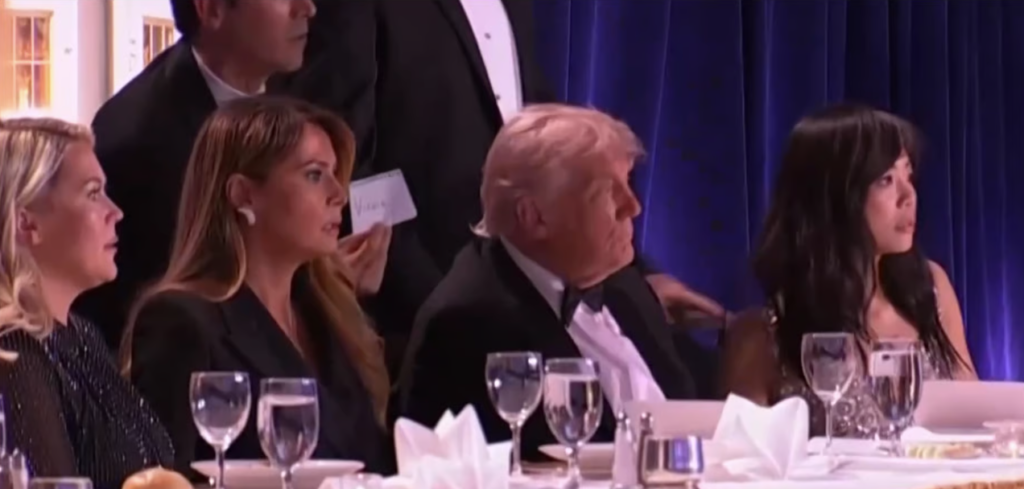
On the evening of Saturday, April 25, an individual identified as Cole Tomas Allen, a native of New London, Connecticut, forced open the main security camera system at the Washington Hilton Hotel—traditional venue for the White House Correspondents’ Association annual dinner and the National Prayer Breakfast—and fired at least one bullet before being subdued by the Secret Service. President Trump, First Lady Melania Trump, Vice President J.D. Vance, FBI Director Kash Patel, and Secretary of Health Robert F. Kennedy Jr. were in the ballroom when the shots were heard. One agent was struck in his body armor and is recovering well. The attacker had written a manifesto in which he called himself a “Friendly Federal Assassin” and identified government officials as targets; his brother alerted the New London police just minutes before the incident. Trump, evacuated by the Secret Service, later declared that the attack “will not deter me from winning the war against Iran” and attributed the attacker’s motivation to an “anti-Christian” and “lone wolf” profile.
Implications:
This is the third assassination attempt against Donald Trump since July 2024—Butler (Pennsylvania) and West Palm Beach (Florida) preceded the one in Washington. It’s worth emphasizing this stark fact, without mincing words: there wasn’t a single documented assassination attempt against Joseph Biden during his presidency, and none against Kamala Harris; the imbalance is glaring. The incitement to hatred emanating from hardline sectors of the left-wing media—led by MSNBC, certain commentators in the so-called progressive press, and, as a symbolic reminder, that star journalist who went so far as to say regarding the murder of Charlie Kirk, “he had it coming” (he deserved it, it was going to happen to him sooner or later because he was asking for it)—creates a perverse breeding ground. The radical wing of the Democratic Party—the self-styled Democratic Socialists of America and “The Squad,” with figures like Ilhan Omar (the quasi-jihadist Somali), Rashida Tlaib (with a discourse identical to that of Hamas), Alexandra Ocasio-Cortez (with her hate speech that reaches the rich)—and Bernie Sanders and company, have contributed for years to dehumanizing the political adversary to the point of making him socially cancelable and, now, physically eliminable.
Perspectives and scenarios:
The first, and most likely, scenario is the consolidation of the spiral of political violence in the United States during the November 2026 midterm election cycle: threats against elected officials will multiply, and the cost of security—for both Republicans and Democrats—will increase exponentially. The second, equally plausible, scenario is an executive crackdown by Trump—via executive orders, through the Justice Department under Pam Bondi, and through new Secret Service protocols—on university, media, and digital environments that, in the government’s view, fuel incitement. The third scenario—and here lies the great unknown—is that a segment of the Democratic establishment will be forced by civic pressure to openly disavow the Squad and its more sectarian wing; I fear, however, that the dynamics of polarization are already too deep for such an ethical cleansing, from which the entire republic would benefit, to occur.
2. Trump cancels Witkoff-Kushner mission to Islamabad: US-Iran negotiations enter a comatose state
Facts:
On the afternoon of April 25, just hours before the Hilton bombing, President Trump announced on his social media platform, Truth Social, the cancellation of the trip by his special envoy, Steve Witkoff, and his son-in-law, Jared Kushner, to Islamabad, where they were scheduled to hold a second round of talks with Iran through Pakistani mediation. Trump stated, “Too much time wasted traveling, too much work. Also, there’s tremendous infighting and confusion within their leadership. Nobody knows who’s in charge there, including themselves. We have all the cards, they have none. If they want to talk, let them call.” Iranian Foreign Minister Abbas Araghchi left Islamabad for Muscat, Oman, after meeting with Pakistani Prime Minister Shehbaz Sharif and Army Chief of Staff Asim Munir. He returned to the Pakistani capital on Sunday, April 26, without a US counterpart. He is scheduled to meet with Vladimir Putin in Moscow on Tuesday, April 28.
Implications:
The US diplomatic initiative is, de facto, frozen. Trump now proposes “talking by phone”—he has a secure line, he says—which reveals the level of informality and volatility into which the mediation has descended. The jihadist oligarchy in Tehran, trapped by its own paradox of decapitation—I emphasize the concept—is unable to articulate a unified position because the triumvirate of the Islamic Revolutionary Guard Corps (IRGC)—General Ahmed Vahidi (commander-in-chief), Mohamed B. Zolghadr (secretary of the Supreme National Security Council, Al-Quds Brigades), and Rezaei (acting military advisor to the Supreme Leader)—systematically blocks the reformist wing of President Pezeshkian, who remains, in practical terms, a figurehead. Ghalibaf, the Speaker of Parliament, answers to Vahidi, not to Pezeshkian. Araghchi’s flight to Moscow under these conditions reveals where Tehran is leaning when Iran closes the door to negotiations with Washington: towards an alliance of necessity with Putin.
Perspectives and scenarios:
Scenario A—the most likely in the short term—: prolonged stalemate, with episodic phone calls and rhetorical swings from Trump, while the dual blockade of the Strait of Hormuz remains in place and crude oil prices continue to fluctuate uncomfortably. Scenario B: resumption of US tactical bombing of Iranian oil and electrical infrastructure—Trump has threatened to “blow up all the power plants and bridges”—if Tehran continues its mine warfare and boarding of ships. Scenario C: Moscow seizes the opportunity to extract concessions from Tehran in exchange for diplomatic support, or uses the occasion to launch a parallel mediation effort that the US president, true to his transactional style, might even consider. I stand by what I have been saying since February: the US-Israeli military operation against Iran was brilliant in its execution, but astonishingly improvised in its day-after planning .
3. Strait of Hormuz: dual blockade, sea mines and stasis
Facts:
As reported by The Economist in its “World in Brief” section—”Stasis in the Strait”—maritime trade through the Strait of Hormuz remains virtually paralyzed. Only three to five tankers cross it daily, compared to a pre-war average of around 129. The IRGC continues to seize ships—as seen last week with the capture of the MSC Francesca (Panamanian) and the Epaminondas (Greek)—while the US Navy has rerouted 37 vessels to date in its blockade of Iranian ports and continues mine clearance operations that the Pentagon has warned Congress could last up to six months. Brent crude traded this week in a range of $95 to $106 per barrel; WTI, around $87. Fatih Birol, director of the International Energy Agency (IEA), has described the situation as “the biggest threat to energy security in history,” with 13 million barrels a day missing from the market and no immediate solution in sight.
Implications:
The Strait of Hormuz is, in essence, a lifeline of the global economy: 20% of the world’s crude oil and 20% of its liquefied natural gas pass through it. Inflationary pressure on Europe, Asia, and the United States itself will persist as long as the blockade remains in place. There is also a secondary effect of greater severity: the fertilizer and urea crisis, whose production depends on natural gas from the Gulf and whose rising prices threaten corn planting in the United States and, by extension, global food prices in 2027. Goldman Sachs has predicted a windfall for Oman and Saudi Arabia, whose oil revenues are swelling while Iranian ports remain closed. This dynamic reinforces the geopolitical weight of the Gulf Cooperation Council in any negotiated solution. According to business sources cited by Fortune, the Panama Canal is becoming an alternative—despite the cost of four million dollars per crossing—to the risks of the Strait of Hormuz.
Perspectives and scenarios:
The most likely scenario in the next 60-90 days is what Goldman Sachs has termed a “sloppy peace”: a partial reopening of the Strait with naval escorts, low traffic levels, high risk premiums, and persistent volatility. A darker scenario would be a widespread resurgence of violence if Iran, pressured by the blockade, decides to intensify its mine-laying and drone attacks on oil tankers. A third scenario, less likely but not impossible, is an escalation toward Saudi and Emirati energy infrastructure—recall Abqaiq in 2019—which would require an immediate response from US Central Command. I have maintained since March that only a regional diplomatic architecture with an active presence from Riyadh, Abu Dhabi, Doha, Muscat, Baghdad, and Islamabad, and with discreet but firm support from Washington, can create the conditions for a sustained de-escalation.
4. Israel: Bennett and Lapid merge their formations under “Together” to defeat Netanyahu
Facts:
Former Prime Ministers Naftali Bennett (54, pragmatic right) and Yair Lapid (62, centrist, former television presenter) announced at a joint press conference in Herzliya on the afternoon of Sunday, April 26, the merger of their parties—Bennett 2026 and Yesh Atid (There Is a Future)—under a single list called “Together,” led by Bennett. Former Chief of Staff Gadi Eisenkot—head of the Yashar! party—has been invited to join the coalition. Israeli general elections must be held no later than the last day of October 2026. An N12 News poll from April 23 gives Bennett 21 seats in the Knesset (out of 120), compared to 25 for Netanyahu’s Likud party. The combined seats of the new alliance with smaller parties could reach nearly 60, while Netanyahu’s current far-right religious coalition would barely reach 50.
Implications:
This is the most significant political development in Israel since the outbreak of the Iran-Iraq War. Bennett and Lapid already cooperated in 2021 to end Netanyahu’s twelve years in power—in a coalition that, however, survived for barely eighteen months due to internal contradictions. This time, the coalition is narrower (a single party) and the political platform more coherent: both defended the attacks against Iran but criticize Netanyahu for his inability to translate military victories into strategic ones; both are demanding a national commission of inquiry into the failures of October 7, 2023, which Netanyahu continues to block; and both are aligned on the issue—already explosive in Israel—of ending military service exemptions for the ultra-Orthodox. Lapid described the two-week ceasefire with Iran as “a political disaster,” a phrase that encapsulates the growing criticism of the prime minister.
Perspectives and scenarios:
The most likely scenario is a very close election in which Bennett would have a real chance of forming a government with Yair Golan, the moderate Arab-Israeli parties, and, potentially, Eisenkot’s Yashar! party. Netanyahu, however, has demonstrated astonishing political resilience over the past fifteen years and still has the Likud party machine and the support of the religious parties at his disposal.
A second scenario is the fragmentation of the opposition bloc due to internal incompatibilities: Bennett is right-wing, Lapid is centrist, and the Palestinian issue remains divisive—both of them, however, reject the Palestinian state.
A third scenario , the most worrying, is an institutional crisis if Netanyahu tries to force a favorable election timetable or if the legal problems that accompany him erupt in the middle of the campaign.
5. Pentagon Memorandum and Spain’s Suspension from NATO: The Transatlantic Fracture Becomes Explicit
Facts:
On April 24, Reuters revealed the existence of an internal Pentagon memo circulating among senior officials at the U.S. Department of Defense, outlining options for “punishing” NATO allies who refused to grant access, basing, and overflight (ABO) rights during the war against Iran. The most striking option is the suspension of Spain from the Atlantic Alliance; the second, a review of the U.S. position on British sovereignty over the Falkland Islands in light of Argentina’s claim; and the third, removing “difficult” allies from prestigious positions within NATO. Pentagon spokeswoman Kingsley Wilson stated that “as President Trump has said, despite everything the United States has done for its NATO allies, they weren’t there when we needed them.” Spanish Prime Minister Pedro Sánchez responded from Cyprus: “We don’t work with emails; we work with official documents and government positions.” A NATO official clarified to TIME that “the NATO founding treaty does not include provisions for the suspension or expulsion of members.”
Implications:
We are facing the most severe transatlantic rift since the debate over the Iraq War in 2003. The Spanish government’s stance—which has denied the use of joint bases and closed its airspace—borders on irresponsible neutrality and is, frankly, more hostile to the United States than to Tehran. The inconsistency between public discourse and the operational reality of the Rota and Morón bases—which, in practice, remain active logistical support for the operation against Iran—is a paradigmatic case of strategic hypocrisy that should be denounced without reservation. The United Kingdom is also in Washington’s crosshairs due to Prime Minister Keir Starmer’s public refusal to join the war; reconsidering the US position on the Falklands would be a significant symbolic blow and an unexpected geopolitical gift to Buenos Aires. What I have been describing for months is confirmed: a short-sighted, fragmented Europe, afraid to take its own defense and its own destiny seriously, is now paying the price for fifteen years of strategic irresponsibility.
Perspectives and scenarios:
The baseline scenario is that Spain’s effective suspension from NATO will not materialize—the founding Treaty does not contemplate it—but that political, commercial, and diplomatic pressure on Madrid will increase: selective tariffs, exclusion from joint industrial platforms, and pressure on defense spending, which Spain continues to maintain at 2% of GDP despite the Alliance’s commitment to 5% in The Hague by 2025.
A second, more explosive scenario is an open crisis if Trump, with his characteristic volatility, decides to partially withdraw US forces from Europe.
A third point is the consolidation of the “European Pillar”—an idea Macron will insist on, already weakened at home with a 20% approval rating—and a renewed push for European strategic autonomy, an idea we’ve been repeating for decades that still hasn’t moved from rhetoric to operational reality. I demand consistency, not maximalism, from the Spanish government: if it truly believes in this position, it should withdraw from NATO; if not, it should fulfill its allied obligations.
6. Trump confirms “good talks” with Putin and Zelensky: the Ukrainian front tentatively returns to the agenda
Facts:
In an interview on Fox News’ “The Sunday Briefing” on Sunday, April 26, President Trump stated that he is having “good conversations” with both Vladimir Putin and Volodymyr Zelensky , without specifying dates. “We’re working on the Russia situation, Russia and Ukraine, and I hope we get there,” he said. He added, “The hatred between Putin and Zelensky is ridiculous, it’s crazy; and hatred is a bad thing when you’re trying to solve something, but it will pass.” Erdogan confirmed in early April Turkey’s willingness to host a new round of negotiations; Zelensky, during his visit to Baku on Friday, declared himself ready for trilateral talks on Azerbaijani territory. Trump claimed to have “resolved eight wars” and said that the one in Ukraine “should have been the easiest.”
Implications:
The conflict in Ukraine has become what I have been describing as a war of variable temperature—low resolution but high destruction, which no one can win and no one can afford to lose—and has been systematically displaced from the international agenda by the war in Iran. Zelensky recently acknowledged this, admitting that the Iranian conflict has diverted attention and that there is a serious risk that efforts to end hostilities in Ukraine will not resume until the conflict in Iran is over. Trump’s aspiration for a quick settlement clashes with the twofold reality: Putin has no incentive to stop, and the strain on Ukraine works in his favor in the long run, albeit at a huge demographic and military cost; nor can Zelensky cede territory without a solid security guarantee that only NATO could provide.
Perspectives and scenarios:
The most likely scenario is the prolongation of the military status quo with secret talks until the Iranian front is resolved, in one direction or another.
A second scenario is a fragile ceasefire with frozen lines of contact, without recognition of Russian sovereignty over the occupied territories—a Korean-style solution—which would require robust security guarantees and a European defense architecture that does not exist today.
A third, and darkest, scenario is the resumption of large-scale Russian offensives if Putin perceives Washington’s strategic disengagement as a green light. I reiterate my position: we oppose Russian aggression, we oppose the use of force to acquire territory, and we are only moderately critical of Trump on this specific issue, where his negotiating approach—pragmatic, realistic, and transactional—deserves, at the very least, not to be sabotaged a priori by Europe.
III. MEDIA RACK
The international press as a whole dedicates its best headlines to the two linked crises of the weekend: the attack in Washington and the collapse of Islamabad.
USA.
The New York Times headlines about the shooting at Trump dinner and the talks on hold; The Washington Post leads with the cancellation of Witkoff and Kushner talks (“Trump calls off… for Iran peace talks”); the Wall Street Journal underscores the instability for the markets; Politico, The Hill, and Axios dissect the profile of the assailant, Cole Thomas Allen, and his manifesto; Fox News amplifies the presidential line (“lone wolf, anti-Christian”); CNN offers the most comprehensive live updates on Araghchi in Muscat and then in Moscow; CNBC links both events in its Daily Open; CBS confirms the Sharif-Pezeshkian line; The National Interest and Foreign Affairs calmly weigh the strategic consequences; USA Today focuses on the domestic dimension of the attack.
United Kingdom.
The Times of London and The Telegraph provide extensive coverage of the attack and Buckingham Palace’s confirmation that King Charles III’s visit to the United States “will proceed as planned”; The Guardian adds the angle of the manifesto and the debate on WHCD security; the Financial Times dominates the economic rack with an editorial on the energy cost of the dual blockade; The Economist publishes its “Stasis in the Strait”—a key piece for understanding the moment; the BBC offers the most balanced coverage with Palestinian, Israeli, and Iranian voices.
Continental Europe.
Le Monde and Le Figaro lead with the attack in Washington; Libération addresses the dimension of political violence in the United States; La Croix looks to the Vatican and humanitarian mediation; Le Point and L’Express analyze the Franco-American crisis in terms of NATO; LCI and BFM TV broadcast live; France Info dedicates its Monday morning show to the Bennett-Lapid issue; Frankfurter Allgemeine Zeitung and Die Welt seriously address the Pentagon memorandum on Spain; Die Zeit offers an in-depth analysis of the transatlantic rift; Corriere della Sera expands on Hormuz; L’Osservatore Romano highlights the Vatican’s call for dialogue; La Tribune de Genève and Helsingin Sanomat cover the northern flank; Gazeta Wyborcza focuses on Ukraine.
Middle East.
Yedioth Ahronoth, Israel Hayom, and The Jerusalem Post dedicate their Monday front pages to the Bennett-Lapid merger; Haaretz and Maariv add critical analysis of Netanyahu; Al-Jazeera offers the best coverage of Araghchi’s diplomacy between Islamabad, Muscat, and Moscow; Al-Arabia and Asharq Al-Awsat reflect the Saudi position, aligned with opening the Strait; Al-Hayat and Beirut’s An-Nahar focus on the Lebanese ceasefire; L’Orient-Le Jour, The Daily Star, and Al Quds Al Arabi cover the regional repercussions; Jordan Times, Al Rai, Hürriyet, Arab News, Al Riyadh, Saudi Gazette, Gulf News, Khaleej Times, Gulf Today, and Times of Oman each analyze, from their national perspective, the possibility of broader regional mediation.
Asia and the Pacific.
The Times of India, Hindustan Times, and Indian Express cover the security incident at Indira Gandhi Airport and the Indian Navy’s Operation Urja Suraksha in the Gulf of Oman; WION offers the most comprehensive English-language analysis of the Indian position; the South China Morning Post and China Daily react cautiously to the blockade—China is the largest customer of Iranian crude; the Yomiuri Shimbun and Tokyo Times reflect Japanese concerns about energy prices; The Straits Times, from Singapore, offers the most useful perspective on Asian markets; and the Daily Jang and Pakistan Times praise Islamabad’s mediating role in diplomatic terms.
Latin America and the world in Spanish.
Clarín of Buenos Aires highlights the Falklands issue in the Pentagon memorandum; El Mercurio of Chile and Reforma of Mexico report on the CIA incident in Chihuahua and the Sheinbaum-Trump tension.
Russia and the post-Soviet zone.
TASS and Russia Today amplify Araghchi’s trip to Moscow and the planned meeting with Putin—for Vesti, a moral victory for Russian diplomacy—; Ukrainska Pravda, Ukrinform, Fakty i Kommentarii, The Kyiv Independent and Kyiv Post cover Trump’s statements on Ukraine with skepticism.
Think tanks and specialized press.
Foreign Affairs publishes a cautious analysis of Trump’s diplomacy; The Economist Intelligence Unit revises its European inflation forecasts upwards; the bulletins from RUSI, IISS, CSIS, and IFRI each address, in their own way, the NATO rift and the Hormuz blockade; The National Interest and Washington Times offer conservative readings; The Daily Beast and Newsweek, more liberal perspectives; Time and Le Nouvel Observateur round out the weekly spectrum; Bloomberg and The Mail & Globe offer top-tier financial coverage.
IV. RISK TRAFFIC LIGHT
The risk assessment reflects the simultaneous severity of the open fronts. The dual blockade of the Strait of Hormuz and the diplomatic strangulation between the US and Iran remain critical. Political violence in the United States and the transatlantic rift with Spain and the United Kingdom are at a very high level. The Israeli political realignment and the US-Mexico tension due to the CIA presence in Chihuahua remain at a high level. Ukraine remains at a high level due to the persistence of the war status quo and the media’s shift away from the issue. Oil markets, with a wide range of fluctuations, remain under close scrutiny.
| ● | SCOPE / SITUATION | RISK LEVEL |
|---|---|---|
| ● | Strait of Hormuz / dual blockade and sea mines | RED — Critic |
| ● | US-Iran negotiations / Islamabad channel collapsed | RED — Critic |
| ● | Political violence in the US / attack against Trump | ORANGE — Very high |
| ● | NATO cohesion / US-Spain-UK friction | ORANGE — Very high |
| ● | Israel — Bennett-Lapid political realignment | YELLOW — Elevated |
| ● | Sovereignty and drug trafficking — US-Mexico friction (CIA Chihuahua) | YELLOW — Elevated |
| ● | Ukraine — shift in focus due to the Iran war | YELLOW — Elevated |
| ● | Oil markets / Brent in range 95-106 USD | GREEN-YELLOW — Surveillance |
V. EDITORIAL COMMENTARY
It must be said bluntly, with the firm tone I’ve been using since February in La Razón and El Debate: the attack against President Trump at the Washington Hilton is not an isolated incident; it is yet another manifestation of a rotten political culture that tolerates—when it doesn’t openly encourage—violence as long as it comes from the left. It is utter nonsense that the incitement to hatred spewed by mainstream media outlets like MSNBC from the hard left is not even denounced with the necessary force. The ideological bias with which political violence is treated according to its origin—leniency toward the left, severity toward the right—is reminiscent of the appalling comment about Charlie Kirk (“he had it coming,” he deserved it) that some star journalist dared to make live on air with almost no professional repercussions. Whether Trump is liked more, less, or not at all, what is happening in American politics and media is simply dramatic. The question is rhetorical but unavoidable: how many assassination attempts did Joseph Biden survive? How many against Kamala Harris? None. That’s the exact and devastating answer.
The radical left wing of the Democratic Party—the self-styled Democratic Socialists of America and the Squad, with Ilhan Omar, the Somali, delivering a quasi-jihadist discourse; Rashida Tlaib, whose message is almost a carbon copy of Hamas’s; and Alexandria Ocasio-Cortez, the ineffable AOC, whose hate speech reaches even the wealthy and successful—has been sowing, for years, with the passive complicity of Bernie Sanders and company, an atmosphere of cancel culture and dehumanization of the adversary, which is now reaping its bitterest consequences. Let me be absolutely clear: this current does not represent the majority of Democrats, but it conditions and contaminates an entire party because of the cowardice of its establishment in confronting it. Bernie Sanders may tear his hair out after the attack; those of us who have followed his incendiary rhetoric for years are not falling for his feigned surprise.
Regarding Iran and Hormuz: I said it and wrote it at the time, and I stand by it. I support allied attacks against the oligarchic-jihadist regime in Tehran—cosmically corrupt, bloodthirsty, and an exporter of terrorism through its terrorist organizations Hezbollah, the Houthis in Yemen, Hamas, and Iraqi militias. But I am highly critical of the absolute lack of planning for the aftermath: there is no plan for a regime implosion, nor for an orderly transition, nor for a calibrated withdrawal. The paradox of the decapitation—and here I emphasize the concept—is manifesting itself today in all its starkness: the IRGC triumvirate is blocking any negotiated solution because its very existence depends on it, while Pezeshkian is reduced to a mere figurehead, and Araghchi flits from capital to capital without any real mandate. Trump has a point when he says that “nobody knows who’s in charge there, not even they themselves.” But that is precisely the predictable consequence of a military operation brilliant in its execution and astonishingly improvised in its day-after planning. And this, which I have been describing since March, becomes more evident with each passing week.
Regarding the Pentagon memorandum and Spain: the Sánchez government’s inconsistency with the Rota and Morón air bases—which continue to function as active logistical support for the operation against Iran—and its public discourse of neutrality bordering on irresponsibility constitutes a paradigmatic case. This government is more hostile to the United States than to the Iranian jihadist oligarchy; I say this bluntly. If that is its fundamental position, then it should accept all the consequences and withdraw Spain from NATO. If that is not the case, then it should assume its allied obligations, particularly the commitment to 5% of GDP for defense that we collectively agreed to in The Hague. This criticism is not maximalism: it is a demand for consistency. And it is worth remembering that the strength of the transatlantic bond is one of the few serious strategic assets that Spain still possesses, a legacy, among others, of the transition and of King Juan Carlos I, a fundamental architect of our democracy. This analyst believes that the current government is blithely squandering that capital.
Regarding Israel: the Bennett-Lapid merger is the best political news for the Jewish state in a long time. Not because it guarantees Netanyahu’s removal—the prime minister has demonstrated fifteen years of supernatural political resilience—but because it finally offers a coherent alternative to the current, most right-wing government in Israeli history. Bennett and Lapid agree on the essentials—justified attacks on Iran, an end to ultra-Orthodox exemptions, a commission of inquiry into October 7, and a more strategic than tribal approach to relations with Washington—and disagree on the less important points.
Regarding the war in Ukraine: Trump’s renewed interest in the matter, even if only by phone with Putin and Zelensky, is positive. But let’s not be mistaken: Putin currently has no incentive to stop, and Zelensky cannot accept a bad deal. What I’ve been calling “wars of variable temperature”—low-resolution but high-destruction—will continue until the underlying conditions change. As long as Europe remains unable to militarily support the Ukrainian effort, that situation will not change.
I’ll close with a note on the mediocre and short-sighted European political class of the 21st century, against which I have been writing persistently: incapable of taking their own defense, their own security, and their own destiny seriously, European leaders are witnessing the spectacle of a volatile and erratic Trump, incapable of influencing negotiations. Macron’s approval rating is at 20%; Friedrich Merz in the 20-25% range; Keir Starmer hovering around 20%. Trump, mid-30%. The picture speaks for itself. Tocqueville warned against the democracy of the detached individual. Aron, against the intellectual fascination with totalitarian ideologies. Kennan, against the excesses of idealism in foreign policy. Kagan, in recent years, about the return of the jungle. Anne Applebaum, about the global drift toward authoritarianism.