
The money is real and the Europeanization of the commons is a genuine step forward, but the structural deficits that condemn Europe to dependency remain intact.
By Gustavo de Arístegui, as published by La Razón, 12 July, 2026
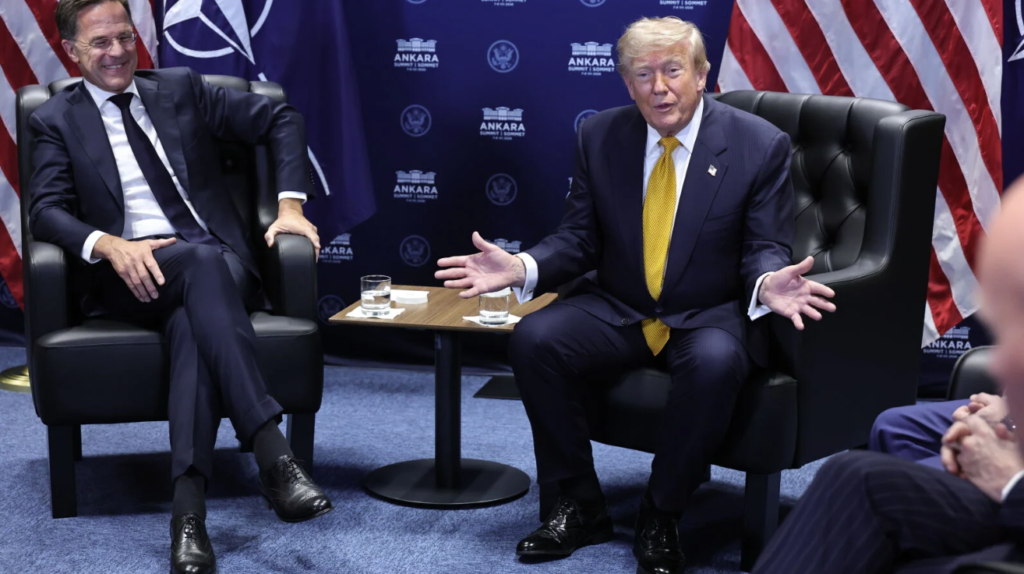
The 36th NATO summit , held on July 7 and 8 at the Bestepe Presidential Complex in Ankara, was on paper
a momentous summit at a momentous time: the first after The Hague’s commitment to invest 5% of GDP in defense, the first after the war against Iran and the Hormuz Strait crisis, the first after the Pentagon’s announcement of a six-month review of its military presence in Europe, and the first after the collapse, on June 8, of the FCAS program, the most ambitious defense project Europe has ever attempted.
Secretary General Mark Rutte presented it as the moment to “turn allied commitments into concrete results” and to unveil what he called NATO 3.0: a stronger Europe within a stronger NATO, less dependent on the United States but with the United States firmly entrenched within it. And yet, this analyst believes the outcome deserves the third adjective in the title: inconsequential conclusions. Not because the announcements were minor—some are genuinely important—but because the entire summit was designed not to resolve the Alliance’s strategic problems, but to manage the whims of a single man : a single working session of barely three hours, a compressed agenda, and a declaration agreed upon beforehand at the ambassadorial level.
Even that wasn’t enough. The figures are, it must be acknowledged, historic. Between 2016 and 2026, the European allies and Canada will have invested an additional $1.2 trillion in defense —Rutte, to flatter Washington, dubs it “Trump’s trillion”—; in 2025 alone, spending grew by 20%, some $139 billion, the largest investment effort since the end of the Cold War, and for the first time, the thirty-two allies are meeting the long-standing target of 2% of GDP.
The Alliance also confirmed €70 billion in military aid to Ukraine by 2026 , with a level “at least equivalent” in 2027. But behind the triumphant aggregate lies a three-speed NATO: the Baltic-Polish vanguard is racing ahead – Poland is approaching 4.5% and will reach 5% many years before the deadline; Estonia will reach 5.4% as early as 2026; the center and north are accelerating, with Germany reforming its constitutional debt brake to reach a base 3.5% in 2029; and the south is lagging behind or simply falling out.
Italy acknowledges it will not reach 5% and is experimenting with creative accounting methods, such as including the Messina Bridge ; the United Kingdom arrived in Ankara reeling from the resignation of its Defense Minister, John Healey, in protest against his own government’s refusal to spend more “in a time of growing threat.” And Spain, finally, proudly displays its self-imposed spending cap of 2.1%.
What was qualitatively relevant in Ankara, however, was not the money, but the “Big Reveal” of the Defense Industry Forum: for the first time in four decades, the backbone of the Alliance’s common assets will be European . NATO will negotiate with Saab the purchase of up to ten GlobalEye aircraft—around €550 million per unit, more than €5 billion in total—to replace its fourteen aging E-3A AWACS aircraft based at Geilenkirchen since 1982. The decision is the most revealing of the decade: the Alliance had chosen the Boeing E-7 Wedgetail in 2023, without a competitive bidding process, but when the Trump Administration canceled its own program in 2025, the allied plan lost its “strategic and financial basis,” and the reopened competition was won by the Swedish aircraft, with a Canadian airframe and Stockholm-built radar. Europe is starting to buy European products not out of conviction, but because Washington no longer offers either programmatic reliability or the willingness to continue subsidizing the shortcomings of others.
Along the same lines, Rutte announced the delivery of the tenth Airbus A330 MRTT tanker to the multinational fleet —with Finland as the ninth partner and a target of twelve aircraft—; the creation of a multinational A400M transport fleet involving Belgium, Croatia, France, Poland, Spain, Turkey, and the United Kingdom; the acquisition of up to five Triton maritime surveillance drones for the Far North ; and the Drone Edge anti-drone initiative. These were complemented by contracts worth approximately $50 billion: two hundred Patriot missiles for Poland, a PAC-3 missile center on Polish soil, precision munitions, and an Arctic satellite communications package.
All of this was staged, with techno music and corporate videos, hours before Donald Trump’s arrival.
And the US president derailed the script as soon as he landed. He again criticized the major European allies—he cited the United Kingdom, France, Germany, Italy, and Spain—for not supporting him in the war against Iran, including the refusal of several to authorize the use of their bases; and in front of Rutte himself, he uttered the phrase that defines his Atlantic doctrine: “We don’t need your money; we don’t need anything. I just want loyalty.”
In Ankara, he issued the ultimate threat—withdrawing “all our soldiers from Europe”—and, seated next to Erdogan, reopened the most dangerous wound: “Greenland should be under the control of the United States, not Denmark ,” because its loss, he said, “is what has damaged my relations with NATO.” Danish Prime Minister Mette Frederiksen had to demand from the summit itself that the allies respect the sovereignty of the Kingdom of Denmark.
The fact that the debate on the territorial integrity of a founding ally has become normalized within the Alliance – after a crisis in January that led the European Commissioner for Defense to warn that an invasion of Greenland “would be the end of NATO” – is, in itself, the most serious conclusion of this summit.
I’ve been describing this for months: when Trump’s foreign policy is guided by the sound judgment of Secretary of State Marco Rubio, it produces results; when it succumbs to transactional impulses, it produces scenes like those in Ankara. Demanding loyalty in wars waged without consultation is not leadership: it’s the logic of protective blackmail applied to the Washington Treaty.
Spain deserves special mention. Pedro Sánchez arrived shielded by his 2.1% commitment – “without cutting an inch from our welfare state” – and armed with data on capabilities that are real and that honor our Armed Forces: seventh-ranked ally in compliance, third in deployed personnel, and first in contribution to the eastern flank. What is not real is the political premise. The refusal to commit to the 5% target, coupled with the veto on the use of Rota and Morón during the war against Iran, has taken Spain from irrelevance to suspicion: Rutte states publicly that we will hardly meet the capability objectives with this investment and that he has “mechanisms to convince” the reluctant; the US ambassador to NATO verbalizes Trump’s “disappointment” with Madrid . A country whose reliability is questioned by both the Secretary General and the Alliance’s largest shareholder is not practicing “healthy disagreement”: it is practicing a neutrality bordering on irresponsibility, and it will pay for it in influence, industry, and security.
I want to be clear in my conclusion, even if it’s pessimistic: the money is real, and the Europeanization of common resources is a genuine step forward, but the three structural deficits that condemn Europe to dependency not only remain intact, but were exacerbated in the month leading up to the summit. The first is the inability to coordinate research, development, and industry, and it has a date and place: on June 8th, in Montenegro, Friedrich Merz and Emmanuel Macron officially declared the death of the FCAS sixth-generation fighter, a program worth around €100 billion launched in 2017, which Spain joined in 2019 through Indra. It didn’t die for technical or budgetary reasons, but because of a battle between national champions: Dassault demanded up to 80% of the work and refused to share intellectual property; Airbus refused to finance a program without oversight. Minister Robles summed it up with a harshness that I share: “The interests of industry have been put before the interests of security and defense in Europe.”
The consequences are devastating on all levels: military, because Europe will be left without its own fighter jet by 2040 while the United States develops the F-47 and China advances ; technological, because it loses the multiplier effect of the only integrating program; industrial and economic, because the market will fragment into three or more parallel programs with Lockheed Martin’s F-35 as the big winner; and in terms of strategic autonomy, because Europe will once again be a perpetual customer of the Pentagon in the most decisive capacity of the century, just when Washington is auditing how much each ally is “worth”.
The second deficiency is power projection. The multinational A400M fleet is both good news and an admission of a profound weakness: Europe completely lacks heavy strategic airlift capabilities. It has nothing comparable to the C-5 Galaxy, with its 129-ton payload, the American C-17, or the Ukrainian An-124s that the West used to charter and whose availability plummeted with the war. The A400M, with all its tactical advantages, carries 37 tons: it cannot move a Leopard 2 tank. A continent that cannot deploy its own divisions is not autonomous ; it is dependent on the capabilities of others.
And the third is anti-submarine warfare, the most inexcusable with the Russian phantom fleet in sight . The United States replaced the P-3 Orion with the P-8 Poseidon, derived from the Boeing 737, more than a decade ago, and operates more than a hundred of them; Europe presents a patchwork of deficiencies in which the few that have filled the gap –the United Kingdom, Norway, Germany– have done so by buying American aircraft, France is running out of its Atlantique 2s, and Spain, which retired its Orions in 2022, is entrusting two oceanic fronts to aircraft with far inferior capabilities.
Ankara leaves behind a European AWACS, a tenth tanker, a shared transport fleet, and fifty billion euros in contracts. And it leaves unresolved the three questions no one wanted to answer in Bestepe: who will move Europe when it needs moving, who will patrol its seas, and with what aircraft will it fight in 2045? As long as these remain unanswered, each summit will be what this one has been: momentous in its timing, solemn in its form, and inconsequential in its conclusions. Deterrence isn’t measured in press releases; it’s measured in tons of cargo, patrol hours, and flying prototypes. And in all three of these metrics, Europe remains in the red.
*Gustavo de Arístegui is a diplomat and was ambassador to India, Bhutan, Maldives, Nepal, and Sri Lanka (2012-2016) gustvodearistegui.substack.com