By Gustavo de Arístegui, as published by Vielle.
28 October 2025
Strategic Intelligence, Diplomacy, and Digital Communication
Thursday, October 16, 2025 Next Step Influence | Antidox | ESL RIVINGTON
EDITORIAL: Trump at the Knesset — The Theater of Power and the Diplomacy of Paradox
By Gustavo de Aristegui (Former Spanish diplomat and politician, graduate of Comillas Pontifical University. Served in various diplomatic roles since 1990, including Ambassador to India and Director for the Middle East during the Gulf War. Member of the Spanish Congress for the Popular Party from 2000–2012).
There are unwritten laws in politics—tectonic forces that govern allegiances. The most immutable of these is undoubtedly the gravity that attracts powers toward the pole of success. Almost everyone loves to associate with a winner, with the notable exception of irreducible enemies, the foolish, and those opportunists who, watching for the direction of the wind, always end up switching sides.
At a time when European chancelleries—from London to Paris, from Brussels to Madrid—are seeking to claim a share of a triumph whose protagonists are nevertheless obvious, it is worth remembering: the United States, under the impulse of a Donald Trump wielding a blunt diplomacy, is the true architect of this reconfiguration. It is a success that some still deny out of dogmatism and that many actors are now trying to appropriate.
Once again, Donald Trump has demonstrated that his direct language, his innate sense of spectacle, and his formidable political intuition can transform into instruments of redoubtable effectiveness. His historic intervention before the Knesset will not only be remembered for its tone or staging, but for the masterful alchemy with which he combined praise, warning, and strategic vision in a single speech. Rarely has a foreign leader uttered words so bold, charged with such symbolism and calculated clarity, at the very heart of the Israeli political reactor.
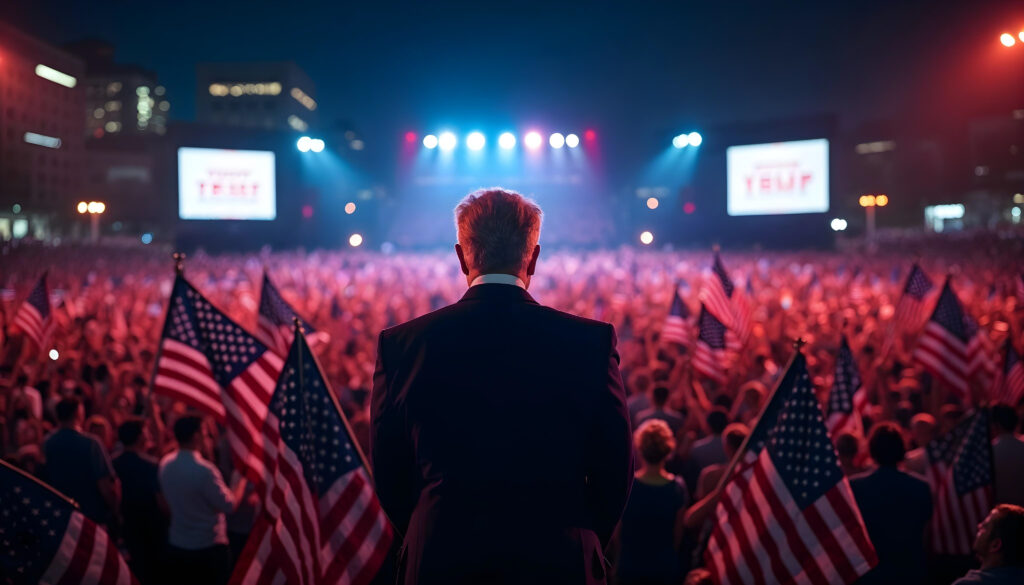
From the first moments, Trump behaved as the archetype of the figure he has patiently crafted. He is the very figure that French thinkers like Guy Debord or Jean Baudrillard could have theorized: a man for whom spectacle is not a simple tool of politics, but politics itself—a simulacrum where image and reality merge until they become indistinguishable. Appearing relaxed and aware of the gravity of the moment, he measured the profound impact each of his sentences would exert on the global chessboard. The striking image of Israeli parliamentarians applauding him with fervor—some wearing the iconic red “MAGA” hats—was not mere decorum; it was the visible manifestation of his ability to export a political mythology far beyond his borders.
Truth as a Rhetorical Weapon
Trump began his speech on a resolutely conciliatory tone, thanking Israel for “its courage and determination.” However, beneath this polished layer of adulation lay messages of considerable reach. In one of the most significant phrases, he urged Israelis to a transmutation of their genius: “If you put the same ingenuity with which you defend yourselves into creating, innovating, and building, the result would be something unprecedented.”
Such an admonition, delivered from Jerusalem, requires extraordinary political courage. It is more than advice; it is a challenge issued to the very identity of a nation built on the security imperative. As the great master of French diplomacy, Talleyrand, recalled: “Speech was given to man to disguise his thoughts.”Trump, however, inverts the axiom: he uses the most brutal frankness as the most sophisticated of masks, making his ultimate intentions perfectly opaque.
“Trump reinforces his status as a global arbiter, the only one capable of bringing the irreconcilable into dialogue.”
His audacity did not stop there. He praisefully mentioned Qatar and “other Arab states,” recognizing their role as mediators. The silence that then settled in the chamber was palpable. In doing so, Trump reinforced his status as a global arbiter, the only one capable of bridging the gap between the irreconcilable. Here, he paradoxically joins the Realpolitik tradition of Henry Kissinger, for whom “the role of the statesman is to bridge the gap between experience and vision.” Trump, in his own way, bridges this gap through the sheer force of his will and personality.
Diplomacy as a Continuation of War
In another key moment, the President extended an unexpected hand to Tehran, stating that “America’s hand is open if Iran chooses peace,” immediately after accusing the Ayatollah regime of “sowing death and destruction.” This calculated duality seems straight out of Machiavelli’s The Prince, where the sovereign is advised to know how to “use the beast and the man.” This rhetorical technique, which he masters to perfection, allows him to place himself above diplomatic orthodoxies.
His approach seems to reverse Clausewitz’s adage that war is the continuation of politics by other means. For Trump, diplomacy itself is the continuation of war by other means: a psychological, narrative, and economic war. The fact that a large part of the speech was improvised is not a detail, but the key to its effectiveness. This calculated spontaneity allowed him to navigate with disconcerting naturalness from humor to challenge, and from irony to thunderous applause.
His gesture toward the leader of the opposition, Yair Lapid (“BB, behave well with him, you are no longer at war and I like him a lot”), was a masterstroke: a call for national unity disguised as familiarity, positioning himself as the benevolent godfather of the Israeli political scene.
The Pinnacle of a Symbolic Reign
The emotional peak occurred when he called Jerusalem the “eternal and indivisible capital of the State of Israel.” But the political “climax” was reached when he publicly asked the Israeli President to consider a full pardon for Benjamin Netanyahu. At that precise moment, only half of the chamber stood up, exposing the seismic fracture running through the country.
Ultimately, as General de Gaulle observed in his War Memoirs: “True diplomacy always supposes a certain community of views between the parties. But force remains the final argument.” Trump embodies this vision where power is not a taboo, but the primary lever for reshaping reality. The spectacle, however brilliant, will still have to prove its permanence. But one thing is certain: that day in Jerusalem, Donald Trump did not just deliver a speech. He offered a performance that redefined the limits of the possible in international politics. His legacy may not be measured in treaties, but in the very reconfiguration of what we thought was the “art of the possible.”
EXPERT VIEW: New Defense Agreement between Saudi Arabia and Pakistan
By Bertrand Besancenot (Senior Advisor at ESL Rivington, former French Ambassador to Qatar and Saudi Arabia, and former Special Envoy to the Gulf for President Emmanuel Macron).
Some observers are questioning the significance and real content of the new defense agreement signed on September 17 in Riyadh between the Pakistani Prime Minister and the Saudi Crown Prince.
The details of this pact are naturally not public, but questions are being raised about its potential scope in the nuclear field. The response from Pakistani authorities is clear: Defense Minister Muhammad Asif stated that “nuclear weapons were not on the radar” of the agreement. Unofficial Saudi statements are less clear: “It is a global defensive agreement involving all military means” and “the agreement aims to develop aspects of defense cooperation between the two countries and strengthen joint deterrence.”
In reality, the announcement made on September 17 mentions neither nuclear weapons nor financial assistance to Pakistan, but the agreement stipulates that “any aggression against one of the countries will be considered an aggression against both.”
“Saudi Arabia is worried about Netanyahu’s hardline policy in the Middle East and questions the reliability of President Trump’s commitments.”
The Pakistani Prime Minister also thanked the Saudi Crown Prince for his “keen interest in developing investment, trade, and business ties.” It is clear that the Kingdom is willing to continue its financial assistance and increase economic relations with its Pakistani ally.
Naturally, this agreement is viewed with suspicion by both India and Israel. While New Delhi has developed strong economic ties with Saudi Arabia, Israel has always been wary of the Pakistani “Islamic bomb,” though it is likely aware that this specific agreement probably lacks a nuclear component. However, this does not mean that if Iran were to acquire a nuclear weapon, Saudi Arabia would not do the same—as the Crown Prince has publicly stated—and would certainly turn to its Pakistani ally for help.
Ultimately, this agreement corresponds to a reciprocal interest but also sends a clear message to Washington and Tel Aviv: Saudi Arabia is concerned about Netanyahu’s uncompromising policy and the reliability of U.S. commitments. It is therefore strengthening ties with traditional allies like Pakistan, which in turn needs Gulf aid to escape its economic impasse.
EXPERT VIEW: France Facing Petrochemical Plastic Pollution
By Kelly Leotardi (Media Relations Consultant at Comcorp, specialized in B2B and strategic communication).
As the new Ministry of Ecological Transition takes shape, plastic pollution of petroleum origin stands out in 2025 as a major ecological challenge. In France, 2.2 million tons of single-use plastic packaging are put on the market annually, but only 27% are recycled.
“Negotiations are underway, but the figures remain alarming.”
In the face of this urgency, media and local authorities are becoming engines of change.
The Media: A Powerful Lever
From television campaigns to social media, the media plays a key role. France Télévisions launched a new climate convention in October 2025 to reduce carbon emissions. Additionally, social media movements like #BeatPlasticPollution generate millions of interactions, influencing young generations and diplomatic decisions alike.
Local Authorities: Action on the Ground
Local authorities are implementing the Anti-Waste Law for a Circular Economy (AGEC), which mandates a 20% reduction in single-use plastic packaging by the end of 2025.
- Paris: Deploying a plan to eliminate single-use petrochemical plastics in food and promotional items.
- Lyon: Acting to limit plastic bottles in accordance with regulations.
These practices prove that the fight against this scourge is a collective social dynamic.