The “blockade” is not the cause of Cuba’s failure; it is the false pretext used by the dictatorship to keep some of the most dogmatic leftists worldwide from ignoring reality.
By Gustavo de Arístegui, as published by La Razón, 24 May, 2026
There is an image that brutally and eloquently encapsulates the Cuban regime: on February 24, 1996, two MiG-29 fighter jets of the Cuban communist Air Force flew over the Florida Straits and, in international waters, fired their missiles at two unarmed civilian aircraft whose crews were searching for Cuban rafters to rescue them. All four pilots died. The Cuban pilots celebrated their vile and cowardly murder with euphoric shouts in their communications. The regime presented the killing as an act of “sovereign defense.” Madeleine Albright, then the United States ambassador to the United Nations, looked up from her papers at the Security Council and uttered the most defining phrase ever spoken about the Cuban communist regime in a multilateral forum: “That is not cojones!!!” (she pronounced it “cohounes”). “It is cowardice!!!” Brilliant, forceful, and corrosive to the communist vermin. Finally, thirty years later, Raúl Castro—the cruel and corrupt tyrant who gave the order—has been formally charged with this repugnant and cowardly crime. Justice may be slow, but history must not forget.
Cuba has been governed for 67 years by a brutal communist regime (excuse the redundancy) that has turned lies into state dogma, bloody repression into daily reality, and rampant, unpunished, shameless, and institutionalized theft into its economic model. It is not a revolution that went astray, nor a so-called socialist experiment that stumbled upon adverse circumstances; it is a bestial communist dictatorship (one of the most perverse and murderous ideologies in the history of humanity, alongside Nazism and Fascism) that never intended to share power, that deliberately constructed a system of absolute control over all aspects of Cuban life, and that has spent more than six decades blaming the supposed external enemy for failures that are solely due to its incompetence, ineptitude, fanaticism, stupidity, sociopathic cruelty, corruption, theft, obsessive greed, and a psychopathic evil that is difficult to describe.
Cuba’s economic situation in 2026 is so dire that it defies any euphemism. Accumulated inflation over the past four years exceeds 500%. State salaries are equivalent to between $15 and $25 per month at the black market exchange rate, which is the only realistic rate on the island. Blackouts last up to 22 hours a day in many provinces; in October 2024, the national electrical grid collapsed completely for several days, leaving eleven million people without power. Cuba now imports more than 70% of the food it consumes. All this in a tropical country with fertile soil that in 1959 was one of the world’s largest sugar producers and exported tobacco, nickel, and agricultural resources of immense value. The destruction of that wealth was not caused by any embargo, it was caused by communism, the perverse ideology of centralized planning, forced collectivization and the structural incompetence of a regime corrupted to the core that selects its cadres by submission and/or encyclopedically ignorant fanaticism, not by ability.
While ordinary people queue for hours or even days to get half a liter of oil, corrupt officials line their pockets. The Business Administration Group SA –GAESA–, controlled by the Armed Forces of the abominable regime, is a mafia-like and kleptocratic structure that manages more than 50% of the Cuban economy: tourism, imports, exports, telecommunications, and fuel distribution. The terrorist organization of Iran’s Revolutionary Guard is an amateur in comparison, controlling only 40% of the Iranian economy. It’s the Champions League of murderous leeches. These corrupt officials are the obligatory intermediaries between Cuba and the world, and every transaction that passes through their hands leaves millions in commissions in the pockets of the regime’s top brass.
Fidel Castro, the supposed apostle of socialist equality, amassed, according to independent estimates, a personal fortune of over one billion dollars. Raúl Castro and his family controlled, through GAESA, a network of assets that included properties abroad and stakes in joint ventures with European investors, repugnant accomplices of this execrable regime. This, which in any serious democracy would be called rampant and unpunished corruption, punishable by imprisonment, in Cuba is called “the Revolution.” The obscenity of the contrast—millionaire communist leaders and a starving populace—is so repugnant that it is nauseating that this abominable regime has unconditional and sectarian followers in our democracies. I find it as shocking as it is shameful. There is not a single center or center-right party in the world that does not condemn fascism or Nazism, as well as any other form or version of the most radical right-wing extremism. It is almost impossible to find parties on the left (with the exception of some genuine social democrats) that condemn the murderous and ruthless ideology of communism in all its versions.
I cannot write about Cuba without dismantling the most profitable myth the regime has produced in its sixty-seven years in power: the U.S. “blockade.” There is no blockade. Spain, France, Germany, China, Canada, Mexico, and dozens of other countries trade freely with Cuba. The U.S. Navy does not intercept any ships bound for the island. Washington is, in fact, one of Cuba’s main food suppliers, with exports that in some years have exceeded $700 million. What exists is a partial embargo—on direct investment, tourism, and the dollar banking system—which the regime has turned into its universal alibi for not having to explain its unpunished crimes. The “blockade” is not the cause of Cuba’s failure; it is the most deceitful alibi the dictatorship has found to allow a segment of the world’s most dogmatic and fanatical left to continue willfully ignoring reality.
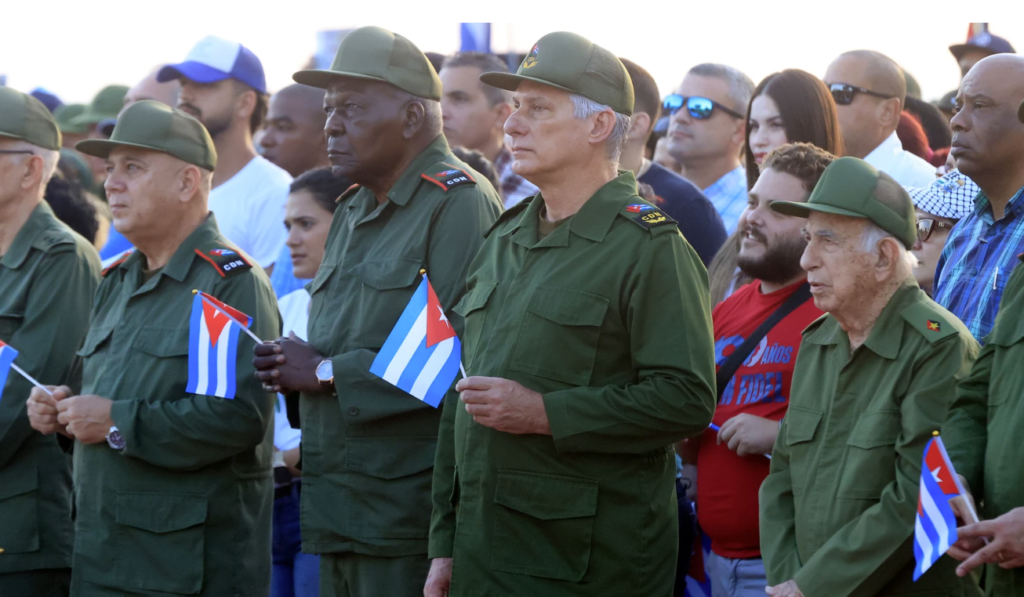
Brutal and relentless repression is the only mechanism keeping the regime alive, albeit on life support. In July 2021, thousands of Cubans spontaneously took to the streets in more than fifty towns and cities across the country, shouting “Freedom!”—the largest wave of protests since 1994. The regime responded with brutality (like its Iranian allies): plainclothes police, paramilitary shock troops, and the sinister Committees for the Defense of the Revolution crushed the demonstrators; there were hundreds of arbitrary arrests; more than 700 people were tried in summary proceedings that the European Parliament denounced as a “judicial farce,” with sentences of up to 25 years in prison simply for demonstrating in public. The message was deliberately exemplary: those who protest lose their jobs, their freedom, their families, or their lives. This is why the majority of Cubans are staunchly opposed to the regime, as evidenced by the exodus of millions of people over the past 67 years.
The regime’s crimes are not the errors of an imperfect system; they are its permanent policy. The thousands of executions in the early years, many personally overseen at La Cabaña prison by the serial killer and homophobic militant (he shot homosexuals in the back of the head) “Commander” Che Guevara, with the psychopathic coldness he himself confessed to enjoying. The “Black Spring” of 2003, taking advantage of the fact that the international spotlight was focused on the start of the Iraq War, saw the regime arrest 75 journalists, librarians, and human rights activists in a single operation. The Ladies in White, beaten and arrested every Sunday after leaving Mass for more than two decades. The record of crimes committed by this regime is so long and well-documented that its impunity, sustained for more than six decades, constitutes one of the greatest shames for the international community.
The real Cuba is a Cuba of boundless ingenuity, of creativity that flourishes even in scarcity, of joy that survives even fear. A country with such human resources, with such a geographic location—90 miles from the world’s largest economy—with such cultural and natural wealth, free from the crushing weight of communism, would undoubtedly be the leading power in the Caribbean. What the regime has stolen from Cuba is not only its present and its past, but its entire future.
The delegitimization of the communist system among the younger generation is absolute. The question is not if it will change, but when and how. In this context, the international community has a responsibility that it is failing to fulfill. Spain, in particular, has a special debt and commitment due to our deep historical, cultural, linguistic, and also economic ties, given the scale of our relations with that wonderful country.
The indictment of Raúl Castro for the murder of the Brothers to the Rescue is a surprising step in the right direction—symbolically powerful, practically limited—in a process of justice that history has yet to complete. But it is a reminder that crimes do not expire and that dictators are not eternal. Cuba will regain its freedom. Its people have everything they need to build a prosperous and free society as soon as the relentless yoke that crushes them is lifted. On that day, those in the free world who looked the other way will have to explain why. Which is, ultimately, what Madeleine Albright did that day in February 1996 when she slammed her fist on the table and denounced the cruel cowardice of the regime. And what Cubans have been doing for sixty-seven years, in their own way, every time they dare to whisper what everyone knows: that the regime is as much a thief as it is a murderer, that the Revolution is a lie, and that Cuba deserves to be free.