By Gustavo de Arístegui, as published by Negocios.
28 October 2025
1. Russia Tests the Burevestnik Nuclear Cruise Missile: A Qualitative Leap and a Strategic Message
Facts.
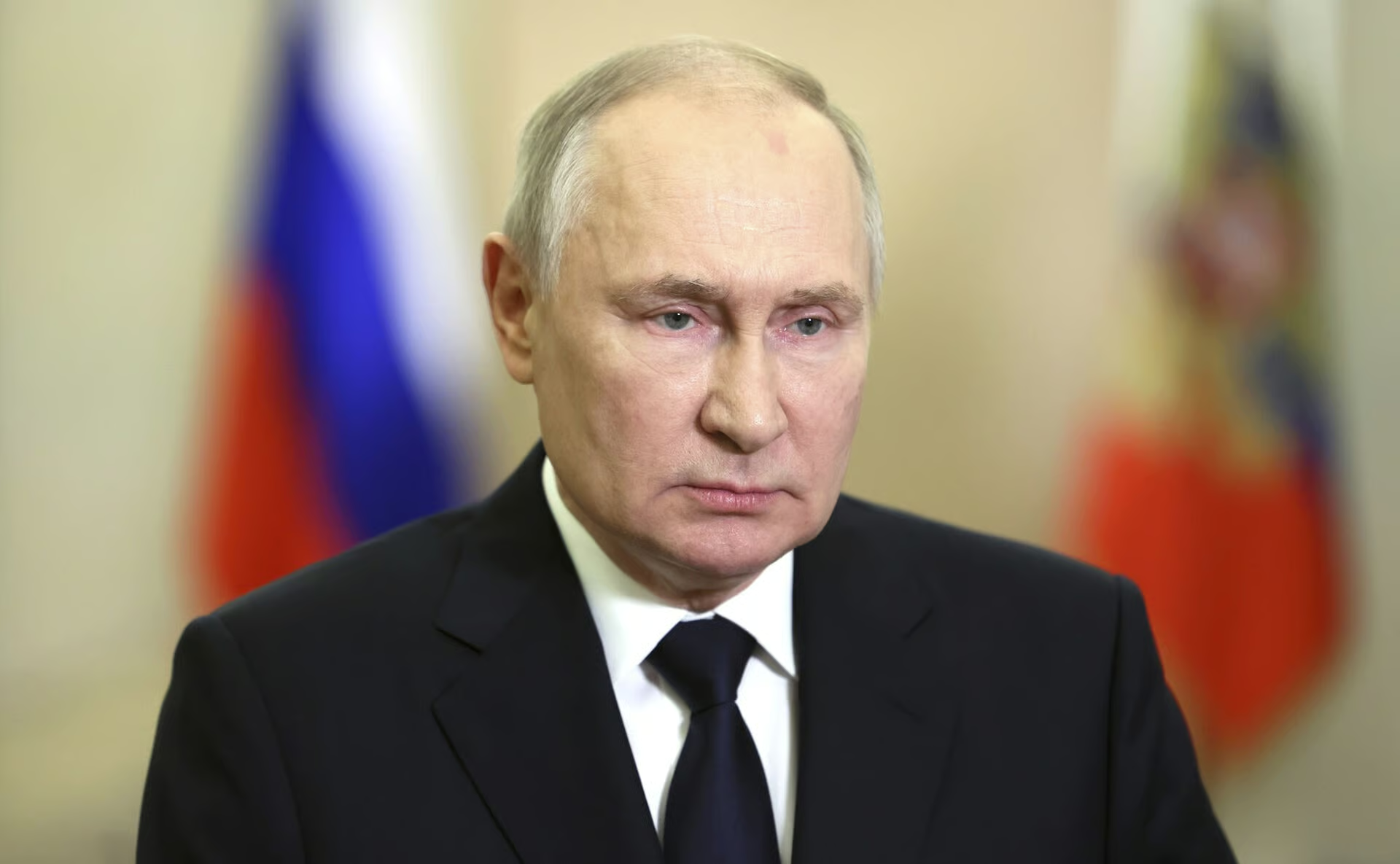
Moscow has not merely confirmed a test; it has confirmed the materialization of a nuclear doctrine long announced by Vladimir Putin. The 9M730 Burevestnik (designated by NATO as the SSC-X-9 Skyfall) is a nuclear-powered delivery system. In practical terms, this means that its power plant grants it a theoretically unlimited range, allowing it to remain airborne for days if necessary, circumnavigating the globe to strike from unexpected vectors.
Unlike an intercontinental ballistic missile (ICBM), which follows a predictable arc, the Burevestnik flies at low altitude (terrain-hugging flight), concealing itself below the radar horizon and adapting to the terrain. The choice of Novaya Zemlya, the traditional Arctic test range of the Soviet era, underscores the solemnity and seriousness of the message. The Kremlin is not improvising: it frames the test as its direct response to the collapse of the arms-control architecture (the U.S. withdrawal from the ABM Treaty and the demise of the INF) and to its perception of strategic encirclement through NATO expansion.
Implications.
We are witnessing “second-generation deterrence.” This is no longer Mutual Assured Destruction (MAD) based on calculating ballistic trajectories; it is deterrence through strategic saturation and psychological attrition.
A weapon of this nature is not, a priori, designed for a first strike, but to guarantee an undetectable second strike or to neutralize the most sophisticated air-defense systems on the planet (such as AEGIS or THAAD). It forces Pentagon planners to redefine the concept of left-of-launch (the ability to neutralize a missile before it is fired), because once the Burevestnik is airborne, tracking it is virtually impossible.
For Europe, this means that conventional early-warning systems become obsolete. This missile adds a layer of instability and “nuclear fog” that poisons any future arms-control negotiations, pushing nuclear strategy back into an era of uncertainty we believed had been overcome.
2. RSF in Sudan: Systematic Ethnic Atrocities in Darfur
Facts.
What is happening in El-Fasher, the last remaining stronghold of the regular army (SAF) in the vast Darfur region, is not conventional combat; it is an ethnic cleansing broadcast in slow motion. The Office of the UN High Commissioner employs the diplomatic euphemism “ethnically motivated atrocities.”
In practice, the Rapid Support Forces (RSF) of “Hemedti” are applying exactly the same genocidal playbook as their direct predecessors, the Janjaweed. This includes summary executions, the systematic use of rape as a weapon of war, and the deliberate siege of internally displaced persons (IDP) camps, which are shelled to force mass flight.
Implications.
We are witnessing the “Rwanda effect,” without the speed of 1994 but with the same intent. The international community is failing spectacularly. If El-Fasher falls completely, it will not only consolidate total RSF control over Darfur, but also legitimize barbarism as a valid method for seizing power.
The impact will not be local. It will generate a refugee wave of biblical proportions that will immediately destabilize Chad and Libya and, by extension, overwhelm migration routes toward the central Mediterranean. The Sahel is a powder keg, and Sudan is the lit fuse. Tolerating Hemedti is not pragmatism; it is complicity in a mass crime that is redrawing the map of terror in the Horn of Africa.
3. Trump’s Asia Tour: “Golden Age” with Japan and a Rare-Earths Pact
Facts.
The meeting between Donald Trump and Prime Minister Sanae Takaichi in Tokyo is far more than a protocol photograph; it represents the consolidation of the most robust axis in the Indo-Pacific. Takaichi, known for her firmness on defense (a “hawk” in strategic jargon), has found in Trump the ideal partner to accelerate the revision of Article 9 of Japan’s pacifist constitution.
The signed document is not a vague memorandum. It is a supply-chain assurance pact for rare earths (RE) and critical minerals. This is not merely trade; it is a direct strike against Beijing’s de facto monopoly over these elements, which are vital to the entire technology and defense industries.
Implications.
Washington is executing a surgical de-risking strategy. By hardening this technological and mineral alliance with Tokyo, Trump sends an unequivocal message to Xi Jinping ahead of their imminent summit: the Indo-Pacific is not a bargaining chip.
If this new “Critical Minerals Axis” expands to formally include South Korea (for its technological capacity) and Australia (for its vast extractive resources), China’s capacity for economic coercion will be drastically reduced.
For Europe, this is an urgent wake-up call. Either it moves swiftly to integrate itself into this new friend-shoringarchitecture as a top-tier technological partner (consider ASML in the Netherlands), or it risks being irreversibly relegated to a mere consumer market, irrelevant in the great battle over semiconductors, batteries, and permanent magnets of the 21st century.
4. Côte d’Ivoire: Ouattara Secures a Fourth Term; Cameroon: Biya Renews His Grip on Power
Facts.
What we have witnessed in both Côte d’Ivoire and Cameroon is the chronicle of a democratic farce foretold. In Abidjan, Alassane Ouattara secures a fourth term with a result (89.77%) reminiscent of Soviet-era voting, achieved only after disqualifying, exiling, or imprisoning his main rivals, such as Laurent Gbagbo and Guillaume Soro.
Meanwhile, in Yaoundé, Paul Biya, aged 92 and in power for nearly half a century, is proclaimed the winner with 53.66% in a process riddled with allegations of fraud and violence, particularly in the conflict-ridden Anglophone regions.
Implications.
This is not stability; it is “authoritarian stability,” which by definition is merely postponed fragility. By sealing off all democratic escape valves and shutting down any path to peaceful alternation, these gerontocratic regimes are incubating their own destruction.
The alienation of an overwhelmingly young population (the median age in Cameroon barely exceeds 18), which sees neither future nor representation, creates the perfect breeding ground for jihadist extremism already devouring the Sahel. For the European Union, continuing to finance these regimes in exchange for fictitious migration control is a grave strategic error. Political conditionality (linking aid and cooperation to genuine reforms) is not a neo-colonial option; it is the only realistic policy to prevent West Africa from becoming a permanent source of instability on Europe’s doorstep.
5. Argentina: The “Milei Moment” After the Midterms – Reforms, Markets, and Governability
Facts.
The ruling coalition’s decisive victory in the midterm legislative elections is not a simple blank check for Javier Milei; it is popular ratification of his “shock therapy.” Markets, which understand confidence rather than ideology, reacted instantly: Argentine sovereign bonds surged, country risk collapsed, and the peso appreciated significantly.
Wall Street interprets this result as the definitive green light to advance the most liberal reform agenda in Argentina’s recent history: massive deregulation, an ambitious privatization program of loss-making state-owned enterprises, and above all, the consolidation of ironclad fiscal discipline.
Implications.
Milei has moved from the “chainsaw” (the symbol of his campaign) to the legislative scalpel. The real battle now begins: converting immense accumulated political capital into durable laws. If he succeeds in passing a strengthened version of his DNU (Decree of Necessity and Urgency) through Congress and uses a parliamentary fast-track, Argentina has a real opportunity—perhaps the last in a generation—to break the curse of chronic hyperinflation.
However, the risk is enormous. The real economy is not a spreadsheet. Without a solid federal pact with provincial governors (many of them Peronists), and without effective social buffers to protect the most vulnerable during adjustment, the economic shock will inevitably collide with street-level reality. Governability will be tested.
6. Stock-Market Rally on Clay Feet: Mega-Cap Volatility Exposes Fragility
Facts.
The Financial Times highlights a deeply unsettling reality: the current bull market (rally) rests on foundations of clay. We are witnessing daily swings in the aggregate valuation of large technology firms (“Mega-caps” or the “Magnificent Seven”) on the order of USD 100 billion.
This is not healthy volatility driven by price discovery. It is the symptom of a feverish market, hypertrophied by extreme options leverage (especially 0DTE, same-day-expiry options) and an unprecedented concentration of capital in a handful of ETFs that replicate these giants.
Implications.
The underlying market message is clear: liquidity is fragmented and investor positioning is extreme. In other words, everyone is on the same side of the boat. The mantra that “everything goes up” has created dangerous complacency.
With central banks virtually out of ammunition (interest rates remain restrictive) and corporate earnings under microscopic scrutiny, any quarterly earnings disappointment could trigger a cascading correction—a flash crash. The recommendation for any prudent investor is not panic, but tactical humility: take hedges (puts), increase cash positions (liquidity), and seek genuine diversification, not cosmetic diversification.
6. Hurricane Melissa: Imminent Historic Impact on Jamaica and a Regional Threat
Facts.
Melissa is not just another hurricane in the season. It is a Category 5 “monster,” the most powerful cyclone ever recorded, threatening a direct hit on Jamaica. We are talking about sustained winds approaching 280 km/h (175 mph), an absolute destructive force.
Mass emergency evacuations affect not only Jamaica; eastern Cuba (Santiago, Guantánamo) is on maximum alert, as are Haiti and the Bahamas. Fatalities have already been reported as it passed over smaller Caribbean islands.
Implications.
The hurricane season has entered a new dimension of intensity, a clear geopolitical risk multiplier. The immediate impact is humanitarian, but the geostrategic consequences are severe.
The entire Caribbean arc is a critical logistical hub for global trade. Key ports (Kingston, Havana, Mariel), oil refineries, and shipping routes feeding the Panama Canal could be paralyzed for weeks. This will generate immediate supply-chain disruption. Insurance and reinsurance markets (led by Lloyd’s of London) will suffer multi-billion-dollar losses. For Europe, the risk is indirect but real: it will affect global prices of soft commodities such as sugar, coffee, and bananas, and complicate Atlantic logistics.
6. Run-Up to the Trump–Xi Summit: Risk Reallocation in the Indo-Pacific
Facts.
Donald Trump’s Asian tour is, in reality, a meticulous preparation of the ground for his face-to-face meeting with Xi Jinping. After locking in the “economic security” and critical-minerals pact with Japan, the White House has established its red lines.
The Financial Times poses the defining question of the summit: will Trump’s tariff protectionism (“America First”) force Southeast Asian nations (ASEAN) to fall definitively into Beijing’s arms?
Implications.
Trump is playing a complex double game. If his policy combines high tariffs (protectionism) with smart, well-financed friend-shoring (strategic relocation of value chains), ASEAN countries (such as Vietnam, Malaysia, or Indonesia) will be able to diversify risk and balance Chinese influence.
But if these nations perceive only punitive tariffs without a credible alternative of U.S. investment, they will have no choice but to pivot toward Chinese capital and China’s vast market.
Europe stands at a dangerous crossroads. It must move with diplomatic and economic agility, sealing mid-scale investment deals with ASEAN and South Korea, and offering attractive fiscal windows for chip and battery production on European soil. Otherwise, it will lose the Indo-Pacific technological race, and its strategic irrelevance will become a fact.
Media Rack (Curated Sample by Outlet and Focus)
- Global agencies & reference: Reuters (Burevestnik; Japan tour; rare earths; Norway) · AP (Hurricane Melissa; Argentine midterms) · RFI (RSF/El-Fasher; Côte d’Ivoire elections)
- Business press: Financial Times (rally fragility; Indo-Pacific coverage; U.S.–Japan “golden age”)
- European general press: The Guardian (Biya and protest context)
- Video & live: Reuters Live (Trump agenda in Tokyo; North Korean abductees)
Trends:
- Technological re-militarization (critical minerals, de-risking);
- African authoritarianism with electoral varnish;
- Extreme climate as a risk multiplier;
- Nuclear geostrategy returning to the hard agenda.
Media Analysis
This summary analyzes coverage across the 90 listed outlets on the day’s key news, based on the provided sources and searches conducted. I focus on topics such as Russia’s Burevestnik missile test, atrocities in Sudan, Trump’s trip to Japan, elections in Cameroon and Côte d’Ivoire, Milei’s next steps in Argentina, hidden market volatility, the geopolitical consequences of hurricanes like Melissa, and an additional relevant story: the U.S.–Japan rare-earths agreement.
The analysis reveals a pattern of polarized coverage: Western media criticize Russian escalation and highlight Trump’s role in Latin America, while Russian media defend defensive actions and minimize impacts. Arab media emphasize the humanitarian crisis in Sudan, and Asian outlets prioritize the economic implications of Trump’s tariffs. This committed approach underscores how Trump’s isolationism strengthens autocrats but weakens democratic alliances, demanding a balanced global response to prevent greater instability.
Risk Traffic Light
| Risk | Level | Horizon | Executive Comment |
| Tactical/accidental nuclear escalation (Russia–NATO) | Red | Immediate–3 months | Burevestnik raises unpredictability and pressure on radar/defenses; deterrence and de-confliction channels must be reinforced. |
| Genocidal drift in Sudan/El-Fasher | Red | Immediate | Ethnically biased atrocities; without international coercion, violence may spill over into Darfur and the western Sahel. |
| Caribbean/Atlantic logistical disruption due to Melissa | High Amber | 1–4 weeks | Risk to refining, ports, and insurance; impact on soft commodities. |
| Systemic mega-cap volatility | Amber | 2–6 weeks | Options-gamma exposure and index concentration elevate risk of sharp correction. |
| U.S.–China tension in the Indo-Pacific | Amber | 1–3 months | U.S.–Japan critical-minerals pact strains geoeconomics; tone of Trump–Xi meeting is key. |
| Political instability in West Africa (CI/Cameroon) | Amber | 1–6 months | Continuity without reform fuels alienation and episodic violence risk. |
| Social risk in Argentina from reform shock | Amber | 1–6 months | Economic success requires political pacts and safety nets; otherwise, protest and gridlock. |
| Critical-minerals supply chains | Green-Amber | 6–12 months | Window of opportunity for “friend” alliances if Europe moves quickly. |