Gustavo de Arístegui,
June 16, 2026
I. INTRODUCTION
There are days that are heralded as an end but turn out to be little more than a respite. Today is one of them. While markets around the world uncork relief —Tokyo’s Nikkei up nearly five percent, European gas prices easing, and crude oil retreating— it’s worth remembering, without spoiling the party but also without joining in the euphoria, that peace has not yet been signed between Washington and Tehran: a memorandum of understanding (a preliminary agreement) has been signed, extending the truce for sixty days and promising to reopen the Strait of Hormuz. It’s a lot, and it’s nothing. It’s the agreement that doesn’t yet exist.
I’ve decided to change the opening and tone of this report today because the news demands it: we’re not facing a fait accompli, but a promise with an expiration date . The backdrop is a world moving at several speeds simultaneously—the diplomacy of Lake Geneva, the bombs over Kyiv, Beijing’s shadowy pressure in the South China Sea, and the silent burial of the European fighter jet project of the future—and it’s my duty to read it all, without the naiveté of the optimist or the glee of the doomsayer. I will attempt, as always, with rigor and without bias.
II. THE MOST IMPORTANT NEWS OF THE LAST 24 HOURS
1. The agreement that (still) doesn’t exist: the US-Iran memorandum and the reopening of Hormuz
Facts
President Donald Trump announced on June 14 that a ceasefire agreement had been reached with Iran and that navigation through the Strait of Hormuz would reopen, a fact confirmed by Iranian Deputy Foreign Minister Kazem Garibabadi. The agreement is not a treaty, but a memorandum of understanding (preliminary framework agreement) that extends the existing truce for sixty days, reopens the Strait of Hormuz, lifts the US naval blockade, and ends related hostilities in Lebanon. The formal signing is scheduled for June 19 in Switzerland, with Pakistan and the Sultanate of Oman acting as mediators.
The crucial point, however, is what the memorandum postpones: limits on uranium enrichment, the fate of highly enriched uranium (HEU) stockpiles, sanctions relief, and the release of frozen assets are all left for later negotiations. The regime continues to enrich uranium to sixty percent and has not readmitted inspectors from the International Atomic Energy Agency (IAEA), whose Director General, Rafael Grossi, has bluntly warned that any agreement without verification will be “an illusion of an agreement.” It is important not to forget the origin of all this: the attacks of February 28 decapitated the regime’s leadership and killed the inexplicably named “supreme leader.”
Implications
Here, the paradox of decapitation operates with full force : the surviving hawks of the Revolutionary Guard triumvirate—Vahidi, Zolghadr, and Rezaei—lack the rank, ideological authority, and personality necessary to impose their will on their peers and force the acceptance of such painful concessions. The deceased leader could enforce internal discipline; this triumvirate are equals without arbiter. Therefore, the signature of a jihadist, dictatorial, and mafia-like oligarchy on a memorandum does not equate to its fulfillment: it amounts, at best, to buying time. We are, it must be said clearly, facing a contained systemic fracture : the regime is not imploding, but neither is it governing its own surrender.
Perspectives and scenarios
Scenario A (35%): The agreement is signed on June 19th, and implementation progresses gradually, with Anglo-French demining and the effective reopening of the Strait of Hormuz within weeks. Scenario B (40%): The memorandum is signed, but compliance is bogged down by technicalities and postponements; the regime gains breathing room without relinquishing its core principles. Scenario C (25%): Relapse and resumption of hostilities, as already occurred on June 11th, with a renewed closure of the Strait. The sum is deliberate: the forty percent for the intermediate scenario reflects my conviction that Tehran will sign whatever it takes to survive and then bargain away every clause.
2. The G7 in Évian: applause for Trump and a reflection of European impotence
Facts
The G7 summit is being held from June 15 to 17 in Évian-les-Bains, under the French presidency. It is the first in-person G7 meeting since the start of the Iran-Contra conflict, which is now entering its fifteenth week. President Macron greeted Trump with explicit praise: the agreement with Iran, he said, is “a very important step for peace throughout the world.” Washington, for its part, criticized the four European leaders of the Atlantic Alliance for their lack of support during the conflict, while it was leaked that the United Kingdom and France might contribute ships to the demining efforts and the reopening of the Strait of Hormuz. Trump reiterated his position that expelling Russia from the former G8 was a mistake.
The guest list commands its own headline: alongside Brazil, India, Kenya, and South Korea, Macron has invited Syrian President Ahmed al-Sharaa—a name that, not so long ago, appeared on very different lists. The host, who will leave the Élysée Palace next year, is facing his last summit and taking the opportunity to promote his preferred idea of European strategic autonomy, with artificial intelligence on the agenda and Sam Altman invited to the debate. Trump will extend his stay with a dinner with Macron at Versailles on Wednesday.
Implications
The scene is telling and, for a committed European, painful. Europe celebrates an agreement it didn’t negotiate, on a crisis it doesn’t control, and offers as its contribution a handful of minesweepers. It’s the perfect portrait of a mediocre and short-sighted 21st-century political class, incapable of taking its own defense, security, and destiny seriously. Macron’s “strategic autonomy,” in its swan song, sounds more like a slogan than a program. And al-Sharaa’s presence in the family photo—however much realpolitik may have its reasons—demands vigilance: the normalization of those who yesterday championed jihadism cannot be done without remembering or without conditions.
Perspectives and scenarios
Scenario A (50%): a minimal statement, managed friction, and a photo op of unity lacking substance. Scenario B (30%): an open clash over tariffs or Russia that overshadows the summit and reopens the transatlantic wound. Scenario C (20%): concrete progress—a European naval force in Hormuz, a verifiable commitment to defense spending—that would finally give some substance to the rhetoric.
3. While the G7 calls for peace, kyiv burns
Facts
In the early hours of June 14-15, Russia launched one of its largest combined attacks on Kyiv. The provisional toll stands at around 30 casualties, four of them fatal, with damage to the building of the Higher Anti-Corruption Court in the capital. Ukrainian air defenses neutralized some 50 missiles and nearly 600 drones; a Patriot battery reportedly shot down a Russian Zircon missile during the offensive. In the last 24 hours, more than 200 combat engagements have been recorded along the front. The war, now in its fifth year, shows no signs of abating, and Kyiv is escalating its long-range attacks against Russian territory.
Implications
The contrast is stark and must be denounced without euphemism: while in Évian they toast to peace, Moscow bombs hospitals, homes, and—with sinister symbolism—an anti-corruption court. We are, and always have been, staunchly opposed to Russian aggression and the use of force as a means of acquiring territory. And we return to the same crux of the matter: a Europe that is incapable of providing itself with self-defense will hardly be able to support Ukraine the day Washington moderates its commitment. The war in Ukraine is also the test that Europe has been failing for years.
Perspectives and scenarios
Scenario A (55%): The war of attrition continues without substantial change on the front. Scenario B (25%): The G7’s diplomatic push, with personal pressure from Trump, opens a negotiating framework that does not currently exist. Scenario C (20%): Vertical escalation, with more far-reaching attacks and an increasingly severe Russian response.
4. The geoeconomics of relief: crude oil eases and Asian stock markets celebrate
Facts
The market reaction to the agreement announcement was immediate and euphoric. Tokyo’s Nikkei surged around 5 percent, South Korea’s Kospi climbed over 5.2 percent, and the Shenzhen index rose more than 3 percent. US futures pointed to a decidedly bullish open—the S&P 500 up around 1.3 percent and the Nasdaq near 1.9 percent—while European gas fell by about 7 percent. The geopolitical risk premium that had kept energy prices under pressure during the conflict suddenly deflated.
Implications
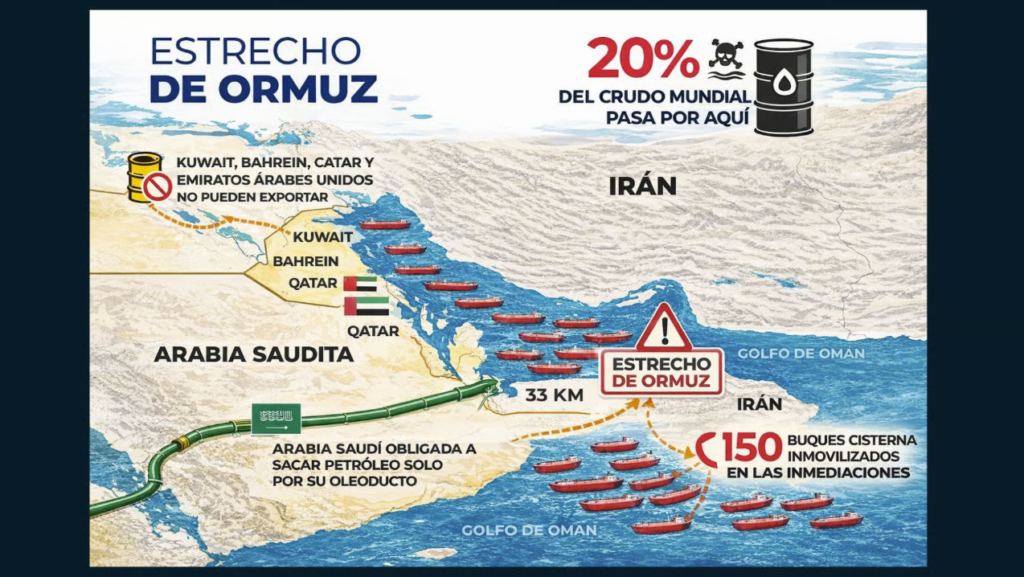
The market is pricing in a peace agreement that hasn’t even been signed yet: it’s a textbook case of wishful thinking . The real protagonist isn’t the agreement itself, but the risk premium: around 20 percent of the world’s crude oil passes through the Strait of Hormuz, and a single relapse could turn that 7 percent relief in gas prices into a sharp increase. The relief is real, but fragile; it’s best to enjoy it with a firm grip. Today’s renewed optimism could become tomorrow’s correction if the memorandum of the 19th remains just a dead letter.
Perspectives and scenarios
Scenario A (40%): Relief is consolidated if the signing on the 19th materializes and the Strait of Hormuz reopens in an orderly manner. Scenario B (35%): Market correction in the event of non-compliance with or postponement of the memorandum. Scenario C (25%): Sharp increase in the risk premium—and in crude oil—in the event of renewed hostilities in the Gulf.
5. Beijing strains the South China Sea: gray pressure on Pratas
Facts
Taiwan has reported for the first time the presence of mainland Chinese law enforcement vessels near the Pratas Islands (Dongsha), which it controls. Several experts warn that this deployment could lay the groundwork for de facto “effective control” by Beijing over these waters. The move follows Chinese accusations of inaction against Taiwan’s ruling party regarding maritime boundary talks between Japan and the Philippines, which affect exclusive economic zones claimed by both Beijing and Taipei. It is another link in a sustained pattern of pressure involving coast guard and “research” vessels.
Implications
We have said it repeatedly: we must be very vigilant regarding Chinese expansionism in Asia, the South China Sea, the Pacific, Africa, and Latin America, as well as its ambition to control strategic raw materials and rare earth elements. The tactic is the same as always—the “salami” of gray pressure, slice by slice, below the threshold of open conflict—and it is being executed precisely when the world is looking towards Hormuz and Kyiv. We are facing a systemic rivalry between an established power and a rising one with incompatible models—not a second Cold War—and the logic of “small garden and high fence” demands that we not neglect either fence.
Perspectives and scenarios
Scenario A (60%): Continued gray pressure without a kinetic incident. Scenario B (25%): Incident between coast guards with controlled escalation and diplomatic reaction. Scenario C (15%): Major crisis, with a quarantine or partial blockade that internationalizes the dispute.
6. European strategic autonomy, a slogan without muscle: the shadow of the FCAS on Évian
Facts
France and Germany officially ended their Future Combat Air System (FCAS) program on June 8th. This sixth-generation fighter jet was to be developed jointly with Spain. The project, valued at over €100 billion and launched in 2017, collapsed due to an irreconcilable dispute between Dassault Aviation and Airbus Germany over who would lead the aircraft’s development. The issue now looms like a ghost over the G7’s debate on strategic autonomy. Meanwhile, the UK, Italy, and Japan are advancing their rival GCAP program, the US is accelerating its F-47 development, and China has flown not one, but two sixth-generation prototypes.
Implications
There is no more accurate metaphor for European impotence. In the same week that Évian turns strategic autonomy into a mantra, Europe has just buried its most ambitious defense project due to a war of industrial egos over the division of labor. While Washington, London, Rome, Tokyo, and Beijing are building the fighter jet of the future, Paris, Berlin, and Madrid are arguing over who will put in the screws. The price of disunity is being paid in sovereignty: France is flirting with a national program—an evolved Rafale—and Airbus is sounding out Sweden’s Saab. Spain, caught in the middle, watches its seat at the table of high-tech military development evaporate. It is, in a word, a strategic disgrace.
Perspectives and scenarios
Scenario A (50%): Fragmentation—France going it alone, Germany and Spain gravitating towards GCAP or Saab. Scenario B (30%): Partial rescue, salvaging the “combat cloud” and accompanying drones. Scenario C (20%): Unlikely political reactivation of the trilateral program in its original format.
III. MEDIA RACK
How the world’s major newspapers have framed the key events of the day —the memorandum with Iran, the G7 in Évian, the attack on kyiv and the Chinese pressure—:
The New York Times. It underlines the preliminary nature of the agreement and the long list of nuclear issues that remain unresolved after the announced signing.
The Washington Post focuses on the G7 choreography and European discomfort with a Trump who demands gratitude for an agreement he single-handedly negotiated.
The Wall Street Journal. Read the day’s market highlights: energy risk premium plunges and stock market rally follows the reopening of the Strait of Hormuz.
Financial Times warns of the fragility of the memorandum and that the real negotiation—enrichment and sanctions—has not even begun.
The Times (London). Highlights the potential British naval contribution to the demining of the Strait as a gesture of Atlantic significance.
The Daily Telegraph. It emphasizes Trump’s rebuke of Europeans for their tepid response during the conflict.
The Guardian. Critical of the euphoria: it reminds us that the Iranian regime still refuses to readmit IAEA inspectors.
Le Monde frames Évian as Macron’s last major international stage and his waning commitment to strategic autonomy.
Le Figaro. It highlights the Versailles dinner and the erosion of Franco-German cooperation after the collapse of the FCAS.
Frankfurter Allgemeine (FAZ). Analyzes the German industrial cost of the end of the European fighter jet and the drift towards national programs.
Die Welt. It links the FCAS fiasco to the urgent need to rearm the Bundeswehr in a hostile environment.
Corriere della Sera. It sees the GCAP as a lifeline for a fractured European industry.
BBC. Sober coverage of the memorandum, emphasizing its conditional nature and the sixty-day extension.
CNN. Headlines with market relief, but tempers analysts’ skepticism about Iranian compliance.
Fox News presents the agreement as a personal diplomatic triumph for President Trump.
Al Jazeera. It focuses the story on the mediation between Pakistan and Oman and the reopening of Hormuz.
Al-Arabiya. It addresses the regional impact and the caution of the Gulf monarchies towards a weakened but not surrendered Tehran.
Asharq al-Awsat. It highlights the Saudi and Omani roles in the architecture of the truce.
The Jerusalem Post insists that without IAEA verification, any agreement is a dangerous concession to the jihadist oligarchy.
Reuters. Fact report: Truce extended, signing scheduled for the 19th in Switzerland, and issues postponed.
Associated Press (AP). Confirms the Swiss meeting and mediation, with caution regarding the true scope of the agreement.
Agence France-Presse (AFP). Macron’s praise of Trump and the AI agenda in Évian stands out.
South China Morning Post. Documents the entry of Chinese vessels near Pratas as a possible base for effective de facto control.
China Daily frames the pressure on Taiwan in terms of sovereignty and a “routine mission,” denying any escalation.
The Times of India highlights Modi’s presence as a guest and India’s interest in Gulf stability and oil prices.
The Kyiv Independent details the massive attack on Kyiv and the symbolism of its impact on the Anti-Corruption Court.
The Economist. It puts the day in context: a tactical relief that does not alter the structural flaws of the international system.
IV. RISK TRAFFIC LIGHT
| Risk vector | Level | Headline with sound judgment |
|---|---|---|
| Iran · Gulf · Hormuz | 🟠 | Extended truce and unsigned memorandum: conditional relief, not peace. |
| Iran’s terrorist regime | 🟠 | Headless and without an internal referee; signature yes, compliance yet to be seen. |
| Lebanon · Hezbollah and proxies | 🟡 | Cessation of related hostilities, but the terrorists have not disarmed. |
| Russia–Ukraine | 🔴 | Massive attack on kyiv as the G7 toasts to peace. |
| China–Taiwan · South China Sea | 🟠 | Gray pressure on Pratas: effective control through the back door. |
| European defense · FCAS | 🟠 | With the European fighter jet buried, strategic autonomy remains just a slogan. |
| Transatlantic · G7 | 🟡 | Trump collects the toll of gratitude; Europe, a guest on its own continent. |
| Venezuela · Caribbean | 🟡 | Mafia regime in limbo after Maduro’s fall; transition without direction. |
| Energy Markets | 🟢 | The risk premium has deflated; real but reversible relief. |
Legend: 🔴 high risk · 🟠 elevated risk · 🟡 moderate risk · 🟢 low risk / distension.
V. EDITORIAL COMMENTARY
Let the reader take away one idea above all others: nothing has ended today; today time has been bought. And time, in the hands of a jihadist, dictatorial, and mafia-like oligarchy, is not a neutral commodity, but a weapon. The memorandum of June 19 could be the first brick in a lasting peace or the umpteenth ploy of a regime that, leaderless and without a mediator, will sign anything to survive and then haggle over every comma. The difference between one scenario and the other will not be decided by the markets or the Évian communiqués, but by verification—that word that Grossi so aptly uttered—and the political will to enforce it.
We support, as we have stated unequivocally, the attacks that brought Tehran’s terrorist machine to its knees; we criticize with equal firmness the lack of a plan for the aftermath, which is the chronic ailment of this diplomacy of hunches and outbursts. When President Trump acts prudently and heeds the wisdom of someone like Marco Rubio, he achieves success; when he improvises to the point of excess, he sows uncertainty. Let us hope that the system and the level-headedness of those around him will ultimately prevail, also in Hormuz.
And meanwhile, Europe. Europe, celebrating others’ agreements while burying its own; turning strategic autonomy into a ritual while burning the FCAS over a squabble of industrial turf; offering minesweepers where resolve is needed. Drones and missiles rain down on Kyiv, and in the South China Sea, Beijing advances slice by slice, taking advantage of the world’s indifference. We are Atlanticists at heart and staunch Europeans precisely because we refuse to accept this mediocrity. Today’s relief is welcome; complacency, never. The rest—verification, rearmament, unity—remains an unfinished task, and that task brooks no further postponement.