Gustavo de Arístegui,
June 18, 2026
I. INTRODUCTION
Today I break with the usual format of five or six news items to devote the entire report to a single file, because a single file deserves it: the Memorandum of Understanding (MOU) that the United States and the Islamic Republic of Iran signed electronically this week—the one already known as the “Islamabad Memorandum”—and, within it, the clause that Washington least wants to publicize and which, nevertheless, contains the most serious concession made to Tehran in a generation: the Strait of Hormuz.
I wrote this just five days ago in my weekly column in La Razón: “The Agreement That Doesn’t Yet Exist,” and forgive the self-quotation, because reality has just proven me right with a speed as unsettling as it is revealing. I argued then that celebrating this as peace was, quite simply, wishful thinking (unforgivable in politics and lethal in geopolitics) that has undermined every previous Western approach to the Iranian regime. I warned that “reopening” the Strait of Hormuz did not constitute a binding and enforceable guarantee of free and safe passage, and that the text left the door ajar for Tehran to impose tolls, fees, or “inspection charges” on ships in transit. Well, in just five days, the regime itself has confirmed my worst prediction.
The spokesman for the Iranian Foreign Ministry, Esmaeil Baghaei, has declared—without a hint of embarrassment—that Iran will establish, together with the Sultanate of Oman (which, since the death of the wise and prudent Sultan Qaboo, has lost its way), a new regime to “administer” the strait and will charge “service fees” to navigation. What they were selling as the reopening of Hormuz is, in reality, the inauguration of a “Strait Authority” that will collect tolls from half the planet. This analyst does not consider this a technical detail: I believe it is the crux of the entire agreement, and that Western public opinion, hypnotized by the word “peace,” has not yet grasped that the terrorist regime of Iran has been handed a weapon of economic coercion more versatile, more reusable, and ultimately more dangerous than any nuclear warhead.
This monograph rests on three mutually reinforcing pillars: my own prior analysis of the memorandum; the essay by historian Niall Ferguson in The Times of London on June 6, whose insightful conclusions I share; and the thesis, which I adopt and expand upon, that the West—through its lack of coordination, courage, and capacity for sacrifice—has handed Tehran de facto control over Hormuz. I will state it with the forcefulness that the moment demands: we are not witnessing the end of a war, but rather the acceptance and institutionalization of blackmail.
II. MONOGRAPHIC ANALYSIS: THE ISLAMABAD MEMORANDUM AND THE SURRENDER OF HORMOUZ
Facts
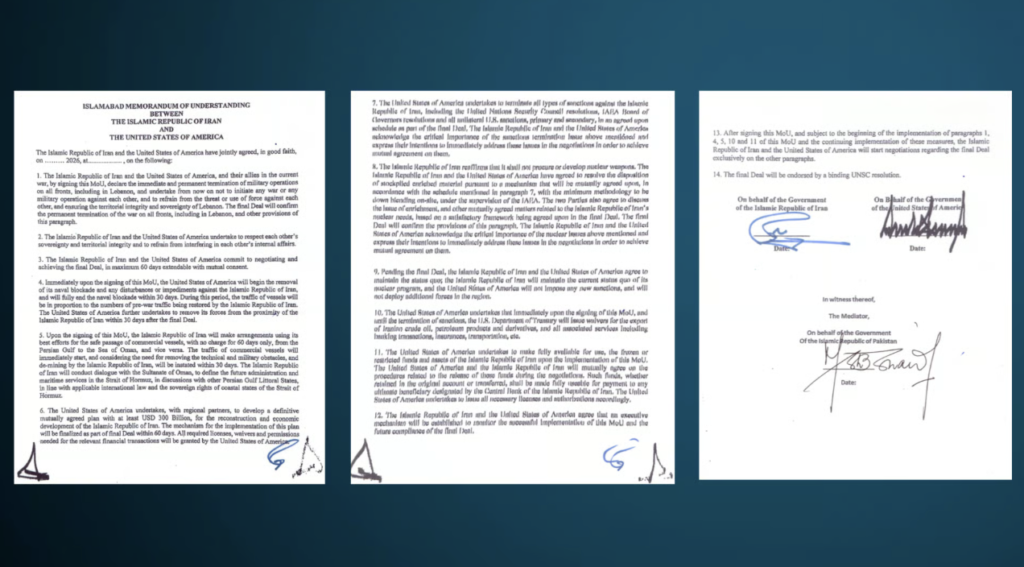
It is important to first establish, with clinical detachment, what we know for certain this morning, separating fact from propaganda. The memorandum has been electronically signed by both presidents: President Trump signed it in Versailles, on the sidelines of the G-7 summit held in France, while Iranian President Masoud Pezeshkian displayed the document before state television cameras. The sinister spokesman for the Iranian Foreign Ministry, Esmail Baghaei, summarized it with a phrase that should chill the blood of optimists: the text “has been finalized with the presidents’ signatures; now it’s time to test its implementation.” In other words: there is no agreement yet, only a commitment to begin negotiating the agreement.
It is a fourteen-point memorandum that fits on a single page and, by its very nature, is not a final agreement: it will only become an “agreement”—if it ever does—at the end of a sixty-day negotiation period, and both sides retain the right to walk away from the table until then. The formal signing ceremony was scheduled for Friday, June 19, in Switzerland, but it will not take place. I suppose the American side neither can nor wants to boast too much in light of the disturbing consequences that dozens of analysts are drawing from this disastrous agreement. The text was negotiated by special envoys Steve Witkoff and Jared Kushner, sending messages through Pakistan—which has not been a negotiator at all, merely a “messenger,” and which considers it “closed”—and the Emirate of Qatar, which continues to refine it with both sides to try to prevent the important negotiations that begin on Saturday, June 20, from derailing.
The austere US version promises: immediate sanctions waivers for Iranian crude oil exports; the release of funds frozen during negotiations; a reconstruction fund of at least three hundred billion dollars contributed by “regional partners”; Iran’s commitment never to pursue nuclear weapons; a reinforced inspection regime with surprise inspections; discussion of a ban on underground facilities and the removal of highly enriched uranium from the country—with the option, it is said, of transferring it to the United States; and the “immediate” opening of the Strait of Hormuz, “toll-free for sixty days.”
The Iranian version is the inverted image, and it’s the one that matters because it’s the one Tehran tells its supporters: it claims that between twelve and twenty-five billion dollars in assets will be released immediately—Reuters puts the amount at around twenty-five billion; the version seen by Bloomberg doesn’t contain such a stipulation—that nuclear development is postponed to “later phases,” and—this is crucial—that Iran and Oman will collect “service fees” in the Strait of Hormuz, with the proceeds earmarked for the “reconstruction” of the regime. In other words: two narratives based on the same text, each designed to portray victory to its own audience.
It is important to emphasize with the utmost force and horror that a murderous and terrorist regime has $25 billion in funds unfrozen by the US and $300 billion in reconstruction funds (we were shocked when Biden unfroze $6 billion, which never fully reached Tehran!!! Part of the funds that did arrive were used to finance the Hamas and Islamic Jihad attacks against Israel on October 7, 2022). The abject regime of Iran, currently led by a serial killer, General Ahmed Vahidi, commander-in-chief of the Revolutionary Guard and directly responsible for thousands of deaths in terrorist attacks in four corners of the world, and with an international arrest warrant issued by INTERPOL for the bombing of the AMIA Jewish center in Buenos Aires on July 18, 1994. Also wanted for the same attack is General Mohsen Rezaei, current military advisor to the leader of the revolution, Mukhtaba Khamenei. Can we even imagine what this regime could do with this enormous amount of money, to which must be added what it would obtain annually in “tolls” (terrorist extortion) for passage through the Strait of Hormuz (between $100,000 and $200,000)?
Three more facts complete the picture, and all three are devastating.
First: Israel is not a party to the memorandum; its defense minister has proclaimed that it will not withdraw its forces from southern Lebanon and that this “is not a condition of the agreement.”
Second: While the “reopening” was being announced, what remained of the Revolutionary Guard Navy kept Hormuz at “step zero,” not authorizing the transit of a single ship for more than ninety-six hours, and circulated a “map” to guide ships through the mines it had itself sown.
Third: the US intelligence community has awakened from its slumber and assessed that Iran can close the strait again whenever it pleases—in short, it has acquired a relentlessly effective and enduring asymmetric capability. Everything else revolves around this last fact.
Implications
a) Hormuz: the disguised concession, a weapon more powerful than any nuclear bomb. The strait was closed by Iran in the early days of the war and has not been reopened since, suffocating the entire world with its economic consequences: nearly twenty percent of the planet’s oil and liquefied natural gas passed through its channel. That the memorandum “reopens” what Iran closed is not a concession from Tehran; it is Tehran reselling what it stole. And worse still: the regime is not only returning what it took, but is announcing that it will charge for returning it, establishing, together with Oman, an “authority” that will monetize a right that never belonged to it.
Here, international law is unequivocal, and it is worth remembering this because the memorandum, by remaining silent, condones a blatant illegality. The regime of transit passage through straits used for international navigation, codified in Article 38 of the United Nations Convention on the Law of the Sea (Montego Bay, 1982), establishes that such passage “shall not be impeded” and that the coastal State cannot suspend it. And the judgment of the International Court of Justice in the Corfu Channel case (1949) established, three-quarters of a century ago, that no coastal State can impede passage through straits that serve international navigation. Hormuz has never been subject to tolls; the entire world has always considered it an international waterway. What Tehran is proposing is, quite simply, illegal—but the memorandum, by remaining silent, whitewashes it.
Let the reader consider what is at stake in purely financial terms. If the regime accepts the imposition of tolls, the jihadist oligarchy would fill its meager coffers with between one hundred and two hundred billion dollars annually: money that will not go to hospitals or schools, but to ballistic missiles, the repression of its own people, and the rearming of its satellite terrorist organizations. And this is not just this analyst’s hypothesis: the Iranian Foreign Ministry itself has declared that the revenue will be allocated to “reconstruction.” The Institute for the Study of War (ISW) has been warning for weeks that Tehran aspires to establish a “Persian Gulf Strait Authority” and force oil-importing countries to sign transit agreements under threat of high tolls or exclusion; what seemed like prospective analysis has now, this week, become declared policy.
But the most serious dimension is not economic, but doctrinal: the principles of the supremacy of international law and of yielding to terrorists are what inspire the title of this report. We in the West, through our lack of coordination, courage, resilience, and capacity for sacrifice, have confirmed to Iran—and the regime, which knows a thing or two about learning these lessons—that it can employ targeted attacks against the Gulf’s energy infrastructure as a first-rate asymmetric capability. Having used them effectively during the war without major consequences, it now has another tool it can use to its advantage in the future, even repeatedly, because it is convinced that its neighbors will not have the courage to respond, attack their civilian and economic targets, and/or close the Strait of Hormuz. Brilliant move on our part, indeed. We have handed Tehran a permanent grip on the throat of the global economy: deniable, reusable, and now, moreover, semi-legitimized by a text we ourselves signed. That, and not the gas centrifuge for uranium enrichment, is a weapon more powerful than any nuclear bomb.
Allow me a historical analogy, not rhetorical, but diagnostic. We Westerners and the Gulf monarchies resemble the Roman Empire in decline, offering gold and paying barbarians to buy ephemeral security—the old danegeld that only buys the certainty of the next blackmail. We already know how that story ended. And we must prepare ourselves, in the near future, for simultaneous blockades of the Strait of Hormuz and the Bab el-Mandeb Strait—which connects the Red Sea to the Indian Ocean—another point of strangulation for world trade that the regime can activate through the instigation of its Houthi proxies, a terrorist organization that has already demonstrated its capacity and its impunity. Two throats of global trade closed at once, at Tehran’s whim: that is the deferred price of this weekend’s euphoria.
b) The paradox of decapitation and the problem of the counterpart. The structural deficiency of the entire edifice stems directly from what I have been describing for months as the paradox of decapitation. The attacks of February 28 did not eliminate the moderates—there were none left—; the tragedy for this repeatedly thwarted agreement is that each of the ultra-radicals who survived lacks the ideological authority, hierarchical rank, and dominant personality necessary to impose their will on their comrades and force them to accept the concessions that any reasonable agreement would have required. Of course, in the end, it hasn’t been necessary because the US has been unable to impose any truly tough and hard-to-swallow conditions on the butchers who remain at the head of the regime. These are the same people whom Trump inexplicably calls “far more reasonable than those who came before.”
Ali Khamenei, who despite having cheated to be appointed supreme leader was indeed the ideological heir of Imam Khomeini, was able to impose internal discipline; his successors are all equal, without a clear primus inter pares to arbitrate among them, although Vahidi is increasingly gaining influence at the top of the regime. This is not a paradox about moderation: it is a paradox about governance.
And here, the reality of the last few weeks has confirmed my diagnosis with almost surgical precision. The new “supreme leader,” Mukhta Khamenei—wounded, invisible, and without a public appearance since the first hours of the war that killed his father—lives secluded behind a security cordon of the Revolutionary Guard, which filters everything that reaches his ears, to the point that information from the civilian government, according to reports, reaches him via motorcycle messengers. The de facto triumvirate that governs Iran—General Ahmed Vahidi, commander-in-chief of the Revolutionary Guard; General Mohammad Bagher Zolghadr, secretary of the National Security Council; and Mohsen Rezaei, the visible liaison and military advisor—is composed of equals without a mediator. President Pezeshkian, from the reformist wing, has been systematically blocked: he even went so far as to submit—and then deny—a resignation letter in which he denounced a “complete takeover” by the Guard and a “deep and unprecedented fracture” in the upper echelons of power.
Let us focus today, as I announced, on the rise of the bloodthirsty general (and terrorist wanted by INTERPOL) Ahmed Vahidi, because he is the piece that exposes the entire farce. Vahidi—who has not been seen in public since February 8—is a brutal hawk who commands Iran’s most powerful force; a man wanted by Interpol since 2007 for his alleged involvement in the 1994 bombing of the AMIA Jewish center in Buenos Aires, in which eighty-five people were killed, and linked to the 1983 bombing of the U.S. Marine barracks in Beirut and the 1996 Khobar Towers bombing. He is the one who has declared, unequivocally, that “in times of war, it is the Revolutionary Guard, not the president, who appoints the leaders.” It is he, and not Pezeshkian, who has become the main point of contact for the mediators. Herein lies the paradox in its purest form: the United States signs with those who cannot enforce the agreement—Pezeshkian, Ghalibaf, Araghchi—while the one who could, Vahidi, is an internationally wanted terrorist who opposed the agreement. A signature extracted from a headless oligarchy is binding on no one. It is not a theocracy that signs; it is a jihadist, dictatorial, and mafia-like oligarchy that rents its consent for sixty days.
c) Two contradictory agreements and nuclear issues postponed indefinitely. What the high-ranking US official described as “dismantling” and the “removal and destruction” of the material turns out, in the operational text, to be a mere promise to negotiate the program at a later stage, while the deactivation of the existing arsenal is, astonishingly, left in the hands of the Iranians themselves under nothing more firm than a vague obligation to “cooperate” with the International Atomic Energy Agency (IAEA). I want the reader to consider what is being conceded: nearly a thousand pounds—about four hundred and fifty kilograms—of uranium enriched above 60%, plus an undisclosed quantity enriched beyond 83.7%, a level dangerously close to 90% of the weapons grade, which would have to be neutralized by the regime itself.
Entrusting the fox with disarming the henhouse, and verifying this through an agency that the regime has been obstructing for years with its “managed access” doctrine , is not arms control: it is the whitewashing of a threshold nuclear capability, disguised as disarmament. Ronald Reagan, who knew a thing or two about negotiating with dictatorships, made the Russian proverb “trust, but verify” famous; this text inverts the maxim to the point of absurdity, trusting without verifying and handing over the verification to the one being verified. The IAEA Director General himself, Rafael Grossi, has been reminding the Board of Governors for months that without full, continuous, and unhindered access, there is no possible technical guarantee that Iran will not rearm its program. Herein lies the most dangerous example of playing a game of solitaire.
d) The three deafening and extremely serious silences: missiles, terrorism, and the false guarantee of the Treaty of Hormuz. The text says nothing, in binding terms, about Iran’s ballistic missile program—the same missiles that rained down on the region during the war and that constitute Tehran’s deadliest instrument of aggression: they will not be dismantled or frozen; they are not even mentioned. An agreement that aims to denuclearize Iran while leaving intact the launching mechanism capable of carrying the nuclear warhead it could manufacture tomorrow regulates the gunpowder but forgets the weapon. Nor does it say anything about Iran’s sponsorship of its satellite terrorist organizations: there is no obligation whatsoever to cease the funding, arming, and training of Hezbollah, the Houthis, Hamas, and the rest of the constellation, each of whose members remains, individually, a terrorist. And the third silence, that of Ormuz, has already ceased to be silence and has become a roar: the “guarantee” of free passage was, as I warned, its exact opposite.
e) Sequence and leverage: the regime plays better. The core of any genuine agreement is postponed to the sixty-day technical phase, while the immediate and tangible concession—the lifting of the embargo, sanctions waivers, the release of funds, and the promise of a $300 billion reconstruction fund—is delivered upfront. The regime thus obtains the only commodity it has pursued in every round since 2025: time. Worse still, this sixty-day window functions as a sunset clause by design—the regime negotiates against the clock it precisely prefers—and the much-invoked enforceability is asserted rather than implemented: there is no automatic and credible reactivation of sanctions, no pre-agreed snapback mechanism , nothing that makes Iranian noncompliance an unavoidable cost rather than a new round of pleas. Whoever grants the lever before obtaining compliance has lost the negotiation before it even begins. We are paying the barbarian in advance and trusting in their good faith.
f) A regional peace without Israel and an abandoned Lebanon. It is touted as a regional peace—encompassing Lebanon, the Gulf states, Iran, and Israel—and yet Israel is not a party to the memorandum, as it has unequivocally stated, refusing to withdraw from southern Lebanon. A regional arrangement whose decisive actor has not signed, and which rests on the assumption that Jerusalem will refrain from striking, is inherently fragile. And Lebanon exposes the deepest hypocrisy of the design: the text makes a gesture toward Beirut, but provides wholly insufficient support—military, financial, and political—to the Lebanese Armed Forces (LAF), the only national institution capable of disarming Hezbollah and restoring the full sovereignty of the Lebanese state over its own territory. Leaving this terrorist arsenal intact is to hold the martyred Lebanese state hostage in perpetuity and to mistake a ceasefire in Lebanon for the liberation of Lebanon. Lebanese sovereignty is not possible as long as a militia answers to Tehran and not to Beirut.
Perspectives and scenarios
Let’s conclude this analysis with the scenarios, because the arithmetic of probabilities is, in itself, a warning. (A) Formalized signing on Friday and credible and verifiable compliance, with a real guarantee of toll-free passage through the Strait of Hormuz and effective nuclear dismantling: around 20%. (B) Signing followed by ambiguity and stalemate in the sixty-day technical phase, with the freeze precariously holding and the Hormuz tolls becoming a fait accompli and irreversible: 40%. (C) No final agreement, or the memorandum leads to a breakdown and re-escalation—fueled by Ghalibaf’s rhetoric, Israeli attacks in Lebanon, or an incident in the strait—: 40%.
The most likely path, therefore, is not peace, but a kind of coma induced by the dangerous drugs of concessions without any quid pro quo, which the next provocation could confirm as definitive, with no possibility of resuscitation. And in all three scenarios—note this carefully—the toll on Hormuz is likely to remain, because no Western negotiator seems willing to wage the diplomatic battle that reversing it would cost.
III. MEDIA RACK
The international press offers, regarding this memorandum, a revealing mosaic in which the triumphalism of some contrasts with the caution of others and with the stark realism of the best.
The Times (London). Niall Ferguson has written the most penetrating weekend essay I’ve ever read: using a quote from Camus as his motto, he describes these past months as a presidential rollercoaster of fluctuating pronouncements and “almost-agreements” to peace, and asks how many “almost” we’ve already had: four? five? He addresses Barak Ravid’s leak in Axios regarding the elements of the MOU and contrasts the two possible interpretations: that of commentator Patrick Bet-David, according to whom Trump has succeeded where Bush, Obama, and Biden failed; and that of Robert Kagan in The Atlantic, for whom the Iranian terms “are those of a victor” and Trump’s acceptance is “a tacit admission of defeat.” He also makes the devastatingly accurate observation that the most conventional thing Trump has ever done was to go to war in the Middle East.
Axios. Barak Ravid holds the documentary scoop: the fourteen-point memorandum, negotiated by Witkoff and Kushner, the $300 billion reconstruction fund, and the tiered reward structure. He is the source that has allowed the rest of the world to read a text that its own signatories preferred to keep secret.
Al Jazeera, IRNA, and Tasnim. The Iranian machine shamelessly sells the victory: Baghaei confirms the “service fees” in the Strait of Hormuz administered jointly with Oman; Deputy Foreign Minister Gharibabadi attributes the “progress” to threats from the Iranian Armed Forces. The Al Jazeera correspondent warns, however, of internal unease in the United States, where even some Republicans believe Iran has been treated with excessive leniency and where the Administration “is striving to persuade public opinion that this is not a defeat.”
The Israeli press (The Times of Israel, Jerusalem Post, Haaretz, Yedioth Ahronoth) anxiously underscores that Israel is not a party to the agreement and will not abandon southern Lebanon, and headlines with revealing acrimony: While Trump proclaims victory, Iran emerges bruised but resilient, with a lever over the Strait of Hormuz. The image of the “Hormuz pawnshop”—the regime pawning peace in exchange for taxes—is already circulating as a summary of the outcome.
WSJ, Financial Times, Bloomberg, and Fortune. The financial press documents the existence of at least three circulating articles that diverge on essential points—especially regarding how much money Iran receives and when—and notes the euphoria in the markets: crude oil fell by more than four dollars a barrel following the announcement. This analyst considers this euphoria premature, because it celebrates the cessation of the symptom while ignoring the metastasis.
Gulf Press (Asharq Al-Awsat, Arab News, Gulf News, Times of Oman). It reflects the anxiety of Arab capitals, caught between the relief of the cessation of hostilities and the well-founded fear of being left at the mercy of a neighbor that has just been rewarded with a new capacity for coercion over the artery of its own prosperity.
IV. RISK TRAFFIC LIGHT
Assessment of the main risk vectors derived from the memorandum, ordered by severity:
| Risk vector | Level | |
|---|---|---|
| ● | Recurrent closure or strangulation of Hormuz (asymmetric capability confirmed by US intelligence) | VERY HIGH |
| ● | Permanent toll and the Iran-Oman “Strait Authority”: tolerated illegality and massive regime funding | VERY HIGH |
| ● | The ballistic missile program remains intact, and is not mentioned in the text. | HIGH |
| ● | Latent nuclear threshold: ~450 kg of enriched uranium in the hands of the regime itself, verification delivered to the verified | HIGH |
| ● | Financing and rearming of proxy terrorist organizations (Hezbollah, Houthis, Hamas) | HIGH |
| ● | Bab el-Mandeb: Simultaneous blockade via Houthis as a second throat of world trade | HIGH |
| ● | Breakdown during the 60-day technical phase (without snapback or actual enforceability) | HIGH |
| ● | Lebanon: Hezbollah rearmament, unassisted FALs, Israel’s absence from the agreement | HIGH |
| ● | Internal fragmentation of the regime: the Guard triumvirate (Vahidi, Zolghadr, Rezaei) facing a blocked Pezeshkian | HIGH |
| ● | Open and immediate war between Israel and Iran | CONTENT |
V. EDITORIAL COMMENTARY
It’s best to say it bluntly, because this is no time for cowardly nuances: what is being sold to the world this weekend as a historic understanding is not an agreement, but an announcement seeking a signature that its own authors describe as mutually incompatible. And its most dangerous clause is not the nuclear one—dangerous as that is—but the maritime one. We have handed over de facto control of the Strait of Hormuz to the jihadist oligarchy of Tehran, and we have done so, moreover, by paying for it: the Danegeld —the tribute under threat of violence that the French and English paid to the Viking invaders—of the 21st century.
The paradox of the decapitation explains why this agreement will not bind anyone. The regime that must comply is a headless oligarchy in which the man who truly holds power—Vahidi, wanted by Interpol for the murder of eighty-five people in Buenos Aires—neither signs nor believes in what has been signed, while those who sign have no real power. Confusing a willingness to talk with a will to change has been the recurring error of all Western diplomacy toward Tehran since the mirage of the 2015 JCPOA; we are making it again, and this time with the added problem of having armed the adversary with a capacity for blackmail that it previously lacked.
I am, and always have been, a proponent of a pragmatic and realistic foreign policy, and I have praised President Trump’s diplomatic successes when he has acted prudently and been advised by the sound judgment of Secretary of State Marco Rubio. But here I see not prudence: I see transactional improvisation, driven by intuition and impulsiveness, with no plan for the aftermath and lacking the firmness required when negotiating with a terrorist state. As Professor Nial Ferguson has written, Trump is now seeking, just as Nixon did in his day, a face-saving way out; and stupidity, as Camus warned, has the unfortunate habit of getting its way: a war can be “too stupid” and still last. I trust that the system and the good sense of those around him will ultimately prevail; I fear that, in Hormuz, it will already be too late.
Raymond Aron defined the Cold War with a formula that is fully relevant here—”peace impossible, war improbable”—and this memorandum is precisely the limbo of contained systemic fracture to which it leads us: a war of variable intensity, a low-resolution confrontation with extremely high destruction that no one can win and no one can afford to lose. It is worth remembering, with Clausewitz, that war is nothing but the continuation of politics by other means: what is being signed this weekend does not end that politics, it only changes the instrument.
Let us not, therefore, confuse the absence of bombs with the achievement of peace. And let us not confuse the reopening of Hormuz with its liberation: what has been reopened is not a strait, but a cash register in the name of the Revolutionary Guard. Stupidity, indeed, has prevailed—but this time, we will all pay the price, and for a long time to come.