Gustavo de Arístegui,
June 19, 2026
I. INTRODUCTION
The world awoke today to a deceptive image: that of an armistice signed beneath the chandeliers of Versailles—President Trump affixed his signature to the Islamabad Memorandum of Understanding (MOU) during a gala dinner following the G7 summit, while President Macron and the other guests applauded—and that of a Strait of Hormuz once again breathing oil after three months of suffocation. It is important, however, not to confuse diplomatic choreography with peace. I have maintained since the first day of this war that the problem was not to overthrow the regime (something announced but not achieved) but the glaring absence of a clear medium and long-term strategy: an agreement that grants Tehran immediate benefits in exchange for vague and deferred promises is not a peace treaty, it is a managed truce whose solidity will depend on who really rules the jihadist oligarchy that still governs Persia.
In this installment I analyze six vectors that, far from being watertight compartments, depict the same contained systemic fracture:
- The signing of the MOU and the reopening of Hormuz;
- The structural fragility of the framework, laid bare by the sudden suspension of the Bürgenstock (Switzerland) talks and by the role —as reluctant as it was revealing— of Vice President JD Vance;
- Lebanon as a crack through which the pact can bleed;
- The rise of the brutal General Ahmed Vahidi (who is subject to an international arrest warrant) and what I have called the paradox of the decapitation;
- The closure without a statement of the G7 summit in Évian, a mirror of the Western fracture;
- The largest Ukrainian drone attack on Moscow stands in stark contrast to Washington’s dismissive view of the war in Europe. Six news items, one lesson: transactional diplomacy, when practiced impulsively and impulsively, buys headlines but doesn’t create stability.
II. MOST IMPORTANT NEWS OF THE LAST 24 HOURS
1. The signing of the “Islamabad MOU”: the armistice that is not yet peace
Facts
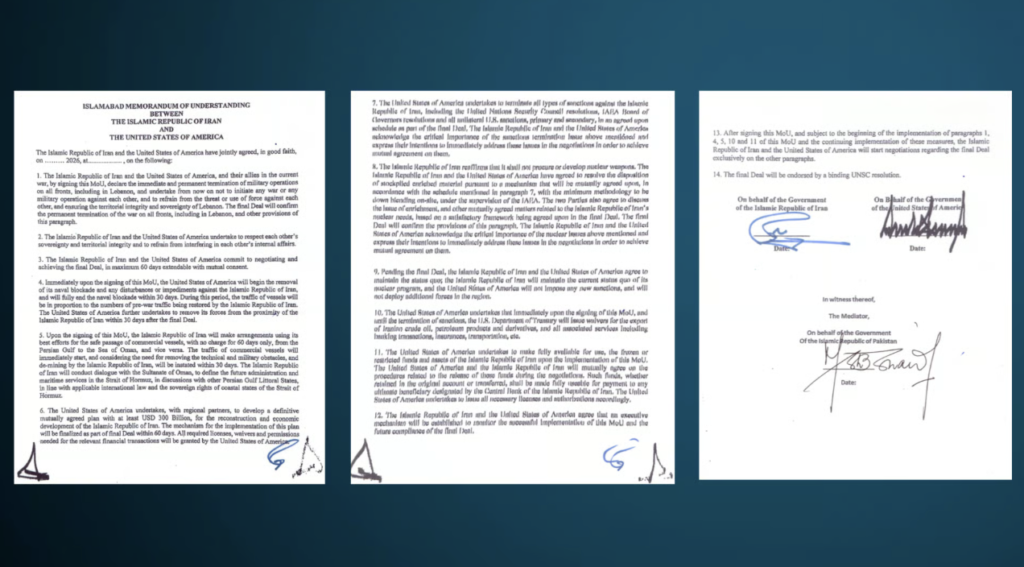
On June 18, the United States and Iran signed a fourteen-point memorandum of understanding electronically aimed at ending hostilities. President Donald Trump signed it at the Palace of Versailles after the dinner following the G7 summit; Iranian President Masoud Pezeshkian signed it remotely; and Pakistani Prime Minister Shehbaz Sharif countersigned it as mediator. The text orders the immediate and permanent cessation of military operations—including in Lebanon—the dismantling of the U.S. naval blockade, and the reopening of the Strait of Hormuz, which Iran pledges to allow toll-free passage for an initial period of sixty days. It also opens a sixty-day window for negotiations on the nuclear program and sanctions, with phased sanctions relief, the release of frozen assets, and Treasury exemptions for Iranian crude oil exports. The UK Maritime Trade Operations Organisation (UKMTO) confirmed that same Thursday that the Strait of Hormuz was open and the blockade had ended; tankers resumed transit and Brent crude fell to around $79 a barrel, accumulating a weekly drop of nearly 9.5%.
Implications
The merit of having stopped a war that threatened to engulf the Gulf is real and should be acknowledged without pettiness: the reopening of the choke point through which almost a fifth of the world’s crude oil and 30% of its natural gas flows provides immediate relief to the global economy. But the devil, as always, is in the details, in this case the deafening silences of the MOU and an uncertain 60-day negotiation. As legislators from both parties in Washington—and Israel as well—recognize, the agreement grants Tehran advance benefits while postponing to an uncertain future the only issue that justified the war: preventing Iran’s terrorist regime from obtaining nuclear weapons, and without obtaining any real concessions regarding its support for and use of its terrorist proxies, and with Trump’s explicit blessing of the Iranian missile program (he even declared that it was normal for them to have missiles if their neighbors have them… a statement rarely heard from a head of state). Special envoy Steve Witkoff announced that Iran will invite the International Atomic Energy Agency (IAEA) to inspect its facilities and locate the enriched material. It’s worth remembering that this material—more than 400 kilograms of highly enriched uranium—remains, according to estimates corroborated by multiple sources, buried under rubble. However, intelligence sources cited by some media outlets reveal that it was likely moved to a safe place before the Israeli and US attacks. This 454 kg of uranium, enriched to over 60%, could reach 90% in a few days, and that amount would be enough to manufacture 18 nuclear bombs (according to IAEA criteria; others indicate 12), each with a yield of up to 25 kilotons, more powerful than those of Hiroshima and Nagasaki (15 and 21 kilotons, respectively). It is important to conclude emphatically: a memorandum is not a treaty, and a promise of inspection is not an inspection, and the 60-day negotiations that should have started today have a disastrous outcome for regional and global peace and security, since they are based on a very significant series of concessions by the US.
Perspectives and scenarios
Scenario A — Fragile Consolidation (35%): The ceasefire holds for sixty days, the Strait of Hormuz remains open, and a tortuous but lively negotiation on the nuclear issue begins. This is the outcome the markets are pricing in, and therefore the most vulnerable to a surprise.
Scenario B — Zombie Truce (40%): The framework doesn’t formally break down, but it becomes devoid of content; Iran does the bare minimum in Hormuz and delays everything else, while Washington declares victory and looks away. A war of fluctuating temperature that no one wins and no one can afford to lose.
Scenario C — Relapse (25%): An incident in the Strait, a blocked inspection, or a retaliatory strike in Lebanon triggers the ceasefire before its deadline. The probability is not negligible precisely because the agreement lacks a robust verification mechanism.
2. Hormuz reopens, but the “day after” remains unplanned
Facts
Barely had the memorandum been signed when the diplomatic machinery stumbled under its own haste. The Swiss Foreign Ministry confirmed that the talks between the United States and Iran scheduled for this Friday at the Bürgenstock complex would not take place as planned, and Vice President JD Vance—who was supposed to travel to Switzerland—canceled his trip. At the same time, Vance has assumed the role of the pact’s main champion: he has given a series of interviews and released a video endorsing it, to the point that Senator Lindsey Graham, an avowed hawk, dubbed him on social media “the architect of the agreement.” It is striking—and I emphasize this because it contains a lesson—that it is precisely Vance, the most skeptical of those surrounding Trump regarding foreign military adventures and himself an Iraq War veteran, who is capitalizing on a ceasefire that Secretary of State Marco Rubio, far more cautious and pro-Atlantic, has managed discreetly behind the scenes.
Implications
The leak of the draft agreement unleashed, according to the US press, a wave of anger and skepticism on Capitol Hill—from Democrats and Republicans alike—and in Jerusalem. These objections align with what this analyst has been warning: the agreement appears to offer Iran early victories while guaranteeing very little in return, and the stated purpose of the war remains unresolved. The Administration has not even held a formal briefing with Congress. We are witnessing a symptom of a transactional foreign policy governed by intuition and dramatic gestures, in which the system and the level-headedness of figures like Rubio act as a firewall against presidential excess. To be fair, President Trump’s diplomacy has achieved genuine successes—Cambodia-Thailand, Azerbaijan-Armenia, Gaza—when it has acted prudently and on sound advice; The problem arises when decision-making becomes erratic and ruled by outbursts, and then the headline is signed before the architecture that should support it.
Perspectives and scenarios
Scenario A — The system imposes sanity (38%): Rubio and the security apparatus redirect the process, a serious negotiation channel is reopened, and the skepticism of Congress translates into useful conditionality.
Scenario B — Inertia and opacity (40%): the agreement survives as an object of domestic propaganda; Vance defends it, the White House declares peace and verification is indefinitely suspended.
Scenario C — Internal fracture in Washington (22%): The rebellion of the hawks and pro-Israeli pressure erode political support for the pact, which breaks down due to domestic implosion rather than Iranian non-compliance.
3. Lebanon, the crack through which the agreement could bleed out
Facts
Despite the memorandum ordering a cessation of hostilities in Lebanon, Israeli airstrikes against the south of the country have not stopped. Israeli Defense Minister Israel Katz has been unequivocal: the Israel Defense Forces will remain “indefinitely” in the security zones of Lebanon, Syria, and Gaza, and he warns that if Iran attacks Israel in response to events in Lebanon, it will respond “with full force.” Hezbollah, the Shiite terrorist organization funded by Tehran, was excluded from all negotiations and, through Naim Qasem, had already rejected the previous ceasefire, arguing that it serves “the enemy’s objectives.” Amnesty International, for its part, denounces Israel for declaring approximately 6% of Lebanese territory a “no-go zone,” preventing the return of tens of thousands of civilians.
Implications
Herein lies the contradiction that threatens to derail the entire process. Israel refuses to subordinate its security policy to an agreement that Washington signed without guaranteeing anything regarding Hezbollah, and Tehran had warned throughout the negotiations that Israeli operations in Lebanon could derail the talks. President Trump, according to various sources, expressed his irritation at the crossfire of bombings while the pact was being finalized. The paradox is stark: the very memorandum that proclaims the end of the war is incapable of halting the war being waged on its most volatile flank. And it is important to remember that Hezbollah is not a militia or an “armed group”—a convenient term I categorically reject—but a terrorist organization whose members are, individually and collectively, terrorists, and whose disarmament remains the sine qua non for any lasting stability in the Levant.
Perspectives and scenarios
Scenario A — Tacit containment (32%): Israel maintains its positions but moderates the intensity of its attacks; Hezbollah, leaderless and exhausted, does not open a second front. The rift does not close, but neither does it widen.
Scenario B — Permanent low-intensity tension (40%): a status quo of occupation and selective attack becomes chronic, eroding the spirit of the MOU without formally breaking it, keeping Lebanon as a martyr state caught in the crossfire.
Scenario C — Escalation that drags Tehran in (28%): a major Israeli attack or a Hezbollah retaliation forces Iran to respond in order not to lose face, reactivating the general confrontation that the agreement intended to end.
4. The rise of General Ahmed Vahidi and the paradox of the decapitation
Facts
While the world celebrates the signing of the peace agreement, it’s worth asking who truly holds power in Tehran. General Ahmed Vahidi has been the commander-in-chief of the Islamic Revolutionary Guard Corps (IRGC) since March 1, 2026, following the death of his predecessor, Mohammad Pakpour, during the initial phase of Operation Epic Fury. Vahidi—a former defense minister under Ahmadinejad, former interior minister under Raisi, and former head of the Quds Force—has been subject to an Interpol Red Notice for decades in connection with the 1994 bombing of the AMIA Jewish center in Buenos Aires, which killed eighty-five people. Sanctioned by the European Union and the United States for his role in internal repression, he is one of the architects of the appointment of the current nominal leader, Mukhta Khamenei. And here’s the decisive piece of information from the last few hours: a message attributed to Mojtaba Khamenei —inexplicably called “supreme”— acknowledges that he authorized the signing of the MOU “despite having a different opinion in principle.”
Implications
That phrase—”despite having a different opinion in principle”—perfectly encapsulates what I’ve dubbed the decapitation paradox . It’s important to clarify the concept, because it’s often misunderstood: the paradox isn’t that the moderates have been eliminated—there weren’t any—but rather that the surviving hawks individually lack the ideological authority, rank, and dominant personality necessary to impose their will on their peers and force them to accept concessions. The former leader could enforce internal discipline; the triumvirate that now governs de facto—Vahidi himself at the head of the IRGC, Mohamed B. Zolghadr as secretary of the National Security Council and commander of the Al-Quds Brigades, and Rezaei as interim military advisor—is made up of equals without a mediator. It is, therefore, a paradox of governance, not of moderation. Pezeshkian is systematically blocked, and Ghalibaf answers to Vahidi, not to the president.
Hence the inherent fragility of the agreement: a signature exists, but the authority capable of guaranteeing its fulfillment does not. A Mokhta Khamenei who confesses to having yielded against his own wishes is a leader who neither imposes his will nor can ensure that the triumvirate will abide by it. Trusting Vahidi—as analyst Yigal Carmon of the Middle East Media Research Institute warned—is a grave mistake: he belongs to the hard core of the “Death to America” movement. The question, then, is not whether Iran wants a truce, but whether the man who truly remains silent or concedes behind the scenes at the IRGC believes that confrontation better serves his interests.
Perspectives and scenarios
Scenario A — Tactical Pragmatism (30%): Vahidi accepts the truce as a respite to rebuild the decimated military apparatus, without abandoning the underlying doctrine. He buys time, not out of conviction.
Scenario B — Erratic compliance due to lack of referee or primus inter pares (40%): the absence of an authority that imposes discipline generates contradictory signals; the regime complies on one front and fails to comply on another, not due to strategy, but due to an inability to coordinate internally.
Scenario C — Hardcore sabotage (30%): The most intransigent wing of the IRGC sabotages the agreement to preserve the ideological raison d’être of the regime, demonstrating that Pezeshkian’s signature did not bind those who truly wield weapons.
5. The G7 summit in Évian closes without a statement: a reflection of the Western divide
Facts
The 52nd G7 summit, held from June 15-17 in Évian-les-Bains under the French presidency, concluded Wednesday without a joint communiqué—for the second consecutive year, following a similar failure in 2025 under the Canadian presidency. Despite producing some thematic outcomes (artificial intelligence governance, critical minerals, economic security, global health), the leaders were unable to agree on a unified document. Divisions also surfaced in the area of security: European partners expressed their willingness to participate in maritime escort operations in the Strait of Hormuz, while President Trump maintained that restoring navigation did not require any external involvement. According to Politico, European capitals maneuvered to avoid a direct confrontation with Trump, who shifted the focus from the Iranian crisis back to the Russian-Ukrainian conflict. In the presence of Ukrainian President Zelensky, however, the G7 reaffirmed its commitment to the sovereignty and territorial integrity of Ukraine and agreed to increase military support — air defense, interceptors and long-range capabilities.
Implications
That the main alliance of advanced democracies is unable, for the second time in a row, to sign a communiqué is not a mere procedural anecdote: it is a symptom of a fractured West and the bloc’s dwindling capacity to represent and manage global affairs in a multipolar world. Analysts are already pointing, without euphemism, to the United States as the main source of uncertainty within the G7 itself—a historic reversal that should shame all of us who for decades saw Washington as the anchor of the liberal order. The Hormuz episode is revealing in its miniature form: Europe, ready to deploy ships; Trump, dismissing the offer with a gesture. And this diplomatic paralysis is part of the same strategic abdication that, just ten days ago, confirmed the demise of the Franco-German sixth-generation fighter program (FCAS/SCAF): a mediocre and short-sighted Europe, incapable of taking its own defense seriously, preferring the distribution of perks to true sovereignty. Those who do not build a plane together will hardly sign a joint statement.
Perspectives and scenarios
Scenario A — Pragmatic transatlantic rearmament (35%): Pressure on Europe forces it to take on more burden — escorts in Hormuz, sustained support for Ukraine —, rebuilding a minimum unity on the basis of realism and not rhetoric.
Scenario B — Drift towards irrelevance (40%): the G7 becomes chronic as a photo opportunity without decision-making capacity; divisions become entrenched and the bloc loses traction against the Global South and the alternative forums that China patiently cultivates.
Scenario C — Open rupture (25%): a frontal clash — trade or over Ukraine — between Washington and European capitals visibly fractures the alliance, with direct consequences for NATO cohesion.
6. Ukraine launches its biggest drone attack against Moscow and hits a refinery
Facts
In the early hours of June 18, Ukraine carried out its largest drone strike against Moscow since the start of the full-scale Russian invasion, hitting an oil refinery. At least seventeen people, including two children, were injured in the Moscow Oblast, according to Ukrainian sources. That same day, President Zelensky stated that around ten countries had endorsed the new Priority List of Requirements for Ukraine (PURL) packages. The diplomatic front, however, remains deadlocked: the Orthodox Easter (April) and Victory Day (May) ceasefires resulted in thousands of mutual violations, and President Trump, when asked about the war at the G7 summit, went so far as to claim that the conflict “doesn’t affect us… we’re thousands of miles away.”
Implications
The Ukrainian attack on Moscow—and on the energy infrastructure that finances the Kremlin’s war machine—demonstrates that Kyiv refuses to accept the role of passive victim and that long-range drone warfare has reached the symbolic heart of Russia. I am, and always have been, unequivocally opposed to Russian aggression and the use of force as a means of acquiring territory; therefore, I welcome Europe’s—albeit tentative—starting to discuss its own ballistic missile defense and the G7’s reaffirmation of its commitment. But the contrast between this rhetorical “strategic awakening” and the transactional indifference of a Trump who dismisses the largest land war on European soil since 1945 as a foreign matter, “thousands of miles away,” encapsulates the tragedy of our time: the historical guarantor of European security has ceased to believe in it, and Europe still does not believe itself capable of replacing it.
Perspectives and scenarios
Scenario A — Internationalization of support (33%): PURL packages and G7 commitment materialize into effective air defense; Ukraine stabilizes the front and raises the cost for Moscow.
Scenario B — Protracted war of attrition (40%): neither religious truces nor diplomatic pressure alter the dynamics; the war of variable temperature becomes chronic, with reciprocal blows in depth and no victor in sight.
Scenario C — US disengagement (27%): Trump’s transactional drift translates into an effective withdrawal of support, forcing an ill-prepared Europe to sustain the effort alone, with the risk of capitulation.
III. MEDIA RACK
The international coverage of the last twenty-four hours confirms a factual consensus on the signing, and a notable divergence on its solidity —a divergence that, as is often the case, says more about the perspective of each publication than about the event itself.
Leading US newspapers, The Washington Post and Associated Press, focus on JD Vance as the unexpected “face” of the agreement and on the bipartisan anger over a text that grants Tehran early advantages; The Hill emphasizes the vice president’s long-standing skepticism toward foreign wars; the Post also reports Trump’s icy “it doesn’t affect us” statement regarding Ukraine. The conservative Fox News network continues to highlight Vahidi as the decisive factor in Iran’s compliance.
British and financial press. The Financial Times, Reuters, and Bloomberg lead the economic analysis of the reopening of the Strait of Hormuz and the fall in Brent crude, and highlight the G7’s failure to issue a joint statement as evidence of the erosion of the liberal order.
Mainland and Chinese press. Le Monde, Le Figaro and the German press emphasize the divisions in Évian and Trump’s pivot from Iran to Ukraine; the official Xinhua news agency, from Beijing, gleefully capitalizes on the lack of a statement as proof of “Western decadence”—a reminder that every crack in our ranks is, for the Chinese regime, a propaganda opportunity.
Middle Eastern press. Al Jazeera headlines with the continuation of Israeli attacks on Lebanon “despite the agreement”; The Times of Israel reports Katz’s refusal to withdraw; Iran International—a highly reliable dissident source—provides the crucial information of Mojtaba Khamenei’s message authorizing the signing “against his wishes,” as well as confirmation of the reopening of the Strait of Hormuz via the UKMTO and the fall in Brent crude prices.
Mediation, Asian, and Ukrainian press. Geo.tv and the Pakistani press highlight Islamabad’s leading role as mediator; Outlook India and The Times of India detail the fourteen points of the memorandum; The Kyiv Independent and Ukrainska Pravda report on the largest Ukrainian drone attack on Moscow and support for the PURL packages.
IV. RISK TRAFFIC LIGHT
● Strait of Hormuz and global energy: Reopened and with Brent crude falling, but without a verification mechanism to prevent another closure. High risk of reversal in the event of any incident.
● Nuclear program and compliance by the Iranian terrorist regime: The highly enriched uranium remains unlocated, and the IAEA inspection is, for now, just a promise. Critical vector: this is where the ultimate reason for the war lies.
● Lebanon and Israel-Hezbollah: Attacks continue despite the MOU; the excluded terrorist organization Hezbollah rejects the truce. A rift with the potential to ignite the entire situation.
● Power structure in Tehran: The IRGC triumvirate governs without arbiter; the paradox of the decapitation makes compliance unpredictable. Vahidi is the true barometer.
● Western cohesion and the G7: Second consecutive summit without a communiqué; the US singled out as a source of uncertainty. The European strategic abdication—from the FCAS to the G7—is structural, not circumstantial.
● Russian-Ukrainian front: Major Ukrainian drone attack on Moscow; Washington’s transactional disengagement threatens the allied effort. High and persistent risk.
● Markets and crude oil prices: Immediate easing due to the reopening of Hormuz; energy relief is real, although full normalization will take months.
V. EDITORIAL COMMENTARY
There are days when diplomacy dresses up in its finest and signs, in the splendor of Versailles and to the applause of the guests, what does not yet exist. The “Islamabad Memorandum” halts a war—and that, I repeat, deserves unconditional recognition—but it does not create peace, because peace requires what this agreement lacks: a clear strategic plan and an authority in Iran capable of guaranteeing its implementation. I have been describing, since the first shot of this conflict, that the original sin was not striking the jihadist, dictatorial, and mafia-like oligarchy that ravages Iran and massacres its own people—attacks which, at the time, I supported—but rather the glaring absence of a plan for a scenario in which the regime would neither capitulate nor implode. Today, that void has a technical name: Pezeshkian’s signature doesn’t bind those who truly wield weapons, because in Tehran there is no longer an arbiter to enforce discipline, but rather a triumvirate of equals presided over by the brutal General Vahidi. Therein lies the contained systemic fracture that defines our time.
And while the Middle East manages its zombie truce , the West displays its own paralysis in Évian. That the G7 has concluded for the second consecutive year without a joint statement is not a mere protocol slip-up: it is the X-ray of an alliance that has lost sight of its purpose. The most serious aspect—and I write this with the pain of someone who is an Atlanticist at heart and a staunch Europeanist—is that today, analysts themselves are pointing to the United States as the main source of uncertainty for the club that once embodied the promotion and defense of the liberal order. This paralysis did not arise from nothing: it is the same strategic abdication that, ten days ago, buried the European sixth-generation fighter jet, that mediocre and short-sighted Europe that prefers the distribution of perks to true sovereignty. Those who are incapable of building a common aircraft can hardly defend a common continent.
And on the Eastern Front, while Ukraine sends its drones to the heart of Moscow and attacks the refineries that finance the aggression, President Trump dismisses the largest ground war on European soil since 1945 with a glacial phrase: “It doesn’t affect us, we’re thousands of miles away.” We must unequivocally oppose Russian aggression and the use of force to conquer territories, and precisely for this reason I welcome every step—however timid—towards an autonomous European defense. But the tragedy of our time lies in this contrast: the historical guarantor of European security has ceased to believe in it, and Europe still does not believe itself capable of replacing it. On these three fronts—Tehran, Evian, Kyiv—the same battle is being waged: the battle of common sense and responsibility versus intuition and impulsiveness. I trust, as always, that the system, and the wisdom of those who uphold it, will ultimately prevail.