Gustavo de Arístegui,
June 23, 2026
I. INTRODUCTION
| The day has a single center of gravity—Bürgenstock’s table—around which almost everything else revolves: the price of crude oil, the key to the Strait of Hormuz, the real power in Tehran, and, less visibly but no less decisively, the internal war that the Iran-Contra affair has unleashed within the Republican Party. Two satellites orbit around it, demanding our attention and which no honest analysis can dismiss: the political earthquake in London, where Sir Keir Starmer has fallen and Andy Burnham is emerging; and the complicit silence surrounding the massacre being prepared in El Obeid. Five news items, one common thread: the fragility of an order sustained by the will—and temperament—of a handful of men, and by a memorandum of understanding (MoU) devoid of verification. It is advisable, as always, to face them head-on and without anesthesia. |
II. MOST IMPORTANT NEWS OF THE LAST 24 HOURS
1. United Kingdom: Starmer’s decline and Burnham’s rise, seventh premier in a decade
| Facts |
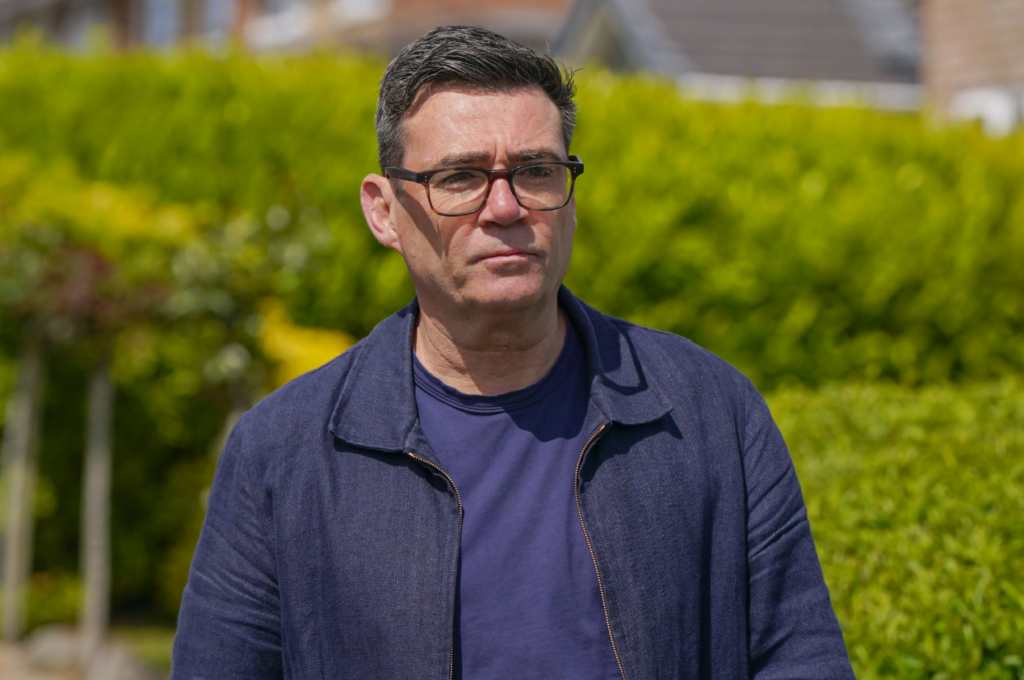
| Sir Keir Starmer announced his resignation as Labour leader on Monday, June 22, in front of cameras at the gates of 10 Downing Street. This followed months of internal pressure that intensified when his main rival, Andy Burnham, the Mayor of Greater Manchester, returned to Parliament after a comfortable victory—nearly 25,000 votes and a majority exceeding 9,200—in the Makerfield by-election, which had been called specifically to secure him a seat from which to challenge for the leadership. Starmer, who informed King Charles III that same morning, will remain as caretaker prime minister until the election of a new Labour leader. Nominations open on July 9 and close on July 16, meaning that without a challenger, Burnham would take office within weeks; with a contest, the outcome would be postponed until Parliament reconvenes in September. Former Health Secretary Wes Streeting, who was expected to challenge him, has chosen to back him. This would make him the seventh occupant of Downing Street in a single decade. This is no small detail: President Trump himself, whose relationship with Starmer has soured in tandem with the Iran-Contra affair, went so far as to predict Starmer’s downfall on Monday and criticize his immigration and energy policies. |
| Implications |
| This dizzying turnover—seven prime ministers in ten years—reveals the deep crisis of governance corroding one of the oldest and most admired parliamentary democracies in the world. The change shifts the Labour Party’s center of gravity from Starmer’s gray technocracy to a more instinctive and communicative populist and municipalist profile, amidst a struggle to contain the rise of Reform UK’s nationalism, which has drained votes from the governing left. For a Europe bereft of reliable partners, the question is paramount: will London maintain the unwavering Atlanticism and firm support for Ukraine that have characterized its foreign policy, or will it succumb to the temptation of navel-gazing precisely when the continent most needs leadership? Burnham arrives with domestic credibility, but his domestic profile does not guarantee competence on the international stage. |
| Perspectives and scenarios |
| Scenario A (45%): orderly transition and coronation of Burnham almost without opposition before the summer break, with a line of Atlanticist continuity. |
| Scenario B (40%): a real contest —with some aspirant from the Starmer wing— that strains the debate on NATO, defense spending and Ukraine, and prolongs the interim period until September. |
| Scenario C (15%): The leadership crisis deepens and opens the door to greater upheaval in a disoriented Labour Party. The real question is not who, but what: Burnham’s first message on NATO and Kyiv will have to be carefully considered, because it will determine whether we are witnessing a change of face or a change of course. A shift towards ambiguity in defense commitments would be terrible news at the worst possible time. |
2. Iran-United States: Bürgenstock’s first round and the Vahidi factor – the decapitation paradox in action
| Facts |
| The inaugural round of high-level talks concluded early Monday morning in Bürgenstock, on the shores of Lake Lucerne, under the auspices of the fourteen-point memorandum of understanding signed the previous week by President Trump and his Iranian counterpart, Masoud Pezeshkian, to extend the fragile ceasefire for at least sixty days. The mediators—the Emirate of Qatar and Pakistan—spoke of “encouraging progress” and a roadmap toward a final agreement within sixty days. Vice President JD Vance proclaimed four achievements: a communication line to prevent incidents in the Strait of Hormuz, a “de-conflict cell” to sustain the truce in Lebanon, a schedule of technical rounds, and the return of inspectors from the International Atomic Energy Agency (IAEA). It would be wise, however, not to declare victory prematurely: Tehran has expressly denied having accepted this return, and President Pezeshkian reiterated on Sunday that Iran will “never renounce” uranium enrichment. And above all, it is important not to lose sight of who truly holds power in Tehran: since March 1, the Revolutionary Guard Corps (IRGC) has been led by General Ahmad Vahidi, wanted by Interpol via a red notice since 2007 for the bombing of the AMIA Jewish community center in Buenos Aires—which killed 85 people in 1994—sanctioned by Washington and Brussels, and singled out by Milei’s Argentina, which, like most democracies worldwide, has declared the IRGC itself a terrorist organization. The Institute for the Study of War maintains that Vahidi and his inner circle now control not only the military response but also the regime’s negotiating strategy. |
| Implications |
| This is where our concept of the decapitation paradox, which we have explained so many times and which current events confirm daily, comes into play. The paradox lies not in the fact that the attacks eliminated the moderates—there were no moderates to eliminate in the upper echelons of the jihadist oligarchy—but rather in the fact that the survivors, all of them extremists, lack the ideological authority, rank, and dominant personality necessary to impose their will on their peers and force them to make concessions. The late Ali Khamenei could enforce internal discipline; his successor, Mojtaba, does not, and the IRGC triumvirate—Vahidi at the head of the Guard, General Zolghadr as Secretary General of the National Security Council and former commander of the Quds Force, and General Rezaei as military advisor to the leader of the revolution—are equals without arbiter, although the serial terrorist Vahidi is gradually acquiring all the levers of power. It is a paradox of governance, not of moderation, and it explains Tehran’s erratic slowness at the negotiating table. In short, we are facing a contained systemic fracture that is not being resolved, only managed. Herein lies the true absurdity threatening these talks: entrusting the management of the Strait of Hormuz—one of the planet’s great energy arteries, through which nearly a fifth of the world’s oil and more than 25% of its natural gas flows—to the fiefdom of a man with pending charges for international terrorism is not realism, but reckless irresponsibility. And regarding the nuclear promise, this publication has been repeating this since February: a memorandum is not a treaty, and a promise of inspection—which Tehran doesn’t even acknowledge—is not an inspection. To believe otherwise is wishful thinking. To replenish the coffers of the jihadist oligarchy, even under the pretext of American wheat, is to revive the world’s largest exporter of terrorism, the mainstay of Hezbollah, the Houthis of Yemen, the pro-Iranian terrorist militias of Iraq, and Hamas. |
| Perspectives and scenarios |
| Scenario A (35%), fragile consolidation: the truce lasts sixty days, Hormuz remains open and a tortuous but lively negotiation on the nuclear program begins. |
| Scenario B (40%), zombie truce: the framework is not broken, but it is emptied; Iran does the minimum in the strait and dilates everything else, while Washington sings victory and looks the other way. |
| Scenario C (25%), relapse: an incident in Hormuz, a blocked inspection, or a retaliatory strike in Lebanon could derail the ceasefire prematurely. The likelihood of this last scenario is not negligible, precisely because the agreement lacks a robust verification mechanism and because, in the logic of volatile warfare, neither actor can win nor afford to lose. |
3. The return of Iranian crude: the 60-day license and the fall in Brent prices
| Facts |
| The first practical effect of the memorandum: the US Treasury authorized on Monday, through a sixty-day general license—valid until August 21—the production, transport, and sale of Iranian oil and petrochemicals, even permitting their import into the United States with payment in dollars, something unprecedented in decades. The market reacted instantly: Brent crude closed down 3.31% at $77.90—its lowest level since early March—after reaching $82.30 at the open due to Trump’s threats to resume attacks; West Texas Intermediate fell to $74.82. Tanker traffic through Hormuz is rebounding strongly, with Iran increasing its shipments to their highest level since the start of the conflict—offering discounts to China and shipping more than 30 million barrels in a single week—and Gulf producers preparing to expand supply: Kuwait has lifted force majeure and the Emirati ADNOC is resuming operations, with nearly 80 million barrels waiting to be shipped if the strait is fully reopened. |
| Implications |
| The relief at the pump is real and welcome for a recovering global economy, but the easing of logistical pressures should not be mistaken for peace. Much of the current abundance, as Quantum Strategy and ANZ point out, is due to the liquidation of inventories and crude oil stored on tankers, not to a solid recovery in production. When those reserves run out, the market will tighten again, and it’s worth remembering that the US strategic reserve itself is near its lowest level since 1983, so Washington’s buffer is narrower than it appears. And there remains the uncomfortable downside, which we cannot ignore: every dollar the regime receives through this channel is a dollar that will not go to hospitals or schools, but to ballistic missiles, internal repression, and the rearming of its terrorist satellites. |
| Perspectives and scenarios |
| Scenario A (25%): An incident in Hormuz or a new outburst reignites the war premium and pushes Brent back above $80. Scenario B (40%): A sluggish market and contained prices for months, with Brent fluctuating between $72 and $80 while logistics normalize. Scenario C (35%): Oversupply and the exhaustion of the war premium, coupled with weak Chinese demand, break through the $72 floor. In all cases, the constant risk—and the one that concerns us most—is that Tehran will take advantage of the economic respite to rebuild its military might and its network of terrorist proxies. Therefore, vigilance over the actual destination of the released funds must be paramount and non-negotiable. |
4. Vance’s move: a show of force and a sword of Damocles hanging over the Republican Party
| Facts |
| That the vice president, and not a technical negotiator, is personally at the helm is a clear show of authority. The American press is already dubbing the pact “the Vance deal,” not always as a compliment. Internal polls favor him: he is the undisputed frontrunner for 2028—36% in The Center Square/Noble Predictive Insights poll from June 1-4, more than double that of his closest rival, and an overwhelming 43% among those under thirty. The problem, however, emerges as soon as one moves beyond the confines of the Republican primaries: the battle he is now waging remains deeply unpopular, and the parallel with the burden that Biden’s legacy represented for Kamala Harris in 2024 is already being invoked, without disguise, by quite a few strategists within the party itself. Senator Lindsey Graham challenged him, as the “architect of the agreement,” to defend the memorandum before Congress—though he softened his tone days later after speaking with envoy Steve Witkoff—; Senator Bill Cassidy has called it “the worst foreign policy mistake in decades”; and Ted Cruz, a potential rival in 2028, has aired his misgivings. Trump himself, with his characteristic humor, is already joking about sharing the credit—or the blame—while Secretary of State Marco Rubio watches in silence. |
| Implications |
| Herein lies the crux of the matter. The Iran war has not fractured the Republican Party once, but twice, and on opposite sides, leaving Vance caught in the exact center of the cut. From the more nationalist wing of the MAGA movement, he accused the White House of betraying its “zero war” promise—a bill that figures like Megyn Kelly have presented to him directly. From the side of the hawkish neoconservatives, the memorandum now infuriates hardliners, who interpret it as inexplicable concessions from a victor to a vanquished. Note the subtlety: the hawks are no longer targeting Trump, but his chosen successor. Vance has become a willing lightning rod: by taking on the negotiations, he has made himself responsible for an agreement whose outcome he does not control. If the war resumes, he bears the blame for the failure; if peace is sealed with concessions, he bears the accusation of appeasement. The man who didn’t want war ends up being the master of peace: success and failure point to the same man. But it is undoubtedly a show of force, because the one who truly has the future at stake in the November 2028 elections is JD Vance. He has taken the reins to ensure there are no further derailments, because Witkoff and Kushner will do whatever President Trump tells them. Vance will do whatever is best for the Republican Party as a whole. |
| Perspectives and scenarios |
| Scenario A (30%), consecration: the truce holds, crude remains cheap and Vance sells “peace through strength”, surviving on both flanks. |
| Scenario B (40%), a zombie truce that takes its toll: neither side forgives the ambiguous result, the Republican Party is playing for the House in November and Vance arrives in 2028 as a wounded favorite. |
| Scenario C (30%), catastrophic relapse: the armistice collapses, and the vice president is left with both a failed agreement and a reignited war. Not even the best-case scenario grants him a victory without a price: that, in essence, is the sword hanging over his throne. |
5. Sudan: RSF’s barbarity on El Obeid, the forgotten conflict
| Facts |
| Far from the spotlight, Sudan is dying. The Rapid Support Forces (RSF), successors to the sinister Janjaweed, are massing troops and increasing drone attacks around El Obeid, the capital of North Kordofan, while the Sudanese army launched preemptive airstrikes on Saturday to thwart the assault. The UN High Commissioner for Human Rights, Volker Türk, and Secretary-General António Guterres warned on Thursday of an imminent risk of atrocities and recalled, bluntly, that “we have seen this script before,” alluding to the El Fasher massacre—classified as genocide by the UN—and the Zamzam camp after its fall in October. Some thirty countries, led by Norway, signed a joint declaration of alarm on June 18; the Security Council demanded a halt to the assault on June 19. Ten days of drone attacks have killed at least fifty civilians, and today 33.7 million Sudanese — 60% of them children — need humanitarian assistance: the world’s biggest crisis. |
| Implications |
| We are against barbarity of any kind, and we will not remain silent in the face of this. The situation in Sudan is yet another example of the moral mediocrity of an international political class incapable of moving from warnings to action, with a Security Council paralyzed by geopolitical rivalries. And there is an uncomfortable actor lurking behind the scenes that consistency compels us to name: the persistent and well-documented accusations against the United Arab Emirates as a financial backer of the RSF, precisely when Abu Dhabi is a key interlocutor on the Gulf stage and in the Iranian case itself. One cannot condemn the terror being orchestrated in Tehran and look the other way when it is financed in Darfur and Kordofan; this double standard is, here too, the beginning of complicity. |
| Perspectives and scenarios |
| Scenario A (45%): The consummation of a new ethnic massacre in El Obeid, following the pattern of El Fasher—siege, famine, and targeted killings of non-Arab communities—the most feared scenario today precisely because of international inaction. Scenario B (40%): A prolonged siege, without a decisive assault, slowly suffocating the city in a sustained humanitarian catastrophe. Scenario C (15%): Real pressure—effective sanctions, guaranteed humanitarian corridors, and cutting off the flow of weapons to the combatants—changes the course of events. Meanwhile, the world looks the other way, and indifference becomes complicity. |
III. MEDIA RACK
| Reuters, Time and Al Jazeera celebrate the change in Downing Street and interpret it as a symptom of the British governance crisis, with Burnham already emerging as the almost inevitable successor after his victory in Makerfield. |
| Bloomberg, NPR, and CNN report on Bürgenstock’s “encouraging progress” and sixty-day roadmap, without hiding Saturday’s episode, when a threat from Trump almost derailed the talks; The New York Times, true to its skepticism, predicts a difficult advance—a useful, albeit self-serving, counterpoint. |
| CNBC, Reuters and Trading Economics focus on the Treasury’s license and Brent’s fall below $78, with a tone of relief, although they qualify —via Quantum Strategy and ANZ— that the abundance responds more to the liquidation of inventories than to a real recovery in supply. |
| The Globe and Mail, The Hill, NBC News, and The Center Square offer the best political summary of the day: Vance’s risk is inheriting both sides of the split—the war that alienated isolationists and the compromise that infuriates hawks—while maintaining a comfortable lead in the 2028 internal polls. That’s the key takeaway. |
| OHCHR, UN News, Middle East Eye and Al Jazeera are almost single-handedly keeping the focus on Sudan and the risk of a massacre in El Obeid; the silence of the rest is, in itself, the news. |
| Al Jazeera, Israel Hayom, and Fox News portray General Vahidi from opposing angles—an irrepressible hawk to some, a pragmatic manager to others—while the Institute for the Study of War emphasizes that the Revolutionary Guard has taken control not only of the military response but also of Tehran’s negotiating strategy. |
IV. RISK TRAFFIC LIGHT
| Scenery | Level | Short reading | |
|---|---|---|---|
| Strait of Hormuz | ● High | De facto management in the fiefdom of General Vahidi and the Revolutionary Guard; the real Achilles’ heel of the agreement. | |
| Iranian nuclear program | ● High | Substantive negotiations have not yet begun, and Tehran denies the return of the inspectors that Washington has announced; without robust verification, there is no guarantee. | |
| Sudan / The Obeid | ● High | Imminent risk of ethnic massacre following the El Fasher pattern; international inaction and Emirati support for RSF. | |
| European defense / FCAS | ● High | Europe still lacks a common sixth-generation fighter jet after the program collapsed, at a structural disadvantage compared to the GCAP, the American F-47 and the Chinese prototypes. | |
| US-Iran truce | ● Medium | The sixty-day roadmap is alive, but at the mercy of an incident in Hormuz or an outburst on social media. | |
| Republican Party Cohesion | ● Medium | Double fracture —isolationists and hawks— with Vice President Vance as a voluntary lightning rod in the run-up to November. | |
| British political transition | ● Medium | The change of leadership is expected to be orderly; the unknown factor is the Atlanticist course and the commitment to kyiv of the likely new occupant of Downing Street. | |
| Energy market | ● Content | Brent crude around $78; ample supply if Hormuz fully reopens, with the war premium compressed. | |
| Legend: ● High ● Medium ● Content |
V. EDITORIAL COMMENTARY
| The thread that runs through this day is the growing dependence of the international order on the temperament of a handful of men. We wholeheartedly applaud the pragmatic foreign policy of the Trump administration when it bears fruit—and it has, from Cambodia and Thailand to the Caucasus, from the ceasefire in Gaza to the capture of the tyrant Maduro, who has decapitated the Chavista narco-dictatorship, and now in halting a war that threatened to engulf the Gulf—especially when it is exercised with the restraint that Marco Rubio brings. But we will remain critical, without reservation, when the decision-making becomes erratic, transactional, and driven by outbursts, as when a message on social media nearly derailed the Bürgenstock table this past weekend. Bombing the jihadist oligarchy in Tehran was legitimate; lacking a plan for the day after—for when the regime capitulates or implodes—remains the true strategic sin, the same one we have denounced from day one. |
| And while Washington negotiates, Europe once again turns its back on its own destiny. There’s no need to revisit the already consummated shipwreck of the European sixth-generation fighter jet to confirm this: one need only observe the chronic apathy with which the continent that most needs strategic autonomy—with the war in Ukraine on its eastern border and an increasingly transactional American ally—takes its own defense and security seriously. The Franco-German engine seizes up again at the worst possible moment, and integration is repeatedly confused with mere rhetoric in official statements. Atlanticists at heart and convinced Europeans, we say it once more: faced with the fanaticism of Tehran, the barbarity of Darfur, and Europe’s own indifference, neither equidistance nor silence is an option. Today, as yesterday, the only reliable compass is the uncompromising defense of freedom, liberal democracy, and the security of the West. |