Gustavo de Arístegui,
June 25, 2026
I. INTRODUCTION
Today’s events confirm—once again—that we are living within what I have been describing as a “contained systemic fracture.” Internationally, two devastating earthquakes have torn Venezuela apart; Israel reiterates that it will not abandon southern Lebanon while Tehran demands its withdrawal as a condition of the fragile memorandum with Washington; Secretary of State Marco Rubio tours a Gulf deeply disappointed with the US and President Trump, trying to sell an agreement that his allies consider excessively generous to the oligarchic-jihadist regime; and President Trump engages in a shouting match with a senator from his own party over a war whose initial objectives have not been met. But today also demands a closer look at Spain, where the Supreme Court’s final conviction of the former second-in-command to Sánchez has precipitated the most serious crisis of moral credibility in our recent democracy. Five fronts outside and one inside, and a single lesson that runs through them all: when ethics abdicates as a limit to power, politics degrades, becomes an instrument of domination and power without restraint or moral compass, and a mere instrument of personal gain or survival.
II. MOST IMPORTANT NEWS OF THE LAST 24 HOURS
1. Venezuela: Devastating double earthquake at the heart of the narco-dictatorship
Facts:
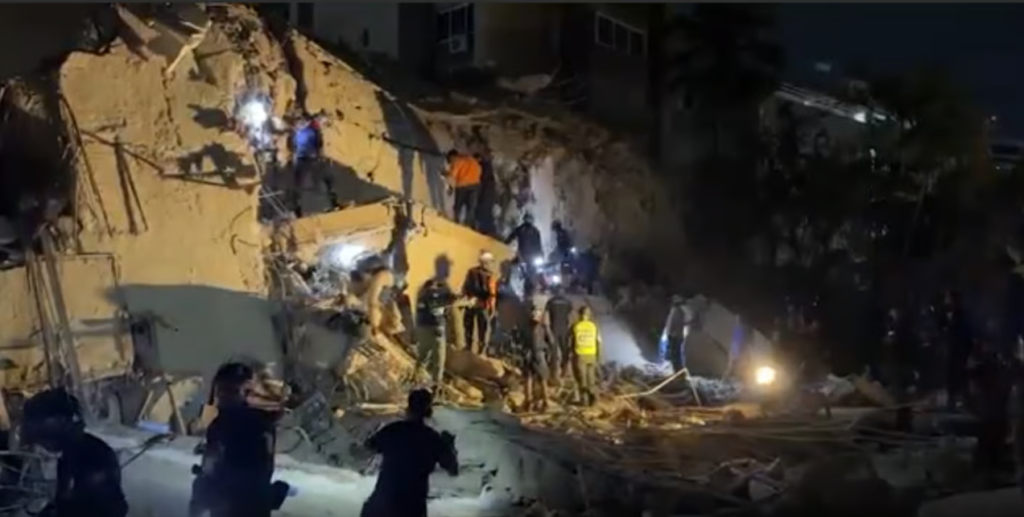
On the evening of June 24, two consecutive earthquakes—a first tremor of magnitude 7.2 followed just thirty-nine seconds later by another of magnitude 7.5, which the United States Geological Survey (USGS) has described as a “double-thrust”—shook northern Venezuela, with its epicenter near Morón and the state of Yaracuy, about 100 kilometers west of Caracas. The second is the largest tremor recorded in the country since 1900—the 1812 earthquake left some 30,000 dead in Mérida and Caracas. In her address early Thursday morning, acting president Delcy Rodríguez put the death toll at at least 32, with more than 700 injured, a provisional tally that she herself admitted would rise and that does not yet include the state of La Guaira, the hardest hit. The Simón Bolívar International Airport was closed due to the damage; numerous buildings collapsed in Caracas and La Guaira; Rescue teams worked throughout the night and pulled about twenty people alive from the water in the Chacao municipality alone. The official toll is only provisional from the first few hours: estimates from US technical services and institutes—particularly the USGS PAGER model, which has issued a red alert—place the death toll at a minimum of around ten thousand and project it to be around twenty thousand, within a range of tens of thousands that the agency itself estimates with a 37% probability; economic losses are estimated at 1-7% of Venezuela’s GDP. The US State Department has announced the deployment of search and rescue teams. Likewise, several countries in the region are sending aid, and the SUMMA emergency medical service of the Community of Madrid is already en route to Venezuela with teams specialized in disaster rescue.
Implications:
The tragedy has struck a failed and mafia-ridden state, devastated by two decades of incompetence and plunder under the narco-Castro-Chavista regime , lacking the institutional, medical, and logistical capacity to respond to a catastrophe of this magnitude. And the totalitarian reflex has immediately resurfaced: exiled opposition leader Edmundo González has denounced the “systematic and prolonged information blackout”—a communications blackout that prevents millions of Venezuelans from knowing if their families are safe—while the only reliable information comes from journalists recording with their own phones.
Perspectives and scenarios:
Scenario A (35%): The magnitude of the catastrophe forces the regime to accept massive international aid, opening a window of pressure and external scrutiny on the narco-dictatorship. Scenario B (40%): The Rodríguez brothers exploit the disaster—channeling aid through the regime’s structures, reinforcing social control, and manipulating the figures—as other totalitarian regimes have done in the face of their own people’s suffering. Scenario C (25%): The humanitarian collapse, coupled with the information blackout and popular disaffection, accelerates the internal erosion of the Chavista apparatus and precipitates a crisis of governance. In all cases, international oversight of the actual destination of the aid is imperative.
2. Lebanon: Israel does not withdraw from the south while Tehran conditions the memorandum on its withdrawal
Facts:
The Israeli Defense Minister stated on June 24 that his troops will not withdraw from southern Lebanon—a strip they have controlled since March—a major stumbling block to the agreement between Washington and Tehran. Israel has been fighting Hezbollah, the Lebanese branch of the Iranian regime, since early March. Meanwhile, Iranian Foreign Minister Abbas Araghchi maintains that an end to hostilities in Lebanon—and an Israeli withdrawal—is an indispensable condition of the memorandum of understanding (MOU), which he defines as a pact between “the United States and Israel, on one side, and Iran and Hezbollah, on the other.” The Speaker of the Iranian Parliament, Mohammad Baghr Ghalibaf—who answers de facto to General Vahidi rather than President Pezeshkian—equated the ceasefire in Lebanon with that of Iran in Baku.
Implications:
Tehran intends to shield its main terrorist proxy under the umbrella of the agreement, reintroducing through the back door the “ring of fire” doctrine that the war had dismantled. The Israeli presence in the south, far from being a whim, responds to the logic of preventing Hezbollah from rearming once UNIFIL is dissolved. The Lebanese conflict is, today, the main potential trigger for a resumption of hostilities.
Perspectives and scenarios:
Scenario A (30%): A phased Israeli withdrawal timetable is reached, contingent upon the deployment of the Lebanese army and the effective disarmament of Hezbollah in the “pilot zones.” Scenario B (40%): A tense and unstable status quo is maintained—neither a full-scale withdrawal nor a resumption of hostilities—with intermittent incidents that erode the memorandum without breaking it. Scenario C (30%): Hezbollah or a rogue faction provokes a serious incident that plunges the region back into open confrontation.
3. The Gulf, in a state of mistrust: Rubio tries to sell an agreement that irritates his allies
Facts:
Secretary of State Marco Rubio is touring the Gulf—he held a working lunch with the President of the United Arab Emirates, Sheikh Mohammed bin Zayed, on June 24—to reassure deeply skeptical allies. Riyadh, Abu Dhabi, and the other Gulf monarchies consider the memorandum excessively generous to Tehran: it includes a fund of up to $300 billion and the lifting of sanctions, and they fear that these resources will be used by the regime to rebuild its military. Several Gulf states have requested missile defense reinforcements from Washington. Irritation is particularly intense in the Emirates, which are deeply disappointed with President Trump and say they feel deceived by him.
Implications:
The damage to American credibility is profound and, I fear, lasting. The Arab partners who suffered firsthand from Iranian attacks during the war now watch as Washington rewards the aggressor with a multi-billion dollar fund and the unfreezing of tens of billions of dollars. Here the paradox of decapitation emerges in all its starkness : the war did not eliminate the moderates—there were none—but rather left standing a few hawks—General Ahmed Vahidi at the head of the Revolutionary Guard, Mohammad Bagher Zolghadr as secretary of the Supreme National Security Council in command of the Al-Quds Brigades, and Rezaei as interim military advisor to the phantom leader Mukhta Khamenei, a dying or incapacitated puppet in the hands of the Revolutionary Guard—who individually lack the ideological authority, hierarchical rank, and dominant personality necessary to prevail over their peers and force the acceptance of concessions. But little by little the worst of them all is taking over (if it were possible to be worse among so many monsters): the bloodthirsty terrorist and murderer in the “mega-series”, General Ahmed Vahidi, commander-in-chief of the Revolutionary Guard.
Perspectives and scenarios:
Scenario A (30%): Rubio’s tour contains the unrest and consolidates bilateral security guarantees that stabilize confidence in the Gulf.
Scenario B (40%): mistrust becomes chronic and pushes monarchies towards strategic diversification — closer ties with China and Russia as suppliers and transactional partners — without an open break with Washington.
Scenario C (30%): a new episode of unpredictability from the president that precipitates a further crisis of confidence with new and intense consequences on the bases and defense agreements in the region.
4. United States: shouting match in the Senate and $70 billion for a war with no objectives met
Facts:
In a closed-door meeting with Republican senators, President Trump engaged in a heated shouting match with Senator Bill Cassidy—whom he himself had helped defeat in the primaries—who reproached him for failing to explain to the American people a war that “was supposed to last four weeks and has been going on for four months” without achieving its initial objectives. If it ever had any. Hours later, the Administration requested $70 billion from Congress to finance the conflict. On Tuesday, the Senate had passed—in a largely symbolic gesture—a war powers resolution urging withdrawal; on Wednesday, a second vote partially reversed the rebuke, with Cassidy and Rand Paul changing their votes after a report from Vice President Vance and envoy Steve Witkoff. Trump called the vote “meaningless.”
Implications:
This episode exposes the internal fracture within the Republican Party regarding a foreign policy that the president himself conducts in a transactional, intuitive, and erratic manner, too often marked by excess and outbursts. The request for $70 billion for a war whose stated objectives—dismantling the nuclear program and curbing support for terrorism—have not been met is the best illustration of the lack of clear strategies, achievable goals, or a plan for the “day after,” a problem I have been denouncing since the first shot was fired. In contrast to this policy of impulsive improvisation, Secretary Rubio—and the institutional system itself—continues to act as a necessary counterweight of reason.
Perspectives and scenarios:
Scenario A (35%): Party discipline and the national security apparatus steer the president towards a more prudent and advised line.
Scenario B (40%): Tension persists between an unpredictable Trump and an increasingly uncomfortable Congress, without a break, but with continued wear and tear ahead of the midterm elections.
Scenario C (25%): A new presidential outburst—about Iran, the Gulf, or military spending—worsens the Republican fracture and compromises the governability of his own legislative agenda.
5. SPECIAL SECTION, SPAIN: The corruption of the Sánchez regime and a president without a moral compass
FACTS:
On June 22, the Supreme Court unanimously sentenced José Luis Ábalos—former Minister of Transport and former Secretary of Organization of the PSOE (Spanish Socialist Workers’ Party), Pedro Sánchez’s former second-in-command—to 24 years and three months in prison for leading a criminal group that committed up to seven crimes (including organized crime, bribery, embezzlement, and influence peddling) in what became known as the “Masks Case.” His former advisor, Koldo García, was sentenced to 19 years and eight months; businessman Víctor de Aldama received a suspended sentence of four and a half years for his cooperation with the Justice system. This is the longest sentence ever handed down to a Spanish minister for his actions while in office and the first final judgment against members of Sánchez’s inner circle. Ábalos and García entered Soto del Real prison last November. The sentence is also part of a constellation of cases surrounding the president’s political, partisan, and personal circle: his wife, Begoña Gómez, was sent to trial by jury on June 20 for four alleged crimes —influence peddling, corruption in business, misappropriation, and embezzlement—with her passport confiscated and a travel ban imposed on her; his brother, David Sánchez, is being tried in Badajoz for his employment at the Provincial Council; his predecessor and mentor, José Luis Rodríguez Zapatero, has been investigated for his alleged involvement in the bailout of the airline Plus Ultra; the PSOE headquarters on Ferraz Street was searched for the alleged irregular financing of the party; and the Attorney General himself, Álvaro García Ortiz, was convicted last fall for revealing secrets. On June 24, in a heated appearance before Congress, Sánchez denied the existence of “widespread corruption,” attributing it to “lies and rumors,” and refused both to resign and to call elections. In his rebuttal, the leader of the opposition, Alberto Núñez Feijóo, identified him as “the corrupting political link,” reproached him for an “absolute lack of morality,” and uttered two now-famous phrases: “My career wasn’t financed by any prostitution magnate”—alluding to the sauna businesses of the president’s father-in-law—and, regarding that same “sauna son-in-law,” “from the sauna to the sewer, there’s a fairly coherent path.”
Implications: What is at stake is no longer an isolated accusation, but the collapse of the ethical credibility of a president who came to power in 2018 waving the banner of regeneration and “zero tolerance” against corruption, precisely after the fall of Mariano Rajoy’s government due to the Gürtel corruption case verdict. The paradox is cruel: the man who made this supposed cleansing his sole heroic promise now governs surrounded by convicted, indicted, and investigated individuals belonging to his inner circle—a former minister and deputy prime minister, his wife, his brother, his mentor, and his attorney general. The strategy of “shielding” himself—resisting at any cost, delegitimizing judges and prosecutors by labeling them “lawfare,” playing the victim, and buying time through concessions to his pro-independence partners—reveals a complete lack of moral compass and a purely patrimonial conception of power. I am not disputing here the presumption of innocence of those who are merely under investigation, which I defend without reservation; nor has Sánchez been personally charged, and the government denounces judicial persecution—a claim even echoed in some editorials of the pro-government press. But political responsibility does not require a sentence: it requires decency. And decency, as Feijóo rightly maintained, “is something you either have or you don’t.”
Special section — The most critical international press
The shockwave has spilled beyond borders. Euronews called Ábalos’s conviction a “major blow” to Sánchez and described it as the first final sentence against a former minister in his Cabinet. Politico —reported by The Week—speaks of a “whirlwind of corruption scandals,” with a president “on the ropes” after “scandal after scandal.” CNN portrays a “growing danger” and highlights the raid on the PSOE headquarters, the trial of his wife, and the investigation into former president Zapatero. Agence France-Presse depicts Sánchez, a “global hero of the left” for his clashes with Trump and Israel, denying “widespread” corruption as cases against him mount, and reports Santiago Abascal’s question to him: “Don’t you have even a shred of shame?” The Jerusalem Post goes so far as to describe a plot that has become a “threat to the Spanish elite” and reports on the discovery by the UCO (Central Operative Unit of the Civil Guard), in a search linked to Zapatero’s circle, of a safe containing more than a hundred luxury items and notes about transactions with Venezuela. The international picture, taken as a whole, paints a portrait of a morally decaying government clinging to power.
Perspectives and scenarios:
Scenario A (35%): Sánchez completes his “shielding”, exhausts the legislature until 2027 relying on his partners and avoids the pressure, at the price of a deep and lasting institutional erosion.
Scenario B (40%): the combined pressure —new legal developments, defection of some partner (Junts is already demanding its replacement), sustained electoral decline— precipitates an early election ahead of schedule.
Scenario C (25%): some of the open cases end up directly implicating the president with criminal effects, opening a state crisis with dramatic consequences for the image of Spanish democracy.
IN ALL THREE CASES, THE REPUTATIONAL DAMAGE TO SPANISH DEMOCRACY AND TO TRUST IN ITS INSTITUTIONS IS OF COSMIC DIMENSIONS AND WITHOUT AN EASY REMEDY.
III. MEDIA RACK
US press and agencies. CBS, NPR, ABC, NBC, and AP deploy massive coverage of the Venezuelan earthquake “double,” with the USGS estimating casualties in the thousands or tens of thousands and noting that it is the largest tremor since 1900; CNN follows the news blackout minute by minute and reports on Edmundo González’s complaint. Reuters and US News highlight Israel’s firm stance on southern Lebanon and Rubio’s tour of the Gulf. The Washington Times recounts how Trump reprimanded a quartet of senators; Fox News describes the spat with Cassidy as a “seven out of ten”; TIME reports the president’s “inconsequential” comment on the Senate vote.
British and European press. The Economist summarizes the international day with the Venezuelan earthquake and Israel’s firm stance in Lebanon. Regarding Spain, Euronews headlines with the “major blow” to Sánchez; Politico—via The Week—speaks of a “blizzard of scandals”; the BBC covers the case against Leire Díez for an alleged disinformation campaign. The continental coverage agrees in portraying a government in a crisis of credibility.
Arab and Israeli world. Arab News leads with the Trump-Cassidy clash and underscores regional skepticism regarding a $300 billion fund; Al Arabiya and Al Jazeera portray General Vahidi as the true “power behind the throne.” The Jerusalem Post connects the Spanish corruption scandal to Zapatero’s inner circle and its alleged Venezuelan ramifications.
The Russian-Ukrainian space. TASS and Izvestia publicize any fissure on the Western front and the statements of Lavrov and Putin; Pravda’s mirrors reflect with satisfaction any sign of European weakness. The propaganda exploitation is, as always, systematic.
Analysis firms and think tanks. The Institute for the Study of War (ISW) maintains that Vahidi and his inner circle have consolidated control over Iran’s military response and negotiating policy; the Foundation for Defense of Democracies (FDD) recalls his history “replete with efforts to kill Americans”; the Washington Institute qualifies the actual degree of his control. Regarding European defense, the EUISS and the DGAP insist that the FCAS debacle demonstrates the clash between national self-interest and strategic integration.
IV. RISK TRAFFIC LIGHT
Scale: 🔴 critical · 🟠 high · 🟡 medium · 🟢 low
| Scope | Level | Reading |
| Iran – US (memorandum / “contained systemic fracture”) | 🔴 | Fragile agreement, unmet objectives, and entrenched hawks at the head of the regime. |
| Lebanon – Israel – Hezbollah | 🔴 | Israel’s continued presence in the south and Tehran’s demands are the main trigger for the resumption of hostilities. |
| Gulf – trust with Washington (UAE / Saudi Arabia) | 🟠 | Deep disappointment; risk of strategic diversification towards other suppliers. |
| US – political cohesion and war powers | 🟠 | Republican fracture and erratic leadership; the institutional counterweight still operates. |
| Venezuela – humanitarian collapse under the narco-dictatorship | 🔴 | Seismic catastrophe, information blackout and failed state; great unknown about aid. |
| Spain – corruption and institutional erosion | 🔴 | Firm condemnation of the “number two” of the Sanchismo and constellation of cases in the environment of the president. |
| European defense / FCAS | 🟠 | Sixth generation program buried: strategic self-castration; net advantage for the GCAP. |
V. EDITORIAL COMMENTARY
There are days when geopolitics seems determined to prove a thesis, and today proves mine: that the problem of our time is rarely the strength of the adversaries, and almost always the mediocrity—or the indecency—of those who should embody the opposite. In Tehran, the war did not decapitate the oligarchic-jihadist regime; it left it in the hands of a handful of hawks led by General Ahmed Vahidi—wanted by Interpol since 1994 for the AMIA bombing in Buenos Aires, a member of the “Death to America” movement—who rule without governing. And Washington, instead of capitalizing on its military victory, rewards a terrorist state with three hundred billion dollars while its Gulf allies, who suffered its missiles, watch in astonishment. I am not surprised by Abu Dhabi’s irritation, nor by the embarrassment of a President Trump who is shouting at his own people over a war with no plan for the aftermath.
But if there’s one spectacle that’s truly shameful, it’s the Spanish one. Pedro Sánchez came to power in 2018 proclaiming himself a champion of regeneration, and today he governs surrounded by convicted and indicted individuals who bear his mark: a former minister and deputy prime minister sentenced to twenty-four years for leading a criminal organization; a wife facing trial; a brother on trial; a mentor under investigation; an attorney general convicted. And, faced with such a litany of accusations, the president doesn’t resign—because, in Feijóo’s apt phrase, he has “neither the authority, nor the credibility, nor the decency to remain in that seat”—but rather digs in, delegitimizes the judiciary, and buys time at any cost. The leader of the opposition defined it with a starkness that reality has made difficult to refute: “From the sauna to the sewer, there’s a fairly coherent path.” It’s not just corruption: it’s the absolute absence of a moral compass erected as a method of governance.
The thread that unites Caracas, Tehran, and Madrid is not ideology, but the abdication of ethics as a limit to power. In Venezuela, nature punishes a people whom the narco-dictatorship of the Rodríguez brothers has been plundering for years, and whose first reaction to the tragedy has not been to ask for help, but to shut down the information; let’s monitor every last dollar of the aid, because in the hands of a mafia organization disguised as a state, even compassion becomes plunder. In Spain, the same contempt for the rules dresses itself in democratic garb, but it shares the same root: the conviction that power is above the law and decency. It should be noted, in the interest of truth, that the president denies all wrongdoing, has not been charged, and denounces a persecution; but political responsibility is not measured in sentences, but in shame, and he has shown no restraint in that regard.
The conclusion is the same as always, and no less true for being repeated: the world is turning toward extremes because the sensible center—that of staunch Atlanticism, demanding Europeanism, and unapologetic liberal democracy—has too often tolerated the normalization of indecency. Regeneration, in Spain and elsewhere, will not come from those who have made survival their sole doctrine; it will come, if at all, from citizens who are robbed of their right to decide with every passing day without elections. It is not much to ask. It is, quite simply, the bare minimum.