Gustavo de Arístegui,
June 29, 2026
I. INTRODUCTION
The global geopolitical chessboard awoke this Monday, June 29, 2026, with three dominant points of focus that, taken together, brutally reveal the full complexity and fragility of the post-Cold War international order: the humanitarian catastrophe ravaging Venezuela under the criminal regime of the Rodríguez brothers, heirs to the Maduro narco-dictatorship; the Israel-Lebanon framework agreement signed on June 26 in Washington under the auspices of Secretary of State Marco Rubio—an agreement that deliberately and significantly excludes the terrorist organization Hezbollah; and the announced resignation of Serbian President Aleksandar Vučić, precipitated by months of citizen protests triggered by the collapse of a canopy at the Novi Sad train station, a symbol of the systemic corruption that devours public infrastructure contracts in non-Western Europe.
Venezuela is the epicenter of the most urgent anguish. The two consecutive earthquakes of June 24—measuring 7.2 and 7.5 on the Richter scale, occurring just 39 seconds apart—have left, according to the latest official update from a high-ranking Chavista official, at least 1,450 dead and thousands injured, missing, and displaced. The horror of these figures alone would be enough to stop the heart of any observer; but what makes this tragedy qualitatively different—and demands to be called by its name—is the evidence, documented by international experts, that the predatory regime that governed Venezuela for more than two decades deliberately built on fear, lies, and plunder, ignoring earthquake-resistant building codes, dismantling the state’s capacity to respond to disasters, ruining hospitals, and currently blocking information and media access to the affected areas. Nature triggered the earthquake; the criminal negligence of the Chavista regime multiplied the deaths.
In the Middle East, the signing of the Israel-Lebanon framework agreement in Washington last Friday represents a real, albeit fragile, step in the right direction, and constitutes one of the diplomatic successes attributable to Secretary Rubio and President Trump’s tenacity in listening to those around him. The agreement, however, excludes Hezbollah—which has formally rejected it—and does not resolve the Israeli military presence in southern Lebanon, guaranteeing that the process will remain turbulent. In the Balkans, Vučić’s announced resignation opens a period of uncertainty whose ramifications extend from Brussels to Moscow, by way of Beijing.
II. MOST IMPORTANT NEWS OF THE LAST 24 HOURS
1. Venezuela: seismic catastrophe, state collapse and the criminal legacy of Chavismo
FACTS
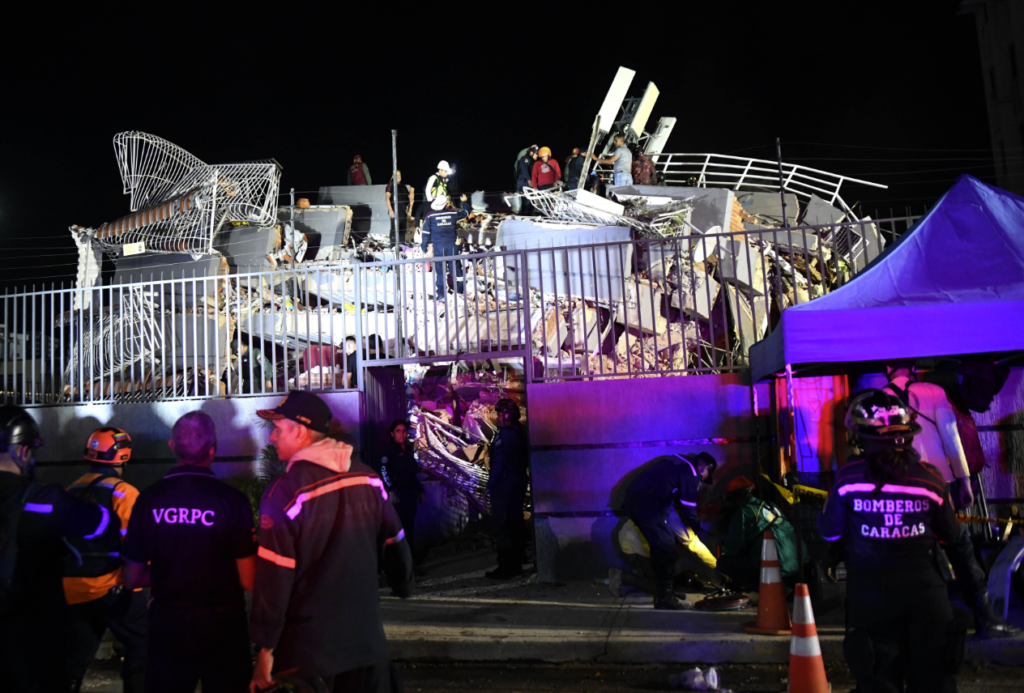
The double earthquake of June 24— the most devastating to hit Venezuela in over a century— has left at least 1,450 confirmed dead on the fourth day of rescue operations, according to government officials cited by CNN, with hundreds still trapped under the rubble and more than 157 missing. The states of La Guaira and Caracas have suffered the most brutal impact: some 250 buildings collapsed completely or partially, Maiquetía International Airport was damaged and closed for days, and entire neighborhoods of Catia La Mar—built during the years of the Chavista oil boom without regard for current earthquake-resistant building codes—were swept away as if they were made of cardboard.
Interim President Delcy Rodríguez declared a state of emergency and the state of La Guaira a disaster zone. The U.S. Treasury approved a temporary general license lifting sanctions for humanitarian operations until October 23, and Washington pledged $150 million in aid. Rescue teams from El Salvador, Spain, Mexico, Colombia, Turkey, Germany, Switzerland, and other countries have been deployed to the area. However, Interior Minister Diosdado Cabello restricted access to La Guaira after 8:00 p.m., and a radio announcer was threatened with being taken to the SEBIN (Bolivarian National Intelligence Service) for broadcasting the rescue efforts live.
IMPLICATIONS
What has happened in Venezuela cannot be understood solely as a natural disaster. This analyst has been arguing for years that narco-dictatorships have a dimension of institutional destruction that goes far beyond economic plunder: they also destroy the State’s capacity to protect its citizens from catastrophes or violence. Venezuela is today the most eloquent and most painful example of this thesis. Twenty-seven years of dictatorship, incompetence, blind and stubborn ideological fanaticism, folly, and the dismantling of the state to steal from any institution, department, or state account. The theft is so brutal that in PDVSA alone, the visible and known looting amounts to 25 billion dollars. The Castro-Chavista regime, governed today by the demonstrated ineptitude and incapacity of its repressive apparatus (the only thing narco-dictatorships are known for, besides rampant theft), is not only incapable of managing the crisis, imposing order (looting is rampant), and rescuing victims and recovering bodies to prevent cholera epidemics and other diseases associated with this type of natural disaster, but it also creates obstacles, prevents volunteers and international teams from working effectively, and lies about the number of victims. The UN reports at least 50,000 missing persons. Furthermore, no one is reporting what is happening in the shantytowns that populate the hills surrounding the Caracas Valley, where a true humanitarian catastrophe may be underway, about which we have barely any information.
The experts consulted by AP, CNN, and The Associated Press are unanimous: decades of corruption in the awarding of construction contracts—documented by Transparency Venezuela in 173 open court cases for alleged corruption active in 30 countries, totaling more than $72 billion—left buildings standing that should never have been built, or that were never reinforced according to the seismic codes updated in 2001. Engineer David Cocke, former president of the U.S. Earthquake Engineering Research Institute, explains it with the stark precision that only engineers can achieve when politics has failed: the buildings collapsed “like an accordion, floor by floor,” simply because they lacked the reinforcing steel connections required by modern standards. Studies published since 2013 by the Central University of Venezuela and FUNVISIS warned that 80% of the country’s population lived in areas of high seismic risk and that the recommendations for structural reinforcement were never implemented. The regime knew this. He chose not to act. His leaders preferred to plunder the public treasury with phantom infrastructure contracts.
PERSPECTIVES AND SCENARIOS
The massive international aid—which the regime is managing opaquely and with its usual control mechanisms—could become the key to Venezuela’s political transition, if Washington has the strategic foresight to set conditions for it. The US Treasury Secretary has already indicated that “a new Venezuela” must integrate into the dollar system: this signals that the door isn’t closed, but that the key lies with the Rodríguez regime, which must choose to either crack it open or continue condemning its people. The fact that María Corina Machado is announcing her return “very soon” to Venezuela to “stand with the people” suggests that the democratic opposition also perceives this moment as a historic opportunity it cannot afford to miss.
The greatest risk is that the emergency will become a pretext for the regime to entrench itself: the restriction of access to disaster zones, the threats to journalists and the opaque management of foreign aid are unequivocal signs that the Rodríguez brothers want to control the narrative as much as the corpses.
2. Israel-Lebanon: Washington’s framework agreement and the truce that Hezbollah rejects
FACTS
On June 26, 2026, Secretary of State Marco Rubio presided over the signing of a framework agreement between Israel and Lebanon—represented by their respective ambassadors to the U.S., Yechiel Leiter and Nada Hamadeh—at the State Department in Washington. Rubio described the agreement as “the beginning of the beginning” of a process toward “lasting peace and security.” The agreement includes the creation of “pilot zones” in which the Lebanese Armed Forces will assume exclusive control of the territory, excluding all non-state actors; the establishment of a U.S.-facilitated Tripartite Military Coordination Group for Lebanon (MCG4L); the provision of $100 million in immediate humanitarian aid and an additional $30 million for the Lebanese Armed Forces; and a structured process for dismantling Hezbollah’s terrorist arsenal.
Hezbollah was not part of the negotiations. The terrorist organization formally rejected the agreement through its MP Hassan Fadlallah, who called the negotiations “absurd, humiliating, and insulting” and warned that the agreement would lead to “internal conflict” in Lebanon. Israeli Prime Minister Netanyahu hailed it as “a severe blow to Iran” and described the process as solidifying the principle that Tehran “has no role in southern Lebanon.” However, Israel renewed its attacks on southern Lebanon as early as Sunday, June 28, while the Lebanese army reported casualties.
IMPLICATIONS
The Washington framework agreement is a real milestone, not a mirage. It is the first time since 1993 that Israel and Lebanon have negotiated directly—albeit through their ambassadors in Washington—a document intended to be permanent. And it is a diplomatic success for Rubio that deserves recognition, especially given that it was achieved against the backdrop of the still-unresolved Iran-Contra conflict and with Hezbollah remaining the actor with real veto power over any agreement on the ground.
Therein lies the inherent fragility of the process: Hezbollah—a terrorist organization that must be designated as such without ambiguity or euphemism—has not only rejected the agreement, but has made it clear that it will continue to act according to the dictates of the IRGC triumvirate that has governed Iran since Khamenei’s fall. The paradox of decapitation that this analyst has been describing and refining since the beginning of the post-Khamenei era is fully realized here: General Ahmed Vahidi, primus inter pares of the IRGC triumvirate, dominates through force and terror, but lacks the institutional and religious authority that allowed Khamenei to impose discipline on his proxies. This means that Hezbollah can act with greater operational autonomy than in the past, and that no agreement in Washington guarantees its inaction on the ground.
The text of the agreement stipulates that Hezbollah must withdraw north of the Litani River and dismantle its terrorist infrastructure. No one in Washington, Beirut, or Tel Aviv is unaware that this will not happen willingly. The relevant question is whether the Lebanese army has the capacity and the will to implement the pilot zones and whether the US is prepared to maintain pressure when—not if—violations occur. Trump asked Netanyahu for a “softer hand” in Lebanon at the G7 summit; Netanyahu responded by continuing the attacks. This dialogue between uneasy allies is the true heart of the negotiation.
PERSPECTIVES AND SCENARIOS
The framework agreement can evolve in two directions. In the first, the pilot zones function as a laboratory of trust, the Lebanese army consolidates its presence in the south, and the process moves toward an Israeli-Lebanon normalization that the moderate Arab world—especially Saudi Arabia—would view with growing satisfaction. In the second, Hezbollah sabotages the pilot zones, the attacks continue, Netanyahu responds forcefully, and the process fragments, in which case Iran will have achieved exactly what Leiter described: a “derailment.” Everything depends on whether the IRGC triumvirate decides that the cost of thwarting the agreement is greater than the cost of tolerating it. Given Vahidi’s profile—the most brutal and fanatical of the three, with no incentive for moderation—pessimism is justified.
3. Serbia: Vucic’s resignation, political responsibility and the European contrast
FACTS
Serbian President Aleksandar Vučić announced on Saturday, June 27, at a rally before his supporters in Belgrade that he will resign “in a few weeks” and run for prime minister in early elections, the date of which he has not yet specified. The announcement comes after eighteen months of mass protests—the longest sustained in Serbia since the overthrow of Slobodan Milošević in 2000—triggered by the collapse of the canopy at Novi Sad train station in November 2014, which killed 16 people. The structure that collapsed had been renovated by Chinese companies. The student protests, which forced the resignation of Prime Minister Miloš Vučević—former mayor of Novi Sad—in January 2025, have grown into a broad civic movement denouncing systemic corruption in infrastructure contracts, police repression, and the regime’s links to organized crime. Thousands of Serbs took to the streets again on Sunday, June 28, in a historic commemoration, indicating that the public pressure has not subsided.
IMPLICATIONS
Vučić’s resignation is not a surrender: it is a tactical retreat by a politician who has been in power for thirteen years and who has learned to survive his own crises by transforming them into electoral opportunities. His declared intention to run for prime minister confirms that he has no desire to retire. What changes is the institutional framework: the battle will no longer be fought from the presidency, but from the government, with direct access to the machinery of the state and with the advantage of continuing to control the hegemonic party, the SNS.
But beyond the Serbian political arithmetic, this episode illuminates a question this analyst cannot help but ask when looking toward Spain: when did political accountability become a relic of the past in a democracy? In Serbia, sixteen deaths in the collapse of a bus shelter—awarded through corruption and built without proper quality assurance—were enough to mobilize hundreds of thousands of citizens for a year and a half, to force the resignation of a prime minister in January 2025 and of the president himself in June 2026. In Spain, the floods of autumn 2024 in Valencia caused hundreds of deaths, the Adamuz train accident resulted in fatalities, and not a single high-ranking official resigned. Ximo Puig, who for years refused to invest in the hydraulic infrastructure that would have mitigated the Valencian catastrophe, remains very much present in public life. The difference between Belgrade and Madrid is not one of latitude: it is one of civic responsibility and political shame.
The contrast with Spain is as revealing as it is shameful in reverse: here, after the deadly floods in Valencia in the autumn of 2024 and the Adamuz train crash, no one has resigned. In Serbia, sixteen deaths in the collapse of a bus shelter were enough to mobilize the entire country and force the president’s resignation. In Spain, hundreds of deaths in the Valencian floods led to meetings, commissions, and cross-accusations between administrations, but not a single high-ranking official took responsibility. The difference is not geographical. It is one of civic culture and democratic accountability.
For the European Union, Vučić’s resignation presents both an opportunity and a risk. The opportunity: to accelerate Serbia’s accession process, freeing it from the Russian and Chinese sphere of influence. The risk: that early elections, without sufficient guarantees of a fair process, will simply replicate the same system in the hands of the same actors. Brussels has rightly demanded that Serbian foreign policy align with that of the EU—including sanctions against Russia for its aggression against Ukraine—but Belgrade’s energy dependence on Moscow and deeply ingrained Pan-Slavic sentiment make this conditional alignment a significant challenge.
PERSPECTIVES AND SCENARIOS
If Vučić wins reelection in snap elections—a likely scenario given his control of the party apparatus and the media—Serbia will remain an ally of Russia, an uncomfortable neighbor for NATO, and an obstacle on the Balkan flank of European security. If the opposition manages to articulate a credible alternative, a genuine Euro-Atlantic shift becomes possible. NATO views a neutral Serbia leaning toward Moscow as an unstable flank in a region surrounded by Alliance member states. From the perspective of the Western Balkan migration route, any destabilization in Belgrade has direct consequences for the countries on the front lines of reception, including Spain.
III. MEDIA RACK
International publishing overview in the last 24 hours:
| HALF | EDITORIAL LINE / MAIN FOCUS |
| New York Times | Extensive coverage of the Venezuelan earthquake, focusing on the international humanitarian response and the pressure on the Rodríguez regime. Analysis of the Israel-Lebanon framework agreement as a “fragile diplomatic milestone” mediated by Rubio. |
| Washington Post | Critical editorial on Delcy Rodríguez’s chaotic management: “The regime acts more as an obstacle than as a first responder.” Follow-up on the Washington framework agreement, highlighting Hezbollah’s exclusion from the negotiations. |
| The Economist | An analysis of the Israel-Lebanon truce titled “Israel and Lebanon’s fragile truce,” warning that Hezbollah is not a party to the agreement and that Iran will do everything possible to sabotage it. A column on Venezuela as a “failed state under the umbrella of disaster.” |
| Financial Times | Economic focus: The US Treasury temporarily lifts sanctions on Venezuela. Energy markets await developments in the Strait of Hormuz following Vahidi’s promise to regain control of the waterway. |
| The Times (London) | Front page with Vucic’s resignation: “Belgrade’s strongman yields to the streets.” Comparative context with infrastructure corruption across Eastern Europe. |
| The Guardian | Report on the humanitarian crisis in Venezuela: “1,450 dead and a regime that blocks information.” Criticism of Diosdado Cabello’s actions in restricting access to La Guaira. |
| Le Monde | Geopolitical analysis: “Washington’s role between Israel and Lebanon, without Hezbollah.” It warns that without Tehran’s active involvement, the truce is worthless. Column on Vucic’s resignation and its consequences for the Balkans. |
| Le Figaro | Editorial line favorable to the Rubio framework agreement: “An American diplomatic victory in the Middle East.” Report on Venezuelan constructive corruption and its parallels with the accelerated privatization of the Chavista years. |
| FAZ (Frankfurter Allgemeine) | Analysis of Vucic’s resignation: “Serbien nach Vucic — wohin?”. Emphasis on European conditions for accession and the energy dilemma with Russia. Column on Iran and the post-Khamenei IRGC. |
| Reuters / AFP / AP | News agencies: continuous dispatches on the Venezuelan earthquake, with figures updated to 1,450 dead; signing of the Israel-Lebanon framework agreement in Washington on June 26; and continued protests in Serbia following Vucic’s announcement. |
| Al Jazeera | Arab Focus: Critical coverage of the Israel-Lebanon agreement, highlighting Hezbollah’s rejection. Interviews with leaders of the terrorist group who describe the framework as “humiliating and insulting.” Column on Venezuela as a victim of economic imperialism. |
| Jerusalem Post/Times of Israel | Analysis of the Israel-Lebanon framework agreement: “The beginning of the beginning.” Positive assessment of Leiter’s participation in the negotiations and the role of the US. Warning about Iran’s willingness to sabotage the process. |
| Asharq al-Awsat / Arab News | From Riyadh: an analysis of Hezbollah’s weakening in the post-Khamenei context. A positive assessment of the Washington framework agreement as a sign that the Iran-Hezbollah axis is losing ground in the Middle East. |
| Corriere della Sera | Double analysis: the chaos of the Venezuelan response to the earthquake and the governance crisis it reveals; and Vucic’s resignation read from the Italian perspective of the Balkan candidate for the EU. |
| Kyiv Independent / Ukrinform | Following Vucic’s resignation: cautious satisfaction, fear that he will maneuver to perpetuate himself as prime minister. Link between the Serbian case and the narrative of Russian influence in the Balkans. |
| IISS / RUSI / CSIS | Think tanks: the IISS warns about the new morphology of Iranian power under the IRGC triumvirate; the RUSI publishes a note on the risk of Hezbollah’s disintegration without a functional Iranian pattern; the CSIS analyzes the framework agreement as a test for the Levant’s new security architecture. |
IV. GEOPOLITICAL RISK TRAFFIC LIGHT
| 🔴VenezuelaCRITICAL | 🔴Lebanon / HezbollahCRITICAL | 🔴Iran (IRGC)HIGH | 🟡Serbia / BalkansHIGH | 🟡Hormuz / EnergyHIGH | 🟢Marco Israel-LebanonSURVEILLANCE |
🔴 CRITICAL — Immediate risk with potential for escalation or serious humanitarian crisis.
🟡 HIGH — Significant tension; active monitoring required.
🟢 MONITORING — Ongoing process with key unknowns for its evolution.
V. EDITORIAL COMMENTARY
Three snapshots of a world without a safety net.
The world on this last Monday of June 2026 offers us three images that, placed side by side, brutally summarize everything that can go wrong when political power capitulates to corruption, fanaticism, or the autocrat’s mere instinct for survival. Venezuela bleeds beneath the rubble of what Chavismo built—or rather, what it failed to build, because infrastructure contracts were the spoils, not the objective. Lebanon contemplates a document signed in Washington that Hezbollah, true to its nature as a terrorist organization in the service of Iran, has rejected with the contempt it reserves for the sovereignty of the Lebanese state. And Serbia watches as its strongman—who also built his power on opacity and shady deals—performs a tactical pirouette to avoid total collapse, while the public doesn’t forgive him an inch.
Venezuela first. The June 24 earthquake would have been devastating in any well-governed country. In Venezuela, under the regime of the sinister Rodríguez brothers, it has been a genocide through accumulated negligence. More than 1,450 deaths in four days are not just the result of two earthquakes of magnitude 7.2 and 7.5: they are the result of decades of looted construction contracts, of anti-seismic regulations updated in 2001 that no one enforced, of underfunded hospitals, of dismantled civil protection, of a state that was systematically gutted until it was reduced to an institutional facade at the service of narco-terrorism. Transparency Venezuela documents 173 cases of alleged corruption in 30 countries totaling more than 72 billion dollars: that is the real price of each building that collapsed “like an accordion” on its inhabitants. Cabello’s restriction of access to La Guaira and the threats against journalists broadcasting live the rescue efforts are not anomalies: they are the regime functioning exactly as it was designed to function, that is, to control information and the narrative even if the cost is letting those who are still breathing under the rubble die.
International aid has arrived quickly and generously: $150 million from the US, elite rescue teams from the most advanced countries in this field, and a temporary lifting of sanctions. This is the right thing to do. It is also a test for the regime. Washington must insist that humanitarian access be free and unrestricted, that independent organizations can operate without interference from SEBIN (the Venezuelan intelligence service), and that aid not become an instrument for perpetuating the regime that has been so difficult to dismantle. Maduro’s capture was the first act of the transition; the earthquake may be the second—or it may be the pretext for a definitive entrenchment. Everything depends on whether Washington understands that solidarity with the Venezuelan people and pressure on the regime are not mutually exclusive options, but rather complementary and inseparable.
The Israel-Lebanon framework agreement is a welcome piece of good news in a bleak landscape, and this analyst says so without reservation. Rubio has done serious, tenacious, and effective diplomatic work: five rounds of talks, patience in the face of Hezbollah’s provocations, creativity in designing the pilot zones, and firmness in rejecting Iranian oversight. The text clearly establishes that Iran and Hezbollah are excluded from the Lebanese peace process. Netanyahu has described it as “a severe blow to Iran,” and he is right in a symbolic sense: for the first time since the founding of the State of Israel, Lebanon and Israel are directly negotiating a peace framework with American mediation, without Tehran being able to act as arbitrator. That is significant.
But the warning this analyst offers is equally important: an agreement that excludes the actor with veto power on the ground is not a complete agreement. Hezbollah—a terrorist organization with between 100,000 and 150,000 projectiles aimed at Israel—has not only rejected the text but has also warned that any attempt to implement it will generate “internal conflict” in Lebanon. What the IRGC triumvirate, headed by Vahidi, decides to do in the coming weeks will determine whether the framework agreement is the beginning of something transformative or just another document in the archives of the Levant’s missed opportunities. The paradox of decapitation—a dominant hawk who cannot guarantee compliance because he lacks the authority generally accepted by all sectors of the regime that the ousted Ali Khamenei possessed—applies here with full force: Vahidi may want to sabotage the agreement, he may order it, but he can no longer guarantee that its implementation will be orderly. That makes the process more dangerous, not safer.
And Serbia. The Serbian case is, in a way, the most instructive of the three precisely because it offers the most direct lesson for European democracies that look at themselves honestly in the mirror. Sixteen deaths in the collapse of a bus shelter—awarded through corruption, built without complying with regulations, and renovated by Chinese companies with shady contracts—were enough to keep half the country in the streets for eighteen months until the president was forced to resign. Compare that to the number of deaths in the 2024 Valencia floods. Compare that to the perfect impunity with which those responsible for that catastrophe have continued to hold office or enjoy their perks. The difference isn’t one of political system: Serbia is an imperfect democracy, but its citizens have a culture of demanding accountability that here seems to have dwindled to almost nothing. How many deaths does it take in Spain for someone to resign?
Three snapshots. A world teetering on the brink of several abysses, all of different natures, but equally deadly. An international community without a robust security architecture, without guarantees that corruption will have consequences, and without certainty that signed agreements will translate into real peace. But also a world where Belgrade’s civil society demonstrated that street protests can bring an autocrat to his knees, where Rubio showed that patient diplomacy yields results, and where international aid to Venezuela—if used with strategic intelligence and prevented from being stolen by Castro-Chavista kleptocrats—can become the engine of a transition that the Venezuelan people have been waiting for far too long.