Gustavo de Arístegui,
July 6, 2026
I. INTRODUCTION
Monday dawns, condensing into a mere twenty-four hours almost all the fault lines I’ve been describing since the outbreak of the Iran-Contra conflict: Tehran’s funeral choreography—bidding farewell to Ali Khamenei with a pomp intended to mask the power vacuum he himself left behind when he was killed—the still-intermittent reopening of the Strait of Hormuz and its immediate impact on a deflating oil market, the brutal Russian onslaught on Kyiv on the very eve of the NATO summit, the Chinese ballistic missile test in the heart of the denuclearized South Pacific, and, on the darkest flank, the horrors looming in Sudan after the fall of El-Fasher. I close the day with a seemingly minor note—the scandalous political interference in the World Cup rules—which, nevertheless, speaks volumes about the character of those behind it.
This analyst believes that the common thread of the day is not force, but its opposite: the lack of leadership. This is evident in a terrorist regime that buries its leader without anyone to replace him with authority; in a Europe unable to defend its own airspace; and, with some nuances, in an American foreign policy that alternates between successful military planning and improvisations marked by outbursts.
II. MOST IMPORTANT NEWS OF THE LAST 24 HOURS
1. Khamenei’s funeral and the consolidation of the Revolutionary Guard triumvirate
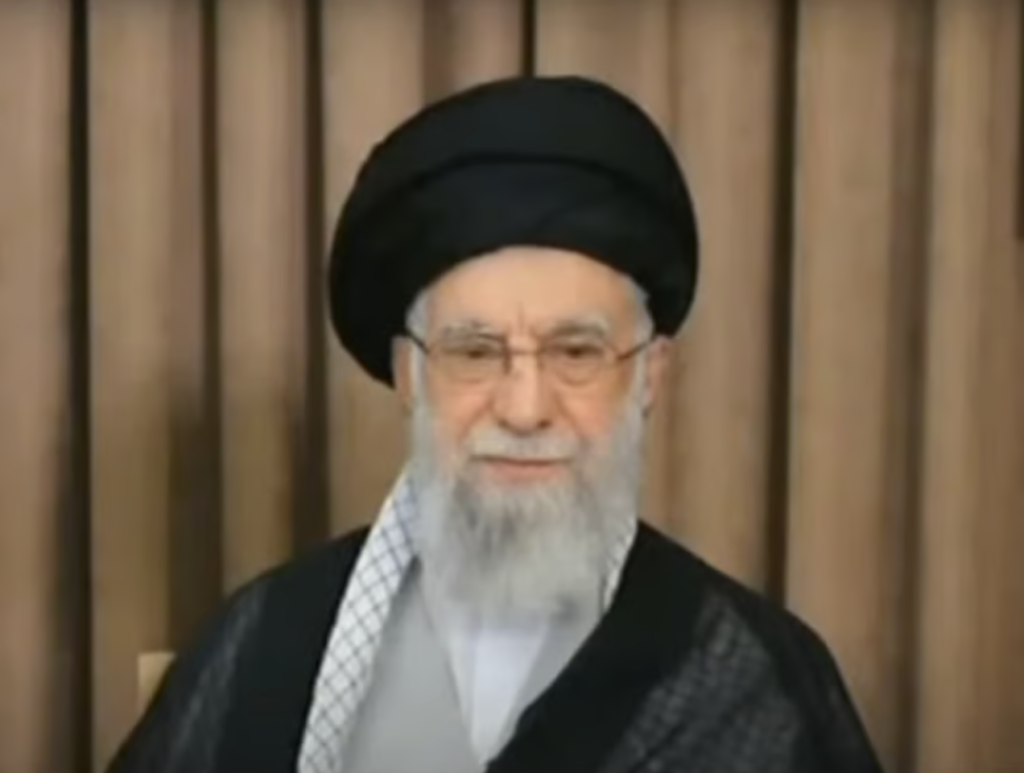
Facts.— Tehran held a grand funeral procession on Monday, July 6, for Ali Khamenei—killed on February 28, the first day of the war, in a joint US-Israeli attack on his residence—as part of a week-long funeral rites (July 3-9) that traveled through Tehran, Qom, and the Iraqi cities of Najaf and Karbala before his burial in Mashhad. The regime mobilized representatives from more than one hundred countries—including Russian President Dmitry Medvedev and Pakistani Prime Minister Shehbaz Sharif—closed the airspace over the capital, and transformed the ceremony into an act of ideological reaffirmation, with chants of “Death to America” and “Death to Israel,” and a poet who called for the death of Donald Trump before the crowd. The most revealing thing, however, is an absence: Mochtaba Khamenei, proclaimed successor and new “supreme leader”, has not appeared and his whereabouts remain unknown.
Implications.— This absence is not anecdotal: it is empirical confirmation of what I have been calling the paradox of decapitation . Mochtaba is a puppet leader , a figurehead; real power resides in the Revolutionary Guard triumvirate headed, as primus inter pares , by General Ahmed Vahidi—by far the worst option, as fanatical as the others, but much more ruthless and brutal—along with Mohamed B. Zolghadr ya Rezaei. The paradox, far from being resolved, worsens: the one who prevails is precisely the most bloodthirsty, so he can steer and dominate the negotiations, but he lacks the ideological, institutional, and religious authority—which Khamenei did possess—to impose internal discipline and guarantee compliance with the agreements. Not an equal without an arbiter, but a dominant hawk without the legitimate authority—or the will—to fulfill them. Hence the chaotic intermittency of Hormuz, which is the physical signature of this void. The very pomp of the funeral—with the leaders of its satellite terrorist organizations parading to stage the resilience of the so-called “axis of resistance”—is theater of continuity amidst a void of governance.
Perspectives and Scenarios.— Baseline Scenario (60%): Persistence of a fragile status quo , in which Vahidi dominates through force, fear, and fanaticism, but does not arbitrate; with Pezeshkian’s reformist wing systematically blocked and Ghalibaf answering to the triumvirate, not the president. Scenario B (40%): A Tehran emboldened by the turnout for the funeral, taking advantage of Washington’s foreseeable distraction—between the 250th anniversary of independence and the NATO summit—to try to regain regional influence through its terrorist proxies. In neither scenario is there a reliable guarantor of concessions: that is the structural bad news.
2. OPEC+ increases production and confirms the fragile reopening of the Strait of Hormuz
Facts.— The seven members who manage OPEC+ policy—Saudi Arabia, Russia, Iraq, Kuwait, Kazakhstan, Algeria, and Oman—agreed on July 5, in a teleconference, to increase production by 188,000 barrels per day starting in August, the fifth consecutive monthly increase. Since April, they have restored nearly 800,000 barrels per day—which, with the August increase, approaches one million—reversing the voluntary 2023 cut, now without the United Arab Emirates, which left the alliance on May 1. Brent crude is trading around $70-72, back to pre-war levels, while traffic through the Strait of Hormuz is recovering slowly—well below the nearly 130 daily transits of the past—and Iran has poured some fifty million barrels onto the market since the lifting of the naval blockade. Several analysts are already warning of a risk of oversupply in the short term.
Implications.— The market is pricing in a normalization that the Vahidi regime cannot credibly guarantee. The “paper barrels”—quotas that for months failed to materialize due to the closure of the Strait of Hormuz—are beginning to become real barrels, but on an unstable political foundation: we are, once again, facing the simmering systemic fracture that defines the relationship between Iran and the West today. The UAE’s withdrawal is also reshaping internal loyalties within the cartel and straining quota discipline.
Outlook and Scenarios.— Baseline scenario: gradual oversupply and soft prices, fueled by weaker Chinese demand, increased US and Russian exports, and the coordinated release of strategic reserves by the IEA. But the warning is crucial: a single incident in the Strait of Hormuz instantly drives up the price of crude, precisely because there is no command in Tehran that can offer guarantees. Today’s calm could be reversed in a matter of hours.
3. Russia strikes kyiv on the eve of the NATO summit
Facts.— In the early hours of July 6, Russia launched a combined barrage on Kyiv—according to the Ukrainian Air Force, 23 ballistic missiles, 39 cruise missiles, 6 Zircon hypersonic missiles, and 351 drones—leaving at least eleven to fourteen dead and more than sixty wounded, several of them children, with residential buildings devastated in several districts. This is the second major attack against the capital in less than a week, following the one on July 2, which caused more than twenty deaths. The most serious military fact: Ukraine failed to intercept a single ballistic missile due to the acute shortage of Patriot interceptors. Zelensky summed it up accurately: “This is typical of Putin: right after US Independence Day and before the NATO summit in Ankara.” Poland even activated fighter jets as a preemptive measure; Ukraine, for its part, attacked the Russian Baltic ports of Vysotsk and Ust-Luga, leaving Sevastopol without power. All of this came just hours before Trump and Zelensky were scheduled to meet at the NATO summit on July 8, and following a 90-minute phone call between Trump and Putin.
Implications.— We are unequivocally opposed to Russian aggression and the use of force as a means of acquiring territory. The timing of the attack—immediately after July 4th and on the eve of the summit—is a deliberate provocation and a message of contempt. But the biggest scandal is European: the shortage of Patriot interceptors is tangible proof of a continent that refuses to take its own defense, security, and destiny seriously, held hostage by a mediocre and short-sighted political class. Here the day’s leitmotif reappears: the leadership vacuum , which links the void in Tehran with the empty chair of a Europe—and of a Spain—that watches the spectacle without the capacity to dissuade. Spain’s exclusion from the Berlin Five was, and I maintain, a deserved and entirely justified exclusion: from lower NATO defense spending, one inevitably moves from irrelevance to suspicion. Regarding Trump, I am only moderately critical: his transactional diplomacy with Putin—a ninety-minute call that ends, hours later, with another massacre—lacks leverage; the hope lies in the good sense of those around him, and most notably Secretary of State Marco Rubio, ultimately prevailing over impulsiveness.
Perspectives and Scenarios.— The Ankara summit is a test: either the allies finally close the Ukrainian missile defense gap with Patriots and interception systems, or they condemn another round of this “variable-temperature war”—low-resolution but extremely destructive—that no one can win or afford to lose. Without credible air defense, every night in Kyiv will be a night of destruction.
4. China fires a submarine-launched ballistic missile in the denuclearized South Pacific
Facts.— The People’s Liberation Army Navy conducted a test launch of a “strategic” ballistic missile from a nuclear-powered submarine on Monday, July 6, at 12:01 p.m. local time , in the South Pacific. Beijing, through the Xinhua news agency, presented it as a “routine” part of its annual training, in accordance with international law and not directed against any country. The reality is more troubling: the test took place within the South Pacific Denuclear Zone—the 1986 Rarotonga Treaty, whose protocols China ratified in 1987, committing itself not to test nuclear weapons in the region. Japan “strongly urged” Beijing to reconsider; New Zealand’s Foreign Minister Winston Peters complained that he was notified only a few hours beforehand. And the launch coincided, on the same day, with the signing of a mutual defense treaty between Australia and Fiji aimed at countering Chinese influence, which Australian Minister Penny Wong described as “destabilizing”.
Implications.— We are very vigilant regarding Chinese expansionism in Asia, in the South China Sea, and in the Pacific. This is not a new Cold War—a framework I reject—but rather a systemic competition between an established power and an emerging one with incompatible models; the well-known “Thucydides Trap,” in Graham T. Allison’s formulation. The violation of the spirit of Rarotonga and the calculated coincidence with the Australia-Fiji agreement reveal textbook intimidation of the Pacific microstates, where China cultivates transactional partners, never true allies. It is the same logic—“small garden, high fence”—that the West applies to critical technologies and rare earth elements, now reflected as in a mirror.
Perspectives and Scenarios.— We are witnessing a nuclear arms race in the Pacific—Beijing already has around 600 warheads and will exceed 1,000 before 2030, according to the Pentagon, to the point that Rubio himself has warned that the United States could soon face “two nuclear pairs.” The reasonable response is not appeasement, but deterrence: AUKUS, the Quad, and a defense architecture that restores credibility to commitments.
5. Sudan: The looming horrors after the fall of El-Fasher
Facts.— Amnesty International published the report ” City Under Siege , Children Under Fire” at the end of June, concluding that the Rapid Support Forces (RSF) of General Mohamed Hamdan Daglo, alias Hemedti, committed crimes against humanity and ethnic cleansing during the capture of El-Fasher, the capital of North Darfur, which fell on October 26, 2025, after an eighteen-month siege. The UN independent fact-finding mission had already identified, in February, “indications of genocide” against the Zaghawa and Fur ethnic groups, with at least three acts constituting the crime; more than 6,000 people were reportedly killed in just three days. The war, which began in April 2023 between the Sudanese Army and the RSF, has caused tens of thousands of deaths and displaced nearly 14 million people. Amnesty warns that the same “manual of atrocities” is now being prepared for El-Obeid, in Kordofan — the imminent horrors to which The Economist points — and documents the supply of weapons to the RSF from several countries, pointing to the United Arab Emirates as its main military and diplomatic backer.
Implications.— We must expose barbarity wherever it occurs, without geostrategic excuses. Sudan is the most stark moral rebuke to a mediocre and short-sighted 21st-century international political class: Europe and the United States cut humanitarian aid while the slaughter was taking place, and African institutions—including the African Union—have been incapable of a unified response. That the main Security Council penholder on Sudan, the United Kingdom, yielded—as has been reported to its own Parliament—to pressure not to disclose external support for RSF is the precise measure of this abdication.
Perspectives and scenarios.— El-Obeid could be the next El-Fasher if the international community does not move beyond rhetoric to the effective protection of civilians, respect for the arms embargo, and accountability for those responsible, already named by Amnesty International. It is also a test of the credibility of the entire Western framework for “atrocity prevention.”
6. The scandalous political interference in the World Cup rules
Facts.— Forward Folarin Balogun, the US national team’s top scorer at the World Cup, was sent off on July 1 against Bosnia-Herzegovina, receiving an automatic one-match suspension that would have prevented him from playing in the round of 16 against Belgium. Donald Trump phoned FIFA President Gianni Infantino to request a review of the red card; and on Sunday, July 5, FIFA, invoking Article 27 of its disciplinary code, suspended the suspension —subjecting it to a one-year probationary period—and reinstated the player. Trump celebrated on social media as the redress of “a great injustice.” The Belgian federation declared itself “astonished” and is considering an appeal. According to experts, this is the first time since 1962—the Garrincha case—that a red card in a World Cup has not resulted in a suspension. It is worth remembering that Infantino presented Trump with a “peace prize” last year and gave him tickets worth $15,000, and that the United States is co-organizing this World Cup.
Implications.— I’ve written about the geopolitics of football enough not to be fooled: sport is a formidable instrument of soft power and , at the same time, a mirror of the character of whoever wields it. This episode portrays the worst of Trump—the erratic, transactional one, presided over by excess and outbursts—capable of bending an international organization to its will to force the letter of its own rules and erode fair play. And the nuance I always emphasize is necessary: I am in favor of a pragmatic and realistic American foreign policy, the kind that has achieved diplomatic successes when it acts prudently and with Rubio’s advice; but the capricious interference of a president in a footballer’s red card undoubtedly belongs to the other side of the coin.
Perspectives and scenarios.— The reputational damage to FIFA is significant and sets a poisoned precedent: if political power can overturn a sporting sanction based on a phone call, the integrity of the tournament is called into question. We will have to follow the reaction of UEFA and the Belgian federation—and any potential appeal to the Court of Arbitration for Sport—in what is already a new theater of political vanity.
III. MEDIA RACK
Summary of news coverage by regional blocks. Each entry paraphrases the main focus of the newspaper on the day’s news.
UNITED STATES PRESS
The New York Times
Live coverage of Khamenei’s funeral and the mysterious whereabouts of Mochtaba; also opens with Trump’s interference in FIFA and the Chinese nuclear test in the Pacific.
The Washington Post
It frames the launch of the Chinese missile as a breach of the denuclearized zone of the South Pacific and a focus of regional protests.
The Wall Street Journal/CNBC/Bloomberg
They emphasize OPEC+, the risk of oversupply, and Brent crude at pre-war levels; Bloomberg underlines that kyiv did not intercept a single ballistic missile.
CNN / Fox News / AP / Axios / Politico / The Hill
The Iranian challenge to Trump since the funeral and the FIFA-Balogun controversy dominate; Fox highlights the hardline stance and the 250th anniversary.
UK PRESS
The Guardian / BBC
They record the chants of revenge against Trump at the funeral and the clamor for more air defense for Ukraine.
The Times / The Telegraph
Strategic reading of the power vacuum in Tehran and the Russian provocation on the eve of the summit.
Financial Times
Crude oil market, UAE’s exit from OPEC+ and oversupply as the economic focus of the day.
The Economist
He warns of the impending horrors in Sudan and what Iran will have to bury besides Khamenei.
CONTINENTAL EUROPEAN PRESS
Le Monde / Le Figaro / Liberation
Pay attention to the Iranian regime’s choreography and the new barrage against kyiv; debate on European strategic autonomy.
FAZ / Die Welt / Die Zeit
Emphasis on the air defense gap and German responsibility within NATO.
Corriere della Sera
Mediterranean perspective on Iran and the Gulf.
L’Osservatore Romano
A humanitarian perspective on the civilian victims of Sudan and Ukraine.
MIDDLE EAST, GULF AND ISRAEL
Al Jazeera / Al Arabiya
Extensive coverage of the funeral as a stage set for the “resistance” and the leaders of the pro-Iranian organizations present.
Jerusalem Post / Haaretz
They analyze Tehran’s next move and the uncertainty surrounding post-Khamenei leadership.
Asharq Al-Awsat / Arab News
Focus on the stability of the Gulf and the recovery of traffic through Hormuz.
Gulf News / Times of Oman
Monitoring maritime trade and OPEC+ production.
ASIA-PACIFIC
The Japan Times / Yomiuri Shimbun
Tokyo “strongly urged” China not to launch the missile; concern over the opacity of Chinese rearmament.
South China Morning Post/China Daily
They reproduce the official version: a “routine” test in accordance with international law.
The Times of India / WION / The Straits Times
They frame the launch within the Indo-Pacific arms race and the Australia-Fiji pact.
RUSSIA, POST-SOVIET SPACE AND UKRAINE
TASS / Russia Today
They present the attack as a “precision” response to Ukrainian blows and publicize Medvedev’s presence in Tehran.
Kyiv Independent / Ukrainska Pravda / Ukrinform
They detail the death toll in kyiv, the Patriots’ absence, and Zelensky’s prior warning.
IBERO-AMERICA, AGENCIES AND THINK TANKS
Reuters / AFP / AP / DPA
Reference news reports on the funeral, OPEC+, kyiv and the Chinese missile, cross-referenced with multiple sources.
Clarín / El Mercurio / Reforma
Echo of interference in the World Cup and the rearmament of the Pacific.
RUSI / IISS / CSIS / IFRI / EIU
Analysis of deterrence in the Indo-Pacific, the Iranian command vacuum, and the oil oversupply.
IV. RISK TRAFFIC LIGHT
● Strait of Hormuz and post-Khamenei Iran: maximum risk. Without a leader capable of guaranteeing concessions, the reopening is reversible in hours; Vahidi’s triumvirate rules by force, but does not arbitrate.
● Russia-Ukraine: Missile gap: maximum risk. Kyiv did not intercept a single ballistic missile; the shortage of Patriot missiles makes every night a direct threat to the civilian population.
● Sudan / El-Obeid: maximum risk. RSF’s “atrocity manual” points to a new genocide if there is no effective protection of civilians.
● Pacific: China’s nuclear program: high and growing risk. The test in a denuclearized zone and the Australia-Fiji pact are straining an already volatile Indo-Pacific.
● Crude oil market: moderate risk. Oversupply is putting downward pressure on prices, but an incident in Hormuz would send them soaring immediately.
● European cohesion and Spain: moderate and structural risk. The lack of leadership and the underspending on defense perpetuate the transition from irrelevance to suspicion.
● Political interference in sport: reputational risk. The FIFA-Balogun precedent erodes the institutional integrity of the tournament.
● Maritime traffic through Hormuz: gradually recovering, with crude oil prices back to pre-war levels: the only note of relief, albeit precarious.
V. EDITORIAL COMMENTARY
There are days when geopolitics can be interpreted with a single key, and today’s key is the absence of leadership. Tehran is burying Ali Khamenei with excessive pomp precisely because it has nothing to fill the void he leaves: a son proclaimed as his successor who has already disappeared, and a triumvirate of ultra-conservative generals in which the most brutal, Ahmed Vahidi, holds sway. He can terrorize, but he cannot promise anything the regime is obligated to fulfill. This is the ultimate reason for the Hormuz Strait’s intermittent nature and the nervousness of the markets: there is no reliable interlocutor, only a dominant hawk without legitimate authority. Iran’s oligarchic-jihadist regime—a terrorist state and exporter of instability through its satellite terrorist organizations—survives, but as a headless structure that confuses revenge with strategy.
The same sense of abandonment, with a different face, is looming over the West. That Ukraine has failed to shoot down a single ballistic missile while Russia chooses the date—the day after July 4th, the eve of the NATO summit—to punish the civilian population of Kyiv is not just a Ukrainian tragedy: it is a testament to European abdication. I have long denounced a 21st-century political class incapable of taking its own defense seriously; today that denunciation has a technical name—a shortage of Patriot interceptors—and a political name: a Europe, and a Spain, that witnesses this drama without any capacity for deterrence. Spain’s exclusion from the Berlin Five was deserved and entirely justified; grandstanding is useless when you are the ally that invests the least in the Alliance. With Trump I maintain the same nuance as always: I applaud his foreign policy when it is pragmatic and moderated by Rubio, and I criticize it when it gives in to impulse—a ninety-minute call to Putin that ends with a massacre hours later is diplomacy without leverage.
In the Pacific, China launches a missile from a nuclear submarine in an area it has pledged to keep denuclearized, and it does so on the very day that Australia and Fiji sign their defense pact: this is no coincidence, it is a choreographed act of intimidation. This is not the Cold War—that comparison is lazy—but a systemic competition between incompatible models, the Thucydides Trap described by Graham T. Allison, in which Beijing cultivates transactional partners and never true allies. And in Sudan, the barbarity of the Rapid Support Forces—crimes against humanity, ethnic cleansing, evidence of genocide—challenges us without excuses: while Europe and the United States cut humanitarian aid, El-Fasher burned, and El-Obeid could be next. We are opposed to dictatorships and barbarity of any kind, and this barbarity demands to be named, held accountable, and effectively protected from the innocent.
There remains the final note, seemingly frivolous but ultimately revealing: a president’s interference in a footballer’s red card. I have written about the geopolitics of football enough to know that sport is a mirror of character. Trump, who has achieved undeniable diplomatic successes when governing prudently, reveals his true colors when he twists FIFA’s arm on a whim and calls the application of the rules a “great injustice.” We are Atlanticists at heart and staunch Europeans, grounded in reason and common sense; and from this conviction, I maintain that the greatest danger of our time is not the strength of our adversaries, but the leadership vacuum left by those who should be leading the free world and who are not always up to the task. Reason, I trust, will ultimately prevail; but it will not come on its own, and it certainly won’t come without a price.