Gustavo de Arístegui,
July 7, 2026
I. INTRODUCTION
We are living through, without rhetorical exaggeration, one of the most delicate moments the international order has experienced since the end of the Cold War—and I dare say, in some respects, the most delicate of all. The day we are analyzing today encapsulates this fragility with almost didactic clarity: a NATO summit, which should be momentous, opens in Ankara at a crucial moment, but—I warn you now—will end with utterly inconsequential results; the oligarchic-jihadist regime in Tehran, decapitated at its apex and without an arbiter capable of guaranteeing anything, once again sets the Strait of Hormuz ablaze; a car bomb explodes near President Macron’s hotel in Damascus; and a terrorist oligarchy buries its assassinated leader amid cries for revenge, displaying defiance instead of mourning.
The much-vaunted—but not truly desired, since we’re not even close to genuinely wanting it—strategic autonomy of Europe is, for now, a pipe dream. We lack the collective political will, the leaders endowed with the necessary vision and capabilities, the resources committed to our defense, and even the basic awareness of the gravity of the risks that threaten us. Against this backdrop unfolds a leitmotif I’ve been describing for weeks, which today reaches its starkest expression: the absence of leadership. The same absence that reigns in Tehran—where the most ruthless of generals rules by force without being able to arbitrate—reverberates, despite all moral differences, in the empty chair that Europe, and especially Spain, occupy at the table where its own destiny is decided.
II. MOST IMPORTANT NEWS OF THE LAST 24 HOURS
1. A NATO summit begins in Ankara, doomed to irrelevance under the aegis of Erdogan’s ego.
Facts
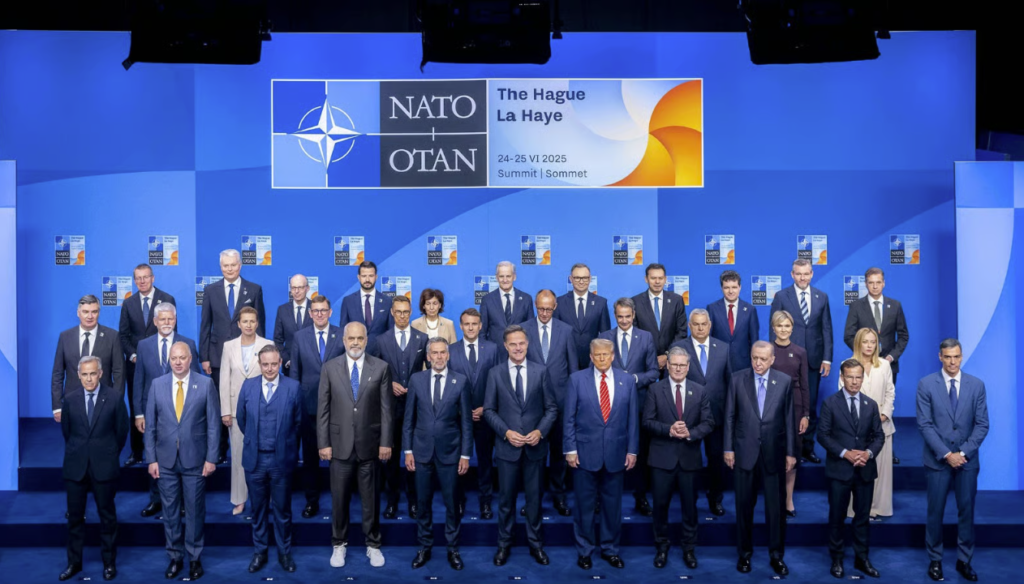
The heads of state and government of the 32 allies are meeting today and tomorrow, July 7 and 8, at the megalomaniacal presidential complex in Ankara—Recep Tayyip Erdogan’s ode to ego—for a summit that Mark Rutte, the Alliance’s secretary general, has sought to frame as a “defense industrial revolution.” In an event shamelessly dubbed ” the big reveal,” the Europeans will announce tens of billions of dollars in new arms contracts—a good portion of them, paradoxically, awarded to American companies—the replacement of the half-century-old AWACS surveillance aircraft fleet with Saab’s Swedish GlobalEye, and a battery of drone, missile, and interceptor programs partly financed by the European Union’s defense lending fund, endowed with up to $170 billion. The final declaration reaffirms the “unwavering” commitment to Article 5, describes Russia as a “long-term threat,” and pledges some 70 billion euros in military assistance to Ukraine by 2026. All this comes in the shadow of the Russian bombardment that, on the eve of the conclave, unleashed dozens of missiles and hundreds of drones on Kyiv, leaving at least eleven dead.
The background is well-known: Donald Trump, who has gone so far as to call NATO a “paper tiger , ” is demanding that the allies accelerate their spending to the 5% of GDP agreed upon in The Hague—3.5% on nuclear defense and 1.5% on expanded security—while Washington promotes its “NATO 3.0” doctrine: that Europe assume responsibility for its conventional defense so that the United States can focus on the Indo-Pacific against China. Trump will hold bilateral meetings with Zelensky, with the Syrian president Ahmed Al Shaara, and with Erdogan himself, whose potential reinstatement to the F-35 fighter jet program faces explicit opposition from Israel.
Implications
The Secretary General’s attempt to sell us a fairy tale about the Alliance’s new and unstoppable capabilities—the retirement of geriatric AWACS aircraft disguised as a technological leap—sounds like a tired joke from an unemployed comedian. And it’s worth stating this clearly: the problem isn’t just the 5%. Several European partners are already very close to or ahead of the United States, which spends a mere 3.4% of its GDP on defense and was—a devastating fact—the only NATO country whose defense spending, measured as a percentage of GDP, was lower in 2024 than in 2014. Poland (4.1%), Estonia (3.4%), Latvia (3.2%), and Greece (3.1%) disprove the narrative of the freeloading European. Washington should simply adhere to the standards it demands of others. In short, the summit exposes the asymmetry between a power that dictates and a Europe that obeys without direction.
Perspectives and scenarios
This analyst estimates that the outcome will be, at best, incremental progress without a rupture—just enough for Trump to claim a victory lap and for Europeans to breathe a sigh of relief at not having been publicly humiliated. Nothing resembling an autonomous strategic architecture. The underlying risk persists: an Alliance sustained by the arithmetic of spending rather than by shared political will is an imposing edifice built on foundations of sand.
2. The Revolutionary Guard attacks again in Hormuz: the Qatari gas tanker Al Rekayyat, punished for evading the regime’s “toll”.
Facts
On Monday night, the Islamic Revolutionary Guard Corps (IRGC) fired at least two missiles at merchant ships transiting the Strait of Hormuz, according to US sources cited by The Wall Street Journal and Axios. One of the vessels hit was the Al Rekayyat, a liquefied natural gas carrier owned by Nakilat (Qatar Gas Transport Company). The missile struck its port side, causing a fire in the engine room, but there were no casualties. It is significant that the victim was a Qatari vessel: Qatar is, in fact, the architect of the ceasefire. The IRGC had warned via maritime radio that its “missiles and drones are ready to fire” at those using the route near Oman instead of the corridors that Tehran claims the right to designate. Brent crude oil rebounded to around $73 a barrel; the UK and France announced a mission to secure the strait.
Implications
This episode confirms two theses I’ve been arguing. The first: that the regime plans to charge—after the sixty-day duty period—a fee for “navigation services,” that is, mafia-style extortion disguised as bureaucracy. The second, more profound, is what I’ve called the paradox of the decapitation : the removal of Tehran’s top brass hasn’t cleared the path to moderation, but rather exacerbated the governance problem. The regime now has a dominant figure—General Ahmed Vahidi—but lacks a reliable guarantor of any concessions. The most ruthless, not the most authoritative, prevails; and a dominant hawk without the legitimacy or the will to comply can only generate this chaotic intermittency in the Strait of Hormuz. This isn’t an accident: it’s the very hallmark of the new power structure.
Perspectives and scenarios
We are witnessing a textbook example of what I call variable-temperature warfare: low-resolution conflicts with extremely high destructive potential that neither side can win nor afford to lose. The IRGC’s triumvirate of general-terrorists needs constant tension to justify its rule and continue subjugating its own people. As long as the contained systemic fracture remains the regime’s natural state, the Strait of Hormuz will oscillate between self-serving openness and intimidating attacks, and the risk premium for crude oil will rise and fall in rhythm with this labored breathing.
3. Car bomb next to Macron’s hotel in Damascus: a warning in Al Shaara’s fragile Syria
Facts
Two explosions rocked central Damascus today as President Emmanuel Macron was concluding a two-day visit to Syria. The device—apparently an explosive attached to a vehicle—detonated near the Four Seasons Hotel, where the French president was staying, and the headquarters of the Ministry of Tourism. Macron, who was on his way to the People’s Palace to meet with his counterpart Ahmed Al Shaara, was unharmed and continued with his schedule as planned; the Élysée Palace confirmed that he did not even hear the blast. Images showed a burning vehicle and bloodstains on the asphalt, with feared casualties, although no official figures have been released. No group has claimed responsibility as of the time of this report. This was the first visit by a Western European head of state to Damascus since the fall of Bashar al-Assad, and Macron was accompanied by a business delegation—including the CEOs of TotalEnergies and CMA CGM—focused on reconstruction efforts.
Implications
Although the perpetrators remain unclear, the most plausible hypotheses point in two directions that should not be confused: terrorist cells sent or inspired by Tehran—which is undeniably harmed by the normalization of a post-Assad Syria oriented toward the West—or ISIS, Al Shaara’s mortal enemy. In either case, the message is identical: the security of the new Syria is a scarce and contested commodity, and those who strive for its stabilization are doing so on a minefield, both literally and figuratively.
Perspectives and scenarios
Syrian stabilization will remain hostage to its saboteurs. The attack—failed in its presumed objective, but effective as a warning—will not derail European openness, but it will increase its cost and slow the flow of investment that reconstruction requires. It will be necessary to closely monitor whether the investigation can identify the perpetrators, because the tone of the Franco-Syrian response in the coming weeks will depend on it.
4. Tehran buries Khamenei amid cries of revenge: defiance instead of mourning and a new regional order in the making
Facts
From July 3rd until his burial on the 9th in Mashhad, Iran is holding a state funeral for Ali Khamenei, who was killed on February 28th in the joint US-Israeli attack that triggered the war. Hundreds of thousands of people—the regime claims millions—have filed past the coffin at the Great Mosalla in Tehran, chanting slogans of “revenge” and reciting the words of a poet who openly called for the deaths of Trump and Netanyahu. Reuters summarizes the meaning of the ceremony: a display of defiance and the announcement of a new regional order. Delegations from some 100 countries—led by Russia, Pakistan, the Taliban, and the Central Asian republics, with the West conspicuously absent—have attended; envoys from the terrorist organizations Hezbollah and Hamas met with Foreign Minister Araqchi.
Implications
The crucial point is not who was present, but who was absent and who was superfluous. Mukhta Khamenei, the son “inexplicably called ‘supreme'” and designated successor, was absent. He has not appeared in public since his rise to power—wounded, in hiding, perhaps incapacitated—and is confirmed as a puppet leader, a figurehead, an empty shell. And General Ahmed Vahidi, commander-in-chief of the IRGC, was conspicuously absent, reappearing seated beside the coffin after months in hiding. Herein lies the heart of the matter. Real power now rests with a triumvirate of the Revolutionary Guard: Vahidi as primus inter pares—by far the worst of the options, as fanatical as the others but infinitely more brutal and ruthless, and wanted by Interpol for the 1994 bombing of the AMIA Jewish community center in Buenos Aires, which left 85 dead—; Former General Mohamed B. Zolghadr heads the National Security Council and the Al-Quds Brigades, with Rezaei serving as interim military advisor. Ghalibaf answers to Vahidi, not to the thwarted reformist Pezeshkian.
Perspectives and scenarios
The funeral choreography aims to project continuity and control over the transition, but it betrays the exact opposite: a regime with a ruthless ruler and no legitimate arbiter. I assign a 40% probability to Scenario B—a negotiation steered by the dominant hawk but incapable of guaranteeing compliance. As long as Vahidi rules through fear rather than authority, Iranian foreign policy will be one of exporting terror and instrumentalizing conflict as a method of internal survival. The defiance displayed at the funeral is not strength: it is the mask of a jihadist oligarchy that only knows how to sustain itself through constant pressure.
5. JetZero challenges Airbus and Boeing from the Mojave Desert: aerospace innovation as a barometer of power
Facts
In a hangar in California’s Mojave Desert, the startup JetZero is building the first full-scale demonstrator of a blended-wing-body commercial airliner—a manta ray-shaped design that the company says could cut fuel consumption by up to half. The 200- to 270-seat aircraft is targeting the mid-market segment once occupied by the Boeing 757 and 767. The demonstrator, partly funded by the U.S. Air Force ($235 million since 2023), is being manufactured by Scaled Composites—a subsidiary of Northrop Grumman—using Pratt & Whitney engines, and is expected to fly by the end of 2027. United and Alaska Airlines have already invested; United has an option to purchase up to 100 aircraft, with the possibility of ordering another 100. Analysts like Richard Aboulafia (AeroDynamic Advisory) judge it “premature, but not irrational,” while Bjorn Fehrm (Leeham News) points out that the promised savings have yet to be proven.
Implications
This news should not be dismissed as a mere industrial curiosity. The capacity of an ecosystem—venture capital, military contracts, universities, and agile regulators—to incubate a direct challenge to the Airbus-Boeing duopoly is, in itself, an indicator of national power. The United States transforms its economic muscle into technological capability with a fluidity that Europe observes with poorly disguised envy. And here the comparison is unavoidable: while on the other side of the Atlantic, entrepreneurial audacity flourishes with intelligent public support, the Old Continent witnesses, time and again, the paralysis of its major industrial programs due to the arithmetic of national returns and mutual distrust. Europe’s strategic abdication is not only military: it is also, and alarmingly, industrial and innovative.
Perspectives and scenarios
JetZero’s future hinges almost entirely on the flight of its demonstrator: if the aerodynamic promise is confirmed, industry skepticism will turn into a backlog of orders, and the project—fueled by the investor euphoria unleashed by SpaceX’s record-breaking IPO—could reshape the commercial aviation landscape by 2030. If it fails, it will remain a splendid military prototype. In either case, the lesson for Europe is the same: competition comes from innovation, not from lamenting.
III. MEDIA RACK
A regional summary of the dominant approach in the leading international press over the past 24 hours. Russian and Iranian state media are presented as symptomatic of regime propaganda, never as a reliable source.
North America (USA and Canada)
The New York Times
It frames the Ankara summit as a litmus test of spending promises and underscores the Iranian challenge at Khamenei’s funeral.
The Washington Post
It highlights the “great unveiling” of arms contracts with which NATO seeks to convince Trump.
The Wall Street Journal
It reports, with official sources, the IRGC attack on merchant ships in Hormuz and the radio warning to the vessels.
CNN
Follow live the impact with the gas tanker near Hormuz and the funeral procession in Tehran.
Fox News / CNBC
They focus on Trump’s pressure regarding burden-sharing and the rebound in crude oil prices after the attack.
Axios / Politico / The Hill
They detail Trump’s bilateral agenda (Zelenski, Al Shaara, Erdogan) and the internal frictions of the Alliance.
Foreign Affairs / The National Interest
They are debating the “NATO 3.0” doctrine and the US withdrawal towards the Indo-Pacific.
United Kingdom and Ireland
The Times / The Telegraph
They anticipate Ankara’s arms deals and the replacement of AWACS aircraft with the Swedish GlobalEye.
The Guardian
It captures the chants of revenge at Khamenei’s funeral and European doubts about the Iran war.
Financial Times
It analyzes the European defense lending fund and the risk that the spending will benefit the American industry.
BBC
Chronology of the fragile ceasefire in Hormuz and the opaque succession in Tehran.
The Economist / RUSI / IISS
They question the political sustainability of the 5% target and the divergence of threat perceptions within NATO.
Continental Europe and the Holy See
Le Monde / Libération
Intense coverage of the Damascus attack during Macron’s visit and his commitment to Syrian reconstruction.
Le Figaro / Le Point
They highlight Macro’s diplomatic boldness and the risk taken in an unstable Syria.
FAZ / Die Welt / Die Zeit
They discuss the German role in the new European defense architecture and the pressure from Washington.
Corriere della Sera
It focuses on the pulse of military spending and Italy’s position ahead of the summit.
L’Osservatore Romano / La Croix
Calls for peace and the protection of the civilian population in Syria and the Gulf.
IFRI
It warns about European industrial fragmentation compared to the effectiveness of the American model.
Middle East, Gulf and Israel
Al Jazeera / Al Arabiya
Minute-by-minute coverage of the Damascus explosions and the attack on the Qatari gas tanker.
Asharq Al Awsat / Arab News
Gulf wariness of Iranian extortion in Hormuz and the exploitation of the funeral.
The Jerusalem Post / Haaretz
They analyze Vahidi’s rise and the Israeli threat to eliminate the new “supreme” leader.
Yedioth Ahronoth / Times of Israel
They highlight the reappearance of the IRGC commander and the slogans against Trump and Netanyahu.
An-Nahar / L’Orient-Le Jour
They interpret the Damascus attack from the perspective of Lebanese and Syrian regional security.
The Peninsula / Gulf News
Qatari concern over the collision with a Nakilat vessel despite its mediating role.
Asia-Pacific and India
South China Morning Post
Ankara frames the US-China rivalry and the US shift to the Indo-Pacific.
China Daily
A pro-Tehran narrative critical of Western “interference” — labeled as propaganda.
The Times of India / Hindustan Times
They cover the Indian delegation at the funeral and the impact on Gulf energy routes.
The Straits Times / WION
They are monitoring maritime security in Hormuz and its effects on Asian trade.
Yomiuri Shimbun
Attention to the burden-sharing within the Alliance and to Japanese energy security.
Dawn / Daily Jang (Pakistan)
They highlight the presence of Prime Minister Sharif and the army chief in Tehran.
Russia and the post-Soviet space — symptom, not source
RT / TASS / Vesti
They amplify the “defiant” Iranian liturgy and sow doubts about who was responsible for the attack on the ships — regime propaganda.
The Kyiv Independent / Kyiv Post
They denounce the Russian bombing of kyiv on the eve of the summit and demand security guarantees.
Ukrainska Pravda / Ukrinform
They detail the $70 billion in military aid and the defense agreements that kyiv will sign with allies.
Agencies, think tanks and economic-strategic press
Reuters / AFP / AP / DPA
Hormuz attack, Damascus bombing and Ankara’s “great unveiling” confirmed.
Bloomberg
Brent crude rebounds towards $73 and energy markets become nervous.
Foreign Policy
X-ray of NATO’s internal fractures regarding trust and threat perception.
CSIS/Atlantic Council/PIIE
Skeptical about the viability of the 5% and whether the spending will translate into real capabilities.
The Economist Intelligence Unit
Evaluate the geoeconomic risk of Hormuz intermittency on the price of crude oil.
IV. RISK TRAFFIC LIGHT
Red = high risk / active · ● Amber = moderate risk / under surveillance · ● Green = favorable evolution / under control · ●
● Strait of Hormuz / Gulf maritime security — IRGC attack on merchant ships; covert extortion and rising crude oil risk premium.
● Succession and cohesion of the Tehran regime — Dominant hawk (Vahidi) without legitimate arbiter; missing successor; challenge as a method.
● Eastern Front / Ukraine War — Massive Russian bombing of Kiev on the eve of the summit; at least eleven dead.
● Atlantic cohesion / Ankara summit — Rising spending without common political will; US-Europe asymmetry and “NATO 3.0” doctrine.
● Syria / Al Shaara security — Car bomb next to Macron’s hotel; stabilization hostage of Tehran and DAESH.
● Spain / leadership vacuum — Reliability questioned by allies: from irrelevance to suspicion, empty chair at the decision-making table.
● Western aerospace innovation (JetZero) — A sign of US technological vitality; a contrast to European industrial paralysis.
V. EDITORIAL COMMENTARY
Some days are like X-rays, and today is one of them. In Ankara, the Alliance is projecting its strength with a catalog of contracts and a declaration of resolve; in Hormuz, a decapitated jihadist oligarchy demonstrates that the uncertainty about who is in charge inevitably translates into intermittent violence; in Damascus, a car bomb serves as a reminder that Syrian peace is a building under construction surrounded by arsonists. Three scenarios, one common thread: the lack of leadership.
Regarding the United States, I maintain my usual equanimity. I wholeheartedly applaud Trump’s foreign policy when it is pragmatic and realistic, when it is guided by the firm hand of Secretary of State Marco Rubio, and when it translates into tangible diplomatic successes. But the pressure exerted on allies in Ankara, without an accompanying strategic framework, belongs to a different register: that of erratic and transactional politics, governed by intuition and impulsive outbursts. With the Iranian regime, there can be no ambiguity: I was and remain in favor of the attacks that degraded its nuclear capabilities, but I have denounced from day one the glaring absence of a plan for the aftermath. That operation earned a 10 in military planning and a 0 in geostrategic planning, and the power vacuum that Vahidi now manages is the price of that lack of foresight.
And so we inevitably arrive at Europe—specifically, Spain. The strategic autonomy that is so often discussed will remain a pipe dream as long as the Old Continent fails to take its own defense, security, and destiny seriously. Spain, in particular, has been late and reluctant to acknowledge the threat, and has reaped what it sowed: a deep distrust among its allies that is on its way to becoming something far worse than irrelevance—suspicion. It is not just a matter of spending figures, but of reliability; and reliability, once lost, is extremely slow to rebuild. The fact that other Europeans are already surpassing the United States in relative effort demonstrates that Spain’s problem is not one of resources, but of will and vision.
I’ll end where I began. The JetZero of the Mojave Desert and the empty chair of Europe are two sides of the same coin: one of those who transform their wealth into capability and the other of those who squander it on indecision. The lesson, for those willing to hear it, is as old as national politics: power is neither inherited nor proclaimed; it is built—by innovating, spending wisely, and, above all, making decisions. The rest is just talk.