Gustavo de Arístegui,
July 24, 2026
I. BRIEF INTRODUCTION
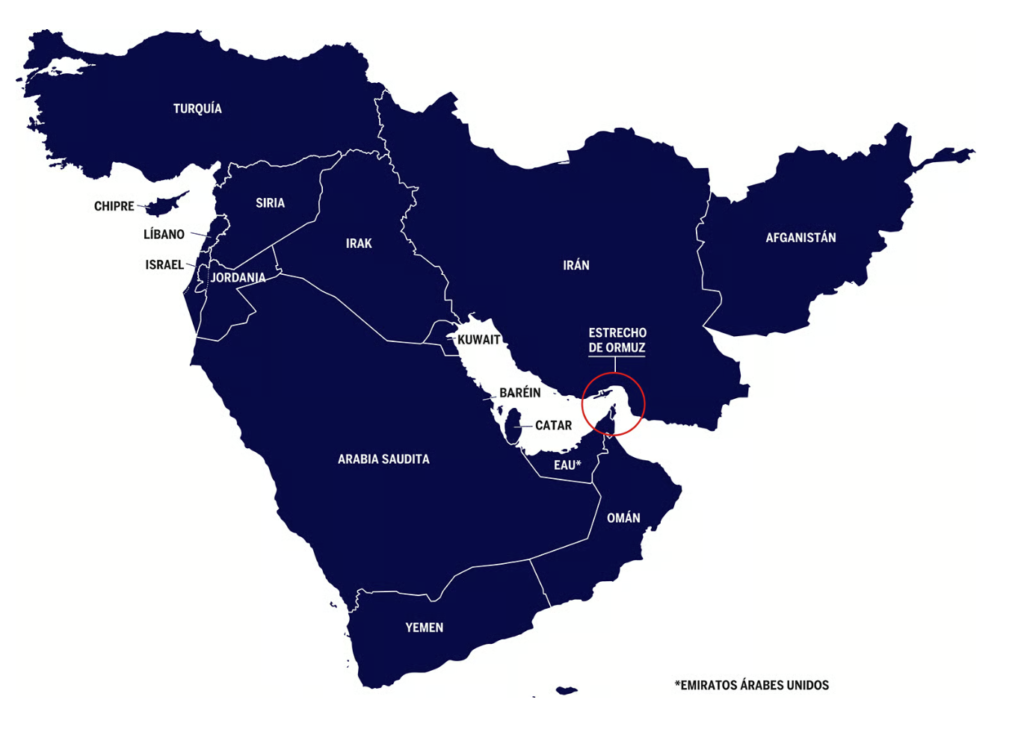
There are days when the world map is better understood by looking at the water than at the land. Yesterday was one of them. In less than 24 hours, the Tehran regime and its Yemeni proxy have achieved something the Soviet Union failed to accomplish in 40 years of Cold War: to simultaneously threaten the two straits upon which trade between Asia and Europe depends. The Strait of Hormuz has been an extortionate tollbooth for months; Bab el-Mandeb has just been added to the list. Brent crude surpassed 100 dollars a barrel, and the world rediscovered, with the clumsiness of someone who stumbles twice over the same stone, that globalization doesn’t float in the air, but rather rests on a few nautical miles of narrow, heavily guarded water.
The rest of the day confirmed a pattern this report has been pointing out for months. Washington signed a civilian nuclear agreement with Riyadh on Wednesday and, 24 hours later, rewrote its terms on social media. The Office of the U.S. Trade Representative (the equivalent of a foreign trade secretary in the U.S.) erected a new tariff wall on 60 trading partners that account for 99 percent of U.S. imports. In Manila, Marco Rubio and Sergey Lavrov met without any results, while Volodymyr Zelensky once again dismissed his top military leadership. And the Islamic Revolutionary Guard Corps declared British bases a “legitimate target,” placing, for the first time, the home territory of a European NATO ally in Tehran’s explicit crosshairs.
We’ll close with Elon Musk, who has once again done what he does best: turning an interview into a geopolitical event. His predictions seem outlandish, and I certainly hope so, because they are deeply unsettling. His immense influence is often criticized, along with that of other tech magnates, as it’s believed he has no control and that they are already far more powerful than nation-states. Some argue that these large corporations should be monitored much more closely. That’s always been Europe’s obsession, and that’s why we don’t have them on our continent. Europe still refuses to learn; I hope I haven’t ruined your weekend.
II. THE SIX MOST IMPORTANT NEWS STORIES OF THE LAST 24 HOURS
1. The double maritime strangulation: Bab el-Mandeb joins Hormuz and Brent breaks the one hundred dollar barrier
Facts
- The Yemeni Houthis, aligned with Tehran, claimed responsibility on Thursday for missile and drone attacks against two Saudi oil tankers in the Red Sea, identified as the Encelia and the Layla. The official Saudi Press Agency (SPA) confirmed a fire on the bow of the Encelia. No casualties have been reported. This is the first attack since the group announced a naval blockade of Saudi ports on Monday in retaliation for the Saudi blockade of Yemen and an attack on Sana’a International Airport.
- The effect on shipping was immediate. Five oil tankers changed course on Wednesday to avoid Bab el-Mandeb, and three loaded with Saudi crude bound for China and India turned back on Tuesday. The Institute for the Study of War counts at least seven diverted vessels.
- Brent crude surpassed $100 a barrel for the first time in two months. West Texas Intermediate (WTI) crude advanced more than 6 percent in a single session to climb above $92, marking its fifth consecutive day of gains and its highest level since early June. Goldman Sachs warns that Brent could exceed $120 in the fourth quarter if the Strait of Hormuz remains disrupted.
- Transits through the Strait of Hormuz have fallen by around 90 percent. According to HSBC’s analysis, liquid flows through the strait have been below two million barrels per day for the last six days, compared to more than six million in June and more than ten million at the beginning of July.
- The US Central Command completed its twelfth consecutive night of attacks on Iran. Tehran, in turn, claimed responsibility for attacks against US missile systems, weapons, and fuel depots in Jordan, as well as against military positions in Kuwait, including the Ali Al Salem air base and the Arifjan and Doha camps.
- President Trump announced on Wednesday an automatic retaliation doctrine: for every ship attacked in the Strait of Hormuz, the United States would destroy a bridge or power plant in Iran, including targets in or near the capital. An Iranian military source quoted by the Tasnim news agency countered that Tehran would strike infrastructure, bridges, and energy facilities throughout the region where the United States has interests.
- As collateral damage, Kazakhstan’s Energy Ministry suspended loading operations at the Caspian Pipeline Consortium terminal in Novorossiysk and cut production, amid the threat of Ukrainian attacks on oil infrastructure and ships in the Black Sea.
Implications
Bab el-Mandeb is no ordinary strait. Around twelve percent of global trade and a quarter of global container traffic pass through it, on the route linking Europe and Asia via the Suez Canal. The fact that both access points to the Arabian Peninsula are simultaneously compromised means we are no longer talking about a regional crisis, but a structural dysfunction of global trade. The irony is bitter: the same analysts who for years maintained that economic interdependence made war unthinkable are now discovering that interdependence, without the capacity to protect it, is not insurance but a vulnerability.
It’s important to understand the adversary’s logic, because it’s more intelligent than it’s given credit for. Tehran doesn’t need to close the Strait of Hormuz; it simply needs to make it unpredictable. Insurance premiums, route deviations, and increased freight costs do the rest without the need to fire a single additional missile. This is what we’ve called in these reports the “variable-temperature war”: neither peace nor open war, but a thermostat that the regime raises and lowers at will to extract political and economic gains. The Houthi blockade of Sana’a and the Red Sea is the extension of that same thermostat to a second bottleneck.
And here it is necessary to turn our attention to the man who now commands the Revolutionary Guard Corps. Since March 1, following the death of Mohammad Pakpour on the first day of the war, the IRGC has been under the command of General Ahmad Vahidi. It is worth recalling his background, because it explains much of what we are witnessing: he was the first commander of the Quds Force, before Soleimani; he is subject to an Interpol Red Notice for his alleged role as the mastermind behind the AMIA bombing in Buenos Aires; and he was sanctioned by the US Treasury for the brutal repression of the protests following the death of Mahsa Amini. Experts who are most familiar with the Iranian power structure agree that he is even more radical than his predecessor and that he is one of the most vehement opponents of any compromise with Washington.
It is the paradox of decapitation in its purest form. The regime’s leadership—including Ali Khamenei himself—was eliminated in the expectation that the system would either collapse or implode, but the exact opposite has occurred: the power vacuum has handed the coercive apparatus to the most hardline figures within the regime, precisely those who have nothing to negotiate because their personal survival depends on there being no negotiation. Those who fail to plan for the future should not be surprised when others plan for it.
There is also a Saudi dimension that cannot be overlooked. Riyadh is under attack on both its maritime flanks precisely the week it signs a civilian nuclear agreement with Washington and the US president publicly demands that it recognize Israel. The sequence is, to say the least, unfortunate.
Perspectives and scenarios
The first scenario, the most likely in the short term: a gradual, fluctuating escalation. Sporadic attacks without a formal closure of either strait, nighttime US retaliation, and Brent crude fluctuating widely between $90 and $115. HSBC considers the Houthi threat to Saudi exports overvalued, and weak Chinese demand for crude acts as a buffer. This scenario suits the regime, allowing it to collect the toll without crossing the threshold that would trigger a terminal response.
Second scenario, escalation: Trump literally implements the “bridge or power plant” doctrine against targets near Tehran, Iran responds by striking Gulf energy infrastructure, and Brent crude surges above $120, with the historical benchmark of $128 in 2022 within reach. The probability is not negligible, and it increases with each night of bombing and each ship set ablaze.
Third scenario, de-escalation: Omani or Qatari mediation to re-establish a verifiable transit regime. This is the sensible solution and, for that very reason, the least likely while the IRGC remains under its current control. In any case, Muscat’s actions should be closely monitored, as it has already submitted a tentative proposal for managing routes in the strait.
2. Washington signs the civilian nuclear agreement with Riyadh and twenty-four hours later conditions it on the Abraham Accords
Facts
- On Wednesday, June 22, Energy Secretary Chris Wright and his Saudi counterpart signed the so-called 123 Civil Nuclear Cooperation Agreement. According to US officials, it has a 30-year horizon and is worth tens of billions of dollars, and incorporates a bilateral safeguards agreement designed to prevent any military applications of the program. It is accompanied by a bilateral protection agreement.
- The International Atomic Energy Agency confirmed that it had been notified of the intention to request verification measures related to the bilateral agreement, and stated that it was awaiting formal receipt of that request.
- On Thursday, the 23rd, President Trump posted on Truth Social that the agreement “will be approved, but is entirely contingent” on Saudi Arabia joining the Abraham Accords, adding that there would be no material enrichment. White House Press Secretary Karoline Leavitt confirmed to the press that, for the president, the agreement would fall apart if that condition was not met.
- Two US officials told ABC News that the text leaves open the possibility of future domestic enrichment. Various media outlets report a two-year feasibility study on this issue. Congress has 90 days to review the agreement before it takes effect.
- From Manila, Secretary of State Marco Rubio stressed that the agreement guarantees Riyadh will work with American companies and not with competitors, mentioning China, South Korea, France, and Russia as alternatives the kingdom could turn to.
- Benjamin Netanyahu publicly welcomed the prospect of Saudi Arabia joining the Abraham Accords, even though the nuclear agreement had previously drawn criticism in Israeli state media. Riyadh remained silent on the condition imposed by Trump. The kingdom has consistently rejected normalization with Israel without a serious path toward the establishment of a Palestinian state.
Implications
Let’s start with the essentials, because at this point it’s important to be clear and not join the easy chorus of neutrality: the civilian nuclear agreement with Saudi Arabia is good news and deserves applause, not censure. This isn’t a double standard. Washington will verify that the Saudi program remains strictly civilian—and the IAEA has already been notified to that effect—while no one, absolutely no one, can vouch for the intentions of the Iranian program. Riyadh is getting this agreement because it’s a solid US ally and a pillar of regional stability, and because it genuinely wants to stop burning oil and gas to generate electricity, which is as legitimate as it is reasonable. The message being sent is the right one: the West is sharing technology with those who want a genuinely peaceful program, while dual-use facilities, plutonium, and enrichment levels above 90 percent reveal, in themselves, the intentions of those who operate them. And there is an implicit deterrent message that Tehran would do well to decipher: nuclear cooperation between Washington and Riyadh could be redirected from civilian to military if Iran crosses the atomic threshold.
That said, and precisely because the underlying principle seems sound, the method deserves severe criticism. Signing a thirty-year treaty on Wednesday and rewriting its essential terms on Thursday on social media is not tough negotiation: it’s transactional improvisation. It devalues the United States’ signature, which is the most valuable strategic asset possessed by the world’s leading power, and places a partner in the humiliating position of having to negotiate in public what it had already agreed to privately. This is exactly the pattern of impulsiveness and impulsiveness that we have been criticizing, and it contrasts sharply with the sober, reasoned, and strategically intelligible approach represented by Secretary Rubio, whose intervention yesterday in Manila—the argument of competition, not blackmail—is the one that should have prevailed.
There is also a problem of timing. Demanding that Riyadh recognize Israel at the precise moment when its oil tankers are burning in the Red Sea and its ports are under Houthi blockade is asking it to bear the maximum domestic political cost at its most vulnerable hour. No government in the world, least of all a monarchy that rules over the custodianship of Islam’s Holy Sites, can afford to be seen trading recognition of Israel for jets while its fleet is under attack. The objective—the expansion of the Abraham Accords—is magnificent and deserves to be pursued with determination; the timing and manner chosen make that objective more difficult, not easier.
The unresolved contradiction remains between the president’s assertion—that there will be no enrichment—and the description provided by his own officials: a text that leaves the door ajar for a feasibility study. This ambiguity will be the focus of debate on Capitol Hill, and the Senate’s non-proliferation faction will have no shortage of ammunition.
Perspectives and scenarios
Congress will scrutinize the agreement closely, and the battle will be fought over the enrichment clause, not the normalization clause. A cross-party coalition of skeptics is expected to demand gold safeguards—the so-called gold standard, meaning an explicit waiver of enrichment and reprocessing—as a condition for not blocking it.
Riyadh will not normalize relations under duress and in the midst of the Red Sea crisis. The most likely outcome is a discreet advance, tied to some verifiable gesture on the Palestinian issue, and certainly not before the waters of the Gulf calm down. If the agreement falls apart, the worst possible result will be the kingdom turning to Beijing, Seoul, Paris, or Moscow, and then the Western verification currently under discussion will be nonexistent. Those who oppose the agreement out of non-proliferationist zeal should ask themselves what alternative they are actually promoting.
3. The new tariff wall: between 10% and 12.5% for sixty trading partners for forced labor
Facts
- The Office of the United States Trade Representative (the U.S. trade minister) announced Thursday the imposition of tariffs ranging from 10 to 12.5 percent on imports from 60 trading partners, representing 99 percent of U.S. imports. These tariffs take effect at 12:01 a.m. on Friday, just as the temporary global tariff of 10 percent expires.
- The legal basis is Section 301 of the Trade Act 1974, relating to unfair trading practices, following an investigation opened in mid-March into the alleged lack of enforcement and effective application of the ban on importing goods produced with forced labor.
- The distribution: seventeen partners remain at ten percent for having adopted at least some restrictions —among them the United Kingdom, Canada, Mexico and India, whose rate fell from the initial twelve and a half—; thirty-eight remain at twelve and a half, including Vietnam and China; and five, including the European Union, are subject to a supplementary levy to reach the corresponding rate.
- Oil, gas, and fertilizers are exempt, as are products that meet the franchise requirements of the United States-Mexico-Canada Agreement. The new rates are not cumulative with existing tariffs. Steel, aluminum, and automotive components remain under Section 232.
- The legal context is crucial: in February, the Supreme Court struck down the so-called Liberation Day tariffs, imposed under the International Emergency Economic Powers Act, for exceeding its authority. The subsequent 10 percent global tariff adopted under Section 122 was declared illegal by the Court of International Trade in May, although an appeals court suspended that ruling. This is, therefore, the third legal challenge in six months.
- Trade Representative Jamieson Greer argued that the United States has had its own ban on imports produced with forced labor for nearly a century and that it is time for its partners to do the same. The European Union firmly rejected the accusation even before the final ruling was announced.
Implications
Let it be recorded that our position, which has always been the same and has not changed, is that we do not support restrictions on free international trade. We stand in the tradition of Ronald Reagan, for whom open trade was not a concession to others but a source of prosperity, freedom for democracies, and strategic strength for the United States itself. A tariff is a tax, paid by American businesses and consumers, and no amount of rhetoric about reindustrialization changes that basic arithmetic.
Forced labor is a real and extremely serious scourge, and the author of these lines needs no convincing: the quasi-slave labor exploitation in Xinjiang and so many other parts of the world is one of the systematic crimes of our time and deserves the strongest possible response. But precisely for this reason, the instrumental use of an undeniable moral cause is so painful. When the same tariff rate is applied to the United Kingdom, Canada, and the European Union as to authoritarian regimes that practice forced labor as a state policy, forced labor is not being combated: the accusation is trivialized, and allies are angered. Moral condemnation, when it becomes a pretext for universal revenue collection, loses precisely what made it effective.
There is a second, deeper problem: the legal merry-go-round. Three different legal frameworks in six months to support the same trade policy is not firmness; it is an admission that policy precedes the legal basis and that the legal basis is sought afterward. Legal certainty is a strategic asset of the highest order, perhaps the most undervalued of all, and eroding it is costly in the long run, even if it generates headlines in the short term.
And there’s a geoeconomic opportunity worth highlighting. Erecting a tariff wall the same week Brent crude breaks $100 is like adding one inflationary shock to another. The American consumer will pay twice: at the pump and at the supermarket. With the Federal Reserve already in an uncomfortable defensive pause, the combination is hardly fortunate.
Perspectives and scenarios
There will be litigation, again. But it’s worth noting that Section 301 stands on much firmer legal ground than the Emergency Economic Powers Act: it’s the classic instrument for combating unfair practices, it requires prior investigation—which has taken place here—and it has withstood previous challenges. Anyone expecting a swift annulment will likely be disappointed.
The European response will predictably be measured: negotiation rather than retaliation, with the anti-coercion instrument as a latent threat, not the first option. This is the sensible course of action, and it is what Brussels will do, although it will once again demonstrate that the Union always reacts one step behind the curve.
The Indian case is worth noting. New Delhi has managed to lower its rate from 12.5% to 10% by tightening its regulations. This is the actual mechanism the instrument rewards, and this is the precedent other partners will try to replicate in the coming weeks. Bilateral technical negotiations will be, more than a dispute, the way out.
4. London in the crosshairs: IRGC declares British bases a “legitimate target”
Facts
- The Islamic Revolutionary Guard Corps issued a statement on July 23 warning that any British military base used by the United States to attack Iran constitutes a legitimate target, and specifically names the Royal Air Force base at Fairford in Gloucestershire.
- The statement maintains that the United States has resorted to using B-1B Lancer bombers launched from Fairford after warships deployed in the Indian Ocean exhausted their stockpiles of cruise missiles. Flight tracking websites recorded a B-1 departing Fairford on Tuesday night, heading toward Iranian airspace. Tehran further accuses London of being one of the main architects of instability in the Middle East and warns it against further damaging its record.
- Hours before the threat, two EA-37B Compass Call electronic warfare aircraft arrived in Fairford from the United States.
- The new British Prime Minister, Andy Burnham, has confirmed the continuation of his predecessor Keir Starmer’s policy, authorizing the use by the United States of the bases at Diego Garcia, in the Indian Ocean, and Fairford for defensive attacks against Iranian missile sites that threaten maritime traffic in Hormuz.
- The official British response was that its armed forces are prepared to defend the country both at home and abroad. There is a precedent: on March 20, Iran launched two Jorramshahr-4 intercontinental ballistic missiles at Diego Garcia; one failed in flight and the other was intercepted.
Implications
That a terrorist state would name a base located within the metropolitan territory of a European NATO member after itself is not a rhetorical episode that can be dismissed with a shrug. It is the first time in this war that the threat has been formulated in this way, and it deserves to be taken extremely seriously: not one degree more, so as not to play into the regime’s propaganda machine, and not one degree less, so as not to repeat the mistake of those who for decades confused Tehran’s bravado with harmlessness. The jihadist oligarchy that governs Iran has been exporting terrorism by proxy for forty-seven years, and its proxies have struck in Beirut, Buenos Aires, Baghdad, and the Red Sea. They know how to do it.
But the truly uncomfortable lesson of this news isn’t in Tehran, it’s in Europe. Observe the roles being played. London is acting: it’s lending its bases, assuming the risk, and its new prime minister—from whom a change of course might have been expected—is maintaining the Atlanticist continuity of his predecessor, which is to his credit. Paris and Berlin are talking. And Madrid is looking the other way, after having distanced itself even from the naval mission in Hormuz. A country that derives a substantial part of its prosperity from maritime trade, that has its own bottleneck in the Strait of Gibraltar, and that aspires to be taken seriously in the forums where decisions are made, cannot afford systematic absence. Absence is also a policy, and it has a price that is exacted at the least opportune moment.
And here we must be blunt about the issue that best encapsulates the mediocrity of 21st-century European politics: the demise of the sixth-generation fighter jet. In June, Paris and Berlin certified the end of the FCAS program—more than one hundred billion euros, the flagship of so-called European strategic autonomy—not because of a fundamental strategic disagreement, not because of a change in the threat, but because of an irreconcilable power struggle between Dassault and Airbus over who controlled technological development and the combat cloud. Let’s read that again: Europe relinquished its air superiority capability for the next four decades over a dispute over shareholding percentages.
The Franco-German Council of Ministers in Cologne on July 17th was busy trying to cover up the disaster by announcing German conventional participation in a French nuclear exercise. Chancellor Merz even went so far as to claim that the FCAS was much more than a fighter jet, that it was a system. He was right: it was much more than an aircraft, and that’s why it’s all the more serious that it’s now much less than an aircraft. The Spanish Minister of Defense, Margarita Robles, unequivocally labeled the outcome a failure and blamed the companies for prioritizing their economic interests over the security of Europe. The diagnosis is correct; the omission, glaring. Companies do what companies do. It was the governments—the French, the German, and also the Spanish—that had the political obligation to prioritize strategic interests over industrial division, and they failed to do so. Spain, a full partner through Indra, watched the shipwreck as a mere bystander, powerless, voiceless, and without an alternative plan.
The result is cruelly ironic: the biggest beneficiary of European strategic autonomy is Lockheed Martin. The continent’s air forces will continue buying F-35s and upgrading fourth- and mid-generation platforms, and Europe will remain, in the air, a perpetual customer of the Pentagon. Let it be known that we are Atlanticists at heart and that we consider the transatlantic relationship the most valuable asset of the West; precisely for this reason, it is unbearable that Europe is a subordinate partner due to its own incompetence and not out of necessity. An alliance between an adult and a minor is not an alliance: it is guardianship.
Perspectives and scenarios
The probability of an effective Iranian attack against British territory is low: the March failure against Diego Garcia exposed the limitations in the accuracy of Iran’s long-range ballistic missile arsenal, and the alternatives being considered—cluster munitions to compensate for the inaccuracy—have more propaganda value than military value. But the probability is not zero, and a single attempt would be enough to open a debate on Article 5 for which the Alliance is not politically prepared.
If such a thing were to happen, Europe would suddenly discover that it has neither the air defenses, nor the doctrine, nor the ammunition stockpiles to sustain anything beyond a few days. It is the conversation that has been postponed for twenty years and that no European Council is willing to seriously engage in.
In the industrial sphere, two paths are opening up: the German-Spanish configuration of the so-called Team Gen 6, with Sweden also involved and Spanish industry—Airbus, GMV, Grupo Oesía, Indra, ITP Aero, and Sener—offering its capabilities; and the potential participation in the British-Italian-Japanese GCAP program, where Spain would have the advantage of its prior experience with the Eurofighter. Madrid will have to choose, and it will be five years behind schedule no matter what it does.
5. Musk in The Economist: prophecy as a method and unchecked private power
Facts
- The Economist published a 90-minute interview with Elon Musk on Thursday, June 23, conducted by its editor, Zanny Minton Beddoes, and recorded on Monday, June 20, in the main lobby of Tesla’s Gigafactory in Texas. It is his first extensive interview since SpaceX’s initial public offering in June, a transaction that briefly made him the first trillionaire in history.
- His three main predictions: artificial intelligence could surpass the sum of human intelligence in about five years; in ten years robotics in the workplace will generate such abundance that money will lose its meaning; and the United Kingdom will be plunged into a civil war within twenty years.
- He acknowledged that the probability of artificial intelligence going catastrophically wrong is not zero, although he believes the most likely outcome is widespread abundance. He also argued that the Treasury should simply issue checks to citizens, and that this would not generate inflation but rather deflation due to overproduction, a thesis that his interviewer challenged live on air.
- He admitted to having been swayed by politics during his time leading the so-called Department of Government Efficiency. He also announced the merger of his artificial intelligence company with SpaceX and his intention to support that activity with orbiting data centers, a project about which various experts have warned of very serious consequences for the Earth’s environment.
Implications
It is important to separate three things that media coverage tends to mix up.
The first is the technological forecast. That artificial intelligence will radically transform the economy and international security is a certainty; whether it will do so within the exact timeframe Musk announces is a conjecture, and it’s worth remembering that he himself has repeatedly been wrong in his previous timelines. The specific deadlines, in his words, are more of a tool for mobilizing capital than a calibrated prediction.
The second is political prophecy, and this one is simply irresponsible. Announcing a civil war in an allied democracy—from a platform one owns, about a country one hasn’t visited in years, and with a declared obsession with its immigration debates—is not analysis: it’s intervention. The words of the world’s richest man, owner of a global social network and a constellation of satellites upon which entire armies depend, are not private opinions: they are geopolitical facts that move markets, alter public debates, and embolden extremists. We reject extremism wherever it comes from, and catastrophic prophecy is its favorite fuel.
The third, and most important for our readers, point is that the unprecedented concentration of strategic capabilities—space launch, orbital connectivity, and now computing—in the hands of a single private actor, without checks and balances, without democratic accountability, and without being subject to the interests of its nation or its foreign policy, is extraordinarily worrying. We already saw in Ukraine the extent to which Starlink connectivity could influence a military operation. Europe today depends, for its connectivity, its access to space, and its computing capacity, on infrastructure that it does not control, does not regulate effectively, and is not in a position to replace. It is exactly the same lesson as the FCAS, applied to another domain, and with the same causes: lack of vision, excessive rhetoric, and absence of political will.
One last point of economic common sense. A Treasury that issues checks against the promise of future productivity has a well-known name in economic history, and it’s not abundance. Just ask in Buenos Aires or Caracas.
Perspectives and scenarios
Increased regulatory friction is expected in the European Union and the United Kingdom, particularly following civil war predictions about the latter. London now has an added political incentive to tighten its platform oversight framework.
On the corporate front, the consolidation of SpaceX and its artificial intelligence activities creates a dual-capability player of a scale that no current Western regulatory framework addresses. It’s a global security issue disguised as a stock market transaction, and that’s how it should be treated in Washington and Brussels.
III. MEDIA RACK
Selection of dominant approaches in the international press during the last twenty-four hours. Paraphrased content.
Leading Anglo-Saxon press
- The Economist publishes an interview with Elon Musk, accompanied by an editorial that openly questions whether there are reasons to fear him. The underlying issue is the concentration of private power, not the technical plausibility of his predictions.
- Financial Times and Bloomberg. Absolute dominance of the energy and trade angle. Bloomberg headlines about the reconstruction of the tariff wall after the breach opened by the Supreme Court, and about Brent crude rising above one hundred dollars after the Houthi attack.
- The Wall Street Journal. It insists on the sensitive detail of the Saudi agreement: the provision that would open a study on domestic enrichment, publicly contradicted by the president.
- The New York Times and The Washington Post. Domestic policy framing: the succession of legal bases to support the tariffs and the scrutiny awaiting the nuclear agreement with Riyadh on Capitol Hill.
- The Times, The Telegraph, and The Guardian. The IRGC’s threat to Fairford overshadows everything else. The Telegraph and The Times emphasize the exposure of British territory and Prime Minister Burnham’s continued Atlanticist stance; The Guardian criticizes London’s enabling role in the US campaign.
- CNN, CBS, Fox News, and CNBC. Live coverage of the twelfth cycle of attacks and the bridge-or-power plant doctrine. Fox highlights Rubio’s praise of China’s position on freedom of navigation; CNBC focuses on oil prices and Goldman Sachs’ warning about $120 per barrel.
- Axios, Politico, and The Hill. Procedural detail: the ninety-day congressional session to review Agreement 123 and the White House press secretary’s confirmation that the agreement lapses without Saudi adherence to the Abraham Accords.
European continental press
- Le Monde, Le Figaro, and Libération. Particular attention is given to the double maritime strangulation and its effects on European inflation. All three continue to analyze the industrial consequences of abandoning the sixth-generation fighter jet.
- FAZ and Die Welt. Focus on the tariff impact on the German export industry and the corresponding supplementary levy imposed by the European Union. Die Welt maintains its critical stance on the direction of German defense policy following the Franco-German failure.
- Corriere della Sera. A Mediterranean reading of the Red Sea crisis: freight costs, Suez Canal traffic and direct impact on Italian ports.
- L’Osservatore Romano. Call for the protection of the civilian population in Yemen and Iran and warning about the human cost of an energy escalation that will hit the poorest countries first and hardest.
- Politico Europe. The EU’s response to tariffs and the recurring debate on the anti-coercion instrument.
Middle Eastern Press
- Asharq Al-Awsat, Arab News, and Al Riyadh. A restrained approach to the attack on the oil tankers and a telling silence regarding the condition imposed by Washington. The strictly civilian nature of the nuclear program and its adherence to the highest international safety and non-proliferation standards are emphasized.
- Gulf News, Khaleej Times and The Peninsula. Concern over rising freight and insurance costs and the exposure of the Gulf Cooperation Council’s energy infrastructure.
- Yedioth Ahronoth, Israel Hayom, and The Jerusalem Post. Satisfaction with the agreement’s conditionality on the Abraham Accords and continued reservations about any potential for enrichment on Saudi soil.
- Haaretz. Skeptical about the viability of Saudi normalization without verifiable progress on the Palestinian issue.
- Al-Jazeera. It insists on the opacity of the nuclear agreement and the contradiction between what was signed and what was later declared by the US president.
- Al-Arabiya. Prominent coverage of the British authorization to use its bases and the Iranian reaction.
Asian press
- South China Morning Post and China Daily. Emphasis on the 12.5 percent tariff imposed on China and the accusation of forced labor, which was flatly rejected. Rubio’s acknowledgment of China’s position on freedom of navigation is noted with interest.
- The Times of India, Hindustan Times, and Indian Express. Celebration of the Indian interest rate cut from 12.5 to 10 percent as a diplomatic success, alongside concerns about Saudi crude being diverted in the Red Sea.
- Yomiuri Shimbun and The Straits Times. Risk to Asian supply chains and increased cost of alternative routes to the Suez Canal.
- WION. Intensive coverage of diverted vessels and the effect on energy prices in the subcontinent.
Russian, Ukrainian and Central European press
- TASS and Russia Today. A review of the Moscow press focuses on three issues: the dismissal of the Ukrainian commander-in-chief, the nuclear agreement with Riyadh, and British authorization of attacks from its bases. Predictable framing: The West divided and overextended.
- Gazeta Wyborcza and Helsingin Sanomat. Approval of the twenty-first package of sanctions after the lifting of the Greek veto and Russian preparations for a possible mobilization.
Research institutes and specialized publications
- Institute for the Study of War. It counts at least seven ships diverted from the Bab el-Mandeb and documents the extent of US attacks to the west and northwest of Iran, beyond the south of the country.
- HSBC and Goldman Sachs. Divergent readings that should be compared: HSBC considers the Houthi threat to Saudi exports overestimated; Goldman warns of Brent crude above $120 in the fourth quarter if the Strait of Hormuz remains closed.
- RUSI, IISS, CSIS and IFRI. They converge in the analysis of the fragmentation of the European military aeronautics industry after the abandonment of the joint program and in the consequences for the industrial and technological base of the continent.
- Foreign Affairs and The National Interest. In-depth debate on the limits of coercion as a substitute for strategy and on the absence of a plan for the day after in Iran.
IV. RISK TRAFFIC LIGHT
Twenty-four-hour assessment. Red: critical and active risk. Orange: high risk with ongoing escalation. Yellow: moderate risk, situation under surveillance. Green: no significant developments during the period.
● Strait of Hormuz and Iran. Twelfth consecutive night of US attacks, a doctrine of automatic retaliation announced, transits plummeting by around ninety percent, and an IRGC commanded by General Ahmad Vahidi, the most intransigent faction of the regime. No operational de-escalation channel.
● Bab el-Mandeb and the Red Sea. Houthi naval blockade of Saudi ports, first effective attack against two oil tankers, and increasing traffic diversions. Second bottleneck activated in the same week.
● Energy markets. Brent crude above $100, fifth consecutive session higher, Kazakh cargoes suspended in Novorossiysk, and warnings of a potential price increase towards $120. A major global inflation risk.
● War in Ukraine. Rubio-Lavrov meeting without results, Russian maximalist conditions intact, legislative preparations for mobilization in Moscow and instability in the Ukrainian high command.
● NATO territory and British bases. Explicit designation of Fairford as a legitimate target by the IRGC. Low probability of execution, but far-reaching political and legal implications if it materializes.
● Trade war. Tariffs of 10 to 12.5 percent have been imposed on 60 partners, with the European Union, China, and Vietnam among the most affected. Litigation and retaliation are expected.
● Saudi-Israeli normalization. Public conditions placed on the nuclear agreement could either accelerate or derail the process. Riyadh remains silent and will not normalize under pressure while its oil tankers burn.
● European defense. Debris from the sixth-generation joint program, ongoing industrial reconfiguration, and increasing dependence on the F-35. Structural erosion, without an immediate triggering event.
● Lebanon and Iranian proxies. Fragile ceasefire and Hezbollah’s reactivation capacity linked to the evolution of the campaign on Iran.
V. EDITORIAL COMMENTARY
If this day had to be summed up in a single image, it would be that of water and a signature. Water, because two straits that together span barely a few dozen nautical miles now hold in their hands the price of energy, the inflation of five continents, and the stability of dozens of governments. A signature, because a thirty-year nuclear treaty, negotiated over years, was rewritten in a social media post twenty-four hours after being signed. Between these two elements—the physical vulnerability of global trade and the volatility of a promise—lies almost everything that is wrong with the international order of 2026.
Let’s start with Iran, because it’s the origin of almost everything else. This report has maintained from day one that the campaign against the Iranian nuclear program was necessary and justified: a regime that funds Hezbollah, Hamas, the Houthis, and Iraqi militias, that represses its own people with documented cruelty, and that aspired to nuclear weapons could not be left alone indefinitely. We have written this and we stand by it. But we have also maintained, with equal insistence and growing bitterness, that the complete lack of planning for the aftermath would transform military success into a strategic problem of even greater magnitude than the original one. Here we are. The regime was decapitated, and the result has not been moderation or implosion, but rather a hardening of its power: the coercive apparatus has fallen into the hands of General Ahmed Vahidi, a man with an Interpol red notice for the AMIA bombing in Buenos Aires in July 1994 and sanctioned for the repression following the death of Mahsa Amini—precisely the profile of someone who has absolutely nothing to gain in a negotiation and everything to lose. The paradox of this decapitation is not a theoretical nicety: it is the price the West is paying this week in the price of oil.
It’s important to be fair about President Trump, and being fair requires saying two uncomfortable things at the same time. The first is that his foreign policy has accumulated diplomatic successes in less than two years that his predecessors failed to achieve in two decades: the conflict between Cambodia and Thailand, the peace process between Azerbaijan and Armenia, the architecture of the Abraham Accords and their expansion, and now a civilian nuclear agreement with Riyadh, which, we insist, is excellent news and deserves unreserved applause. There’s no double standard: Washington will verify the Saudi program, and the IAEA has already been notified, while no one can answer for the Iranian program. Riyadh is a solid ally, a pillar of stability, and a country that legitimately wants to stop burning its own crude oil to generate electricity. And there’s an implicit deterrent message that Tehran should read carefully: what is civilian cooperation today could be redirected tomorrow.
The second troubling thing is that this same president systematically undermines his own achievements with erratic, transactional, and impulsive behavior, characterized by outbursts. Signing agreements on Wednesday and rewriting them on Thursday; demanding recognition of Israel from a trading partner the week its oil tankers are burning; imposing a tariff wall on an oil crisis; maintaining a trade policy based on the third legal basis in six months. None of this is tough negotiating: it’s the absence of a clear and coherent strategy, at least on the geopolitical stage. Perhaps it will yield some benefits domestically, but frankly, I doubt it. We trust—and we write this with the hope of someone who has seen institutional systems function in worse times—that the good sense of those around him, and especially that of Secretary Marco Rubio, whose speech yesterday in Manila was a model of strategic argumentation, will ultimately prevail over impulsiveness. The successes of this administration almost always bear Rubio’s signature; the missteps, almost always his outburst.
And so we come to Europe, which is where this commentary necessarily takes a harsh turn. While Tehran threatens, by name alone, an airbase in Gloucestershire and the United Kingdom takes the risk of transatlantic solidarity, the continent remains absorbed in its own irrelevance. In June, France and Germany buried the sixth-generation fighter jet—the flagship program of European strategic autonomy, worth over one hundred billion euros—not because of a disagreement about the threat, but because of a power struggle over industrial division between Dassault and Airbus. The continent’s air superiority for the next four decades was sacrificed on the altar of a shareholding percentage, and in Cologne, the corpse was covered with the sheet of a joint nuclear exercise. The companies defended their interests, as companies do; it was the governments that had the obligation to impose the strategic interest, and they failed to do so. Spain, a full partner, watched the shipwreck like a mere bystander, powerless, voiceless, and without an alternative plan, just as it distanced itself from the naval mission in Hormuz. The great victor in the fight for European strategic autonomy is Lockheed Martin, and we say this as staunch Atlanticists who, precisely because of this, find it unbearable that Europe is a subordinate partner due to its own incompetence.
There is a common thread running through all the issues in this report, and it should be stated plainly. The Strait of Hormuz and the Bab el-Mandeb Strait demonstrate that the West does not control the arteries of its own trade. The FCAS demonstrates that it is unwilling to pay the price of controlling them. Musk’s interview demonstrates that the strategic capabilities of the future—space, connectivity, computing—are being transferred to private hands without any democratic checks and balances, while European governments debate regulations. And the tariff volatility demonstrates that even the power that sustains this order is unable to defend it with coherent instruments. These are four symptoms of the same disease: a political class that manages the short term with its eyes on the electoral cycle, while the decisions that matter have horizons of twenty and forty years.
I conclude with a conviction and a warning. The conviction is that liberal representative democracy, an open market economy, and a well-managed welfare state remain the best system humanity has ever devised, and that defending them requires capabilities, not rhetoric. The warning is that the regimes that challenge us today—the jihadist oligarchy in Tehran, Putin’s Russia, Chinese expansionism, the narco-dictatorships of the Caribbean—share a common interpretation of our times: they believe the West is no longer willing to pay the price for its own principles. This week, in two straits and a canceled aviation program, we have given them reason to think so. Correcting this impression is urgent, and it cannot be done with press releases.