
Gustavo de Arístegui,
July 31, 2026
THE MIGRATION CRISIS IN CEUTA
The Supreme Court ruling as the trigger, the Spanish government’s border negligence and its diplomatic consequences in Europe and the Maghreb
INDEX
1. Executive Summary
2. The facts
3. The trigger: the Supreme Court ruling
4. The diplomatic context: Western Sahara and Resolution 2797
5. Sánchez’s trip to Algiers and the Commemoration of the Throne
6. Conspiracy theories and their refutation
7. The reaction of the Spanish Government: chronicle of negligence
8. Italy, Schengen and Meloni’s reason
9. Prospective scenarios
10. Conclusions
1. EXECUTIVE SUMMARY
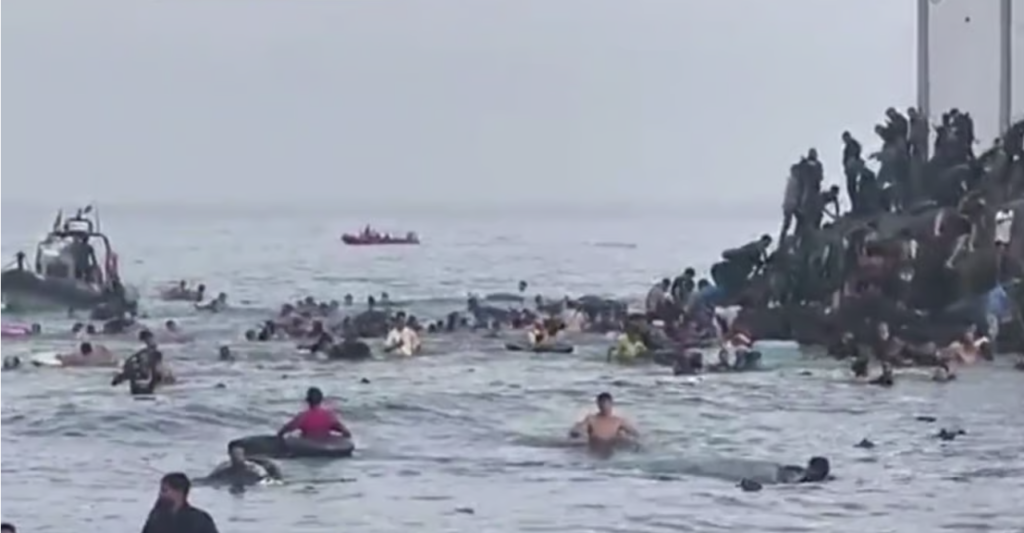
On July 30, 2026, coinciding with the Commemoration of the Throne—the most solemn date on the Moroccan political calendar—an unprecedented wave of migration overwhelmed the autonomous city of Ceuta. Between 1,500 and 2,000 people had entered in the previous ten days, and several hundred more arrived that very day, by sea in inflatable boats and by land by scaling fences whose fragility the Civil Guard had been denouncing for fifteen or twenty years.
The immediate trigger was the Supreme Court ruling in early July, which prohibits the summary deportation of migrants intercepted in Spanish waters. The decision, legally grounded in the protection of human rights, radically altered the incentives for migration, and human trafficking networks exploited the legal loophole with their characteristic speed.
The Spanish government’s reaction exacerbated the situation the ruling had already triggered: inexcusable slowness, a refusal to declare a national emergency, a paltry military reinforcement of sixty troops, and confirmation of two decades of ignoring the Civil Guard’s warnings about the state of the seawall’s defenses. An administration besieged by corruption scandals and exhibiting unprecedented incompetence in Spain and Europe demonstrated, once again, its insensitivity to the urgent needs of the southern border.
A rigorous analysis of the facts—particularly Morocco’s immediate acceptance of the pushbacks—refutes the conspiracy theories circulating in Moroccan media about an alleged deliberate Spanish provocation. There was no intrigue: there was incompetence. And Giorgia Meloni’s announced decision to suspend the application of Schengen with Spain, far from being an affront, is the logical and justified consequence of failed border management.
2. THE FACTS
2.1 Magnitude and methods
Between 1,500 and 2,000 people entered Ceuta during the ten days leading up to July 30; several hundred more arrived on that day. The crossings occurred via two routes: by sea, in inflatable boats from the Moroccan coast, and by land, by scaling the border fences. Some migrants were filmed shouting “Long live Spain!” upon reaching Ceuta.
2.2 The institutional response
Juan Jesús Vivas, president of the Autonomous City, declared an “absolute humanitarian and social emergency” and requested that Madrid send troops to reestablish control of the border. The Ministry of the Interior rejected the declaration of a national emergency, although it pledged additional resources, and deployed only sixty members of the Armed Forces. Minister Fernando Grande-Marlaska did not visit Ceuta until July 31, the day after the crisis erupted.
3. THE TRIGGER: THE SUPREME COURT RULING
3.1 Content and scope
In early July 2026, the Supreme Court issued a ruling prohibiting the return to Morocco of migrants intercepted in Spanish waters while attempting to reach Ceuta or Melilla. The decision, based on the protection of human rights and compliance with Spanish and international law, effectively eliminated the main mechanism by which Spain and Morocco had been managing migration flows.
3.2 The change in incentives
Before the ruling, anyone attempting the sea crossing faced interception and immediate deportation, which deterred many would-be migrants and kept the flow at manageable levels. After the ruling, interception no longer results in deportation: anyone reaching Spanish waters has a real chance of remaining in Spain and continuing on to the mainland. The trafficking networks understood the change immediately and turned it into a marketing advantage. A source within the Civil Guard summed it up precisely: “It’s been a slow trickle since the ruling, but today it’s been an explosion.”
3.3 Legal legitimacy, failure of coordination
The ruling itself is not open to criticism from a legal standpoint. What is truly reprehensible—and seriously so—is that no state institution prepared for its perfectly foreseeable consequences: the Ministry of the Interior did not reinforce the border, the Prime Minister’s Office did not coordinate with Rabat, and no contingency plan was ever put in place. The judiciary ruled according to the law; the executive branch, quite simply, did nothing.
4. THE DIPLOMATIC CONTEXT: WESTERN SAHARA AND RESOLUTION 2797
In March 2022, the government of Pedro Sánchez abandoned the traditional Spanish position and described the Moroccan Autonomy Plan as “the most serious, realistic and credible basis” for resolving the Western Sahara dispute, which caused a four-year rift with Algeria, including the withdrawal of ambassadors and trade restrictions.
On October 31, 2025, the United Nations Security Council adopted Resolution 2797 by eleven votes in favor, none against, and three abstentions (China, Russia, and Pakistan; Algeria did not participate in the vote). The text renews MINURSO’s mandate until October 31, 2026, and, for the first time, positions the Moroccan plan as “the most viable solution,” without formally recognizing Moroccan sovereignty or removing the reference to self-determination.
The diplomatic shift is, in any case, fundamental: the United States recognized Moroccan sovereignty in December 2020, Israel in July 2023, and France in July 2024, and more than fifty countries now accept it de facto, twenty-four of which maintain consulates in Dakhla or Laayoune. In this context, Morocco’s international position is stronger than ever.
5. Sánchez’s trip to Algiers and the commemoration of the throne
On July 20, 2026, ten days before the crisis, President Sánchez made an official visit to Algiers with the aim of resolving the bilateral crisis that began in 2022 and boosting energy and trade cooperation. The Eighth High-Level Meeting was announced for October 2026, but no immediate tangible results were achieved.
The surge towards Ceuta occurred on July 30, the day Morocco celebrates the Commemoration of the Throne, the anniversary of Mohammed VI’s enthronement in 1999. Moroccan television broadcast images of masses running towards the border while the king was giving his speech in Tangier, a coincidence that immediately fueled conspiracy theories.
6. CONSPIRACY THEORIES AND THEIR REFUTATION
The theory circulated in certain Moroccan media outlets and social networks that Spain had orchestrated the incident to humiliate the King on the most important day of his year. This hypothesis does not withstand the slightest scrutiny.
First, such an operation would have required the complicity of the Moroccan forces deployed in the area, something impossible to keep secret. Second, Spain had no reason to act: its position on Western Sahara has been aligned with Rabat since 2022 and was consolidated after Resolution 2797. Third—and decisively—Morocco immediately accepted the pushbacks, a practice it had historically rejected: the reaction of a surprised and overwhelmed state seeking to regain control, not that of the victim of a conspiracy. Nor should the episode be interpreted as Moroccan retaliation for Sánchez’s trip to Algiers: Morocco has never reacted to Spanish visits to Algeria with immigration measures, and to do so now, when Spain maintains its position on Western Sahara, would be a strategic contradiction.
There was no conspiracy on either side. As so often happens, it was a combination of poorly managed legal reforms, opportunistic criminal networks, and two administrations that failed to communicate in time.
7. THE REACTION OF THE SPANISH GOVERNMENT: CHRONICLE OF NEGLIGENCE
The Spanish government’s response deserves the harshest condemnation. It was not merely insufficient: it was the culmination of years of neglect, exacerbated by slowness, political minimization, and a chronic insensitivity to the needs of the southern border.
7.1 Slowness: three weeks of inaction
The government had two to three weeks, from the publication of the ruling, to anticipate what any analyst saw coming. A diligent administration would have immediately assessed the migration implications of the decision, coordinated with Rabat to reinforce surveillance, prepared a significant deployment of personnel, and publicly warned of the risks of crossing. It did none of the four. The crisis caught it by surprise, as if the ruling didn’t exist.
7.2 The refusal to declare a national emergency
In response to President Vivas’s explicit request, the Ministry of the Interior rejected the declaration of a national emergency with an argument that was formally defensible but politically cowardly. The legal framework provided avenues for an extraordinary mobilization of resources; the government chose not to use them. This refusal was not a legal necessity, but rather an act of political minimization whose message—”this is not serious”—translated into scarce resources and a delayed response.
7.3 Sixty personnel for two thousand people
The deployment of sixty soldiers to face an influx of two thousand people—one soldier for every thirty-three migrants—speaks for itself. A proportionate response would have required, at a minimum, between five hundred and one thousand personnel for the control, containment, and processing of those arriving. The chosen number does not reveal a miscalculation: it reveals a lack of concern.
7.4 Fifteen to twenty years ignoring the Civil Guard
The most serious failure is not recent, but rather a decades-long problem. For fifteen or twenty years, the Civil Guard has been denouncing the Ceuta seawall defenses as completely inadequate and their urgent need for expansion: obsolete fences, easily climbed, with entry points lacking proper surveillance. That migrants easily breached them on July 30th surprised no one who had heeded these warnings. Governments of all stripes ignored them equally. It wasn’t a technical oversight: it was a sustained political decision not to invest in border security.
7.5 An insensitive government, corroded by corruption and incompetence
This negligence is not an isolated incident, but rather a reflection of an administration besieged by corruption scandals, with a discredited Interior Minister and a government operating with unprecedented clumsiness and incompetence in Spain and Europe. For this government, the southern border is a provincial problem undeserving of attention. Its insensitivity to its urgent needs is systematic, and on July 30th, the bill came due.
8. ITALY, SCHENGEN AND MELONI’S REASON
Italian Prime Minister Giorgia Meloni announced the suspension of the Schengen Agreement with Spain in response to the Ceuta crisis. The measure, however painful for Madrid, is justified.
Schengen rests on a fundamental pact: free movement within the country in exchange for effective border control. Spain has shown that it is not fulfilling its part of the agreement. Two thousand people entered without effective containment; the border defenses are, in the words of the Civil Guard itself, ridiculous; the government’s response consisted of sixty officers deployed a day late; and the warnings accumulated over two decades were ignored. If Spain cannot contain the overflow in Ceuta, Italy has well-founded reasons to fear that the arrivals will end up on its territory.
Meloni is therefore justified in questioning Spain’s compliance with its Schengen obligations, in demanding the immediate reinforcement of border defenses, and in reintroducing controls until the situation is rectified. Her announcement is not an unfair punishment of Spain: it is the foreseeable consequence of systemic negligence, and the Spanish government should understand this instead of adopting a victim mentality.
9. PROSPECTIVE SCENARIOS
It is highly unlikely that Morocco will maintain sustained migratory pressure on Ceuta. Rabat was overwhelmed, is seeking to regain control, and has already demonstrated its capacity for containment by accepting summary returns; its political incentives—Resolution 2797, the recognitions from the United States, Spain, and France—have been satisfied, and prolonged pressure would be counterproductive for its international image. A return to normal migration flows of tens or hundreds of people, not thousands, is to be expected.
At the European level, Italy is likely to maintain pressure on Spain until it obtains verifiable commitments to border reinforcement, and it is possible that other partners will follow suit. The 8th High-Level Meeting with Algeria, scheduled for October, will offer the Spanish government an opportunity to rebuild the regional coordination that this crisis has demonstrated is nonexistent.
10. CONCLUSIONS
First. The trigger for the crisis was the Supreme Court ruling that prohibits summary returns: legitimate in law, it radically altered migration incentives and was immediately exploited by trafficking networks.
Second. The reaction of the Spanish Government was a compendium of failures: slowness, refusal to declare a national emergency, a derisory reinforcement of sixty personnel and the culmination of fifteen to twenty years of ignoring the warnings of the Civil Guard about the defenses of the seawall.
Third. This negligence is not accidental: it is the expression of a Government insensitive to the urgent needs of the border, corroded by corruption and of an unprecedented incompetence in Spain and in Europe.
Fourth. Conspiracy theories are unfounded: Morocco’s immediate acceptance of the pushbacks proves that Rabat was caught off guard and overwhelmed, not the victim of a plot.
Fifth. Italy is right. The suspension of Schengen announced by Meloni is the legitimate consequence of Spain’s failure to fulfill its obligations to safeguard the common external border.
Sixth. The underlying lesson is that the inevitable —the geopolitical readjustment around the Sahara— was handled with avoidable clumsiness, and that the Ceuta crisis, perfectly foreseeable, is the product of institutional negligence accumulated over two decades and a lack of coordination between the powers of the State.