Gustavo de Arístegui,
September 14, 2026
I. INTRODUCTION
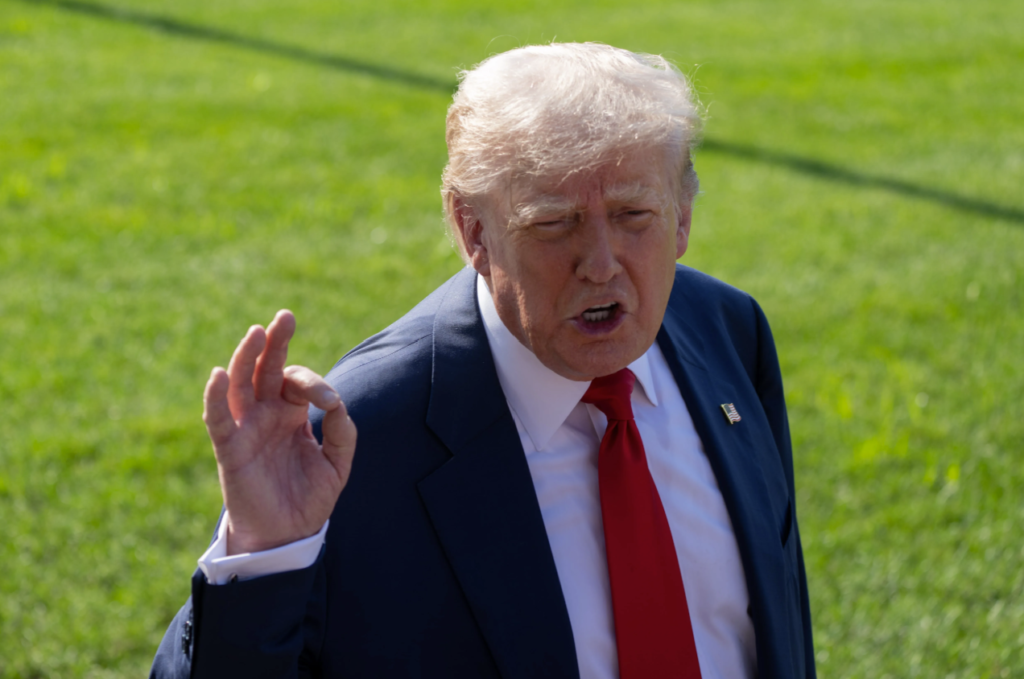
The weekend left us with an image that’s hard to top as a portrait of our times: the President of the United States conducting top-level foreign policy from the balcony of a golf tournament held on a course he owns on Ireland’s Atlantic coast. In just a few hours, and before an impromptu gathering of journalists, Donald Trump reopened the most sensitive issue in British and Irish politics—the reunification of the island—and asked Volodymyr Zelensky to stop attacking Russian diesel refineries. Two statements, two earthquakes. Neither seemed to be part of a plan.
Meanwhile, something truly serious was happening. The Houthis were completing their takeover of the entire Yemeni Red Sea coast and Perim Island, right at the mouth of the Bab el-Mandeb Strait, while a drone attack launched from Iraq forced the closure of the Saudi East-West pipeline, the only artery keeping the Kingdom’s crude oil exports afloat after the blockade of the Strait of Hormuz. For the first time since the end of World War II, the two major maritime chokepoints of the global economy were simultaneously under the real threat of a single actor and its proxies. In Salalah, Oman postponed indefinitely the regional meeting that was to address the future of the Strait of Hormuz.
Added to this are a Russian drone attack on the locomotive of the kyiv-Warsaw train two kilometers from the Polish border, with a European diplomatic convoy at that same station just minutes before; a Swedish election result separated by a single seat; and a European aerospace industry still picking up the pieces of the FCAS program. The thread that runs through all these news stories is the same: far-reaching decisions made without planning, sequencing, or considering the aftermath. Let’s take it one step at a time.
II. THE MOST IMPORTANT NEWS OF THE LAST 24 HOURS
1. Doonbeg: the reunification of Ireland, served up as a headline between coups
Facts
Donald Trump concluded his two-day visit to the Republic of Ireland on Sunday. On Saturday, at Farmleigh House, alongside Taoiseach Micheál Martin, he told the press that Irish unity would be “fantastic” and, in his opinion, should happen. On Sunday, at the Doonbeg resort in County Clare, he reiterated this idea with greater force: reunification is inevitable and could very well happen now. He added, with revealing candor, that it is one of those questions for which there is no good answer, no matter how you phrase it. Hours later, he presented the Irish Open trophy to the winner, Irishman Shane Lowry, and announced from the podium that he would eliminate tariffs on Irish whiskey.
Taoiseach Martin publicly downplayed the matter, noting that it wasn’t the first time Trump had said something similar, pointing out that the US president considers unity the logical configuration for the island, and emphasizing that his lunch at the resort had not been a political meeting. From London, sources close to British Prime Minister Andy Burnham referred to his statement from the previous Wednesday: the UK would only consider authorizing a referendum if public opinion had shifted to the point where such a consideration was unavoidable. Martin will meet with Burnham at the end of next week. The visit sparked large demonstrations in central Dublin.
It is worth recalling the legal framework, because it is precisely what the presidential declaration ignores. The 1998 Good Friday Agreement—in whose achievement American mediation was decisive—put an end to the violence, but deliberately left the final status of Northern Ireland open, and stipulated that a border referendum would only be held if the Secretary of State for Northern Ireland believed that a majority would vote in favor. The guiding principle is that of consent, not the enthusiasm of a third party.
Implications
A historical clarification is necessary here, one that most international media outlets continue to dismiss negligently. The IRA (Irish Republican Army) was the organization that fought the British Empire across the island until independence, and to which, among others, Éamon de Valera, later head of government and president of Ireland, belonged. The organization that bloodied Ulster for three decades was the PIRA (Provisional Irish Republican Army), a 1969 splinter group and the largest and deadliest of the republican factions. Opposing it were the loyalist militias, notably the UVF (Ulster Volunteer Force) and the UDA (Ulster Defence Association). The conflict left around three thousand five hundred dead, attacks in Great Britain itself, and a society divided into two communities that still coexist today, separated by walls that no one dares to tear down.
The partition was also the bitter concession the Founding Fathers had to accept in the Anglo-Irish Treaty of 1921 to secure the freedom of the South, and that concession cost the country a civil war between 1922 and 1923. It is on this foundation that a foreign president speaks today from the balcony of his own hotel. The United States is not just any actor in this matter: it is the political guarantor of the 1998 Agreement. When a guarantor takes sides in one of the two possible outcomes of a referendum that has not yet been called, it ceases to be a guarantor and becomes a party to the agreement.
The damage is threefold. It hands republicans an argument from authority they hadn’t won at the ballot box; it puts a newly arrived British prime minister in an awkward position; and it reignites in unionists the existential fear of abandonment, which is precisely what fueled the loyalist militias. All this without any benefit whatsoever for Washington. It’s pure diplomatic blundering, the kind that seeks not advantage, but immediate applause.
Perspectives and scenarios
— Most likely scenario (60%): The episode fades into the background noise. Dublin elegantly buries it, London ignores it, and next week’s Martin-Burnham meeting focuses on trade, energy, and the border. The cost is borne by the credibility department, not the facts.
— Friction scenario (30%): Unionism reads the declaration as an American turn, the DUP (Democratic Unionist Party) hardens its positions and the governability of Stormont suffers again in an already complicated autumn.
— Unlikely scenario (10%): The White House turns the idea into policy and pushes for a border consultation timetable. This would be a major blunder and would face opposition from the Foreign Office and virtually the entire British establishment.
2. Diesel rules: Trump asks Zelensky to stop attacking Russian refineries
Facts
In that same impromptu appearance in Doonbeg, and asked if he had spoken with Zelensky after his conversation with Vladimir Putin the previous day, Trump made a request that can hardly be considered minor. According to Reuters, the president stated that the Ukrainian leader has to do one thing: “He has to stop destroying diesel fuel in Russia.” He added that there are many other targets available and that attacking diesel is hurting the entire world.
The economic context explains the outburst. The average price of diesel in the United States surpassed six dollars per gallon at the end of the week for the first time ever; the AAA (American Automobile Association) placed the average at $6.20, about 68% higher than a year ago. Brent crude is trading above one hundred dollars per barrel. The midterm elections are in November, and fuel prices are, in American politics, the most unforgiving of indicators.
Data from the International Energy Agency (IEA) published on Friday speaks volumes: net exports of diesel and middle distillates from Gulf countries in August barely exceeded a quarter of what they were before the start of the war with Iran in February, and disruptions to the Russian refining system, along with the virtual paralysis of its refined product exports following the intensification of Ukrainian attacks, have exacerbated these losses. In February, the Gulf and Russia together accounted for nearly 45% of global exports of this product. Russia banned its diesel exports in July and is experiencing internal fuel rationing. On Sunday, Ukrainian drones struck Nizhnekamsk, one of Tatarstan’s major refining and petrochemical complexes, killing two and wounding twelve, according to regional authorities.
Implications
It is legitimate, even obligatory, for a US president to be concerned about energy prices. What is difficult to explain is the asymmetry. Refineries are legitimate military targets under international humanitarian law when they support the aggressor’s war effort, and Ukraine has been rightly arguing for months that the Russian energy industry is literally financing and fueling the war machine that is destroying it. However, no similarly forceful condemnation has been heard, before the same international media, of the systematic Russian bombing of residential neighborhoods, hospitals, schools, and the Ukrainian power grid on the eve of winter.
Formally, the rise in diesel prices in Western Europe shouldn’t be related to these attacks, since Russian diesel is under embargo. In practice, however, it is very much so: a significant portion of the product reached the European market through clandestine channels, by being blended and relabeled in third countries, and this flow acted as a price buffer. The transportation costs are immediately passed on to inflation in food and consumer goods. In other words: the problem is real. The proposed solution is not.
The crux of the matter is the transactional nature of this foreign policy. The victim of aggression is being asked to relinquish its most effective instrument of pressure—the only one that has forced Moscow to ration fuel on its own territory—in exchange for nothing, and this is being done publicly, depriving Kyiv of any room for discreet negotiation. Moscow is taking note that its energy campaign against Ukraine has no diplomatic cost, while Ukraine’s does. That is precisely the message they wanted to avoid sending.
Perspectives and scenarios
— Most likely scenario (50%): Kyiv acknowledges the situation without formally committing, slows the pace of attacks against export refineries, and shifts its focus to storage facilities, pumping stations, substations, and military logistics. A gesture sufficient for Washington, but continued damage for Moscow.
— Negotiated scenario (25%): the partial moratorium is exchanged for air defense and interceptors, which Ukraine is short of. This would be the only acceptable version of this request, and it would require professional diplomacy—Secretary of State Marco Rubio—to take the lead on the matter.
— Friction scenario (25%): Kyiv refuses and maintains the campaign. A new episode of tension opens between the White House and Bankova, with the risk, already seen on other occasions, that military aid will become a bargaining chip.
3. Bab el-Mandeb and Hormuz: for the first time since 1945, the two bottlenecks of the world economy are in the hands of the same actor
Facts
The Houthis completed their control of Yemen’s entire Red Sea coast on Friday, September 11. The offensive, which unfolded in a matter of days, included the capture of the port of Mocha on Thursday, September 10, the advance on the coastal town of Dhubab, and the occupation of Perim Island (Mayun), located at the mouth of the Bab el-Mandeb Strait, following the withdrawal of forces from the internationally recognized Yemeni government, which is backed by Riyadh. Several analysts quoted in the international press describe this advance as the most significant regional development since the United States and Israel launched their war against Iran on February 28.
On the same Friday, and simultaneously, a drone attack launched from Iraqi territory forced the closure of the Saudi East-West pipeline, known as Petroline. The Kingdom’s Ministry of Energy confirmed the shutdown. Saudi diplomats announced that, at the request of the Iraqi prime minister, they would not retaliate for now, although they reserved the right to take whatever measures were necessary to protect their sovereignty, security, and critical infrastructure. Baghdad condemned the attack and thanked Riyadh for its restraint.
The importance of this pipeline is undeniable. Stretching 1,200 kilometers between the Abqaiq complex and the port of Yanbu on the Red Sea, the Petroline became, after the de facto closure of the Strait of Hormuz, the only operational outlet for Saudi crude: around five million barrels per day diverted from the Gulf, reaching a record high of seven million in March. According to Kpler data released by AFP, Yanbu handled approximately 92% of Saudi crude oil exports in June. Aramco’s CEO, Amin Nasser, himself had indicated that the pipeline was helping to mitigate market disruption more effectively than the release of emergency strategic reserves.
These events are not an isolated incident, but the culmination of a sustained campaign. On July 20, the Houthis declared a maritime embargo against Saudi ports and against ships loading or unloading there. Since then, they have set fire to the Aramco refinery in Jizan—with a capacity of 400,000 barrels per day—launched ballistic missiles at the Yanbu oil facilities, which were intercepted by a Patriot battery operated on Saudi territory by Greek military personnel under an agreement with Riyadh, struck the Amzan vessel belonging to the state-owned Bahri shipping company with a ballistic missile off the coast of Yanbu, and carried out a double attack against the cargo ship Tihamah in Bab el-Mandeb, resulting in six deaths—the first fatalities in maritime traffic since the start of the war. In the days immediately preceding the September attacks, the offensive against Saudi energy facilities and civilian targets left more than seventy wounded.
In the other impasse, the outlook is equally bleak. The Sultanate of Oman announced yesterday, Sunday, the postponement of the regional meeting scheduled for today, Monday, in Salalah between Iran and the Gulf states to discuss the future of the Strait of Hormuz. The official Omani news agency explained that the meeting was being postponed to a later date to create conditions conducive to constructive dialogue, and Foreign Minister Badr Albusaidi framed it on his Twitter account with a revealing phrase: the postponement is “in the interest of consensus.” Tehran had announced the attendance of Iraq and the Gulf states, but no government in the region confirmed its participation, and Bahrain expressly ruled it out. The meeting was to examine an Omani plan to establish a temporary navigation corridor; according to sources cited by CNN, the idea of Iranian tolls remains flatly rejected, although voluntary contributions for navigational safety services are being considered. The United States was not going to be present, and they have privately conveyed to their Gulf counterparts that they wish to redirect any future negotiations toward the nuclear program.
To put the scale into perspective: before the crisis, approximately four and a half million barrels of crude oil and refined products passed through Bab el-Mandeb daily, and nearly 20% of the world’s oil flowed through the Strait of Hormuz. CENTCOM (United States Central Command) stated on September 12 that it had diverted one hundred merchant ships in sixty days and that none had transited without US authorization. Washington is also assisting Riyadh in developing and coordinating objectives within Yemen. On August 7, Saudi Arabia signed a defense pact with Turkey and Pakistan stipulating that an armed attack against any one of the three would be considered an attack against all three.
Implications
Let’s state this with the solemnity the fact deserves: for the first time in eighty-one years, since the end of the Second World War, two essential bottlenecks in global trade and energy are simultaneously closed or threatened with closure by the same actor and its delegated organizations. This is not a mere maritime anecdote. It is a geoeconomic and geostrategic issue of the highest order, with direct effects on the price of crude oil, freight rates, insurance premiums, and ultimately, on the shopping basket of any European family.
It is time to discard the excuse of autonomy once and for all. The Houthis are not independent actors. They have a certain degree of operational leeway, yes, but they depend on Tehran for their funding, weapons, training, ideological inspiration, and external projection. They are, in fact, the most effective proxy of the Iranian regime, and they are so precisely because Iran no longer controls the Strait of Hormuz alone, nor can it operate in the Eastern Mediterranean as it did through the henchman and terrorist regime of Bashar al-Assad. The implosion of that regime substantially reduced Iran’s capacity to finance, arm, and train Hezbollah, and significantly complicated its logistical relationship with Hamas and Palestinian Islamic Jihad. Reduced: not eliminated. In the midst of war, Tehran continues to rebuild channels and networks in Syria and Iraq, and continues to employ its Iraqi militias against Western interests. Let’s remember that a large number of the missiles and drones that have attacked US and allied positions in Iraq and Jordan were launched from Iraqi, not Iranian, soil. Friday’s attack on the Petroline, launched from Iraq, is yet another confirmation of this pattern.
Hence the most important warning in this report. Allowing Iran to institutionalize the collection of a toll for transit through the Strait of Hormuz—a form of blackmail disguised as a service fee, channeled through Western shipping agencies, law firms, and opaque intermediaries—would provide the regime with a revenue stream of a magnitude that, according to our own estimates, could range between one hundred and two hundred billion dollars annually. It is important to emphasize that this is our own estimate and not an official figure; but even discounting it by half, the destination of this money is beyond doubt: its own rearmament, the rearmament of its proxies, the recovery of hegemonic positions in Iraq, Syria, and Lebanon, the rebuilding of Hamas’s arsenal, and preparations for a war larger than the current one. This would not be buying stability: it would be financing the next war.
Finally, it’s worth remembering how often we’ve heard Western media and political parties, lulled by their own complacency, criticize the attacks against the Houthis in previous years. Those operations were insufficient—their operational capabilities, unfortunately, weren’t destroyed—but the lesson some drew was the opposite of the correct one: instead of demanding greater effectiveness, they demanded less firmness. The result is plain to see today at the mouth of the Red Sea.
Perspectives and scenarios
— Most likely scenario (50%): Saudi campaign of targeted attacks in Yemen with US assistance in target selection, without territorial recovery. Bab el-Mandeb is effectively closed to all traffic linked to Saudi Arabia, the detour around the Cape of Good Hope is consolidated, adding fifteen to twenty days to the crossing, and insurance premiums skyrocket.
— Extension scenario (30%): A new attack of Iraqi origin to which Riyadh decides to respond opens a front in Iraq, with the risk of drawing in the Baghdad government and triggering consultations within the framework of the Saudi-Turkish-Pakistani pact. This would be the definitive regionalization of the conflict.
— Capitulation scenario (20%): a de facto toll system is consolidated in both straits, with the tacit acquiescence of major Asian and European consumers in exchange for supply stability. The worst of all possible worlds, and currently not the least likely.
4. Yahodyn: The Russian drone against the Warsaw train and the line that no one should cross
Facts
On Sunday, September 13, a Russian jet-propelled drone struck the locomotive of a Kyiv-Warsaw passenger train at Yahodyn station in the Volhynia region, about two kilometers from the Polish border. Another impact set fire to a gas station near the Yahodyn-Dorohusk border crossing. According to the state railway operator Ukrzaliznytsia, a diplomatic train carrying security advisors from several European Union member states and former European leaders, including former British Prime Minister Boris Johnson, had been at the same station shortly before the attack; Der Spiegel also reported that German Chancellor Günter Sautter, an advisor to the German Chancellor, was on that train. Former CIA Director General David Petraeus was traveling on another train stopped at the station at the exact moment of the impact.
Ukrzaliznytsia believes the diplomatic train may have been the target, noting that it had departed earlier than scheduled due to timetable adjustments imposed by the constant threat of attacks. No one on board was injured. Johnson was returning from the Yalta European Strategy annual meeting held in Kyiv on the 11th and 12th. Polish Foreign Minister Radosław Sikorski summed up the incident in two words: “Putin escalates.” Prime Minister Donald Tusk convened a crisis cabinet. Ukrainian Foreign Minister Andrii Sybiha wrote that Putin’s terror is now knocking directly on the doors of the European Union and NATO. Rail service to Warsaw was restored several hours later, albeit with delays.
The incident was part of a day of widespread attacks. The Ukrainian Air Force reported that 453 drones were launched against the country, of which it claims to have intercepted 405. The national toll for the day was six dead and forty-three wounded. In Odesa, an attack on Saturday against a high-rise residential building killed two people and wounded twenty-six, and on Sunday logistics warehouses burned and an electrical substation was damaged. Four glide bombs fell on Kramatorsk, injuring six civilians; in the Kherson region, there were two dead and thirteen wounded; in Sumy, an electrical worker was killed. Lithuania issued a yellow alert for an aerial threat near Vilnius.
Implications
There was something very close to a tacit truce along the rail corridor linking Poland and Kyiv. Heads of state and government, ministers, parliamentarians, international officials, and journalists travel along this line, and until now Moscow had understood that attacking it was tantamount to striking countries that, while not neutral, were also not belligerents. That understanding has been broken. If the target was the diplomatic convoy—and the rail operator maintains that it could have been—we would be facing a major qualitative leap: a deliberate attack against citizens of NATO states on the territory of a country under attack.
Even under the most benign scenario, that of a misidentification of the target, the result is identical in terms of deterrence: Russia demonstrates that it can reach, with low-cost drones, a point located two kilometers from the Alliance’s border, and tests the reaction. The European response—a crisis cabinet in Warsaw, an alert in Vilnius, statements—does not alter this equation. The contrast is worth emphasizing: on the same day that Washington publicly asked Kyiv to moderate its attacks, Moscow bombed a border station through which former European prime ministers had just passed.
Perspectives and scenarios
— Most likely scenario (55%): Poland raises consultations within the Alliance without formally invoking Article 4, air defenses along the western corridor are reinforced, and official convoys alter routes and schedules. Logistics and insurance costs rise; no strategic change.
— Controlled escalation scenario (30%): New strikes on the border perimeter in the coming weeks as a deliberate test. The Alliance would be forced to decide whether to establish some form of air defense over western Ukraine, a debate it has thus far avoided due to a sheer lack of political will.
— Serious scenario (15%): impact with fatalities on the territory of a Member State or against European official personnel identified as such. Invocation of Article 4, and probably Article 5 in its most flexible version. This is the scenario that all of Europe says it fears and for which very few capitals have prepared.
5. Sweden: tie at one seat each and first historic setback for the Sweden Democrats
Facts
Sweden elected its 349 members of the Riksdag yesterday, along with its regional and municipal assemblies. With nearly 92% of the votes counted by early this morning, the four-party opposition bloc, led by Magdalena Andersson of the S (Socialdemokraterna, Swedish Social Democratic Party), held 175 seats, compared to 174 for the government bloc of Prime Minister Ulf Kristersson of the M (Moderaterna, Moderate Party). An absolute majority is precisely 175 seats. The Social Democrats garnered around 27-28% of the vote, while the Moderates fell below 20%.
The most significant piece of news of the night is something else entirely: the SD (Sverigedemokraterna, Sweden Democrats) fell to around 17.5%, its first decline since entering Parliament. The final result will not be known before Wednesday, when overseas and pending early votes are tallied, and the provincial electoral boards then conduct an automatic recount that usually takes a week. Kristersson announced that, if the result is confirmed, he will respect Andersson’s attempt to form a government, although he added that he will explore other possibilities. Andersson asked everyone to wait for the final count. A professor of Political Science at the University of Gothenburg summarized the night as a heart-stopping situation.
The campaign focused on healthcare, the cost of living, energy prices, and the outgoing government’s immigration policy. Neither side is questioning the national consensus on NATO membership or support for Ukraine.
Implications
This result should be interpreted objectively. It comes just a week after the victory of the AfD (Alternative for Germany) in German regional elections, and it refutes the thesis of the mechanical and unstoppable advance of the radical right in Europe. The Swedish case suggests something different and far more interesting: that four years of effective influence over immigration policy through the Tidö Agreement, without assuming ministerial portfolios or management responsibilities, have worn down the Sweden Democrats without providing them with the benefit of a victory of their own. The formula of permanent external support is a dead end for those who provide it and a source of instability for those who receive it.
The second implication is purely one of governance. A one-seat majority is not a majority: it’s a precarious legislature, subject to any resignation, any dissent, and any emergency vote. Sweden has been a NATO member for two years, with a Baltic maritime border, an ongoing rearmament plan, and Saab at the heart of all discussions about the future of European fighter jets. This is not the ideal moment for a Parliament divided by a single vote.
Perspectives and scenarios
— Most likely scenario (55%): Article 175-174 is confirmed, and Andersson forms a coalition or minority government with parliamentary support after several weeks of negotiations. Strict continuity in foreign and defense policy; fiscal and health-related shifts in domestic policy.
— Turnaround scenario (30%): overseas and early voting alter the final distribution on Wednesday, and Kristersson retains a majority by one or two seats, this time with the Sweden Democrats claiming ministerial posts. It would be a crucial test for the Swedish center-right.
— Blockage scenario (15%): no bloc manages to invest and a prolonged institutional crisis opens up, with early elections on the horizon.
6. From FCAS to GCAP: Europe pays the price for its industrial vanity
Facts
Airbus Defence and Space CEO Michael Schoellhorn reiterated this week that his company would be interested in joining a program where it could secure a significant share of the work and leadership, and that this possibility is being explored. This is the clearest indication to date of Germany’s future following the collapse of the FCAS (Future Combat Air System) program.
Let’s recall the sequence of events. The FCAS was launched in 2017 by France and Germany, with Spain joining as a full partner in 2019. It was intended to produce a sixth-generation manned fighter jet, escort drones, and a combat cloud by 2040, at an estimated cost of around one hundred billion euros. On June 9, 2026, after the definitive failure of mediation, Paris and Berlin ended their cooperation on the manned aircraft. Nine years, not a single prototype. The reason wasn’t money: it was the division of industrial workloads—the workshare (the division of tasks and intellectual property)—and Dassault’s demand for a leadership role that Airbus was unwilling to accept, exacerbated by divergent operational requirements, as France needed nuclear capability and carrier-based operations.
Since then, fragmentation has accelerated. Airbus and seven other companies—including MBDA, Hensoldt, Diehl Defence, MTU Aero Engines, Liebherr, and Autoflug—formed the Team Gen 6 consortium at the ILA air show in Berlin. During Emmanuel Macron’s state visit to Sweden on August 31, France left the door open to developing a next-generation fighter jet with Saab, although no formal agreement has been reached. Meanwhile, the Global Combat Air Programme (GCAP), a joint venture between the UK, Italy, and Japan (comprised of BAE Systems, Leonardo, and Japan Aircraft Industrial Enhancement Co.), is progressing with a £4.6 billion contract awarded in July, a demonstrator planned for 2027, and entry into service expected around 2035. The Italian CEO has warned that any interested party must decide before the end of 2026.
Implications
We are witnessing the most glaring failure of so-called European strategic autonomy, a concept that Brussels has been proclaiming at every summit for a decade without ever providing it with any industrial or budgetary substance. Three countries with a declared commitment, one hundred billion euros pledged, and nine years of work have not produced an airplane: they have produced two rival consortiums, a French partner seeking a Nordic partner, and an orphaned Spanish partner.
The German paradox is cruel. Airbus rejected junior partner status in the FCAS compared to Dassault, and now it aspires to join the GCAP demanding precisely what it denied others: a significant share of the work and leadership. One of the three current partners would have to relinquish a stake in a distribution they’ve been fine-tuning for years. In other words, it intends to import into the GCAP the same virus that killed the FCAS.
For Spain, the situation is especially delicate. The Air Force and Space Force had linked the replacement of its Eurofighters to the success of the FCAS, and Indra had built its position on digital architecture and the combat cloud. Our country must now choose between following Germany, exploring its own path within the GCAP, or resigning itself to a second wave of American F-35s, with the consequent technological dependence. Choosing poorly, or not choosing at all, is extremely costly. Every month of European indecision translates into market share for the American industry and strategic dependence for the continent’s air forces.
Let’s be clear: this isn’t a geopolitical disaster, it’s a case of mediocre and short-sighted political leadership. No European government dared to prioritize the continent’s general interest over the corporate interests of two companies. That, and not a lack of technology or money, is what has left Europe without a sixth-generation fighter jet in the year that Russia is bombing trains two kilometers from the Alliance’s border.
Perspectives and scenarios
— Most likely scenario (45%): Germany enters the GCAP before the end of the year with a quota lower than it claims, and the program assumes the risk of delay in exchange for the German volume, estimated at up to one hundred and fifty aircraft.
— Fragmentation scenario (35%): Berlin opts for the national route with Team Gen 6, possibly with Sweden or Spain, while France moves forward alone or with Saab. Three European programs competing for the same resources and the same export customers.
— Withdrawal scenario (20%): Operational urgency takes over, governments increase F-35 orders and the European sixth generation is postponed to the 2040s. Strategic autonomy would go from slogan to epitaph.
III. MEDIA RACK
Only media outlets whose coverage could be directly verified at the time of publication are included. Newspapers on the regular mailing list that had not yet published their own articles on these matters are not included in the table, in accordance with the factual rigor of this report.
| ANGLO-SAXON BLOC |
Reuters: Dry dispatch from Doonbeg with the request on diesel and the context of the far-reaching Ukrainian campaign against Russian refining.
Associated Press: Dual focus: Irish reunification as a highly political issue and the president’s mixing of official duties and personal interests.
NBC News: Feature story on the Houthi takeover of Yemen’s Red Sea coast and the shutdown of the Saudi East-West pipeline by drones launched from Iraq.
NPR: The capture of Mayun Island at the mouth of Bab el-Mandeb as a direct threat to Saudi exports.
Bloomberg: The postponement of Salalah and the temporary navigation corridor in Hormuz, with the crude oil market as a frame of reference.
CNN: Highlight the relevant fact: the Gulf meeting was going to be held without the United States, and Washington wants to redirect the negotiation to the nuclear issue.
CBS News: Face the Nation: Admiral Brad Cooper says he’s not worried about the level of US stockpiles of precision missiles and munitions.
CNBC: Tracking the deployment of Houthi missiles and drones in the vicinity of Bab el-Mandeb and navigational warnings.
Newsweek: AAA figures: National average diesel at $6.20 per gallon, up 68% from the previous year.
The Hill: Kpler data on the collapse of ship traffic through Bab el-Mandeb following the attacks on Saudi depots.
The Globe and Mail: The call for reunification and the mass protests in Dublin, with critical voices from Irish civil society.
CBC: Swedish result in the context of the rise —and now slowdown— of the radical European right, with reference to the recent AfD result in Germany.
PBS NewsHour: IEA data on the collapse of Gulf distillate exports and its worsening due to Ukrainian attacks.
| IRISH AND BRITISH BLOC |
RTÉ: In-depth coverage of the two days: Trump’s vindication of his own words, Martin’s dismissal, and the protests.
The Irish Times: It points out that the statements were not improvised and are particularly inopportune for the British Government.
Breaking Defense: Overview of European sixth-generation programs after the demise of FCAS: upgrades, F-35, Saab and domestic production.
| FRANCOPHONE AND EUROPEAN BLOC |
France 24: The Swedish technical draw, Kristersson’s willingness to respect Andersson’s attempt and the retreat of the radical right.
Der Spiegel (via agencies): Identifies German Chancellor Günter Sautter’s advisor in Yahodyn’s diplomatic convoy.
| CENTRAL AND EASTERN EUROPE BLOC |
The Kyiv Independent: National tally of the day —six dead and forty-three injured— and direct testimony of a passenger evacuated in Yahodyn.
Ukrzaliznytsia (official note): It maintains that the diplomatic convoy may have been the target and details who was at the station.
| MIDDLE EAST AND GULF BLOC |
Arab News: Salalah postponement, Bahrain’s explicit refusal to participate, and crude oil above one hundred dollars.
Al Jazeera: Double front: The question of whether the Houthis can close the Red Sea and Trump’s attribution of fuel shortages to Ukrainian attacks.
TRT World: Contextualizes the postponement in the blockade and counter-blockade of the strait since February 28.
The Times of Israel: Live coverage of the Iranian front, protests over fuel prices in Syria, and the US naval deployment.
Iran International / Israel Hayom: Profile and career of General Ahmad Vahidi and the new military leadership appointed by Mojtaba Khamenei.
| ASIAN BLOC |
South China Morning Post: Presence of high-ranking Western figures in Yahodyn and Polish reaction; Sikorski and Tusk’s crisis cabinet.
The Tribune (India) / ANI: Reading from South Asia: the record for North American diesel and its electoral implications for November.
IV. RISK TRAFFIC LIGHT
| Scenery | Level | Justification |
|---|---|---|
| Bab el-Mandeb and the Red Sea | ● CRITICAL | Houthi control of the entire Yemeni coast and Perim Island. Maritime embargo against Saudi ports and deadly attacks on merchant ships. |
| Strait of Hormuz and Iran | ● CRITICAL | Salalah indefinite postponement, active blockade and counter-blockade, crude oil above one hundred dollars and Vahidi’s IRGC in effective command of the case. |
| Saudi energy infrastructure | ● CRITICAL | The East-West pipeline was shut down by drones launched from Iraq. In June, Yanbu accounted for 92% of the Kingdom’s maritime crude oil exports. |
| Energy markets and diesel | ● CRITICAL | Record high above six dollars per gallon in the United States; Gulf distillate exports at a quarter of their February level. |
| NATO border / Polish-Ukrainian corridor | ● VERY HIGH | A drone strike two kilometers from Poland hit an international train, with a diplomatic convoy at the same station. A crucial tacit truce has been broken. |
| War in Ukraine (front and rear) | ● VERY HIGH | Four hundred and fifty-three drones in twenty-four hours and a systematic campaign against the electrical grid on the eve of winter. |
| European defense and sixth generation | ● STOP | Fragmentation completed after the FCAS, GCAP deadline at the end of the year and Spain without a decision adopted on the replacement of the Eurofighter. |
| Iraq as a launching pad | ● STOP | The attack on the Petroline originated from Iraqi soil. Riyadh postponed retaliation at Baghdad’s request, but reserved the right to act. |
| Venezuela and the Caribbean | ● STOP | A transition overseen by Delcy Rodríguez since Maduro’s capture in January, with open negotiations with the opposition and intact structures of the narco-regime. |
| Northern Ireland | ● MODERATE-HIGH | Presidential statements on reunification that strain unionism without, for the moment, altering the consent mechanism of the 1998 Agreement. |
| Levant and Syria | ● MODERATE-HIGH | Protests erupted in several Syrian provinces over fuel price hikes following a 30% increase in gasoline and a 40% increase in diesel. |
| Nordic governance (Sweden) | ● MODERATE | The result was a one-seat difference, with the recount continuing until Wednesday and weeks of negotiations ahead. Consensus remains intact on NATO and Ukraine. |
| Indo-Pacific and South China Sea | ● STABLE | No significant developments in the last 24 hours. Structural tension that requires constant monitoring. |
V. EDITORIAL COMMENTARY
There are days that don’t produce a decisive event, yet they explain everything. This has been one of them. The most powerful man on earth has conducted foreign policy from the balcony of a golf tournament he owns, and he’s done so twice, in two different ways, both wrong. He has touched the most sensitive wound of the British Isles unnecessarily, and he has asked a country under attack to renounce the only instrument that has managed to inflict real damage on its aggressor. There is no doctrine behind either of these actions. There is intuition, there is an outburst, and above all, there is the price of diesel fuel eight weeks before a general election.
Let’s be fair and accurate, which is what this report aims for every morning. This administration’s foreign policy has yielded considerable diplomatic successes, from the conflict between Cambodia and Thailand to the rapprochement between Azerbaijan and Armenia, and its resolve against drug trafficking and the narco-dictatorial regime that still clings to Miraflores Palace deserves unwavering support. When it listens to its Secretary of State, Marco Rubio, and allows the foreign service to do its job, the results are there. The problem arises when it makes decisions alone, loudly and before an impromptu microphone. Then the superpower behaves like an erratic actor, and the allies learn—this is the serious part—not to rely on it.
That said, the big news of the day isn’t in Doonbeg, but at the mouth of the Red Sea. The fact that the two major maritime chokepoints on the planet are simultaneously under threat from the same actor for the first time since 1945 is not just another headline: it’s a turning point in global energy security. And it’s important to be frank about where the disaster originated. The campaign against the Tehran regime was well-planned militarily—the commanders performed their duties with tactical and operational competence—but it was planned geopolitically in a frankly disastrous way. There was no plan for the aftermath: neither for the possibility that the regime would give in, nor for that of its implosion, nor for the most predictable scenario of all, which is the one that has unfolded: that the regime would survive, wounded, and shift the pressure to the straits through its proxies. We support action against an oligarchic-jihadist regime that has been exporting terrorism and instability for almost half a century. We criticize, with equal firmness, the absolute lack of foresight regarding what comes next.
There is also a European reproach that must be stated plainly. When Washington requested months ago the deployment of naval units to keep the waterway open, the then British Prime Minister, Keir Starmer, refused, and France, Germany, and South Korea also declined. The request was not for participation in acts of aggression or attacks against Iranian targets; it was for the deployment of defensive capabilities—anti-aircraft and anti-missile systems, escort, and mine countermeasures—to protect states that were once British colonies or protectorates and are now key Western allies: Saudi Arabia, the United Arab Emirates, Qatar, Kuwait, and Bahrain. London limited itself to minor defensive measures. This is a serious dereliction of international obligations, and not only on the part of Britain.
This leads to an uncomfortable reflection that this report has long maintained. Sitting as a permanent member of the United Nations Security Council and possessing veto power is not merely an honor or a vestige of historical prestige: it entails concrete obligations in maintaining international peace and security. If the two European nuclear powers with permanent seats are unwilling to exercise that leadership when global trade is being strangled, then the reform and expansion of the Council must be seriously considered, and the question openly asked is whether it makes sense to maintain this status for those who renounce the responsibilities that justify it. This is not a mere whim: it is the logical consequence of two decades of abdication.
Regarding the Houthis, a final point that deserves to be repeated as often as necessary. For years, Western media and short-sighted political parties, numbed by their own complacency and disconnected from reality, criticized the attacks against the militia. Those operations were insufficient and did not destroy their capabilities; the correct conclusion was to demand greater effectiveness, not less firmness. Today, the Houthis control the eastern bank of the Bab el-Mandeb Strait. And if, in addition, their patrons in Tehran are allowed to institutionalize the Hormuz toll, with the complicity of Western shipping agencies, offices, and intermediaries, we will be financing, with our own money, the rearmament of Hezbollah, Hamas, and the Iraqi militias, and the next war, which will be larger than this one.
Europe remains, and it is where the diagnosis hurts the most. Nine years and one hundred billion euros committed have not produced a sixth-generation fighter jet: they have produced two rival consortiums and a Spanish partner without a roadmap. No capital had the courage to prioritize the continental interest over the corporate interests of two companies. While Moscow bombs trains two kilometers from the Alliance border and Tehran closes two straits through intermediaries, our governments argue over dividing up the workload. Strategic autonomy does not fail due to a lack of technology or money: it fails due to a lack of political stature.
One final, and not insignificant, point from Stockholm. The defeat of the Sweden Democrats, the first in their history, prompts a re-examination of the narrative of the unstoppable advance of the radical right in Europe. Those who wield influence without taking responsibility ultimately pay the price; those who govern depending on that support also ultimately pay the price. The liberal and sensible center, pro-Atlantic and pro-European, is not condemned to lose: it is condemned to deserve it. This is a lesson worth heeding in Madrid, Berlin, and Paris, where much more than a presidency is at stake next year.