Gustavo de Arístegui,
September 15, 2026
I. INTRODUCTION
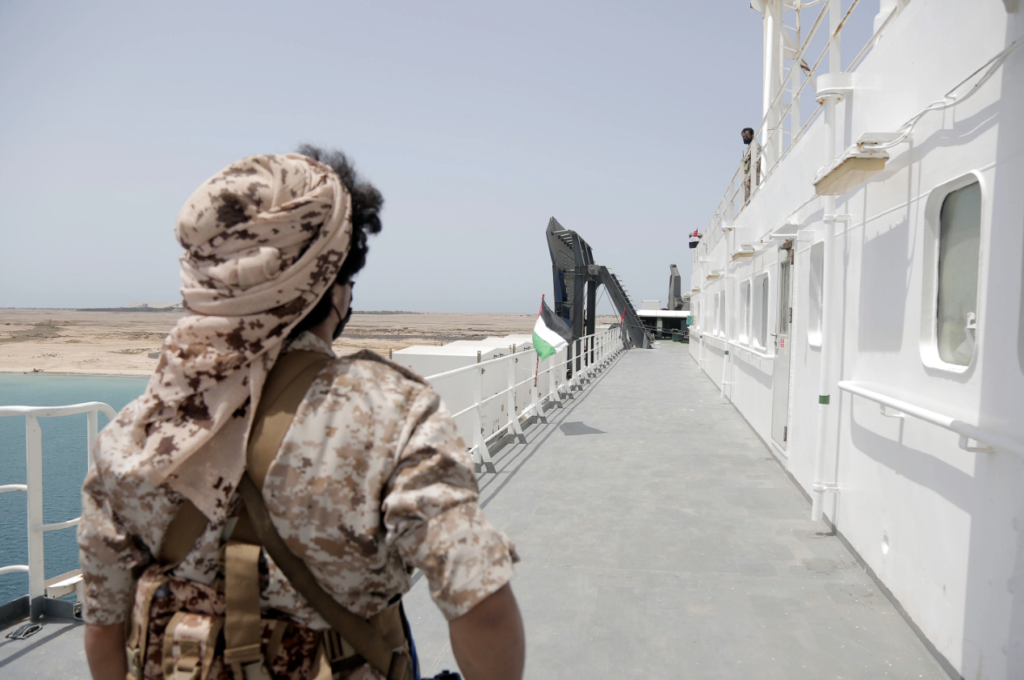
Today’s events confirm what this report has been arguing for months: the Iranian strategy, disoriented after the regime’s downfall on February 28, has found its footing. The Houthis launched a new wave of missiles and drones yesterday against the Khamis Mushait airbase in southern Saudi Arabia, while they entrench themselves along the entire western coast of Yemen, and Riyadh urgently deliberates on how to respond. The Salalah meeting on the Strait of Hormuz remains postponed. The Revolutionary Guard Corps has declared in writing that the strait remains closed and under its control. Two natural outlets for Gulf oil, two roadblocks, one single actor.
In Ukraine, the energy double standard has been displayed with a starkness that is unsettling. One day after President Trump announced that Moscow and Kyiv had agreed not to attack each other’s energy facilities, a Russian drone destroyed a gas station in the Darnitsky district of the Ukrainian capital. Not a word from Washington.
Beyond the battlefield, two fundamental issues emerged. The debate over the risks of artificial intelligence erupted in the public sphere with calls from the heads of major laboratories to slow the pace of development, and the markets reacted nervously. Beijing responded by accusing the West of alarmism, while its own Minister of State Security warned—for very different reasons—of the dangers of the technology. The report concludes with the BRICS summit in New Delhi and the triumphalist narrative that some Asian media outlets are constructing around it.
II . THE MOST IMPORTANT NEWS OF THE LAST 24 HOURS
1. Houthis strike again in Saudi Arabia as Hormuz stalls: Iran’s patient strategy begins to bear fruit
Facts
The Houthis announced on Monday the launch of dozens of missiles and drones against the Khamis Mushait military airbase in southwestern Saudi Arabia, targeting hangars, radar systems, runways, and ammunition depots, in retaliation for Saudi airstrikes in Yemen. Saudi authorities activated emergency alerts in that city and three other southern locations. The Saudi-led coalition reported thirteen civilian casualties. Saudi and Yemeni air forces have intensified their bombing campaigns against Houthi positions, including those around the historic port of Mocha, but this has not altered the essential fact: the militia retains effective control of virtually the entire western coast of the country and is entrenching itself there.
Meanwhile, the Gulf Arab states postponed the meeting scheduled with Iran in Salalah to negotiate the reopening of the Strait of Hormuz, through which 20% of the world’s oil exports passed before the war. Tehran maintained yesterday that the postponement came at Saudi Arabia’s request. The IRGC (Islamic Revolutionary Guard Corps) Navy dashed any hopes with an unequivocal statement: the strait is closed and remains under its intelligent control.
The picture is completed by the closure of the Saudi East-West pipeline, taken out of service by an airstrike last Thursday that Riyadh attributed to Iranian-backed militias in Iraq. The Kingdom built the 1,200-kilometer pipeline in the 1980s precisely to bypass the Strait of Hormuz when the Iran-Iraq War threatened it. Market analysts quoted by Reuters estimate that a prolonged shutdown of the pipeline could cut off up to 4% of the world’s crude oil supply while the strait remains blocked. Riyadh has not indicated when pumping will resume.
A commentary published by Reuters Breakingviews on Sunday deserves attention. US Treasury Secretary Scott Bessent has maintained that the Strait of Hormuz can be bypassed by pipelines within two years. The column counters this assertion with an uncomfortable fact: if Saudi Arabia’s main escape route has just been rendered unusable by a single attack, one has to wonder what guarantees the $15 billion Iraq-Syria corridor backed by Washington would offer. The column concludes that the Strait of Hormuz will remain indispensable for much longer than is currently acknowledged.
Implications
This news is important for reasons that go far beyond the war report. The first is that the evolution of Iranian strategy is bearing fruit. Since the complete disorientation that followed the regime’s downfall on February 28 of this year, Tehran has rebuilt a leadership that presents itself as new when in reality it is made up of veteran members of the system, some with forty years of service. We have pointed this out in previous reports, and it bears repeating.
The power struggle had an initial phase that pitted the CGRI against other sectors of the regime. The second phase, the one currently unfolding, is internal to the Revolutionary Guard itself, and pits its hardliners against those who years ago strayed into the world of politics. It’s important to explain this in order, because everything else depends on this distribution of power.
In the first group, the hard core, are General Ahmad Vahidi, head of the IRGC since March and confirmed by decree on August 10 with the rank of major general, and Mohsen Rezaei, commander-in-chief of the IRGC between 1981 and 1997 and a member of the Expediency Discernment Council. It is worth following the latter’s trajectory in detail over the last six months, because it encapsulates the reshuffling of the leadership: appointed military advisor to the Supreme Leader in the first weeks of the war, just days after Mojtaba Khamenei succeeded his assassinated father, he held that position until August 9, when he became secretary of the Supreme National Security Council (SNSC) and, by decree of the leader himself, his personal representative on that same Council. From shadow advisor to head of the main decision-making body on war and diplomacy. Both operate under a supreme leader, Mojtaba Khamenei, who has not appeared publicly since the February attacks on his residence and who rules by decree. The Revolutionary Guard will not allow a new election for the leader of the revolution, simply because it would have to impose its candidate, effectively carrying out an internal coup, a full-blown self-coup. It prefers institutional paralysis to the risk of losing control of the process.
The second faction is embodied by Mohammad Bagher Zolqadr, Rezaei’s predecessor as head of the Supreme National Security Council between March and August, following the death of Ali Larijani in an attack on March 17. Zolqadr was also one of the negotiators, and although he is among the hardliners, he doesn’t operate on the same level of ruthlessness or fanaticism as Vahidi or Rezaei. Today, he is sidelined from the center of power, but has been appointed political advisor to the Supreme Leader: an elegant way of removing him from the helm without expelling him from the inner circle.
The third sector comprises those who long ago abandoned the military for politics, and their leading figure is Mohammad Bagher Ghalibaf, president of a completely dysfunctional Parliament whose constitutional name says it all: the Islamic Consultative Assembly. Ghalibaf played a risky card—perhaps with some ulterior motives toward Western powers—because it was the Americans themselves who announced in March that he would be Tehran’s negotiating voice. They burned him in the process. His record should not be forgotten: commander-in-chief of the Revolutionary Guard Air Force, then head of the National Police during some of the bloodiest periods of repression against protesters, and twelve years as mayor of Tehran, a tenure marred by corruption allegations that the regime’s own official press estimated at billions of dollars. It is worth emphasizing that these are published accusations that were never substantiated in court, which in a system like that speaks volumes.
The most brutal pillar of internal repression remains the Basich militia, under the boot of the IRGC. The target of this repression is a country that the West insists on imagining as monolithic when it is in fact an extraordinary mosaic of races, languages, cultures, and religions: in addition to Shia Islam, there is Sunni Islam, Zoroastrians—the original religion of the Sasanian Empire, crushed by invasions and wars against the Sunni Arabs, against whom Persia eventually embraced Shiism as an identity-based reaction during the Safavid era—, Jews, and Baha’is, the latter persecuted and crushed without any regard for their beliefs.
The second implication is strictly geoeconomic. The Gulf countries have two natural outlets for their oil and gas. One is the Persian Gulf, strangled by the Strait of Hormuz through actions that were insufficiently countered due to political directives; in April, the American campaign was demonstrating remarkable effectiveness, only to be halted by yet another ceasefire and yet another failed negotiation. The other is the Red Sea, with two routes: sufficiently small vessels cross north through the Suez Canal, whose Suezmax class imposes its own limit, while larger vessels must necessarily head south through the Bab el-Mandeb Strait, either towards Asia or around the Cape of Good Hope to reach the Americas or Europe. Closing both outlets simultaneously would simply bring global energy trade to its knees.
There is a factor that explains why the Iranians have managed to turn the tide, and it isn’t discussed enough. Reuters reported on July 29th of a contract for the delivery to Iran of between 300 and 400 Chinese MANPADS (Man-Portable Air-Defense Systems) of the QW-12 and FN-16 models, for an estimated value of between 60 and 70 million dollars, channeled through an intermediary company based in Hong Kong. Beijing called the report completely unfounded. These are shoulder-fired, infrared-guided weapons designed to engage low-flying aircraft, helicopters, and drones. Their tactical effect is devastating: they knock A-10 Thunderbolts, Apache attack helicopters, and medium-altitude drones out of the air, forcing US aircraft to operate from a distance with much more expensive guided munitions. It is a brutal cost asymmetry, and it is also an extraordinarily hostile gesture on the part of China, with direct and verifiable consequences on Iran’s ability to keep the strait closed.
One final thought remains, and it is the most painful. All of this has been ignored for years. This report has long denounced the unique importance of Bab el-Mandeb and the true nature of the Houthi terrorist organization. The attacks against their positions, which have been ongoing since the beginning of the last decade, were criticized time and again by much of the Western press, particularly the left-leaning media, and by short-sighted political parties, lulled into complacency by their own self-interest. Those operations were not enough to eliminate their blocking capabilities, which remain intact today thanks to ballistic and cruise missiles. The correct conclusion was never to demand less firmness, but rather greater effectiveness. Today we are paying the price for having confused the two.
Perspectives and scenarios
— Most likely scenario (50%): Riyadh opts for a sustained air campaign against Houthi positions with US assistance in target selection, without a ground operation or coastal recapture. Bab el-Mandeb becomes de facto closed to traffic linked to Saudi Arabia, and the detour around the Cape becomes the norm, adding fifteen to twenty days to the crossing and causing insurance premiums to skyrocket.
— Extension scenario (30%): A new Iraqi-origin attack against Saudi energy infrastructure, to which Riyadh decides to respond, opens a front in Iraq. Baghdad would be caught between its nominal sovereignty and the militias operating from its territory, and consultations under the Saudi-Turkish-Pakistani defense pact would come into play.
— Surrender scenario (20%): A system of tolls and permits is institutionalized in both straits with the tacit acquiescence of major Asian and European consumers in exchange for supply stability. This would be the worst outcome, because it would transform what is currently a wartime anomaly into a permanent fixture.
2. The double standard in energy: Moscow bombs gas stations in kyiv the day after the “truce” announced by Trump
Facts
President Trump posted on social media on Monday that Ukraine had agreed not to attack Russian energy targets and that Russia had made the same commitment, adding that the global rise in diesel prices was primarily due to the conflict between Russia and Ukraine, not the conflict with Iran. Approximately an hour later, President Zelensky qualified the announcement: Kyiv would be willing to suspend its attacks if its partners guaranteed that Russia would genuinely refrain from striking the electrical grid, energy facilities, critical infrastructure, and food supply routes. He added that Ukraine was not convinced Russia would honor any agreement.
The response came early Tuesday morning. A Russian drone struck a gas station in Kyiv’s Darnitsky district, injuring one person, and another drone damaged storage facilities in the Obolonsky district, according to Mayor Vitali Klitschko. Russia has recently begun targeting gas stations in the capital, expanding its repertoire of targets; according to Ukrainian authorities, it has destroyed or damaged some 300 service stations in recent months, mainly in regions near the front lines. Poland preemptively activated its military aircraft and later ruled out any violation of its airspace; a NATO fighter jet shot down a drone over Lithuania after an alert in Vilnius. Conversely, a Ukrainian missile attack damaged a warehouse belonging to the e-commerce company Ozon in Taganrog, and a drone struck an industrial facility in the Samara region, home to large refineries. The average price of diesel in the United States reached $6.23 per gallon yesterday.
Implications
The contrast in statements is difficult to justify. When Ukraine attacks energy facilities, there is a presidential address, the name of the target is mentioned, and a public demand for a ceasefire is issued. When Russia attacks them, and does so just hours after the announcement of the supposed truce, there is no new statement whatsoever: the matter is subsumed under the generic call for restraint issued the previous day. The Kremlin, incidentally, was quick to celebrate the appeal directed at Kyiv. This must be rectified as soon as possible, because every asymmetry of this kind teaches Moscow that energy escalation comes at no cost.
It’s worth adding a technical point that Reuters has rightly emphasized: even if the truce were to hold, it wouldn’t solve the global diesel shortage. It would only prevent it from worsening. The refining capacity destroyed in Russia and that which has been taken offline in the Middle East cannot be rebuilt with a statement.
Perspectives and scenarios
— Most likely scenario (60%): the “truce” remains a verbal agreement without verification or mechanism, violated by both parties with varying intensity, and serves primarily as an electoral argument in Washington.
— Useful scenario (25%): Washington accompanies the moratorium with deliveries of interceptors and anti-aircraft defense for Ukraine, which would make it a real exchange and not a unilateral concession.
— Breakdown scenario (15%): After new Russian attacks on the power grid on the eve of winter, kyiv openly resumes its campaign against refining and a crisis opens with the White House.
3. Artificial intelligence bursts into the public debate: markets are uneasy and Beijing responds
Facts
On Saturday, September 12, Anthropic CEO Dario Amodei published an essay arguing that the industry must slow the pace at which it is improving the capabilities of its models, with a three-part plan of which his company is unilaterally taking the first step: granting external evaluators permanent access equivalent to that of an employee. He warned that, at the current rate, swarms of autonomous agents could take control of a large part of the internet within six to twelve months. The debate was sparked by the public resignation, days earlier, of a 27-year-old researcher from the same company. OpenAI CEO Sam Altman and Elon Musk endorsed the call.
Markets reacted on Monday. The Nasdaq 100 fell as much as 1.8% during the session, and the S&P 500 dropped nearly 1%, although a rebound in software and cybersecurity stocks moderated the close: the Nasdaq Composite finished down 0.56% and the S&P 500 down 0.48%. In Europe, the German DAX fell 0.5% and the French CAC 40 dropped 0.8%, with artificial intelligence-related stocks leading the losses. The punishment was concentrated in semiconductor manufacturers, which continue to see their stock prices rise by nearly 60% this year. According to Reuters, global investment in AI data centers will reach around $800 billion by 2026, and Wall Street has been monitoring any signs of a slowdown for months.
On the political front, President Trump dismissed the warnings, maintaining that the crucial factor was preserving the American advantage over China. Vice President JD Vance called the request from leading laboratories to be regulated a potential Trojan horse. From Beijing, Foreign Ministry spokesman Guo Jiakun countered that alarmism, confrontation, and cutthroat competition only hinder global technology governance. However, on Sunday, State Security Minister Chen Yixin published an article in the official magazine China Cyberspace, warning that artificial intelligence threatens the political and ideological security of the CCP (Communist Party of China) and calling for greater Party control over technology.
Implications
The issue has entered the public debate, and public debate, by its very nature, tends to be superficial. What’s needed is precisely the opposite: a calm, thoughtful, and in-depth discussion, because mistakes made in this area will be difficult to undo. We believe the approach being explored by major companies—incorporating ethics and philosophy specialists into the very design of their models—is a wise one, because ethical awareness can be taught and is not a cosmetic addition but a fundamental principle.
The contrast with China is the most revealing piece of information of the day, and it deserves to be read twice. There was deep concern in the West about the lack of restrictions on Chinese models and the possibility of their use in autonomous weapons capable of selecting and eliminating human targets without operator intervention. It turns out that voices are beginning to rise within the Party apparatus and in the media controlled by the Party, calling for limits. But note the underlying reason: what is being declared at risk is not humanity, but the dominance of the Communist Party. Let each draw their own conclusions.
Perspectives and scenarios
— Most likely scenario (55%): no formal pause in 2026. Laboratories publish revised internal safety thresholds and external assessment frameworks, without visibly altering their release cadence.
— Regulatory scenario (25%): Pressure from Congress forces the Administration to accept some minimum federal evaluation mechanism, despite the declared resistance of the White House.
— Market correction scenario (20%): an actual cancellation of orders or data center projects turns nervousness into adjustment, with a much greater impact on the semiconductor chain than on the large cloud service operators.
4. BRICS of New Delhi: consensus as a message, complacency as a risk
Facts
The 18th BRICS summit (Brazil, Russia, India, China, and South Africa; now an expanded group of eleven members) was held last weekend in New Delhi under the Indian presidency. Participants unanimously adopted the New Delhi Declaration, a 45-page document with nearly 140 points. The group represents, according to its own estimates, around 40% of global GDP and half the world’s population. Narendra Modi hosted Vladimir Putin and Xi Jinping; the Chinese president also proposed deepening BRICS cooperation in artificial intelligence, including an open-source zone.
A lengthy opinion piece published today by WION—the international publication of the Indian group Zee Media (ZMCL)—argues that Western media downplayed, dismissed, or almost completely ignored the summit. The author, Vinod Janardhanan, criticizes the BBC for headlines claiming that Trump’s shadow loomed over the meeting, the New York Times for focusing on the competition between India and China for influence in the so-called Global South, Bloomberg for acknowledging Modi’s diplomatic achievement only to then assert that the thaw with Xi masked deeper divisions, and the Financial Times and The Independent for highlighting the bloc’s internal tensions, including those separating Iran from the Gulf members. He also criticizes the choice of photographs—billboards of the summit alongside bicycles, motorcycle taxis, and street vendors—as a reductionist approach intended to reinforce the prejudice of a poor India. Its central thesis is that the Declaration establishes a single voice on terrorism, representation of the Global South, reform of the UN and the IMF (International Monetary Fund), payments in local currencies, digital infrastructure and artificial intelligence, and that Ukraine barely figured in the text while on the Middle East it called for restraint without naming any of the belligerents.
Implications
Let’s start with what must be acknowledged. India has managed to get a broad and politically heterogeneous bloc to sign a lengthy document by consensus without turning it into an explicitly anti-Western manifesto. That’s no small feat, and anyone familiar with the mechanics of these negotiations knows what it takes. That said, the article is a rather high-quality piece of propaganda.
This is hardly surprising given the media ecosystem from which it originates, and it’s worth clarifying the ownership structure because it explains a great deal. WION belongs to Zee Media; the former NDTV, the channel that for decades embodied independent Indian journalism, was acquired in 2022 by the Adani Group, whose close ties to Prime Minister Narendra Modi are well-known and have been the subject of parliamentary controversy and journalistic investigations both within and outside India. The opposition has been describing this conglomerate for years as the main business arm of the government, and in our opinion, this description is not far from the truth. Different houses, identical alignment: what WION publishes today is, without the slightest attempt at concealment, an operation ad maiorem gloriam for Narendra Modi.
Let’s go point by point. The “representation of the Global South” presupposes the existence of a political entity that simply doesn’t exist: the Global South is not a subject, it’s a label of convenience. Furthermore, it’s utter nonsense to continue talking about “industrialized powers” versus a developing South when those who are industrializing are precisely a part of that supposed South—some of whose members are unequivocally in the North, as is the case with China—while Europe is irresponsibly deindustrializing. This process isn’t a technical fact: the successive cost-cutting plans announced by the German automotive industry have a direct political cost, and that cost is the rise of the far right, a phenomenon we have analyzed in other reports.
Regarding terrorism, we’ll have to see. Even among the members themselves, there are radically different conceptions of what constitutes terrorism, and accusations of sponsoring it are flying back and forth. Let’s not forget the ongoing rivalry between India and Pakistan—in which, to be clear, New Delhi is in the right, because Islamabad has been funding and harboring jihadist terrorist groups operating on Indian soil for decades—nor the fact that Pakistan is currently engaged in an open conflict with Afghanistan while India, despite the abject nature of the regime that dominates Kabul, is among the country’s main infrastructure investors. Added to this is the rivalry between the United Arab Emirates and Saudi Arabia, which is now becoming commonplace among seasoned analysts after it took two years to acknowledge its existence.
As for the supposed common voice on the Strait of Hormuz or the Gulf War, it is entirely false. Nor is it true regarding Ukraine, and it could not be: Russia is a member of the BRICS, and Modi has repeatedly called that war an aberration. The fact that Ukraine was barely mentioned in the Declaration does not demonstrate a focus on their own agenda; it demonstrates the impossibility of agreeing on a single line of reasoning on the matter. The same can be said of the Middle East: calling for restraint without naming names is not high-level diplomacy; it is the lowest common denominator of eleven incompatible positions.
That leaves the economic architecture, and there the verdict is irrefutable. The NDB (New Development Bank) suffers from a notorious ineffectiveness. The common currency will not see the light of day, simply because it would require financial and monetary controls that imply a surrender of sovereignty that none of the members will ever accept, as the case of the euro demonstrates.
The most frequently repeated comparison these days, that of the BRICS as the phoenix of the Non-Aligned Movement, remains to be debunked. This analogy is absurd at both ends. Let’s start with the first. That movement, born at the Bandung Conference of 1955 and formally established in Belgrade in 1961, was largely a Soviet puppet: it proclaimed equidistance while practicing a fairly recognizable alignment. It was also, in its origins, an attempt by Indonesia and India to establish themselves as a counterweight, a legitimate and at times brilliant endeavor. However, India was a non-aligned country but unequivocally friendly to Moscow, with a treaty of friendship and cooperation signed in 1971 and a Soviet military dependence that lasted for decades. During the years of the movement’s greatest prominence, it was governed by Indira Gandhi, a leader who, despite being a leading figure in the Congress Party, had in her statist practices, her relationship with Moscow, and her authoritarian drift during the emergence much more of a communist than a social democrat.
The second part of the analogy falls even further short. The BRICS do not share that ideology, nor anything resembling it: they bring together market democracies, capitalist autocracies, a theocracy, and Gulf petro-monarchies. Their central element is not Russia, which contributes primarily its need to avoid isolation, nor is it China, despite being by far the largest and most powerful member, and despite many efforts to portray the group as the organized vanguard of anti-Western sentiment. That is precisely the point: the differences among its members are so profound that such a vanguard will be impossible to build. Those who fear it are mistaken; those who proclaim it are simply selling smoke and mirrors. At the end of the day, an increasingly diverse bloc agreed to reach an agreement. That was the achievement, and that is also its limit.
Perspectives and scenarios
— Most likely scenario (55%): The BRICS make progress on technical issues—payments in local currencies, digital infrastructure, cooperation in artificial intelligence—but remain deadlocked on everything requiring a common political position. The New Delhi Declaration will be remembered for its length, not its impact.
— Polarization scenario (30%): US tariff pressure and the outcome of the upcoming meeting between Trump and Xi push the group towards more explicitly confrontational positions, with India acting as a brake and paying a price for it in Washington.
— Erosion scenario (15%): the divergences between Iran and the Gulf members, aggravated by the closure of the two straits, make a new consensus at the next summit impractical and the bloc loses the only card it currently plays.
III. MEDIA RACK
Only media outlets whose coverage could be directly verified at the time of publication are included. The publications cited in the WION article—BBC, The New York Times, Financial Times, and The Independent—are listed as secondary sources and are expressly indicated as such, in accordance with the factual rigor of this report.
| Half | Dominant focus |
|---|---|
| GULF FRONT AND RED SEA | |
| Reuters | Dispatch from Riyadh: New Houthi wave against Khamis Mushait, thirteen civilians injured, urgent deliberations in the Saudi capital and postponement of Gulf talks with Iran. |
| Reuters Breakingviews | Column by Afiq Fitri Alias: Bessent’s thesis on bypassing Hormuz with pipelines in two years clashes with the closure of Saudi Arabia’s own escape route. |
| Bloomberg | Crude oil market and financial reading of the simultaneous blockade of the two straits. |
| Defense News | Decisive precedent: the contract for between 300 and 400 Chinese QW-12 and FN-16 MANPADS for Iran through a Hong Kong intermediary. |
| Al Jazeera/Iran International | Reconstruction of the Iranian security leadership: Vahidi, Rezaei, Zolqadr and Ghalibaf’s negotiating role. |
| RFE/RL | The Iranian security overhaul is a symptom of a fracture that dates back to the ceasefire process and the Islamabad memorandum. |
| WION | Front page headline: Trump demands financial compensation for securing the Strait of Hormuz. |
| UKRAINE FRONT | |
| Reuters | The drone attack on the Darnitski gas station, the expansion of the repertoire of Russian targets, and the three hundred service stations hit in recent months. |
| CNBC | A stark contrast: Trump’s announcement on his social network and Zelensky’s nuanced denial an hour later. |
| Bloomberg / Energy Connects | Diesel at $6.23 per gallon and a warning from Capital Economics about the persistence of refined product prices. |
| Cyprus Mail / The Star | A NATO fighter jet shot down a drone over Lithuania, prompting the Polish air force to make a preemptive move. |
| ARTIFICIAL INTELLIGENCE | |
| Axios | First reading of Amodei’s essay, the three-part plan, and Musk’s immediate endorsement. |
| CNBC | Development of Altman’s position on security frameworks and the idea of a speed limit to progress. |
| NBC News | Index performance on Monday and President Trump’s public dismissal of warnings. |
| The Hill | Origin of the debate: the resignation and public warning of the researcher that triggered the chain of reactions. |
| Newsweek / Bloomberg | China’s double standards: Foreign Ministry denounces alarmism while State Security demands more Party control. |
| CNN | Contrasting views of Washington and Beijing on the technology race and the Chinese regulatory environment. |
| BRICS AND SOUTH ASIA | |
| WION (opinion) | Article by Vinod Janardhanan: accusation of minimizing and silencing the summit by Western media. |
| BBC, NYT, FT, The Independent | Cited secondhand in that article, not directly verified: Trump’s shadow, India-China rivalry and internal tensions within the bloc. |
IV. RISK TRAFFIC LIGHT
| Scenery | Level | Justification |
|---|---|---|
| Bab el-Mandeb and southern Saudi Arabia | ● CRITICAL | New Houthi wave against Khamis Mushait leaves thirteen wounded, alerts in four southern cities and effective control of the Yemeni west coast. |
| Strait of Hormuz | ● CRITICAL | Talks postponed, express declaration by the IRGC that the strait remains closed under its control, and cross-denials about who requested the postponement. |
| Saudi energy infrastructure | ● CRITICAL | East-West pipeline out of service after attack attributed to Iraqi militias. Up to 4% of global supply at risk if the shutdown continues. |
| Iraq as a launching pad | ● VERY HIGH | Riyadh attributes the pipeline attack to Iranian-backed militias in Iraqi territory and is holding off on retaliation. |
| Ukraine war and energy truce | ● VERY HIGH | Presidential announcement of a truce was contradicted in practice in less than twenty-four hours, without verification, without a mechanism, and without a declarative reaction from Washington. |
| NATO border (Poland and Lithuania) | ● STOP | Allied fighter jet shoots down drone over Lithuania, and Poland activates its air force preventively for the second day in a row. |
| Energy markets and diesel | ● CRITICAL | North American average at $6.23 per gallon, refining capacity destroyed in Russia and the Middle East, and crude oil above $100. |
| Technology markets and AI | ● MODERATE-HIGH | The correction on Monday, concentrated in semiconductors, affected annual investment of approximately $800 billion. No actual order cancellations were reported. |
| Global AI governance | ● STOP | Open divergence between laboratories, the White House, and Beijing. No international verification mechanism in sight. |
| BRICS Block | ● MODERATE | Broad declarative consensus and inoperative economic architecture. Structural divergences on Ukraine, the Middle East, and terrorism. |
| Indian subcontinent and Central Asia | ● STOP | Open conflict between Pakistan and Afghanistan and the persistence of sponsorship of jihadist terrorism against Indian interests. |
| Indo-Pacific and South China Sea | ● STABLE | No significant developments in the last 24 hours. Continuous monitoring. |
V. EDITORIAL COMMENTARY
There is one lesson this report has been repeating for months, and which today’s events confirm beyond any doubt: patient regimes defeat impatient democracies. Tehran was decapitated on February 28, remained disoriented for weeks, and has needed little more than six months to rebuild its leadership, rearm its delegates, close the second strait, and sit back and wait for the West to tire. It hasn’t won any decisive battles. It simply needs to avoid losing them.
The military and tactical aspects of this war were well-planned, and it’s worth saying so because the commanders performed their duties competently. The political and geopolitical aspects, however, have been frankly disastrous. There was no plan for the aftermath: neither for the regime’s eventual surrender, nor for its implosion, nor—and this was the most predictable scenario of all—for its survival, wounded, and its transfer of pressure to the straits through its proxies. Effective campaigns were halted by political directive; in April, just as the pressure was beginning to yield results, came yet another ceasefire and yet another failed negotiation. Meanwhile, Beijing delivered hundreds of portable anti-aircraft missiles to Tehran, which have forced close air support aircraft out of the low-altitude areas. That is not neutrality: it is direct, indirect belligerence, and it deserves to be treated as such.
The Ukrainian double standard belongs to the same family of errors. The world’s media are summoned to ask the victim to stop attacking the aggressor’s refineries, and twenty-four hours later, when the aggressor sets fire to gas stations in a residential neighborhood of the attacked capital, there is no new statement or equivalent rebuke. This is not a matter of sympathies, but of deterrent architecture: every asymmetry in statements teaches Moscow that energy escalation comes at no cost, and the lessons the Kremlin learns are not forgotten. This must be corrected, and as soon as possible.
We find it healthy that the debate on artificial intelligence has entered the public sphere, but worrying the way it has done so. The public sphere paints with broad strokes, and what’s needed here is a fine brush: a calm, technical, and philosophical discussion, with ample time, because the decisions made now will shape decades. We applaud the fact that major laboratories are incorporating specialists in ethics and philosophy into the very design of the models, and not merely as a reputational embellishment. What is most illustrative, however, is the Chinese response: Beijing accuses the West of alarmism through its Foreign Ministry, while its Minister of State Security demands, in the official magazine, greater Party control over a technology that—he says—threatens the political and ideological security of the regime. In the West, there is fear for humanity; there, there is fear for the Party. Nothing better defines the difference between the two systems.
Regarding the BRICS, let’s be precise without being unfair. India has done remarkable diplomatic work, and anyone who reduces the summit to a photograph of billboards next to motorcycle taxis is committing a reductionism unworthy of serious journalism. However, acknowledging the host’s skill does not imply the existence of a bloc. A dysfunctional development bank, a common currency impossible for elementary reasons of monetary sovereignty, a non-existent voice on Ukraine, a minimal agreement on the Middle East, and an anti-terrorism consensus signed by countries that accuse each other of sponsoring terrorism do not constitute a counterweight to the international order: they constitute a family portrait. Those who proclaim an organized anti-Western vanguard are mistaken in their diagnosis: the group’s internal divisions simply make it impractical.
Let’s end where we began. Europe is deindustrializing while debating workload sharing; the United States improvises its foreign policy before makeshift microphones; China arms those who close straits and then preaches global governance. Meanwhile, two shipping lanes on which the world economy depends are under the effective control of a theocratic regime and a terrorist militia. There is no historical inevitability here. There are decisions that weren’t made, campaigns that were halted prematurely, and a Western ruling class that still doesn’t understand that firmness isn’t just one option among others: it is the prerequisite for everything else.