Gustavo de Arístegui,
September 28, 2026
I. INTRODUCTION
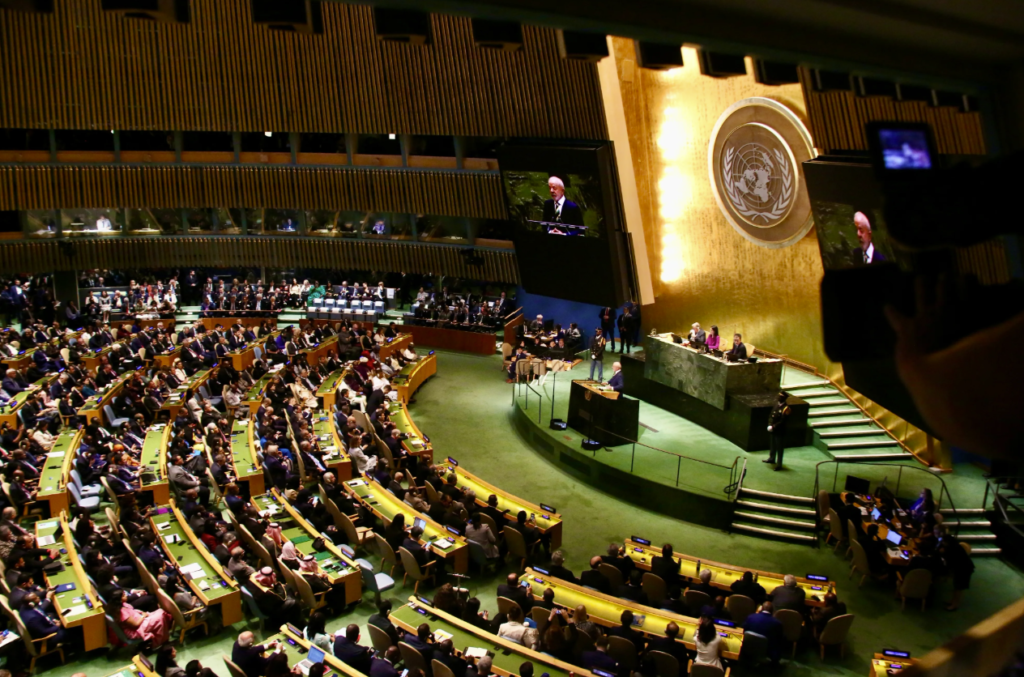
Today, Monday, September 28, the general debate of the 81st session of the UN General Assembly (UNGA) concludes in New York, held under the theme “Restoring Trust, Managing Transformation: A United Nations That Delivers for All.” This report, based on the author’s article published yesterday in La Razón (“If the UN didn’t exist, it would have to be invented. But it doesn’t”), examines the current state of the UN at the end of its high-level week: what the Assembly has ceased to be, the congenital defect of the veto, the anatomy of its spending, a legally viable reform proposal, and the succession of António Guterres, whose term expires on December 31.
The central argument is twofold. On the one hand, the Organization remains indispensable: no other body offers a truly universal forum, nor does it deploy agencies on the ground that, like UNHCR or WFP, support millions of people in the most dangerous places on the planet. On the other hand, its structure is exhausted: the absolute veto power of the five permanent members, inherited from San Francisco, has rendered the UN Security Council (United Nations Security Council) virtually inoperative in the face of the wars that now define the international order.
The past week has starkly demonstrated this. The only significant initiative regarding the war with Iran—Tehran’s proposal to reopen the Strait of Hormuz within seven days—has been channeled through mediators such as Pakistan, Qatar, and Oman, not in the Security Council, and President Trump rejected it on Saturday. Meanwhile, the Houthi terrorists’ offensive against Saudi Arabia has precipitated a de facto coalition between Riyadh, Islamabad, and Ankara, operating outside any UN mandate. The decisive diplomacy of 2026 is happening outside the UN building.
According to the formula used in the September 11th special report, the most important news of the last 24 hours is not grouped into its own section, but is incorporated into the Media Rack (section III) and the Risk Traffic Light (section IV).
II. MONOGRAPHIC ANALYSIS
Facts
During the Cold War, and somewhat paradoxically, the General Assembly was the center of world diplomacy. The meetings on the sidelines of the plenary hall were a hive of activity, the kind of networking that small and medium-sized countries would have found very difficult to organize in an era without instant communication: makeshift offices were set up in the corridors, while the major powers met discreetly, using all the resources at their disposal, in their permanent missions or at their ambassadors’ residences. That Assembly served a purpose.
This year’s meeting has served, above all, to measure the extent of the deterioration. António Guterres, in his final week at the high-level meeting, called for a world built on interdependence and reminded the superpowers that their power is not so “super.” Barely an hour later, Donald Trump offered the opposite interpretation, presenting himself as someone who has not promised force, but rather used it. The US president threatened to “annihilate” Iran if there is no agreement, accused the Organization of imposing the far-left agenda of globalist bureaucrats, and lashed out at the ICC (International Criminal Court). The only tangible diplomatic news of the week was that his envoys met for three hours with Iranian officials on the sidelines of the Assembly: on the sidelines, as in the Cold War; not in the plenary, which is no longer suitable for that purpose.
From that same platform, the Iranian regime proposed reopening the Strait of Hormuz within a week if seven conditions were met, including the lifting of the US naval blockade, the release of its frozen funds, and a cessation of attacks on all fronts, including Lebanon. Essentially, the offer amounted to a return to the June memorandum of understanding, and Tehran added that the reopening should be facilitated through a bilateral agreement already reached with Oman. Trump rejected it on Saturday; on Sunday, Foreign Minister Abbas Araghchi countered that Iran would not lower its demands and would await an official response from Pakistan, Qatar, and Oman.
The exception to the general tone, unanimously praised as the best speech of the session—for the level of the session, it should be noted—was the intervention of the President of Finland, Alexander Stubb. He quoted Kofi Annan, framed the dilemma as a choice between cooperation or conflict, and called for a refounding, a new “San Francisco moment”: at least two new permanent seats for Africa, two for Asia-Pacific, and one for Latin America; that no state should have veto power on its own; and that any member of the Council who violates the Charter should have their voting rights suspended.
Implications
The plenary session has become a series of monologues aimed at each speaker’s national audience, while the real negotiations have moved to the corridors or, directly, to mediating capitals outside the United Nations system. The fact that the Hormuz Canal passes through Islamabad, Doha, and Muscat, and not through the Security Council, is the most telling proof that the Organization is merely a spectator to the most impactful global economic crisis of the year.
Added to this is the decline in the quality of the once-powerful political elites, now mere political classes, which is one of the causes of this worsening situation. One need only imagine the corridors of the UN and the bilateral meetings with figures of the stature of Adenauer, De Gaulle, or Eisenhower, and, closer to our time, Kohl, Mitterrand, Felipe González, or José María Aznar, to appreciate the stark contrast with the present. Stubb’s speech demonstrates that the debate on reform remains alive among medium-sized democracies, but it lacks advocates among the five permanent members, who are the ones who make the decisions.
Perspectives and scenarios
Baseline scenario (most likely): The general debate concludes today without operational results, and attention shifts to the high-level meeting on the elimination of nuclear weapons scheduled for tomorrow, September 29, and the succession race at the Security Council. Alternative scenario: The contacts on the margins crystallize into a stable channel between Washington and Tehran through mediators, which seems unlikely today after Trump’s rejection and Iran’s refusal to soften its conditions. Risk scenario: The week in New York remains a diplomatic interlude before a new escalation in the Strait of Hormuz, with attacks on ships and limited US reprisals against IRGC (Islamic Revolutionary Guard Corps) naval assets.
2. A crisis of origin: the San Francisco veto
Facts
The crisis of the United Nations is rooted in its origins, though not its stability: it began in San Francisco with the veto power granted to the victors of the war, and has been in decline ever since. Harry Truman himself acknowledged this when he closed the Conference on June 26, 1945, stating that the Charter, like the American Constitution, “will be expanded and improved over time,” as no one intended it to be a definitive or perfect instrument. Eighty-one years later, it remains virtually unchanged.
This inherent flaw was compounded by the institution’s growth in membership—from the 51 founders to the current 193—, in powers, and in specialized agencies: a veritable labyrinth of overlapping responsibilities and competition between bodies, and among their leaders, driven by often excessive ambitions and egos. The Secretary-General is not the head of state—thankfully—but the administration he leads with fairly sweeping powers is, at best, and most cases are, mediocre in its functioning, if not simply incompetent. Guterres himself admitted in August, in statements to the Financial Times , that the Security Council is practically paralyzed by vetoes, especially those of the United States and Russia.
Implications
The absolute veto has degenerated into a system of protected irresponsibility: each permanent member shields itself and its clients. Russia has systematically vetoed any resolution condemning its aggression against Ukraine and its attempt to acquire territory by force, in open contradiction with Article 2.4 of the Charter; the United States has exercised its veto on projects concerning Gaza; China protects its partners when its interests demand it. The result is a Council that cannot act precisely in the conflicts for which it was conceived. For the outgoing Secretary-General to describe his own impotence is a difficult epitaph for a ten-year term.
Perspectives and scenarios
Without reform, the Council will continue to be subject to ad hoc coalitions and bilateral mediations, and the centrality of the Charter will erode in favor of a shifting, minilateralist approach. This week offers two clear examples: the Pakistani, Qatari, and Omani mediation in the Strait of Hormuz, and the coordinated response of Saudi Arabia, Pakistan, and Turkey to the Houthi terrorists, with France deploying troops to protect the Saudi oil terminal of Yanbu without formally joining the conflict. Neither of these dynamics passes through New York.
3. What it costs and what is done
Facts
Figures circulating about the cost of the Organization vary widely, and it is important to clarify them. The Secretariat’s regular budget—what member states pay in mandatory contributions—has been cut to approximately $3.24 billion for 2026, 15% less than in 2025, with an 18.8% reduction in jobs. This is because, in the words of the Secretary-General, the UN is in a “race to bankruptcy” if member states do not pay on time; arrears alone at the end of 2025 totaled $760 million. Of that regular budget, approximately 70% is for payroll, and the remaining 30% is allocated to buildings, technology, security, conferences, translation, and travel.
It would be a mistake, however, to conclude from this that the UN spends 70% on bureaucracy and 30% on aid. Humanitarian aid, refugees, food, and vaccines do not come from that budget, but from voluntary contributions that fund programs and programs. Looking at the entire system, annual spending is around $67 billion, and almost half of that is humanitarian assistance.
There are agencies that carry out exemplary work, with local officials and staff who are true unsung heroes: UNHCR (Office of the United Nations High Commissioner for Refugees), WFP (World Food Programme), and even the field missions of UNICEF (United Nations Children’s Fund), WHO (World Health Organization), and UNDP (United Nations Development Programme). Yemen illustrates this point these days: according to the UNICEF representative in the country, at least 146,000 people have been displaced in the last three weeks, mainly in the Taiz Governorate, and the agency has verified at least 15 children killed and 14 injured since the beginning of September. OCHA (Office for the Coordination of Humanitarian Affairs) estimates that more than 22 million Yemenis need assistance, 18.3 million suffer from acute food insecurity, and 2.2 million children under five suffer from acute malnutrition.
Implications
The problem, therefore, is not that the Organization is expensive in its raw form—the UN’s regular budget is less than that of many European cities—but that the membership fees are almost entirely allocated to a structure that duplicates functions, where agencies vie for responsibilities, and whose effectiveness is never audited based on results. The paradox is that the part that works, the part that saves lives on the ground, depends on voluntary contributions subject to the ever-changing whims of donors. The contrast between these people and the corridors of the Secretariat in New York is the best proof that the problem is not the idea, but its architecture.
Perspectives and scenarios
The liquidity crisis presents the next Secretary-General with both an opportunity and a risk. The opportunity lies in merging agencies with overlapping mandates, reducing the number of offices, and subjecting each program to performance audits. The risk is that, in the absence of reform, the cuts will ultimately affect field operations, which are precisely what justify the Organization’s existence in the eyes of the public in contributing countries.
4. Reform the veto without asking for the impossible
Facts
This is where Stubb’s speech, for all its nobility, crashes against the Charter. Abolishing the veto requires amending Article 27.3, and Article 108 stipulates that any amendment requires a two-thirds majority in the General Assembly and ratification by two-thirds of the member states, including all permanent members of the Security Council: the five would have to ratify their own decapitation. The same applies to suspending the voting rights of any state that violates the Charter: Article 5 already allows for the suspension of a state, but only upon the recommendation of the Security Council, that is, subject to a veto. Russia could veto itself with complete ease. Asking the five to renounce the veto is like asking them to amputate both arms.
There is, however, a precedent for accepted reform. In 1963, the General Assembly adopted resolution 1991 (XVIII), which expanded the Council from eleven to fifteen members. The Soviet Union and France voted against it, and the United States abstained, but all five ultimately ratified it, and the amendment entered into force in 1965. It is the only amendment the Council has ever considered, demonstrating that the major powers accept what they cannot politically block. Furthermore, practice has gradually eroded the veto power without altering the text itself: the International Court of Justice (ICJ), in its 1971 advisory opinion on Namibia, confirmed that the voluntary abstention of a permanent member does not constitute a veto, contrary to the strict letter of Article 27.3; and since 2022, General Assembly resolution 76/262 requires that every veto be debated and justified before the plenary.
What some of us have been asking for for years is more modest and, precisely for that reason, possible. The following table compares the three options under consideration.
| Model | What does it mean? | Viability |
| Absolute veto (status quo) | A single permanent member blocks any substantive decision, including those under Chapter VII. | In force. It produces the paralysis that Guterres himself has acknowledged. |
| Abolition of the veto (Stubb proposal) | No State could block voting on its own; suspension of voting rights for anyone who violates the Charter. | Null in the short and medium term: it requires ratification by the five, who would have to renounce their privilege (art. 108). |
| Weighted veto (author’s proposal) | Decisions in Chapter VII would be deemed approved by nine affirmative votes unless two or more permanent members voted against them. | Difficult but negotiable: it still requires ratification by the five, but asks them to give up a monopoly, not their power. |
Implications
The proposal rests on two pillars. First, the addition of new permanent members: India and Japan without question, perhaps Germany, along with African and Latin American representation. Second, transforming the absolute veto into a weighted veto , which is almost a contradiction in terms but has a precise legal translation: adding to Article 27.3 a special rule for decisions adopted under Chapter VII—those concerning international peace and security, the only ones that are legally binding—so that they would be considered approved with the affirmative vote of nine members unless two or more permanent members cast a negative vote.
A single veto would no longer suffice; a veto partner would be needed. This doesn’t eliminate the privilege of the five, but it transforms it into a power of coalition rather than a matter of whim, and would force Moscow to seek support from Beijing, or Washington from London or Paris, every time it wanted to block a resolution on Ukraine, Gaza, Sudan, or the Sahel, or new sanctions against Russia or Iran. The political cost of blocking would increase considerably, because every veto would necessarily become a visible and justifiable alliance before the plenary, along the lines already established by resolution 76/262.
Perspectives and scenarios
In the short term , the most likely scenario is the status quo, with a practical erosion of the veto through accountability to the Assembly. In the medium term , expanding the Council with new permanent members—with or without veto power for the newcomers—is the most viable reform, because it replicates the logic of 1963: majority pressure that the larger members cannot block without cost. In the long term , a weighted veto constitutes the realistic negotiating horizon, as opposed to abolition, which, however laudable, only serves to ensure that nothing changes.
5. Guterres’ succession: it will be decided among the five
Facts
In accordance with Article 97 of the Charter, the Secretary-General is appointed by the General Assembly upon the recommendation of the Security Council. The Council held its third round of straw polls on September 18 , with no clear frontrunner. According to leaked results, Rebeca Grynspan of Costa Rica, the Secretary-General of UNCTAD (United Nations Conference on Trade and Development), regained the lead with nine votes in favor, five against, and one abstention, followed by Carolyn Rodrigues-Birkett of Guyana, with eight votes in favor.
Following that poll, in which she received only one vote of support compared to eleven against, former Chilean President Michelle Bachelet withdrew her candidacy on Saturday, September 19. Seven candidates remain: Grynspan, Rodrigues-Birkett, Argentine Rafael Grossi, Director General of the IAEA (International Atomic Energy Agency), former Senegalese President Macky Sall, Ecuadorian María Fernanda Espinosa, her compatriot Ivonne A-Baki, nominated by Tonga, and Ugandan Olara Otunnu. No date has been set for the fourth poll, the ballots do not yet color-code the votes of the permanent members, and the Council aims to formulate its recommendation in October. New candidates may still enter the race.
Implications
As long as the ballots are not differentiated by color, no one knows whether the dissenting votes each candidate has received came from a permanent member—that is, whether they amount to a veiled veto. The election, therefore, is decided behind closed doors by the five, as always. Whoever is elected will inherit an Organization in technical bankruptcy, a paralyzed Council, and a Gulf War that has effectively shut down the planet’s main energy artery. The regional rotation convention points to Latin America, which opens the possibility of the first Latin American Secretary General since the Peruvian Javier Pérez de Cuéllar, a matter that should interest Spanish diplomacy more than it has shown thus far.
Perspectives and scenarios
Scenario A: Grynspan consolidates her lead if, in the upcoming polls, using colored ballots, no permanent member unsettles her. Scenario B: The deadlock among the five favors a compromise candidate, even a newcomer, as happened in 1981 with Pérez de Cuéllar himself. Scenario C: The paralysis continues until November or December, with the consequent shortening of the transition period and a new Secretary General weakened from day one.
III. MEDIA RACK
Selection of the most relevant information from the last 24 hours, published by media outlets on the reference list, with the corresponding reading.
Al Jazeera (Doha) — Hormuz after Trump’s rejection.
Hours after Washington dismissed the Iranian roadmap, Iranian media reported explosions near Qeshm Island, attributed to anti-ship missiles and drones launched against vessels transiting without Tehran’s authorization. The IRGC released a video on Sunday of what it claims is the second US underwater drone captured this month, and the Iranian Strait Authority threatened to blacklist charterers who order unauthorized routes. The takeaway: the oligarchic-jihadist regime combines bribery in New York with extortion at sea; it’s the same blackmail with two faces.
Al Jazeera (Doha) — US denial.
Washington rejected Iran’s claim of having captured an “advanced” drone in the Strait of Hormuz. The takeaway: the war of words over control of the strait is as intense as the operational battle; each side needs to project dominance to its public and the markets.
Bloomberg (New York) — Tehran is not giving in.
Iran says it is awaiting a definitive US response to its seven-day proposal, but warns that it will not soften its conditions. The takeaway: the offer was not a concession, but an attempt to revive the June memorandum with the embargo lifted and funds released.
Fox News (New York) — Trump: victory “very soon”.
The president asserted that the war with Iran would be won very soon, did not rule out further attacks, and claimed that a record amount of crude oil, exceeding pre-war levels, had left the strait overnight. However, this triumphalist rhetoric clashes with the data on commercial traffic and the lack of a post-war plan; tactical success is not translating into geopolitical success.
CBS (New York) — Interview with Pezeshkian.
In an interview broadcast on Sunday, the Iranian president stated that his country will honor its commitments and expressed openness to resuming nuclear negotiations if the United States accepts his proposal. Reading: Pezeshkian remains the friendly face of a system in which real power resides with the security apparatus; his words carry no weight with those who make the decisions.
Al Jazeera (Doha) — Yemen: Government counter-offensive in Taiz.
Yemen’s legitimate government forces claim to have carried out multiple air and ground operations against Houthi terrorists in Taiz within 24 hours, following the Houthi capture of Mocha and their advance on Bab el-Mandeb. The Saudi-led coalition intercepted two ballistic missiles and two drones launched against Riyadh and Khamis Mushait on Saturday. The Saudi Foreign Minister called for international condemnation of these attacks at the General Assembly, the Secretary-General of the GCC (Gulf Cooperation Council) described them as a flagrant violation of Saudi sovereignty, and the Saudi Defense Minister invoked the Mecca Joint Defense Agreement with Pakistan. The takeaway: a Riyadh-Islamabad-Ankara axis is consolidating against Houthi terrorism, while Tehran denies any involvement—a denial that no one in the region believes.
The Kyiv Independent (Kiev) — Russian air offensive and Ukrainian response.
Russian attacks left 14 dead and 57 wounded in Ukraine, with a massive strike on the Odesa region and the launch of 170 Shahed drones. Ukraine, for its part, struck a Tactical Missile Corporation plant in Azov that manufactures missile components, and Poland offered to host a Patriot missile production line for Ukraine after Kyiv obtained the US license. Read: While the General Assembly debates Security Council reform, the permanent member blocking it continues bombing the civilian population of a member state.
Ukrinform (Kiev) — Kiev under drones.
Nine people were injured in Kyiv on Sunday, and Russia has deployed 277 attack drones, 155 of them jet-propelled, since the previous day; two people were killed in the Bucha district. Read: The increasing proportion of jet-propelled drones poses a qualitative challenge to Ukrainian air defenses on the eve of winter.
UN News (institutional source) — Fifth day of the general debate.
Artificial intelligence and migration dominated Saturday’s session; German Foreign Minister Johann Wadephul argued that when power becomes global, so too must responsibility, and Djibouti appealed for international aid in the face of thousands of refugees fleeing Yemen. The takeaway: the Assembly’s agenda remains disconnected from its actual responsibilities; everything is discussed, but almost nothing is decided.
IV. RISK TRAFFIC LIGHT
| Scope | Level | Justification |
| Strait of Hormuz and war with Iran | ● CRITICAL | US rejection of the Iranian proposal, explosions near Qeshm and threats of retaliation from the IRGC: the cycle of attacks and limited retaliation has been reactivated and commercial traffic remains virtually paralyzed. |
| Red Sea, Yemen and Bab el Mandeb | ● CRITICAL | Houthi terrorists control Moca, launch missiles and drones against Riyadh and Khamis Mushait and threaten the Saudi alternative route; the de facto coalition with Pakistan and Türkiye raises the risk of internationalization. |
| Ukraine War | ● STOP | Massive attacks against Odesa and kyiv with increasing use of jet drones; the Ukrainian response against the Russian missile industry and the Polish offer to produce Patriot maintain the balance of attrition. |
| Security Council paralysis | ● STOP | Structural risk: the absolute veto prevents action in all open wars and displaces diplomacy towards mediators outside the system. |
| UN Liquidity and Financing | ● STOP | Ordinary budget cut by 15%, arrears of 760 million at the end of 2025 and risk that the adjustments will fall on field operations. |
| Succession of the Secretary-General | ● MODERATE | Seven candidates, no consensus among the five, and ballots still without colors; possible extension of the deadlock until the end of the year. |
| Incremental reform of the Council | ● OPPORTUNITY | The precedent of 1963 and resolution 76/262 demonstrate that the expansion and accountability of the veto are possible; the weighted veto offers a realistic negotiating horizon. |
V. EDITORIAL COMMENTARY
On June 26, 1954, exactly nine years after Truman closed the San Francisco Conference, Winston Churchill left one of his most quoted sayings at the White House: “To jaw-jaw is always better than to war-war.” It was a modest, almost skeptical, defense of institutions of dialogue, and it should be read with the same modesty. The week that ends today in New York has shown that the General Assembly remains the only place where everyone talks to everyone; it has also shown that talking there no longer equates to negotiating.
The Iran-Contra affair exemplifies this. Tehran’s oligarchic-jihadist regime has used the platform to present what is in reality blackmail as a peace initiative: reopening a strait it itself closed in exchange for lifting the blockade, releasing its funds, and halting attacks against its Hezbollah terrorists in Lebanon. Washington was right not to accept a return to a memorandum that the regime itself violated. But this rejection, delivered amid threats of annihilation and boasts about record oil production, is no substitute for a strategy: the tactical and military effectiveness of the campaign continues to be countered by the absence of a plan for the aftermath, and this transforms a military success into a geopolitical failure. It is to be hoped that the American establishment, and figures like Marco Rubio, will ultimately prevail over outbursts of prudence.
Henry Kissinger argued in *World Order * (2014) that no international order can endure unless it rests on both a balance of power and a shared principle of legitimacy; the quote is offered here in indirect style. The United Nations was created to legitimize the balance established in 1945, and the veto was the price the major powers demanded in accepting it. Eighty-one years later, that price has eroded legitimacy: the Security Council cannot condemn Russian aggression against Ukraine because the aggressor has veto power, nor can it order the reopening of the Strait of Hormuz because the Iranian regime has supporters within it. Power remains; legitimacy has gone to Islamabad, Doha, Muscat, and Riyadh.
Europe, meanwhile, is once again a spectator. With the exception of France, which has deployed troops to protect the Yanbu terminal, no European capital has a recognizable role in the two crises that are redrawing the world’s energy map. Spain, which could leverage the influence of an Ibero-American Secretary General and its own experience in reforming the Council, has remained silent this week. It is the same inability to take its own security seriously that we have been denouncing for years.
Dag Hammarskjöld famously declared in 1954 that the United Nations was not created to lead humanity to heaven, but to save it from hell. By that standard, and despite all its serious flaws and shortcomings, it must be said bluntly: if the UN did not exist, we would have to invent it. But we would invent it with fewer buildings and more Blue Helmets, with fewer secretariats and more UNICEF kitchens, and with a Security Council in which a single state could not hijack world peace.