
By Gustavo de Arístegui,
February 25, 2026
I. INTRODUCTION
The days of February 24-25 were marked by six major news stories with geopolitical and geoeconomic impact that deserve close analysis. President Trump delivered the longest State of the Union address in modern history—108 minutes—in what was essentially a pre-election campaign rally for the November midterm elections, peppered with claims that do not stand up to rigorous verification. South Korea offered a glimmer of hope in the global demographic crisis with a rebound in its birth rate, although the figure of 0.8 children per woman remains catastrophic. Europe once again put on a sorry spectacle with the announced demise of the FCAS sixth-generation fighter jet program, a victim of national and industrial egos. Trump is laying the groundwork for possible military action against Iran, a strategically coherent decision given a regime that continues its nuclear program. The battle for control of Warner Bros. Discovery between Paramount and Netflix is redefining the map of global media power. And Mike Dolan, from Reuters, invites us to a necessary reflection: perhaps the global economy does not revolve exclusively around artificial intelligence.
II. MOST IMPORTANT NEWS OF THE LAST 24 HOURS
1. State of the Union Address: Trump defends his record in the longest speech in modern history
FACTS
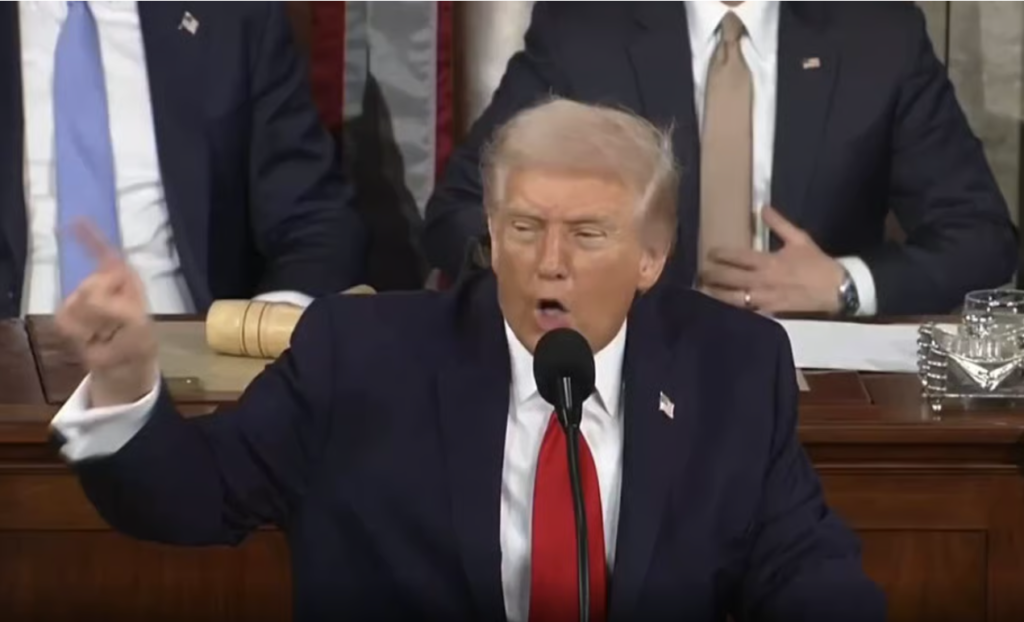
President Donald Trump delivered his first State of the Union address of his second term last night before a joint session of Congress. At 108 minutes, it broke his own record from the previous year and became the longest address since at least 1964, according to the American Presidency Project at the University of California, Santa Barbara. The official theme was “America at 250: Strong, Prosperous, and Respected,” referring to the 250th anniversary of independence.
Trump presented what he called a “historic turnaround” for the economy, claiming to have secured $18 trillion in investment commitments (a figure his own White House only supports up to $9.6 trillion and which ABC News calls “without evidence”). He defended his tariffs—declared illegal by the Supreme Court four days earlier by a 6-3 vote, with three of his own nominees in the majority—and announced new 15% tariffs under different legal grounds. On immigration, he claimed that “zero illegal immigrants have been admitted” in nine months, a figure that fact-checks by CBS News, ABC News, and NPR call inaccurate: the Border Patrol has not released any detainees, but thousands continue to cross monthly (6,000 in January alone). Crossings have indeed fallen to their lowest level since 1970, a genuine achievement.
In foreign policy, he devoted a brief passage to Iran, warning that Tehran continues to pursue nuclear weapons; he celebrated the capture of Nicolás Maduro in Venezuela, awarding the Medal of Honor to Chief Warrant Officer Eric Slover; and he barely mentioned Ukraine-Russia —on the fourth anniversary of the invasion— nor devoted substantive attention to Europe or China.
Republicans gave sustained ovations. Democrats remained mostly seated. Representative Ilhan Omar shouted “You have killed Americans!” during the passage on immigration, referring to two citizens killed during Operation Metro Surge in Minneapolis. Representative Al Green was removed from the House chamber after displaying a sign. Virginia Governor Abigail Spanberger, in the Democratic response from Colonial Williamsburg, stated that “we are not hearing the truth from our president” and focused her message on the affordability of the cost of living.
The main fact-checking organizations (CBS News, ABC News, NPR, CNN) identify the record jobs figure as misleading (the labor force participation rate is identical to Biden’s), the claim of having passed “the biggest tax cuts in history” as inaccurate (the Tax Foundation ranks them as the sixth largest), and the statement that drug prices are now “the lowest in the world” as unfounded.
IMPLICATIONS
The speech was an exercise in electoral communication ahead of the November midterm elections, at a time when Trump’s disapproval rating has reached 60% and six out of ten Americans believe the country is worse off than a year ago (NPR/PBS News/Marist poll). The silence on Europe, China, and Ukraine reveals a transactional foreign policy geared toward immediate media impact, rather than building a stable international order. While the firm stance against Iran and the capture of Maduro are real assets, the omissions regarding the major strategic issues of the 21st century—transatlantic relations, competition with Beijing, and resolving the Russian-Ukrainian conflict—are cause for legitimate concern.
PERSPECTIVES AND SCENARIOS
The most likely scenario is that the speech will set the Republican narrative for the midterm elections: a strong economy, a closed border, and a hardline foreign policy. Democrats will focus on affordability as their campaign theme. The tariff crisis triggered by the Supreme Court will force the administration to seek new legal grounds, creating considerable uncertainty for the markets. Tensions with Iran will continue to escalate with negotiations in Geneva this week.
Sources: CBS News, ABC News, NPR, CNN, PBS News, CNBC, The Washington Post, Reuters, AP.
2. The disaster of demographic implosion: South Korea registers a slight rebound in the world’s lowest birth rate
FACTS
South Korea’s fertility rate—the lowest in the world—rose for the second consecutive year in 2025, reaching 0.80 children per woman, up from 0.75 in 2024 and 0.72 in 2023, according to preliminary data released Wednesday by the Ministry of Data and Statistics. There were 254,500 births, a 6.8% increase over the previous year, the largest percentage increase since 2007. Marriages rose 8.1%, following a 14.8% jump in 2024, driven in part by couples who postponed weddings during the pandemic. The average age of mothers rose to 33.8 years.
Despite the rebound, deaths (363,400) continued to far outnumber births, resulting in a natural population decline of 110,000 for the sixth consecutive year. The generational replacement rate is 2.1 children per woman. Seoul, the capital, has the lowest rate in the country at 0.63. President Lee Jae-myung’s government is preparing a five-year roadmap for demographic response and planning measures to attract skilled foreign workers. The central bank estimates that potential GDP growth will fall to 0.6% annually between 2045 and 2049.
IMPLICATIONS
The rebound is moderately positive news, but we shouldn’t be misled: a rate of 0.80 is still catastrophically low, less than half the replacement rate. This phenomenon is not unique to South Korea: Japan (5.7 births per 1,000 inhabitants in 2024), Taiwan (4.6), and China (5.6) share this trend. The demographic implosion of East Asia is one of the great geoeconomic challenges of the 21st century, with direct implications for economic growth, pension systems, military capacity, and the geopolitical weight of these nations. Incentive policies (childcare subsidies, housing support, preferential mortgages) have limited effects compared to deep-seated structural causes: the cost of housing, work pressures, and a cultural shift that prioritizes career advancement.
PERSPECTIVES AND SCENARIOS
South Korean authorities project a birth rate of 1.0 children per woman by 2031, an optimistic forecast. The more likely scenario is a stabilization at around 0.8-0.9 children per woman over the next few years, insufficient to prevent a severe demographic decline. Attracting skilled foreign labor will be essential, posing integration challenges in a traditionally homogeneous society. The South Korean case should serve as a warning for Europe, where several nations face similar, albeit less extreme, dynamics.
Sources: Reuters, Bloomberg, The Korea Times, Financial Times, Straits Times, Japan Times.
3. The European sixth-generation fighter crashes before takeoff: ego, industrial rivalries and lack of strategic vision
FACTS
The FCAS (Future Combat Air System) program, Europe’s flagship defense project to develop a sixth-generation fighter jet intended to replace the French Rafale and the German and Spanish Eurofighters by 2040, is in its terminal state. German Chancellor Friedrich Merz stated on the political podcast Machtwechsel that France needs an aircraft with nuclear and naval capabilities, “which is not what we currently need in the German Armed Forces,” a statement that Belgian Defense Minister Theo Francken publicly interpreted as the program’s death knell, tweeting that “the SCAF is dead.”
The IG Metall union—Germany’s largest industrial union, representing Airbus workers—and the Federation of German Aerospace Industries (BDLI) published a joint manifesto in the Handelsblatt calling for Germany to develop its own fighter jet and seek new partners. Its leader, Jürgen Kerner, declared that “we no longer trust Dassault” and that the French company “has completely disqualified itself as a reliable partner.” Former Airbus CEO Tom Enders spoke from the sidelines, warning that a German domestic program would be prohibitively expensive (over $400 billion, using the F-35 as a benchmark).
To make matters worse, Merz has questioned whether Germany even needs to significantly increase its defense budget for a manned fighter jet, suggesting that advances in drones and artificial intelligence could make a new-generation piloted aircraft unnecessary. Meanwhile, Germany is negotiating the purchase of 35 additional F-35s from the United States, further solidifying its reliance on American technology.
IMPLICATIONS
The spectacle is lamentable, and not for the first time. Europe demonstrates time and again its inability to overcome national egos and industrial interests in favor of genuine strategic autonomy. The FCAS program, launched in 2017 with an estimated budget of €100 billion, has become mired in a petty squabble between Dassault (which claims total design leadership and refuses to share source code) and Airbus (which demands an equitable division). France wants a nuclear-powered, naval aircraft; Germany and Spain do not. The intervention of the IG Metall union, meddling in what should be a matter of strategic sovereignty, illustrates the distortions of the German industrial system.
If Europe fails to build its own sixth-generation fighter jet, it will become definitively dependent on American technology (F-35) while the UK, Italy, and Japan advance with the GCAP (Global Combat Air Programme). This represents a surrender of European strategic autonomy in one of the most critical areas of defense.
PERSPECTIVES AND SCENARIOS
The most likely scenario is a reformulation of the FCAS program that preserves cooperation in the combat cloud and drones, while the manned fighter component is diversified: France with an evolution of the Rafale and Germany seeking alternative partners (Spain, possibly the GCAP program). The total cost will be higher and the operational capacity lower than if the program had functioned as designed. A bitter lesson for European defense.
Sources: Financial Times, Reuters, Breaking Defense, Euronews, Aerotime, Daily Sabah, Handelsblatt, European Council on Foreign Relations.
4. Trump is preparing the ground for possible military action against Iran
FACTS
President Trump used his State of the Union address to present his public argument on Iran, warning that Tehran continues to pursue nuclear weapons despite the U.S. airstrikes in June that he claimed “annihilated” Iran’s nuclear program. Trump stated his preference for diplomacy but insisted that Iran has not uttered “the secret words: we will never have a nuclear weapon.” Hours before the speech, Secretary of State Marco Rubio and CIA Director John Ratcliffe briefed the Gang of Eight (the eight congressional leaders with access to classified intelligence) on the situation with Iran.
The US military deployment to the Middle East is the largest since the invasion of Iraq: a second aircraft carrier and additional fighter jets have been deployed to the region. Negotiations between the United States and Iran will resume on Thursday in Geneva. Iranian Foreign Minister Abbas Araghchi declared that same day that Iran is not seeking a nuclear weapon, a claim that lacks credibility given the regime’s track record. Trump posted on Truth Social that his Chairman of the Joint Chiefs of Staff believes a war with Iran would be “easily won.”
IMPLICATIONS
Trump’s firm stance against the Tehran regime stems from a sound strategic logic. A nuclear Iran would represent an existential threat to the stability of the Middle East and to Western interests in the region. The regime’s history—decades of systematic deception of the IAEA, uranium enrichment to near-weapon-grade levels, and support for terrorist proxies ranging from Hezbollah to the Houthis and Hamas—more than justifies a firm position. The combination of military pressure and diplomacy is the correct approach: negotiating from a position of strength.
The Commander-in-Chief’s prerogative to order limited military action to neutralize a threat to national security is well established in U.S. constitutional practice. A preemptive deployment against a hostile regime’s nuclear facilities falls within the legitimate scope of executive authority. What is worth noting, however, is a certain rhetorical inconsistency: claiming that the program was “annihilated” in June while simultaneously warning of its reconstruction requires a more articulated explanation.
PERSPECTIVES AND SCENARIOS
The baseline scenario is a controlled escalation with negotiations in Geneva and increasing military pressure. If negotiations fail, limited military action against nuclear facilities is plausible. Iran has deployed 23 Ghadir-class submarines in the Persian Gulf, and China is reportedly providing real-time satellite surveillance to Tehran. A larger escalation would draw in Iranian proxies throughout the region. Oil would be the first indicator of tension.
Sources: Reuters, CNN, PBS News, CBS News, NPR, CNBC, AP.
5. The battle for Warner Bros.: Paramount raises its offer and casts doubt on the Netflix deal
FACTS
The bidding war for Warner Bros. Discovery is intensifying. Paramount Skydance, led by David Ellison (son of Larry Ellison, co-founder of Oracle and a close ally of Trump), has raised its offer to $31 per share in cash—up from the previous $30—for all of Warner Bros. Discovery, including cable networks such as CNN, TBS, and Discovery. The offer includes a $7 billion break-up fee if the deal fails to gain regulatory approval, in addition to covering the $2.8 billion Warner would owe Netflix for breaking their previous agreement.
Netflix had closed a deal in December to acquire only the studio and HBO Max for $27.75 per share ($82.7 billion with debt). Warner Bros. Discovery’s board stated that Paramount’s revised offer “could reasonably be” higher than Netflix’s, although it has not formally changed its recommendation. If the board determines that Paramount’s offer is higher, Netflix will have four business days to improve its proposal. The shareholder vote on the Netflix deal is scheduled for March 20.
IMPLICATIONS
This deal goes far beyond the business sphere. In the 21st century, control of content platforms and major news and general-interest television networks is a matter of power. If Paramount acquires Warner Bros., a single group will control CBS News, CNN, and an unparalleled audiovisual catalog (HBO, Harry Potter, DC Comics, Game of Thrones). The implications for media pluralism are considerable, especially after the editorial changes already implemented at CBS News under Skydance’s new ownership (with the appointment of Bari Weiss as editor-in-chief). Several Democratic senators have warned that a Paramount-Warner merger would control “almost everything Americans watch on television.”
If Netflix wins, it would become an unprecedented audiovisual giant, combining its subscription platform (streaming) with Hollywood’s most prestigious studio and content library. Antitrust regulators—both American and European—will have the final say.
PERSPECTIVES AND SCENARIOS
Netflix is likely to respond with an improved offer, sparking a bidding war. The political factor is relevant: the Ellisons’ relationship with Trump could facilitate Paramount’s regulatory approval, although Trump has stated he will not get involved. Whatever the outcome, the global entertainment and information industry will become more concentrated.
Sources: Reuters, CNBC, NBC News, Bloomberg, Al-Jazeera, CBS News, Hollywood Reporter, Fortune.
6. Isn’t the global economy solely about artificial intelligence? Mike Dolan’s thesis
FACTS
Mike Dolan, chief finance and markets editor at Reuters, develops a provocative but necessary thesis in his most recent columns: the markets’ obsession with artificial intelligence may be distorting the perception of the global economy. Dolan points out that, since the emergence of ChatGPT three years ago, the AI narrative has dominated stock markets regardless of the underlying macroeconomic fundamentals, sometimes acting as a shield and other times as a source of volatility.
The data supports caution: a study by the San Francisco Federal Reserve published this week concludes that “most macroeconomic studies on productivity find limited evidence of a significant effect from AI.” A Bank of America survey shows that more than 50% of global fund managers consider AI a bubble, and 45% identify it as the biggest systemic risk (tail risk) to investments in 2026. At the same time, markets suffered another wave of declines this week, concentrated in the software and payments sectors most vulnerable to AI disruption.
IMPLICATIONS
Dolan’s reflection connects with a broader concern: the fundamentals of the real economy—GDP growth, inflation, interest rates, employment, international trade—remain the determinants of economic well-being, but they are being overshadowed by a technological narrative that fuels stratospheric stock valuations without proportionate evidence of real short-term returns. The trillions of dollars invested in data centers and computing power for AI represent a macroeconomic stimulus in themselves, but they also generate inflationary pressures (energy prices in the United States have risen 6.3% in part for this reason) and increasing debt.
BlackRock, the world’s largest asset manager, has shown in its annual outlook that it would be extraordinarily difficult for even a technological transformation of this magnitude to alter the 150-year growth trajectory of the US economy. Technology is important, but it’s not everything.
PERSPECTIVES AND SCENARIOS
The scenario of a significant correction in AI-related technology stocks is increasingly plausible if tangible returns don’t materialize soon. A 15% to 20% drop in the most exposed stocks wouldn’t be surprising. However, long-term technological transformation appears irreversible; the question is whether markets are pricing in a reality that will take years to materialize.
Sources: Reuters (Mike Dolan, ROI), Bank of America Global Fund Manager Survey, San Francisco Federal Reserve, BlackRock Annual Outlook.
III. MEDIA RACK
Anglo-Saxon media: Coverage of the State of the Union (SOTU) absolutely dominates. The New York Times, The Washington Post, CNN, CBS, NBC, PBS, and Fox News offer extensive coverage with real-time fact-checking. There is general agreement in identifying inaccuracies in the employment, investment, and pharmaceutical price figures. Fox News maintains a more pro-president tone. The Wall Street Journal and Financial Times combine SOTU coverage with monitoring of the post-Supreme Court tariff crisis and the Warner/Paramount/Netflix battle. The Guardian and The Times of London cover SOTU from a transatlantic angle, highlighting the absence of Europe in the speech. POLITICO and The Hill focus on the implications for the November midterm elections.
French and German media outlets: Le Monde, Le Figaro, and Libération closely follow the FCAS crisis from a French perspective (defending Dassault and French industrial leadership). FAZ, Die Welt, and Die Zeit reflect the German position, paying particular attention to Merz’s statements and IG Metall’s intervention. BFM and LCI cover Franco-German tensions in defense.
Israeli and Middle Eastern media outlets— Jerusalem Post, Haaretz, Israel Hayom, and Yedioth Ahronoth—focus on Trump’s statements regarding Iran and the military deployment in the region. Al Jazeera and Al Arabiya cover both the SOTU and the battle for Warner Bros., with an angle on CNN. Asharq Al-Awsat, Arab News, and Gulf News follow the Iran-US negotiations in detail.
Asian media outlets such as The Korea Times, Yomiuri Shimbun, Straits Times, and Japan Times provide extensive coverage of South Korean demographics. The South China Morning Post and China Daily maintain a low profile regarding the absence of China in Trump’s speech. WION and the Times of India cover the SOTU with an angle on the Rafale sale to India and its implications for FCAS.
Ukrainian media outlets: Kyiv Post, Kyiv Independent and Ukrinform report with restrained frustration the minimal attention Trump paid to Ukraine on the fourth anniversary of the invasion.
Russian media: Russia Today and TASS offer coverage of the SOTU focused on statements about Iran and marginal mention of the Ukrainian conflict.
Latin American media: Clarín, El Mercurio and Reforma cover Trump’s celebration of Maduro’s capture and the implications for the region.
IV. RISK TRAFFIC LIGHT
🔴 HIGH RISK — Iran/Persian Gulf. Largest US military deployment since the invasion of Iraq. Negotiations in Geneva on Thursday. Trump’s rhetoric escalates. Iran deploys submarines in the Gulf. Possible military action if diplomacy fails. Direct impact on energy markets.
🔴 HIGH RISK — Tariffs/Trade War. Legal vacuum following the Supreme Court ruling. New 15% tariffs on uncertain legal grounds. $130 billion repayment pending. Maximum uncertainty for markets and trading partners.
🟡 MEDIUM-HIGH RISK — Ukraine-Russia. Fourth anniversary with no prospects for peace. Negotiations stalled. Maximalist demands from Putin. Pressure from Washington on Zelensky with a possible June deadline. 25,000 casualties per month according to Trump.
🟡 MEDIUM RISK — European defense/FCAS. The joint fighter program is nearing its end. Fragmentation of the European defense industry. Growing dependence on US technology (F-35). Weakening of strategic autonomy.
🟡 MEDIUM RISK — Global media concentration. Warner/Paramount/Netflix battle with implications for media pluralism. Antitrust review pending in the US and Europe.
🟢 LOW-MEDIUM RISK — Demographics: East Asia. Long-term structural impact on economic growth and geopolitical balance. No immediate risk but with irreversible cumulative consequences.
V. EDITORIAL COMMENTARY
The events of February 24-25, 2026, offer an eloquent portrait of the state of the world. A US president delivering the longest speech in history to a divided nation; a Europe unable to agree on building an airplane; an Iranian regime continuing to play with nuclear fire; and an entertainment industry consolidating in the hands of very few, while we wonder if artificial intelligence is the revolution it promises or the bubble we fear.
Of all this news, the most worrying for those of us who defend the transatlantic link and the idea of a strong Europe is not Trump’s rhetoric—predictable in its triumphalism—but the FCAS debacle. That in the midst of global rearmament, with Russia at war with a European country and China aggressively expanding its military presence, Europe is incapable of overcoming an industrial battle between Dassault and Airbus to see who dominates aircraft design is, quite simply, shameful. That the IG Metall union is demanding a German national program and that Chancellor Merz himself is questioning whether Germany needs a sixth-generation fighter reveals a worrying lack of geostrategic vision. The Belgian Defense Minister, Theo Francken, had the brutal honesty to say it out loud: “The SCAF is dead.” Europe, once again, is signing its own dependency.
Regarding Iran, Washington’s firm stance is correct. You cannot negotiate with a regime that enriches uranium to near-weapon-grade levels while funding Hezbollah, Hamas, and the Houthis and brutally repressing its own population. The combination of military pressure and diplomacy is precisely the right approach. Those clamoring for a softer approach would do well to remember the consequences of the 2015 nuclear agreement, which granted Tehran economic relief in exchange for commitments it systematically violated.
On the demographic front, South Korea’s slight improvement should not generate false optimism. A birth rate of 0.80 children per woman is a slow-motion disaster. East Asia faces a demographic implosion that will redraw the geopolitical map of the coming decades, and Europe is not far removed from the same dynamic.
And perhaps the most necessary reflection is that of Mike Dolan: amidst the artificial intelligence frenzy, it’s important not to lose sight of the fact that the real economy—with its jobs, mortgages, coffee prices, and energy costs—remains what determines citizens’ well-being. Technological revolutions transform societies, but they do so at their own pace, not at the pace of stock market prices.
—–
This report was compiled using information from over 90 international media sources. All information has been verified with at least two independent sources. The opinions expressed in the Editorial Commentary reflect the author’s editorial line.