By Gustavo de Arístegui,
March 12, 2026
I. BRIEF INTRODUCTION
Today marks the twelfth day of Operation Epic Fury, the joint military offensive launched by the United States and Israel against the jihadist regime in Tehran on February 28, 2026, which has radically transformed the global geopolitical and geoeconomic landscape. The elimination of Ayatollah Ali Khamenei in the first wave of attacks, the appointment of his son Mukhtaba Khamenei as the new Supreme Leader, the effective closure of the Strait of Hormuz, the outbreak of a regional war that has engulfed nine countries, and an energy crisis unprecedented since the 1970s form the backdrop for this analysis.
Today’s events are marked by five points of high tension: first, the continued blockade of the Strait of Hormuz and the new attacks on ships flying the Japanese, Thai, and Liberian flags; second, the revealing analysis by US intelligence concluding that the Iranian regime is not at risk of imminent collapse; third, the Spanish diplomatic scandal surrounding the dismissal of the ambassador to Israel and the equanimity with which Hamas and the Houthis received Sánchez’s announcement; fourth, the political fiasco of Ursula von der Leyen, who had to backtrack on her bold geopolitical stance less than 48 hours after adopting it; and fifth, the paradox of Iranian oil continuing to flow to China while the rest of the world suffers from a collapse in supply through the Persian Gulf.
II. MOST IMPORTANT NEWS OF THE LAST 24 HOURS
1. The Strait of Hormuz: the biggest energy disruption since 1973
Facts
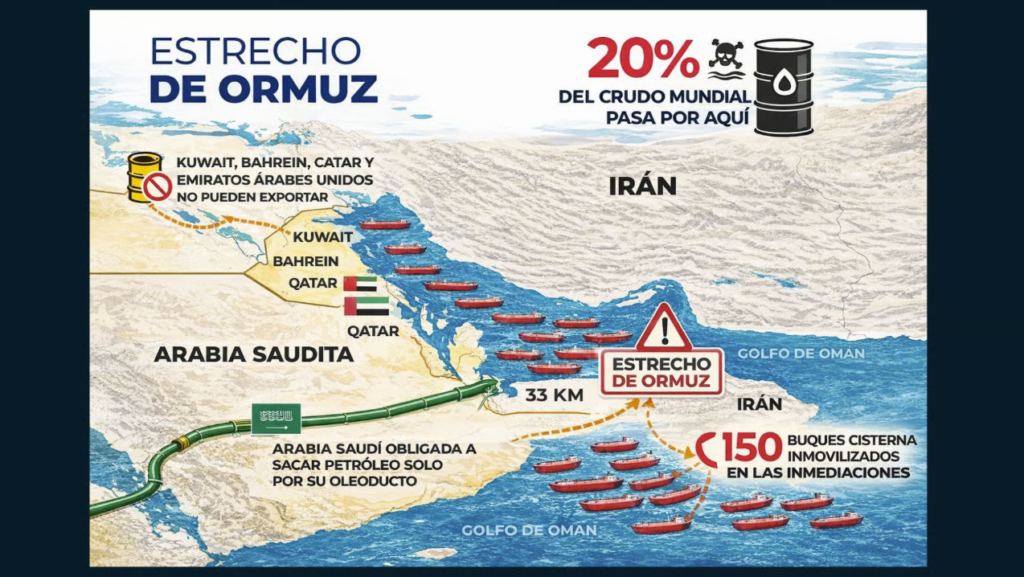
The Islamic Revolutionary Guard Corps (IRGC) announced on Wednesday, March 11, that it will not allow “a single liter of oil” to pass through the Strait of Hormuz. In the past 24 hours, three more ships were hit by projectiles: the Thai-flagged cargo ship Mayuree Naree, a Japanese container ship belonging to the shipping company ONE Majesty, and a Liberian-flagged vessel. The International Energy Agency (IEA) approved the release of 400 million barrels from its strategic reserves, the largest such operation in its history. IRGC Headquarters spokesman Khatam al-Anbiya warned that the price of oil “will reach $200 per barrel” and threatened to attack pipelines throughout the region. Reuters reported on Wednesday that Iranian oil continues to flow unimpeded to China, under parallel agreements that too many analysts had refused to acknowledge.
The price of Brent crude has experienced unprecedented volatility: it rose to $119 per barrel at the beginning of the week, fell below $80 amid rumors—denied hours later—of a US naval convoy in the Strait, and is currently trading above $90, with the latent threat of exceeding $120 if the blockade continues. Major shipping lines such as Maersk and Hapag-Lloyd have suspended their Mediterranean and Gulf routes. Qatar temporarily suspended liquefied natural gas (LNG) production at Ras Laffan. Natural gas prices in Europe have risen by 50 percent since the start of the conflict. Gulf countries have seen their crude oil exports collapse due to the inability to load tankers.
Implications
We are facing the greatest disruption to the global energy supply since the oil crises of the 1970s. The effective closure of the Strait of Hormuz, through which approximately 20 percent of the world’s oil and equivalent quantities of LNG pass, is not just an energy crisis: it is a looming global economic crisis. Analysts at Rice University’s Baker Institute predict a global recession if the blockade lasts more than two weeks. Fertilizers—a third of global trade passes through Hormuz—have already seen their prices skyrocket by 43 percent, with direct consequences for food security in developing countries. Shipping companies avoiding the Strait are resorting to the alternative route around the Cape of Good Hope, which adds 10 to 14 days to the journey, drives up freight rates, and creates bottlenecks in ports worldwide.
The paradox of Iranian oil flowing unimpeded to China while its Gulf neighbors see their exports blocked confirms what some independent analysts have been warning about for years: the existence of bilateral agreements between Tehran and Beijing that Washington has been unwilling or unable to neutralize, despite its “maximum pressure” policy. This scenario of geopolitical double standards in energy supply reinforces the architecture of a bifurcated world order, where Western sanctions simply do not reach the actors who knowingly ignore them.
Perspectives and scenarios
Scenario 1 (most likely, 55%): President Trump yields to market pressure and orders naval escort for transiting vessels, forcing de facto negotiations with Tehran and opening a de facto path to a ceasefire within ten to fifteen days, stabilizing prices below $100.
Scenario 2 (possible, 30%): The IRGC intensifies attacks on energy infrastructure in Saudi Arabia and the United Arab Emirates, the price of Brent crude exceeds $130, and global inflationary pressure triggers a coordinated response from the US Federal Reserve and the European Central Bank that exacerbates the economic slowdown.
Scenario 3 (unlikely but catastrophic, 15%): The IRGC successfully mines the Strait, driving the price up to the announced $200 per barrel and triggering a global recession. This scenario is unlikely because it would also devastate the economies of Iran’s allies, including China, whose oil is currently flowing through its borders.
2. US intelligence rules out the collapse of the Iranian regime
Facts
Reuters exclusively reported on Tuesday that US intelligence services have formally concluded that the Iranian government is not at risk of imminent collapse, despite twelve days of massive bombing, the elimination of Supreme Leader Ali Khamenei and dozens of high-ranking military and security officials, and the attack on more than 5,000 facilities, according to Pentagon figures. The new Supreme Leader, Mukhtaba Khamenei, has consolidated his authority with the explicit backing of the IRGC. The rate of Iranian ballistic missile launches has decreased by 90 percent since the first day, and the rate of drone launches by 80 percent, according to Admiral Brad Cooper of US Central Command (CENTCOM), revealing more a depletion of ammunition than a political defeat for the regime.
President Trump has wavered between demanding Iran’s “unconditional surrender,” calling for a popular uprising, and offering amnesty to military commanders who defect. Israeli Prime Minister Benjamin Netanyahu declared on Fox News that this war “is not an endless war” and that it will open the door to “an era of peace we haven’t even dreamed of.” However, analysts on the ground do not share this optimism. Meanwhile, the exiled Reza Pahlavi, son of the former Shah, whose name has been chanted at previous demonstrations, maintains a low public profile, and no significant military or palace uprisings have occurred.
Implications
This assessment by American intelligence is, politically speaking, a major setback for the strategic premises that gave rise to Operation Epic Fury. The gamble on a decapitation effect—eliminating the supreme leader and hoping the regime would collapse like a house of cards—has failed spectacularly. The Tehran regime is not a conventional dictatorship where power resides in a single person. It is a theocratic oligarchy with multiple layers of loyalty and co-optation, where the IRGC not only protects the regime but is the regime itself, and where a segment of the Iranian population—estimated at least fifteen percent—actively supports the theocracy out of ideological conviction, economic interest, or simple fear. Without an internal coup or palace mutiny—which have not occurred—the jihadist state apparatus can survive massive bombing campaigns, as totalitarian regimes since World War II have historically demonstrated.
This places Washington and Israel before a dilemma of historic proportions: continue escalating without any guarantee of a political outcome; accept an agreement that Trump himself called unacceptable just two weeks ago; or prolong a war of attrition whose cost in the first hundred hours already exceeds $3.7 billion for the United States alone, according to the Center for Strategic and International Studies (CSIS).
Perspectives and scenarios
The Iranian regime’s resilience demonstrates once again that the theory of a “democratic blitzkrieg” through aerial bombardments—the same fallacy that fueled the 2003 invasion of Iraq—lacks a solid empirical basis. An orderly political transition in Iran remains possible in the long term, but it will require factors that bombing cannot provide: cohesion within the internal opposition, a fracture within the IRGC, and economic exhaustion that overcomes the regime’s repressive tendencies. None of these factors are currently present in a decisive manner.
3. Spain’s diplomatic embarrassment: the dismissal of the ambassador to Israel
Facts
The government of Pedro Sánchez announced last Tuesday the dismissal of Ana María Salomón Pérez as Spain’s ambassador to Israel, a decision communicated with little official explanation through the Official State Gazette. The news reached the world first through the social media account of US Republican Senator Lindsey Graham—whose dissemination even preceded the official statement from the Council of Ministers—rather than through the usual diplomatic channels. The first organizations to congratulate President Sánchez on the measure were Hamas and the Houthis of Yemen, which serves as a political barometer to gauge the moral and geopolitical context of this decision. President Trump himself had already criticized Spain the previous week with threats of trade sanctions. Sánchez has positioned himself as the most prominent European spokesperson against the US and Israeli attacks on Iran.
Implications
That the first to applaud a Spanish foreign policy decision are terrorist organizations designated as such by the European Union, the United States, and most liberal democracies is no small detail: it is the moral portrait of a foreign policy that has perverted the instinct for solidarity, turning it into an objective accomplice of jihadist fanaticism. Spain does not dismiss its ambassador to Russia, which has spent two years massacring Ukrainian civilians with Iranian-made missiles. It does not dismiss its ambassador to Venezuela, where Maduro’s narco-dictatorship systematically crushes fundamental rights. But it dismisses its ambassador to the only democratic state in the Middle East while a totalitarian and terrorist regime threatens to destroy the world energy order. Moral consistency does not appear to be a priority for the coalition government in Madrid.
This decision, adopted in the midst of the Gaza hostage crisis, the open war between the US-Israel and Iran, and the Strait of Hormuz crisis that is severely impacting the European economy, including Spain’s, sends a signal of weakness and ideological alignment with the most radical positions on the world political spectrum, degrading Spain’s diplomatic reputation and its specific weight on the international stage.
Perspectives and scenarios
Washington’s pressure on Madrid is now a real factor: Trump has threatened trade measures. In the context of the EU’s tariff negotiations with the US administration, Spain becomes the weakest link in the European chain, giving Brussels an additional argument to marginalize Sánchez’s positions in the European Council. The relevant question is not whether this gesture will have consequences—it will—but whether Sánchez’s government is prepared to face them, demonstrating that domestic electoral gains, in its political calculations, outweigh any consideration of long-term national interest.
4. Von der Leyen’s about-face: the geopolitical awakening that never was
Facts
European Commission President Ursula von der Leyen appeared before the European Parliament in Strasbourg on Tuesday, March 11, to retract—with all due diplomatic finesse—her statements from the previous day, in which she had asserted that “Europe can no longer be the guardian of the old world order” and had suggested that the ends might justify the means in the conflict with Iran. In less than 48 hours, the head of the EU executive had to underscore her “unconditional” commitment to international law and the United Nations legal order. Previously, European Council President António Costa had publicly rebuked her, stating that “freedom and human rights are not achieved with bombs.” Von der Leyen has been criticized both from the left, which accuses her of not condemning the American and Israeli attacks, and from the right, which accuses her of exceeding her powers in foreign policy matters, which the EU Treaty reserves to Kaja Kallas as High Representative and to Costa himself.
In her address to Parliament, von der Leyen acknowledged that ten days of war had cost European taxpayers an additional €3 billion in fossil fuel imports, and that gas prices had risen by 50 percent and oil prices by 27 percent. She also used the occasion to implicitly campaign for renewable energy and nuclear power as an alternative to dependence on hydrocarbons from the Persian Gulf.
Implications
Von der Leyen’s handling of this crisis confirms the structural deficit of European foreign governance: a Commission that oversteps its bounds, a Council that holds it back, a High Representative who acts with sluggishness, and twenty-seven member states with divergent interests. Von der Leyen’s attempt to use the Iranian crisis as leverage for Europe’s “geopolitical awakening” lasted precisely as long as it took national governments to exercise their diplomatic veto. The practical result is the image of an institution that oscillates between grandiloquence and impotence in a matter of hours, which only exacerbates the perception of the EU’s irrelevance on the great powers’ stage.
The real tragedy lies in the fact that von der Leyen’s initial diagnosis was correct: Europe has been a passive spectator for too long of an international order shaped by others at will, and its energy dependence on the Gulf is a strategic Achilles’ heel. But the hasty reversal—the result of pressure from the very deniers of the reality von der Leyen herself denounced—has squandered the opportunity to articulate a coherent European position at the most critical moment in recent years.
Perspectives and scenarios
The Extraordinary Summit of the European Council scheduled for March 19-20 becomes, in this context, a litmus test for EU cohesion. The divisions between countries favoring a more Atlanticist position—Poland, the Baltic states, and the Netherlands—and those advocating for an independent mediation process—Spain, and to a lesser extent France—could undermine any joint declaration. Orbán’s Hungary and Sánchez’s Spain, the two obstacles that von der Leyen has privately identified as the main impediments to her proposals, will continue to be Brussels’s bane.
5. The regime’s audacity: Iran threatens to “consider the defense of its neighbors as aggression”
Facts
Iranian Foreign Minister Abbas Araghchi declared in recent hours that any defensive measures taken by Iran’s neighbors to neutralize Iranian missiles and drones launched against their territories—including refineries, airports, ports, residential neighborhoods, and desalination plants— “will be considered an act of aggression and will lead to further attacks against them.” Simultaneously, an IRGC general threatened to attack “all the economic centers of the Middle East,” and the foreign policy advisor to the new Supreme Leader, Kamal Kharazi, dismissed any possibility of diplomacy in an interview with CNN as long as the attacks continue. Kuwait has intercepted 178 ballistic missiles and 384 drones. The United Arab Emirates has shot down 169 of the 182 missiles detected, with the rest falling into the sea, in addition to 645 drones. Bahrain has intercepted 70 missiles and 76 drones. An Iranian drone crashed into the British air base at Acrotiri, in Cyprus.
Implications
Araghchi’s declaration is, in legal and moral terms, an exercise in cynicism that is hard to surpass. Iran launches missiles at airports, refineries, and residential neighborhoods of sovereign countries that are not militarily involved in the conflict, and then has the audacity (the outrageous audacity, to use milder diplomatic terms) to claim that defending them constitutes aggression. This doctrine—which transforms the right to self-defense into a cause for belligerency—is the same one that totalitarian regimes have historically used to intimidate their neighbors and expand their perimeter of impunity.
The IRGC’s logic is clear: if the Gulf states cannot defend themselves without risking an even more intense attack, their only rational options would be diplomatic capitulation, forced neutrality, or integration into Tehran’s axis. This logic explains why Qatar, according to Western sources, launched attacks against Iran after it attempted to destroy Doha’s airport, a claim vehemently denied by the Qatari Foreign Ministry spokesperson. The information blackout surrounding what is really happening in the Gulf is itself an indicator of the gravity and complexity of the situation.
Perspectives and scenarios
Araghchi’s threat is not merely rhetorical: it is an attempt to dissuade the Gulf states from actively cooperating with the American coalition. If Saudi Arabia, the Emirates, or Qatar perceive that their security is not guaranteed by either the coalition or neutrality, they could be forced to seek separate agreements with Tehran, fragmenting the front that Washington needs to maintain pressure on the regime. The result would be a strategic victory for the IRGC without having won a single battle on the ground.
III. MEDIA RACK
The following is a summary of the predominant editorial line of the main international media outlets in the last twenty-four hours regarding the ongoing conflict.
Western Anglophone Media
Reuters/AP/AFP: Factual coverage of the attacks in the Strait of Hormuz, the IEA’s release of reserves, and the IRGC’s statements. Reuters has published the exclusive on the uninterrupted flow of Iranian oil to China. AP reports on the latest Hezbollah attacks on northern Israel from Lebanon.
The New York Times/Washington Post: Deep skepticism about the viability of the “regime change” objectives follows the intelligence report. The NYT quotes analysts who compare the American strategy to the mistakes made in Iraq in 2003. The WashPost reports on the cost of the first 100 hours of the operation and the questions raised by Congress.
Wall Street Journal/Financial Times: In-depth analysis of the economic impact of the Strait of Hormuz closure: rising natural gas prices in Europe, fertilizer costs, and alternative shipping routes. The FT points out the paradox of China benefiting energetically from the chaos while the West suffers.
CNN/CBS/NBC: Continued coverage of the attacks on ships in the Strait, the internal debate within the Trump administration regarding the duration of the conflict, and the potential naval escort. CBS released the preliminary report on the attack on the Minab school.
Fox News: In-depth interview with Netanyahu, who defends the operation as a prelude to “an era of peace” in the Middle East. Editorial line favorable to Trump’s position and critical of European neutrality.
BBC / The Times / The Telegraph: Detailed coverage of the attack on Acrotiri airfield and the implications for British sovereign territory in Cyprus. The Telegraph is highly critical of the European position of inaction. The Guardian maintains a more critical stance regarding the military intervention.
The Economist / Foreign Affairs: Strategic analysis on the risk of a “war of attrition” with no political solution. The Economist publishes an in-depth article on the resilience of the Iranian state and historical precedents of resistance to bombing.
Continental European media
Le Monde / Le Figaro / Libération: France continues to call for a cessation of hostilities and openness to mediation, reflecting the position of the Macron government. Le Figaro is more pro-Atlantic and critical of the IRGC. Libération maintains a position questioning the legality of the operation.
FAZ / Die Welt / Die Zeit: German media outlets focus on the energy impact on Europe and the consequences for divestment from fossil fuels. FAZ publishes a critical analysis of von der Leyen’s policies. Die Welt supports the frustrated European geopolitical awakening.
Corriere della Sera / L’Osservatore Romano: The Vatican newspaper publishes a call for peace signed by Cardinal Parolin, highlighting the suffering of civilians in Iran and Lebanon. Corriere analyzes the impact of rising oil prices on Italy’s economic recovery.
Media from the Middle East and the Arab world
Al Jazeera: Systematically critical coverage of the American-Israeli intervention, with particular emphasis on civilian casualties in Iran and Lebanon. Al Jazeera reports over 1,300 civilian deaths and nearly 10,000 civilian sites hit, according to Iranian data that could not be independently verified.
Jerusalem Post / Israel Hayom / Yedioth Ahronoth: The Jerusalem Post covers the massive joint attacks by Iran and Hezbollah on northern Israel, with missiles intercepted over the Sharon region. Israel Hayom reinforces Netanyahu’s narrative about the “path to peace.” Haaretz maintains a more critical stance regarding the operation’s strategic objectives.
Arab News / Asharq al-Awsat / Gulf News: Gulf media reflect the growing tension between solidarity with the American coalition and the fear of becoming an Iranian target. Arab News reports damage to Saudi Arabian facilities. Asharq al-Awsat analyzes Araghchi’s threat against countries that defend themselves as an unprecedented escalation.
Al-Arabiya: Favorable coverage of the dismantling of the Iranian military apparatus, although with growing concern about the impact of Tehran’s attacks on the civilian infrastructure of the Gulf Cooperation Council states.
Asian and emerging market media
South China Morning Post / China Daily / Xinhua: Beijing presents the conflict as a product of Western “hegemony” and calls for dialogue, while Iranian oil continues to flow uninterrupted to Chinese ports. The coverage avoids mentioning the energy benefits China derives from the Gulf chaos.
The Times of India / Hindustan Times: India faces a severe supply crisis: 95 percent of its Gulf oil arrives via the Strait of Hormuz. New Delhi calls for calm, contacts Riyadh to secure alternative supplies, and maintains a neutral stance in the face of pressure from Washington and Beijing.
WION (India): Coverage more sympathetic to the American coalition’s position. Detailed analysis of the impact on the Indian economy and the strategic vulnerability of Asian countries dependent on Gulf oil.
Yomiuri Shimbun / Tokyo Times: Japan releases 80 million barrels of oil from its strategic reserves and activates emergency diplomatic contacts. Japanese media cover with alarm the attack on the Japanese-flagged tanker ONE Majesty in recent hours.
Russia Today/TASS: Moscow presents the attacks as a “flagrant violation of international law” and calls on the UN Security Council to take action, a stance the Kremlin uses to legitimize its own invasion of Ukraine by contrast. RT underscores Washington’s growing diplomatic isolation.
Media from Eastern Europe and Ukraine
Kyiv Independent / Ukrinform / Ukrainian Pravda: Ukrainian media outlets are observing with concern that the conflict with Iran is diverting military resources and political attention from Washington, and that arms promises to Kyiv could be delayed. The Kyiv Post warns that the use of Iranian missiles in Russian hands during the war in Ukraine is a factor directly linking the two conflicts.
IV. RISK TRAFFIC LIGHT
| RISK | LEVEL | DESCRIPTION |
| Strait of Hormuz | 🔴 CRITICAL | Active blockade. Threat of $200/barrel. Global energy crisis brewing. |
| Escalation of the Iran-Israel-US conflict. | 🔴 CRITICAL | Day 12 with no signs of cessation. IRGC maintains attack capability. Lebanese front active. |
| Iranian regime collapse | 🟠 STOP | Ruled out in the short term by US intelligence. Regime consolidated under new leader. |
| Global economic impact | 🔴 CRITICAL | Gas +50%, oil +27% in Europe. Fertilizers +43%. Risk of recession if it lasts more than 2 weeks. |
| Regional spread of the conflict | 🔴 CRITICAL | Attacks on nine countries. British base in Cyprus hit. Qatar, Saudi Arabia, UAE, Bahrain and Kuwait under fire. |
| Diplomatic crisis in Europe | 🟠 STOP | Von der Leyen backtracks. Spain isolates Israel. European Council fragmented ahead of the March 19-20 summit. |
| Iranian weapons in Ukraine / Russia | 🟠 STOP | The conflict in Iran is draining Washington’s resources and attention, risking a reduction in aid to kyiv. |
| Residual nuclear risk | 🟡 MODERATE | IAEA (International Agency for International Economic Cooperation) will not have access to Iranian facilities from June 2025. Uncertainty about actual damage to the nuclear program. |
V. EDITORIAL COMMENTARY
Twelve days have been enough to confirm the most uncomfortable truth of contemporary international politics: the gap between strategic theory and geopolitical reality is often an abyss. Operation Epic Fury was conceived, at least in part, on the premise that eliminating the supreme leadership of the jihadist regime in Tehran would trigger a domino effect leading to the collapse of the theocracy. That premise has proven false. And what was predictable for any serious analyst of the Iranian regime—that the IRGC was not a one-man army but the backbone of a totalitarian state with deep social, economic, and patronage-based roots—has been confirmed by US intelligence itself.
The ayatollahs’ regime is not a typical dictatorship. It is a theocratic-military oligarchy of a complexity that superficial analyses often overlook. Its effective support base may be a minority, but it is loyal, armed, and distributed throughout all the levers of the state, from neighborhood Basij militia to IRGC cadres with massive economic interests. Destroying this network from the air is technically impossible. And history confirms this: neither Germany nor Japan capitulated to strategic bombing until they were militarily defeated on the ground or subjected to such brutal pressure that any other option became unfeasible. Neither of these factors exists in Iran today.
All of this does not mean that Operation Epic Fury was a mistake in absolute terms. The destruction of Iran’s nuclear and ballistic missile systems, the severe degradation of the IRGC’s capabilities, and the elimination of the leadership that for decades has financed, armed, and directed Hezbollah, Hamas, the Houthis, and pro-Iranian Iraqi militias is, objectively, a result of enormous long-term strategic significance. But confusing military dismantling with political change is the same mistake that buried Baghdad’s adventures in 2003. And Washington, unfortunately, seems to have repeated it.
Meanwhile, Europe watches the shipwreck of its own attempt at geopolitical awakening. For forty-eight hours, Von der Leyen had the right instinct: that the world has changed, that the old order based on ineffective consensus no longer works, and that Europe needs to speak with one voice and with instruments of real power. But the coalition of cowards and national interests—led by Sánchez and Orbán, from opposing ideological positions—forced her to back down. The result is the same old story: Europe as a qualified spectator of a game played by others, for which it pays its expensive energy bills, and which declares itself powerless to influence the outcome.
As for Spain, the dismissal of its ambassador to Israel deserves a separate, albeit brief, paragraph, because brevity is the only appropriate response to the indefensible. The fact that the first applause for the Sánchez government’s action came from Hamas and the Houthis is not anecdotal: it is defining. A foreign policy applauded by terrorist organizations and denounced by Spain’s democratic allies is not a foreign policy; it is an ideological stance disguised as diplomacy.
The Strait of Hormuz remains closed. Energy prices continue to rise. Iran’s new supreme leader consolidates his power from the ruins of Tehran. And the world, which believed that twelve days of massive bombing would open the doors to a free and democratic Iran, faces the dawn of the thirteenth day without a clear political horizon. History, as always, exacts its price when strategy is mistaken for wishful thinking.
■
Analysis prepared on March 12, 2026 with verified sources from Reuters, CNN, CBS News, Al-Jazeera, Jerusalem Post, Euronews, Wikipedia (2026 Iran War), CNBC, Al-Jazeera Economy, The Hill, and official documentation from the European Parliament and the Library of Congress of the United States.