By Gustavo de Arístegui,
March 31, 2026
I. BRIEF INTRODUCTION
March 31, 2026, is marked by five major geopolitical upheavals which, viewed together, reveal the depth of the international disorder in which we live. The conflict between the United States and Israel against the Iranian jihadist oligarchy remains the axis around which all major diplomatic, military, and economic movements of the moment revolve, but fractures are accumulating around this axis that deserve rigorous and unflinching analysis.
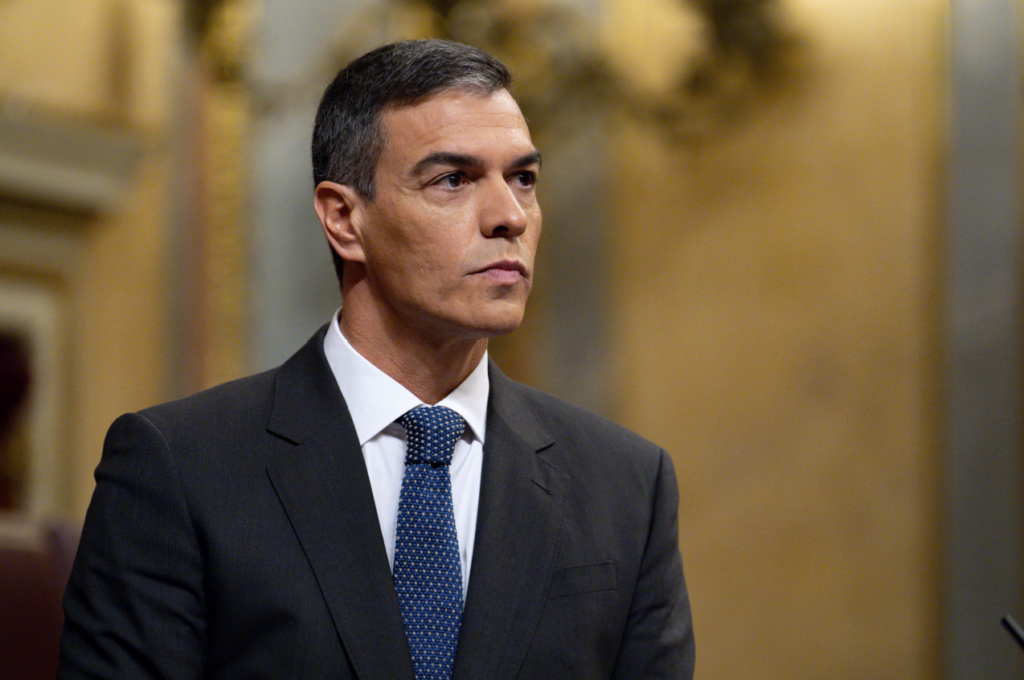
Spain has taken an unprecedented step in NATO history by closing its airspace to US military aircraft participating in Operation Epic Fury, making Pedro Sánchez the most disruptive NATO leader in recent decades. President Trump, meanwhile, uttered words of almost unimaginable diplomatic vulgarity at the Saudi investment forum in Miami, jeopardizing the architecture of trust with Gulf allies at the most delicate moment of the conflict. Within Iran, the jihadist oligarchy is intensifying its repression of its own population, aware that economic collapse could ignite a new wave of protests even more violent than those of January. President Zelensky returns from a historic tour of Saudi Arabia, the UAE, Qatar, and Jordan with far-reaching defense agreements. And within the United States, the “No Kings” demonstrations have exposed a network of funding for the radical left and far-right that deserves close scrutiny and a thorough investigation into its origins and intentions.
II. MOST IMPORTANT NEWS OF THE LAST 24 HOURS
1. Spain closes its airspace to US military aircraft linked to the Iran war
Facts
On Monday, March 30, Spanish Defense Minister Margarita Robles confirmed to the media that Spain had formally closed its airspace to US military aircraft participating in operations related to the Iran-Contra conflict. The measure was first reported by the newspaper El País, citing military sources, and later confirmed by First Vice President and Minister of Economy Carlos Cuerpo in an interview with Cadena SER radio. Cuerpo stated that the decision “is part of the position already adopted by the Spanish government of not participating in or contributing to a war initiated unilaterally and in violation of international law.” Foreign Minister José Manuel Albares ratified the measure on the Catalan radio station RAC1. Spain had previously denied the use of the Rota and Morón de la Frontera air bases; the airspace closure expands and consolidates this stance. It should be noted that emergency flights are exempt from the ban.
Implications
What Spain has done is unprecedented in the recent history of the Atlantic Alliance. In 2003, Turkey refused to allow its bases to serve as a launching point for the invasion of Iraq, but permitted overflights of its territory. France and Germany, which were staunchly opposed to that war, readily granted airspace to the allies because—as French Foreign Minister Dominique de Villepin explained at the time—”there are practices among allies that we must respect, including overflight rights . ” No critic of the second Iraq war has been more acerbic, incisive, and articulate than Villepin, whose arguments, while one may or may not agree with them, were considered brilliant even by his staunchest critics. Of course, we are in a different league, with a different intellectual weight in politics and, above all, in terms of principles and values.
Sánchez has gone further than any other European ally in times of active war. The operational implications are real: US military aircraft will have to fly around Spanish territory, increasing flight times, fuel consumption, and logistical complexity. But the political implications are even more serious: Spain is sending a signal of institutional defiance that has severely eroded its image and credibility with other European governments, seriously undermining NATO cohesion at the worst possible time. Trump responded by threatening to cut off trade with Madrid, which accounts for barely 1% of Spanish exports to the United States, but the damage in terms of trust, credibility, and reliability is immeasurable and long-lasting, regardless of which government comes to power.
Perspectives and scenarios
The Sánchez government has calculated that the domestic consequences of this measure—applauded by its radical left-wing electorate—outweigh the external risks. This calculation could prove tragically wrong. If the peace negotiations break down and the conflict with Iran drags on, Spain will be branded as the NATO ally that spuriously failed to uphold its allyship obligations, such as those so eloquently expressed by Villepin 24 years ago, at the alliance’s most critical juncture. The issue of the Rota and Morón air bases—whose strategic value to the allies is incalculable—has now entered a period of extreme tension. It is quite possible that Washington will demand a renegotiation of the bilateral Defense Agreement under conditions far less favorable to Madrid. In the medium term, Spain’s credibility as a reliable security partner will be seriously compromised in the eyes of Washington, the EU, and NATO.
2. Trump’s words about MBS: an unacceptable diplomatic outburst with serious consequences
Facts
On Friday, March 28, during his address at the Future Investment Initiative (FII) forum hosted by the Saudi sovereign wealth fund in Miami Beach, President Trump uttered words that have resonated around the world: “He didn’t think this was going to happen. He didn’t think he was going to be kissing my ass. He really didn’t think so… and now he has to be nice to me. Tell him he better be nice to me.” These words referred to Crown Prince Mohammed bin Salman (MBS). Trump had previously described MBS as “a warrior” who “fights alongside us,” and later attempted to soften his remarks by calling the prince “a smart guy, a regular guy.” The forum in question is entirely funded by the Saudi sovereign wealth fund (PIF) and brought together more than 1,500 delegates.
Implications
Saudi Arabia is suffering Iranian attacks on its energy infrastructure as a direct consequence of hosting US military bases. The Persian Gulf is the theater of operations from which the jihadist oligarchy of Tehran is being fought. In this context, the fact that the US president publicly humiliated the leader of Washington’s main Arab ally, at an event paid for by the US sovereign wealth fund, constitutes a diplomatic blunder of the highest order. According to the Washington Post and various intelligence sources, MBS has been privately urging Trump to maintain military pressure on Iran, calling the moment a “historic opportunity” to weaken the regime. Saudi Arabia has absorbed half or two-thirds of Lockheed Martin’s annual production of PAC-3 MSE interceptors in a matter of weeks, with no possibility of replenishment until well into 2027. In this context of absolute dependence and maximum vulnerability, Trump chose the moment to launch an outburst that no US president had ever uttered about a head of state of the Gulf Cooperation Council. Goldman Sachs estimates that Saudi GDP could contract by around 5% this year. The political cost of Trump’s words is incalculable in terms of trust and coalition cohesion.
Perspectives and scenarios
Riyadh has issued no official statement—neither the Royal Court nor the Foreign Ministry—following the usual protocol for managing provocations from key security partners: no amplification, no confrontation, no official acknowledgment of the grievance. But the wound is open. If peace negotiations fail and the conflict drags on, Saudi Arabia will be forced to rethink—even if only in the very long term—its security architecture, exploring alternatives to dependence on the United States. In the short term, the Gulf allies will continue to cooperate because they have no other operational option; but the capital of trust built up over decades of discreet diplomacy erodes every time Trump speaks in public without any filter.
3. Iran intensifies internal repression amid fears of economic collapse
Facts
A Reuters report, published on March 30 and widely reproduced by media outlets around the world—from The Japan Times to Al-Monitor and The Sunday Times—details the situation inside Iran a month after the start of the conflict with the United States and Israel. The jihadist oligarchy is trying to prevent any spark of internal dissent through mass arrests, executions, and massive deployments of the Revolutionary Guard and affiliated paramilitary groups, even going so far as to recruit children to man checkpoints. Louis Charbonneau of Human Rights Watch states that “Iranian authorities continue to carry out waves of arrests targeting real and perceived dissidents, members of ethnic and religious minorities, including Baha’is, and people who share reports or images of attacks.” Security forces patrol residential neighborhoods, intimidating citizens in their own homes. Parents of suspected agitators have been warned that their children could be imprisoned or executed. Hadi Ghaemi, director of the Center for Human Rights in Iran, confirms tactics of systematic occupation of public space.
Implications
The situation described by Reuters confirms what we have been analyzing for months: Tehran’s jihadist oligarchy entered this war already severely wounded by the January 2016 protests—in which the Revolutionary Guards killed thousands of demonstrators—and by the economic collapse that preceded the conflict. The rial had already lost nearly 90% of its value against the dollar since 2018. Professor Ali Ansari of the University of St Andrews succinctly summarizes it: “The Iranian regime was already in serious trouble before the war, and now it is taking a devastating blow. The political and economic crisis it was already facing will simply worsen when peace arrives.” The regime is aware that the end of the conflict—whatever its outcome—will unleash a pressure cooker of crisis: the businesses that reopen after the Iranian holidays will reveal the magnitude of the economic collapse. In this sense, preemptive repression is a sign of structural weakness, not strength.
Perspectives and scenarios
Everything suggests that the systemic fracture within the jihadist oligarchy will worsen after the end of hostilities, regardless of how they conclude. If the regime survives the war, the rallying around the flag that has partially dampened discontent will dissipate, and the pressure accumulated from economic hardship and repression could erupt into social unrest more violent than that of January. If the regime collapses or implodes, the power vacuum poses risks of regional instability with unpredictable consequences—a scenario for which neither Washington nor Tel Aviv seems to have adequately prepared. The “decapitation paradox” remains unresolved and without a satisfactory answer.
4. Zelensky returns from the Middle East with “historic” defense agreements with Saudi Arabia, the UAE, Qatar and Jordan
Facts
Ukrainian President Volodymyr Zelenskyy returned to Kyiv on March 30 after completing a tour of Saudi Arabia (March 27), the United Arab Emirates (March 28), Qatar (March 29), and Jordan (March 29). In his evening address, he described the agreements reached as “historic” and confirmed that they include cooperation in air defense—with a particular focus on intercepting Iranian-made drones, the Shahed-136 and its variants—joint defense production development, long-term technology partnerships, and energy agreements—including the supply of diesel, essential for both the Ukrainian armed forces and the agricultural sector. The agreements with Saudi Arabia, the UAE, and Qatar are valid for ten years. More than 200 Ukrainian experts have already been deployed to Gulf countries to advise on drone interception. Zelensky also confirmed that Jordan and Kuwait are in talks, and that Bahrain and Oman have submitted “additional requests.” Ukraine is offering the know-how accumulated during four years of war against Russia, which is using Shahed drones—acquired from Iran—as a weapon of systematic destruction against Ukrainian energy infrastructure.
Implications
Zelensky’s tour represents a significant strategic shift: in the midst of its war with Russia, Ukraine is becoming a net exporter of anti-drone doctrine and capabilities to the Gulf States, which are themselves the allies most vulnerable to Iranian attacks. The paradox is remarkable—and politically powerful: the country that has suffered more than any other from Iranian drones is now the one best positioned to teach others how to defend against them. At the same time, Zelensky is seeking to secure diesel fuel and financial support from the Gulf, at a time when the Hungarian veto threatens the flow of European aid and the Trump Administration is considering redirecting some of the weaponry originally destined for Kyiv to the Middle East. From Ukraine’s perspective, these agreements are a major strategic victory: they broaden the circle of states interested in Kyiv’s survival and defensive capabilities and reinforce its role as a global security actor, extending beyond the Ukrainian-Russian front.
Perspectives and scenarios
If the agreements materialize on schedule, Ukraine could become a leading supplier of drone warfare technology and countermeasures to the Gulf states—an emerging defense market niche with enormous economic and political potential. Energy cooperation with the Gulf, meanwhile, could reduce Ukraine’s energy vulnerability and strengthen Kyiv’s negotiating position with its Western allies. The element of tension is the signal Zelensky sent to Washington: that Ukraine is seeking to diversify its support and is not solely dependent on the American umbrella, which could complicate negotiations regarding the flow of American weaponry to the Ukrainian front.
5. The “No Kings” demonstrations: radicalism, opaque funding and street violence
Facts
On March 28, 2026, millions of people took to the streets across the United States and more than a dozen other countries for the “No Kings” protests against the Trump administration. Fox News Digital published an in-depth investigation identifying a network of some 500 organizations with combined annual revenues estimated at around $3 billion as the coordinating force behind these protests. The permit for the main march, held in Saint Paul, Minnesota, was issued to Indivisible, a high-level Democratic political organization funded by billionaire George Soros. Fox also identified the active participation of socialist and communist organizations—including the People’s Forum, the Party for Socialism and Liberation, and CodePink—linked to tech mogul Neville Roy Singham, an American self-proclaimed communist residing in China. In several cities—Portland, Dallas, Los Angeles, and Denver—the protests turned violent: in Denver, police arrested nine people after declaring an unlawful assembly. In Times Square, protesters were filmed carrying flags with the hammer and sickle and chanting, “The only solution is communist revolution.”
Implications
Several analytical distinctions that media coverage tends to ignore are worth making here. First: the right to peaceful protest is one of the pillars of liberal democracy, and no one can or should question it. Second: the massive and opaque funding of protest movements by actors with avowedly revolutionary agendas and ties to foreign powers is a matter of national security that deserves rigorous and transparent investigation, regardless of the political affiliation of the government being pressured. Third: the presence of communist flags and chants in favor of “communist revolution” at demonstrations presented as defenses of democratic values constitutes a contradiction that those participating in these protests in good faith should be the first to denounce. The fact that a magnate residing in China—a one-party, authoritarian state—funds organizations calling for “revolution” in the United States deserves specific attention from intelligence agencies and Congress, regardless of their political leanings.
Perspectives and scenarios
The “No Kings” movement will continue to gain momentum as the Iran-Contra affair drags on and the economic costs of Trump’s tariffs take their toll on the American middle class. The tension between legitimate citizen protest and the radical exploitation of that protest will be the central political issue in the United States in the coming months. The Trump administration, whose White House press secretary, Abigail Jackson, dismissed the demonstrations as “Trump’s derangement therapy sessions,” risks underestimating the genuine discontent of broad sectors of American society—a political blunder with foreseeable electoral consequences.
6. China’s manufacturing PMI returns to expansion territory in March: 50.4 points, exceeding forecasts
Facts
On March 31, 2026, China’s National Bureau of Statistics (NBS) released the official March Manufacturing Purchasing Managers’ Index (PMI), which came in at 50.4 points, above the 50-point threshold that separates expansion from contraction, and exceeding the 50.1 forecast by analysts polled by Reuters. This figure breaks two consecutive months of contraction—49.0 in February 2026, partly distorted by the Chinese New Year festivities—and marks the best official manufacturing reading in a year. The private RatingDog/S&P Global survey, which reached 52.1 points in February—its highest level since December 2020—is scheduled for release on Wednesday, April 1, with a forecast of a moderate decline to 51.6 points, partly due to the impact of the oil shock on sectors such as refining and petrochemicals. Chinese goods exports had grown robustly in the first two months of 2026, acting as the main driver of growth despite US tariffs. Beijing announced in early March a more flexible growth target—between 4.5% and 5%—for 2026, after having reached 5% in 2025.
Implications
This data has geopolitical and geoeconomic significance that goes beyond the purely statistical and should be analyzed within its context. China is the world’s largest importer of Iranian oil and one of the main actors interested in resolving the Gulf conflict, given that the oil shock resulting from the disruptions in the Strait of Hormuz directly impacts its refining and petrochemical industry. The fact that its official manufacturing activity is returning to expansion in this highly adverse environment reveals several things: first, the structural resilience of Chinese industry thanks to the diversification of export markets—compensating for the drop in exports to the US with increases in the EU, ASEAN, and other destinations; second, the cushioning impact of government fiscal stimulus, including the special 100 billion yuan (approximately $14.47 billion) fund for private consumption and investment; And third, Beijing’s ability to maintain a narrative of economic stability at a time when Washington and its allies are facing severe inflationary pressures and a slowdown. Profits at major Chinese industrial firms jumped 15.2% in the first two months of 2026 compared to the previous year, according to T. Rowe Price, with private companies growing by as much as 37.2%.
Perspectives and scenarios
The Chinese PMI data comes precisely as Trump begins his visit to Beijing—scheduled for March 31 to April 2, 2026—to meet with Xi Jinping at a summit that analysts describe as a critical test of the bilateral relationship amid a fragile trade truce. Beijing arrives at this summit buoyed by favorable manufacturing data, with greater negotiating power following the US Supreme Court ruling that struck down the emergency tariffs imposed in 2025—replacing them with a temporary global tariff of 10%—and as the only major player capable of pressuring Tehran’s jihadist oligarchy both economically and diplomatically, given its dependence on Iranian oil and its influence over the regime. Chinese expansionism in all its facets—technological, commercial, military, and in raw materials—remains the major long-term strategic challenge that cannot be obscured by any favorable economic data. Trump’s visit to Beijing and the PMI data offer China a global image platform that Beijing knows how to exploit masterfully.
III. MEDIA RACK
International media coverage of March 30-31, 2026 clearly reflects the main themes of the day:
Spain’s decision to close its airspace has dominated headlines and editorials. The Associated Press distributed the news globally, and it was picked up in full by the Washington Post, PBS, ABC News, Military.com , and US News. Euronews contextualizes the measure within the framework of divisions within NATO, noting that Spain is going further than any other ally. Bloomberg focuses on the operational consequences for US military logistics.
Trump’s remarks about MBS at the FII Forum in Miami have generated a flurry of coverage, particularly in Gulf, South Asian, and strategic analysis media. Middle East Eye and RT published full videos of the remarks. The House of Saud website offers the most detailed analysis of the strategic implications for the Washington-Riyadh alliance. Business Today India and WION provided extensive coverage of the Asian media reaction.
The Reuters report on Iranian repression was picked up by Al-Monitor, The Japan Times, The Sunday Times (South Africa), and dozens of regional media outlets. It constitutes the most comprehensive journalistic account available on the internal situation in Iran within the context of the conflict.
Zelensky’s tour of the Middle East has generated extensive coverage in the Israeli (The Times of Israel), Ukrainian ( president.gov.ua , Pravda Hungary), French (France 24, AFP), and Qatari press. The ten-year agreements with Saudi Arabia, the UAE, and Qatar are top news stories in the Gulf media.
The “No Kings” protests and Fox News Digital’s investigation into their funding have dominated the American media agenda, with very divergent versions depending on the outlet: predominantly favorable coverage on NPR, PBS and progressive-oriented media; and critical analysis of the funding and episodes of violence on Fox News, the Washington Times and conservative media.
The Chinese manufacturing PMI for March has been covered as major economic news by Reuters, CNBC, MarketScreener, and Bloomberg, with particular attention in Asian media—South China Morning Post, Yomiuri Shimbun, Strait Times—given the context of Trump’s visit to Beijing, which begins today. The World Economic Forum and the Economist Intelligence Unit offer further perspective on the implications of China’s Fifth Five-Year Plan (2026-2030).
IV. RISK TRAFFIC LIGHT
🔴 RED — MAXIMUM — US-Israeli-Iran armed conflict (Operation Epic Fury): no signs of an imminent ceasefire. Netanyahu confirms that the halfway point of the war missions has been passed, but the conflict continues with full intensity.
🔴 RED — MAXIMUM — Internal Iranian repression and risk of regime implosion: Tehran’s jihadist oligarchy is implementing emergency repression that could lead to a political and social collapse without any international plan to manage this scenario.
🟠 ORANGE — STOP — NATO fracture / Spanish decision: Spain’s closure of its airspace sets an irreversible precedent in the history of the Atlantic Alliance. The risk of contagion to other reluctant European allies is real.
🟠 ORANGE — HIGH — Global energy markets: Disruptions in the Strait of Hormuz and volatile crude oil prices continue to put pressure on the global economy. Goldman Sachs forecasts a contraction of Saudi GDP of around 5% in 2026.
🟠 ORANGE — STOP — Trump-Xi Summit in Beijing (March 31-April 2): The visit coincides with a favorable Chinese PMI and the renegotiation of the tariff truce. Beijing has a negotiating advantage. The implications for the Iran conflict—given China’s role as the largest buyer of Iranian oil—are of paramount importance.
🟡 YELLOW — MODERATE — Zelensky’s tour and Ukraine’s position: the Gulf agreements are positive for kyiv, but the possible reorientation of American weaponry towards the Middle East introduces a new risk variable for the Ukrainian-Russian front.
🟡 YELLOW — MODERATE — Internal political instability in the United States: the “No Kings” demonstrations and the investigation into their funding reveal extreme polarization within American society, with risks of escalating political violence.
🟡 YELLOW — MODERATE — US-Gulf relations: Trump’s words about MBS have opened a diplomatic wound that could complicate the management of the conflict with Iran and the negotiation of the Abraham Accords with Saudi Arabia.
🟢 GREEN — LOW — Zelensky’s tour as a stabilization vector: the ten-year defense agreements with the Gulf introduce new actors interested in regional stability, which may indirectly facilitate pressure on Iran.
V. EDITORIAL COMMENTARY
There are days when geopolitical events accumulate with such density that it becomes difficult to distinguish the noise from the signal. March 31, 2026, is one of those days—and the most important signal, the most worrying, and the one that most deserves stark analysis, is the one coming from Madrid.
What the Sánchez government has done is not a diplomatic gesture of national sovereignty. It is something qualitatively different and far more serious: it is the first time in NATO history that an ally has closed its airspace to another ally during active war. France did not do it in 2003, despite De Villepin’s inflammatory rhetoric. Turkey did not. Not even Greece during its most tense moments with Washington. The social-communist government of Pedro Sánchez has done it, and it has done so fully aware of the consequences, because domestic electoral calculations outweigh the obligations of the Alliance. The shame this represents for Spain—for serious Spain, Atlantic Spain, the Spain that built its transition to democracy under the NATO umbrella—is difficult to overstate.
The legitimate debate about the Iran war—its causes, its conduct, and the complete lack of a post-war plan—should not be confused with a breach of NATO commitments. One can disagree with a war and still fulfill one’s obligations as a member. One can criticize Washington without closing airspace. Spain has chosen the path of outbursts and populist foreign policy, and will pay a price—in credibility, reliability, and strategic relevance—that will take years to recover from.
Trump, for his part, offers us the other major scandal of the day. That the President of the United States would utter obscene words about the Crown Prince of Saudi Arabia—Washington’s most important Arab ally in the Iran conflict, the country suffering attacks on its energy infrastructure for hosting American bases—at an event financed by the Saudi sovereign wealth fund, is a diplomatic blunder that no foreign policy cabinet would have let any ordinary head of state get away with. But Trump is not an ordinary head of state, and that is precisely the tragedy. His foreign policy has moments of admirable realism and boldness—those of Marco Rubio—but it also has these moments of outbursts and arrogance that erode in hours the political capital accumulated over months of diplomatic work.
Inside Iran, the jihadist oligarchy does what it has always done when cornered: ruthlessly repress the weak. The Reuters report is a historic indictment of a regime that recruits children for its checkpoints and threatens the parents of dissidents with their children’s execution. It is a faithful portrait of what we have always denounced: institutionalized state terrorism. And yet, the illusion persists in Washington and some European capitals that this regime can be a reliable partner in any long-term negotiations. The paradox of decapitation—who do you negotiate with if you eliminate the leadership?—remains unanswered, and the future of Iran remains undefined.
Zelensky’s tour is, in this bleak landscape, the most encouraging note. A president fighting a Russian war of aggression on his own soil and, instead of begging for handouts, offering knowledge, capabilities, and strategic alliances to countries in need. That is leadership. That is diplomacy of action. Kyiv is turning its suffering into a comparative advantage, and that deserves explicit recognition.
And then there’s China. The Chinese manufacturing PMI returns to expansionary territory today—50.4 points in March—and Trump lands in Beijing today to meet with Xi Jinping. The timing is no coincidence: Beijing has carefully crafted a narrative of economic stability and diplomatic pragmatism while the West grapples with a war, the Atlantic rift, and internal polarization. China is the largest buyer of Iranian oil, wields real influence over Tehran, and arrives at the summit with Trump with more negotiating power than a year ago, thanks to the US Supreme Court ruling that struck down the 2025 emergency tariffs. No one should mistake a favorable PMI for strategic convergence: Chinese expansionism—in the South China Sea, in Africa, in Latin America, in strategic raw materials and rare earth elements—continues its course with the same patience and determination as always. But it must be acknowledged that today, on the global stage, Beijing is playing its cards better than its adversaries.
Finally, the “No Kings” demonstrations: millions of American citizens exercising their constitutional right to protest, which is admirable and healthy in any democracy. But the presence of communist organizations funded by China—a one-party state that is the United States’ main strategic adversary—behind the coordination of these same protests is an issue that goes far beyond partisan politics. You cannot defend democracy with money from those who want to bury it. That is precisely the question that no one on the American progressive left seems willing to ask.
Many fronts remain open, few certainties are achievable, and there is an increasingly clear sense that the post-Cold War world has definitively ended and the new international order has yet to take shape. Amid this void, the responsibility of those who analyze and those who govern is, at the very least, to call things by their proper names.