By Gustavo de Arístegui,
April 14, 2026
1. BRIEF INTRODUCTION
April 14, 2026, will mark a turning point in the most serious conflict of the 21st century to date. At 10:00 AM (Eastern Time), the U.S. Central Command (CENTCOM) began implementing the total naval blockade of Iranian ports, decreed by President Trump hours after the collapse of the Islamabad negotiations. A few hours later, Vice President JD Vance announced that an agreement with the Iranians was possible. President Trump confirmed this outside the Oval Office, stating that a call had been received from “the right Iranian contacts” informing them that they were willing to reach an agreement.
The Islamabad talks—the first face-to-face meeting between high-level delegations from Washington and Tehran since 1979—lasted 21 hours without producing any agreement. Vice President JD Vance left, having presented what he described as the United States’ “final and best offer,” with the only truly non-negotiable point: Iran’s affirmative commitment not to develop nuclear weapons. Iran responded with a public defense of its “red lines” and accusations of “maximalism” and “excessive demands” on the part of the US delegation. The jihadist oligarchy that governs Iran wanted to give the impression that, far from yielding to military and economic pressure, it had opted for resistance, more for show than anything else. The cracks within the regime are becoming increasingly evident; nothing wants to appear soft, and this leads all those who speak to the media to appear the most compliant, the most orthodox, and the most hardline.
This report analyzes the current state of the geopolitical chessboard, with particular attention to the consequences of the naval blockade, the military deployment in the surrounding seas, the actual state of negotiations after Islamabad, Chinese pressure on Tehran, the internal struggles of the Iranian regime, the tensions within the Trump Administration, and the prospects for resolving a conflict that has the global energy and financial system on edge.
1. TOP NEWS
1. The US naval blockade: consequences and scope
Facts:
CENTCOM announced that, starting at 10:00 a.m. on April 13, it would begin enforcing the blockade of all traffic entering or leaving Iranian ports in the Strait of Hormuz. Two guided-missile destroyers—the USS Frank E. Peterson and the USS Michael Murphy—began mine-clearing operations in the area. Brent crude closed Friday above $95.20 a barrel—an increase of more than 31% since the start of the trade war on February 28—and U.S. crude above $96.57. On Sunday, in response to the declaration of the blockade, oil prices again surpassed $100 a barrel, surging an additional 8%.
Implications:
The naval blockade is qualitatively different from the closure of the Strait of Hormuz imposed by Iran. While the jihadist oligarchy’s regime used the strait as a weapon of pressure, the US blockade now closes Iranian ports from the outside, preventing both crude oil exports and imports of essential goods. For Iran, this amounts to economic strangulation that threatens the total collapse of its already impoverished war economy within weeks. Iranian Foreign Ministry spokesman Esmaeil Baghaei warned that this measure “is tantamount to retaliation against the global economy,” placing Tehran in a rhetorical position of victimhood—perfectly suited to its domestic narrative—as it navigates between real economic catastrophe and the ideological pressure from its own ultraconservatives, who are demanding resistance.
Perspectives:
The immediate prospects of the blockade (which, from the perspective of pressuring for an agreement, makes perfect sense) could be profoundly destabilizing for global energy markets if the impasse persists. Analyst Karen Young, from Columbia University’s Center for Global Energy Policy, warned in an interview with CNN that “it could be a long time” before prices fall, adding that the variables—reopening the strait and repairing damaged facilities—”are enormous and unresolved.” This analyst estimates that, if the blockade continues for the next few weeks, the scenario of oil prices above $120 a barrel before the end of May is entirely plausible, with direct recessionary impacts on the European economy and on energy prices in Spain—whose fuel import bill already consumes an unsustainable percentage of its GDP.
2. Increased military presence in the Eastern Mediterranean, the Persian Gulf, the Gulf of Oman, the Gulf of Aden and the Red Sea.
Facts:
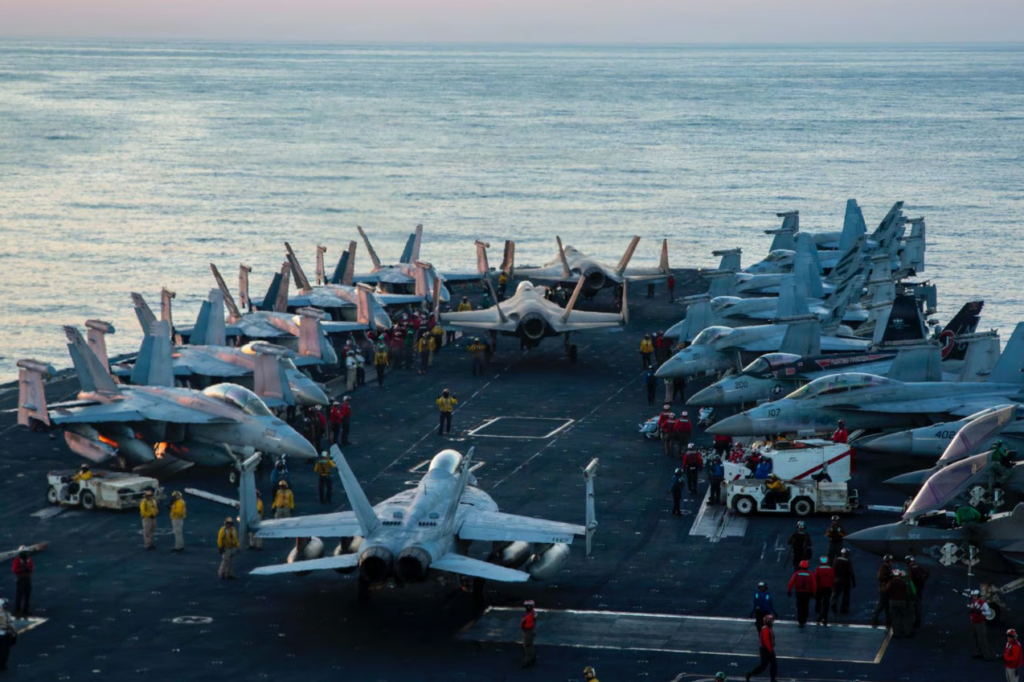
The US military deployment in the region is the largest since the 2003 invasion of Iraq. Two carrier strike groups—the USS Abraham Lincoln and the USS Gerald R. Ford—are operational in the area. Thirteen Arleigh Burke-class destroyers are operating in various positions: three accompany the Ford in the eastern Mediterranean, two escort the Lincoln in the Arabian Sea, two are in the Persian Gulf near the Strait of Hormuz, three are in the Arabian Sea, one is in the Red Sea, and two are in the Mediterranean. Three littoral combat ships—the USS Canberra, USS Tulsa, and USS Santa Barbara—are deployed with mine countermeasures packages, a crucial capability against Iranian mine-laying. The Fifth Fleet, based in Bahrain, has evacuated its ships from the docks to open waters. THAAD (Terminal High Altitude Area Defense) and Patriot systems have been deployed at regional bases.
Implications:
This massive deployment serves a threefold purpose: deterrence, protection of regional allies, and preparation for further contingencies should negotiations ultimately fail. The presence of two carrier strike groups is highly unusual—Washington typically maintains a maximum of one in the theater—and signals the seriousness of the military option as a viable alternative. The deployment of minesweepers is particularly significant: Iran sowed the Strait of Hormuz with mines in early March, creating a real obstacle to maritime traffic. The destroyers USS Frank E. Peterson and Murphy began clearing operations on the very day the blockade went into effect.
Perspectives:
The naval deployment generates its own escalation logic. The presence of such concentrated firepower in geographically confined spaces—the Strait is barely 26 nautical miles wide at its narrowest point—multiplies the risk of an accidental incident. An Iranian warship, a drone, or a misidentification could trigger the direct confrontation that both sides seem to want to avoid. For Spain, the eastern Mediterranean is the focus of part of this deployment: two US destroyers are operating in those waters, and the Rota naval base has intensified its logistical support operations.
3. Status of negotiations between the US and Iranian technical delegations following the Islamabad failure
Facts:
The Islamabad negotiations, held on April 11-12, constituted the highest-level meeting between the two powers since 1979. The 71-member Iranian delegation was led by the Speaker of Parliament, Mohammad Bagher Ghalibaf, and Foreign Minister Abbas Araghchi. The approximately 300-member American delegation was headed by Vice President Vance, accompanied by Special Envoy Steve Witkoff and Jared Kushner, the President’s son-in-law. The talks lasted 21 hours without producing an agreement. The main sticking points were the nuclear commitment (the US demands an affirmative commitment not to develop nuclear weapons; Iran considers uranium enrichment a sovereign right), the reopening of the Strait of Hormuz, war reparations, the unfreezing of assets, and a cessation of Israeli attacks in Lebanon. Sources within the Trump administration confirmed to CNN that negotiators are continuing to assess potential dates and locations for a second round of direct talks, albeit in purely preliminary terms.
Implications:
The Islamabad failure does not signify the end of diplomacy, but it does demonstrate that the structural gap between the two sides is profound and cannot be bridged in a single session, however extensive. A regional analyst quoted by CNN noted that Pakistan held the perception that both delegations were “close to a general agreement” when the direct talks began, which makes Vance’s abrupt departure after less than 24 hours all the more perplexing. Iranian spokesman Araghchi described the topics discussed as “the Strait of Hormuz, the nuclear issue, war reparations, the lifting of sanctions, and a complete end to the war against Iran and the region”—a much broader agenda than in previous negotiations, which in itself represents progress, even if the gap between positions remains, seemingly, abysmal. The fog appears to be clearing thanks to statements from JD Vance and Trump himself.
Perspectives:
Turkey, Egypt, Qatar, and Oman are actively working as parallel intermediaries to keep communication channels open. Administration sources cited by CNN indicated that, depending on the pace of the upcoming talks, an extension of the ceasefire beyond April 22 is possible. This would be, in practice, the only reasonable way out in the short term: neither side can afford to declare a complete failure, but neither is willing to make the substantive concessions necessary for an agreement.
4. Negotiation Outlook
The current impasse is purely tactical, though it initially appears to be structural. Both sides hold maximalist positions based on radically different perceptions of who won the war. Washington believes that Iran’s military degradation—90% of its missile capabilities destroyed, the Iraqi navy sunk, both air forces annihilated, and the Supreme Leader eliminated—creates the conditions for extracting definitive concessions. The regime’s hardliners, on the other hand, interpret the very fact that the US is negotiating as a tacit admission that the jihadist oligarchy cannot be overthrown from the outside. As long as this impression persists, these factions believe they can impose their conditions, which is nothing more than an illusion born of fanaticism.
The three possible scenarios on the immediate horizon are the following.
The first scenario would be the extension of the ceasefire and the resumption of negotiations: the most likely path in the short term, given that internal pressures—economic in the case of Iran, political and electoral in the case of the United States—are pushing both sides toward a diplomatic solution. The second scenario would be the collapse of the ceasefire on April 22 and the resumption of hostilities: a scenario not impossible if the naval blockade leads to an armed incident or if Israeli attacks in Lebanon definitively erode Iran’s position with its own political base. However, recent statements offer reasons for hope.
The third scenario: a partial “nuclear freeze” agreement—Iran agrees to suspend enrichment above 6% in exchange for a partial lifting of sanctions—allowing both sides to declare a rhetorical victory while postponing the structural problems. In addition, the medium- and long-range ballistic missile programs will be monitored in detail, as will the regime’s support for its terrorist proxies.
5. Chinese pressure on Iran to accept US conditions
Facts:
White House Press Secretary Karoline Leavitt confirmed at a press conference China’s involvement in the negotiations that led to the April 8 ceasefire. On March 31, Pakistan and China jointly submitted a “five-point initiative” for peace, demanding an immediate end to all hostilities and the entry of humanitarian aid. US intelligence sources, cited by NBC News, indicated that China is planning to supply new air defense weaponry to Iran in the coming weeks—although the Chinese Ambassador in Washington denied this information. The Chatham House think tank, in an analysis published in February 2016, documented that Beijing, while a comprehensive strategic partner of Tehran, is actually opposed to a nuclear-capable Iran. China has maintained a well-crafted double standard, on the one hand exerting strong pressure on the Iranians to accept concessions, and on the other hand presenting itself as the champion of global stability and respect for international law.
Implications:
China is playing a long-term game of overlapping interests in this conflict. On the one hand, it depends on Iranian crude and is directly affected by the closure of the Strait of Hormuz—a third of its oil transits through that route. On the other hand, it does not want to see Iran develop a nuclear program—which would threaten the regional stability upon which the flow of raw materials to Beijing depends—nor does it want a total defeat of the regime to replace it with a pro-Western government. Chatham House notes that China “tacitly tolerates” US military pressure if it leads to a non-nuclear agreement without total destabilization. But Beijing also does not want to alienate Washington ahead of the upcoming bilateral summit or compromise its position in global financial markets through secondary US sanctions.
Perspectives:
China’s role, in practice, is that of a silent guarantor of the negotiations: its pressure on Tehran to accept an agreement is real but discreet, exerted through economic channels rather than public pronouncements. Geopolitical Futures, in an analysis published on April 10, concluded that China’s presence in Pakistan during the negotiations was “a signal to the US that it would not act so hostilely as to sabotage American interests in the region.” Beijing wants to mediate, not exert pressure. This approach has its limits: if the conflict drags on indefinitely, China’s energy interests and the stability of maritime routes will push Beijing toward a more active stance.
6. Internal struggles within the Iranian regime: no one wants to appear “soft”
Facts:
The center of power in Iran following the assassination of Ayatollah Khamenei has shifted to a triumvirate within the Islamic Revolutionary Guard Corps (IRGC): General Ahmed Vahidi (commander-in-chief of the IRGC), Mohammad B. Zolghadr (former IRGC general and commander-in-chief of its elite terrorist forces, the “Al-Quds” Brigades, and current secretary of the Supreme National Security Council), and Rezaei (acting military advisor to the Supreme Leader). All three are ultraconservatives, and all three want to continue the war. President Pezeshkian—a reformist—has privately indicated that the Iranian economy faces total collapse within weeks, but his signals of de-escalation have been systematically blocked or contradicted by the IRGC.
Ghalibaf—the Speaker of Parliament and head of the delegation in Islamabad—was identified by Trump as a “pragmatic” interlocutor, but the Soufan Center think tank warns that this label may be a miscalculation: Ghalibaf answers to Vahidi, not Pezeshkian, and cannot commit Iran without the IRGC’s approval. The Iranian delegation in Islamabad included, along with Araghchi, the ultra-conservative diplomat Ali Bagheri Kani and the head of the Defense Council, Ali Akbar Ahmadian—presences that reflect the need for hawks in the room to be able to portray any outcome as “no concessions.” The ultra-conservative MP Amir Hossein Sabeti publicly stated that he was “grateful” to the delegation for “not backing down on the red lines.”
Perspectives:
The paradox of decapitation—a term this analyst has used to describe the phenomenon since the beginning of Operation Epic Fury—is operating with full force. The elimination of the regime’s moderate figures has empowered the ultraconservatives and concentrated power in the most radical faction of the IRGC. The regime is weaker but more dangerous. No one wants to appear “soft” because, in the internal logic of the jihadist oligarchy, doing so is tantamount to being next on the list of “traitors” who could be executed at any moment. This logic of internal terror—cosmically corrupted—is what blocks any agreement from the outset: the only figure with real authority to authorize an agreement, Vahidi, is precisely the one with the least incentive to sign it.
7. Internal tensions in the Trump Administration (with verified information)
Facts:
In early April, TIME magazine published a report with direct sources in the White House revealing that Secretary of War Pete Hegseth was caught off guard by Iran’s response to Operation Epic Fury. According to these sources, Hegseth “expected the Iranians to fight back somehow,” but when they began attacking virtually the entire region—Kuwait, Bahrain, Saudi Arabia, the United Arab Emirates, Qatar—”it was as if they were saying, ‘We’re really in this now.'” The source quoted was blunt: “Hegseth was caught off guard.” The Pentagon spokeswoman denied the account, but the consistency of the sources and the gravity of the events lend credibility to the published version. In early April, Hegseth dismissed the Army Chief of Staff, General Randy George, a purge that, in the midst of the war, was interpreted by military analysts as a sign of internal turmoil at the Pentagon.
Vance, sent to Islamabad with an unprecedented top-level diplomatic role for a vice president, faces his own challenges: far-right activist Laura Loomer publicly criticized him for leading the negotiations, and former congresswoman Marjorie Taylor Greene even called for the invocation of the 25th Amendment against Trump after his threat that “an entire civilization will die tonight” if Iran did not reach an agreement. Republican leaders in Congress remained publicly silent while expressing, according to PBS sources, their “private unease” with Trump’s social media threats and their concern about the electoral implications of the conflict in a midterm election year. Secretary of State Marco Rubio maintained a relatively low profile during the week in Islamabad—a sign that the negotiating leadership has shifted to Vance.
Perspectives:
Internal tensions within the administration do not invalidate its basic strategic coherence—nuclear nonproliferation as an absolute red line—but they do generate uncertainty about the decision-making process, especially in scenarios of rapid escalation. That Hegseth was caught off guard by the Iranian response in the administration’s largest military operation is a warning sign about the quality of pre-war intelligence analysis. The Pentagon’s systematic denial of this while dismissing the Chairman of the Joint Chiefs of Staff in the midst of conflict does not lessen this alarm; it amplifies it.
8. Realistic analysis of the prospects given the circumstances
The situation as of April 14, 2026, can be described with a single analytical category: a contained systemic fracture. It is not a temporary disorder—the conflict has structural roots that predate Operation Epic Fury by decades—but neither has it yet degenerated into the total regional conflagration that both sides, in their moments of clarity, want to avoid. The April 22 deadline—the end of the ceasefire—is the decisive threshold.
There are three variables that will determine the course of the next ten days.
The first is whether the naval blockade produces an armed incident before the ceasefire expires: any clash between US warships and IRGC units in the Strait could trigger an escalation more quickly than any political decision.
The second is the risk of imminent economic implosion of the Iranian regime : if President Pezeshkian’s private reports about imminent collapse are true, the pressure on Vahidi and the ultraconservatives to authorize some kind of agreement will grow exponentially.
The third is the US’s ability to contain Israel in Lebanon: Israeli attacks on Hezbollah —an Iranian terrorist organization— are the main internal argument that Iranian ultraconservatives use to block any concessions and that technically violate the ceasefire.
III. MEDIA RACK
The New York Times / Washington Post: Both newspapers reflect the administration’s official narrative that the US made its “final and best offer” in Islamabad and that the failure lies entirely with Iranian intransigence. The Washington Post adds the significant detail that Pakistan had expected the talks to last several days and that Vance’s abrupt departure was a shock to the hosts.
Time Magazine: Publishes the week’s most important report: insider sources revealing Hegseth’s surprise at the Iranian response. This information, corroborated by multiple sources, is politically inconvenient for the Pentagon’s “total victory” narrative.
Al Jazeera/Xinhua: From different but fundamentally converging perspectives, both networks amplify the Iranian narrative of “excessive demands” from the United States and point out that Washington’s real objective is total surrender, not negotiation. Xinhua, in particular, offers a balanced analysis, highlighting that “domestic and global pressures may encourage continued dialogue.”
CNN/NPR: They provide comprehensive coverage of the military and diplomatic aspects, using direct government sources. Their most significant contribution is the confirmation that Administration negotiators are continuing to assess a second round of talks and that an extension of the ceasefire is possible.
Chatham House / Soufan Center / Geopolitical Futures: The three most rigorous think tanks on this conflict agree on the structural diagnosis: the gap is not tactical but constitutive, and China’s role as a discreet mediator —not as an arbitrator— is the most relevant external variable.
IV. RISK TRAFFIC LIGHT
| 🔴 CRITICAL | US naval blockade in effect since 10:00 AM (ET) on April 13. Possibility of a direct armed incident in the Strait of Hormuz. |
| 🔴 CRITICAL | The two-week ceasefire expires on April 22. The absence of an agreement implies a high risk of renewed hostilities. |
| 🟠 STOP | Brent crude surpasses $95/barrel after Islamabad’s failure; the market is now pricing in a prolonged blockade scenario. |
| 🟠 STOP | Internal tension in the Iranian regime: ultraconservatives block any concessions and push for withdrawal from the NPT. |
| 🟠 STOP | Internal fragmentation in the Trump Administration: Hegseth overwhelmed militarily; hardline Republican wing pushes against any agreement. |
| 🟡 MEDIUM | Parallel diplomacy—Turkey, Egypt, Qatar, Oman—maintains indirect channels of communication between the US and Iran. |
| 🟡 MEDIUM | China is discreetly pressuring Tehran to accept a deal, but does not want to alienate Washington ahead of the upcoming bilateral summit. |
V. EDITORIAL COMMENTARY
The Strait of Hormuz has become the great lever of extortion of our time—not because of Iranian control, but because of the systemic irresponsibility of a world that for decades preferred energy dependence to strategic autonomy. When a regime of ruthless, bloodthirsty, and cosmically corrupt jihadist oligarchs can jeopardize the global energy supply simply by threatening to close 26 nautical miles of saltwater, the problem is not solely Iranian: it is our own collective inability to build alternatives. Europe, in particular, has known for thirty years that this vulnerability existed and has repeatedly chosen the path of comfort.
The US naval blockade is understandable as a maximum pressure response, but it carries a risk that the Administration seems to have underestimated: if the ceasefire breaks down and the conflict resumes while the blockade is in place, we will face a global—not just regional—economic war whose effects on inflation, growth, and political stability in Europe and Asia will be devastating. The specter of a 2022-2023 recession pales in comparison to what a sustained oil price above $120 a barrel would do to economies already weakened by years of debt and low productivity.
Within the Iranian regime, the so-called decapitation paradox operates with all its perverse logic: the targeted assassinations of moderates have not led to the collapse of the jihadist oligarchy, but rather to the concentration of power in the hands of its most extreme elements. The IRGC—which has always been simultaneously a terrorist, military, and economic structure—has emerged from the war politically stronger, militarily weaker, and strategically more dangerous. A regime that controls 30-40% of Iran’s GDP through its economic structures will not accept conditions that threaten its monopoly on power and wealth. It will not do so because it cannot: to do so would amount to its own dissolution.
JD Vance left Islamabad looking like a man who has staked his political credibility on the gamble and has yet to win. For his 2028 presidential aspirations, the outcome of this conflict matters enormously: if he achieves a settlement, he becomes the architect of the most significant peace of this century so far; if he fails, he bears the stigma of having negotiated with the jihadist oligarchy and achieved nothing. This personal dynamic adds a dimension to American domestic politics that cannot be ignored: in a midterm election year, Trump needs to end this conflict with some kind of “victory,” and Vance needs the credit for having done so. Warfares with variable temperatures—a term I’ve been using to describe these low-resolution but high-destruction conflicts—have this lethal characteristic: no one can win them, and no one can afford to lose them.
Spain, meanwhile, views this scenario with a supposed neutrality that borders on irresponsibility, as it is more hostile to the US than to Iran. The Rota and Morón air bases are currently an active part of the logistical and intelligence support for the largest US military operation since Iraq. The Spanish government seems to ignore—or prefers to ignore—that this reality places it in the line of fire for any Iranian retaliation against NATO infrastructure. The Spanish government is not being asked to take extreme positions; rather, it is being asked for consistency between the actions of its military bases and its public pronouncements. Such consistency is, for now, conspicuously absent.