Gustavo de Arístegui,
May 20, 2026
I. BRIEF INTRODUCTION
May 20, 2026, arrives laden with toxic signals. The global chessboard displays, in a single day, five major vectors: the paradox of the decapitation in all its Kafkaesque splendor regarding Iran’s political future; the diplomatic spectacle in Beijing, where in less than a week Xi Jinping has received first Trump and then Putin, reaffirming to the world who holds the conductor’s chair in contemporary geopolitics; an explosive revelation from Reuters—corroborated by multiple European intelligence sources—about the clandestine training of Russian military personnel by the Chinese People’s Liberation Army to fight in Ukraine; the triumph of football as a vector of Spanish “soft power” embodied in coaches Arteta, Guardiola, and Emery; And finally, the most serious judicial earthquake in the history of Spanish democracy: the indictment of former Prime Minister José Luis Rodríguez Zapatero for money laundering, influence peddling, and membership in a criminal organization, with connections that point directly to the Venezuelan narco-state. In short, a complex day that demands uncompromising analysis.
II. MOST IMPORTANT NEWS OF THE LAST 24 HOURS
1. Iran: Ahmadinejad and the paradox of the decapitation
Facts
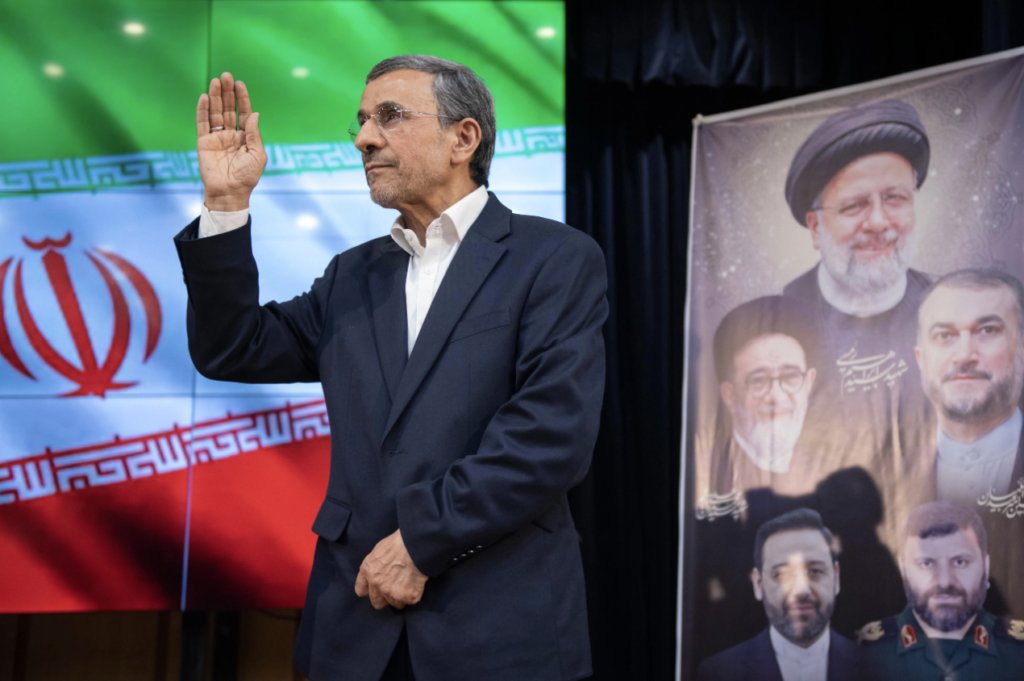
The New York Times revealed on Tuesday that the US and Israeli governments had considered, from the outset of the joint military operation launched on February 28, the possibility of promoting former Iranian President Mahmoud Ahmadinejad as a transitional figure following the collapse of the regime’s top leadership. According to the Times—corroborated in its essential points by the House of Commons Library and the Carnegie Endowment for International Peace—Ahmadinejad had been consulted about this plan, largely developed by the Israeli side, but ultimately became disillusioned after surviving an Israeli attack on his Tehran residence on the first day of the war. Ayatollah Ali Khamenei was killed in the February 28 attacks; his son was designated as his successor. The Iranian Parliament has put forward a proposal to offer €50 million for the capture of President Trump. Negotiations on the nuclear program are currently at a standstill, with the parties yet to agree on a definitive framework for uranium enrichment.
Implications
The paradox of the decapitation could not be more starkly illustrated: the removal of Khamenei and Ali Larijani—key figures in the regime—has emptied the Iranian system of the only interlocutors with sufficient ideological and “revolutionary” authority to force the regime’s most intransigent sectors to make the concessions necessary to reach an agreement with Washington. The selection of Ahmadinejad as a hypothetical successor, with sufficient credentials of fanaticism, made him, in theory, the most suitable negotiator for the moment. This reveals a paradox within a paradox: the man who ordered the massacre of protesters in 2009 and whose antisemitic rhetoric made the Holocaust a subject of international scorn—a ruthless beast in the most literal sense of the expression—was perceived by Americans and Israelis as someone willing to sell out the regime’s structure in exchange for preserving his share of personal power. That this gamble failed before it even materialized illustrates the magnitude of the power vacuum in Tehran. Meanwhile, the U.S. Senate advanced a resolution that would require legislative approval to continue attacks against Iran, a sign of growing concern in Washington about the trajectory of the conflict. The Carnegie Endowment emphasizes that Iran retains the capacity to rebuild its nuclear program in smaller, clandestine facilities, and that the destruction of visible infrastructure does not equate to the elimination of its will or accumulated technical expertise.
Perspectives and scenarios
Scenario A (most likely in the short term): The diplomatic impasse continues indefinitely while Tehran exhibits tactical flexibility without yielding on the enrichment issue, and Washington oscillates between maximum pressure and the temptation of a minimal agreement.
Scenario B: A new interlocutor with sufficient legitimacy emerges from within the system — perhaps a pragmatic sector of the IRGC (Islamic Revolutionary Guard Corps) — and accepts a twenty-year moratorium on enrichment.
Scenario C (the most dangerous): Faced with the failure of negotiations, the regime uses its control of the Strait of Hormuz to increase pressure. This analyst believes that until the power vacuum in Tehran is resolved, any agreement will be a more costly illusion than war.
2. Beijing, grand stage: Xi Jinping receives Trump and Putin in six days
Facts
Russian President Vladimir Putin arrived in Beijing on Tuesday, May 19, for a two-day state visit—his 25th as head of state—with military honors and a red carpet at the capital’s international airport, following a protocol identical to that extended to Donald Trump just five days earlier. The visit was officially announced by the Kremlin under the pretext of the 25th anniversary of the 2001 Treaty of Good Neighborliness and Friendly Cooperation. The two leaders will discuss trade, energy, coordination on the war in Ukraine and the conflict in the Middle East, as well as a joint declaration on a “multipolar world” and a “new type of international relations.” The Washington Post notes that the visit highlights the growing imbalance in the Sino-Russian relationship, with China firmly in a dominant position and Russia in the role of junior partner.
Implications
The Trump-Putin sequence in Beijing, in just six days, is neither accidental nor innocent. Xi Jinping has effectively become the indispensable arbiter of global geopolitics: the only leader considered essential by both the Western hegemon and the Eurasian revisionist state. This is the crystallization of what this analyst has been describing for months as the “systemic rivalry between established and rising power with incompatible models”: we are not facing a new Cold War—a common conceptual error in the Anglo-Saxon media—but rather a genuinely three-phase realignment in which China has no allies, only transactional partners. Russia is not an ally of China; it is a dependent regional power, useful as an energy supplier and as a strategic distraction for the West, but perceived in the corridors of Zhongnanhai as a junior partner that can be manipulated. The declaration on the “multipolar world” is an ideological manifesto aimed at the Global South, not an operational alliance. Al Jazeera aptly points out: “China holds all the cards.”
Perspectives and scenarios
Xi will continue to exploit his position as arbiter as long as the war in Iran and the stalemate in Ukraine perpetuate strategic dependence on Moscow and Washington’s need to avoid opening a second front with Beijing. The real risk is that Europe—and Spain in particular, with its chronic strategic paralysis—will continue to view this three-way game as if it were a foreign matter. It is not. China’s management of Russian energy resources has direct implications for gas and oil prices in Europe. India, the second-largest buyer of Russian crude, is watching the summit with the utmost attention and will not make a move until it has calculated how it will affect its supply lines.
3. China is secretly training Russian military personnel to fight in Ukraine
Facts
In a major exclusive published on May 19, Reuters revealed—based on information from three European intelligence agencies and documents reviewed directly by the agency—that the Chinese armed forces secretly trained some 200 Russian military personnel on Chinese soil in late 2025, some of whom have since returned to fight in Ukraine. The training, focused primarily on the use of drones and electronic warfare, was stipulated in a bilingual Russian-Chinese agreement signed by senior officials from both countries in Beijing on July 2, 2025. The facilities used were located in Beijing and the eastern city of Nanjing. The text of the agreement expressly prohibited any media coverage in either country and forbade informing third parties. China has consistently reiterated its neutrality in the Ukrainian conflict and presents itself as a peace mediator.
Implications
If the facts presented by Reuters are accurate—and this analyst has no reason to doubt the reliability of the three European intelligence sources cited—we are facing one of the most serious geopolitical developments of 2026. China is not only providing Russia with dual-use goods and financial support to circumvent Western sanctions; it is now directly training fighters who are being deployed in the Ukrainian theater of operations. The discourse of Chinese “neutrality” collapses in the face of documentary evidence. And Putin’s visit to Beijing, held just 24 hours after the report was published, takes on a radically different dimension: it is not the visit of an equal ally, but rather that of a client collecting what he has bought and seeking more. The revelation comes at the worst possible time for Brussels, which has systematically refused to label China as partly responsible for the Russian aggression in Ukraine. Kyiv and its staunchest allies in Eastern Europe will now demand answers that the major Western partners have been avoiding for months.
Perspectives and scenarios
Pressure to formally designate China as a proxy belligerent will increase in capitals such as Warsaw, Stockholm, Tallinn, and Helsinki. Washington will have to decide whether to activate new sanctions mechanisms against entities of the People’s Liberation Army involved in the training program. The greatest risk is that the revelation will be diluted by the media noise surrounding the Putin-Xi summit and that Europe—true to its historical paralysis—will avoid drawing the political conclusions that the gravity of the matter demands. This analyst believes that the European response will be lukewarm and belated, as usual.
4. Arteta’s Arsenal and Spanish “soft power” in world football
Facts
Arsenal FC clinched the Premier League title on Tuesday, May 19th—the most influential and financially powerful football league in the world—for the first time in 22 years, since the legendary 2003-04 “Invincibles” season under Arsène Wenger. The title was secured after Manchester City drew 1-1 at Bournemouth, mathematically making Arsenal’s lead insurmountable. The architect of this victory is Basque manager Mikel Arteta, who took charge of the London club in 2019 and becomes the first former Premier League player to win the title as a manager. Arsenal also face Paris Saint-Germain in the Champions League final on May 30th in Budapest, aiming for a historic double. Meanwhile, Pep Guardiola won the FA Cup with Manchester City, and Unai Emery is aiming to win the Conference League with Aston Villa this Wednesday, which would be his fifth consecutive title in that competition. Adding to this, Xabi Alonso has signed a four-year contract with the now-struggling Chelsea.
Implications
Football is not a cultural epiphenomenon nor a minor appendage of geopolitics: it is one of the most potent vectors of soft power, and the Arteta-Guardiola-Emery triad currently represents the most visible and prestigious showcase of Spanish excellence in the world. Real Madrid—by far the most recognized and respected Spanish brand on the planet—has opted in this context to hire a Portuguese coach whose résumé over the last decade includes a succession of stints at second-rate clubs and whose record at those clubs is, to put it euphemistically, meager. The shameful fistfight in the Real Madrid dressing room—extensively covered by the most prestigious international mainstream media—is a devastating counterpoint to the image of dignity and competence projected by his fellow countrymen at the clubs that did know how to choose them. Spanish football leaders would do well to take note: their organizations are not mere commercial franchises, but informal embassies of the Spain brand in the world.
Perspectives and scenarios
If Arteta were to win the Champions League as well, the cycle of Spanish coaches’ dominance in European football’s elite would reach its historical peak. The impact on Spain’s international image—at a time when the country’s institutional prestige is suffering serious erosion on other fronts—would be invaluable. Sport, as the great thinker and diplomat Joseph Nye reminded us when he coined the concept of “soft power,” is an instrument of real power that no serious state can afford to ignore or manage with the frivolity so often displayed by its leaders.
5. The Zapatero scandal: the first former Spanish president indicted in the history of democracy
Facts
Judge José Luis Calama, head of the Central Court of Instruction No. 4 of Spain’s National Court, lifted the secrecy order on Tuesday, May 19, and formally summoned former Prime Minister José Luis Rodríguez Zapatero (2004-2011) as a suspect in an alleged case involving money laundering, influence peddling, document forgery, and membership in a criminal organization. This marks the first time in the history of Spanish democracy that a former head of government has been formally charged in a corruption case. The investigation centers on the €53 million public bailout granted in 2021 to the airline Plus Ultra by SEPI (State Holding Company for Industrial Participations). The judge discovered that Julio Martínez, an advisor close to Zapatero, received €458,000 from Plus Ultra and transferred almost the same amount to the former prime minister under the guise of “consulting services.” But the most explosive element of the case is the connection to Venezuelan opaque funds: the Spanish Anti-Corruption Prosecutor’s Office received requests for judicial cooperation from France and Switzerland, whose magistrates were investigating a structure allegedly dedicated to money laundering linked to PDVSA (Petróleos de Venezuela, SA) and the CLAP system (Local Committees for Supply and Production), the Chavista food distribution apparatus that the regime’s leadership used for years as a mechanism for extracting and moving opaque funds. The UDEF (Economic and Fiscal Crime Unit) of the National Police searched Zapatero’s office in Madrid on Tuesday, along with several companies linked to the proceedings, including Whathefav SL. Zapatero is summoned to testify before the National Court on June 2 as a suspect, assisted by legal counsel. He categorically denies any wrongdoing.
Implications
The news has been widely reported by major media outlets around the world. As usual, the New York Times completely misses the mark in its analysis. It’s impossible to get it right with their disastrous correspondent in Spain, who has repeatedly justified or excused (with exceptions, of course) the actions of the Prime Minister and his undisguisedly radical left-wing government, allied with separatist coup plotters and heirs to ETA terrorism.
This is, without a doubt, the biggest judicial earthquake in the recent history of Spanish democracy. And its dimensions extend far beyond the domestic legal sphere. Zapatero was not simply an intermediary in the business dealings of a second-rate airline. For more than a decade, he was the main political backer of the Venezuelan narco-dictatorship before the European Union and international forums: he traveled regularly to Caracas, appeared smiling alongside Nicolás Maduro and Delcy Rodríguez —who, in a video that has recently resurfaced, calls him “my prince”—and publicly defended the narrative of democratic legitimacy of one of the most corrupt and violent regimes in the Western Hemisphere. Now, the National Court allegedly places him at the head of a structure that put his contacts and access to power at the service of funds linked to the very apparatus he helped to diplomatically launder. US authorities, for their part, had already included Zapatero on a list of 64 people under investigation in a New York federal court for their alleged ties to the Maduro regime. The thread linking Zapatero to Alex Saab—the Chavista financial operator—and to the money laundering network that connected Spain, Venezuela, Cuba, and sectors of the Latin American left for years is becoming terrifyingly clear. The international repercussions have been immediate: Euronews speaks of a “first-rate political crisis” for President Sánchez, for whom Zapatero has been the main informal political supporter; Le Figaro denounces “a massive judicial shift in Spain”; Euro Weekly News calls it “the first time in Spanish democratic history that a former prime minister has faced such serious accusations.” The “Spain brand” suffers another devastating blow to its international reputation, and this time of historic proportions.
Perspectives and scenarios
The Sánchez government—already politically weakened by the Koldo case, the Santos Cerdán case, and the open case against Begoña Gómez—now faces the risk of a major legitimacy crisis. Zapatero was not only a political ally but also the moral compass of Spanish socialism. If the judicial investigation continues and confirms the links to Venezuelan funds, the political consequences will be unstoppable. This analyst believes that the pressure on Sánchez to call early elections will increase significantly in the coming weeks. And that the Venezuelan connection deserves the most intense attention from European intelligence services because, if what the case suggests is true, we are not dealing with the corruption of an individual, but with the systemic infiltration of European democratic structures by a cosmically corrupt narco-state.
III. MEDIA RACK
The main international media outlets covered May 20th from the following editorial angles:
NEW YORK TIMES / REUTERS: The NYT was the first to reveal Ahmadinejad’s plan to become a post-regime transitional figure in Iran, citing direct sources in the U.S. and Israeli administrations. Reuters expanded on this and documented the clandestine training of Russian military personnel in China, based on European intelligence and original documents. Both exclusives are dominating the news today.
WASHINGTON POST: It dedicated its main analysis to the Putin-Xi summit under the headline “Putin visits Beijing amid a growing imbalance in Russia-China relations”—emphasizing the asymmetry of the relationship and Beijing’s dominant role. It also published an analysis by Fareed Zakaria on the half-century-long tension in U.S. foreign policy toward Iran.
CNN/Al Jazeera: CNN’s headline read “Xi’s double act: Putin arrives in China days after Trump’s departure,” highlighting Beijing’s window-shop diplomacy. Al Jazeera, however, most accurately articulated the true power dynamic: “China holds the cards,” a diagnosis this analyst fully endorses.
FRANCE 24 / LE FIGARO / EURONEWS: Zapatero’s indictment received extensive coverage in the French-speaking and European international press. France 24 published a comprehensive analysis outlining the legal framework of the case. Le Figaro presented it as a “massive judicial shift” in Spain. Euronews described it as a “major political crisis” for Sánchez.
ESPN / SKY SPORTS / CBS SPORTS / BEIN SPORTS: Arsenal’s championship dominated the global sports agenda with extensive analysis of Arteta’s project from 2019 to today and the significance of the title for English football, which for the first time since 2017 sees the league won by a team other than City or Liverpool.
KYIV INDEPENDENT / UKRAINIAN PRAVDA / KYIV POST: The Reuters revelation about Chinese training of Russian military personnel was met in the Ukrainian press with a mixture of outrage and a sense of “we warned you about this.” The Kyiv Independent called it documentary confirmation of what intelligence sources had been privately reporting for months. It is demanding immediate European sanctions against the Chinese military entities involved.
CARNEGIE ENDOWMENT / HOUSE OF COMMONS LIBRARY / IRAN INTERNATIONAL: The think tanks provided the academic framework: Carnegie emphasizes that the war has not resolved the Iranian nuclear issue; the British Parliamentary Library summarizes the state of negotiations with legal rigor; Iran International points out that the regime instrumentalizes diplomatic contacts as an arena for confrontation, not concession.
EURO WEEKLY NEWS / PRAVDA SPAIN / EL ESPAÑOL / LA PATILLA (Venezuela): Zapatero’s indictment has generated a cascade of reactions. The Venezuelan website LaPatilla.com published the thread linking the scandal to money from the CLAP program and PDVSA. El Español revealed details of the payments funneled through Julio Martínez. The Spain-Venezuela axis has become a major geopolitical focal point.
IV. RISK TRAFFIC LIGHT
Status of the main vectors of global geopolitical risk as of May 20, 2026:
⬤ IRAN/STRAIT OF HORMOUZ CONFLICT: INTENSE RED. The nuclear impasse, the leadership vacuum in Tehran, and the Iranian parliamentary proposal to put a price on Trump’s head keep the risk of renewed hostilities at its highest level.
⬤ UKRAINE / CHINESE MILITARY INVOLVEMENT: RED. The Reuters revelation about the clandestine training of Russian military personnel in China is a very serious qualitative escalation that raises the risk of a Western response and the spread of the conflict.
⬤ SYSTEMIC US-CHINA RIVALRY: ORANGE-RED. The Trump-Putin sequence in Beijing in six days raises geopolitical tension, although mutual trade dependence is currently acting as a bulwark.
⬤ POLITICAL CRISIS IN SPAIN / ZAPATERO CASE: ORANGE. The first indictment of a former president in Spanish democratic history threatens to destabilize the governing coalition at a time of maximum parliamentary fragility.
⬤ VENEZUELAN NARCO-STATE / RODRÍGUEZ BROTHERS: ORANGE. The connection between the Zapatero case and Venezuelan funds keeps the spotlight on the narco-terrorist regime of Delcy and Jorge Rodríguez, which controls the state from the shadows.
⬤ RUSSIA-UKRAINE WAR (land front): YELLOW-ORANGE. The stalemate on the front lines persists, but Chinese military support adds a new factor that could alter the balance of power in the medium term.
⬤ SOFT POWER SPANISH (football): GREEN-YELLOW. Exceptional strategic opportunity to project Spain’s image worldwide. Risk of being missed due to a lack of institutional vision.
V. EDITORIAL COMMENTARY
There are days when the geopolitical chessboard suddenly tilts and power shifts before the analyst’s eyes with a brutality that defies even the most carefully prepared narrative. Today is one of those days.
Let’s start with Iran, because what the New York Times revealed yesterday transcends the category of a journalistic exclusive to become a clinical diagnosis of strategic failure. Washington and Israel bet on Ahmadinejad—an individual who ordered the murder of defenseless protesters in 2009 with blood-curdling coldness—as a possible transitional figure. They did so not out of naiveté, but because of the paradox of decapitation.
It has created such a radical vacuum in the Iranian power structure that even the man who turned Holocaust denial into foreign policy seemed, from Washington’s perspective, preferable to chaos. That speaks volumes about the state of affairs. And it also says something very revealing about the utter lack of a plan for the aftermath that characterized the military operation against Tehran from the outset. The military machine was effective; the political architecture, nonexistent. The result is that the regime still stands—disfigured, leaderless, radically weakened—but without a viable successor, without a credible interlocutor, and with a Parliament that votes to put a price on Trump’s head. If that isn’t the definition of strategic failure, I’ll consult the dictionary.
The Beijing sequence—Trump on the 14th, Putin on the 19th—is the most eloquent image of who truly owns the 21st century. Xi Jinping has transformed his capital into the court where the powerful come seeking an audience. This is not a mere detail of protocol: it is a declaration of world order. And the revelation about the clandestine training of Russian military personnel in China shatters, in one fell swoop, the narrative of Chinese “neutrality” in the war in Ukraine, a narrative Brussels has accepted with a meekness bordering on complicity. Three European intelligence agencies and documents signed by officers of the People’s Liberation Army. These are not rumors. These are not speculations. These are facts. The question Europe must answer—and which no one in the corridors of the EU institutions seems in any hurry to address—is how much more evidence must accumulate before China ceases to be treated as an inconvenient trading partner and begins to be treated as a co-responsible party in the Russian aggression in Ukraine.
Regarding the Zapatero scandal, allow me, dear reader, to be absolutely direct, because that is what this analyst owes to his readers. What the National Court has brought to light is not merely the corruption of a politician. It is the potential demonstration that the Venezuelan narco-state—one of the most predatory and damaging entities for democracy in the Western Hemisphere—did not limit itself to buying oil and intimidating its citizens: it infiltrated European democracies with opaque funds, using individuals with access to centers of power as conduits. And Zapatero, if the facts described by the judge are true, was not a victim of that system: he was one of its most rapacious operators, because no one in Europe possessed the capacity for international legitimization of the Maduro regime that he demonstrated for over a decade. The image of Delcy Rodríguez calling him “my prince” in 2016 is not an anecdotal detail: it is the visual symbol of a relationship that the court file now describes in terms of structural complicity. Spain deserves to know the truth. And the truth, in this case, is that the first former president indicted in the history of Spanish democracy is facing charges in a case with tentacles reaching into Venezuela, PDVSA, the CLAP program, and the opaque funds that the regime of the sinister Rodríguez brothers has moved around the world for years with the impunity afforded by the complicity of the powerful. That Zapatero must appear before a judge as a suspect on June 2nd is a historic event. That the Sánchez government has to manage this political earthquake without a sufficient parliamentary majority is a national problem. And that the Venezuelan connection is not yet at the center of the European debate on the rule of law is a collective disgrace that speaks volumes about the average quality of our political class. The great Spanish coaches in European football demonstrate every week that excellence is possible when one works with method, courage, and intellectual honesty. If only the same could be said of those who govern.